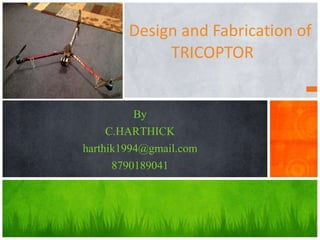
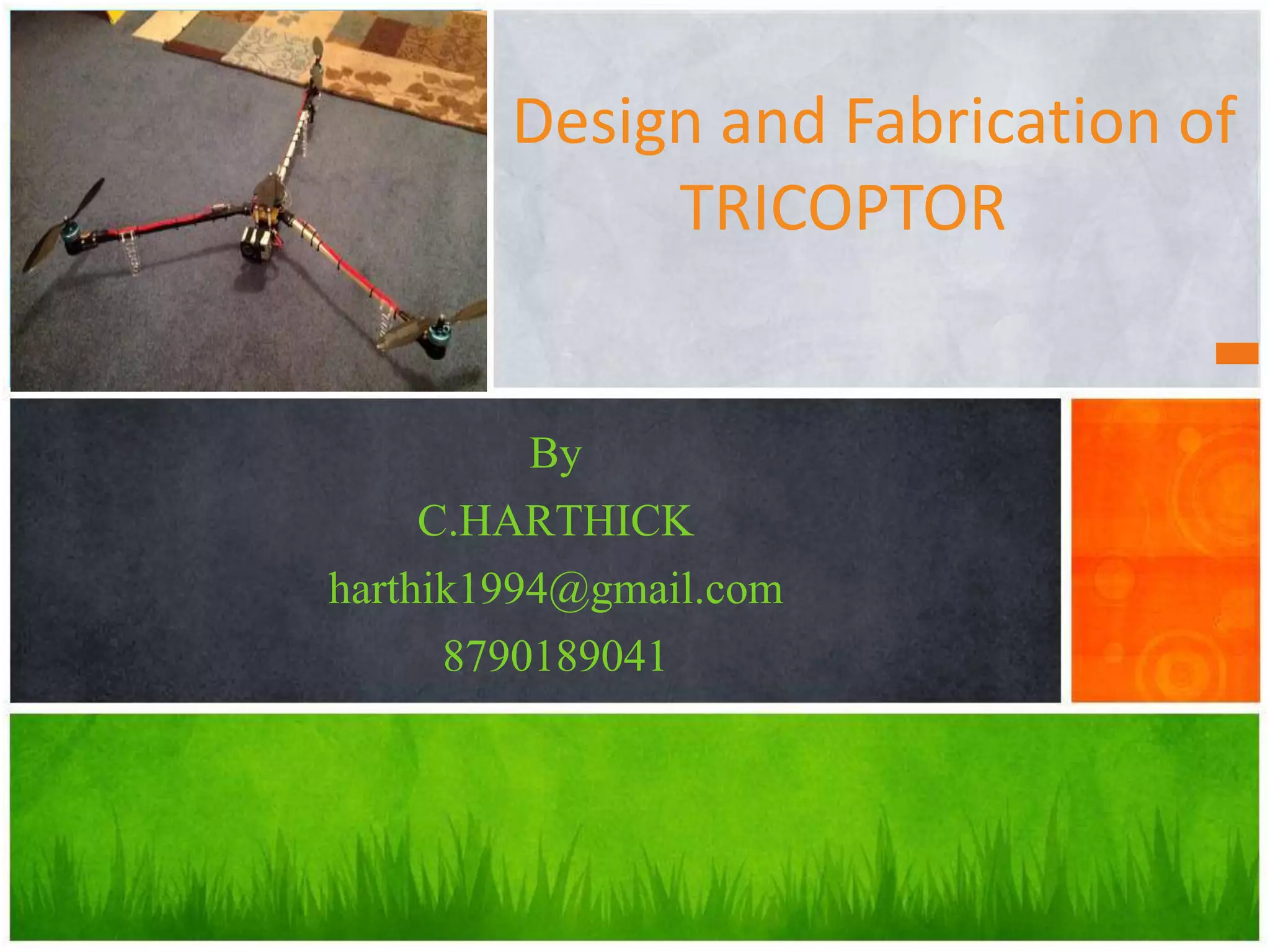
Design and Fabrication of
TRICOPTOR
By
C.HARTHICK
harthik1994@gmail.com
8790189041
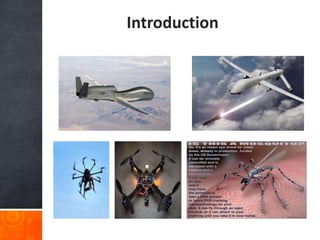
Introduction
Project
Overview
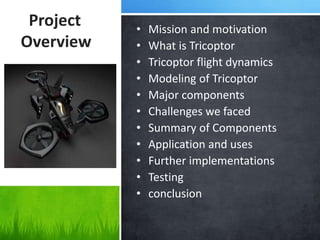
• Mission and motivation
• What is Tricoptor
• Tricoptor flight dynamics
• Modeling of Tricoptor
• Major components
• Challenges we faced
• Summary of Components
• Application and uses
• Further implementations
• Testing
• conclusion
Our mission and motivation
• Building with less budget
• less cost-high efficiency
• Reducing over all weight along
With frame and miscellaneous
• DARPA and DARO
WHAT IS TRICOPTOR
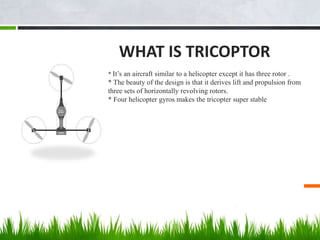
* It’s an aircraft similar to a helicopter except it has three rotor .
* The beauty of the design is that it derives lift and propulsion from
three sets of horizontally revolving rotors.
* Four helicopter gyros makes the tricopter super stable
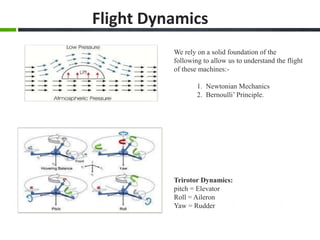
We rely on a solid foundation of the
following to allow us to understand the flight
of these machines:-
1. Newtonian Mechanics
2. Bernoulli’ Principle.
Trirotor Dynamics:
pitch = Elevator
Roll = Aileron
Yaw = Rudder
Flight Dynamics
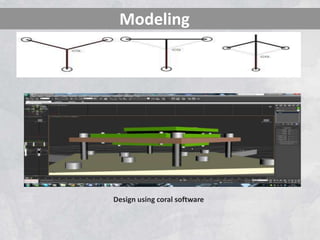
Design using coral software
Modeling
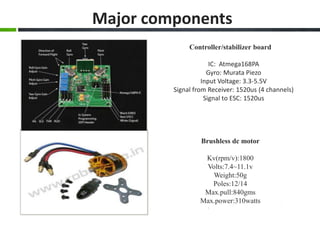
Controller/stabilizer board
IC: Atmega168PA
Gyro: Murata Piezo
Input Voltage: 3.3-5.5V
Signal from Receiver: 1520us (4 channels)
Signal to ESC: 1520us
Brushless dc motor
Kv(rpm/v):1800
Volts:7.4~11.1v
Weight:50g
Poles:12/14
Max.pull:840gms
Max.power:310watts
Major components
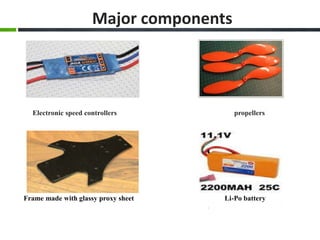
Electronic speed controllers propellers
Frame made with glassy proxy sheet Li-Po battery
Major components
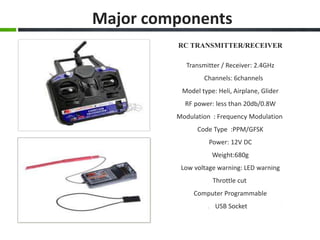
RC TRANSMITTER/RECEIVER
Transmitter / Receiver: 2.4GHz
Channels: 6channels
Model type: Heli, Airplane, Glider
RF power: less than 20db/0.8W
Modulation : Frequency Modulation
Code Type :PPM/GFSK
Power: 12V DC
Weight:680g
Low voltage warning: LED warning
Throttle cut
Computer Programmable
USB Socket
Major components
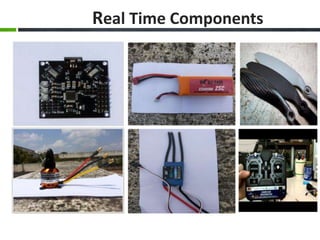
Real Time Components
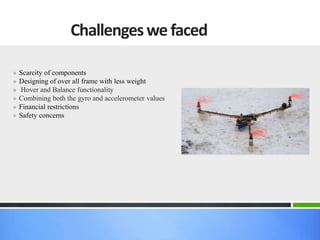
» Scarcity of components
» Designing of over all frame with less weight
» Hover and Balance functionality
» Combining both the gyro and accelerometer values
» Financial restrictions
» Safety concerns
Challengeswe faced
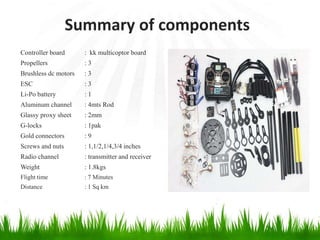
Summary of components
Controller board : kk multicoptor board
Propellers : 3
Brushless dc motors : 3
ESC : 3
Li-Po battery : 1
Aluminum channel : 4mts Rod
Glassy proxy sheet : 2mm
G-locks : 1pak
Gold connectors : 9
Screws and nuts : 1,1/2,1/4,3/4 inches
Radio channel : transmitter and receiver
Weight : 1.8kgs
Flight time : 7 Minutes
Distance : 1 Sq km
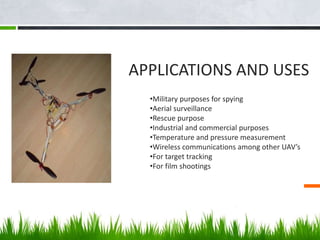
APPLICATIONS AND USES
•Military purposes for spying
•Aerial surveillance
•Rescue purpose
•Industrial and commercial purposes
•Temperature and pressure measurement
•Wireless communications among other UAV’s
•For target tracking
•For film shootings
Further implementation
>> Additional IR sensors, cameras and wireless technologies like GSM can be added to
make the UAV more useful.
>> A camera can be mounted on this UAV since it has a payload capacity of 0.5 kg in
tri- rotor mode.
>> GPS for auto landing at the origin
Testing
STAGE 1 : Mechanical design with perfect ‘CG’
STAGE 2 : Propellers selection and its rotation
STAGE 3 : Electronic connections/wiring
STAGE 4 : Balancing the tricoptor(major stage of entire project)
STAGE 5 : Controlling the transmitter at its best
STAGE 6 : Programming both stabilizer board and transmitter
STAGE 7 : Gyros setup for kkboard v5.5
STAGE 8 : Vertical takeoff and Landing(VTOL)
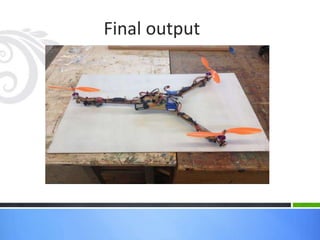
Final output
conclusion
The capabilities of this design may prove to be asymptotic in nature,
however these may not be realized until proper funding is given and
experimental analysis is conducted. Given the stable platform
produced by this group, further research and development can and
should be done to improve the functionality of our design. This
project has increased our interests in robotics and autonomous design,
knowledge which will serve useful throughout our professional
careers. We feel that this form of thinking and engineering will be
prevalent in the modern world and beyond as new applications are
found which will test the limits of current technologies.
Queries and Feedback
are welcome

Tricopter -design and its fabrication

  • 1.
    Design and Fabricationof TRICOPTOR By C.HARTHICK harthik1994@gmail.com 8790189041
  • 2.
  • 3.
    Project Overview • Mission andmotivation • What is Tricoptor • Tricoptor flight dynamics • Modeling of Tricoptor • Major components • Challenges we faced • Summary of Components • Application and uses • Further implementations • Testing • conclusion
  • 4.
    Our mission andmotivation • Building with less budget • less cost-high efficiency • Reducing over all weight along With frame and miscellaneous • DARPA and DARO
  • 5.
    WHAT IS TRICOPTOR *It’s an aircraft similar to a helicopter except it has three rotor . * The beauty of the design is that it derives lift and propulsion from three sets of horizontally revolving rotors. * Four helicopter gyros makes the tricopter super stable
  • 6.
    We rely ona solid foundation of the following to allow us to understand the flight of these machines:- 1. Newtonian Mechanics 2. Bernoulli’ Principle. Trirotor Dynamics: pitch = Elevator Roll = Aileron Yaw = Rudder Flight Dynamics
  • 7.
    Design using coralsoftware Modeling
  • 8.
    Controller/stabilizer board IC: Atmega168PA Gyro:Murata Piezo Input Voltage: 3.3-5.5V Signal from Receiver: 1520us (4 channels) Signal to ESC: 1520us Brushless dc motor Kv(rpm/v):1800 Volts:7.4~11.1v Weight:50g Poles:12/14 Max.pull:840gms Max.power:310watts Major components
  • 9.
    Electronic speed controllerspropellers Frame made with glassy proxy sheet Li-Po battery Major components
  • 10.
    RC TRANSMITTER/RECEIVER Transmitter /Receiver: 2.4GHz Channels: 6channels Model type: Heli, Airplane, Glider RF power: less than 20db/0.8W Modulation : Frequency Modulation Code Type :PPM/GFSK Power: 12V DC Weight:680g Low voltage warning: LED warning Throttle cut Computer Programmable USB Socket Major components
  • 11.
  • 12.
    » Scarcity ofcomponents » Designing of over all frame with less weight » Hover and Balance functionality » Combining both the gyro and accelerometer values » Financial restrictions » Safety concerns Challengeswe faced
  • 13.
    Summary of components Controllerboard : kk multicoptor board Propellers : 3 Brushless dc motors : 3 ESC : 3 Li-Po battery : 1 Aluminum channel : 4mts Rod Glassy proxy sheet : 2mm G-locks : 1pak Gold connectors : 9 Screws and nuts : 1,1/2,1/4,3/4 inches Radio channel : transmitter and receiver Weight : 1.8kgs Flight time : 7 Minutes Distance : 1 Sq km
  • 14.
    APPLICATIONS AND USES •Militarypurposes for spying •Aerial surveillance •Rescue purpose •Industrial and commercial purposes •Temperature and pressure measurement •Wireless communications among other UAV’s •For target tracking •For film shootings
  • 15.
    Further implementation >> AdditionalIR sensors, cameras and wireless technologies like GSM can be added to make the UAV more useful. >> A camera can be mounted on this UAV since it has a payload capacity of 0.5 kg in tri- rotor mode. >> GPS for auto landing at the origin
  • 16.
    Testing STAGE 1 :Mechanical design with perfect ‘CG’ STAGE 2 : Propellers selection and its rotation STAGE 3 : Electronic connections/wiring STAGE 4 : Balancing the tricoptor(major stage of entire project) STAGE 5 : Controlling the transmitter at its best STAGE 6 : Programming both stabilizer board and transmitter STAGE 7 : Gyros setup for kkboard v5.5 STAGE 8 : Vertical takeoff and Landing(VTOL)
  • 17.
  • 18.
    conclusion The capabilities ofthis design may prove to be asymptotic in nature, however these may not be realized until proper funding is given and experimental analysis is conducted. Given the stable platform produced by this group, further research and development can and should be done to improve the functionality of our design. This project has increased our interests in robotics and autonomous design, knowledge which will serve useful throughout our professional careers. We feel that this form of thinking and engineering will be prevalent in the modern world and beyond as new applications are found which will test the limits of current technologies.
  • 19.

Editor's Notes

  • #2 This presentation demonstrates the new capabilities of PowerPoint and it is best viewed in Slide Show. These slides are designed to give you great ideas for the presentations you’ll create in PowerPoint 2010! For more sample templates, click the File tab, and then on the New tab, click Sample Templates.