














Writing a Two-Point Outline
English V
When you are using a telephone
directory for the number of a friend,
do you go through all of the names?
How do you do it? Do you know that
you are using a skill in reading known
as scanning?
Motivation
Scanning is a technique in reading.
You’ll be using this technique in today’s
lesson.
Motivation
Now fill the blanks with the correct
vocabulary words.
1. The process by a rock changes from
one kind to another is called ______.
2. The gold that have flattened into
thin plates or layers is said to be ___.
3. The lahar that covered most of
places in Pampanga is made up of
______ materials.
Unlocking of Difficulties
4. Some rocks are called ______ rocks
because they hardened underneath
the earth’s surface.
5. Rocks that hardened when they
reached the surface of the earth are
said to be ______.
Unlocking of Difficulties
Before we start practicing scanning,
we will scan some information first
about scanning.
Please read it carefully and thoroughly,
Unlocking of Difficulties
Scanning
What is meant by scanning?
Scanning is a fast reading technique.
It’s a way of reading to look for specific
information in a text. Scanning can be used
to look up for a phone number, read
through the small ads in a newspaper, or
for browsing TV schedules, timetables,
lists, catalogues or web pages for
information. For these tasks you don’t
A Text A Day/Presentation
need to read or understand every word.
Scanning is also useful when studying
or looking to find specific information from
a book or article quickly as there is not
always time to read every word. It involves
running your eyes down the page looking
for specific facts or keywords and phrases.,
Presentation
Hints and tips for better scanning.
1. Don’t try to read every word. Instead let
your eyes move quickly until you find
what you are looking for.
2. Use clues on the page, such as headings
and titles, to help you.
3. In a dictionary or phone book, use the
‘header’ words to help you scan. You can
find these in bold type at the top of each
page.
Presentation
4. If you are reading for study, start by
thinking up or writing down some
questions that you want to answer.
Doing this can focus your mind and help
you find the facts or information that
you need more easily.
5. Many texts use A-Z order. These include
everyday materials such as phonebook
and indexes to books and catalogues.
Presentation
6. There are many ways to practice
scanning skills. Try looking up a favorite
recipe in the index of a cookbook,
search for a plumber in your local Yellow
Pages, or scan web pages on the Internet
to find specific information.
Source: http:/www.bbc.co.uk
Presentation
Always remember the hints and tips
about scanning. Remember you are
developing a fast reading technique. You
will scan the text. Use the subheading to
locate answers to these questions. Since
you are only scanning, you are given only
30 minutes to answer these questions.
Presentation
1. What are the three main kinds of rocks?
2. What are the principal forms of igneous
rocks?
3. What are the three groups of
sedimentary rocks?
a. What make up clastic or fragmental
sedimentary?
b. What make up chemical sedimentary?
c. What make up organic sedimentary?
4. What are the 2 kinds of metamorphic
rock? Differentiate.
Presentation
You can now begin scanning the text in
order to locate the information needed.
Presentation
Rocks
There are many kinds of rocks. Generally,
according to how they are formed, rocks
are classified as igneous, sedimentary or
metamorphic.
Igneous Rocks
Deep within the earth’s surface exists
molten or melted materials known as
magma. This molten rock material is
extremely hot with temperature ranging
from 749˚ to 1093˚C. High pressure may
force the magma to work its way upward
to the earth’s surface through the cracks or
fissures. When these molten rock materials
cool off and solidify, they form what we call
igneous rocks which mean “formed by
fire.” Igneous rocks occur in two principal
forms: intrusive igneous rock and extrusive
igneous rock. Intrusive igneous rocks are
igneous rocks that do not rise all the way
to the surface of the earth. They hardened
up before reaching the earth’s surface.
They have coarse mineral grains and
crystals that can be easily seen. These are
also called plutonic rocks. Extrusive
igneous rocks are formed and solidified on
the surface of the earth. They are usually
fine grained, glassy or finely crystalline in
texture. Since these rocks are formed from
molten materials that are expelled by
volcanic eruptions, they are also called
volcanic rocks or pyroclastic rocks.
Sedimentary Rocks
There are rocks that consist of
materials that were once was part of older
rocks or of plants and animal parts. These
rocks were deposited millions of years ago
water causes the minerals to crystallize
leaving mineral deposits. Organic
sedimentary is composed of shells,
skeletons and other parts of plants or
animals.
Many different substances can act as
cement that bind the sedimentary rocks.
Of these, the most common are calcium
carbonate, silica, mud, clay and iron oxide.
Metamorphic Rock
Rocks that have changed its
appearance and sometimes its mineral
as layers of loose materials which become
cemented together. They are called
sedimentary rocks from the word
“sediments”. They are grouped into three:
1) classic or fragmental sedimentary, 2)
chemical sedimentary, and 3) organic
sedimentary. Classic or fragmental
sedimentary is composed of rock
fragments carried and deposited by wind,
water or glacier and are cemented
together. Chemical sedimentary is
composed of deposits of minerals
dissolved in water. The evaporation of
composition due to either extreme heat or
pressure are called metamorphic rocks.
They often show a layered structure but
some are said to be massive. Metamorphic
rocks that layered in appearance are
known as foliated rocks while those that
are massive are known as unfoliated rocks.
All kinds of rocks, including igneous and
sedimentary, usually undergo
metamorphism and produce the so called
metamorphic rocks.
Source: Compton’s Encyclopedia and Fact Index Vol
Time’s up! Were you able to locate the
specific facts that will answer our
questions?
Let’s answer the guide questions using the
information you have gathered.
Now that we have enriched our scanning
skill, we will also do some outlining. We
will prepare a two-point outline for our
reading material. Do you still remember
how to make an outline?
Discussion and Analysis
Here is a skeleton key of the two-point outline that we
will prepare.
I.
A.
B.
C.
II.
A.
B.
III.
A.
B.
C.
D.
IV.
A.
B.
Discussion and Analysis
a. What does the very first line at the top
represent?
b. What do the Roman numerals
represent? What are found after each
Roman numeral?
c. What do the capital letters represent?
d. How are the capital letters written as
compared with the Roman numerals?
Discussion and Analysis
Let us make our own reminders for
writing an outline.
An outline should have a title.
Roman numerals are used to
indicate the main topic. Place a
period after each Roman numeral.
Be sure that the Roman numerals
and the periods are in a column.
Capital letters are used in subtopics.
Indent the capital letters and place a
period after each. Arrange the capital
Discussion and Analysis
letters in a straight line too.
All main topic heading should be
divided into at least two parts. A
topic cannot logically be decided
into only one part.
All the headings should be expressed
in parallel grammatical form.
All the first word should be
capitalized
Discussion and Analysis
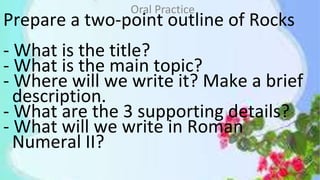
Prepare a two-point outline of Rocks
- What is the title?
- What is the main topic?
- Where will we write it? Make a brief
description.
- What are the 3 supporting details?
- What will we write in Roman
Numeral II?
Oral Practice
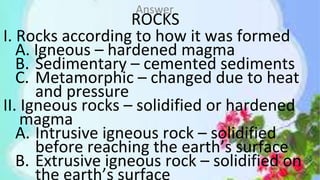
ROCKS
I. Rocks according to how it was formed
A. Igneous – hardened magma
B. Sedimentary – cemented sediments
C. Metamorphic – changed due to heat
and pressure
II. Igneous rocks – solidified or hardened
magma
A. Intrusive igneous rock – solidified
before reaching the earth’s surface
B. Extrusive igneous rock – solidified on
Answer
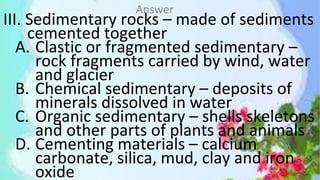
III. Sedimentary rocks – made of sediments
cemented together
A. Clastic or fragmented sedimentary –
rock fragments carried by wind, water
and glacier
B. Chemical sedimentary – deposits of
minerals dissolved in water
C. Organic sedimentary – shells skeletons
and other parts of plants and animals
D. Cementing materials – calcium
carbonate, silica, mud, clay and iron
oxide
Answer
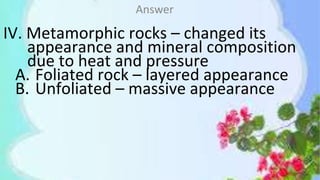
IV. Metamorphic rocks – changed its
appearance and mineral composition
due to heat and pressure
A. Foliated rock – layered appearance
B. Unfoliated – massive appearance
Answer
What skill have we used today?
What is scanning?
What are the tips for better scanning?
Generalization
Scanning is a fast reading technique that
means going over/examining a reading
material quickly to look for specific
information or fact.
• A two-point outline is a plan that
presents the main ideas and
supporting ideas.
• The main ideas are introduced by
Roman numerals while the supporting
ideas are introduced by capital letters.
Remember
Sharks
BIG SHARKS, SMALL SHARKS
Different species of sharks can be
very different in size. The smallest
sharks are only four inches long. The
largest, the whale shark, can grow to
60 feet long. It is not only the largest
fish any kind.
Application
Speedy Sharks
Blue sharks have been recorded
going 43 miles per hour. Unlike most
fish, sharks do not float very well.
They have to swim constantly, so they
will not sink.
People and Sharks
The British use shark meat or fish
and chips. Shark liver used to be a
common source of vitamin A.
Application
Answer these questions.
1. What is the length of the smallest
shark? the biggest shark?
2. How fast can the blue shark swim?
3. How do the British use shark meat?
4. What part of the shark is a source of
vitamin A?
Application
1. What is the length of the smallest
shark? the biggest shark?
2. How fast can the blue shark swim?
3. How do the British use shark meat?
4. What part of the shark is a source of
vitamin A?
5. What vitamin is found in shark-liver
oil?
Prepare a two-point outline of the article
on sharks.
Application
Space Explorations
Pioneers in Space
On October 4, 1957, the Soviet
satellite called Sputnik travelled into
space. A few months later, the United
States launched Explorer 1. These early
space launches of manufactured
satellites paved the way for people to
explore the space.
Evaluation
People in Space
By the 1960s, the United States and
the Soviet Union had sent people in
space. On April 12, 1961, Russian
cosmonaut Yuri Gagarin became the first
man in space. In 1962, American
astronaut John Glenn orbited earth in
Friendship 7.
Following these early years of space
exploration, the Untied States launched
Apollo 11, which traveled 200,000 miles
and make history.
Evaluation
The Moon Landing
After three days’ travel though
space, Apollo 11 reached the moon’s
orbit Astronauts Neil Armstrong and
Edwin Aldrin climbed into the Eagle, a
lunar module designed to take them
from the spaceship and land on the
moon. On July 20, 1969, Armstrong and
Aldrin were the first people to walk on
the moon.
Evaluation
1. How many subtitles does the article
have?
2. What was the first spacecraft launched
into space?
3. Who was the first man on space?
4. What was the name of the United
States manned spacecraft that orbit
the earth?
5. Who were the first people to walk on the
moon?
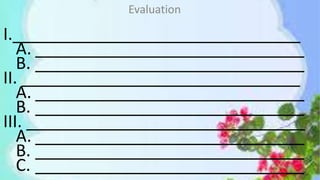
Fill up the skeleton of a two-point outline
using the above article.
Evaluation
I._______________________________
A. _____________________________
B. _____________________________
II. ______________________________
A. _____________________________
B. _____________________________
III. ______________________________
A. _____________________________
B. _____________________________
C. _____________________________
Evaluation

2nd qtr 15 writing a two point outline

  • 1.
    Writing a Two-PointOutline English V
  • 2.
    When you areusing a telephone directory for the number of a friend, do you go through all of the names? How do you do it? Do you know that you are using a skill in reading known as scanning? Motivation
  • 3.
    Scanning is atechnique in reading. You’ll be using this technique in today’s lesson. Motivation
  • 4.
    Now fill theblanks with the correct vocabulary words. 1. The process by a rock changes from one kind to another is called ______. 2. The gold that have flattened into thin plates or layers is said to be ___. 3. The lahar that covered most of places in Pampanga is made up of ______ materials. Unlocking of Difficulties
  • 5.
    4. Some rocksare called ______ rocks because they hardened underneath the earth’s surface. 5. Rocks that hardened when they reached the surface of the earth are said to be ______. Unlocking of Difficulties
  • 6.
    Before we startpracticing scanning, we will scan some information first about scanning. Please read it carefully and thoroughly, Unlocking of Difficulties
  • 7.
    Scanning What is meantby scanning? Scanning is a fast reading technique. It’s a way of reading to look for specific information in a text. Scanning can be used to look up for a phone number, read through the small ads in a newspaper, or for browsing TV schedules, timetables, lists, catalogues or web pages for information. For these tasks you don’t A Text A Day/Presentation
  • 8.
    need to reador understand every word. Scanning is also useful when studying or looking to find specific information from a book or article quickly as there is not always time to read every word. It involves running your eyes down the page looking for specific facts or keywords and phrases., Presentation
  • 9.
    Hints and tipsfor better scanning. 1. Don’t try to read every word. Instead let your eyes move quickly until you find what you are looking for. 2. Use clues on the page, such as headings and titles, to help you. 3. In a dictionary or phone book, use the ‘header’ words to help you scan. You can find these in bold type at the top of each page. Presentation
  • 10.
    4. If youare reading for study, start by thinking up or writing down some questions that you want to answer. Doing this can focus your mind and help you find the facts or information that you need more easily. 5. Many texts use A-Z order. These include everyday materials such as phonebook and indexes to books and catalogues. Presentation
  • 11.
    6. There aremany ways to practice scanning skills. Try looking up a favorite recipe in the index of a cookbook, search for a plumber in your local Yellow Pages, or scan web pages on the Internet to find specific information. Source: http:/www.bbc.co.uk Presentation
  • 12.
    Always remember thehints and tips about scanning. Remember you are developing a fast reading technique. You will scan the text. Use the subheading to locate answers to these questions. Since you are only scanning, you are given only 30 minutes to answer these questions. Presentation
  • 13.
    1. What arethe three main kinds of rocks? 2. What are the principal forms of igneous rocks? 3. What are the three groups of sedimentary rocks? a. What make up clastic or fragmental sedimentary? b. What make up chemical sedimentary? c. What make up organic sedimentary? 4. What are the 2 kinds of metamorphic rock? Differentiate. Presentation
  • 14.
    You can nowbegin scanning the text in order to locate the information needed. Presentation
  • 15.
    Rocks There are manykinds of rocks. Generally, according to how they are formed, rocks are classified as igneous, sedimentary or metamorphic. Igneous Rocks Deep within the earth’s surface exists molten or melted materials known as magma. This molten rock material is extremely hot with temperature ranging from 749˚ to 1093˚C. High pressure may force the magma to work its way upward
  • 16.
    to the earth’ssurface through the cracks or fissures. When these molten rock materials cool off and solidify, they form what we call igneous rocks which mean “formed by fire.” Igneous rocks occur in two principal forms: intrusive igneous rock and extrusive igneous rock. Intrusive igneous rocks are igneous rocks that do not rise all the way to the surface of the earth. They hardened up before reaching the earth’s surface. They have coarse mineral grains and crystals that can be easily seen. These are also called plutonic rocks. Extrusive
  • 17.
    igneous rocks areformed and solidified on the surface of the earth. They are usually fine grained, glassy or finely crystalline in texture. Since these rocks are formed from molten materials that are expelled by volcanic eruptions, they are also called volcanic rocks or pyroclastic rocks. Sedimentary Rocks There are rocks that consist of materials that were once was part of older rocks or of plants and animal parts. These rocks were deposited millions of years ago
  • 18.
    water causes theminerals to crystallize leaving mineral deposits. Organic sedimentary is composed of shells, skeletons and other parts of plants or animals. Many different substances can act as cement that bind the sedimentary rocks. Of these, the most common are calcium carbonate, silica, mud, clay and iron oxide. Metamorphic Rock Rocks that have changed its appearance and sometimes its mineral
  • 19.
    as layers ofloose materials which become cemented together. They are called sedimentary rocks from the word “sediments”. They are grouped into three: 1) classic or fragmental sedimentary, 2) chemical sedimentary, and 3) organic sedimentary. Classic or fragmental sedimentary is composed of rock fragments carried and deposited by wind, water or glacier and are cemented together. Chemical sedimentary is composed of deposits of minerals dissolved in water. The evaporation of
  • 20.
    composition due toeither extreme heat or pressure are called metamorphic rocks. They often show a layered structure but some are said to be massive. Metamorphic rocks that layered in appearance are known as foliated rocks while those that are massive are known as unfoliated rocks. All kinds of rocks, including igneous and sedimentary, usually undergo metamorphism and produce the so called metamorphic rocks. Source: Compton’s Encyclopedia and Fact Index Vol
  • 21.
    Time’s up! Wereyou able to locate the specific facts that will answer our questions? Let’s answer the guide questions using the information you have gathered. Now that we have enriched our scanning skill, we will also do some outlining. We will prepare a two-point outline for our reading material. Do you still remember how to make an outline? Discussion and Analysis
  • 22.
    Here is askeleton key of the two-point outline that we will prepare. I. A. B. C. II. A. B. III. A. B. C. D. IV. A. B. Discussion and Analysis
  • 23.
    a. What doesthe very first line at the top represent? b. What do the Roman numerals represent? What are found after each Roman numeral? c. What do the capital letters represent? d. How are the capital letters written as compared with the Roman numerals? Discussion and Analysis
  • 24.
    Let us makeour own reminders for writing an outline. An outline should have a title. Roman numerals are used to indicate the main topic. Place a period after each Roman numeral. Be sure that the Roman numerals and the periods are in a column. Capital letters are used in subtopics. Indent the capital letters and place a period after each. Arrange the capital Discussion and Analysis
  • 25.
    letters in astraight line too. All main topic heading should be divided into at least two parts. A topic cannot logically be decided into only one part. All the headings should be expressed in parallel grammatical form. All the first word should be capitalized Discussion and Analysis
  • 26.
    Prepare a two-pointoutline of Rocks - What is the title? - What is the main topic? - Where will we write it? Make a brief description. - What are the 3 supporting details? - What will we write in Roman Numeral II? Oral Practice
  • 27.
    ROCKS I. Rocks accordingto how it was formed A. Igneous – hardened magma B. Sedimentary – cemented sediments C. Metamorphic – changed due to heat and pressure II. Igneous rocks – solidified or hardened magma A. Intrusive igneous rock – solidified before reaching the earth’s surface B. Extrusive igneous rock – solidified on Answer
  • 28.
    III. Sedimentary rocks– made of sediments cemented together A. Clastic or fragmented sedimentary – rock fragments carried by wind, water and glacier B. Chemical sedimentary – deposits of minerals dissolved in water C. Organic sedimentary – shells skeletons and other parts of plants and animals D. Cementing materials – calcium carbonate, silica, mud, clay and iron oxide Answer
  • 29.
    IV. Metamorphic rocks– changed its appearance and mineral composition due to heat and pressure A. Foliated rock – layered appearance B. Unfoliated – massive appearance Answer
  • 30.
    What skill havewe used today? What is scanning? What are the tips for better scanning? Generalization
  • 31.
    Scanning is afast reading technique that means going over/examining a reading material quickly to look for specific information or fact. • A two-point outline is a plan that presents the main ideas and supporting ideas. • The main ideas are introduced by Roman numerals while the supporting ideas are introduced by capital letters. Remember
  • 32.
    Sharks BIG SHARKS, SMALLSHARKS Different species of sharks can be very different in size. The smallest sharks are only four inches long. The largest, the whale shark, can grow to 60 feet long. It is not only the largest fish any kind. Application
  • 33.
    Speedy Sharks Blue sharkshave been recorded going 43 miles per hour. Unlike most fish, sharks do not float very well. They have to swim constantly, so they will not sink. People and Sharks The British use shark meat or fish and chips. Shark liver used to be a common source of vitamin A. Application
  • 34.
    Answer these questions. 1.What is the length of the smallest shark? the biggest shark? 2. How fast can the blue shark swim? 3. How do the British use shark meat? 4. What part of the shark is a source of vitamin A? Application
  • 35.
    1. What isthe length of the smallest shark? the biggest shark? 2. How fast can the blue shark swim? 3. How do the British use shark meat? 4. What part of the shark is a source of vitamin A? 5. What vitamin is found in shark-liver oil? Prepare a two-point outline of the article on sharks. Application
  • 36.
    Space Explorations Pioneers inSpace On October 4, 1957, the Soviet satellite called Sputnik travelled into space. A few months later, the United States launched Explorer 1. These early space launches of manufactured satellites paved the way for people to explore the space. Evaluation
  • 37.
    People in Space Bythe 1960s, the United States and the Soviet Union had sent people in space. On April 12, 1961, Russian cosmonaut Yuri Gagarin became the first man in space. In 1962, American astronaut John Glenn orbited earth in Friendship 7. Following these early years of space exploration, the Untied States launched Apollo 11, which traveled 200,000 miles and make history. Evaluation
  • 38.
    The Moon Landing Afterthree days’ travel though space, Apollo 11 reached the moon’s orbit Astronauts Neil Armstrong and Edwin Aldrin climbed into the Eagle, a lunar module designed to take them from the spaceship and land on the moon. On July 20, 1969, Armstrong and Aldrin were the first people to walk on the moon. Evaluation
  • 39.
    1. How manysubtitles does the article have? 2. What was the first spacecraft launched into space? 3. Who was the first man on space? 4. What was the name of the United States manned spacecraft that orbit the earth? 5. Who were the first people to walk on the moon? Fill up the skeleton of a two-point outline using the above article. Evaluation
  • 40.
    I._______________________________ A. _____________________________ B. _____________________________ II.______________________________ A. _____________________________ B. _____________________________ III. ______________________________ A. _____________________________ B. _____________________________ C. _____________________________ Evaluation