ISSN: 2278 – 1323
                               International Journal of Advanced Research in Computer Engineering & Technology
                                                                                   Volume 1, Issue 4, June 2012


 Design & Implementation of 64 bit ALU for Instruction Set Architecture & Comparison between
                             Speed/Power Consumption on FPGA
                                                       1
                                                           Rajeev Kumar

                          Coordinator M.Tech ECE, Deptt of ECE, IITT College, Punjab

                                                 rajeevpundir@hotmail.com
                                                       2
                                                           Manpreet Kaur

                                                 M.Tech ECE, IITT College

                                                gillmanpreet65@yahoo.co.in

_____________________________________________________________________________________

Abstract

In the present paper design of 64 bit ALU is presented. Arithmetic Logical Unit is the part of Microprocessor. All the
arithmetic & logical functions are performed inside the ALU. So ALU is the heart of the microprocessor.The speed of the
ALU decides the speed of the microprocessor. Now in MOS Technology the power consumption is depend upon then
switching frequency of the clock as

P=CV2f

Here P is the power consumption

C is the capacitance of the interconnections

f is the clock frequency of the design

So if the clock frequency is reduced then the power consumption is less but on the other side of the coin the speed
(performance) is reduced at a significant amount.So we should choose a architecture so that when no instruction is available
to ALU it is transferred in power down mode i.e during the waiting states no power is consumed by the ALU.ALU is the part
of the instruction set architecture defined the microarchitecture of the processor. The processor architecture is defined by the
instruction set.

Keywords

ALU, ISA , Microprocessor, MOS Technology, Power Consumption, Power Down mode, Speed

Introduction

Processor is the brain of the computer. Now ALU is the heart of the processor. In the designing of superscalar
processors Fetch, Decode, Execute & Write back stages are present. Now ALU is the building block of the Execute
stage. Now to execute the instruction operation code & the operand (digital data) is required. Now the Opcode is
transferred by control unit tell the processor which operation is done at which time. Now the two operands of
desired width is transferred by the register file. In this particular paper design of 64 bit ALU is presented which is
operated at low power consumption. Low power design is important in hand held devices such as mobile phones in
which long backup of the battery are required. In the present design if instruction is not available to ALU then
it becomes off i.e no power is consumed. So this is the additional arrangement in the present design.

                                                                                                                           186

                                               All Rights Reserved © 2012 IJARCET
ISSN: 2278 – 1323
                              International Journal of Advanced Research in Computer Engineering & Technology
                                                                                  Volume 1, Issue 4, June 2012


Architecture Design

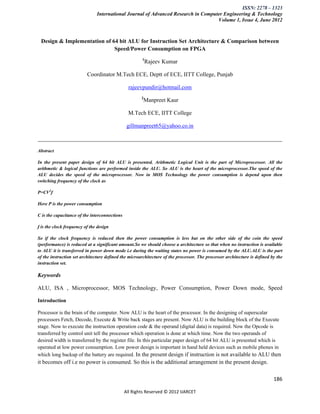
First of all the specifications are written first. In the present architecture x & y is the 64 bit input (operands) and z is
the 64 bit output. Here clk is the clock signal taken as negative edge triggered for fast triggering. Here the clock
contains a period of 100ns i.e 10MHz frequency. control is the control signal generated by the Finite State Machine
(FSM) tell the ALU which operation is done. Which operation is done by the ALU is decided by the instruction set
of                                                        the                                                     processor

.


Instruction Set

Instruction Set of the Processor contains 16 different instructions such as arithmetic, logical, shifting operations &
data transfer instructions which are given as follows


Instruction                    Opcode                             NAND                            1000
Add                            0000                               NOR                             1001
Sub                            0001                               Bitwise AND                     1010
Mul                            0010                               Bitwise OR                      1011
Logical AND                    0011                               Bitwise NAND                    1100
Logical OR                     0100                               Bitwise NOR                     1101
Left Shift                     0101                               Move                            1110
Right Shift                    0110                               Compare                         1111
NOT                            0111                               Power Down Mode                 zzzz


Simulation Result

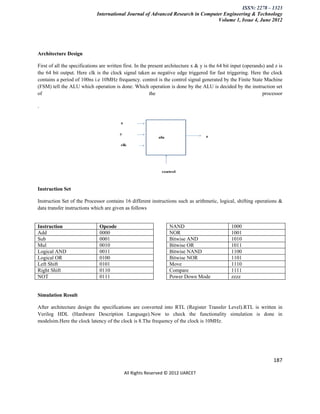
After architecture design the specifications are converted into RTL (Register Transfer Level).RTL is written in
Verilog HDL (Hardware Description Language).Now to check the functionality simulation is done in
modelsim.Here the clock latency of the clock is 8.The frequency of the clock is 10MHz.


                                                                                                                       187

                                           All Rights Reserved © 2012 IJARCET
ISSN: 2278 – 1323
                            International Journal of Advanced Research in Computer Engineering & Technology
                                                                                Volume 1, Issue 4, June 2012


Synthesis Report

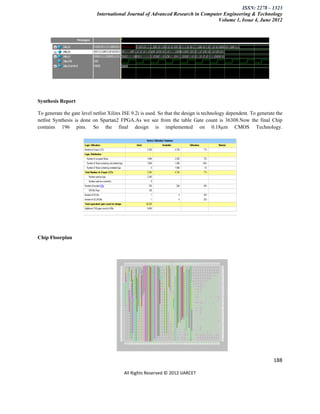
To generate the gate level netlist Xilinx ISE 9.2i is used. So that the design is technology dependent. To generate the
netlist Synthesis is done on Spartan2 FPGA.As we see from the table Gate count is 36308.Now the final Chip
contains 196 pins. So the final design is implemented on 0.18µm CMOS Technology.


Chip Floorplan


                                                                                                                  188

                                          All Rights Reserved © 2012 IJARCET
ISSN: 2278 – 1323
               International Journal of Advanced Research in Computer Engineering & Technology
                                                                   Volume 1, Issue 4, June 2012


Chipdesign


Power Report


                                                                                           189

                          All Rights Reserved © 2012 IJARCET
ISSN: 2278 – 1323
                           International Journal of Advanced Research in Computer Engineering & Technology
                                                                               Volume 1, Issue 4, June 2012


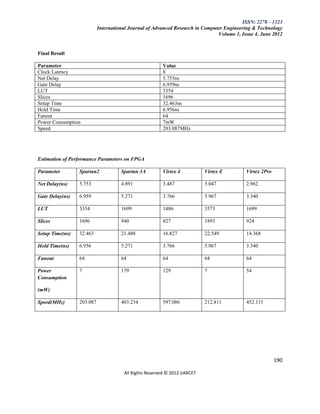
Final Result

Parameter                                               Value
Clock Latency                                           8
Net Delay                                               5.753ns
Gate Delay                                              6.959ns
LUT                                                     3354
Slices                                                  1696
Setup Time                                              32.463ns
Hold Time                                               6.956ns
Fanout                                                  64
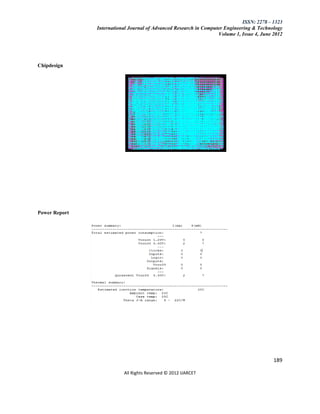
Power Consumption                                       7mW
Speed                                                   203.087MHz


Estimation of Performance Parameters on FPGA

Parameter        Spartan2            Spartan 3A         Virtex 4           Virtex E        Virtex 2Pro

Net Delay(ns)    5.753               4.891              3.487              5.047           2.962

Gate Delay(ns)   6.959               5.271              3.766              5.967           3.340

LUT              3354                1699               1486               3573            1699

Slices           1696                940                827                1893            924

Setup Time(ns)   32.463              21.488             16.827             22.549          14.368

Hold Time(ns)    6.956               5.271              3.766              5.967           3.340

Fanout           64                  64                 64                 64              64

Power            7                   179                129                7               54
Consumption

(mW)

Speed(MHz)       203.087             403.234            597.086            212.811         452.131


                                                                                                         190

                                      All Rights Reserved © 2012 IJARCET
ISSN: 2278 – 1323
                     International Journal of Advanced Research in Computer Engineering & Technology
                                                                         Volume 1, Issue 4, June 2012


Results

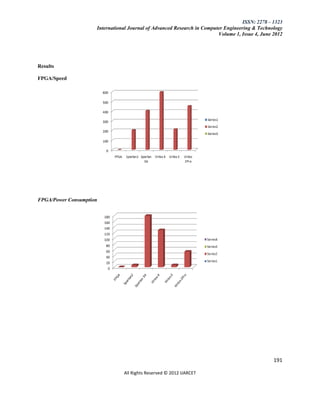
FPGA/Speed


FPGA/Power Consumption


                                                                                                 191

                                All Rights Reserved © 2012 IJARCET
ISSN: 2278 – 1323
                           International Journal of Advanced Research in Computer Engineering & Technology
                                                                               Volume 1, Issue 4, June 2012


FPGA/LUT


FPGA/Slices


Discussion & Conclusion

The final design is implemented on 0.18µm CMOS Technology with gate count of 36308.Present design is used for
low power consumption. In future we can implement the design for low chip area i.e the low fabrication cost. The
design can be done for high speed but in that case the power consumption increases. So there is a compromise
between the speed & power consumption. The final design supports 203.087 MHz clock frequency when
implemented on FPGA. Virtex 4 provides the highest speed & Spartan 2 provides the lowest power consumption.
Virtex 4 Provides low chip area (slices are less).Among these architectures Virtex E provides high speed and low
power                                                                                               consumption.

References

[1]L.Benini, G.D., Micheli, “Dynamic Power Management,” 1st ed.Springer, Nov 1997, pp.24-25

[2]Steve Furber, ARM: System on Chip Architecture, Addison –Wesley, second edition, 2000.

[3]D.A Patterson & J.L Henessey, Computer Architecture: A Quantative Approach, Sant Mateo,

                                                                                                           192

                                       All Rights Reserved © 2012 IJARCET
ISSN: 2278 – 1323
                           International Journal of Advanced Research in Computer Engineering & Technology
                                                                               Volume 1, Issue 4, June 2012


  CA: Morgan Kaufman, 1989.

[4] Dr.R.S Ramchandran, “Digital VLSI System Design”, IIT Madras

[5]Computer Architecture & Parallel Processing, Kai Hwang

[6]Rajeev Kumar, “Design of 64bit Register File for VLIW Processor Architecture”, IJERA vol.2,

   issue.3, May-June 2012, pp.183-186.


Rajeev Kumar obtained his MSc Electronic Science & M.Tech (Microelectronics & VLSI Design) Degree from
Deptt of Electronic Science, Kurukshetra University, Kurukshetra (Haryana).Currently working as Coordinator
M.Tech ECE Program in IITT College of Engineering, Punjab. He is the member of R&D in the IITT College. He is
also the member of IAENG (International Association of Engineers), Research Gates & Silicon India. He worked in
the field of High Speed Processor Architecture, Low Power VLSI Design & Implementation of Hardware for DSP.
He is currently involved in Design & Implementation of VLIW Processor for Reconfigurable Architecture. In future
he is interested to work in ASIP Design for Low Power, Design of Hardware for Neural Network and Design of
DSP Processor for Image Processing. He is keen for Reconfigurable Computing. During M.Tech they are involved
in Full Custom design of 0.1µm NMOS inverter. For Synthesis purpose in Verilog HDL based design they used the
library of Semi Custom Design (ASIC) & FPGA. He is involved logic verification of gates & architecture in C
Language in Linux Operating System. They worked in the area of Microelectronics during MSc Electronic Science
(Thin Film Deposition, Photolithography & Wet Etching).


Manpreet Kaur done his B.Tech ECE from Bhutta College of Engineering Ludhiana, Punjab.Pursuing M.Tech ECE
form IITT College of Engineering,Punjab.In B.Tech they done their project in Dynamic Host Configuration.Her
research interest is DSP, Wireless & Mobile Communication, and Low Power VLSI Design. In future she is
interested to work in high performance Reconfigurable Computing.


                                                                                                           193

                                         All Rights Reserved © 2012 IJARCET

186 193

  • 1.
    ISSN: 2278 –1323 International Journal of Advanced Research in Computer Engineering & Technology Volume 1, Issue 4, June 2012 Design & Implementation of 64 bit ALU for Instruction Set Architecture & Comparison between Speed/Power Consumption on FPGA 1 Rajeev Kumar Coordinator M.Tech ECE, Deptt of ECE, IITT College, Punjab rajeevpundir@hotmail.com 2 Manpreet Kaur M.Tech ECE, IITT College gillmanpreet65@yahoo.co.in _____________________________________________________________________________________ Abstract In the present paper design of 64 bit ALU is presented. Arithmetic Logical Unit is the part of Microprocessor. All the arithmetic & logical functions are performed inside the ALU. So ALU is the heart of the microprocessor.The speed of the ALU decides the speed of the microprocessor. Now in MOS Technology the power consumption is depend upon then switching frequency of the clock as P=CV2f Here P is the power consumption C is the capacitance of the interconnections f is the clock frequency of the design So if the clock frequency is reduced then the power consumption is less but on the other side of the coin the speed (performance) is reduced at a significant amount.So we should choose a architecture so that when no instruction is available to ALU it is transferred in power down mode i.e during the waiting states no power is consumed by the ALU.ALU is the part of the instruction set architecture defined the microarchitecture of the processor. The processor architecture is defined by the instruction set. Keywords ALU, ISA , Microprocessor, MOS Technology, Power Consumption, Power Down mode, Speed Introduction Processor is the brain of the computer. Now ALU is the heart of the processor. In the designing of superscalar processors Fetch, Decode, Execute & Write back stages are present. Now ALU is the building block of the Execute stage. Now to execute the instruction operation code & the operand (digital data) is required. Now the Opcode is transferred by control unit tell the processor which operation is done at which time. Now the two operands of desired width is transferred by the register file. In this particular paper design of 64 bit ALU is presented which is operated at low power consumption. Low power design is important in hand held devices such as mobile phones in which long backup of the battery are required. In the present design if instruction is not available to ALU then it becomes off i.e no power is consumed. So this is the additional arrangement in the present design. 186 All Rights Reserved © 2012 IJARCET
  • 2.
    ISSN: 2278 –1323 International Journal of Advanced Research in Computer Engineering & Technology Volume 1, Issue 4, June 2012 Architecture Design First of all the specifications are written first. In the present architecture x & y is the 64 bit input (operands) and z is the 64 bit output. Here clk is the clock signal taken as negative edge triggered for fast triggering. Here the clock contains a period of 100ns i.e 10MHz frequency. control is the control signal generated by the Finite State Machine (FSM) tell the ALU which operation is done. Which operation is done by the ALU is decided by the instruction set of the processor . Instruction Set Instruction Set of the Processor contains 16 different instructions such as arithmetic, logical, shifting operations & data transfer instructions which are given as follows Instruction Opcode NAND 1000 Add 0000 NOR 1001 Sub 0001 Bitwise AND 1010 Mul 0010 Bitwise OR 1011 Logical AND 0011 Bitwise NAND 1100 Logical OR 0100 Bitwise NOR 1101 Left Shift 0101 Move 1110 Right Shift 0110 Compare 1111 NOT 0111 Power Down Mode zzzz Simulation Result After architecture design the specifications are converted into RTL (Register Transfer Level).RTL is written in Verilog HDL (Hardware Description Language).Now to check the functionality simulation is done in modelsim.Here the clock latency of the clock is 8.The frequency of the clock is 10MHz. 187 All Rights Reserved © 2012 IJARCET
  • 3.
    ISSN: 2278 –1323 International Journal of Advanced Research in Computer Engineering & Technology Volume 1, Issue 4, June 2012 Synthesis Report To generate the gate level netlist Xilinx ISE 9.2i is used. So that the design is technology dependent. To generate the netlist Synthesis is done on Spartan2 FPGA.As we see from the table Gate count is 36308.Now the final Chip contains 196 pins. So the final design is implemented on 0.18µm CMOS Technology. Chip Floorplan 188 All Rights Reserved © 2012 IJARCET
  • 4.
    ISSN: 2278 –1323 International Journal of Advanced Research in Computer Engineering & Technology Volume 1, Issue 4, June 2012 Chipdesign Power Report 189 All Rights Reserved © 2012 IJARCET
  • 5.
    ISSN: 2278 –1323 International Journal of Advanced Research in Computer Engineering & Technology Volume 1, Issue 4, June 2012 Final Result Parameter Value Clock Latency 8 Net Delay 5.753ns Gate Delay 6.959ns LUT 3354 Slices 1696 Setup Time 32.463ns Hold Time 6.956ns Fanout 64 Power Consumption 7mW Speed 203.087MHz Estimation of Performance Parameters on FPGA Parameter Spartan2 Spartan 3A Virtex 4 Virtex E Virtex 2Pro Net Delay(ns) 5.753 4.891 3.487 5.047 2.962 Gate Delay(ns) 6.959 5.271 3.766 5.967 3.340 LUT 3354 1699 1486 3573 1699 Slices 1696 940 827 1893 924 Setup Time(ns) 32.463 21.488 16.827 22.549 14.368 Hold Time(ns) 6.956 5.271 3.766 5.967 3.340 Fanout 64 64 64 64 64 Power 7 179 129 7 54 Consumption (mW) Speed(MHz) 203.087 403.234 597.086 212.811 452.131 190 All Rights Reserved © 2012 IJARCET
  • 6.
    ISSN: 2278 –1323 International Journal of Advanced Research in Computer Engineering & Technology Volume 1, Issue 4, June 2012 Results FPGA/Speed FPGA/Power Consumption 191 All Rights Reserved © 2012 IJARCET
  • 7.
    ISSN: 2278 –1323 International Journal of Advanced Research in Computer Engineering & Technology Volume 1, Issue 4, June 2012 FPGA/LUT FPGA/Slices Discussion & Conclusion The final design is implemented on 0.18µm CMOS Technology with gate count of 36308.Present design is used for low power consumption. In future we can implement the design for low chip area i.e the low fabrication cost. The design can be done for high speed but in that case the power consumption increases. So there is a compromise between the speed & power consumption. The final design supports 203.087 MHz clock frequency when implemented on FPGA. Virtex 4 provides the highest speed & Spartan 2 provides the lowest power consumption. Virtex 4 Provides low chip area (slices are less).Among these architectures Virtex E provides high speed and low power consumption. References [1]L.Benini, G.D., Micheli, “Dynamic Power Management,” 1st ed.Springer, Nov 1997, pp.24-25 [2]Steve Furber, ARM: System on Chip Architecture, Addison –Wesley, second edition, 2000. [3]D.A Patterson & J.L Henessey, Computer Architecture: A Quantative Approach, Sant Mateo, 192 All Rights Reserved © 2012 IJARCET
  • 8.
    ISSN: 2278 –1323 International Journal of Advanced Research in Computer Engineering & Technology Volume 1, Issue 4, June 2012 CA: Morgan Kaufman, 1989. [4] Dr.R.S Ramchandran, “Digital VLSI System Design”, IIT Madras [5]Computer Architecture & Parallel Processing, Kai Hwang [6]Rajeev Kumar, “Design of 64bit Register File for VLIW Processor Architecture”, IJERA vol.2, issue.3, May-June 2012, pp.183-186. Rajeev Kumar obtained his MSc Electronic Science & M.Tech (Microelectronics & VLSI Design) Degree from Deptt of Electronic Science, Kurukshetra University, Kurukshetra (Haryana).Currently working as Coordinator M.Tech ECE Program in IITT College of Engineering, Punjab. He is the member of R&D in the IITT College. He is also the member of IAENG (International Association of Engineers), Research Gates & Silicon India. He worked in the field of High Speed Processor Architecture, Low Power VLSI Design & Implementation of Hardware for DSP. He is currently involved in Design & Implementation of VLIW Processor for Reconfigurable Architecture. In future he is interested to work in ASIP Design for Low Power, Design of Hardware for Neural Network and Design of DSP Processor for Image Processing. He is keen for Reconfigurable Computing. During M.Tech they are involved in Full Custom design of 0.1µm NMOS inverter. For Synthesis purpose in Verilog HDL based design they used the library of Semi Custom Design (ASIC) & FPGA. He is involved logic verification of gates & architecture in C Language in Linux Operating System. They worked in the area of Microelectronics during MSc Electronic Science (Thin Film Deposition, Photolithography & Wet Etching). Manpreet Kaur done his B.Tech ECE from Bhutta College of Engineering Ludhiana, Punjab.Pursuing M.Tech ECE form IITT College of Engineering,Punjab.In B.Tech they done their project in Dynamic Host Configuration.Her research interest is DSP, Wireless & Mobile Communication, and Low Power VLSI Design. In future she is interested to work in high performance Reconfigurable Computing. 193 All Rights Reserved © 2012 IJARCET