CHEMISTRY
PROPERTIES OF SOLUTION

__RaNNY ROLINda RUSMaN__
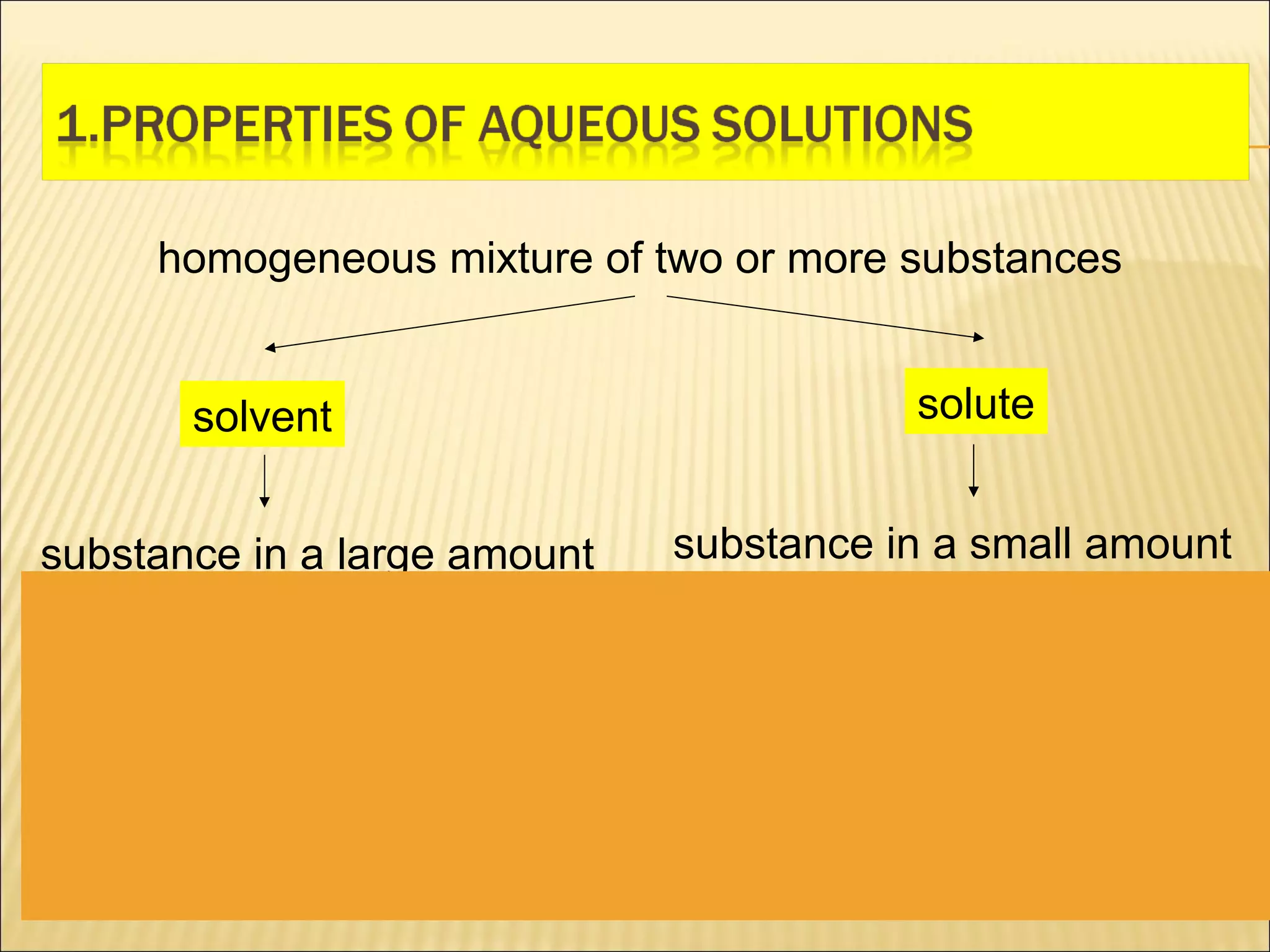
homogeneous mixture of two or more substances
solute

solvent
substance in a large amount

substance in a small amount

N2

gas phase
(air)

O2

Ag

solid phase
(alloys)

Au

H2O

liquid phase
(sea water)

NaCl
EXP1

iodine in ethyl alcohol (C2H5OH)
does not conduct electricity
(molecular solid)
I2

EXP2
table salt in water (H2O)
does conduct electricity
(ionic solid)
Na+Cl-
solute
water (H2O)
solutes

solution conducts
electricity

solution does not
conduct electricity
EXP3

electrolytes

non-electrolytes
electrolytes

non-electrolytes

solution conducts
electricity

solution does not
conduct electricity
non-electrolyte

methanol
sugar
ethanol
water

weak electrolyte

CH3COOH
HCOOH
HF
EXP5

strong electrolyte

ionic compounds
(NaCl, KF)
NaOH
HCl
H2SO4

dark

medium

bright
concentration
SOLUTION
percentage concentration
% = g [solute] / g solvent X 100
12 g of sodium chloride are solved in 150 g of water.
Calculate the percentage concentration

8%
SOLUTION
solubility of a solute
number of grams of solute that can dissolve
in 100 grams of solvent at a given temperature

36.0 g NaCl can be dissolve in 100 g of water at 293 K
Saturn

solvent
H2/He

solute
CH4, PH3
Europa

solvent
H 2O

solute
MgSO4
Triton

solvent
N2

solute
CH4
ELECTROLYTES
methanol
sugar
ethanol
water

ionic compounds
CH3COOH

(NaCl, KF)

HCOOH

NaOH

HF

HCl
H2SO4
migrating negative and positive charges

Kohlrausch

NaCl
DISSOCIATION
‘breaking apart’
NaCl (s) → Na+ (aq) + Cl- (aq)
NaOH (s) → Na+ (aq) + OH- (aq)
HCl (g) → H+ (aq) + Cl- (aq)
Ca(NO3)2 (s) → Ca2+(aq) + 2 NO3- (aq)
strong electrolytes are fully dissociated
polyatomic ions do NOT dissociate

EXP5
δO
δ+

H

H

δ+
SOLVATION

cations

anions
SOLVATION

non-electrolyte
NaCl (s) → Na+ (aq) + Cl- (aq)
strong electrolytes are fully dissociated

→
CH3COOH (aq)← H+ (aq) + CH3COO- (aq)
weak electrolytes are not fully dissociated
reversible reaction
(chemical equilibrium)
1.properties of aqueous solutions

2. reactions in aqueous solutions
a) precipitation reactions
b) acid-base reactions (proton transfer)
c) redox reactions (electron transfer)
2.1. PRECIPITATION REACTIONS

solution 1

solution 2

solution 1 + solution 2
2.1. PRECIPITATION REACTIONS
formation of an insoluble product
(precipitate)
NaCl(aq) + AgNO3(aq)

AgCl(s) + NaNO3(aq)
EXP 6
insoluble compounds
1.M+ compounds (M = H, Li, Na, K, Rb, Cs, NH4)
2. A- compounds (A = NO3, HCO3, ClO3, Cl, Br, I)
(AgX, PbX2)
3. SO42(Ag, Ca, Sr, Ba, Hg, Pb)
4. CO32-, PO43-, CrO42-, S2-
balanced molecular equation

NaCl(aq) + AgNO3(aq) → AgCl(s) + NaNO3(aq)

(table to determine which compound precipitates)
balanced ionic equation
1. NaCl(s) → Na+(aq) + Cl-(aq)
2. AgNO3(s) → Ag+(aq) + NO3-(aq)
3. Na+(aq) + Cl-(aq) + Ag+(aq)+ NO3-(aq) →
AgCl(s) + Na+ (aq) + NO3-(aq)

spectator ions
Ba(NO3)2 (aq) + Na2SO4 (aq)
Ba(NO3)2(aq) + Na3PO4(aq)
Cs2CrO4(aq) + Pb(NO3)2(aq)

1. which compound falls out?
2. balanced molecular equation
3. balanced ionic equations
4. identify spectator ions
1.properties of aqueous solutions

2. reactions in aqueous solutions
a) precipitation reactions
b) acid-base reactions (proton transfer)
c) redox reactions (electron transfer)
ACIDS

HAc → H+ (aq) + Ac- (aq)
ionization

HCl (g) → H+ (aq) + Cl- (aq)
BASES

MOH → M+ (aq) + OH- (aq)
Arrhenius (1883)

NaOH (s) → Na+ (aq) + OH- (aq)
Litmus Paper
acid

red

Säure

base

blue

Base

EXP7
ACIDS

BASES

and
NEUTRALIZE
EACH OTHER

HAc (aq) + MOH (aq) → MAc (aq) + H2O
HCl (aq) + NaOH (aq) → NaCl (aq) + H2O
acid + base

salt + water
Na+

H+

≈ 10-10 m

≈ 10-15 m
ACIDS AND BASES
HCl (g) → H+ (aq) + Cl- (aq)
H+(aq) + H2O

H3O+(aq)

HCl (g) + H2O → H3O+ (aq) + Cl- (aq)

one step
hydronium ion
(aq)
acid

(l)

(aq)

base

hydronium ion

(aq)
cation

hydronium ion
PROPERTIES OF ACIDS
1. acids have a sour taste
vinegar – acetic acid
lemons – citric acid

2. acids react with some metals to form hydrogen
2 HCl(aq) + Mg(s) → MgCl2(aq) + H2(g)

EXP8

3. acids react with carbonates to water and carbon dioxide
2 HCl(aq) + CaCO3(s) → CaCl2(aq) + [H2CO3]
H2CO3 → H2O(l) + CO2(g)

4. some acids are hygroscopic
H2SO4 (conc)

EXP9
BASES
1. bases have a bitter taste
2. bases feel slippery
soap

3. aqueous bases and acids conduct electricity
KOH(aq) and HF(aq)
Mg(OH)2(aq) and HCl(aq)
Ba(OH)2(aq) and H2SO4(aq)
NaOH(aq) and H3PO4(aq)
(stepwise)
ACIDS

proton donors
HAc → H+ (aq) + Ac- (aq)

BASES

proton acceptor
Bronsted (1932)

B + H+ (aq) → BH+ (aq)
strong electrolyte
HCl(aq) + H2O(l) → H3O+(aq) + Cl-(aq)

HNO3(aq) + H2O(l) → H3O+(aq) + NO3-(aq)
weak electrolyte
CH3COOH(aq) + H2O(l)

H3O+(aq) + CH3COO-(aq)

NH3(aq) + H2O(l)

NH4+ + OH-

donor versus acceptor
CH3COOH(aq) + H2O(l)

H3O+(aq) + CH3COO-(aq)

NH3(aq) + H2O(l)

NH4+(aq)+ OH-(aq)

H2O(l) + H2O(l)

H3O+(aq) + OH-(aq)

water can be either an
acid or a base
AUTO DISSOCIATION
monoprotic acids
HF, HCl, HBr, HNO3, CH3COOH

diprotic acid
H2SO4 → H+(aq) + HSO4-(aq)
HSO4-(aq)

H+(aq) + SO42-(aq)

triprotic acid
H3PO4

H+(aq) + H2PO4-(aq)

H2PO4-(aq)

H+(aq) + HPO42-(aq)

HPO42-(aq)

H+(aq) + PO43-(aq)

EXP10
CHEMICAL PROPOERTIES
1. Non-metal oxides react with water to form an acid
(acetic anhydrides)
SO3 (g ) + H 2O → H 2SO 4 (aq) sulfuric acid
N 2 O5 (g ) + H 2O → 2HNO3 (aq) nitric acid
+ H+H
CO 2 (g )2O 2O → H 2CO 3 (aq) carbonic acid

+ H 2O
+ H 2O
Cl2O7, SO2, Br2O5
CHEMICAL PROPERTIES
2. Soluble metal oxides react with water to form a base
(base anhydrides)

CaO(s ) + H 22O→ Ca(OH) 2 (aq) calcium hydroxide
+ HO
Na 2 O(s ) + H 2O → 2NaOH(aq)
+ H 2O

MgO, Al2O3

sodium hydroxide
NAMING ACIDS AND BASES
binary acids

prefix hydrothe suffix –ic
to the stem of the nonmetal name followed by the word acid

HCl(g ) hydrogen chloride

HCl(aq) hydrochloric acid

H 2S(g ) hydrogen sulfide

H 2S(aq) hydrosulfuric acid
NAMING ACIDS AND BASES
oxo acids acids
contain hydrogen, oxygen, plus another element

main group 5
HNO3
HNO2

nitric acid
nitrous acid

H3PO4
H3PO3

phosphoric acid
phosphorous acid
main group 6
H2SO4
H2SO3

sulfuric acid
sulfurous acid

main group 7
HClO4
HClO3
HClO2
HClO

perchloric acid
chloric acid
chlorous acid
hypochlorous acid
Europa

Venus

H2SO4(s)

H2SO4(g)
NH3, H2O, H2S
CH3COOH

HCOOH

HF, HCl
Orion
1.properties of aqueous solutions

2. reactions in aqueous solutions
a) precipitation reactions
b) acid-base reactions (proton transfer)
c) redox reactions (electron transfer)
1. oxidation

loss of electrons

2. reduction

acceptance of electrons

NUMBER OF ELECTRONS MUST BE CONSERVED
Na+Cl-

1. oxidation

Na → Na+ + e

2. reduction

Cl2 + 2 e → 2 Cl-

!!!balance electrons!!!
CaO, Al2O3
substance that lost the electrons
reduction agent
substance that gained the electrons
oxidizing agent
oxidizing agent is reduced
reducing agent is oxidized
2 Na + Cl2 → 2 Na+Cl-
solid state reaction of potassium with sulfur
to form potassium sulfide

EXAMPLE 2
solid state reaction of iron with oxygen
to form iron(III)oxide
OXIDATION NUMBER
ionic compounds ↔ molecular compounds

NaCl
Na+Cl-

HF, H2
?

electrons are fully transferred

covalent bond

charges an atom would have if electrons are
transferred completely
H+ + F-

HF
molecular compound

ionic compound

H+

oxidation state +1

F-

oxidation state -1
H2O

2 H+ + O2-

molecular compound

ionic compound

H+

oxidation state +1

O2-

oxidation state -2
H2
molecular compound

H+ + Hionic compound

OXIDATION NUMBER OF FREE ELEMENTS IS ZERO

H2, O2, F2, Cl2, K, Ca, P4, S8
RULE 2
monoatomic ions
oxidation number equals the charge of the ion
group I

M+

group II

M2+

group III

M3+ (Tl: also +1)

group VII (w/ metal)

X-
RULE 3
oxidation number of hydrogen

+1 in most compounds
(H2O, HF, HCl, NH3)

-1 binary compounds with metals (hydrides)
(LiH, NaH, CaH2, AlH3)
RULE 4
oxidation number of oxygen

-2 in most compounds
(H2O, MgO, Al2O3)

-1 in peroxide ion (O22-) (H2O2, K2O2, CaO2)
-1/2 in superoxide ion (O2-) (LiO2)
RULE 5
oxidation numbers of halogens

F: -1 (KF)

Cl, Br, I: -1 (halides) (NaCl, KBr)
Cl, Br, I: positive oxidation numbers if combined
with oxygen (ClO4-)
RULE 6
charges of polyatomic molecules must be integers
(NO3-, SO42-)

oxidation numbers do not have to be integers

-1/2 in superoxide ion (O2-)
MENUE
1.oxidation states of group I – III metals
2.oxidation state of hydrogen (+1, -1)
3. oxidation states of oxygen (-2, -1, -1/2, +1)
4.oxidation state of halogens
5.remaining atoms
oxidizing agents
OCl-

?????

EXP10

Cl-
reducing agent
2 Na + 2 H2O → H2 + 2 NaOH

EXP11/12
K2O
PO

34

NO+
SO42-

KO2
SO3

NO3NO2

NO
KClO4

BrO-

SO2
NO2-

NO-
1.redox reactions
2. oxidation versus reduction
3. oxidation numbers versus charges
4. calculation of oxidation numbers
1.combination reactions
A+B→C
2. decomposition reactions
C→A+B
3. displacement reactions
A + BC → AC + B
4. disproportionation reactions
1.combination reactions
A+B→C
two or more compounds combine to form a single product

S8(s) + O2(g) → SO2(g)
1. oxidation numbers

2. balancing charges
MENUE
1.oxidation states of group I – III metals
2.oxidation state of hydrogen (+1, -1)
3. oxidation states of oxygen (-2, -1, -1/2, +1)
4.oxidation state of halogens
5.remaining atoms
2. decomposition reactions
C→A+B
breakdown of one compound into two or more compounds

HgO(s) → Hg(l) + O2(g)
KClO3(s) → KCl(s) + O2(g)
1. oxidation numbers

2. balancing charges
3. displacement reactions
A + BC → AC + B
an ion or atom in a compound is replaced by an ion or atom
of another element
3.1. Hydrogen displacement

3.2. Metal displacement

3.3. Halogen displacement
group I and some group II metals (Ca, Sr, Ba)
react with water to form hydrogen

Na(s) + H2O(l) → NaOH + H2(g)
less reactive metals form hydrogen and the oxide in
water (group III, transition metals)

Al(s) + H2O(l) → Al2O3(s) + H2(g)
even less reactive metals form hydrogen in acids

Zn(s) + HCl(aq) → ZnCl2(aq) + H2(g)

EXP12
activity series of metals
Li K Ba Ca Na Mg Al Zn Cr Fe Cd Co Ni Sn Pb H Cu Hg Ag Pt Au

displace H from water

displace H from steam
displace H from acids
Li K Ba Ca Na Mg Al Zn Cr Fe Cd Co Ni Sn Pb H Cu Hg Ag Pt Au

does not like so much to donate electrons

likes to donate electrons
EXP13
3.2. Metal displacement

V2O5(s) + 5 Ca(s) → 2 V(s) + 5 CaO(s)

TiCl4(g) + 2 Mg (l) → Ti(s) + 2 MgCl2(l)
3.3. Halogen displacement
F2 > Cl2 > Br2 > I2
reactivity (‘likes’ electrons)
0

+1 -1

+1 -1

0

Cl2(g) + 2 KBr(aq) → 2 KCl(aq) + Br2(l)
Br2(g) + 2 KI(aq) → 2 KBr(aq) + I2(s)
4. disproportionation reactions
an element in one oxidation state is oxidized and reduced
at the same time

H2O2(aq) → 2 H2O(l) + O2(g)

Cl2(g) + 2 OH-(aq) → ClO-(aq) + Cl-(aq) + H2O(l)
1.combination reactions
A+B→C
2. decomposition reactions
C→A+B
3. displacement reactions
A + BC → AC + B
4. disproportionation reactions
molar concentration
Molarity
(M)

molarity (M) =

moles of solute
= liters of solution
How many grams of AgNO3 are needed to prepare
250 mL of 0.0125 M AgNO3 solution?

0.531 g AgNO3
How many mL of 0.124 M NaOH are required
to react completely with 15.4 mL of 0.108 M H2SO4?

2 NaOH + H2SO4

Na2SO4 + 2H2O

26.8 mL NaOH
How many mL of 0.124 M NaOH are required
to react completely with 20.1 mL of 0.2 M HCl?

NaOH + HCl

NaCl + H2O
How many grams of iron(II)sulfide have to react with hydrochloric acid
to generate 12 g of hydrogen sulfide?
How many moles of BaSO4 will form if 20.0 mL of
0.600 M BaCl2 is mixed with 30.0 mL of 0.500 M MgSO4?
BaCl2 + MgSO4

BaSO4 + MgCl2

This is a limiting reagent problem
0.0120 mol BaSO 4
How many ml of a 1.5 M HCl will be used to neutralize
a 0.2 M Ba(OH)2 solution?

How many ml of a 1.5 M HCl will be used to prepare
500 ml of a 0.1 M HCl?

Vdil X M dil

=

Vconcd X M concd
LIMITING REACTANT
EXP14

C2H4 + H2O

C2H5OH
limiting reactant

excess reactant
How many grams of NO can form when 30.0 g NH3
and 40.0 g O2 react according to
4 NH3 + 5 O2

4 NO + 6 H2O

Properties of Solution