Chapter 8: Reactions and Aqueous Solutions
Predicting Whether a Reaction Will Occur There are several different “driving forces” that cause chemical reactions to take place Formation of a solid Formation of water Transfer of Electrons Formation of a gas When two chemicals come together if any of these changes can occur a chemical reaction will occur.  You can predict whether a reaction will occur and the products that will form by considering these driving forces
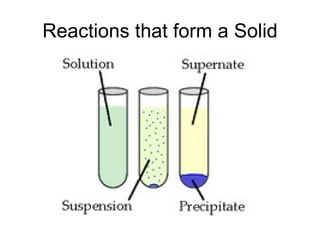
Reactions that form a Solid Precipitation : the formation of a solid in a reaction Precipitate : the solid formed by the reaction Called a  precipitation reaction
Reactions that form a Solid
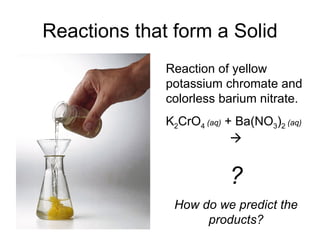
Reactions that form a Solid Reaction of yellow potassium chromate and colorless barium nitrate. K 2 CrO 4  (aq)  + Ba(NO 3 ) 2  (aq)    ? How do we predict the products?
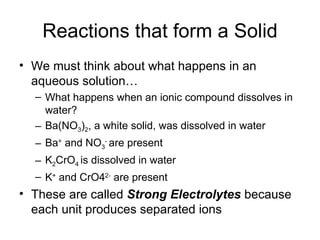
Reactions that form a Solid We must think about what happens in an aqueous solution… What happens when an ionic compound dissolves in water? Ba(NO 3 ) 2 , a white solid, was dissolved in water Ba +  and NO 3 -  are present K 2 CrO 4  is dissolved in water  K +  and CrO4 2-  are present These are called  Strong Electrolytes  because each unit produces separated ions
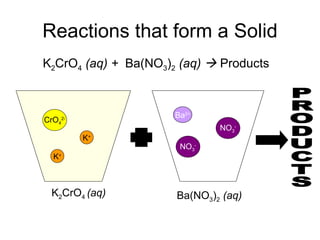
Reactions that form a Solid CrO 4 2- K + K + K 2 CrO 4  (aq) Ba(NO 3 ) 2   (aq) NO 3 - NO 3 - Ba 2+ PRODUCTS K 2 CrO 4   (aq) +  Ba(NO 3 ) 2   (aq)     Products
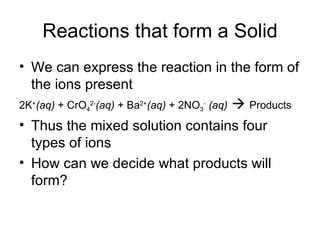
Reactions that form a Solid We can express the reaction in the form of the ions present 2K + (aq)  + CrO 4 2- (aq)  + Ba 2+ (aq)  + 2NO 3 -   (aq)      Products Thus the mixed solution contains four types of ions How can we decide what products will form?
Reactions that form a Solid We know that the reaction must form a solid with a net zero charge So the product must contain cations and anions Most ionic compounds contain only two types of ions One type of cation and one type of anion
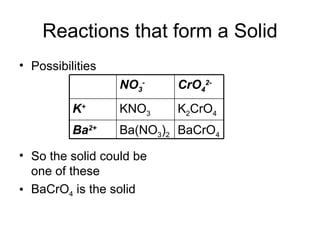
Reactions that form a Solid Possibilities So the solid could be one of these  BaCrO 4  is the solid BaCrO 4 Ba(NO 3 ) 2 Ba 2+ K 2 CrO 4 KNO 3 K + CrO 4 2- NO 3 -
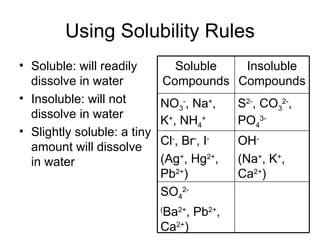
Using Solubility Rules Soluble: will readily dissolve in water Insoluble: will not dissolve in water Slightly soluble: a tiny amount will dissolve in water SO 4 2- ( Ba 2+ , Pb 2+ , Ca 2+ ) OH - (Na + , K + , Ca 2+ ) Cl - , Br - , I -   (Ag + , Hg 2+ , Pb 2+ ) S 2- , CO 3 2- , PO 4 3- NO 3 - , Na + , K + , NH 4 + Insoluble Compounds Soluble Compounds
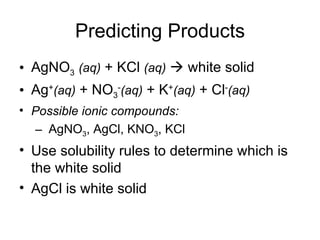
Predicting Products AgNO 3   (aq)  + KCl  (aq)     white solid Ag + (aq)  + NO 3 - (aq)  + K + (aq)  + Cl - (aq) Possible ionic compounds: AgNO 3 , AgCl, KNO 3 , KCl Use solubility rules to determine which is the white solid AgCl is white solid
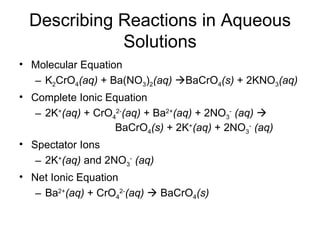
Describing Reactions in Aqueous Solutions Molecular Equation K 2 CrO 4 (aq)  + Ba(NO 3 ) 2 (aq)    BaCrO 4 (s)  + 2KNO 3 (aq) Complete Ionic Equation 2K + (aq)  + CrO 4 2- (aq)  + Ba 2+ (aq)  + 2NO 3 -   (aq)      BaCrO 4 (s)  + 2K + (aq)  + 2NO 3 -   (aq)   Spectator Ions 2K + (aq)  and 2NO 3 -   (aq) Net Ionic Equation Ba 2+ (aq)  + CrO 4 2- (aq)     BaCrO 4 (s)
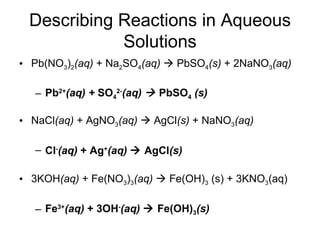
Describing Reactions in Aqueous Solutions Pb(NO 3 ) 2 (aq)  + Na 2 SO 4 (aq)     PbSO 4 (s)  + 2NaNO 3 (aq) Pb 2+ (aq) +  SO 4 2- (aq)     PbSO 4  (s)   NaCl (aq)  + AgNO 3 (aq)     AgCl (s)  + NaNO 3 (aq)   Cl - (aq)  + Ag + (aq)     AgCl (s)   3KOH (aq)  + Fe(NO 3 ) 3 (aq)     Fe(OH) 3  (s) + 3KNO 3 (aq) Fe 3+ (aq)  + 3OH - (aq)     Fe(OH) 3 (s)
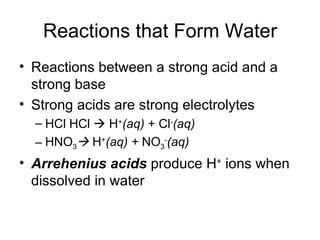
Reactions that Form Water Reactions between a strong acid and a strong base Strong acids are strong electrolytes HCl HCl    H + (aq)  + Cl - (aq) HNO 3    H + (aq) +  NO 3 - (aq)  Arrehenius   acids  produce H +  ions when dissolved in water
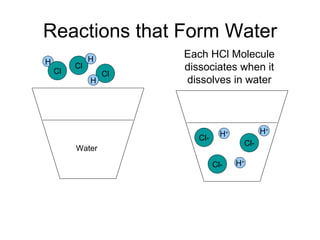
Reactions that Form Water Cl H Cl H H Cl Water Cl- H + Cl- Cl- H + H + Each HCl Molecule dissociates when it dissolves in water
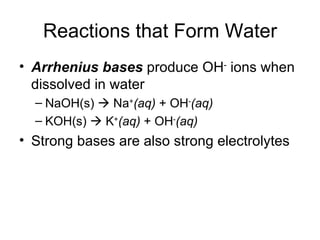
Reactions that Form Water Arrhenius bases  produce OH -  ions when dissolved in water NaOH(s)    Na + (aq)  + OH - (aq) KOH(s)    K + (aq)  + OH - (aq) Strong bases are also strong electrolytes
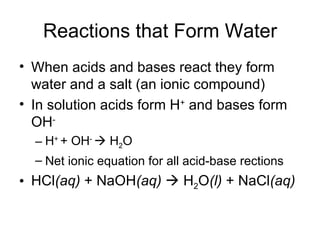
Reactions that Form Water When acids and bases react they form water and a salt (an ionic compound)  In solution acids form H +  and bases form OH -  H +  + OH -    H 2 O  Net ionic equation for all acid-base rections HCl (aq)  + NaOH (aq)     H 2 O (l)  + NaCl (aq)
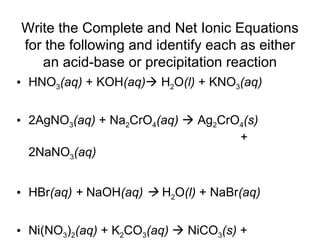
Write the Complete and Net Ionic Equations for the following and identify each as either an acid-base or precipitation reaction HNO 3 (aq)  + KOH (aq)   H 2 O (l)  + KNO 3 (aq) 2AgNO 3 (aq)  + Na 2 CrO 4 (aq)     Ag 2 CrO 4 (s)  + 2NaNO 3 (aq) HBr (aq) +  NaOH (aq)     H 2 O (l)  + NaBr (aq) Ni(NO 3 ) 2 (aq)  + K 2 CO 3 (aq)     NiCO 3 (s)  +  2KNO 3 (aq)
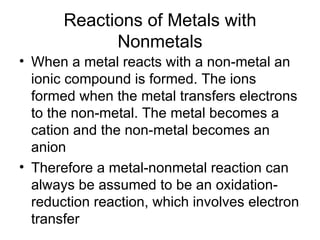
Reactions of Metals with Nonmetals When a metal reacts with a non-metal an ionic compound is formed. The ions formed when the metal transfers electrons to the non-metal. The metal becomes a cation and the non-metal becomes an anion Therefore a metal-nonmetal reaction can always be assumed to be an oxidation-reduction reaction, which involves electron transfer
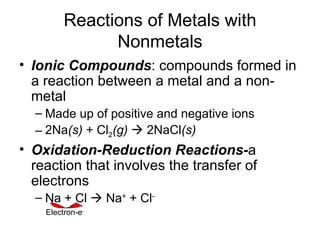
Reactions of Metals with Nonmetals Ionic Compounds : compounds formed in a reaction between a metal and a non-metal Made up of positive and negative ions 2Na (s)  + Cl 2 (g)     2NaCl (s) Oxidation-Reduction Reactions- a reaction that involves the transfer of electrons Na + Cl    Na +  + Cl - Electron-e -
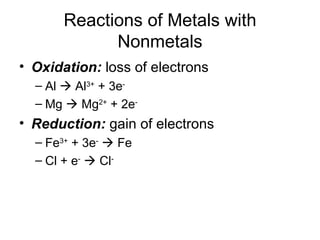
Reactions of Metals with Nonmetals Oxidation:  loss of electrons Al    Al 3+  + 3e - Mg    Mg 2+  + 2e - Reduction:  gain of electrons Fe 3+  + 3e -     Fe Cl + e -     Cl -
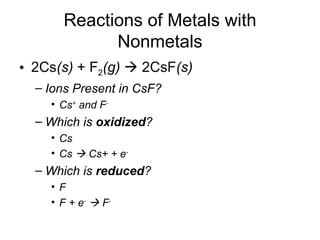
Reactions of Metals with Nonmetals 2Cs (s)  + F 2 (g)     2CsF (s) Ions Present in CsF?  Cs +  and F -   Which is  oxidized ? Cs Cs    Cs+ + e - Which is  reduced ? F F + e -     F -
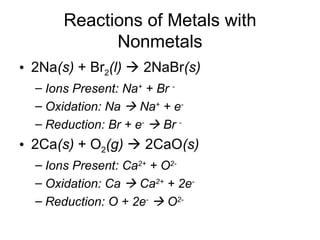
Reactions of Metals with Nonmetals 2Na (s)  + Br 2 (l)     2NaBr (s) Ions Present: Na +  + Br  - Oxidation: Na    Na +  + e - Reduction: Br + e -     Br  - 2Ca (s)  + O 2 (g)     2CaO (s) Ions Present: Ca 2+  + O 2- Oxidation: Ca    Ca 2+  + 2e - Reduction: O + 2e -     O 2-
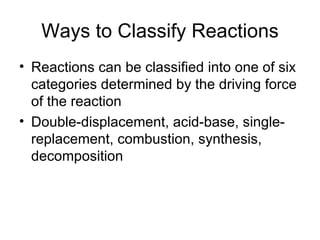
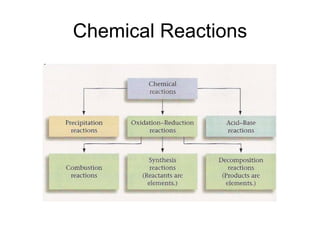
Ways to Classify Reactions Reactions can be classified into one of six categories determined by the driving force of the reaction Double-displacement, acid-base, single-replacement, combustion, synthesis, decomposition
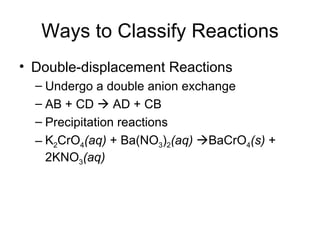
Ways to Classify Reactions Double-displacement Reactions Undergo a double anion exchange AB + CD    AD + CB  Precipitation reactions K 2 CrO 4 (aq)  + Ba(NO 3 ) 2 (aq)    BaCrO 4 (s)  + 2KNO 3 (aq)
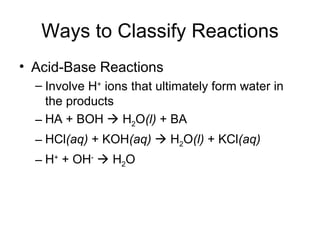
Ways to Classify Reactions Acid-Base Reactions Involve H +  ions that ultimately form water in the products HA + BOH    H 2 O (l)  + BA HCl (aq)  + KOH (aq)     H 2 O (l)  + KCl (aq) H +  + OH -     H 2 O
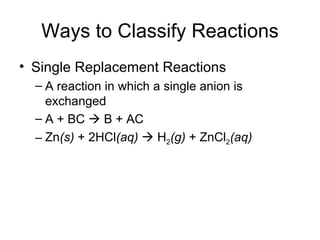
Ways to Classify Reactions Single Replacement Reactions A reaction in which a single anion is exchanged A + BC    B + AC Zn (s)  + 2HCl (aq)     H 2 (g)  + ZnCl 2 (aq)
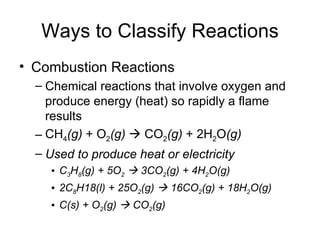
Ways to Classify Reactions Combustion Reactions Chemical reactions that involve oxygen and produce energy (heat) so rapidly a flame results CH 4 (g)  + O 2 (g)     CO 2 (g)  + 2H 2 O (g) Used to produce heat or electricity  C 3 H 8 (g) + 5O 2     3CO 2 (g) + 4H 2 O(g) 2C 8 H18(l) + 25O 2 (g)    16CO 2 (g) + 18H 2 O(g)  C(s) + O 2 (g)    CO 2 (g)
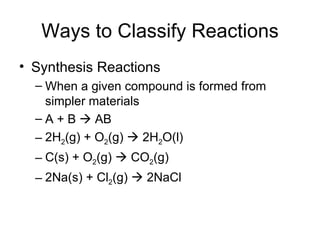
Ways to Classify Reactions Synthesis Reactions When a given compound is formed from simpler materials A + B    AB 2H 2 (g) + O 2 (g)    2H 2 O(l) C(s) + O 2 (g)    CO 2 (g)  2Na(s) + Cl 2 (g)    2NaCl
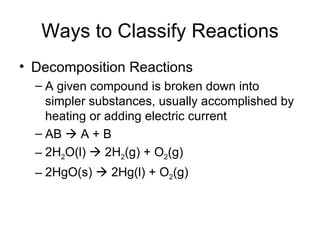
Ways to Classify Reactions Decomposition Reactions A given compound is broken down into simpler substances, usually accomplished by heating or adding electric current AB    A + B  2H 2 O(l)    2H 2 (g) + O 2 (g)  2HgO(s)    2Hg(l) + O 2 (g)
Chemical Reactions
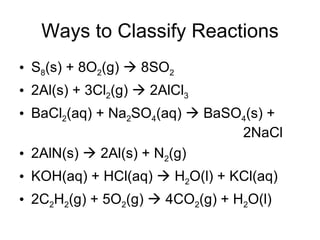
Ways to Classify Reactions S 8 (s) + 8O 2 (g)    8SO 2   2Al(s) + 3Cl 2 (g)    2AlCl 3 BaCl 2 (aq) + Na 2 SO 4 (aq)    BaSO 4 (s) +  2NaCl 2AlN(s)    2Al(s) + N 2 (g)  KOH(aq) + HCl(aq)    H 2 O(l) + KCl(aq) 2C 2 H 2 (g) + 5O 2 (g)    4CO 2 (g) + H 2 O(l)

Chapter 8: Reactions in Aqueous Solution

  • 1.
    Chapter 8: Reactionsand Aqueous Solutions
  • 2.
    Predicting Whether aReaction Will Occur There are several different “driving forces” that cause chemical reactions to take place Formation of a solid Formation of water Transfer of Electrons Formation of a gas When two chemicals come together if any of these changes can occur a chemical reaction will occur. You can predict whether a reaction will occur and the products that will form by considering these driving forces
  • 3.
    Reactions that forma Solid Precipitation : the formation of a solid in a reaction Precipitate : the solid formed by the reaction Called a precipitation reaction
  • 4.
  • 5.
    Reactions that forma Solid Reaction of yellow potassium chromate and colorless barium nitrate. K 2 CrO 4 (aq) + Ba(NO 3 ) 2 (aq)  ? How do we predict the products?
  • 6.
    Reactions that forma Solid We must think about what happens in an aqueous solution… What happens when an ionic compound dissolves in water? Ba(NO 3 ) 2 , a white solid, was dissolved in water Ba + and NO 3 - are present K 2 CrO 4 is dissolved in water K + and CrO4 2- are present These are called Strong Electrolytes because each unit produces separated ions
  • 7.
    Reactions that forma Solid CrO 4 2- K + K + K 2 CrO 4 (aq) Ba(NO 3 ) 2 (aq) NO 3 - NO 3 - Ba 2+ PRODUCTS K 2 CrO 4 (aq) + Ba(NO 3 ) 2 (aq)  Products
  • 8.
    Reactions that forma Solid We can express the reaction in the form of the ions present 2K + (aq) + CrO 4 2- (aq) + Ba 2+ (aq) + 2NO 3 - (aq)  Products Thus the mixed solution contains four types of ions How can we decide what products will form?
  • 9.
    Reactions that forma Solid We know that the reaction must form a solid with a net zero charge So the product must contain cations and anions Most ionic compounds contain only two types of ions One type of cation and one type of anion
  • 10.
    Reactions that forma Solid Possibilities So the solid could be one of these BaCrO 4 is the solid BaCrO 4 Ba(NO 3 ) 2 Ba 2+ K 2 CrO 4 KNO 3 K + CrO 4 2- NO 3 -
  • 11.
    Using Solubility RulesSoluble: will readily dissolve in water Insoluble: will not dissolve in water Slightly soluble: a tiny amount will dissolve in water SO 4 2- ( Ba 2+ , Pb 2+ , Ca 2+ ) OH - (Na + , K + , Ca 2+ ) Cl - , Br - , I - (Ag + , Hg 2+ , Pb 2+ ) S 2- , CO 3 2- , PO 4 3- NO 3 - , Na + , K + , NH 4 + Insoluble Compounds Soluble Compounds
  • 12.
    Predicting Products AgNO3 (aq) + KCl (aq)  white solid Ag + (aq) + NO 3 - (aq) + K + (aq) + Cl - (aq) Possible ionic compounds: AgNO 3 , AgCl, KNO 3 , KCl Use solubility rules to determine which is the white solid AgCl is white solid
  • 13.
    Describing Reactions inAqueous Solutions Molecular Equation K 2 CrO 4 (aq) + Ba(NO 3 ) 2 (aq)  BaCrO 4 (s) + 2KNO 3 (aq) Complete Ionic Equation 2K + (aq) + CrO 4 2- (aq) + Ba 2+ (aq) + 2NO 3 - (aq)  BaCrO 4 (s) + 2K + (aq) + 2NO 3 - (aq) Spectator Ions 2K + (aq) and 2NO 3 - (aq) Net Ionic Equation Ba 2+ (aq) + CrO 4 2- (aq)  BaCrO 4 (s)
  • 14.
    Describing Reactions inAqueous Solutions Pb(NO 3 ) 2 (aq) + Na 2 SO 4 (aq)  PbSO 4 (s) + 2NaNO 3 (aq) Pb 2+ (aq) + SO 4 2- (aq)  PbSO 4 (s) NaCl (aq) + AgNO 3 (aq)  AgCl (s) + NaNO 3 (aq) Cl - (aq) + Ag + (aq)  AgCl (s) 3KOH (aq) + Fe(NO 3 ) 3 (aq)  Fe(OH) 3 (s) + 3KNO 3 (aq) Fe 3+ (aq) + 3OH - (aq)  Fe(OH) 3 (s)
  • 15.
    Reactions that FormWater Reactions between a strong acid and a strong base Strong acids are strong electrolytes HCl HCl  H + (aq) + Cl - (aq) HNO 3  H + (aq) + NO 3 - (aq) Arrehenius acids produce H + ions when dissolved in water
  • 16.
    Reactions that FormWater Cl H Cl H H Cl Water Cl- H + Cl- Cl- H + H + Each HCl Molecule dissociates when it dissolves in water
  • 17.
    Reactions that FormWater Arrhenius bases produce OH - ions when dissolved in water NaOH(s)  Na + (aq) + OH - (aq) KOH(s)  K + (aq) + OH - (aq) Strong bases are also strong electrolytes
  • 18.
    Reactions that FormWater When acids and bases react they form water and a salt (an ionic compound) In solution acids form H + and bases form OH - H + + OH -  H 2 O Net ionic equation for all acid-base rections HCl (aq) + NaOH (aq)  H 2 O (l) + NaCl (aq)
  • 19.
    Write the Completeand Net Ionic Equations for the following and identify each as either an acid-base or precipitation reaction HNO 3 (aq) + KOH (aq)  H 2 O (l) + KNO 3 (aq) 2AgNO 3 (aq) + Na 2 CrO 4 (aq)  Ag 2 CrO 4 (s) + 2NaNO 3 (aq) HBr (aq) + NaOH (aq)  H 2 O (l) + NaBr (aq) Ni(NO 3 ) 2 (aq) + K 2 CO 3 (aq)  NiCO 3 (s) + 2KNO 3 (aq)
  • 20.
    Reactions of Metalswith Nonmetals When a metal reacts with a non-metal an ionic compound is formed. The ions formed when the metal transfers electrons to the non-metal. The metal becomes a cation and the non-metal becomes an anion Therefore a metal-nonmetal reaction can always be assumed to be an oxidation-reduction reaction, which involves electron transfer
  • 21.
    Reactions of Metalswith Nonmetals Ionic Compounds : compounds formed in a reaction between a metal and a non-metal Made up of positive and negative ions 2Na (s) + Cl 2 (g)  2NaCl (s) Oxidation-Reduction Reactions- a reaction that involves the transfer of electrons Na + Cl  Na + + Cl - Electron-e -
  • 22.
    Reactions of Metalswith Nonmetals Oxidation: loss of electrons Al  Al 3+ + 3e - Mg  Mg 2+ + 2e - Reduction: gain of electrons Fe 3+ + 3e -  Fe Cl + e -  Cl -
  • 23.
    Reactions of Metalswith Nonmetals 2Cs (s) + F 2 (g)  2CsF (s) Ions Present in CsF? Cs + and F - Which is oxidized ? Cs Cs  Cs+ + e - Which is reduced ? F F + e -  F -
  • 24.
    Reactions of Metalswith Nonmetals 2Na (s) + Br 2 (l)  2NaBr (s) Ions Present: Na + + Br - Oxidation: Na  Na + + e - Reduction: Br + e -  Br - 2Ca (s) + O 2 (g)  2CaO (s) Ions Present: Ca 2+ + O 2- Oxidation: Ca  Ca 2+ + 2e - Reduction: O + 2e -  O 2-
  • 25.
    Ways to ClassifyReactions Reactions can be classified into one of six categories determined by the driving force of the reaction Double-displacement, acid-base, single-replacement, combustion, synthesis, decomposition
  • 26.
    Ways to ClassifyReactions Double-displacement Reactions Undergo a double anion exchange AB + CD  AD + CB Precipitation reactions K 2 CrO 4 (aq) + Ba(NO 3 ) 2 (aq)  BaCrO 4 (s) + 2KNO 3 (aq)
  • 27.
    Ways to ClassifyReactions Acid-Base Reactions Involve H + ions that ultimately form water in the products HA + BOH  H 2 O (l) + BA HCl (aq) + KOH (aq)  H 2 O (l) + KCl (aq) H + + OH -  H 2 O
  • 28.
    Ways to ClassifyReactions Single Replacement Reactions A reaction in which a single anion is exchanged A + BC  B + AC Zn (s) + 2HCl (aq)  H 2 (g) + ZnCl 2 (aq)
  • 29.
    Ways to ClassifyReactions Combustion Reactions Chemical reactions that involve oxygen and produce energy (heat) so rapidly a flame results CH 4 (g) + O 2 (g)  CO 2 (g) + 2H 2 O (g) Used to produce heat or electricity C 3 H 8 (g) + 5O 2  3CO 2 (g) + 4H 2 O(g) 2C 8 H18(l) + 25O 2 (g)  16CO 2 (g) + 18H 2 O(g) C(s) + O 2 (g)  CO 2 (g)
  • 30.
    Ways to ClassifyReactions Synthesis Reactions When a given compound is formed from simpler materials A + B  AB 2H 2 (g) + O 2 (g)  2H 2 O(l) C(s) + O 2 (g)  CO 2 (g) 2Na(s) + Cl 2 (g)  2NaCl
  • 31.
    Ways to ClassifyReactions Decomposition Reactions A given compound is broken down into simpler substances, usually accomplished by heating or adding electric current AB  A + B 2H 2 O(l)  2H 2 (g) + O 2 (g) 2HgO(s)  2Hg(l) + O 2 (g)
  • 32.
  • 33.
    Ways to ClassifyReactions S 8 (s) + 8O 2 (g)  8SO 2 2Al(s) + 3Cl 2 (g)  2AlCl 3 BaCl 2 (aq) + Na 2 SO 4 (aq)  BaSO 4 (s) + 2NaCl 2AlN(s)  2Al(s) + N 2 (g) KOH(aq) + HCl(aq)  H 2 O(l) + KCl(aq) 2C 2 H 2 (g) + 5O 2 (g)  4CO 2 (g) + H 2 O(l)