Welingkar’s Distance Learning Division
CHAPTER-18
CO-ORDINATION
We Learn – A Continuous Learning Forum
Welingkar’s Distance Learning Division
Introduction
• Co-ordination is the process which ensures
smooth interplay of the functions of
management. Common objectives are
achieved without much wastage of time,
efforts and money with the help of co-
ordination.
We Learn – A Continuous Learning Forum
Welingkar’s Distance Learning Division
We Learn – A Continuous Learning Forum
Welingkar’s Distance Learning Division
Definition
• Co-ordination is balancing and keeping the
teams together by ensuring a suitable
allocation of working activities to the various
members and seeing that these are
performed with due harmony among the
members themselves.
We Learn – A Continuous Learning Forum
Welingkar’s Distance Learning Division
Features or Characteristics
• Not separate functions of management.
• Managerial responsibility
• Provides unity of action
• Co-ordination is necessary to all levels of
organization
• Relevant of group efforts.
• Continuous and dynamic process
• System concept
We Learn – A Continuous Learning Forum
Welingkar’s Distance Learning Division
Need and importance of co-ordination
• Unity in diversity
• Term work or unity of directions
• Functional differentiation
• Specialization
• Reconciliation of goals
• Large number of employees
• Congruity of flows or congruent flows
• Empire building
• Differential and integration
We Learn – A Continuous Learning Forum
Welingkar’s Distance Learning Division
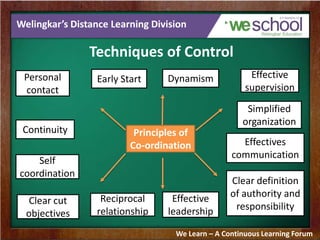
Techniques of Control
We Learn – A Continuous Learning Forum
Principles of
Co-ordination
Personal
contact
Continuity
Self
coordination
Effective
supervision
Simplified
organization
Effectives
communication
Reciprocal
relationship
DynamismEarly Start
Clear cut
objectives
Clear definition
of authority and
responsibility
Effective
leadership
Welingkar’s Distance Learning Division
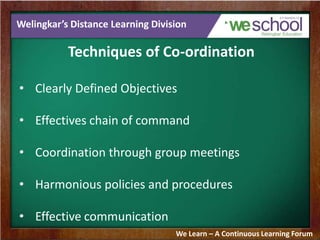
Techniques of Co-ordination
• Clearly Defined Objectives
• Effectives chain of command
• Coordination through group meetings
• Harmonious policies and procedures
• Effective communication
We Learn – A Continuous Learning Forum
Welingkar’s Distance Learning Division
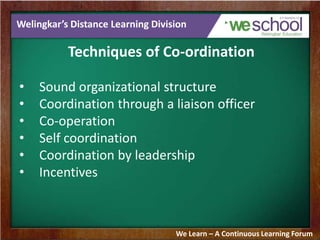
Techniques of Co-ordination
• Sound organizational structure
• Coordination through a liaison officer
• Co-operation
• Self coordination
• Coordination by leadership
• Incentives
We Learn – A Continuous Learning Forum
Welingkar’s Distance Learning Division
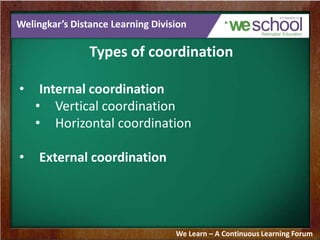
Types of coordination
• Internal coordination
• Vertical coordination
• Horizontal coordination
• External coordination
We Learn – A Continuous Learning Forum
Welingkar’s Distance Learning Division
Internal coordination
• It is the establishment of relationship of the
managers, executives, divisions, subdivisions,
and other workers.
We Learn – A Continuous Learning Forum
Welingkar’s Distance Learning Division
Internal coordination
Vertical coordination:
Superior coordinates his work with his sub
coordinates and vice versa. Sales manager
coordinates his work with the activities of the
sales supervisor.
We Learn – A Continuous Learning Forum
Welingkar’s Distance Learning Division
Internal coordination
Horizontal coordination:
Horizontal Coordination refers between the
persons of the same status. Coordination
between the departmental heads, supervisors,
co-workers
We Learn – A Continuous Learning Forum
Welingkar’s Distance Learning Division
External coordination
• It is the establishment of relationship of the
managers, executives, divisions, subdivisions,
and other workers.
We Learn – A Continuous Learning Forum
Welingkar’s Distance Learning Division
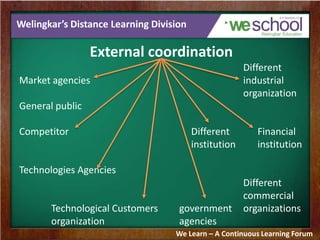
External coordination
Different
Market agencies industrial
organization
General public
Competitor Different Financial
institution institution
Technologies Agencies
Different
commercial
Technological Customers government organizations
organization agencies
We Learn – A Continuous Learning Forum
Welingkar’s Distance Learning Division
Problems of Co-ordination
In practice coordination faces certain problems
listed below.
• Natural hindrance
• Lack of administrative talent
• lack of techniques of coordination
• Ideas and objectives
• Misunderstanding
We Learn – A Continuous Learning Forum
Welingkar’s Distance Learning Division
Steps of effective Co-ordination
• proper delegation of authority and responsibility
• Whole or entire activates of the organization
should be divided department –wise or section-
wise according to the organization
• Preparing and adherence to rigid rules and
regulations, procedures, policies, etc.
• Establishment of an effective communication
system
We Learn – A Continuous Learning Forum
Welingkar’s Distance Learning Division
Steps of effective Co-ordination
• Establishment of employees grievances cell.
• There should be a proper system for reporting.
• Skilled workers are to be rewarded adequately.
• The management should induce the employees
to take active part in meeting, committees,
encourage the employees to have friendly
relationship with others.
We Learn – A Continuous Learning Forum
Welingkar’s Distance Learning Division
Steps of effective Co-ordination
• The management should encourage the
employees to have friendly relationship with
others.
• Managers should have opportunities to get
training to get training in the area of
leadership, coordination, planning staffing
and the like.
We Learn – A Continuous Learning Forum
Welingkar’s Distance Learning Division
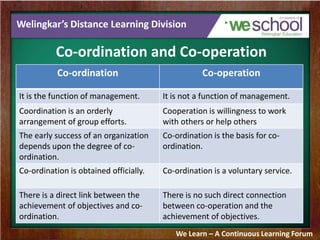
Co-ordination and Co-operation
We Learn – A Continuous Learning Forum
Co-ordination Co-operation
It is the function of management. It is not a function of management.
Coordination is an orderly
arrangement of group efforts.
Cooperation is willingness to work
with others or help others
The early success of an organization
depends upon the degree of co-
ordination.
Co-ordination is the basis for co-
ordination.
Co-ordination is obtained officially. Co-ordination is a voluntary service.
There is a direct link between the
achievement of objectives and co-
ordination.
There is no such direct connection
between co-operation and the
achievement of objectives.

Art of Co-ordination - Management Principles

  • 1.
    Welingkar’s Distance LearningDivision CHAPTER-18 CO-ORDINATION We Learn – A Continuous Learning Forum
  • 2.
    Welingkar’s Distance LearningDivision Introduction • Co-ordination is the process which ensures smooth interplay of the functions of management. Common objectives are achieved without much wastage of time, efforts and money with the help of co- ordination. We Learn – A Continuous Learning Forum
  • 3.
    Welingkar’s Distance LearningDivision We Learn – A Continuous Learning Forum
  • 4.
    Welingkar’s Distance LearningDivision Definition • Co-ordination is balancing and keeping the teams together by ensuring a suitable allocation of working activities to the various members and seeing that these are performed with due harmony among the members themselves. We Learn – A Continuous Learning Forum
  • 5.
    Welingkar’s Distance LearningDivision Features or Characteristics • Not separate functions of management. • Managerial responsibility • Provides unity of action • Co-ordination is necessary to all levels of organization • Relevant of group efforts. • Continuous and dynamic process • System concept We Learn – A Continuous Learning Forum
  • 6.
    Welingkar’s Distance LearningDivision Need and importance of co-ordination • Unity in diversity • Term work or unity of directions • Functional differentiation • Specialization • Reconciliation of goals • Large number of employees • Congruity of flows or congruent flows • Empire building • Differential and integration We Learn – A Continuous Learning Forum
  • 7.
    Welingkar’s Distance LearningDivision Techniques of Control We Learn – A Continuous Learning Forum Principles of Co-ordination Personal contact Continuity Self coordination Effective supervision Simplified organization Effectives communication Reciprocal relationship DynamismEarly Start Clear cut objectives Clear definition of authority and responsibility Effective leadership
  • 8.
    Welingkar’s Distance LearningDivision Techniques of Co-ordination • Clearly Defined Objectives • Effectives chain of command • Coordination through group meetings • Harmonious policies and procedures • Effective communication We Learn – A Continuous Learning Forum
  • 9.
    Welingkar’s Distance LearningDivision Techniques of Co-ordination • Sound organizational structure • Coordination through a liaison officer • Co-operation • Self coordination • Coordination by leadership • Incentives We Learn – A Continuous Learning Forum
  • 10.
    Welingkar’s Distance LearningDivision Types of coordination • Internal coordination • Vertical coordination • Horizontal coordination • External coordination We Learn – A Continuous Learning Forum
  • 11.
    Welingkar’s Distance LearningDivision Internal coordination • It is the establishment of relationship of the managers, executives, divisions, subdivisions, and other workers. We Learn – A Continuous Learning Forum
  • 12.
    Welingkar’s Distance LearningDivision Internal coordination Vertical coordination: Superior coordinates his work with his sub coordinates and vice versa. Sales manager coordinates his work with the activities of the sales supervisor. We Learn – A Continuous Learning Forum
  • 13.
    Welingkar’s Distance LearningDivision Internal coordination Horizontal coordination: Horizontal Coordination refers between the persons of the same status. Coordination between the departmental heads, supervisors, co-workers We Learn – A Continuous Learning Forum
  • 14.
    Welingkar’s Distance LearningDivision External coordination • It is the establishment of relationship of the managers, executives, divisions, subdivisions, and other workers. We Learn – A Continuous Learning Forum
  • 15.
    Welingkar’s Distance LearningDivision External coordination Different Market agencies industrial organization General public Competitor Different Financial institution institution Technologies Agencies Different commercial Technological Customers government organizations organization agencies We Learn – A Continuous Learning Forum
  • 16.
    Welingkar’s Distance LearningDivision Problems of Co-ordination In practice coordination faces certain problems listed below. • Natural hindrance • Lack of administrative talent • lack of techniques of coordination • Ideas and objectives • Misunderstanding We Learn – A Continuous Learning Forum
  • 17.
    Welingkar’s Distance LearningDivision Steps of effective Co-ordination • proper delegation of authority and responsibility • Whole or entire activates of the organization should be divided department –wise or section- wise according to the organization • Preparing and adherence to rigid rules and regulations, procedures, policies, etc. • Establishment of an effective communication system We Learn – A Continuous Learning Forum
  • 18.
    Welingkar’s Distance LearningDivision Steps of effective Co-ordination • Establishment of employees grievances cell. • There should be a proper system for reporting. • Skilled workers are to be rewarded adequately. • The management should induce the employees to take active part in meeting, committees, encourage the employees to have friendly relationship with others. We Learn – A Continuous Learning Forum
  • 19.
    Welingkar’s Distance LearningDivision Steps of effective Co-ordination • The management should encourage the employees to have friendly relationship with others. • Managers should have opportunities to get training to get training in the area of leadership, coordination, planning staffing and the like. We Learn – A Continuous Learning Forum
  • 20.
    Welingkar’s Distance LearningDivision Co-ordination and Co-operation We Learn – A Continuous Learning Forum Co-ordination Co-operation It is the function of management. It is not a function of management. Coordination is an orderly arrangement of group efforts. Cooperation is willingness to work with others or help others The early success of an organization depends upon the degree of co- ordination. Co-ordination is the basis for co- ordination. Co-ordination is obtained officially. Co-ordination is a voluntary service. There is a direct link between the achievement of objectives and co- ordination. There is no such direct connection between co-operation and the achievement of objectives.