Organizational Structure
Organizational Configuration Structure Processes Relationships An organization’s structure reveals: Who is responsible for what Who communicates with whom The levels of skills required at upper level
Types of structures: Functional: grouping done on the basis of functions, for example, production, distribution, sales, marketing, finance Advantages:  Pooling of expertise No duplication of functions Suited to centralized organizations Disadvantages: Vertical barriers Focus on internal processes Struggle to cope with change
Divisional Structure When functionally structured business grows by diversification, divisional structure is likely to be adopted Advantages: Flexibility – in response to strategy Specialist expertise Manager’s interest in division’s strategy Enabling management by head office from distance
Disadvantages: high central management costs Duplication of functions with all functions represented in divisions Vertical barriers may prevent information sharing between divisions Can be complex hierarchical process Product Division – Geographic Division – Holding Company
Matrix Organization Matrix structures attempt to ensure co-ordination across functional lines by the embodiment of dual authority in the organizational structure. Advantages: Greater flexibility Should improve communication Dual authority – multiple orientation Responsibility to achieve end results Inter-disciplinary cooperation – mix of skills and expertise
Disadvantages: Dual authority Role stress Costly – additional product managers One manager may feel threatened Requires consensus which may slow down decision making
Centralization vs Decentralization Flexibility of structure depends upon an organization’s approach to decision making In centralization upper level hierarchy retains authority to make decisions In decentralization authority is given to specific units or persons to make immediate decisions without referring them to the higher authorities
Centralization Advantages: Better management control/co-ordinated decisions Goal congruence Standardization Balance between functional units and divisions Economies of scale Top managers make decisions (experience) Quick decisions in times of crises
Disadvantages: Reduced job satisfaction at lower level Senior management does not have knowledge of all organizational activities Stress on senior managers Limited career opportunities and development for subordinates Decisions take considerable time
Mintzberg Configuration Six possible configurations: Simple structure – strategic apex – op core Machine bureaucracy – techno-structure Professional bureaucracy – dominance of op core Divisional form – strong middle line Adhocracy – complex & disorderly structure e.g. project teams Missionary organizations – based on common set of beliefs: unwilling to change or compromise
Planning and control processes Formal or informal Focused on inputs or outputs Direct or indirect processes
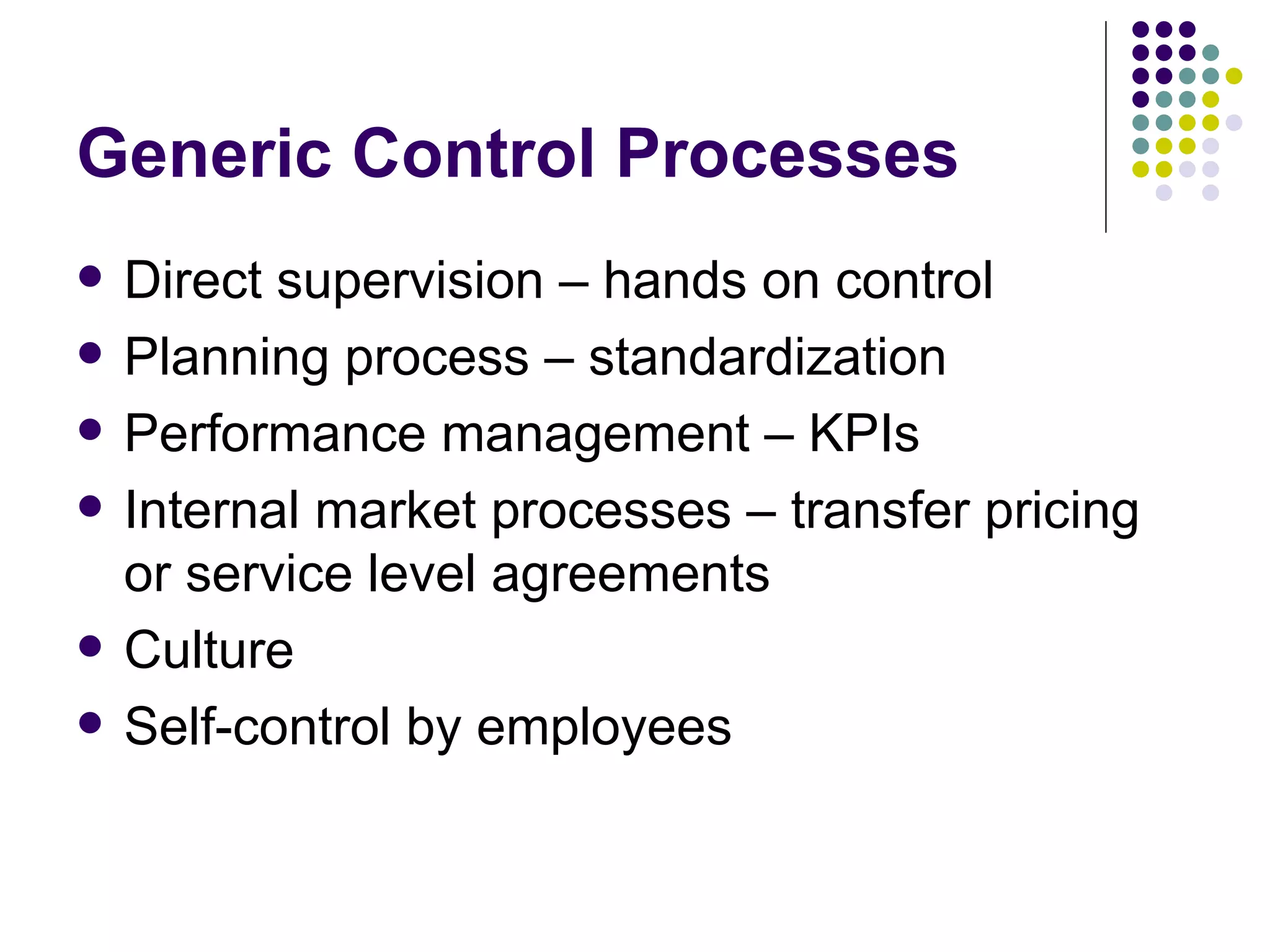
Generic Control Processes Direct supervision – hands on control Planning process – standardization Performance management – KPIs Internal market processes – transfer pricing or service level agreements Culture Self-control by employees
External Relations Outsourcing Strategic Alliances Networks Virtual organizations
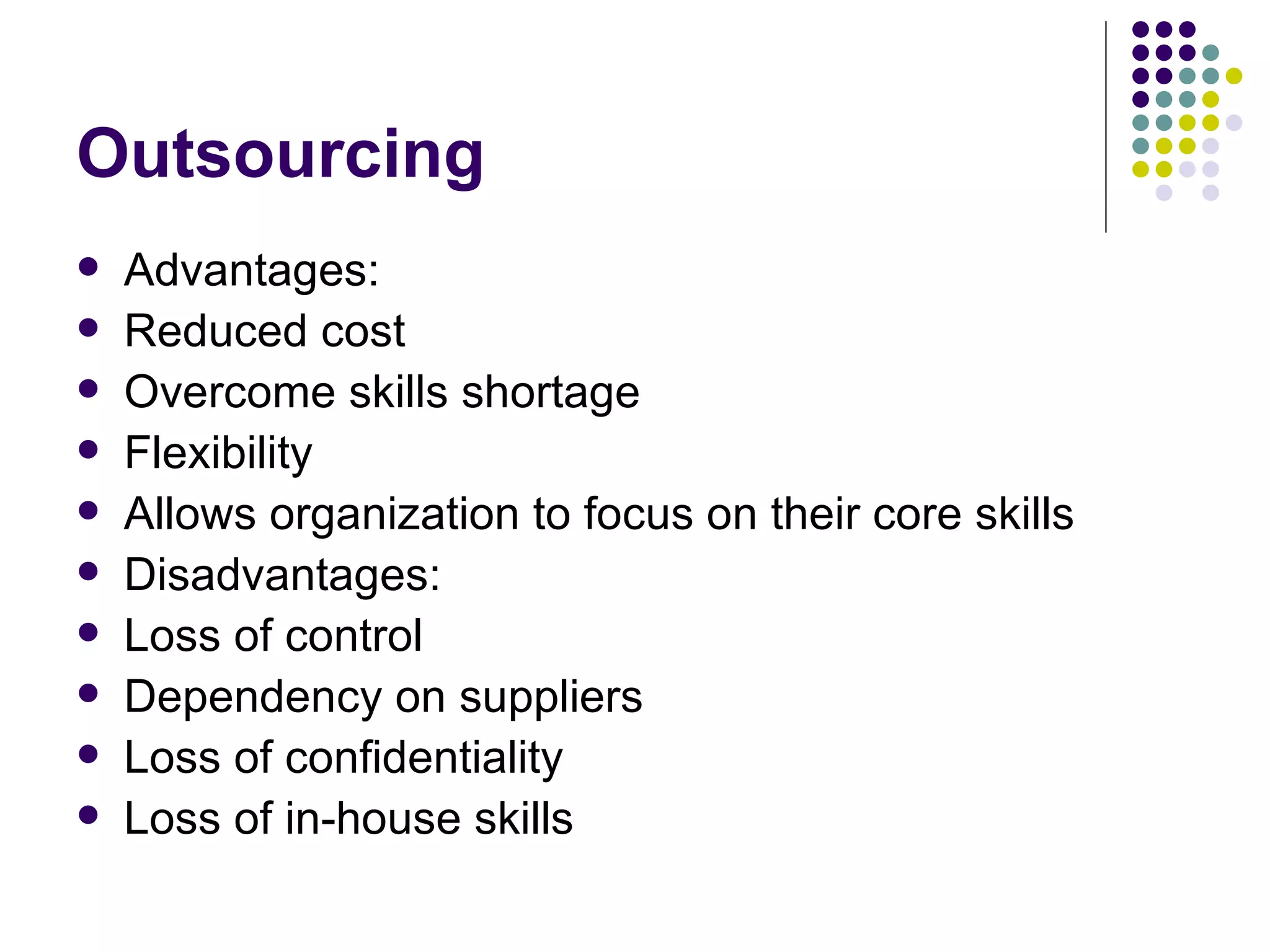
Outsourcing Advantages: Reduced cost Overcome skills shortage Flexibility Allows organization to focus on their core skills Disadvantages: Loss of control Dependency on suppliers Loss of confidentiality Loss of in-house skills
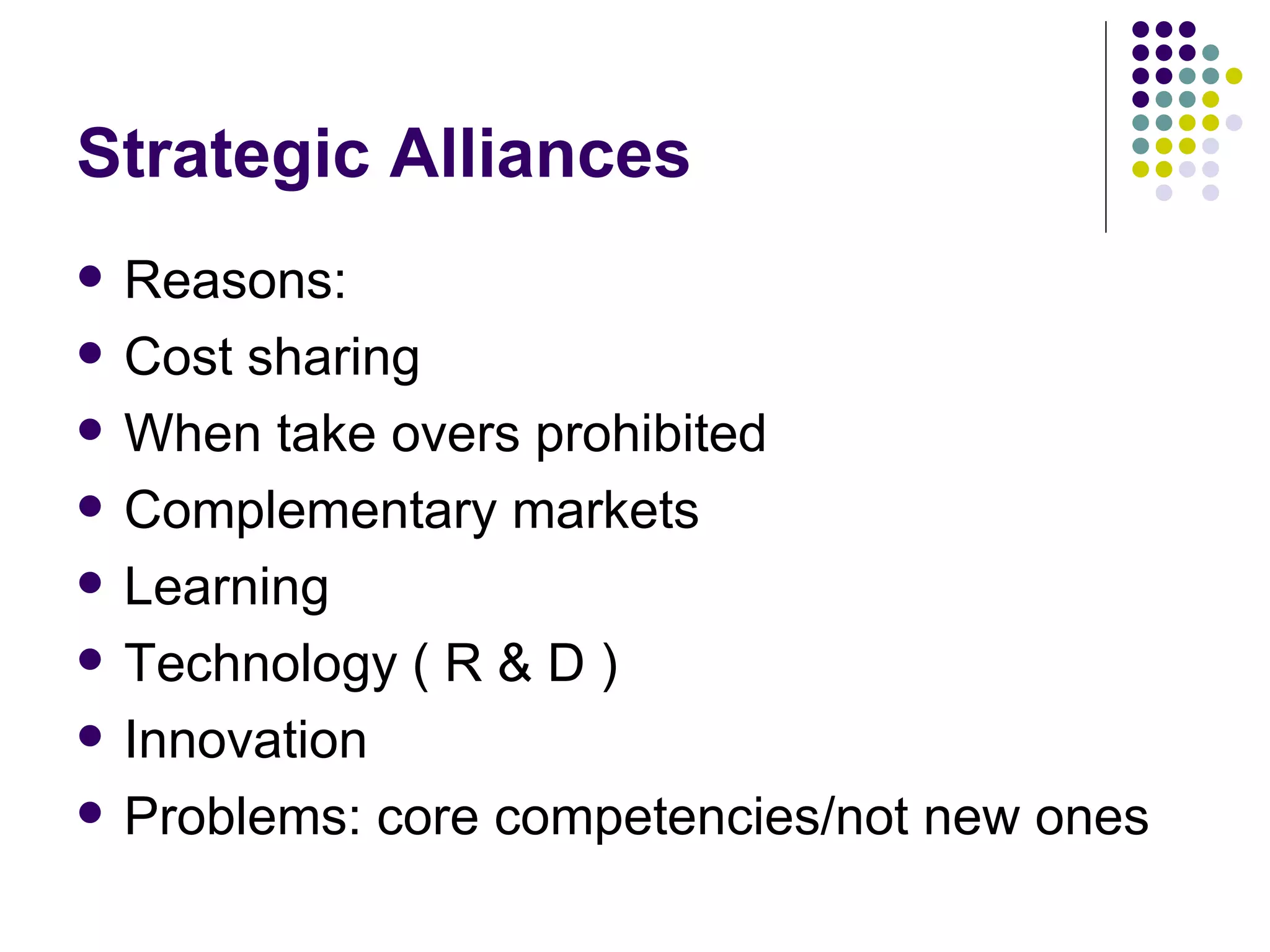
Strategic Alliances Reasons: Cost sharing When take overs prohibited Complementary markets Learning Technology ( R & D ) Innovation Problems: core competencies/not new ones
Networks Networks of experts come together for a particular project or purpose Teleworking One contact point for customers Service networks
Virtual organization The virtual organization is a temporary network of companies that come together quickly to exploit fast changing opportunities
Technology: informational networks will help companies to link up. Things done electronically Opportunism: companies will band together to avail opportunities and evaporate No borders: More cooperation among competitors, suppliers and customers Trust: reliability, fate of one will depend on another Excellence: partners will bring core competencies “best of everything”

Organizational Structure

  • 1.
  • 2.
    Organizational Configuration StructureProcesses Relationships An organization’s structure reveals: Who is responsible for what Who communicates with whom The levels of skills required at upper level
  • 3.
    Types of structures:Functional: grouping done on the basis of functions, for example, production, distribution, sales, marketing, finance Advantages: Pooling of expertise No duplication of functions Suited to centralized organizations Disadvantages: Vertical barriers Focus on internal processes Struggle to cope with change
  • 4.
    Divisional Structure Whenfunctionally structured business grows by diversification, divisional structure is likely to be adopted Advantages: Flexibility – in response to strategy Specialist expertise Manager’s interest in division’s strategy Enabling management by head office from distance
  • 5.
    Disadvantages: high centralmanagement costs Duplication of functions with all functions represented in divisions Vertical barriers may prevent information sharing between divisions Can be complex hierarchical process Product Division – Geographic Division – Holding Company
  • 6.
    Matrix Organization Matrixstructures attempt to ensure co-ordination across functional lines by the embodiment of dual authority in the organizational structure. Advantages: Greater flexibility Should improve communication Dual authority – multiple orientation Responsibility to achieve end results Inter-disciplinary cooperation – mix of skills and expertise
  • 7.
    Disadvantages: Dual authorityRole stress Costly – additional product managers One manager may feel threatened Requires consensus which may slow down decision making
  • 8.
    Centralization vs DecentralizationFlexibility of structure depends upon an organization’s approach to decision making In centralization upper level hierarchy retains authority to make decisions In decentralization authority is given to specific units or persons to make immediate decisions without referring them to the higher authorities
  • 9.
    Centralization Advantages: Bettermanagement control/co-ordinated decisions Goal congruence Standardization Balance between functional units and divisions Economies of scale Top managers make decisions (experience) Quick decisions in times of crises
  • 10.
    Disadvantages: Reduced jobsatisfaction at lower level Senior management does not have knowledge of all organizational activities Stress on senior managers Limited career opportunities and development for subordinates Decisions take considerable time
  • 11.
    Mintzberg Configuration Sixpossible configurations: Simple structure – strategic apex – op core Machine bureaucracy – techno-structure Professional bureaucracy – dominance of op core Divisional form – strong middle line Adhocracy – complex & disorderly structure e.g. project teams Missionary organizations – based on common set of beliefs: unwilling to change or compromise
  • 12.
    Planning and controlprocesses Formal or informal Focused on inputs or outputs Direct or indirect processes
  • 13.
    Generic Control ProcessesDirect supervision – hands on control Planning process – standardization Performance management – KPIs Internal market processes – transfer pricing or service level agreements Culture Self-control by employees
  • 14.
    External Relations OutsourcingStrategic Alliances Networks Virtual organizations
  • 15.
    Outsourcing Advantages: Reducedcost Overcome skills shortage Flexibility Allows organization to focus on their core skills Disadvantages: Loss of control Dependency on suppliers Loss of confidentiality Loss of in-house skills
  • 16.
    Strategic Alliances Reasons:Cost sharing When take overs prohibited Complementary markets Learning Technology ( R & D ) Innovation Problems: core competencies/not new ones
  • 17.
    Networks Networks ofexperts come together for a particular project or purpose Teleworking One contact point for customers Service networks
  • 18.
    Virtual organization Thevirtual organization is a temporary network of companies that come together quickly to exploit fast changing opportunities
  • 19.
    Technology: informational networkswill help companies to link up. Things done electronically Opportunism: companies will band together to avail opportunities and evaporate No borders: More cooperation among competitors, suppliers and customers Trust: reliability, fate of one will depend on another Excellence: partners will bring core competencies “best of everything”