Topic: The News Programmes
PRESENTED BY:
ZAIB UN NISA
TO:
SIR AWAIS
News Programme:
A program devoted to current events, often using interviews and
commentary.
A news program, news show, or newscast is a regularly
scheduled radio or Television programme that reports current events.
A news program can include live or recorded interviews by
field reporters, expert opinions, opinion poll results, and
occasional editorial content.
News programmes aim to provide a broader view of the
day’s news, summarizing the best stories of the day
instead of the hour. Length usually ranges from 20 to 60
minutes. Items are generally longer and more detailed
than those in a bulletin and more sophisticated, using
actualities or film footage, stills and graphics. Some
shorter stories may also be incorporated to increase the
breadth of coverage. If a programme is to gain audience
loyalty, it will have to establish a clear identity and have a
greater balance and variety of material than a bulletin.
Con….
Programme Makers:
 ProducersEditors
 writers
 filmingCutting librarian
 Graphics Artist
 studio production staff
 Camera crews
 Engineering staff
 Reporters
 Anchors
Types Of News Programmes:
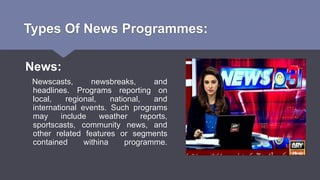
News:
Newscasts, newsbreaks, and
headlines. Programs reporting on
local, regional, national, and
international events. Such programs
may include weather reports,
sportscasts, community news, and
other related features or segments
contained withina programme.
Talk shows and
discussions:
Programs on various topics that
include analysis or discussion,
for example, talk or panel
shows, consumer affairs or
reviews.
Interviews:
Interview is kind of
program where one or
more anchor interviews
one or more guests.
Documentaries:
Original works of non-fiction, primarily designed to
inform but may also educate and entertain,
providing an in-depth critical analysis of a specific
subject or point of view over the course of at least
22 minutes.
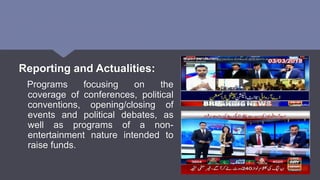
Reporting and Actualities:
Programs focusing on the
coverage of conferences, political
conventions, opening/closing of
events and political debates, as
well as programs of a non-
entertainment nature intended to
raise funds.
Selecting the items:
In the world of the media the consumer is king, and today’s audiences
with remote control TV sets and radio tuners can pass judgment and
verdict on a substandard programme or item in the time it takes to
press a button.
The producer’s first task is to match the coverage to the style and
length of the programme. A two-minute headline summary may cover
the current top eight stories, providing a sketched outline of events. A
half-hour programme may go over substantially the same ground, but
in more depth.
Selecting the stories:
Significance of the story:
The key factors in item selection are the story’s
significance, its impact on a given audience, its interest,
topicality and immediacy.
Impact of the story:
The question is ‘does the story materially affect our audience in
terms of their earnings, spending power, standard of living or
lifestyles?’ Relevance is incorporated into this notion of
significance and impact.
Linking items:
items have linked themes or offer different angles on the same
story. Splitting them up would be a mistake. They should be
rewritten to run together.
Actuality:
The addition of actuality or footage and its length and quality
may be add extra factors in story of a programm.
Making the program fit:
Cutting:
Where a programme is in danger of overrunning and has to be
cut, the incision can be made in a number of ways. The most
drastic is to drop an item completely.
 Replace longer item with shorter one.
 Trimming an item.
Filling:
Filling is a more serious problem than having to cut, because it implies the
programme is short of good material and the producer has been failing in
his or her job. Items should never be run simply as makeweights – every
story should deserve its airtime. It is up to the news producer to make
sure that on even the quietest news day there is enough good material to
run.
Backtiming:
The way to achieve a neat and definite ending is to backtime
the music. Producers need to know the duration of the music –
usually an instrumental signature tune – and they count back
on the clock from the second the programme is due to end to
find the exact time the music should begin.
Putting the show together:
Winning the audience:
The openers are designed to lure and capture the unsuspecting viewer.
The first few seconds of a programme are all-gained or lost. In television
news, the openers are usually the most complicated and closely produced
part of the programme. They will probably comprise a signature tune and
title sequence, featuring sophisticated computer graphics and a tightly
edited montage of still and moving pictures.
Keeping an audienceHeadlines:
Headlines achieve two important functions: at the middle and end of a
programme they remind the audience of the main stories and help
reinforce that information. Reinforcement aids recall, and an audience that
can remember what it has heard is more likely to be satisfied. At the
beginning, the headlines hook the audience in the same way as the
cinema trailer, and later serve to encourage them to bear with an item that
may be less appealing because they know something better is on the way.
Program balance – keeping all things to all people:
Producers will never please all of the people all of the time, but they do
their best to please some of them some of the time and leave everybody
satisfied.
THANK YOU!

News programmes

  • 1.
    Topic: The NewsProgrammes PRESENTED BY: ZAIB UN NISA TO: SIR AWAIS
  • 2.
    News Programme: A programdevoted to current events, often using interviews and commentary. A news program, news show, or newscast is a regularly scheduled radio or Television programme that reports current events. A news program can include live or recorded interviews by field reporters, expert opinions, opinion poll results, and occasional editorial content.
  • 3.
    News programmes aimto provide a broader view of the day’s news, summarizing the best stories of the day instead of the hour. Length usually ranges from 20 to 60 minutes. Items are generally longer and more detailed than those in a bulletin and more sophisticated, using actualities or film footage, stills and graphics. Some shorter stories may also be incorporated to increase the breadth of coverage. If a programme is to gain audience loyalty, it will have to establish a clear identity and have a greater balance and variety of material than a bulletin. Con….
  • 4.
    Programme Makers:  ProducersEditors writers  filmingCutting librarian  Graphics Artist  studio production staff  Camera crews  Engineering staff  Reporters  Anchors
  • 5.
    Types Of NewsProgrammes: News: Newscasts, newsbreaks, and headlines. Programs reporting on local, regional, national, and international events. Such programs may include weather reports, sportscasts, community news, and other related features or segments contained withina programme.
  • 6.
    Talk shows and discussions: Programson various topics that include analysis or discussion, for example, talk or panel shows, consumer affairs or reviews.
  • 7.
    Interviews: Interview is kindof program where one or more anchor interviews one or more guests.
  • 8.
    Documentaries: Original works ofnon-fiction, primarily designed to inform but may also educate and entertain, providing an in-depth critical analysis of a specific subject or point of view over the course of at least 22 minutes.
  • 9.
    Reporting and Actualities: Programsfocusing on the coverage of conferences, political conventions, opening/closing of events and political debates, as well as programs of a non- entertainment nature intended to raise funds.
  • 10.
    Selecting the items: Inthe world of the media the consumer is king, and today’s audiences with remote control TV sets and radio tuners can pass judgment and verdict on a substandard programme or item in the time it takes to press a button. The producer’s first task is to match the coverage to the style and length of the programme. A two-minute headline summary may cover the current top eight stories, providing a sketched outline of events. A half-hour programme may go over substantially the same ground, but in more depth.
  • 11.
    Selecting the stories: Significanceof the story: The key factors in item selection are the story’s significance, its impact on a given audience, its interest, topicality and immediacy.
  • 12.
    Impact of thestory: The question is ‘does the story materially affect our audience in terms of their earnings, spending power, standard of living or lifestyles?’ Relevance is incorporated into this notion of significance and impact.
  • 13.
    Linking items: items havelinked themes or offer different angles on the same story. Splitting them up would be a mistake. They should be rewritten to run together. Actuality: The addition of actuality or footage and its length and quality may be add extra factors in story of a programm.
  • 14.
    Making the programfit: Cutting: Where a programme is in danger of overrunning and has to be cut, the incision can be made in a number of ways. The most drastic is to drop an item completely.  Replace longer item with shorter one.  Trimming an item.
  • 15.
    Filling: Filling is amore serious problem than having to cut, because it implies the programme is short of good material and the producer has been failing in his or her job. Items should never be run simply as makeweights – every story should deserve its airtime. It is up to the news producer to make sure that on even the quietest news day there is enough good material to run.
  • 16.
    Backtiming: The way toachieve a neat and definite ending is to backtime the music. Producers need to know the duration of the music – usually an instrumental signature tune – and they count back on the clock from the second the programme is due to end to find the exact time the music should begin.
  • 17.
    Putting the showtogether: Winning the audience: The openers are designed to lure and capture the unsuspecting viewer. The first few seconds of a programme are all-gained or lost. In television news, the openers are usually the most complicated and closely produced part of the programme. They will probably comprise a signature tune and title sequence, featuring sophisticated computer graphics and a tightly edited montage of still and moving pictures.
  • 18.
    Keeping an audienceHeadlines: Headlinesachieve two important functions: at the middle and end of a programme they remind the audience of the main stories and help reinforce that information. Reinforcement aids recall, and an audience that can remember what it has heard is more likely to be satisfied. At the beginning, the headlines hook the audience in the same way as the cinema trailer, and later serve to encourage them to bear with an item that may be less appealing because they know something better is on the way.
  • 19.
    Program balance –keeping all things to all people: Producers will never please all of the people all of the time, but they do their best to please some of them some of the time and leave everybody satisfied.
  • 20.