1
JOURNEY
OF
BROADCASTING
Dr Rita Rajpoot
MVSc 1st year
M-5641
Credit seminar
2
Content
 DEFINITION
 REVIEW
 METHOD OF BROADCASTING
 TYPE OF BROADCASTING
 BENEFITS OF RADIO AND TELEVISION BROADCAST
 TV CHANNEL (DOORDARSHAN AND DD KISAN)
 RADIO CHENNEL (ALL INDIA RADIO , LOCAL RADIO STATION,
RURAL RADIO FORUMS AND FARM SCHOOL ON AIR)
 FAILURES WITH IN PUBLIC BROADCASTING
3
Broadcasting is the practice of
creating audio or video program
content and distributing it to the
mass audiences of Radio &
Television
• Nair (2011) made an in-depth analysis of the existing framework of
community broadcasting in India along with historical background,
legal and financial aspects, policy interventions, government and
corporate interest. In this paper, the effort is also made to find out
the best possible practices to bring community radio as a
community participatory tool in India to ensure the participation of
the underprivileged sections of the society in designing, producing
as well as subsequent airing of radio programmes mostly based on
local community issues, problems, needs and interests
4
Review
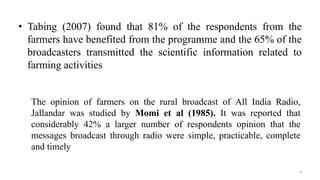
• Tabing (2007) found that 81% of the respondents from the
farmers have benefited from the programme and the 65% of the
broadcasters transmitted the scientific information related to
farming activities
5
The opinion of farmers on the rural broadcast of All India Radio,
Jallandar was studied by Momi et al (1985). It was reported that
considerably 42% a larger number of respondents opinion that the
messages broadcast through radio were simple, practicable, complete
and timely
6
7
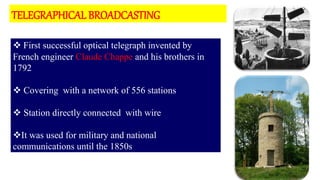
 First successful optical telegraph invented by
French engineer Claude Chappe and his brothers in
1792
 Covering with a network of 556 stations
 Station directly connected with wire
It was used for military and national
communications until the 1850s
TELEGRAPHICAL BROADCASTING
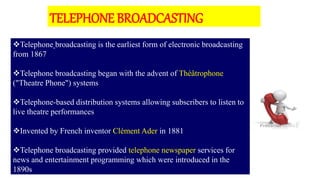
Telephone broadcasting is the earliest form of electronic broadcasting

from 1867
Telephone broadcasting began with the advent of Théâtrophone
("Theatre Phone") systems
Telephone-based distribution systems allowing subscribers to listen to
live theatre performances
Invented by French inventor Clément Ader in 1881
Telephone broadcasting provided telephone newspaper services for
news and entertainment programming which were introduced in the
1890s
TELEPHONE BROADCASTING
9
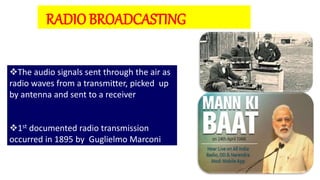
The audio signals sent through the air as
radio waves from a transmitter, picked up
by antenna and sent to a receiver
1st documented radio transmission
occurred in 1895 by Guglielmo Marconi
RADIO BROADCASTING
10
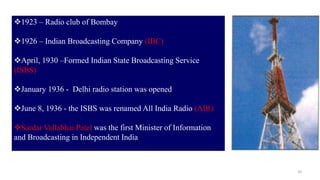
1923 – Radio club of Bombay
1926 – Indian Broadcasting Company (IBC)
April, 1930 –Formed Indian State Broadcasting Service
(ISBS)
January 1936 - Delhi radio station was opened
June 8, 1936 - the ISBS was renamed All India Radio (AIR)
Sardar Vallabhai Patel was the first Minister of Information
and Broadcasting in Independent India
11
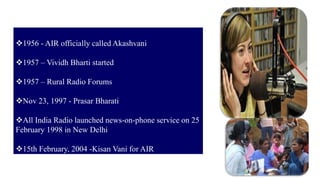
1956 - AIR officially called Akashvani
1957 – Vividh Bharti started
1957 – Rural Radio Forums
Nov 23, 1997 - Prasar Bharati
All India Radio launched news-on-phone service on 25
February 1998 in New Delhi
15th February, 2004 -Kisan Vani for AIR
12
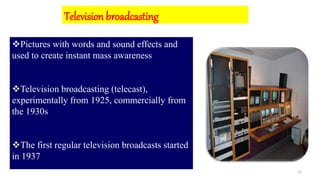
Pictures with words and sound effects and
used to create instant mass awareness
Television broadcasting (telecast),
experimentally from 1925, commercially from
the 1930s
The first regular television broadcasts started
in 1937
Television broadcasting
13
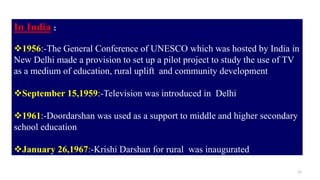
In India :
1956:-The General Conference of UNESCO which was hosted by India in
New Delhi made a provision to set up a pilot project to study the use of TV
as a medium of education, rural uplift and community development
September 15,1959:-Television was introduced in Delhi
1961:-Doordarshan was used as a support to middle and higher secondary
school education
January 26,1967:-Krishi Darshan for rural was inaugurated
14
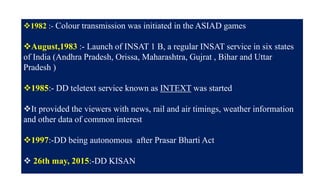
1982 :- Colour transmission was initiated in the ASIAD games
August,1983 :- Launch of INSAT 1 B, a regular INSAT service in six states
of India (Andhra Pradesh, Orissa, Maharashtra, Gujrat , Bihar and Uttar
Pradesh )
1985:- DD teletext service known as INTEXT was started
It provided the viewers with news, rail and air timings, weather information
and other data of common interest
1997:-DD being autonomous after Prasar Bharti Act
 26th may, 2015:-DD KISAN
15
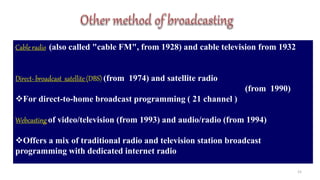
Cable radio (also called "cable FM", from 1928) and cable television from 1932
Direct- broadcast satellite (DBS) (from 1974) and satellite radio
(from 1990)
For direct-to-home broadcast programming ( 21 channel )
Webcasting of video/television (from 1993) and audio/radio (from 1994)
Offers a mix of traditional radio and television station broadcast
programming with dedicated internet radio
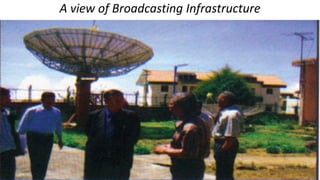
A view of Broadcasting Infrastructure
17
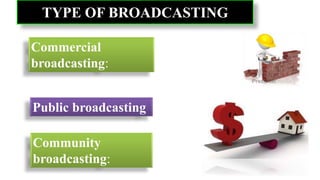
TYPE OF BROADCASTING
Commercial
broadcasting:
Community
broadcasting:
Public broadcasting
Public broadcasting
• Usually non-profit
• Publicly owned stations
• Networks supported by license fees,
government funds
For-profit
Usually privately owned stations
Channels, networks, or services providing
programming to the public
Supported by the sale of time to advertisers for
radio or television advertisements in breaks
between programs
Commercial broadcasting
• A Community Radio Station is one that is operated in
the community, for the community, about the
community and by the community - UNESCO
• There are community television stations and
community radio stations
• Community television stations usually have shows
about local issues and community events
• Community radio stations often get their funding
from local governments, local universities, and from
donations by listeners
Community broadcasting
21
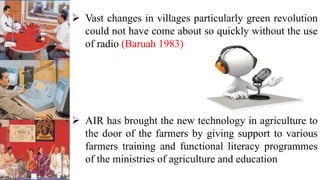
 Vast changes in villages particularly green revolution
could not have come about so quickly without the use
of radio (Baruah 1983)
 AIR has brought the new technology in agriculture to
the door of the farmers by giving support to various
farmers training and functional literacy programmes
of the ministries of agriculture and education
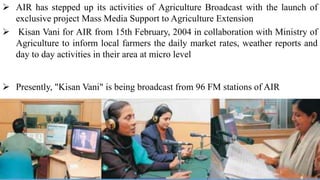
 AIR has stepped up its activities of Agriculture Broadcast with the launch of
exclusive project Mass Media Support to Agriculture Extension
 Kisan Vani for AIR from 15th February, 2004 in collaboration with Ministry of
Agriculture to inform local farmers the daily market rates, weather reports and
day to day activities in their area at micro level
 Presently, "Kisan Vani" is being broadcast from 96 FM stations of AIR
24
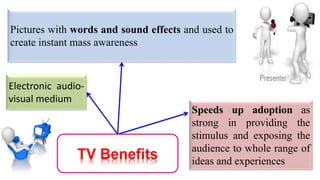
Electronic audio-
visual medium
Pictures with words and sound effects and used to
create instant mass awareness
Speeds up adoption as
strong in providing the
stimulus and exposing the
audience to whole range of
ideas and experiences
TV Benefits
• TV era in India began on Sept 15, 1959 by a
UNESCO grant to study its use as medium of
education, rural uplift and community
development
• In 1967 came the pilot project of agricultural
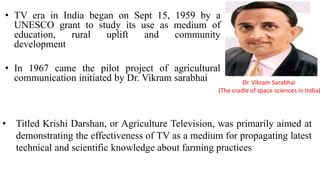
communication initiated by Dr. Vikram sarabhai Dr. Vikram Sarabhai
(The cradle of space sciences in India)
• Titled Krishi Darshan, or Agriculture Television, was primarily aimed at
demonstrating the effectiveness of TV as a medium for propagating latest
technical and scientific knowledge about farming practices
26
Doordarshan
August 15, 1982 also introduced color TV
On Aug 15, 1982 national networking became a
reality with establishment of satellite links
through Indian National Satellite INSAT-1A
Doordarshan was formed in April 1, 1976
27
28
The DD holds the first rights for coverage of national ceremonies such
as the Independence Day, and sporting events of national importance
such as the Olympics, the Commonwealth Games, The Asiad Games
etc
29
Prasar Bharati is India's largest public broadcaster
 It is an autonomous body set up by an Act of Parliament and comprises
Doordarshan television network and All India Radio
Came into existence on 23 Nov, 1997
Prasar Bharati was established following a demand that government
owned broadcasters in India should be given autonomy like those in many
other countries
DD KISAN
It is an Indian agriculture 24 hour television channel which is owned by
Doordarshan
Launched on 26th may, 2015
Dedicated to agriculture & related sectors, disseminates real time inputs to
farmers on new farming techniques, water conservation, organic farming and
credit availability
Updates on daily market rates for commodities and weather
Quiz shows, talk shows, phone-in programmes, news bulletin and
entertainment
31
All India Radio is one of the largest and most famous radio broadcasters
across the world was established in 1930
All India Radio (AIR), officially known as Akashvani since 1956
AIR home service comprises 415 stations today
AIR originates programming in 27 languages 15 are foreign and 12 Indian
AIR launched the FM Rainbow channel on Feb 1, 1993
32
 Vividh Bharati, AIR FM Rainbow, AIR FM Gold, and Radio Kashmir are some
programs of AIR
 At present AIR has 206 FM transmitters across the country
 FM Gold Channel came on air on 1st September, 2001
Local Radio Station
The 3 tier broadcasting network in the country
1. National broadcasts (Started on 18th May 1988)
2. Regional broadcasts (116 Regional Channels )
3. Local (FM) Radio stations (86 Local Stations )
Ideally suited to dissemination of farm technology according to agro
climatic regions
Strong medium for promoting two way communication
34
Radio Rural Forums
Experiment in India sponsored jointly by Ministry of I & B and UNESCO
in 1956
Worked on principle “combination of mass media and interpersonal
communication is more effective than mass media alone”
Farm members listened to biweekly broadcasts for 30-45 mins each day on
agriculture and related subjects, held discussions and forwarded their
questions to be answered by original broadcaster or the expert
Resulted in greater gain in knowledge of innovations among farmers
FarmSchool on AIR
Method of providing systematic education of farming through the process of
distant learning
A comprehensive syllabus is planned in consultation with experts (of State
Government and University) by radio officers
Lessons are broadcast by trainer on pre-announced fixed days, once in a week
with provision for repeated broadcasts
Announcing results on radio and issue of certificates of participation
Farm school trainees are utilized to spread the farm education they obtain from
farm school
Failures of Public Broadcasting
 Political interventions
 Management & staffing inadequacies
 Failure to reach to the audience
 Failure to catch up
 News quality & credibility back drop
 Minimal quality of programmes
 Drawbacks in policy 37
38

Bc credit seminar

  • 1.
    1 JOURNEY OF BROADCASTING Dr Rita Rajpoot MVSc1st year M-5641 Credit seminar
  • 2.
    2 Content  DEFINITION  REVIEW METHOD OF BROADCASTING  TYPE OF BROADCASTING  BENEFITS OF RADIO AND TELEVISION BROADCAST  TV CHANNEL (DOORDARSHAN AND DD KISAN)  RADIO CHENNEL (ALL INDIA RADIO , LOCAL RADIO STATION, RURAL RADIO FORUMS AND FARM SCHOOL ON AIR)  FAILURES WITH IN PUBLIC BROADCASTING
  • 3.
    3 Broadcasting is thepractice of creating audio or video program content and distributing it to the mass audiences of Radio & Television
  • 4.
    • Nair (2011)made an in-depth analysis of the existing framework of community broadcasting in India along with historical background, legal and financial aspects, policy interventions, government and corporate interest. In this paper, the effort is also made to find out the best possible practices to bring community radio as a community participatory tool in India to ensure the participation of the underprivileged sections of the society in designing, producing as well as subsequent airing of radio programmes mostly based on local community issues, problems, needs and interests 4 Review
  • 5.
    • Tabing (2007)found that 81% of the respondents from the farmers have benefited from the programme and the 65% of the broadcasters transmitted the scientific information related to farming activities 5 The opinion of farmers on the rural broadcast of All India Radio, Jallandar was studied by Momi et al (1985). It was reported that considerably 42% a larger number of respondents opinion that the messages broadcast through radio were simple, practicable, complete and timely
  • 6.
  • 7.
    7  First successfuloptical telegraph invented by French engineer Claude Chappe and his brothers in 1792  Covering with a network of 556 stations  Station directly connected with wire It was used for military and national communications until the 1850s TELEGRAPHICAL BROADCASTING
  • 8.
    Telephone broadcasting isthe earliest form of electronic broadcasting from 1867 Telephone broadcasting began with the advent of Théâtrophone ("Theatre Phone") systems Telephone-based distribution systems allowing subscribers to listen to live theatre performances Invented by French inventor Clément Ader in 1881 Telephone broadcasting provided telephone newspaper services for news and entertainment programming which were introduced in the 1890s TELEPHONE BROADCASTING
  • 9.
    9 The audio signalssent through the air as radio waves from a transmitter, picked up by antenna and sent to a receiver 1st documented radio transmission occurred in 1895 by Guglielmo Marconi RADIO BROADCASTING
  • 10.
    10 1923 – Radioclub of Bombay 1926 – Indian Broadcasting Company (IBC) April, 1930 –Formed Indian State Broadcasting Service (ISBS) January 1936 - Delhi radio station was opened June 8, 1936 - the ISBS was renamed All India Radio (AIR) Sardar Vallabhai Patel was the first Minister of Information and Broadcasting in Independent India
  • 11.
    11 1956 - AIRofficially called Akashvani 1957 – Vividh Bharti started 1957 – Rural Radio Forums Nov 23, 1997 - Prasar Bharati All India Radio launched news-on-phone service on 25 February 1998 in New Delhi 15th February, 2004 -Kisan Vani for AIR
  • 12.
    12 Pictures with wordsand sound effects and used to create instant mass awareness Television broadcasting (telecast), experimentally from 1925, commercially from the 1930s The first regular television broadcasts started in 1937 Television broadcasting
  • 13.
    13 In India : 1956:-TheGeneral Conference of UNESCO which was hosted by India in New Delhi made a provision to set up a pilot project to study the use of TV as a medium of education, rural uplift and community development September 15,1959:-Television was introduced in Delhi 1961:-Doordarshan was used as a support to middle and higher secondary school education January 26,1967:-Krishi Darshan for rural was inaugurated
  • 14.
    14 1982 :- Colourtransmission was initiated in the ASIAD games August,1983 :- Launch of INSAT 1 B, a regular INSAT service in six states of India (Andhra Pradesh, Orissa, Maharashtra, Gujrat , Bihar and Uttar Pradesh ) 1985:- DD teletext service known as INTEXT was started It provided the viewers with news, rail and air timings, weather information and other data of common interest 1997:-DD being autonomous after Prasar Bharti Act  26th may, 2015:-DD KISAN
  • 15.
    15 Cable radio (alsocalled "cable FM", from 1928) and cable television from 1932 Direct- broadcast satellite (DBS) (from 1974) and satellite radio (from 1990) For direct-to-home broadcast programming ( 21 channel ) Webcasting of video/television (from 1993) and audio/radio (from 1994) Offers a mix of traditional radio and television station broadcast programming with dedicated internet radio
  • 16.
    A view ofBroadcasting Infrastructure
  • 17.
  • 18.
    Public broadcasting • Usuallynon-profit • Publicly owned stations • Networks supported by license fees, government funds
  • 19.
    For-profit Usually privately ownedstations Channels, networks, or services providing programming to the public Supported by the sale of time to advertisers for radio or television advertisements in breaks between programs Commercial broadcasting
  • 20.
    • A CommunityRadio Station is one that is operated in the community, for the community, about the community and by the community - UNESCO • There are community television stations and community radio stations • Community television stations usually have shows about local issues and community events • Community radio stations often get their funding from local governments, local universities, and from donations by listeners Community broadcasting
  • 21.
  • 22.
     Vast changesin villages particularly green revolution could not have come about so quickly without the use of radio (Baruah 1983)  AIR has brought the new technology in agriculture to the door of the farmers by giving support to various farmers training and functional literacy programmes of the ministries of agriculture and education
  • 23.
     AIR hasstepped up its activities of Agriculture Broadcast with the launch of exclusive project Mass Media Support to Agriculture Extension  Kisan Vani for AIR from 15th February, 2004 in collaboration with Ministry of Agriculture to inform local farmers the daily market rates, weather reports and day to day activities in their area at micro level  Presently, "Kisan Vani" is being broadcast from 96 FM stations of AIR
  • 24.
    24 Electronic audio- visual medium Pictureswith words and sound effects and used to create instant mass awareness Speeds up adoption as strong in providing the stimulus and exposing the audience to whole range of ideas and experiences TV Benefits
  • 25.
    • TV erain India began on Sept 15, 1959 by a UNESCO grant to study its use as medium of education, rural uplift and community development • In 1967 came the pilot project of agricultural communication initiated by Dr. Vikram sarabhai Dr. Vikram Sarabhai (The cradle of space sciences in India) • Titled Krishi Darshan, or Agriculture Television, was primarily aimed at demonstrating the effectiveness of TV as a medium for propagating latest technical and scientific knowledge about farming practices
  • 26.
  • 27.
    Doordarshan August 15, 1982also introduced color TV On Aug 15, 1982 national networking became a reality with establishment of satellite links through Indian National Satellite INSAT-1A Doordarshan was formed in April 1, 1976 27
  • 28.
    28 The DD holdsthe first rights for coverage of national ceremonies such as the Independence Day, and sporting events of national importance such as the Olympics, the Commonwealth Games, The Asiad Games etc
  • 29.
    29 Prasar Bharati isIndia's largest public broadcaster  It is an autonomous body set up by an Act of Parliament and comprises Doordarshan television network and All India Radio Came into existence on 23 Nov, 1997 Prasar Bharati was established following a demand that government owned broadcasters in India should be given autonomy like those in many other countries
  • 30.
    DD KISAN It isan Indian agriculture 24 hour television channel which is owned by Doordarshan Launched on 26th may, 2015 Dedicated to agriculture & related sectors, disseminates real time inputs to farmers on new farming techniques, water conservation, organic farming and credit availability Updates on daily market rates for commodities and weather Quiz shows, talk shows, phone-in programmes, news bulletin and entertainment
  • 31.
    31 All India Radiois one of the largest and most famous radio broadcasters across the world was established in 1930 All India Radio (AIR), officially known as Akashvani since 1956 AIR home service comprises 415 stations today AIR originates programming in 27 languages 15 are foreign and 12 Indian AIR launched the FM Rainbow channel on Feb 1, 1993
  • 32.
    32  Vividh Bharati,AIR FM Rainbow, AIR FM Gold, and Radio Kashmir are some programs of AIR  At present AIR has 206 FM transmitters across the country  FM Gold Channel came on air on 1st September, 2001
  • 33.
    Local Radio Station The3 tier broadcasting network in the country 1. National broadcasts (Started on 18th May 1988) 2. Regional broadcasts (116 Regional Channels ) 3. Local (FM) Radio stations (86 Local Stations ) Ideally suited to dissemination of farm technology according to agro climatic regions Strong medium for promoting two way communication
  • 34.
  • 35.
    Radio Rural Forums Experimentin India sponsored jointly by Ministry of I & B and UNESCO in 1956 Worked on principle “combination of mass media and interpersonal communication is more effective than mass media alone” Farm members listened to biweekly broadcasts for 30-45 mins each day on agriculture and related subjects, held discussions and forwarded their questions to be answered by original broadcaster or the expert Resulted in greater gain in knowledge of innovations among farmers
  • 36.
    FarmSchool on AIR Methodof providing systematic education of farming through the process of distant learning A comprehensive syllabus is planned in consultation with experts (of State Government and University) by radio officers Lessons are broadcast by trainer on pre-announced fixed days, once in a week with provision for repeated broadcasts Announcing results on radio and issue of certificates of participation Farm school trainees are utilized to spread the farm education they obtain from farm school
  • 37.
    Failures of PublicBroadcasting  Political interventions  Management & staffing inadequacies  Failure to reach to the audience  Failure to catch up  News quality & credibility back drop  Minimal quality of programmes  Drawbacks in policy 37
  • 38.