Media Law & Ethics
     Mass Media & Society
First Amendment


Congress shall make no law respecting an
establishment of religion, or prohibiting the free
exercise thereof; or abridging the freedom of
speech, or of the press; or the right of the people
peaceably to assemble, and to petition the
government for a redress of grievances.
Fourth Estate

The media are supposed to keep the other
branches of government in check.
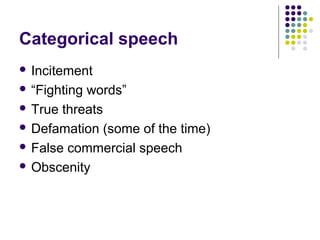
Categorical speech
 Incitement

 “Fightingwords”
 True threats
 Defamation (some of the time)

 False commercial speech

 Obscenity
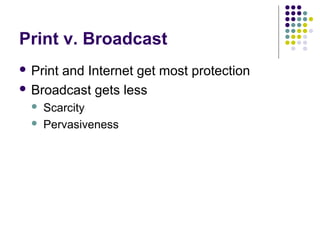
Print v. Broadcast
 Print
      and Internet get most protection
 Broadcast gets less
     Scarcity
     Pervasiveness
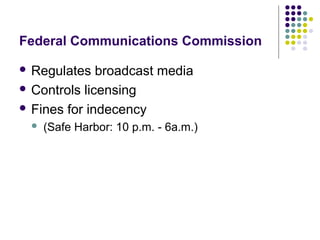
Federal Communications Commission

 Regulates   broadcast media
 Controls licensing

 Fines for indecency
     (Safe Harbor: 10 p.m. - 6a.m.)
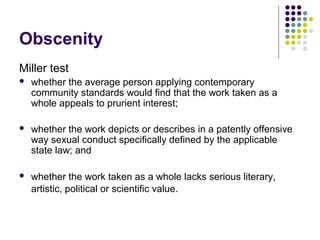
Obscenity
Miller test
   whether the average person applying contemporary
    community standards would find that the work taken as a
    whole appeals to prurient interest;

   whether the work depicts or describes in a patently offensive
    way sexual conduct specifically defined by the applicable
    state law; and

   whether the work taken as a whole lacks serious literary,
    artistic, political or scientific value.
Defamation

Lying about someone or twisting the truth in such a way as to
create a false impression that damages that person’s reputation
or potentially exposes the person to ridicule is the basis for
defamation.
Two types of defamation

 • Libel – published or broadcast
 • Slander – spoken words of limited reach
Six elements of libel
 Publication

 Identification

 Defamation

 Falsity

 Fault

 Injury
Quotes won’t protect you

Repeating a source’s libelous remark in a story or broadcast is
called republication of libel.


Allegedly won’t protect you either.
Defenses to libel
 Truth

 Qualified privilege
 Protected opinion

 Implied consent

 Right of reply
Common-Law Privacy
Violations

  Publication of private facts 

  Intrusion upon seclusion 

  Appropriation for commercial use 

  False Light 
Privacy defenses

   Newsworthiness 
       Public figure or official
   Consent
   Plain view (standing in doctrine)
   Public record or proceeding 
Ethical consideration for
privacy
Journalists need to distinguish among: 

 Right to know

 Need to know

 Want to know (not worth privacy invasion)
Plagiarism
 Plagiarism is the taking of someone else’s 
  words, research or ideas and representing 
  them as your own. 
 It is essentially theft of credit for someone 
  else’s work done. 
Copyright


Involves taking someone else’s protected
expression without permission.


It does not protect facts or ideas.
Copyrights
 Reproduction

 Distribution

 Derivative

 Public performance

 Public display
Criteria for copyright
 Original to the creator

 Fixed in a tangible medium of expression

 Modicum of creativity
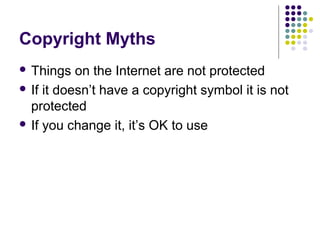
Copyright Myths
 Things on the Internet are not protected

 If it doesn’t have a copyright symbol it is not 
  protected
 If you change it, it’s OK to use
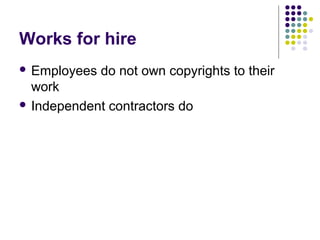
Works for hire
 Employees do not own copyrights to their 
  work
 Independent contractors do
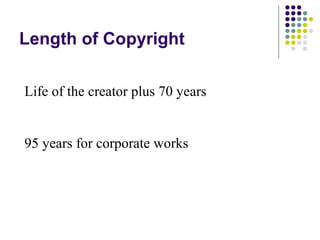
Length of Copyright

Life of the creator plus 70 years


95 years for corporate works
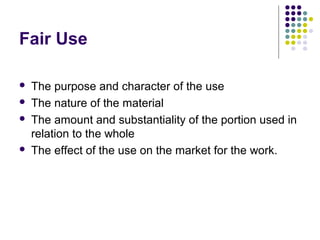
Fair Use

   The purpose and character of the use
   The nature of the material
   The amount and substantiality of the portion used in 
    relation to the whole
   The effect of the use on the market for the work. 
Commercial speech

 False commercial speech not protected


 Regulated by the FTC (but also FCC and 
 FDA)
FTC definition of false advertising
 Representation,   omission or practice must be
  likely to mislead the consumer
 Act or practice must be considered from the
  perspective of a consumer who is acting
  reasonably
 Representation must be material
Responsibility for ad content
   Advertising agencies can be held responsible for
    false advertising if they know or have reason to
    know it is false or misleading
   Media managers are not responsible for false or
    deceptive advertising, or for injuries resulting from
    defective products unless the newspaper, magazine
    or broadcaster helped to create the ad
   Unless potential detrimental effects of an ad are so
    obvious anyone could see it
Right to refuse advertising
 Barring a few exceptions, private publishers
 and broadcasters are under no obligation to
 accept advertising. Courts have also
 extended that into the online realm.
Ethics
Mass Media and Society
Plagiarism

 Defined as taking someone else’s words, research
 or ideas and representing that material as your own.
Three kinds of plagiarists

   • Those who know they are stealing either a part of
     someone’s work, or the whole thing;

   • Those who inadvertently drop a citation or become
      confused about the source of a line; and

   • Those who do not understand the rules of plagiarism
      and do it out of ignorance.
David Cragin comparison
     “Most of these hotels in the city are more than half a
      century old; they were built for the solitary working
      man who streamed into the city to toil at the wharves
      and the railway lines. They were never meant for
      families.”

     “Most of these hotels are more than a half-century old;
      they were built as hives for the working men who
      streamed to this city to toil at the wharves and the
      railway lines. They were never meant for families.”
Cultural hurdles in journalism

 • Pressure to make a story interesting
 • Pressure to get it first
 • Pressure to be objective
 • Pressure to get “both” sides of the story
 • Pressure to take an adversarial approach
What is ethics?


Ethics is the act of reasoned inquiry into the principled or moral
dimension of our lives.
Ethical dilemmas


• Deontological ethics (absolutist / rule-based)
• Teleological ethics (situational / consequential)
Categorical imperative
 Immanuel    Kant - a deontological ethicist
    Act as though your decision would become
     universal law
    Always treat others as ends in themselves, not as
     means to an end.
Utilitarianism
 John   Stuart Mill - a teleological ethicist
    Act so you would do the greatest good for the
     greatest number
    Ethical people consider the consequences of their
     actions
Agape
 Judeo-Christian    ethic
    Treat others as you would like to be treated
    The Golden Rule
Golden Mean
 Aristotle     and Confucius
     Look for the middle course between two
      extremes.
         e.g. Courage is the middle state between acting
          cowardly or acting foolheartedly.
     But some situations don’t have a middle state (i.e.
      stealing)
Veil of Ignorance
 John   Rawls
    Imagine that all parties affected by the ethical
     question could disappear behind a veil of
     ignorance where they might trade places.
    Parties will pick the solution fairest for all out of
     self interest.
Ethical Principles
 Categorical   imperative – Immanuel Kant
 Utilitarianism – John Stuart Mill

 Agape – Judeo-Christian perspective

 Golden Mean – Aristotle and Confucius

 Veil of Ignorance – John Rawls
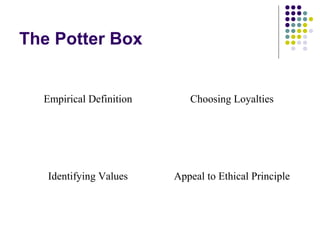
The Potter Box


  Empirical Definition      Choosing Loyalties


   Identifying Values    Appeal to Ethical Principle
Step 1

Define the situation.
What is the ethical dilemma? What are the facts of the
case? Are there any legal considerations?
Step 2

Ask yourself, “What are my personal or
professional values? What is important to me in
this situation?”
Step 3

Ask yourself, “What are my guiding principles?”
Step 4

To whom will you be loyal?
Step 5


Feedback


(The answer you find for your specific dilemma may become
your policy for other situations.)

Media law & ethics

  • 1.
    Media Law &Ethics Mass Media & Society
  • 2.
    First Amendment Congress shallmake no law respecting an establishment of religion, or prohibiting the free exercise thereof; or abridging the freedom of speech, or of the press; or the right of the people peaceably to assemble, and to petition the government for a redress of grievances.
  • 3.
    Fourth Estate The mediaare supposed to keep the other branches of government in check.
  • 4.
    Categorical speech  Incitement “Fightingwords”  True threats  Defamation (some of the time)  False commercial speech  Obscenity
  • 5.
    Print v. Broadcast Print and Internet get most protection  Broadcast gets less  Scarcity  Pervasiveness
  • 6.
    Federal Communications Commission Regulates broadcast media  Controls licensing  Fines for indecency  (Safe Harbor: 10 p.m. - 6a.m.)
  • 7.
    Obscenity Miller test  whether the average person applying contemporary community standards would find that the work taken as a whole appeals to prurient interest;  whether the work depicts or describes in a patently offensive way sexual conduct specifically defined by the applicable state law; and  whether the work taken as a whole lacks serious literary, artistic, political or scientific value.
  • 8.
    Defamation Lying about someoneor twisting the truth in such a way as to create a false impression that damages that person’s reputation or potentially exposes the person to ridicule is the basis for defamation.
  • 9.
    Two types ofdefamation • Libel – published or broadcast • Slander – spoken words of limited reach
  • 10.
    Six elements oflibel  Publication  Identification  Defamation  Falsity  Fault  Injury
  • 11.
    Quotes won’t protectyou Repeating a source’s libelous remark in a story or broadcast is called republication of libel. Allegedly won’t protect you either.
  • 12.
    Defenses to libel Truth  Qualified privilege  Protected opinion  Implied consent  Right of reply
  • 13.
    Common-Law Privacy Violations   Publication of private facts   Intrusion upon seclusion    Appropriation for commercial use    False Light 
  • 14.
    Privacy defenses  Newsworthiness   Public figure or official  Consent  Plain view (standing in doctrine)  Public record or proceeding 
  • 15.
    Ethical consideration for privacy Journalists need to distinguish among:  Right to know  Need to know  Want to know (not worth privacy invasion)
  • 16.
    Plagiarism  Plagiarism is the taking of someone else’s  words, research or ideas and representing  them as your own.   It is essentially theft of credit for someone  else’s work done. 
  • 17.
    Copyright Involves taking someoneelse’s protected expression without permission. It does not protect facts or ideas.
  • 18.
    Copyrights  Reproduction  Distribution Derivative  Public performance  Public display
  • 19.
    Criteria for copyright Original to the creator  Fixed in a tangible medium of expression  Modicum of creativity
  • 20.
    Copyright Myths  Things on the Internet are not protected If it doesn’t have a copyright symbol it is not  protected  If you change it, it’s OK to use
  • 21.
    Works for hire Employees do not own copyrights to their  work  Independent contractors do
  • 22.
    Length of Copyright Lifeof the creator plus 70 years 95 years for corporate works
  • 23.
    Fair Use  The purpose and character of the use  The nature of the material  The amount and substantiality of the portion used in  relation to the whole  The effect of the use on the market for the work. 
  • 24.
    Commercial speech  False commercial speech not protected Regulated by the FTC (but also FCC and  FDA)
  • 25.
    FTC definition offalse advertising  Representation, omission or practice must be likely to mislead the consumer  Act or practice must be considered from the perspective of a consumer who is acting reasonably  Representation must be material
  • 26.
    Responsibility for adcontent  Advertising agencies can be held responsible for false advertising if they know or have reason to know it is false or misleading  Media managers are not responsible for false or deceptive advertising, or for injuries resulting from defective products unless the newspaper, magazine or broadcaster helped to create the ad  Unless potential detrimental effects of an ad are so obvious anyone could see it
  • 27.
    Right to refuseadvertising Barring a few exceptions, private publishers and broadcasters are under no obligation to accept advertising. Courts have also extended that into the online realm.
  • 28.
  • 29.
    Plagiarism Defined astaking someone else’s words, research or ideas and representing that material as your own.
  • 30.
    Three kinds ofplagiarists • Those who know they are stealing either a part of someone’s work, or the whole thing; • Those who inadvertently drop a citation or become confused about the source of a line; and • Those who do not understand the rules of plagiarism and do it out of ignorance.
  • 31.
    David Cragin comparison  “Most of these hotels in the city are more than half a century old; they were built for the solitary working man who streamed into the city to toil at the wharves and the railway lines. They were never meant for families.”  “Most of these hotels are more than a half-century old; they were built as hives for the working men who streamed to this city to toil at the wharves and the railway lines. They were never meant for families.”
  • 32.
    Cultural hurdles injournalism • Pressure to make a story interesting • Pressure to get it first • Pressure to be objective • Pressure to get “both” sides of the story • Pressure to take an adversarial approach
  • 33.
    What is ethics? Ethicsis the act of reasoned inquiry into the principled or moral dimension of our lives.
  • 34.
    Ethical dilemmas • Deontologicalethics (absolutist / rule-based) • Teleological ethics (situational / consequential)
  • 35.
    Categorical imperative  Immanuel Kant - a deontological ethicist  Act as though your decision would become universal law  Always treat others as ends in themselves, not as means to an end.
  • 36.
    Utilitarianism  John Stuart Mill - a teleological ethicist  Act so you would do the greatest good for the greatest number  Ethical people consider the consequences of their actions
  • 37.
    Agape  Judeo-Christian ethic  Treat others as you would like to be treated  The Golden Rule
  • 38.
    Golden Mean  Aristotle and Confucius  Look for the middle course between two extremes.  e.g. Courage is the middle state between acting cowardly or acting foolheartedly.  But some situations don’t have a middle state (i.e. stealing)
  • 39.
    Veil of Ignorance John Rawls  Imagine that all parties affected by the ethical question could disappear behind a veil of ignorance where they might trade places.  Parties will pick the solution fairest for all out of self interest.
  • 40.
    Ethical Principles  Categorical imperative – Immanuel Kant  Utilitarianism – John Stuart Mill  Agape – Judeo-Christian perspective  Golden Mean – Aristotle and Confucius  Veil of Ignorance – John Rawls
  • 41.
    The Potter Box Empirical Definition Choosing Loyalties Identifying Values Appeal to Ethical Principle
  • 42.
    Step 1 Define thesituation. What is the ethical dilemma? What are the facts of the case? Are there any legal considerations?
  • 43.
    Step 2 Ask yourself,“What are my personal or professional values? What is important to me in this situation?”
  • 44.
    Step 3 Ask yourself,“What are my guiding principles?”
  • 45.
    Step 4 To whomwill you be loyal?
  • 46.
    Step 5 Feedback (The answeryou find for your specific dilemma may become your policy for other situations.)