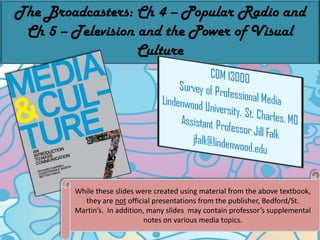
The Broadcasters: Ch 4 – Popular Radio and Ch 5 – Television and the Power of Visual CultureWhile these slides were created using material from the above textbook, they are not official presentations from the publisher, Bedford/St. Martin’s.  In addition, many slides  may contain professor’s supplemental notes on various media topics.
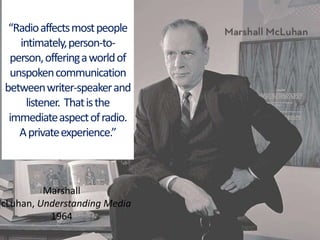
“Radio affects most people intimately, person-to-person, offering a world of unspoken communication between writer-speaker and listener.  That is the immediate aspect of radio.  A private experience.”Marshall McLuhan, Understanding Media 1964
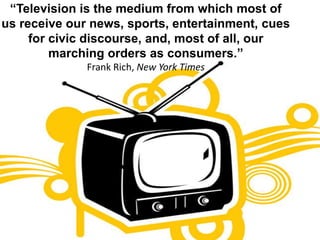
“Television is the medium from which most of us receive our news, sports, entertainment, cues for civic discourse, and, most of all, our marching orders as consumers.”Frank Rich, New York Times
Brief History of Radio and  TelevisionThe Rise and Fall of the Networks and the Transition to TodayWatch for Key Terms…The Telecommunications Act of 1996, FCC and OwnershipMeasuring the Audience - How Ratings and Markets WorkNoncommercial Broadcast StationsToday’sTrends
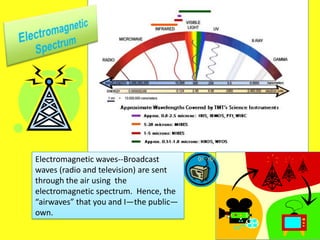
Electromagnetic SpectrumElectromagnetic waves--Broadcast waves (radio and television) are sent through the air using  the electromagnetic spectrum.  Hence, the “airwaves” that you and I—the public—own.
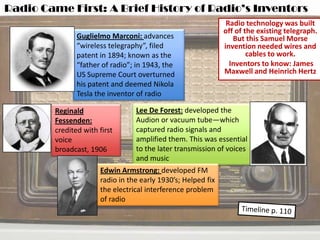
Radio Came First: A Brief History of Radio’s InventorsRadio technology was built off of the existing telegraph.  But this Samuel Morse invention needed wires and cables to work.  Inventors to know: James Maxwell and Heinrich HertzGuglielmo Marconi: advances “wireless telegraphy”, filed patent in 1894; known as the “father of radio”; in 1943, the US Supreme Court overturned his patent and deemed Nikola Tesla the inventor of radioLee De Forest: developed the Audion or vacuum tube—which captured radio signals and amplified them. This was essential to the later transmission of voices and musicReginald Fessenden: credited with first voice broadcast, 1906Edwin Armstrong: developed FM radio in the early 1930’s; Helped fix the electrical interference problem of radioTimeline p. 110
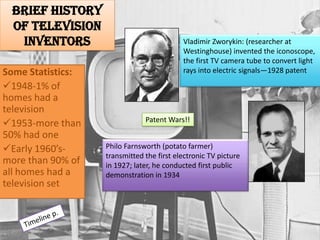
Brief History of Television InventorsVladimir Zworykin: (researcher at Westinghouse) invented the iconoscope, the first TV camera tube to convert light rays into electric signals—1928 patentSome Statistics:1948-1% of homes had a television
1953-more than 50% had one
Early 1960’s-more than 90% of all homes had a television setPatent Wars!!Philo Farnsworth (potato farmer) transmitted the first electronic TV picture in 1927; later, he conducted first public demonstration in 1934Timeline p.
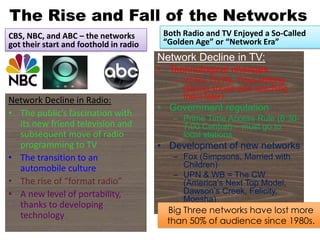
The Rise and Fall of the NetworksBoth Radio and TV Enjoyed a So-Called “Golden Age” or “Network Era”CBS, NBC, and ABC – the networks got their start and foothold in radioNetwork Decline in TV:Technological changesVCRs, DVRs, Time-shifting (taping shows and watching them later) Government regulationPrime Time Access Rule (6:30-7:00 Central) – must go to local stationsDevelopment of new networksFox (Simpsons, Married with Children)UPN & WB = The CW (America’s Next Top Model, Dawson’s Creek, Felicity, Moesha)Network Decline in Radio:The public’s fascination with its new friend television and subsequent move of radio programming to TVThe transition to an automobile cultureThe rise of “format radio”A new level of portability, thanks to developing technologyBig Three networks have lost more than 50% of audience since 1980s.
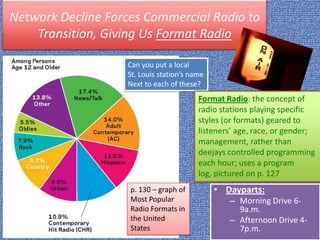
Network Decline Forces Commercial Radio to Transition, Giving Us Format RadioCan you put a localSt. Louis station’s nameNext to each of these?Format Radio: the concept of radio stations playing specific styles (or formats) geared to listeners’ age, race, or gender; management, rather than deejays controlled programming each hour; uses a program log, pictured on p. 127p. 130 – graph of Most PopularRadio Formats in the United StatesDayparts:
Morning Drive 6-9a.m.
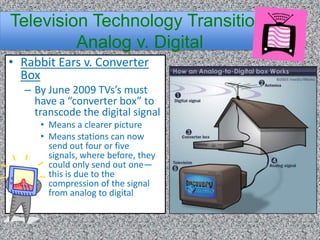
Afternoon Drive 4-7p.m.Television Technology Transition: Analog v. DigitalRabbit Ears v. Converter BoxBy June 2009 TVs’s must have a “converter box” to transcode the digital signalMeans a clearer pictureMeans stations can now send out four or five signals, where before, they could only send out one—this is due to the compression of the signal from analog to digital
The Telecommunications Act of 1996Relaxed ownership rules—meaning companies could own more than the FCC (Federal Communications Commission) previously regulatedFrom 1996-2004, the number of radio station owners declined by 34%!!!!Owners:Most commercial stations are owned by a “group owner”Radio: Clear Channel Communications is the LARGEST owner of commercial radio stations – 1,150; Other big names: Citadel, Cumulus and CoxTelevision Big Names: (besides the O&O’s-network “owned and operated” stations) Tribune, Gannett, Hearst, Sinclair, Belo and Cox
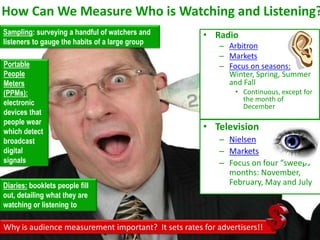
How Can We Measure Who is Watching and Listening?Sampling: surveying a handful of watchers and listeners to gauge the habits of a large groupRadioArbitronMarketsFocus on seasons: Winter, Spring, Summer and FallContinuous, except for the month of DecemberPortable People Meters (PPMs): electronic devices that people wear which detect broadcast digital signalsTelevisionNielsenMarketsFocus on four “sweeps” months: November, February, May and JulyDiaries: booklets people fill out, detailing what they are watching or listening toWhy is audience measurement important?  It sets rates for advertisers!!
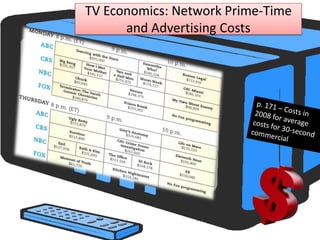
TV Economics: Network Prime-Time and Advertising Costs p. 171 – Costs in 2008 for average costs for 30-second commercial
“Since its creation, commercial television has tended to serve the interest of profit more than those of democracy.  And networks have proved time and again that they are more interested in delivering audiences to advertisers than providing educational and provocative programming to citizens and viewers.”Media & Culture

The Broadcasters - Ch 4 and 5

  • 1.
    The Broadcasters: Ch4 – Popular Radio and Ch 5 – Television and the Power of Visual CultureWhile these slides were created using material from the above textbook, they are not official presentations from the publisher, Bedford/St. Martin’s. In addition, many slides may contain professor’s supplemental notes on various media topics.
  • 2.
    “Radio affects mostpeople intimately, person-to-person, offering a world of unspoken communication between writer-speaker and listener. That is the immediate aspect of radio. A private experience.”Marshall McLuhan, Understanding Media 1964
  • 3.
    “Television is themedium from which most of us receive our news, sports, entertainment, cues for civic discourse, and, most of all, our marching orders as consumers.”Frank Rich, New York Times
  • 4.
    Brief History ofRadio and TelevisionThe Rise and Fall of the Networks and the Transition to TodayWatch for Key Terms…The Telecommunications Act of 1996, FCC and OwnershipMeasuring the Audience - How Ratings and Markets WorkNoncommercial Broadcast StationsToday’sTrends
  • 5.
    Electromagnetic SpectrumElectromagnetic waves--Broadcastwaves (radio and television) are sent through the air using the electromagnetic spectrum. Hence, the “airwaves” that you and I—the public—own.
  • 6.
    Radio Came First:A Brief History of Radio’s InventorsRadio technology was built off of the existing telegraph. But this Samuel Morse invention needed wires and cables to work. Inventors to know: James Maxwell and Heinrich HertzGuglielmo Marconi: advances “wireless telegraphy”, filed patent in 1894; known as the “father of radio”; in 1943, the US Supreme Court overturned his patent and deemed Nikola Tesla the inventor of radioLee De Forest: developed the Audion or vacuum tube—which captured radio signals and amplified them. This was essential to the later transmission of voices and musicReginald Fessenden: credited with first voice broadcast, 1906Edwin Armstrong: developed FM radio in the early 1930’s; Helped fix the electrical interference problem of radioTimeline p. 110
  • 7.
    Brief History ofTelevision InventorsVladimir Zworykin: (researcher at Westinghouse) invented the iconoscope, the first TV camera tube to convert light rays into electric signals—1928 patentSome Statistics:1948-1% of homes had a television
  • 8.
  • 9.
    Early 1960’s-more than90% of all homes had a television setPatent Wars!!Philo Farnsworth (potato farmer) transmitted the first electronic TV picture in 1927; later, he conducted first public demonstration in 1934Timeline p.
  • 10.
    The Rise andFall of the NetworksBoth Radio and TV Enjoyed a So-Called “Golden Age” or “Network Era”CBS, NBC, and ABC – the networks got their start and foothold in radioNetwork Decline in TV:Technological changesVCRs, DVRs, Time-shifting (taping shows and watching them later) Government regulationPrime Time Access Rule (6:30-7:00 Central) – must go to local stationsDevelopment of new networksFox (Simpsons, Married with Children)UPN & WB = The CW (America’s Next Top Model, Dawson’s Creek, Felicity, Moesha)Network Decline in Radio:The public’s fascination with its new friend television and subsequent move of radio programming to TVThe transition to an automobile cultureThe rise of “format radio”A new level of portability, thanks to developing technologyBig Three networks have lost more than 50% of audience since 1980s.
  • 11.
    Network Decline ForcesCommercial Radio to Transition, Giving Us Format RadioCan you put a localSt. Louis station’s nameNext to each of these?Format Radio: the concept of radio stations playing specific styles (or formats) geared to listeners’ age, race, or gender; management, rather than deejays controlled programming each hour; uses a program log, pictured on p. 127p. 130 – graph of Most PopularRadio Formats in the United StatesDayparts:
  • 12.
  • 13.
    Afternoon Drive 4-7p.m.TelevisionTechnology Transition: Analog v. DigitalRabbit Ears v. Converter BoxBy June 2009 TVs’s must have a “converter box” to transcode the digital signalMeans a clearer pictureMeans stations can now send out four or five signals, where before, they could only send out one—this is due to the compression of the signal from analog to digital
  • 14.
    The Telecommunications Actof 1996Relaxed ownership rules—meaning companies could own more than the FCC (Federal Communications Commission) previously regulatedFrom 1996-2004, the number of radio station owners declined by 34%!!!!Owners:Most commercial stations are owned by a “group owner”Radio: Clear Channel Communications is the LARGEST owner of commercial radio stations – 1,150; Other big names: Citadel, Cumulus and CoxTelevision Big Names: (besides the O&O’s-network “owned and operated” stations) Tribune, Gannett, Hearst, Sinclair, Belo and Cox
  • 15.
    How Can WeMeasure Who is Watching and Listening?Sampling: surveying a handful of watchers and listeners to gauge the habits of a large groupRadioArbitronMarketsFocus on seasons: Winter, Spring, Summer and FallContinuous, except for the month of DecemberPortable People Meters (PPMs): electronic devices that people wear which detect broadcast digital signalsTelevisionNielsenMarketsFocus on four “sweeps” months: November, February, May and JulyDiaries: booklets people fill out, detailing what they are watching or listening toWhy is audience measurement important? It sets rates for advertisers!!
  • 16.
    TV Economics: NetworkPrime-Time and Advertising Costs p. 171 – Costs in 2008 for average costs for 30-second commercial
  • 17.
    “Since its creation,commercial television has tended to serve the interest of profit more than those of democracy. And networks have proved time and again that they are more interested in delivering audiences to advertisers than providing educational and provocative programming to citizens and viewers.”Media & Culture
  • 18.
    Noncommercial Radio andTelevisionCreated under the Public Broadcasting Act of 1967 and the Corporation for Public Broadcasting (CPB); Both rely on “corporate sponsorships”National Public Radio (NPR)St. Louis station: 90.7 KWMUPublic Broadcasting Service (PBS)
  • 19.
    St. Louis station:KETC Channel 9Why create and support broadcasting that isn’t reliant on advertisers?
  • 20.
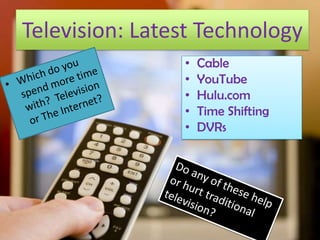
    Television: Latest TechnologyCableYouTubeHulu.comTimeShiftingDVRsWhich do you spend more time with? Television or The Internet?Do any of these help or hurt traditional television?
  • 21.
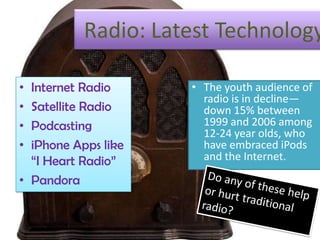
    Radio: Latest TechnologyInternetRadioSatellite RadioPodcastingiPhone Apps like “I Heart Radio”PandoraThe youth audience of radio is in decline—down 15% between 1999 and 2006 among 12-24 year olds, who have embraced iPods and the Internet.Do any of these help or hurt traditional radio?