1
Broadcasting:
History of Broadcast Media
2
History: Inventors
• Early inventors and inventions paved the
way for the electronic mass media
• James Maxwell and Heinrich Hertz
demonstrated the existence of
electromagnetic radiation
3
History: Inventors
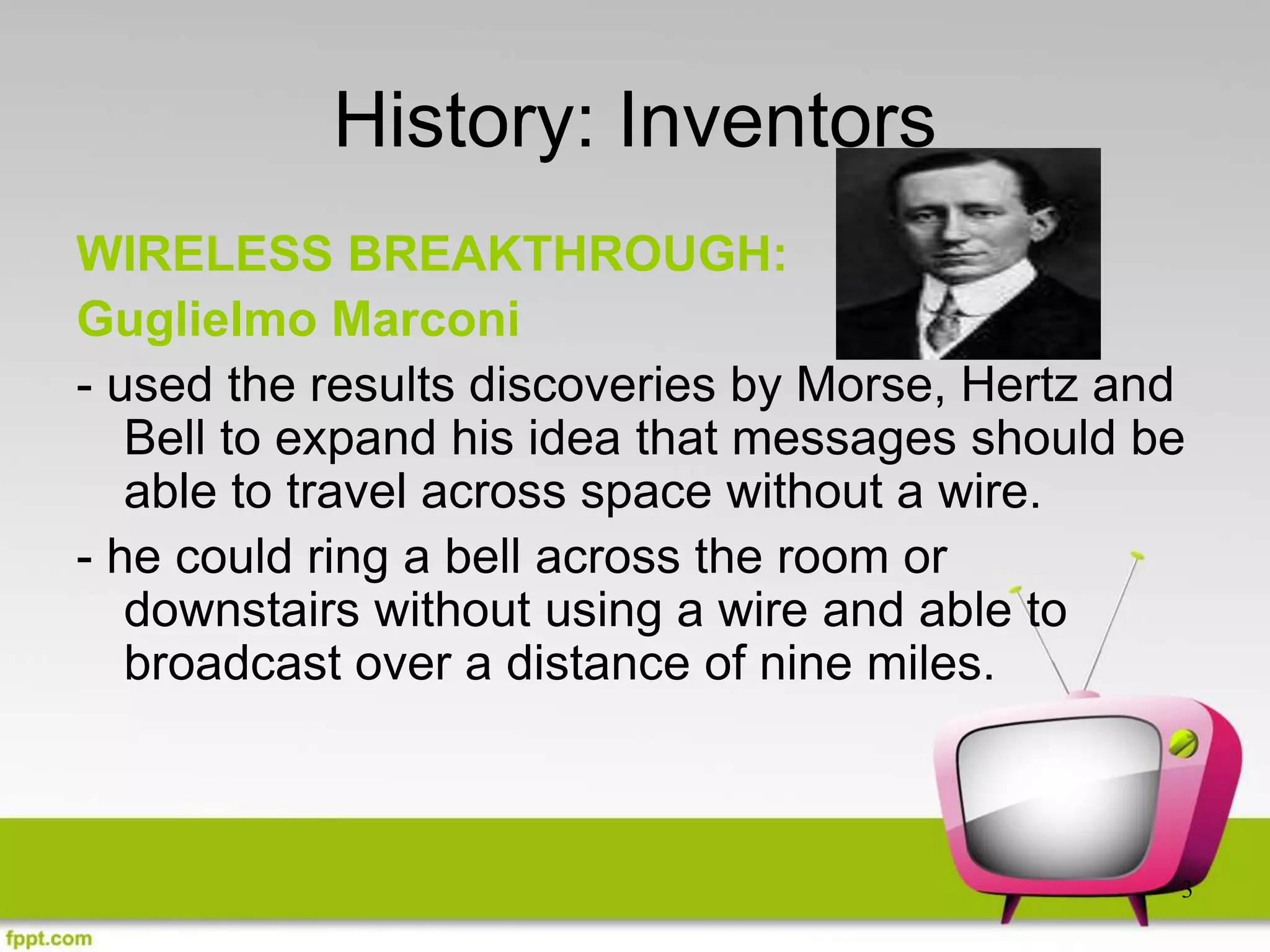
WIRELESS BREAKTHROUGH:
Guglielmo Marconi
- used the results discoveries by Morse, Hertz and
Bell to expand his idea that messages should be
able to travel across space without a wire.
- he could ring a bell across the room or
downstairs without using a wire and able to
broadcast over a distance of nine miles.
4
History: Inventors
- ship-to-ship, ship-to-shore communication
- dots and dashes (Morse code) aka
telegraphy
- two experimenters, Reginald Aubrey
Fessenden and Lee de Forest, advanced
Marconi’s discovery to create today’s radio
- Eventually he developed a powerful
wireless business history.
5
History: Inventors
EXPERIMENTAL BROADCASTS:
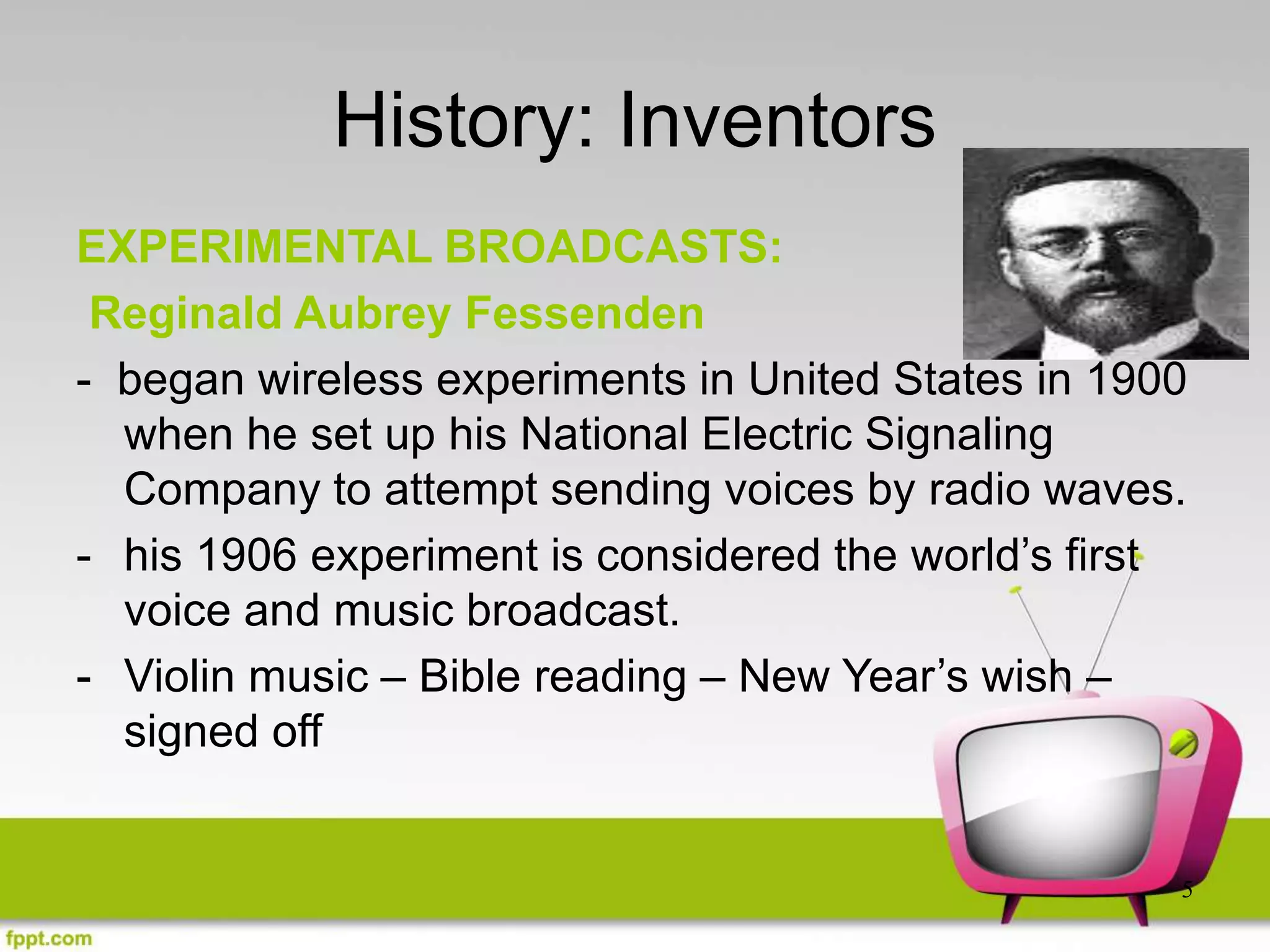
Reginald Aubrey Fessenden
- began wireless experiments in United States in 1900
when he set up his National Electric Signaling
Company to attempt sending voices by radio waves.
- his 1906 experiment is considered the world’s first
voice and music broadcast.
- Violin music – Bible reading – New Year’s wish –
signed off
6
History: Inventors
DETECTING RADIO WAVES:
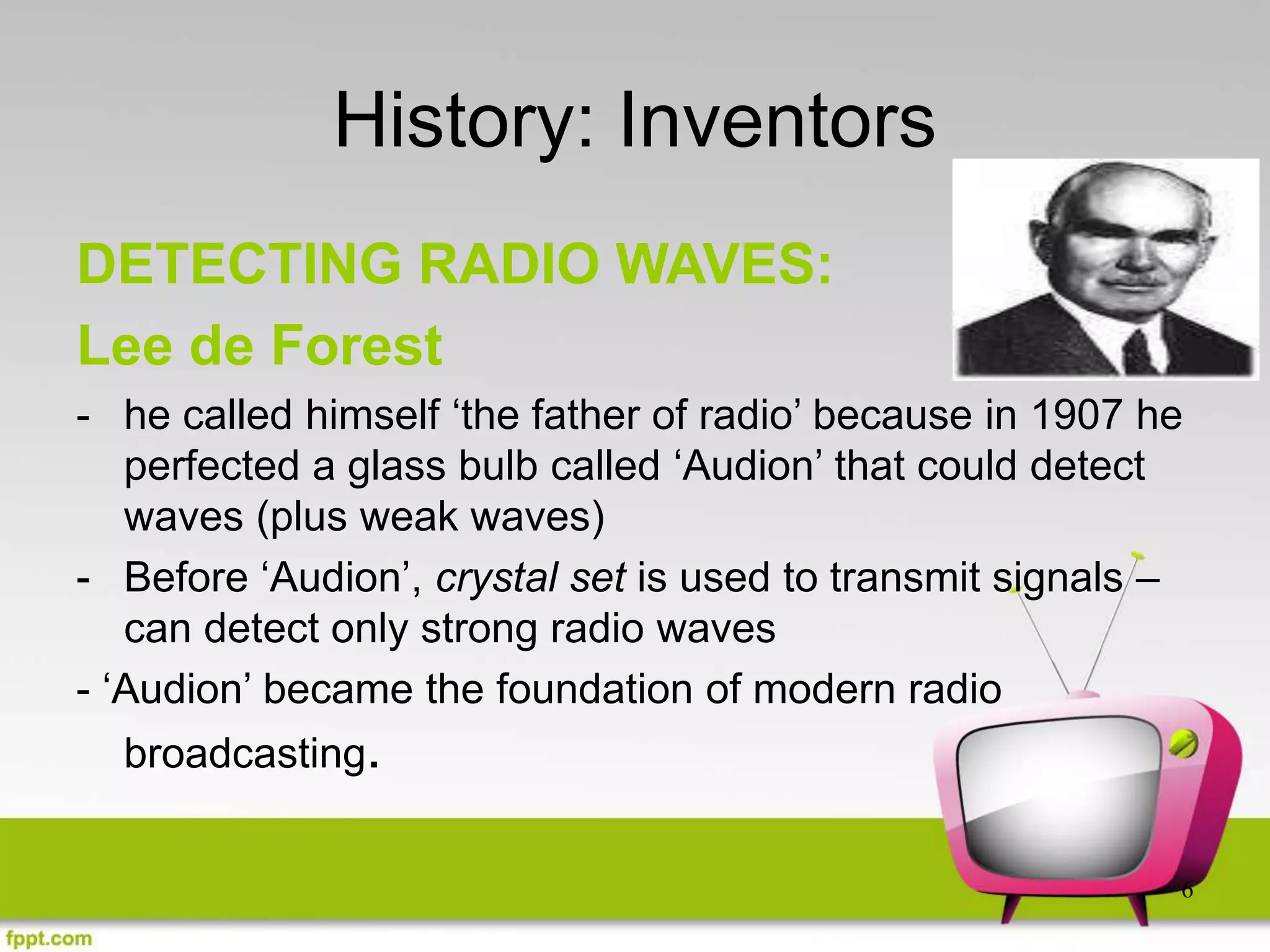
Lee de Forest
- he called himself ‘the father of radio’ because in 1907 he
perfected a glass bulb called ‘Audion’ that could detect
waves (plus weak waves)
- Before ‘Audion’, crystal set is used to transmit signals –
can detect only strong radio waves
- ‘Audion’ became the foundation of modern radio
broadcasting.
7
History of Broadcast Media
Early History (1840’s – 1900’s)
1844 – First transmission by Morse
1861 – transcontinental high speed electric
comm system coded msg
1858 – 1st transatlantic cable
1870 – undersea cables linked western
world
1876 – replacement of Morse code, voice
transmission by wire
8
History of Broadcast Media
1864 – Marconi’s experiment succeed –
wireless voice transmission
1896 – Marconi formed company to
manufacture and sell his device
1901 – Marconi transmitted wireless signals
across the Atlantic
- Fessenden & Lee De Forest – set stage
for radio broadcasting
- Lee De Forest – Father of Radio, created
Audion tube
9
History of Broadcast Media
1912 – Sarnoff demonstrated the importance
of radio
1912 – Titanic disaster
1913 – Marconi dominated radio in Europe
& US
WWI – radio become the medium for
shipping, business, military comm
1920 – Westinghouse began broadcasting
from Pittsburgh
10
History of Broadcast Media
1922 - beginning of 1922, there were 28
stations actively broadcasting
At the end of 1922, there were 570 stations
Signals interference became a major
headache
Radio was commercialized
Until 1940 – AM frequencies
11
Radio Goes to War
• During the First World War, the Navy took
control of all radio operations in the U.S.
• The Navy assumed all responsibility for
patent infringement and installed radio
equipment in all of its ships.
• By the end of the war, technology had
advanced rapidly as a result of the Navy’s
actions.
12
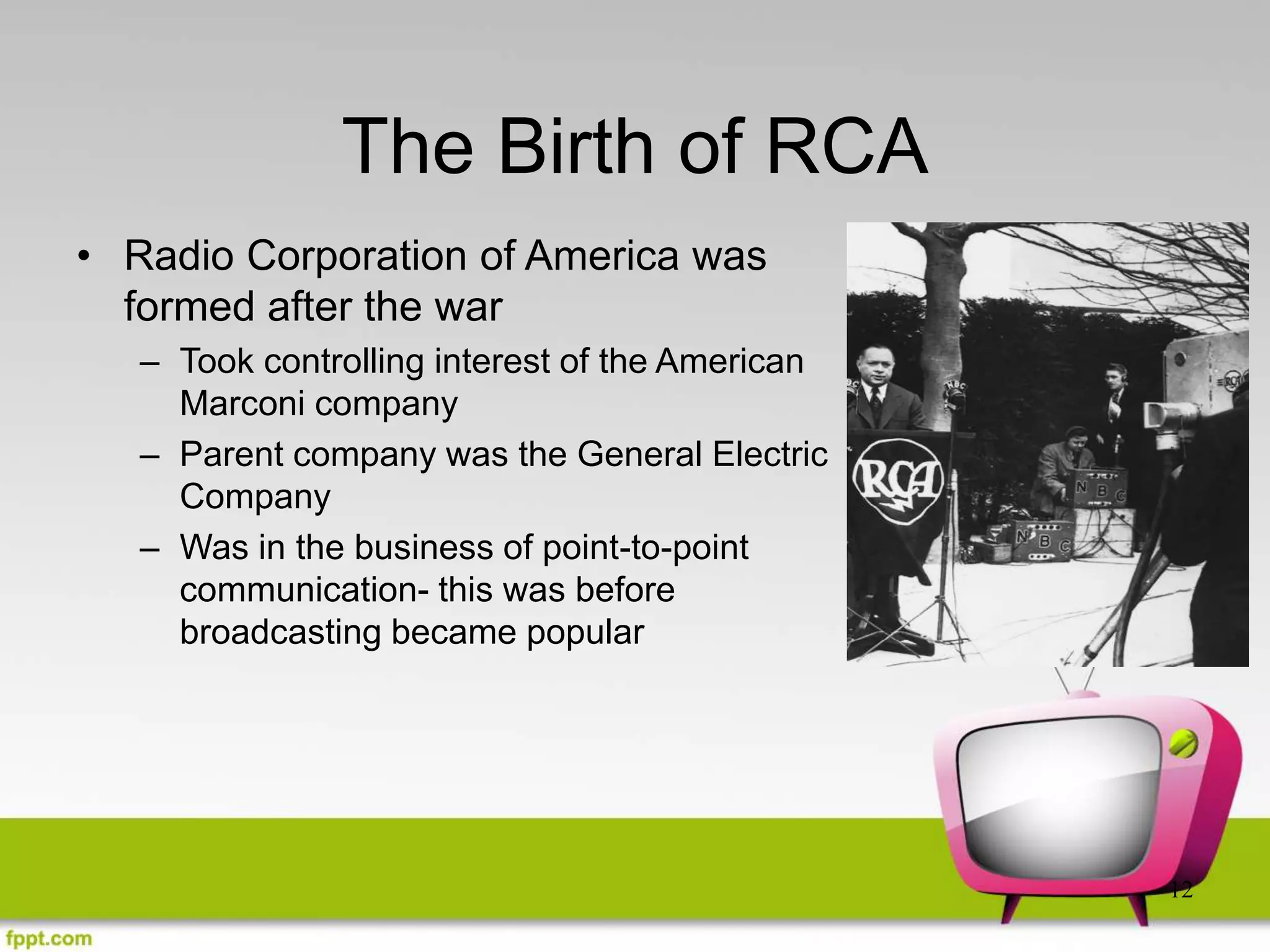
The Birth of RCA
• Radio Corporation of America was
formed after the war
– Took controlling interest of the American
Marconi company
– Parent company was the General Electric
Company
– Was in the business of point-to-point
communication- this was before
broadcasting became popular
13
The Birth of RCA
• RCA entered into a cross-licensing
scheme to solve the patent problems
• The RCA agreement allowed GE, AT&T
and Westinghouse to take advantage of
each others’ discoveries
– GE and Westinghouse would manufacture
radio equipment, RCA would sell it and AT&T
would build transmitters
14
Broadcasting’s Beginnings
• Radio burst on the scene in the 1920s
because:
– Thousands of hobbyists were trained in radio
during the war
– Technological improvements made during the
war gave radio better reception
– Business interests began to realize that
broadcasting might make money
15
Broadcasting Gets Some Rules
• The Radio Act of 1927 made some key
assumptions
– The radio spectrum was a national resource.
Individuals could not own frequencies
– Licensees would have to operate in the public
interest
16
Radio Act
Radio Act 1912 – licensing for transmitters
Radio Act 1927 – Federal Radio
Commission formed and define:
- Broadcast band
- Standardized frequency designations
- Limit the number of stations operating at
night
17
Radio Act
1926 – Radio Corp of America (RCA) setup
radio network named National
Broadcasting Corp (NBC) to share
programming costs. Change to American
Broadcasting Corp (ABC)
1928 – Competition from Columbia
Broadcasting Systems (CBS)
18
Radio Act
By 1927
• The Radio Act 1927:
- Reduced radio frequency overlap and
interference
- Assigned licenses for frequencies
• Ads more dominant
• WWII – info for war
• Towards the end, entertainment dominates
radio – radio drama
19
Radio
After WWII
1933 – Invention of FM radio
1940 – FM stations expand
1948 – more than 600 FM stations licensed
TV viewing becomes a phenomenal
20
Radio
1960
- Economic growth for radio
- Phenomenal growth for FM radio
- Advertising revenue increased slowly
- Network radio stabilized
Mid 1960’s – more than 50% FM stations operated
1965 – AM & FM combinations in cities cannot duplicate
more than 50% of other station’s programming
21
Radio
The role of radio changed with the advent of
TV
1940’s – 1960’s
- Intro of radio formats
- Intro of reliable clock and car radios
22
Radio
• SCOPE OF RADIO TODAY
Organization and industrial structures
- From national to local
- From wide range to limited program
Content
- Issue oriented
Functions
- in-house to mobility
Style
- Content and programming
- Varieties for listeners
23
Television
Audio + visual
Marconi – eliminated sound dependence on
wires and put sound on airwaves
De Forest – contributed ‘Audion’ which
amplified better audio quality
1927 – 2 inch screen by wire experimented
1928 – first dramatic production produced –
The Queen’s Messenger
24
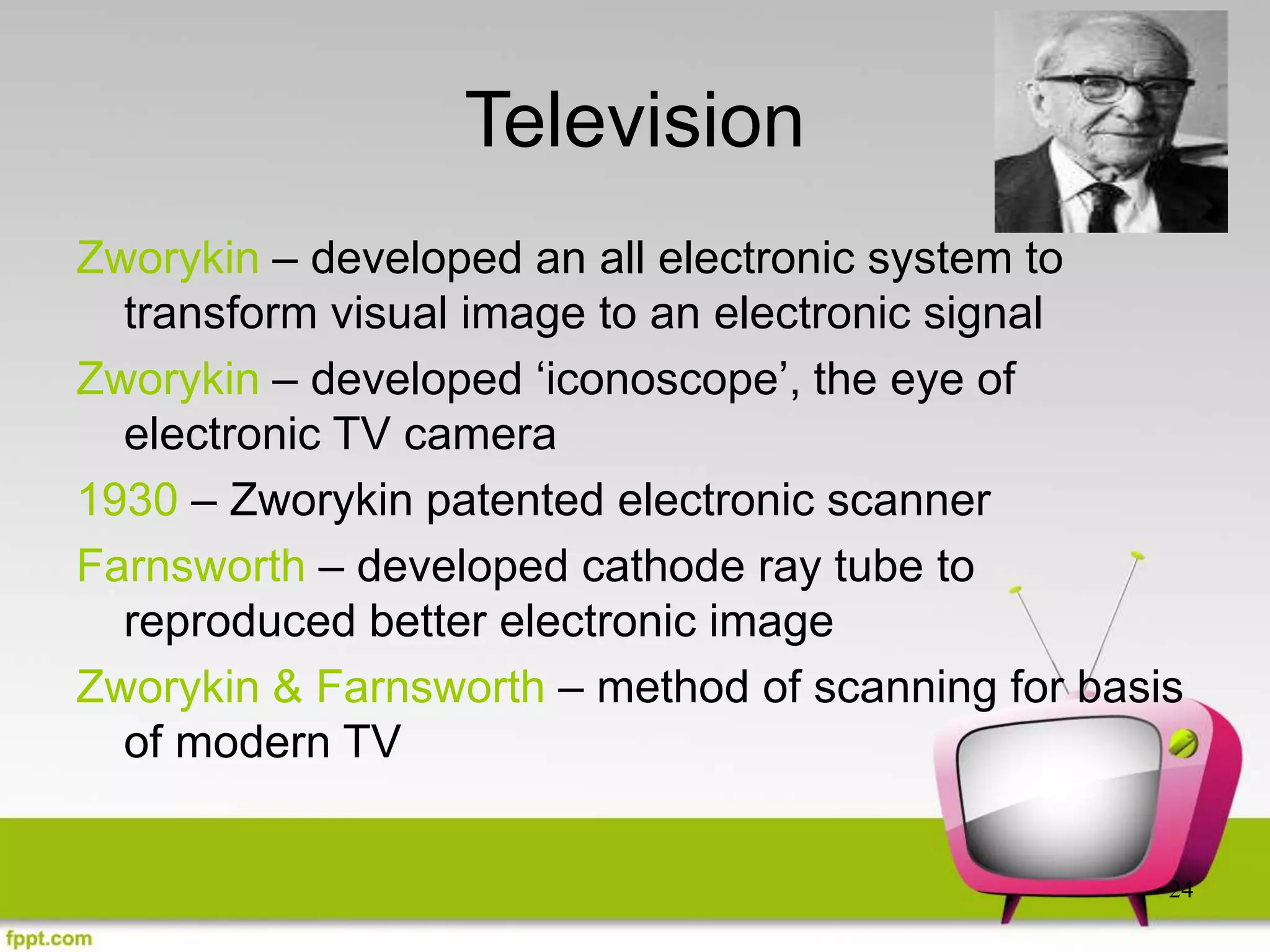
Television
Zworykin – developed an all electronic system to
transform visual image to an electronic signal
Zworykin – developed ‘iconoscope’, the eye of
electronic TV camera
1930 – Zworykin patented electronic scanner
Farnsworth – developed cathode ray tube to
reproduced better electronic image
Zworykin & Farnsworth – method of scanning for basis
of modern TV
25
Television
1930’s – experimental TV stations went on air
1940’s – TV began to conquest
1945 – Federal Communications Commission
(FCC) resumed TV licensing. 10 stations
were on air
1947 – CBS initiated news plus pictures
26
Television
War – interrupted the development of commercial TV
system
After WWII :
- Growth of TV viewing
- Shifting from radio - television
1948
- Network programming
- More stations
- Freeze on new TV stations application
- TV programming developed
- Dominant news and entertainment medium
27
Television
• Early developers of network TV came from
radio and theater practitioner
• Programs originally featured from radio
programming – variety show
• Early TV programming – comedy
dominated TV programming (1940’s -
1954)
28
Television
1954 – Color TV sets introduced
1960’s – TV developed as a force in American
society – political aspect
Programs especially sitcom and drama – begin to
hit critical point of social issues
Main events in 60’s TV:
- Vietnam war
- Assassination & funeral of Kennedy
- Civil rights movement
- Apollo 11 – moon landing
29
Television
• Period of growth
- Networks – more popular in early 1970’s
- Sitcom – shift to adult themes
- 1975 – prime time drama
- 1980 – soap opera
- Viewing level – increased
- Criticism – TV impact & role on society
30
Television
• Changes for TV
1975 – 1999 : great changes in TV industry
Competition:
- cable TV become player
- Satellite replace wires
- VCR as alternative
Mergers:
- Companies merged reshaped broadcasting
landscape
31
Television
Public TV:
- Introduced in 1967
- Owned by universities, school boards,
state govt, community organization
- Issues: Educational? General appeal?
Minority interests?
32
Television
Programming:
- Shift of programming trends – prime time
continuing episodes, sitcom
- CNN began in 1980 & prompted other
networks to expand their services
- 1990 – newsmagazine program
33
Television
Technology
1970’s – Prod equipment become smaller & handy
1970’s – 1980’s – TVRO in rural areas
1980’s – development of Satellite News Gathering
(SNG)
1990’s – Direct Satellite Broadcast (DBS) to send
programming
1990’s – Internet and www
Satellite TV, Cable TV & Videocassette players
(1960’s – 1970’s)
34
Radio’s Period of Adjustment
• TV has an impact on radio
– It completely changed radio network
broadcasting
– Radio stations began to turn to specialized
audiences
– TV brought the radio and record industry
closer
– Radio stations became more dependent on
local revenue
35
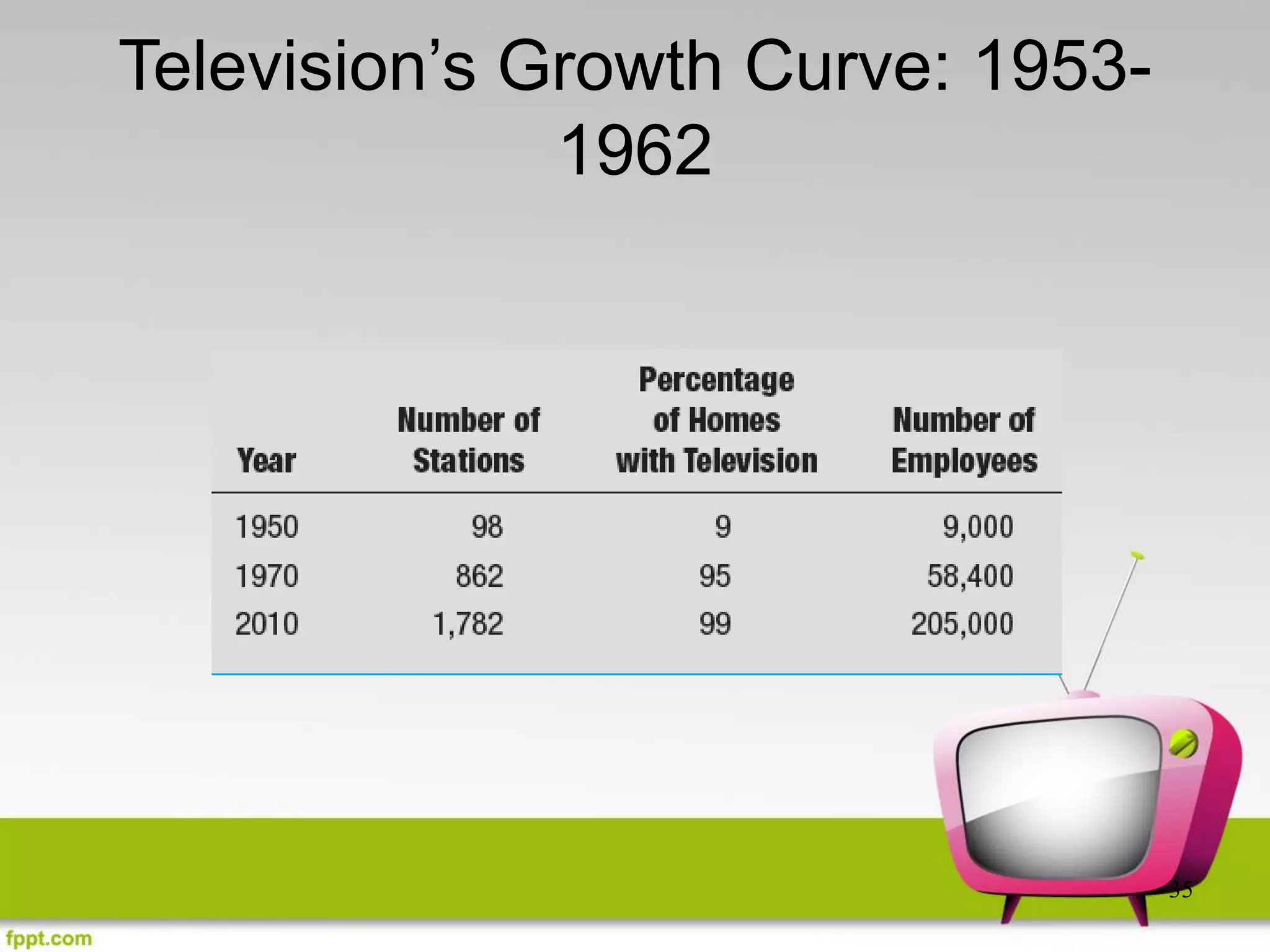
Television’s Growth Curve: 1953-
1962
36
Technological Advances
• Electronic News Gathering (ENG) revolutionizes
TV coverage
• Satellite News Gathering extends the ability to
broadcast from nearly anywhere in the world
• Emergence of the Internet and World Wide Web
• Emergence of satellite radio
37
Broadcasting in the 21st Century
• Tough economic times have effected the
electronic media
• TV broadcasting went to an all digital
system in 2009
• TV and radio can now be accessed
on iPods and cell phones

Ppt_History_of_Broadcast_Media.ppt

  • 1.
  • 2.
    2 History: Inventors • Earlyinventors and inventions paved the way for the electronic mass media • James Maxwell and Heinrich Hertz demonstrated the existence of electromagnetic radiation
  • 3.
    3 History: Inventors WIRELESS BREAKTHROUGH: GuglielmoMarconi - used the results discoveries by Morse, Hertz and Bell to expand his idea that messages should be able to travel across space without a wire. - he could ring a bell across the room or downstairs without using a wire and able to broadcast over a distance of nine miles.
  • 4.
    4 History: Inventors - ship-to-ship,ship-to-shore communication - dots and dashes (Morse code) aka telegraphy - two experimenters, Reginald Aubrey Fessenden and Lee de Forest, advanced Marconi’s discovery to create today’s radio - Eventually he developed a powerful wireless business history.
  • 5.
    5 History: Inventors EXPERIMENTAL BROADCASTS: ReginaldAubrey Fessenden - began wireless experiments in United States in 1900 when he set up his National Electric Signaling Company to attempt sending voices by radio waves. - his 1906 experiment is considered the world’s first voice and music broadcast. - Violin music – Bible reading – New Year’s wish – signed off
  • 6.
    6 History: Inventors DETECTING RADIOWAVES: Lee de Forest - he called himself ‘the father of radio’ because in 1907 he perfected a glass bulb called ‘Audion’ that could detect waves (plus weak waves) - Before ‘Audion’, crystal set is used to transmit signals – can detect only strong radio waves - ‘Audion’ became the foundation of modern radio broadcasting.
  • 7.
    7 History of BroadcastMedia Early History (1840’s – 1900’s) 1844 – First transmission by Morse 1861 – transcontinental high speed electric comm system coded msg 1858 – 1st transatlantic cable 1870 – undersea cables linked western world 1876 – replacement of Morse code, voice transmission by wire
  • 8.
    8 History of BroadcastMedia 1864 – Marconi’s experiment succeed – wireless voice transmission 1896 – Marconi formed company to manufacture and sell his device 1901 – Marconi transmitted wireless signals across the Atlantic - Fessenden & Lee De Forest – set stage for radio broadcasting - Lee De Forest – Father of Radio, created Audion tube
  • 9.
    9 History of BroadcastMedia 1912 – Sarnoff demonstrated the importance of radio 1912 – Titanic disaster 1913 – Marconi dominated radio in Europe & US WWI – radio become the medium for shipping, business, military comm 1920 – Westinghouse began broadcasting from Pittsburgh
  • 10.
    10 History of BroadcastMedia 1922 - beginning of 1922, there were 28 stations actively broadcasting At the end of 1922, there were 570 stations Signals interference became a major headache Radio was commercialized Until 1940 – AM frequencies
  • 11.
    11 Radio Goes toWar • During the First World War, the Navy took control of all radio operations in the U.S. • The Navy assumed all responsibility for patent infringement and installed radio equipment in all of its ships. • By the end of the war, technology had advanced rapidly as a result of the Navy’s actions.
  • 12.
    12 The Birth ofRCA • Radio Corporation of America was formed after the war – Took controlling interest of the American Marconi company – Parent company was the General Electric Company – Was in the business of point-to-point communication- this was before broadcasting became popular
  • 13.
    13 The Birth ofRCA • RCA entered into a cross-licensing scheme to solve the patent problems • The RCA agreement allowed GE, AT&T and Westinghouse to take advantage of each others’ discoveries – GE and Westinghouse would manufacture radio equipment, RCA would sell it and AT&T would build transmitters
  • 14.
    14 Broadcasting’s Beginnings • Radioburst on the scene in the 1920s because: – Thousands of hobbyists were trained in radio during the war – Technological improvements made during the war gave radio better reception – Business interests began to realize that broadcasting might make money
  • 15.
    15 Broadcasting Gets SomeRules • The Radio Act of 1927 made some key assumptions – The radio spectrum was a national resource. Individuals could not own frequencies – Licensees would have to operate in the public interest
  • 16.
    16 Radio Act Radio Act1912 – licensing for transmitters Radio Act 1927 – Federal Radio Commission formed and define: - Broadcast band - Standardized frequency designations - Limit the number of stations operating at night
  • 17.
    17 Radio Act 1926 –Radio Corp of America (RCA) setup radio network named National Broadcasting Corp (NBC) to share programming costs. Change to American Broadcasting Corp (ABC) 1928 – Competition from Columbia Broadcasting Systems (CBS)
  • 18.
    18 Radio Act By 1927 •The Radio Act 1927: - Reduced radio frequency overlap and interference - Assigned licenses for frequencies • Ads more dominant • WWII – info for war • Towards the end, entertainment dominates radio – radio drama
  • 19.
    19 Radio After WWII 1933 –Invention of FM radio 1940 – FM stations expand 1948 – more than 600 FM stations licensed TV viewing becomes a phenomenal
  • 20.
    20 Radio 1960 - Economic growthfor radio - Phenomenal growth for FM radio - Advertising revenue increased slowly - Network radio stabilized Mid 1960’s – more than 50% FM stations operated 1965 – AM & FM combinations in cities cannot duplicate more than 50% of other station’s programming
  • 21.
    21 Radio The role ofradio changed with the advent of TV 1940’s – 1960’s - Intro of radio formats - Intro of reliable clock and car radios
  • 22.
    22 Radio • SCOPE OFRADIO TODAY Organization and industrial structures - From national to local - From wide range to limited program Content - Issue oriented Functions - in-house to mobility Style - Content and programming - Varieties for listeners
  • 23.
    23 Television Audio + visual Marconi– eliminated sound dependence on wires and put sound on airwaves De Forest – contributed ‘Audion’ which amplified better audio quality 1927 – 2 inch screen by wire experimented 1928 – first dramatic production produced – The Queen’s Messenger
  • 24.
    24 Television Zworykin – developedan all electronic system to transform visual image to an electronic signal Zworykin – developed ‘iconoscope’, the eye of electronic TV camera 1930 – Zworykin patented electronic scanner Farnsworth – developed cathode ray tube to reproduced better electronic image Zworykin & Farnsworth – method of scanning for basis of modern TV
  • 25.
    25 Television 1930’s – experimentalTV stations went on air 1940’s – TV began to conquest 1945 – Federal Communications Commission (FCC) resumed TV licensing. 10 stations were on air 1947 – CBS initiated news plus pictures
  • 26.
    26 Television War – interruptedthe development of commercial TV system After WWII : - Growth of TV viewing - Shifting from radio - television 1948 - Network programming - More stations - Freeze on new TV stations application - TV programming developed - Dominant news and entertainment medium
  • 27.
    27 Television • Early developersof network TV came from radio and theater practitioner • Programs originally featured from radio programming – variety show • Early TV programming – comedy dominated TV programming (1940’s - 1954)
  • 28.
    28 Television 1954 – ColorTV sets introduced 1960’s – TV developed as a force in American society – political aspect Programs especially sitcom and drama – begin to hit critical point of social issues Main events in 60’s TV: - Vietnam war - Assassination & funeral of Kennedy - Civil rights movement - Apollo 11 – moon landing
  • 29.
    29 Television • Period ofgrowth - Networks – more popular in early 1970’s - Sitcom – shift to adult themes - 1975 – prime time drama - 1980 – soap opera - Viewing level – increased - Criticism – TV impact & role on society
  • 30.
    30 Television • Changes forTV 1975 – 1999 : great changes in TV industry Competition: - cable TV become player - Satellite replace wires - VCR as alternative Mergers: - Companies merged reshaped broadcasting landscape
  • 31.
    31 Television Public TV: - Introducedin 1967 - Owned by universities, school boards, state govt, community organization - Issues: Educational? General appeal? Minority interests?
  • 32.
    32 Television Programming: - Shift ofprogramming trends – prime time continuing episodes, sitcom - CNN began in 1980 & prompted other networks to expand their services - 1990 – newsmagazine program
  • 33.
    33 Television Technology 1970’s – Prodequipment become smaller & handy 1970’s – 1980’s – TVRO in rural areas 1980’s – development of Satellite News Gathering (SNG) 1990’s – Direct Satellite Broadcast (DBS) to send programming 1990’s – Internet and www Satellite TV, Cable TV & Videocassette players (1960’s – 1970’s)
  • 34.
    34 Radio’s Period ofAdjustment • TV has an impact on radio – It completely changed radio network broadcasting – Radio stations began to turn to specialized audiences – TV brought the radio and record industry closer – Radio stations became more dependent on local revenue
  • 35.
  • 36.
    36 Technological Advances • ElectronicNews Gathering (ENG) revolutionizes TV coverage • Satellite News Gathering extends the ability to broadcast from nearly anywhere in the world • Emergence of the Internet and World Wide Web • Emergence of satellite radio
  • 37.
    37 Broadcasting in the21st Century • Tough economic times have effected the electronic media • TV broadcasting went to an all digital system in 2009 • TV and radio can now be accessed on iPods and cell phones