Rules of Inference
Lecture 4, CMSC 56
Allyn Joy D. Calcaben
Templates for constructing valid arguments
Our basic tools for establishing the truth of statements
Fallacies
common forms of incorrect reasoning which lead to
invalid arguments
Rules of Inference
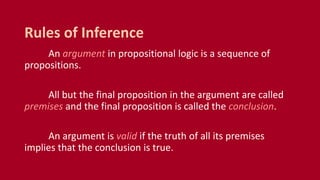
An argument in propositional logic is a sequence of
propositions.
All but the final proposition in the argument are called
premises and the final proposition is called the conclusion.
An argument is valid if the truth of all its premises
implies that the conclusion is true.
Rules of Inference
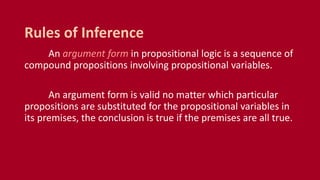
An argument form in propositional logic is a sequence of
compound propositions involving propositional variables.
An argument form is valid no matter which particular
propositions are substituted for the propositional variables in
its premises, the conclusion is true if the premises are all true.
Rules of Inference
Valid Arguments
in Propositional Logic
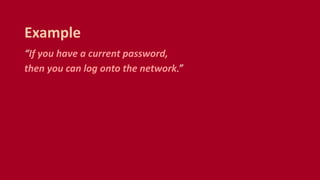
“If you have a current password,
then you can log onto the network.”
Example
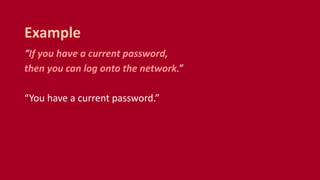
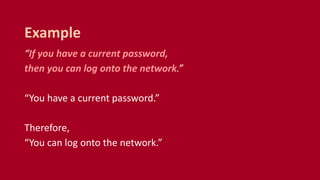
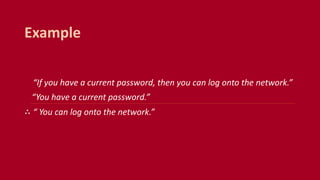
“If you have a current password,
then you can log onto the network.”
“You have a current password.”
Example
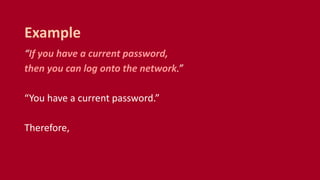
“If you have a current password,
then you can log onto the network.”
“You have a current password.”
Therefore,
Example
“If you have a current password,
then you can log onto the network.”
“You have a current password.”
Therefore,
“You can log onto the network.”
Example
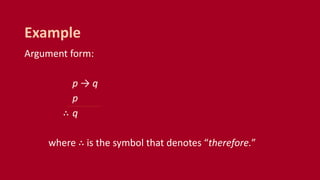
Argument form:
p → q
p
∴ q
where ∴ is the symbol that denotes “therefore.”
Example
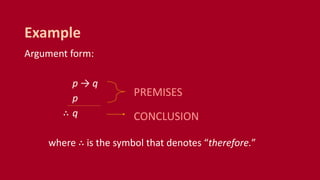
Argument form:
p → q
p
∴ q
where ∴ is the symbol that denotes “therefore.”
Example
PREMISES
CONCLUSION
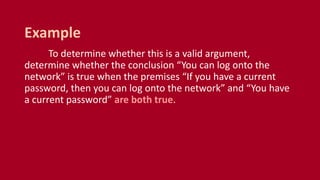
To determine whether this is a valid argument,
determine whether the conclusion “You can log onto the
network” is true when the premises “If you have a current
password, then you can log onto the network” and “You have
a current password” are both true.
Example
“If you have a current password, then you can log onto the network.”
“You have a current password.”
∴ “ You can log onto the network.”
Example
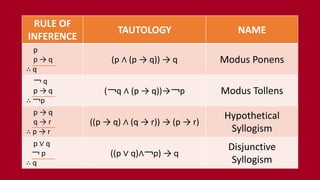
RULE OF
INFERENCE
TAUTOLOGY NAME
p
p → q
∴ q
(p ∧ (p → q)) → q Modus Ponens
¬ q
p → q
∴ ¬p
(¬q ∧ (p → q))→¬p Modus Tollens
p → q
q → r
∴ p → r
((p → q) ∧ (q → r)) → (p → r)
Hypothetical
Syllogism
p ∨ q
¬ p
∴ q
((p ∨ q)∧¬p) → q
Disjunctive
Syllogism
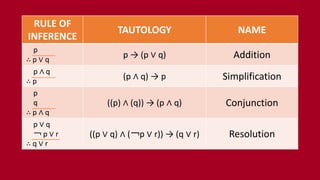
RULE OF
INFERENCE
TAUTOLOGY NAME
p
∴ p ∨ q
p → (p ∨ q) Addition
p ∧ q
∴ p
(p ∧ q) → p Simplification
p
q
∴ p ∧ q
((p) ∧ (q)) → (p ∧ q) Conjunction
p ∨ q
¬ p ∨ r
∴ q ∨ r
((p ∨ q) ∧ (¬p ∨ r)) → (q ∨ r) Resolution
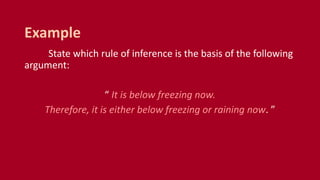
State which rule of inference is the basis of the following
argument:
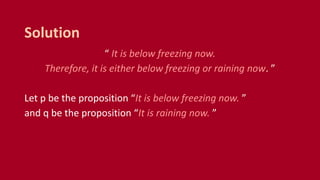
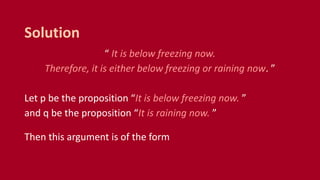
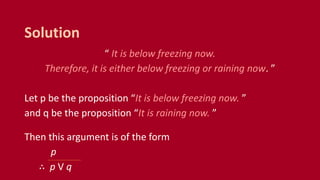
“ It is below freezing now.
Therefore, it is either below freezing or raining now. ”
Example
“ It is below freezing now.
Therefore, it is either below freezing or raining now. ”
Let p be the proposition “It is below freezing now. ”
and q be the proposition “It is raining now. ”
Solution
“ It is below freezing now.
Therefore, it is either below freezing or raining now. ”
Let p be the proposition “It is below freezing now. ”
and q be the proposition “It is raining now. ”
Then this argument is of the form
Solution
“ It is below freezing now.
Therefore, it is either below freezing or raining now. ”
Let p be the proposition “It is below freezing now. ”
and q be the proposition “It is raining now. ”
Then this argument is of the form
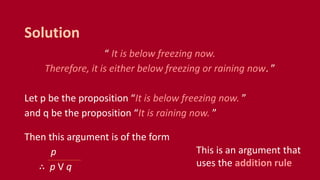
p
∴ p V q
Solution
“ It is below freezing now.
Therefore, it is either below freezing or raining now. ”
Let p be the proposition “It is below freezing now. ”
and q be the proposition “It is raining now. ”
Then this argument is of the form
p
∴ p V q
Solution
This is an argument that
uses the addition rule
State which rule of inference is the basis of the following
argument:
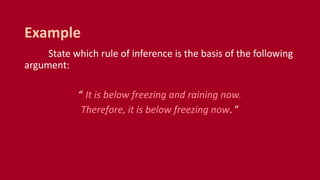
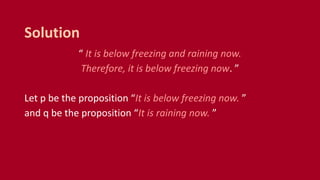
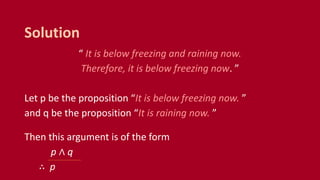
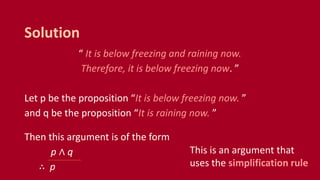
“ It is below freezing and raining now.
Therefore, it is below freezing now. ”
Example
“ It is below freezing and raining now.
Therefore, it is below freezing now. ”
Let p be the proposition “It is below freezing now. ”
and q be the proposition “It is raining now. ”
Solution
“ It is below freezing and raining now.
Therefore, it is below freezing now. ”
Let p be the proposition “It is below freezing now. ”
and q be the proposition “It is raining now. ”
Then this argument is of the form
p ∧ q
∴ p
Solution
“ It is below freezing and raining now.
Therefore, it is below freezing now. ”
Let p be the proposition “It is below freezing now. ”
and q be the proposition “It is raining now. ”
Then this argument is of the form
p ∧ q
∴ p
Solution
This is an argument that
uses the simplification rule
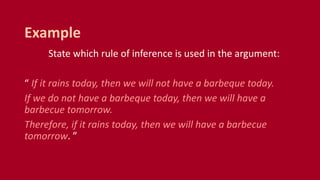
State which rule of inference is used in the argument:
“ If it rains today, then we will not have a barbeque today.
If we do not have a barbeque today, then we will have a
barbecue tomorrow.
Therefore, if it rains today, then we will have a barbecue
tomorrow. ”
Example
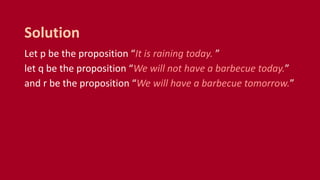
Let p be the proposition “It is raining today. ”
let q be the proposition “We will not have a barbecue today.”
and r be the proposition “We will have a barbecue tomorrow.”
Solution
Let p be the proposition “It is raining today. ”
let q be the proposition “We will not have a barbecue today.”
and r be the proposition “We will have a barbecue tomorrow.”
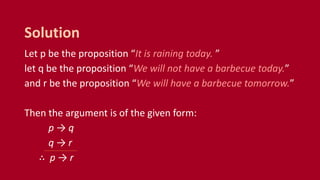
Then the argument is of the given form:
p → q
q → r
∴ p → r
Solution
Let p be the proposition “It is raining today. ”
let q be the proposition “We will not have a barbecue today.”
and r be the proposition “We will have a barbecue tomorrow.”
Then the argument is of the given form:
p → q
q → r
∴ p → r
Solution
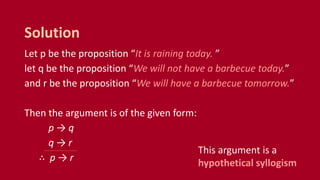
This argument is a
hypothetical syllogism
Definition 2
A formal proof of a conclusion q given hypotheses p1, p2, . . . ,
pn is a sequence of steps, each of which applies some
inference rule to hypotheses or previously proven statements
(antecedents) to yield a new true statement (the consequent).
Formal Proof
Definition 2
A formal proof of a conclusion q given hypotheses p1, p2, . . . ,
pn is a sequence of steps, each of which applies some
inference rule to hypotheses or previously proven statements
(antecedents) to yield a new true statement (the consequent).
A formal proof demonstrates that if the premises are true,
then the conclusion is true.
Formal Proof
Using Rules of Inference
to Build Arguments
Show that the premises:
“It is not sunny this afternoon and it is colder than yesterday,”
“We will go swimming only if it is sunny,”
“If we do not go swimming, then we will take a canoe trip,”
and “If we take a canoe trip, then we will be home by sunset”
lead to the conclusion “We will be home by sunset.”
Example
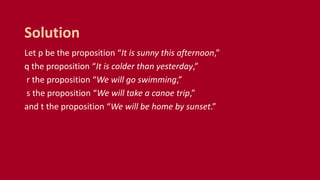
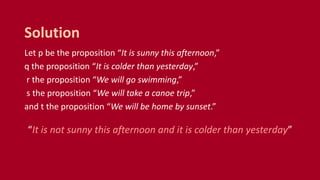
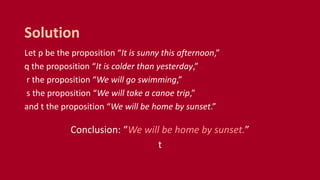
Let p be the proposition “It is sunny this afternoon,”
q the proposition “It is colder than yesterday,”
r the proposition “We will go swimming,”
s the proposition “We will take a canoe trip,”
and t the proposition “We will be home by sunset.”
Solution
Let p be the proposition “It is sunny this afternoon,”
q the proposition “It is colder than yesterday,”
r the proposition “We will go swimming,”
s the proposition “We will take a canoe trip,”
and t the proposition “We will be home by sunset.”
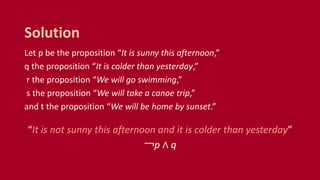
“It is not sunny this afternoon and it is colder than yesterday”
Solution
Let p be the proposition “It is sunny this afternoon,”
q the proposition “It is colder than yesterday,”
r the proposition “We will go swimming,”
s the proposition “We will take a canoe trip,”
and t the proposition “We will be home by sunset.”
“It is not sunny this afternoon and it is colder than yesterday”
¬p ∧ q
Solution
Let p be the proposition “It is sunny this afternoon,”
q the proposition “It is colder than yesterday,”
r the proposition “We will go swimming,”
s the proposition “We will take a canoe trip,”
and t the proposition “We will be home by sunset.”
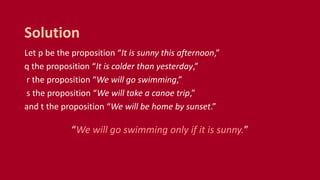
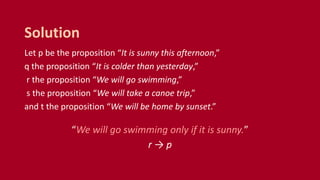
“We will go swimming only if it is sunny.”
Solution
Let p be the proposition “It is sunny this afternoon,”
q the proposition “It is colder than yesterday,”
r the proposition “We will go swimming,”
s the proposition “We will take a canoe trip,”
and t the proposition “We will be home by sunset.”
“We will go swimming only if it is sunny.”
r → p
Solution
Let p be the proposition “It is sunny this afternoon,”
q the proposition “It is colder than yesterday,”
r the proposition “We will go swimming,”
s the proposition “We will take a canoe trip,”
and t the proposition “We will be home by sunset.”
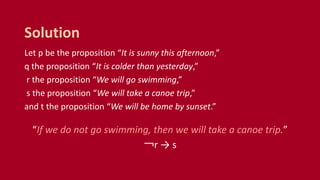
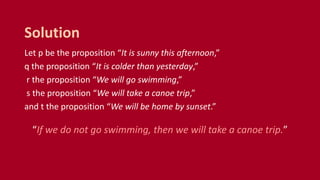
“If we do not go swimming, then we will take a canoe trip.”
Solution
Let p be the proposition “It is sunny this afternoon,”
q the proposition “It is colder than yesterday,”
r the proposition “We will go swimming,”
s the proposition “We will take a canoe trip,”
and t the proposition “We will be home by sunset.”
“If we do not go swimming, then we will take a canoe trip.”
¬r → s
Solution
Let p be the proposition “It is sunny this afternoon,”
q the proposition “It is colder than yesterday,”
r the proposition “We will go swimming,”
s the proposition “We will take a canoe trip,”
and t the proposition “We will be home by sunset.”
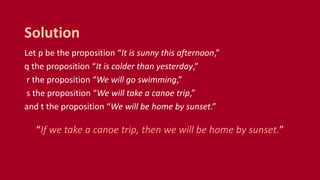
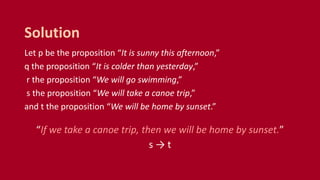
“If we take a canoe trip, then we will be home by sunset.”
Solution
Let p be the proposition “It is sunny this afternoon,”
q the proposition “It is colder than yesterday,”
r the proposition “We will go swimming,”
s the proposition “We will take a canoe trip,”
and t the proposition “We will be home by sunset.”
“If we take a canoe trip, then we will be home by sunset.”
s → t
Solution
Let p be the proposition “It is sunny this afternoon,”
q the proposition “It is colder than yesterday,”
r the proposition “We will go swimming,”
s the proposition “We will take a canoe trip,”
and t the proposition “We will be home by sunset.”
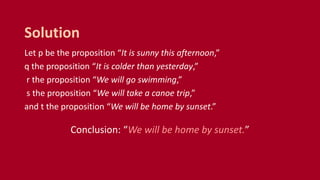
Conclusion: “We will be home by sunset.”
Solution
Let p be the proposition “It is sunny this afternoon,”
q the proposition “It is colder than yesterday,”
r the proposition “We will go swimming,”
s the proposition “We will take a canoe trip,”
and t the proposition “We will be home by sunset.”
Conclusion: “We will be home by sunset.”
t
Solution
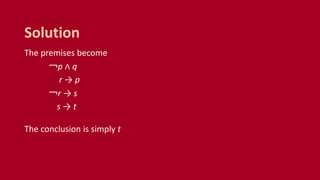
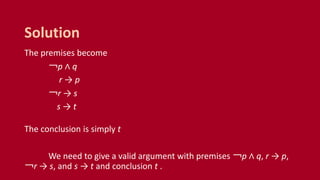
The premises become
¬p ∧ q
r → p
¬r → s
s → t
The conclusion is simply t
Solution
The premises become
¬p ∧ q
r → p
¬r → s
s → t
The conclusion is simply t
We need to give a valid argument with premises ¬p ∧ q, r → p,
¬r → s, and s → t and conclusion t .
Solution
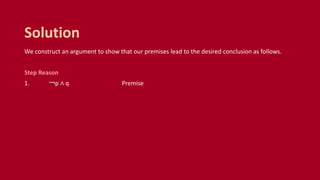
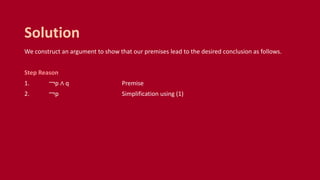
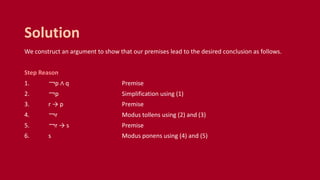
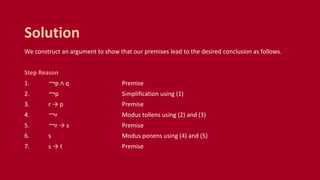
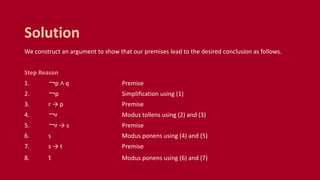
We construct an argument to show that our premises lead to the desired conclusion as follows.
Step Reason
1. ¬p ∧ q Premise
Solution
We construct an argument to show that our premises lead to the desired conclusion as follows.
Step Reason
1. ¬p ∧ q Premise
2. ¬p Simplification using (1)
Solution
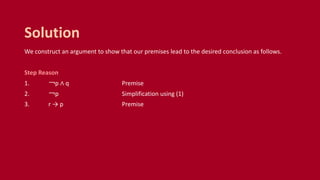
We construct an argument to show that our premises lead to the desired conclusion as follows.
Step Reason
1. ¬p ∧ q Premise
2. ¬p Simplification using (1)
3. r → p Premise
Solution
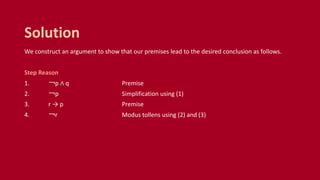
We construct an argument to show that our premises lead to the desired conclusion as follows.
Step Reason
1. ¬p ∧ q Premise
2. ¬p Simplification using (1)
3. r → p Premise
4. ¬r Modus tollens using (2) and (3)
Solution
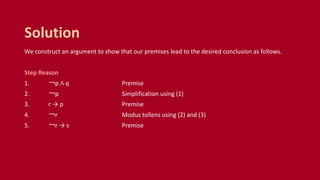
We construct an argument to show that our premises lead to the desired conclusion as follows.
Step Reason
1. ¬p ∧ q Premise
2. ¬p Simplification using (1)
3. r → p Premise
4. ¬r Modus tollens using (2) and (3)
5. ¬r → s Premise
Solution
We construct an argument to show that our premises lead to the desired conclusion as follows.
Step Reason
1. ¬p ∧ q Premise
2. ¬p Simplification using (1)
3. r → p Premise
4. ¬r Modus tollens using (2) and (3)
5. ¬r → s Premise
6. s Modus ponens using (4) and (5)
Solution
We construct an argument to show that our premises lead to the desired conclusion as follows.
Step Reason
1. ¬p ∧ q Premise
2. ¬p Simplification using (1)
3. r → p Premise
4. ¬r Modus tollens using (2) and (3)
5. ¬r → s Premise
6. s Modus ponens using (4) and (5)
7. s → t Premise
Solution
We construct an argument to show that our premises lead to the desired conclusion as follows.
Step Reason
1. ¬p ∧ q Premise
2. ¬p Simplification using (1)
3. r → p Premise
4. ¬r Modus tollens using (2) and (3)
5. ¬r → s Premise
6. s Modus ponens using (4) and (5)
7. s → t Premise
8. t Modus ponens using (6) and (7)
Solution
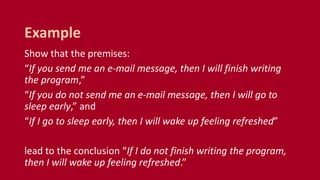
Show that the premises:
“If you send me an e-mail message, then I will finish writing
the program,”
“If you do not send me an e-mail message, then I will go to
sleep early,” and
“If I go to sleep early, then I will wake up feeling refreshed”
lead to the conclusion “If I do not finish writing the program,
then I will wake up feeling refreshed.”
Example
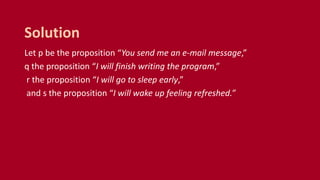
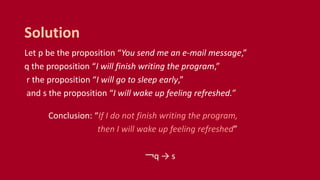
Let p be the proposition “You send me an e-mail message,”
q the proposition “I will finish writing the program,”
r the proposition “I will go to sleep early,”
and s the proposition “I will wake up feeling refreshed.”
Solution
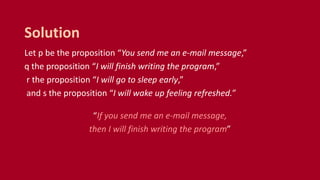
Let p be the proposition “You send me an e-mail message,”
q the proposition “I will finish writing the program,”
r the proposition “I will go to sleep early,”
and s the proposition “I will wake up feeling refreshed.”
“If you send me an e-mail message,
then I will finish writing the program”
Solution
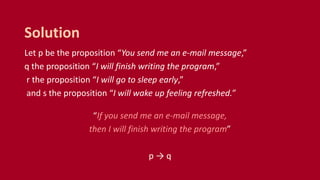
Let p be the proposition “You send me an e-mail message,”
q the proposition “I will finish writing the program,”
r the proposition “I will go to sleep early,”
and s the proposition “I will wake up feeling refreshed.”
“If you send me an e-mail message,
then I will finish writing the program”
p → q
Solution
Let p be the proposition “You send me an e-mail message,”
q the proposition “I will finish writing the program,”
r the proposition “I will go to sleep early,”
and s the proposition “I will wake up feeling refreshed.”
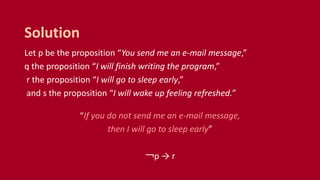
“If you do not send me an e-mail message,
then I will go to sleep early”
Solution
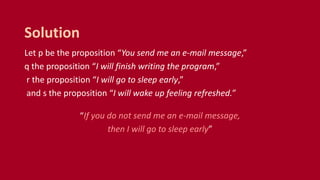
Let p be the proposition “You send me an e-mail message,”
q the proposition “I will finish writing the program,”
r the proposition “I will go to sleep early,”
and s the proposition “I will wake up feeling refreshed.”
“If you do not send me an e-mail message,
then I will go to sleep early”
¬p → r
Solution
Let p be the proposition “You send me an e-mail message,”
q the proposition “I will finish writing the program,”
r the proposition “I will go to sleep early,”
and s the proposition “I will wake up feeling refreshed.”
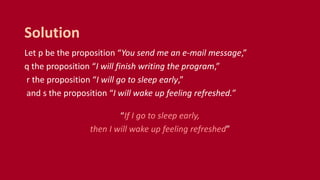
“If I go to sleep early,
then I will wake up feeling refreshed”
Solution
Let p be the proposition “You send me an e-mail message,”
q the proposition “I will finish writing the program,”
r the proposition “I will go to sleep early,”
and s the proposition “I will wake up feeling refreshed.”
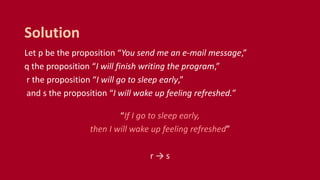
“If I go to sleep early,
then I will wake up feeling refreshed”
r → s
Solution
Let p be the proposition “You send me an e-mail message,”
q the proposition “I will finish writing the program,”
r the proposition “I will go to sleep early,”
and s the proposition “I will wake up feeling refreshed.”
Conclusion: “If I do not finish writing the program,
then I will wake up feeling refreshed”
Solution
Let p be the proposition “You send me an e-mail message,”
q the proposition “I will finish writing the program,”
r the proposition “I will go to sleep early,”
and s the proposition “I will wake up feeling refreshed.”
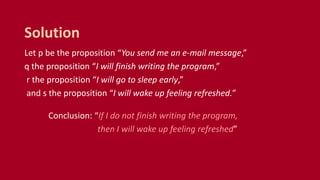
Conclusion: “If I do not finish writing the program,
then I will wake up feeling refreshed”
¬q → s
Solution
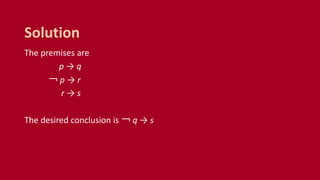
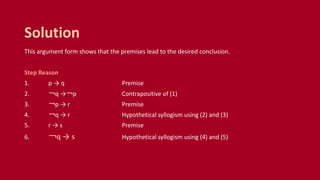
The premises are
p → q
¬ p → r
r → s
The desired conclusion is ¬ q → s
Solution
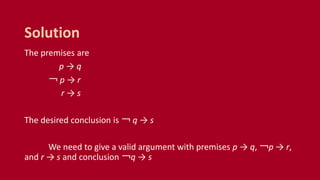
The premises are
p → q
¬ p → r
r → s
The desired conclusion is ¬ q → s
We need to give a valid argument with premises p → q, ¬p → r,
and r → s and conclusion ¬q → s
Solution
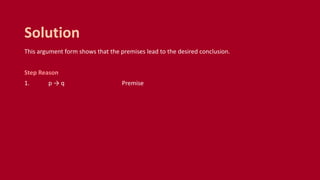
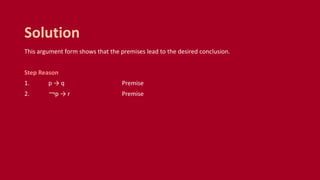
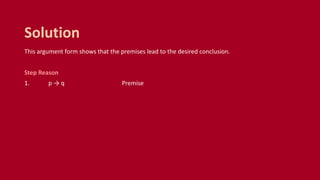
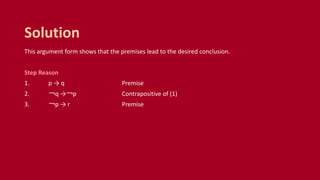
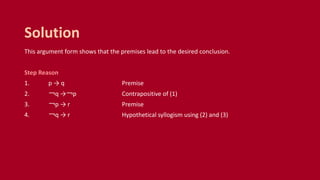
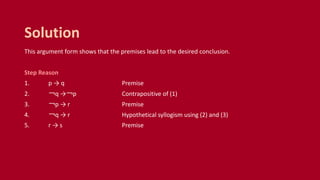
This argument form shows that the premises lead to the desired conclusion.
Step Reason
1. p → q Premise
Solution
This argument form shows that the premises lead to the desired conclusion.
Step Reason
1. p → q Premise
2. ¬p → r Premise
Solution
This argument form shows that the premises lead to the desired conclusion.
Step Reason
1. p → q Premise
2. ¬p → r Premise
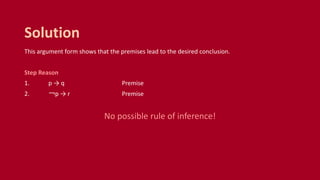
No possible rule of inference!
Solution
This argument form shows that the premises lead to the desired conclusion.
Step Reason
1. p → q Premise
Solution
This argument form shows that the premises lead to the desired conclusion.
Step Reason
1. p → q Premise
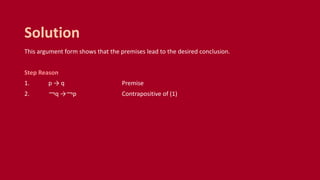
2. ¬q →¬p Contrapositive of (1)
Solution
This argument form shows that the premises lead to the desired conclusion.
Step Reason
1. p → q Premise
2. ¬q →¬p Contrapositive of (1)
3. ¬p → r Premise
Solution
This argument form shows that the premises lead to the desired conclusion.
Step Reason
1. p → q Premise
2. ¬q →¬p Contrapositive of (1)
3. ¬p → r Premise
4. ¬q → r Hypothetical syllogism using (2) and (3)
Solution
This argument form shows that the premises lead to the desired conclusion.
Step Reason
1. p → q Premise
2. ¬q →¬p Contrapositive of (1)
3. ¬p → r Premise
4. ¬q → r Hypothetical syllogism using (2) and (3)
5. r → s Premise
Solution
This argument form shows that the premises lead to the desired conclusion.
Step Reason
1. p → q Premise
2. ¬q →¬p Contrapositive of (1)
3. ¬p → r Premise
4. ¬q → r Hypothetical syllogism using (2) and (3)
5. r → s Premise
6. ¬q → s Hypothetical syllogism using (4) and (5)
Solution
Resolution
A rule of inference used by many Computer programs to
automate the task of reasoning and proving theorems.
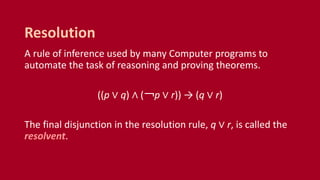
Resolution
A rule of inference used by many Computer programs to
automate the task of reasoning and proving theorems.
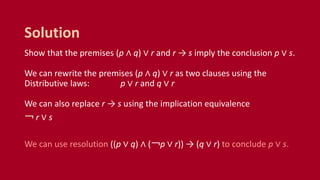
((p ∨ q) ∧ (¬p ∨ r)) → (q ∨ r)
The final disjunction in the resolution rule, q ∨ r, is called the
resolvent.
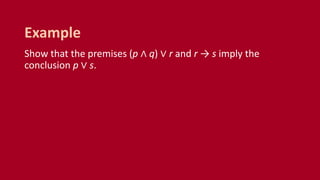
Resolution
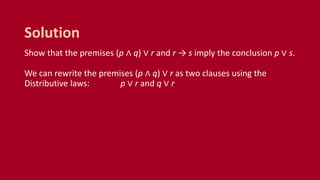
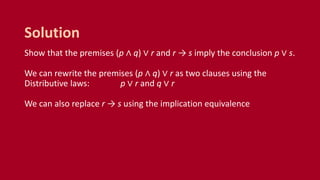
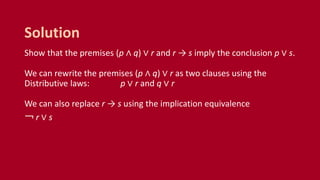
Show that the premises (p ∧ q) ∨ r and r → s imply the
conclusion p ∨ s.
Example
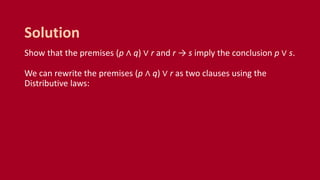
Show that the premises (p ∧ q) ∨ r and r → s imply the conclusion p ∨ s.
We can rewrite the premises (p ∧ q) ∨ r as two clauses using the
Distributive laws:
Solution
Show that the premises (p ∧ q) ∨ r and r → s imply the conclusion p ∨ s.
We can rewrite the premises (p ∧ q) ∨ r as two clauses using the
Distributive laws: p ∨ r and q ∨ r
Solution
Show that the premises (p ∧ q) ∨ r and r → s imply the conclusion p ∨ s.
We can rewrite the premises (p ∧ q) ∨ r as two clauses using the
Distributive laws: p ∨ r and q ∨ r
We can also replace r → s using the implication equivalence
Solution
Show that the premises (p ∧ q) ∨ r and r → s imply the conclusion p ∨ s.
We can rewrite the premises (p ∧ q) ∨ r as two clauses using the
Distributive laws: p ∨ r and q ∨ r
We can also replace r → s using the implication equivalence
¬ r ∨ s
Solution
Show that the premises (p ∧ q) ∨ r and r → s imply the conclusion p ∨ s.
We can rewrite the premises (p ∧ q) ∨ r as two clauses using the
Distributive laws: p ∨ r and q ∨ r
We can also replace r → s using the implication equivalence
¬ r ∨ s
We can use resolution ((p ∨ q) ∧ (¬p ∨ r)) → (q ∨ r) to conclude p ∨ s.
Solution
Rules of Inference
For Quantified Statements
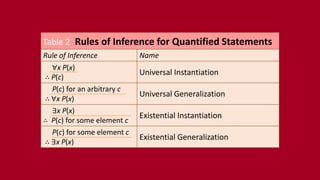
Table 2 Rules of Inference for Quantified Statements
Rule of Inference Name
∀x P(x)
∴ P(c)
Universal Instantiation
P(c) for an arbitrary c
∴ ∀x P(x)
Universal Generalization
∃x P(x)
∴ P(c) for some element c
Existential Instantiation
P(c) for some element c
∴ ∃x P(x)
Existential Generalization
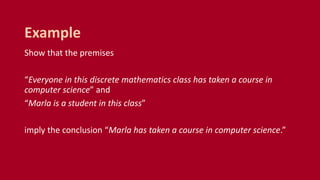
Show that the premises
“Everyone in this discrete mathematics class has taken a course in
computer science” and
“Marla is a student in this class”
imply the conclusion “Marla has taken a course in computer science.”
Example
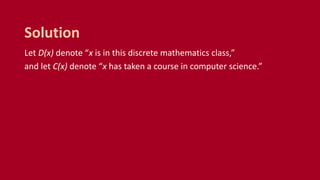
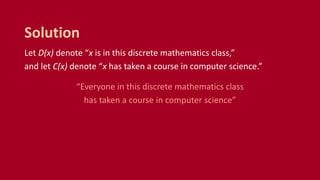
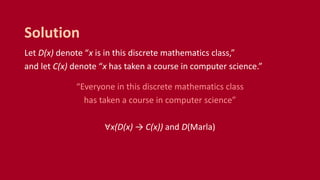
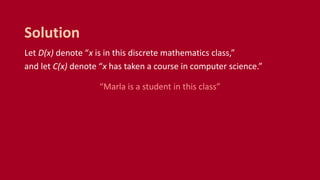
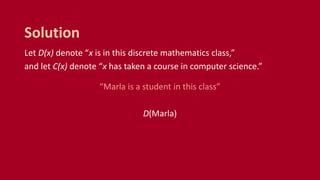
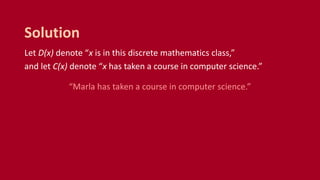
Let D(x) denote “x is in this discrete mathematics class,”
and let C(x) denote “x has taken a course in computer science.”
Solution
Let D(x) denote “x is in this discrete mathematics class,”
and let C(x) denote “x has taken a course in computer science.”
“Everyone in this discrete mathematics class
has taken a course in computer science”
Solution
Let D(x) denote “x is in this discrete mathematics class,”
and let C(x) denote “x has taken a course in computer science.”
“Everyone in this discrete mathematics class
has taken a course in computer science”
∀x(D(x) → C(x)) and D(Marla)
Solution
Let D(x) denote “x is in this discrete mathematics class,”
and let C(x) denote “x has taken a course in computer science.”
“Marla is a student in this class”
Solution
Let D(x) denote “x is in this discrete mathematics class,”
and let C(x) denote “x has taken a course in computer science.”
“Marla is a student in this class”
D(Marla)
Solution
Let D(x) denote “x is in this discrete mathematics class,”
and let C(x) denote “x has taken a course in computer science.”
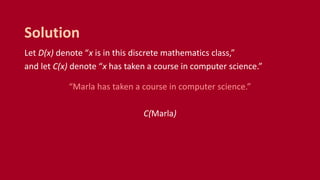
“Marla has taken a course in computer science.”
Solution
Let D(x) denote “x is in this discrete mathematics class,”
and let C(x) denote “x has taken a course in computer science.”
“Marla has taken a course in computer science.”
C(Marla)
Solution
Premises:
∀x(D(x) → C(x))
D(Marla)
Conclusion: C(Marla)
Solution
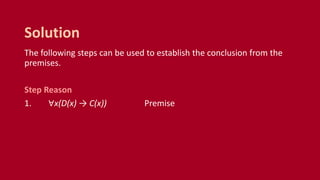
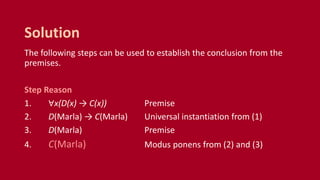
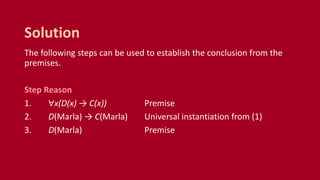
The following steps can be used to establish the conclusion from the
premises.
Step Reason
1. ∀x(D(x) → C(x)) Premise
Solution
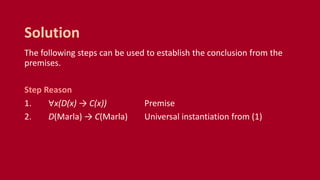
The following steps can be used to establish the conclusion from the
premises.
Step Reason
1. ∀x(D(x) → C(x)) Premise
2. D(Marla) → C(Marla) Universal instantiation from (1)
Solution
The following steps can be used to establish the conclusion from the
premises.
Step Reason
1. ∀x(D(x) → C(x)) Premise
2. D(Marla) → C(Marla) Universal instantiation from (1)
3. D(Marla) Premise
Solution
The following steps can be used to establish the conclusion from the
premises.
Step Reason
1. ∀x(D(x) → C(x)) Premise
2. D(Marla) → C(Marla) Universal instantiation from (1)
3. D(Marla) Premise
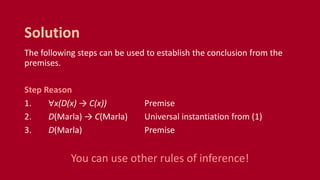
You can use other rules of inference!
Solution
The following steps can be used to establish the conclusion from the
premises.
Step Reason
1. ∀x(D(x) → C(x)) Premise
2. D(Marla) → C(Marla) Universal instantiation from (1)
3. D(Marla) Premise
4. C(Marla) Modus ponens from (2) and (3)
Solution
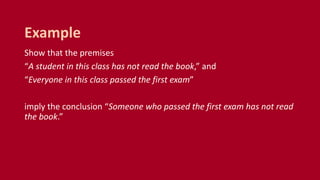
Show that the premises
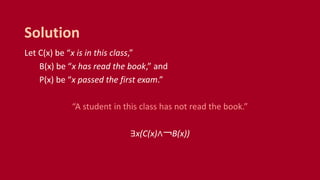
“A student in this class has not read the book,” and
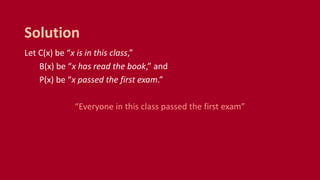
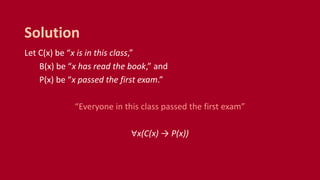
“Everyone in this class passed the first exam”
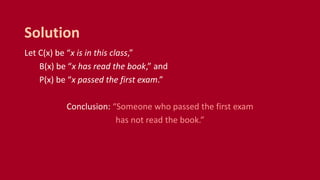
imply the conclusion “Someone who passed the first exam has not read
the book.”
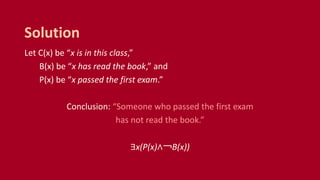
Example
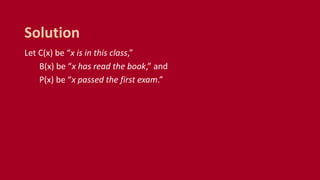
Let C(x) be “x is in this class,”
B(x) be “x has read the book,” and
P(x) be “x passed the first exam.”
Solution
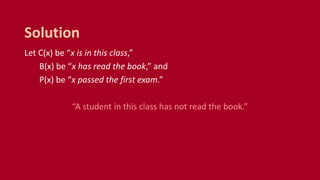
Let C(x) be “x is in this class,”
B(x) be “x has read the book,” and
P(x) be “x passed the first exam.”
“A student in this class has not read the book.”
Solution
Let C(x) be “x is in this class,”
B(x) be “x has read the book,” and
P(x) be “x passed the first exam.”
“A student in this class has not read the book.”
∃x(C(x)∧¬B(x))
Solution
Let C(x) be “x is in this class,”
B(x) be “x has read the book,” and
P(x) be “x passed the first exam.”
“Everyone in this class passed the first exam”
Solution
Let C(x) be “x is in this class,”
B(x) be “x has read the book,” and
P(x) be “x passed the first exam.”
“Everyone in this class passed the first exam”
∀x(C(x) → P(x))
Solution
Let C(x) be “x is in this class,”
B(x) be “x has read the book,” and
P(x) be “x passed the first exam.”
Conclusion: “Someone who passed the first exam
has not read the book.”
Solution
Let C(x) be “x is in this class,”
B(x) be “x has read the book,” and
P(x) be “x passed the first exam.”
Conclusion: “Someone who passed the first exam
has not read the book.”
∃x(P(x)∧¬B(x))
Solution
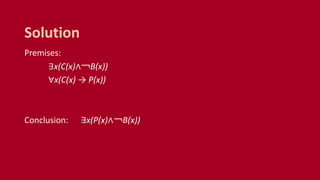
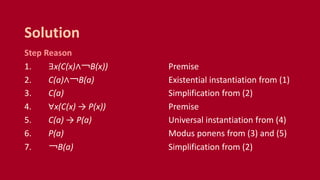
Premises:
∃x(C(x)∧¬B(x))
∀x(C(x) → P(x))
Conclusion: ∃x(P(x)∧¬B(x))
Solution
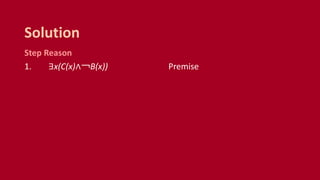
Step Reason
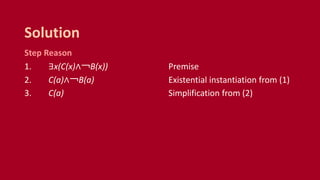
1. ∃x(C(x)∧¬B(x)) Premise
Solution
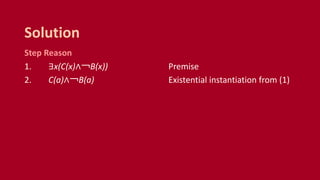
Step Reason
1. ∃x(C(x)∧¬B(x)) Premise
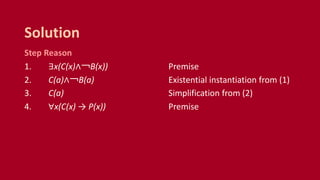
2. C(a)∧¬B(a) Existential instantiation from (1)
Solution
Step Reason
1. ∃x(C(x)∧¬B(x)) Premise
2. C(a)∧¬B(a) Existential instantiation from (1)
3. C(a) Simplification from (2)
Solution
Step Reason
1. ∃x(C(x)∧¬B(x)) Premise
2. C(a)∧¬B(a) Existential instantiation from (1)
3. C(a) Simplification from (2)
4. ∀x(C(x) → P(x)) Premise
Solution
Step Reason
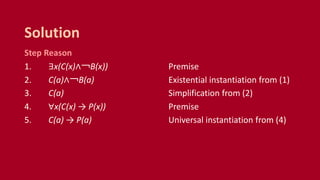
1. ∃x(C(x)∧¬B(x)) Premise
2. C(a)∧¬B(a) Existential instantiation from (1)
3. C(a) Simplification from (2)
4. ∀x(C(x) → P(x)) Premise
5. C(a) → P(a) Universal instantiation from (4)
Solution
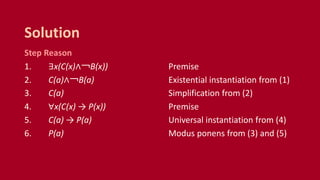
Step Reason
1. ∃x(C(x)∧¬B(x)) Premise
2. C(a)∧¬B(a) Existential instantiation from (1)
3. C(a) Simplification from (2)
4. ∀x(C(x) → P(x)) Premise
5. C(a) → P(a) Universal instantiation from (4)
6. P(a) Modus ponens from (3) and (5)
Solution
Step Reason
1. ∃x(C(x)∧¬B(x)) Premise
2. C(a)∧¬B(a) Existential instantiation from (1)
3. C(a) Simplification from (2)
4. ∀x(C(x) → P(x)) Premise
5. C(a) → P(a) Universal instantiation from (4)
6. P(a) Modus ponens from (3) and (5)
7. ¬B(a) Simplification from (2)
Solution
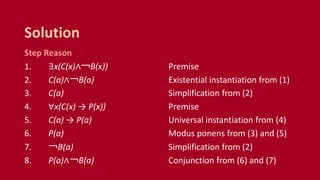
Step Reason
1. ∃x(C(x)∧¬B(x)) Premise
2. C(a)∧¬B(a) Existential instantiation from (1)
3. C(a) Simplification from (2)
4. ∀x(C(x) → P(x)) Premise
5. C(a) → P(a) Universal instantiation from (4)
6. P(a) Modus ponens from (3) and (5)
7. ¬B(a) Simplification from (2)
8. P(a)∧¬B(a) Conjunction from (6) and (7)
Solution
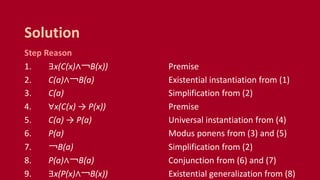
Step Reason
1. ∃x(C(x)∧¬B(x)) Premise
2. C(a)∧¬B(a) Existential instantiation from (1)
3. C(a) Simplification from (2)
4. ∀x(C(x) → P(x)) Premise
5. C(a) → P(a) Universal instantiation from (4)
6. P(a) Modus ponens from (3) and (5)
7. ¬B(a) Simplification from (2)
8. P(a)∧¬B(a) Conjunction from (6) and (7)
9. ∃x(P(x)∧¬B(x)) Existential generalization from (8)
Solution
Combining Rules of Inference for
Propositions and Quantified Statements
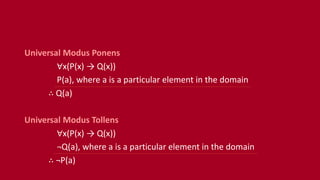
Universal Modus Ponens
∀x(P(x) → Q(x))
P(a), where a is a particular element in the domain
∴ Q(a)
Universal Modus Tollens
∀x(P(x) → Q(x))
¬Q(a), where a is a particular element in the domain
∴ ¬P(a)
Any Question?
Assignment will be posted later.
Deadline: September 7, 2018 (Friday)
1st Long Exam Schedule
Sept. 18 (Part 1) & Sept. 21 (Part 2),
4PM – 5:30PM @ CL2 and CL4
Announcement
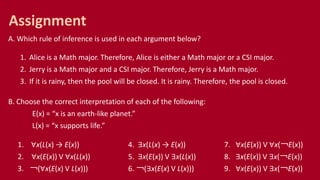
A. Which rule of inference is used in each argument below?
1. Alice is a Math major. Therefore, Alice is either a Math major or a CSI major.
2. Jerry is a Math major and a CSI major. Therefore, Jerry is a Math major.
3. If it is rainy, then the pool will be closed. It is rainy. Therefore, the pool is closed.
B. Choose the correct interpretation of each of the following:
E(x) = “x is an earth-like planet.”
L(x) = “x supports life.”
1. ∀x(L(x) → E(x)) 4. ∃x(L(x) → E(x)) 7. ∀x(E(x)) V ∀x(¬E(x))
2. ∀x(E(x)) V ∀x(L(x)) 5. ∃x(E(x)) V ∃x(L(x)) 8. ∃x(E(x)) V ∃x(¬E(x))
3. ¬(∀x(E(x) V L(x))) 6. ¬(∃x(E(x) V L(x))) 9. ∀x(E(x)) V ∃x(¬E(x))
Assignment
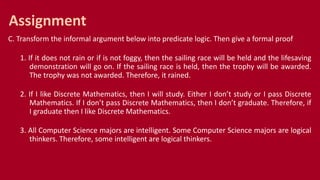
C. Transform the informal argument below into predicate logic. Then give a formal proof
1. If it does not rain or if is not foggy, then the sailing race will be held and the lifesaving
demonstration will go on. If the sailing race is held, then the trophy will be awarded.
The trophy was not awarded. Therefore, it rained.
2. If I like Discrete Mathematics, then I will study. Either I don’t study or I pass Discrete
Mathematics. If I don’t pass Discrete Mathematics, then I don’t graduate. Therefore, if
I graduate then I like Discrete Mathematics.
3. All Computer Science majors are intelligent. Some Computer Science majors are logical
thinkers. Therefore, some intelligent are logical thinkers.
Assignment

CMSC 56 | Lecture 4: Rules of Inference

  • 1.
    Rules of Inference Lecture4, CMSC 56 Allyn Joy D. Calcaben
  • 2.
    Templates for constructingvalid arguments Our basic tools for establishing the truth of statements Fallacies common forms of incorrect reasoning which lead to invalid arguments Rules of Inference
  • 3.
    An argument inpropositional logic is a sequence of propositions. All but the final proposition in the argument are called premises and the final proposition is called the conclusion. An argument is valid if the truth of all its premises implies that the conclusion is true. Rules of Inference
  • 4.
    An argument formin propositional logic is a sequence of compound propositions involving propositional variables. An argument form is valid no matter which particular propositions are substituted for the propositional variables in its premises, the conclusion is true if the premises are all true. Rules of Inference
  • 5.
  • 6.
    “If you havea current password, then you can log onto the network.” Example
  • 7.
    “If you havea current password, then you can log onto the network.” “You have a current password.” Example
  • 8.
    “If you havea current password, then you can log onto the network.” “You have a current password.” Therefore, Example
  • 9.
    “If you havea current password, then you can log onto the network.” “You have a current password.” Therefore, “You can log onto the network.” Example
  • 10.
    Argument form: p →q p ∴ q where ∴ is the symbol that denotes “therefore.” Example
  • 11.
    Argument form: p →q p ∴ q where ∴ is the symbol that denotes “therefore.” Example PREMISES CONCLUSION
  • 12.
    To determine whetherthis is a valid argument, determine whether the conclusion “You can log onto the network” is true when the premises “If you have a current password, then you can log onto the network” and “You have a current password” are both true. Example
  • 13.
    “If you havea current password, then you can log onto the network.” “You have a current password.” ∴ “ You can log onto the network.” Example
  • 14.
    RULE OF INFERENCE TAUTOLOGY NAME p p→ q ∴ q (p ∧ (p → q)) → q Modus Ponens ¬ q p → q ∴ ¬p (¬q ∧ (p → q))→¬p Modus Tollens p → q q → r ∴ p → r ((p → q) ∧ (q → r)) → (p → r) Hypothetical Syllogism p ∨ q ¬ p ∴ q ((p ∨ q)∧¬p) → q Disjunctive Syllogism
  • 15.
    RULE OF INFERENCE TAUTOLOGY NAME p ∴p ∨ q p → (p ∨ q) Addition p ∧ q ∴ p (p ∧ q) → p Simplification p q ∴ p ∧ q ((p) ∧ (q)) → (p ∧ q) Conjunction p ∨ q ¬ p ∨ r ∴ q ∨ r ((p ∨ q) ∧ (¬p ∨ r)) → (q ∨ r) Resolution
  • 16.
    State which ruleof inference is the basis of the following argument: “ It is below freezing now. Therefore, it is either below freezing or raining now. ” Example
  • 17.
    “ It isbelow freezing now. Therefore, it is either below freezing or raining now. ” Let p be the proposition “It is below freezing now. ” and q be the proposition “It is raining now. ” Solution
  • 18.
    “ It isbelow freezing now. Therefore, it is either below freezing or raining now. ” Let p be the proposition “It is below freezing now. ” and q be the proposition “It is raining now. ” Then this argument is of the form Solution
  • 19.
    “ It isbelow freezing now. Therefore, it is either below freezing or raining now. ” Let p be the proposition “It is below freezing now. ” and q be the proposition “It is raining now. ” Then this argument is of the form p ∴ p V q Solution
  • 20.
    “ It isbelow freezing now. Therefore, it is either below freezing or raining now. ” Let p be the proposition “It is below freezing now. ” and q be the proposition “It is raining now. ” Then this argument is of the form p ∴ p V q Solution This is an argument that uses the addition rule
  • 21.
    State which ruleof inference is the basis of the following argument: “ It is below freezing and raining now. Therefore, it is below freezing now. ” Example
  • 22.
    “ It isbelow freezing and raining now. Therefore, it is below freezing now. ” Let p be the proposition “It is below freezing now. ” and q be the proposition “It is raining now. ” Solution
  • 23.
    “ It isbelow freezing and raining now. Therefore, it is below freezing now. ” Let p be the proposition “It is below freezing now. ” and q be the proposition “It is raining now. ” Then this argument is of the form p ∧ q ∴ p Solution
  • 24.
    “ It isbelow freezing and raining now. Therefore, it is below freezing now. ” Let p be the proposition “It is below freezing now. ” and q be the proposition “It is raining now. ” Then this argument is of the form p ∧ q ∴ p Solution This is an argument that uses the simplification rule
  • 25.
    State which ruleof inference is used in the argument: “ If it rains today, then we will not have a barbeque today. If we do not have a barbeque today, then we will have a barbecue tomorrow. Therefore, if it rains today, then we will have a barbecue tomorrow. ” Example
  • 26.
    Let p bethe proposition “It is raining today. ” let q be the proposition “We will not have a barbecue today.” and r be the proposition “We will have a barbecue tomorrow.” Solution
  • 27.
    Let p bethe proposition “It is raining today. ” let q be the proposition “We will not have a barbecue today.” and r be the proposition “We will have a barbecue tomorrow.” Then the argument is of the given form: p → q q → r ∴ p → r Solution
  • 28.
    Let p bethe proposition “It is raining today. ” let q be the proposition “We will not have a barbecue today.” and r be the proposition “We will have a barbecue tomorrow.” Then the argument is of the given form: p → q q → r ∴ p → r Solution This argument is a hypothetical syllogism
  • 29.
    Definition 2 A formalproof of a conclusion q given hypotheses p1, p2, . . . , pn is a sequence of steps, each of which applies some inference rule to hypotheses or previously proven statements (antecedents) to yield a new true statement (the consequent). Formal Proof
  • 30.
    Definition 2 A formalproof of a conclusion q given hypotheses p1, p2, . . . , pn is a sequence of steps, each of which applies some inference rule to hypotheses or previously proven statements (antecedents) to yield a new true statement (the consequent). A formal proof demonstrates that if the premises are true, then the conclusion is true. Formal Proof
  • 31.
    Using Rules ofInference to Build Arguments
  • 32.
    Show that thepremises: “It is not sunny this afternoon and it is colder than yesterday,” “We will go swimming only if it is sunny,” “If we do not go swimming, then we will take a canoe trip,” and “If we take a canoe trip, then we will be home by sunset” lead to the conclusion “We will be home by sunset.” Example
  • 33.
    Let p bethe proposition “It is sunny this afternoon,” q the proposition “It is colder than yesterday,” r the proposition “We will go swimming,” s the proposition “We will take a canoe trip,” and t the proposition “We will be home by sunset.” Solution
  • 34.
    Let p bethe proposition “It is sunny this afternoon,” q the proposition “It is colder than yesterday,” r the proposition “We will go swimming,” s the proposition “We will take a canoe trip,” and t the proposition “We will be home by sunset.” “It is not sunny this afternoon and it is colder than yesterday” Solution
  • 35.
    Let p bethe proposition “It is sunny this afternoon,” q the proposition “It is colder than yesterday,” r the proposition “We will go swimming,” s the proposition “We will take a canoe trip,” and t the proposition “We will be home by sunset.” “It is not sunny this afternoon and it is colder than yesterday” ¬p ∧ q Solution
  • 36.
    Let p bethe proposition “It is sunny this afternoon,” q the proposition “It is colder than yesterday,” r the proposition “We will go swimming,” s the proposition “We will take a canoe trip,” and t the proposition “We will be home by sunset.” “We will go swimming only if it is sunny.” Solution
  • 37.
    Let p bethe proposition “It is sunny this afternoon,” q the proposition “It is colder than yesterday,” r the proposition “We will go swimming,” s the proposition “We will take a canoe trip,” and t the proposition “We will be home by sunset.” “We will go swimming only if it is sunny.” r → p Solution
  • 38.
    Let p bethe proposition “It is sunny this afternoon,” q the proposition “It is colder than yesterday,” r the proposition “We will go swimming,” s the proposition “We will take a canoe trip,” and t the proposition “We will be home by sunset.” “If we do not go swimming, then we will take a canoe trip.” Solution
  • 39.
    Let p bethe proposition “It is sunny this afternoon,” q the proposition “It is colder than yesterday,” r the proposition “We will go swimming,” s the proposition “We will take a canoe trip,” and t the proposition “We will be home by sunset.” “If we do not go swimming, then we will take a canoe trip.” ¬r → s Solution
  • 40.
    Let p bethe proposition “It is sunny this afternoon,” q the proposition “It is colder than yesterday,” r the proposition “We will go swimming,” s the proposition “We will take a canoe trip,” and t the proposition “We will be home by sunset.” “If we take a canoe trip, then we will be home by sunset.” Solution
  • 41.
    Let p bethe proposition “It is sunny this afternoon,” q the proposition “It is colder than yesterday,” r the proposition “We will go swimming,” s the proposition “We will take a canoe trip,” and t the proposition “We will be home by sunset.” “If we take a canoe trip, then we will be home by sunset.” s → t Solution
  • 42.
    Let p bethe proposition “It is sunny this afternoon,” q the proposition “It is colder than yesterday,” r the proposition “We will go swimming,” s the proposition “We will take a canoe trip,” and t the proposition “We will be home by sunset.” Conclusion: “We will be home by sunset.” Solution
  • 43.
    Let p bethe proposition “It is sunny this afternoon,” q the proposition “It is colder than yesterday,” r the proposition “We will go swimming,” s the proposition “We will take a canoe trip,” and t the proposition “We will be home by sunset.” Conclusion: “We will be home by sunset.” t Solution
  • 44.
    The premises become ¬p∧ q r → p ¬r → s s → t The conclusion is simply t Solution
  • 45.
    The premises become ¬p∧ q r → p ¬r → s s → t The conclusion is simply t We need to give a valid argument with premises ¬p ∧ q, r → p, ¬r → s, and s → t and conclusion t . Solution
  • 46.
    We construct anargument to show that our premises lead to the desired conclusion as follows. Step Reason 1. ¬p ∧ q Premise Solution
  • 47.
    We construct anargument to show that our premises lead to the desired conclusion as follows. Step Reason 1. ¬p ∧ q Premise 2. ¬p Simplification using (1) Solution
  • 48.
    We construct anargument to show that our premises lead to the desired conclusion as follows. Step Reason 1. ¬p ∧ q Premise 2. ¬p Simplification using (1) 3. r → p Premise Solution
  • 49.
    We construct anargument to show that our premises lead to the desired conclusion as follows. Step Reason 1. ¬p ∧ q Premise 2. ¬p Simplification using (1) 3. r → p Premise 4. ¬r Modus tollens using (2) and (3) Solution
  • 50.
    We construct anargument to show that our premises lead to the desired conclusion as follows. Step Reason 1. ¬p ∧ q Premise 2. ¬p Simplification using (1) 3. r → p Premise 4. ¬r Modus tollens using (2) and (3) 5. ¬r → s Premise Solution
  • 51.
    We construct anargument to show that our premises lead to the desired conclusion as follows. Step Reason 1. ¬p ∧ q Premise 2. ¬p Simplification using (1) 3. r → p Premise 4. ¬r Modus tollens using (2) and (3) 5. ¬r → s Premise 6. s Modus ponens using (4) and (5) Solution
  • 52.
    We construct anargument to show that our premises lead to the desired conclusion as follows. Step Reason 1. ¬p ∧ q Premise 2. ¬p Simplification using (1) 3. r → p Premise 4. ¬r Modus tollens using (2) and (3) 5. ¬r → s Premise 6. s Modus ponens using (4) and (5) 7. s → t Premise Solution
  • 53.
    We construct anargument to show that our premises lead to the desired conclusion as follows. Step Reason 1. ¬p ∧ q Premise 2. ¬p Simplification using (1) 3. r → p Premise 4. ¬r Modus tollens using (2) and (3) 5. ¬r → s Premise 6. s Modus ponens using (4) and (5) 7. s → t Premise 8. t Modus ponens using (6) and (7) Solution
  • 54.
    Show that thepremises: “If you send me an e-mail message, then I will finish writing the program,” “If you do not send me an e-mail message, then I will go to sleep early,” and “If I go to sleep early, then I will wake up feeling refreshed” lead to the conclusion “If I do not finish writing the program, then I will wake up feeling refreshed.” Example
  • 55.
    Let p bethe proposition “You send me an e-mail message,” q the proposition “I will finish writing the program,” r the proposition “I will go to sleep early,” and s the proposition “I will wake up feeling refreshed.” Solution
  • 56.
    Let p bethe proposition “You send me an e-mail message,” q the proposition “I will finish writing the program,” r the proposition “I will go to sleep early,” and s the proposition “I will wake up feeling refreshed.” “If you send me an e-mail message, then I will finish writing the program” Solution
  • 57.
    Let p bethe proposition “You send me an e-mail message,” q the proposition “I will finish writing the program,” r the proposition “I will go to sleep early,” and s the proposition “I will wake up feeling refreshed.” “If you send me an e-mail message, then I will finish writing the program” p → q Solution
  • 58.
    Let p bethe proposition “You send me an e-mail message,” q the proposition “I will finish writing the program,” r the proposition “I will go to sleep early,” and s the proposition “I will wake up feeling refreshed.” “If you do not send me an e-mail message, then I will go to sleep early” Solution
  • 59.
    Let p bethe proposition “You send me an e-mail message,” q the proposition “I will finish writing the program,” r the proposition “I will go to sleep early,” and s the proposition “I will wake up feeling refreshed.” “If you do not send me an e-mail message, then I will go to sleep early” ¬p → r Solution
  • 60.
    Let p bethe proposition “You send me an e-mail message,” q the proposition “I will finish writing the program,” r the proposition “I will go to sleep early,” and s the proposition “I will wake up feeling refreshed.” “If I go to sleep early, then I will wake up feeling refreshed” Solution
  • 61.
    Let p bethe proposition “You send me an e-mail message,” q the proposition “I will finish writing the program,” r the proposition “I will go to sleep early,” and s the proposition “I will wake up feeling refreshed.” “If I go to sleep early, then I will wake up feeling refreshed” r → s Solution
  • 62.
    Let p bethe proposition “You send me an e-mail message,” q the proposition “I will finish writing the program,” r the proposition “I will go to sleep early,” and s the proposition “I will wake up feeling refreshed.” Conclusion: “If I do not finish writing the program, then I will wake up feeling refreshed” Solution
  • 63.
    Let p bethe proposition “You send me an e-mail message,” q the proposition “I will finish writing the program,” r the proposition “I will go to sleep early,” and s the proposition “I will wake up feeling refreshed.” Conclusion: “If I do not finish writing the program, then I will wake up feeling refreshed” ¬q → s Solution
  • 64.
    The premises are p→ q ¬ p → r r → s The desired conclusion is ¬ q → s Solution
  • 65.
    The premises are p→ q ¬ p → r r → s The desired conclusion is ¬ q → s We need to give a valid argument with premises p → q, ¬p → r, and r → s and conclusion ¬q → s Solution
  • 66.
    This argument formshows that the premises lead to the desired conclusion. Step Reason 1. p → q Premise Solution
  • 67.
    This argument formshows that the premises lead to the desired conclusion. Step Reason 1. p → q Premise 2. ¬p → r Premise Solution
  • 68.
    This argument formshows that the premises lead to the desired conclusion. Step Reason 1. p → q Premise 2. ¬p → r Premise No possible rule of inference! Solution
  • 69.
    This argument formshows that the premises lead to the desired conclusion. Step Reason 1. p → q Premise Solution
  • 70.
    This argument formshows that the premises lead to the desired conclusion. Step Reason 1. p → q Premise 2. ¬q →¬p Contrapositive of (1) Solution
  • 71.
    This argument formshows that the premises lead to the desired conclusion. Step Reason 1. p → q Premise 2. ¬q →¬p Contrapositive of (1) 3. ¬p → r Premise Solution
  • 72.
    This argument formshows that the premises lead to the desired conclusion. Step Reason 1. p → q Premise 2. ¬q →¬p Contrapositive of (1) 3. ¬p → r Premise 4. ¬q → r Hypothetical syllogism using (2) and (3) Solution
  • 73.
    This argument formshows that the premises lead to the desired conclusion. Step Reason 1. p → q Premise 2. ¬q →¬p Contrapositive of (1) 3. ¬p → r Premise 4. ¬q → r Hypothetical syllogism using (2) and (3) 5. r → s Premise Solution
  • 74.
    This argument formshows that the premises lead to the desired conclusion. Step Reason 1. p → q Premise 2. ¬q →¬p Contrapositive of (1) 3. ¬p → r Premise 4. ¬q → r Hypothetical syllogism using (2) and (3) 5. r → s Premise 6. ¬q → s Hypothetical syllogism using (4) and (5) Solution
  • 75.
  • 76.
    A rule ofinference used by many Computer programs to automate the task of reasoning and proving theorems. Resolution
  • 77.
    A rule ofinference used by many Computer programs to automate the task of reasoning and proving theorems. ((p ∨ q) ∧ (¬p ∨ r)) → (q ∨ r) The final disjunction in the resolution rule, q ∨ r, is called the resolvent. Resolution
  • 78.
    Show that thepremises (p ∧ q) ∨ r and r → s imply the conclusion p ∨ s. Example
  • 79.
    Show that thepremises (p ∧ q) ∨ r and r → s imply the conclusion p ∨ s. We can rewrite the premises (p ∧ q) ∨ r as two clauses using the Distributive laws: Solution
  • 80.
    Show that thepremises (p ∧ q) ∨ r and r → s imply the conclusion p ∨ s. We can rewrite the premises (p ∧ q) ∨ r as two clauses using the Distributive laws: p ∨ r and q ∨ r Solution
  • 81.
    Show that thepremises (p ∧ q) ∨ r and r → s imply the conclusion p ∨ s. We can rewrite the premises (p ∧ q) ∨ r as two clauses using the Distributive laws: p ∨ r and q ∨ r We can also replace r → s using the implication equivalence Solution
  • 82.
    Show that thepremises (p ∧ q) ∨ r and r → s imply the conclusion p ∨ s. We can rewrite the premises (p ∧ q) ∨ r as two clauses using the Distributive laws: p ∨ r and q ∨ r We can also replace r → s using the implication equivalence ¬ r ∨ s Solution
  • 83.
    Show that thepremises (p ∧ q) ∨ r and r → s imply the conclusion p ∨ s. We can rewrite the premises (p ∧ q) ∨ r as two clauses using the Distributive laws: p ∨ r and q ∨ r We can also replace r → s using the implication equivalence ¬ r ∨ s We can use resolution ((p ∨ q) ∧ (¬p ∨ r)) → (q ∨ r) to conclude p ∨ s. Solution
  • 84.
    Rules of Inference ForQuantified Statements
  • 85.
    Table 2 Rulesof Inference for Quantified Statements Rule of Inference Name ∀x P(x) ∴ P(c) Universal Instantiation P(c) for an arbitrary c ∴ ∀x P(x) Universal Generalization ∃x P(x) ∴ P(c) for some element c Existential Instantiation P(c) for some element c ∴ ∃x P(x) Existential Generalization
  • 86.
    Show that thepremises “Everyone in this discrete mathematics class has taken a course in computer science” and “Marla is a student in this class” imply the conclusion “Marla has taken a course in computer science.” Example
  • 87.
    Let D(x) denote“x is in this discrete mathematics class,” and let C(x) denote “x has taken a course in computer science.” Solution
  • 88.
    Let D(x) denote“x is in this discrete mathematics class,” and let C(x) denote “x has taken a course in computer science.” “Everyone in this discrete mathematics class has taken a course in computer science” Solution
  • 89.
    Let D(x) denote“x is in this discrete mathematics class,” and let C(x) denote “x has taken a course in computer science.” “Everyone in this discrete mathematics class has taken a course in computer science” ∀x(D(x) → C(x)) and D(Marla) Solution
  • 90.
    Let D(x) denote“x is in this discrete mathematics class,” and let C(x) denote “x has taken a course in computer science.” “Marla is a student in this class” Solution
  • 91.
    Let D(x) denote“x is in this discrete mathematics class,” and let C(x) denote “x has taken a course in computer science.” “Marla is a student in this class” D(Marla) Solution
  • 92.
    Let D(x) denote“x is in this discrete mathematics class,” and let C(x) denote “x has taken a course in computer science.” “Marla has taken a course in computer science.” Solution
  • 93.
    Let D(x) denote“x is in this discrete mathematics class,” and let C(x) denote “x has taken a course in computer science.” “Marla has taken a course in computer science.” C(Marla) Solution
  • 94.
  • 95.
    The following stepscan be used to establish the conclusion from the premises. Step Reason 1. ∀x(D(x) → C(x)) Premise Solution
  • 96.
    The following stepscan be used to establish the conclusion from the premises. Step Reason 1. ∀x(D(x) → C(x)) Premise 2. D(Marla) → C(Marla) Universal instantiation from (1) Solution
  • 97.
    The following stepscan be used to establish the conclusion from the premises. Step Reason 1. ∀x(D(x) → C(x)) Premise 2. D(Marla) → C(Marla) Universal instantiation from (1) 3. D(Marla) Premise Solution
  • 98.
    The following stepscan be used to establish the conclusion from the premises. Step Reason 1. ∀x(D(x) → C(x)) Premise 2. D(Marla) → C(Marla) Universal instantiation from (1) 3. D(Marla) Premise You can use other rules of inference! Solution
  • 99.
    The following stepscan be used to establish the conclusion from the premises. Step Reason 1. ∀x(D(x) → C(x)) Premise 2. D(Marla) → C(Marla) Universal instantiation from (1) 3. D(Marla) Premise 4. C(Marla) Modus ponens from (2) and (3) Solution
  • 100.
    Show that thepremises “A student in this class has not read the book,” and “Everyone in this class passed the first exam” imply the conclusion “Someone who passed the first exam has not read the book.” Example
  • 101.
    Let C(x) be“x is in this class,” B(x) be “x has read the book,” and P(x) be “x passed the first exam.” Solution
  • 102.
    Let C(x) be“x is in this class,” B(x) be “x has read the book,” and P(x) be “x passed the first exam.” “A student in this class has not read the book.” Solution
  • 103.
    Let C(x) be“x is in this class,” B(x) be “x has read the book,” and P(x) be “x passed the first exam.” “A student in this class has not read the book.” ∃x(C(x)∧¬B(x)) Solution
  • 104.
    Let C(x) be“x is in this class,” B(x) be “x has read the book,” and P(x) be “x passed the first exam.” “Everyone in this class passed the first exam” Solution
  • 105.
    Let C(x) be“x is in this class,” B(x) be “x has read the book,” and P(x) be “x passed the first exam.” “Everyone in this class passed the first exam” ∀x(C(x) → P(x)) Solution
  • 106.
    Let C(x) be“x is in this class,” B(x) be “x has read the book,” and P(x) be “x passed the first exam.” Conclusion: “Someone who passed the first exam has not read the book.” Solution
  • 107.
    Let C(x) be“x is in this class,” B(x) be “x has read the book,” and P(x) be “x passed the first exam.” Conclusion: “Someone who passed the first exam has not read the book.” ∃x(P(x)∧¬B(x)) Solution
  • 108.
  • 109.
  • 110.
    Step Reason 1. ∃x(C(x)∧¬B(x))Premise 2. C(a)∧¬B(a) Existential instantiation from (1) Solution
  • 111.
    Step Reason 1. ∃x(C(x)∧¬B(x))Premise 2. C(a)∧¬B(a) Existential instantiation from (1) 3. C(a) Simplification from (2) Solution
  • 112.
    Step Reason 1. ∃x(C(x)∧¬B(x))Premise 2. C(a)∧¬B(a) Existential instantiation from (1) 3. C(a) Simplification from (2) 4. ∀x(C(x) → P(x)) Premise Solution
  • 113.
    Step Reason 1. ∃x(C(x)∧¬B(x))Premise 2. C(a)∧¬B(a) Existential instantiation from (1) 3. C(a) Simplification from (2) 4. ∀x(C(x) → P(x)) Premise 5. C(a) → P(a) Universal instantiation from (4) Solution
  • 114.
    Step Reason 1. ∃x(C(x)∧¬B(x))Premise 2. C(a)∧¬B(a) Existential instantiation from (1) 3. C(a) Simplification from (2) 4. ∀x(C(x) → P(x)) Premise 5. C(a) → P(a) Universal instantiation from (4) 6. P(a) Modus ponens from (3) and (5) Solution
  • 115.
    Step Reason 1. ∃x(C(x)∧¬B(x))Premise 2. C(a)∧¬B(a) Existential instantiation from (1) 3. C(a) Simplification from (2) 4. ∀x(C(x) → P(x)) Premise 5. C(a) → P(a) Universal instantiation from (4) 6. P(a) Modus ponens from (3) and (5) 7. ¬B(a) Simplification from (2) Solution
  • 116.
    Step Reason 1. ∃x(C(x)∧¬B(x))Premise 2. C(a)∧¬B(a) Existential instantiation from (1) 3. C(a) Simplification from (2) 4. ∀x(C(x) → P(x)) Premise 5. C(a) → P(a) Universal instantiation from (4) 6. P(a) Modus ponens from (3) and (5) 7. ¬B(a) Simplification from (2) 8. P(a)∧¬B(a) Conjunction from (6) and (7) Solution
  • 117.
    Step Reason 1. ∃x(C(x)∧¬B(x))Premise 2. C(a)∧¬B(a) Existential instantiation from (1) 3. C(a) Simplification from (2) 4. ∀x(C(x) → P(x)) Premise 5. C(a) → P(a) Universal instantiation from (4) 6. P(a) Modus ponens from (3) and (5) 7. ¬B(a) Simplification from (2) 8. P(a)∧¬B(a) Conjunction from (6) and (7) 9. ∃x(P(x)∧¬B(x)) Existential generalization from (8) Solution
  • 118.
    Combining Rules ofInference for Propositions and Quantified Statements
  • 119.
    Universal Modus Ponens ∀x(P(x)→ Q(x)) P(a), where a is a particular element in the domain ∴ Q(a) Universal Modus Tollens ∀x(P(x) → Q(x)) ¬Q(a), where a is a particular element in the domain ∴ ¬P(a)
  • 120.
  • 121.
    Assignment will beposted later. Deadline: September 7, 2018 (Friday) 1st Long Exam Schedule Sept. 18 (Part 1) & Sept. 21 (Part 2), 4PM – 5:30PM @ CL2 and CL4 Announcement
  • 122.
    A. Which ruleof inference is used in each argument below? 1. Alice is a Math major. Therefore, Alice is either a Math major or a CSI major. 2. Jerry is a Math major and a CSI major. Therefore, Jerry is a Math major. 3. If it is rainy, then the pool will be closed. It is rainy. Therefore, the pool is closed. B. Choose the correct interpretation of each of the following: E(x) = “x is an earth-like planet.” L(x) = “x supports life.” 1. ∀x(L(x) → E(x)) 4. ∃x(L(x) → E(x)) 7. ∀x(E(x)) V ∀x(¬E(x)) 2. ∀x(E(x)) V ∀x(L(x)) 5. ∃x(E(x)) V ∃x(L(x)) 8. ∃x(E(x)) V ∃x(¬E(x)) 3. ¬(∀x(E(x) V L(x))) 6. ¬(∃x(E(x) V L(x))) 9. ∀x(E(x)) V ∃x(¬E(x)) Assignment
  • 123.
    C. Transform theinformal argument below into predicate logic. Then give a formal proof 1. If it does not rain or if is not foggy, then the sailing race will be held and the lifesaving demonstration will go on. If the sailing race is held, then the trophy will be awarded. The trophy was not awarded. Therefore, it rained. 2. If I like Discrete Mathematics, then I will study. Either I don’t study or I pass Discrete Mathematics. If I don’t pass Discrete Mathematics, then I don’t graduate. Therefore, if I graduate then I like Discrete Mathematics. 3. All Computer Science majors are intelligent. Some Computer Science majors are logical thinkers. Therefore, some intelligent are logical thinkers. Assignment

Editor's Notes

  • #3 In English, what is predicate?
  • #77 In English, what is predicate?
  • #78 In English, what is predicate?
  • #79 In English, what is predicate?
  • #80 In English, what is predicate?
  • #81 In English, what is predicate?
  • #82 In English, what is predicate?
  • #83 In English, what is predicate?
  • #84 In English, what is predicate?
  • #99 Rules of Inferences
  • #120 These inference rules are frequently used and combined propositions and quantified statements:
  • #124 ∀x(L(x) → E(x)) Every life-supporting planet is earth-like. ∀x(E(x)) V ∀x(L(x)) Either all planets are earth-like, or all of them support life. ¬(∀x(E(x) V L(x))) Some planets are neither earth-like nor support life. ∀x(E(x)) V ∀x(¬E(x)) All planets are earth-like, or all planets are not. ∀x(E(x) V ¬E(x)) A planet is either earth-like or it is not. fddgd
  • #125 1. Inference Rules 08