‫يم‬ ِ‫ح‬َّ‫الر‬ ِ‫ن‬ ٰ‫حم‬َّ‫الر‬ ِ‫ہللا‬ ِ‫سم‬ِ‫ب‬
1 Arguments 2 Valid Arguments
C O N T E N T S
3 Invalid Arguments
Zofshan CS-79
Muqadas Javaid CS-76
Shaharmeer CS-2822
P R E S E N T E D B Y
01
Arguments
1 Arguments
Arguments:
The arguments can be described as a series of statements or
propositions. It usually has the premises and conclusion.
 Permises:
All the statement or proposition in an argument is called
premises (or assumption or hypotheses) Expect for the final one.
The premises will be represented by p1, p2, p3,....,pn.
 Conclusion:
The final statement is called conclusion.
Statement is supported by atleast one permise.
The symbol (...),which is read “therefore,” is normally
placed just before the conlusion.
1 Arguments
Examples 1:
“If you have a current password ,then you can login into the network.”
If you have a current password, then you can login into the network.
You have a current password.
Therefore, you can login into the network.
If p, then q. p → q
p. p
Therefore,q. ...q
P1, P2, ..., Pn → Q
Where P1, P2...... Pn is the premises
and Q is the conclusion.
1 Arguments
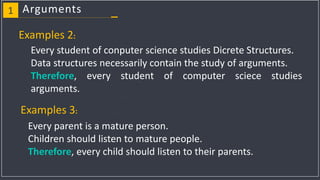
Examples 2:
Every student of conputer science studies Dicrete Structures.
Data structures necessarily contain the study of arguments.
Therefore, every student of computer sciece studies
arguments.
Examples 3:
Every parent is a mature person.
Children should listen to mature people.
Therefore, every child should listen to their parents.
1 Arguments
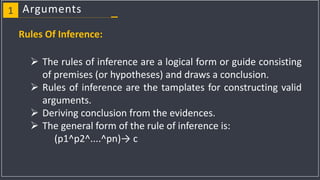
Rules Of Inference:
 The rules of inference are a logical form or guide consisting
of premises (or hypotheses) and draws a conclusion.
 Rules of inference are the tamplates for constructing valid
arguments.
 Deriving conclusion from the evidences.
 The general form of the rule of inference is:
(p1^p2^....^pn)→ c
1 Arguments
Types Rules Of Inference:
1. Modus Ponens: p→q
p OR [(p→ q)^q]→q
...q
P1 If p, then q.
P2 p.
C Therefore,q.
Example:
If it rain, then it is cloudy.
It rains.
Therefore, it is cloudy.
1 Arguments
Modus Ponens :
p q p→q (p→ q)^q [(p→q)^q]→q
T T T T T
T F F F T
F T T F T
F F T F T
1 Arguments
Types Rules Of Inference:
1. Modus Tollens: p→q
~q OR [(p→ q)^~q]→~p
...~p
P1 If p, then q.
P2 ~q.
C Therefore,~p.
Example:
If it rainI am the POTUS , then i’m an American citizen.
I’m not an American citizen.
Therefore, i’m not the POTUS.
1 Arguments
Modus Tollens :
p q p→q ~p ~q (p→ q)^~q [(p→q)^~q]→~p
T T T F F F T
T F F F T F T
F T T T F F T
F F T T T T T
1 Arguments
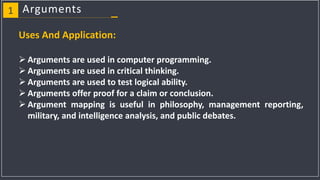
Uses And Application:
 Arguments are used in computer programming.
 Arguments are used in critical thinking.
 Arguments are used to test logical ability.
 Arguments offer proof for a claim or conclusion.
 Argument mapping is useful in philosophy, management reporting,
military, and intelligence analysis, and public debates.
03
Invalid Arguments
Invalid Arguments
An argument is said to be an invalid argument if
its conclusion can be false when its hypothesis
is true.
The main point regarding a valid argument is that it follows from the logical form
itself and has nothing to do with the content. When a conclusion is reached
using a valid argument
How to Check If an Argument is Invalid?
3 Invalid Arguments
To test whether or not an argument is invalid, we have to:
Identify premises and conclusion
Construct a truth table showing conclusion
Look for all the rows where the premises are all true - (critical
rows)
If the conclusion is false in a critical row,
then the argument is invalid.
Otherwise, the argument is valid
2.
3.
1.
Invalid Arguments
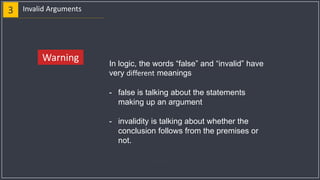
In logic, the words “false” and “invalid” have
very different meanings
- false is talking about the statements
making up an argument
- invalidity is talking about whether the
conclusion follows from the premises or
not.
3
Warning
Invalid Arguments
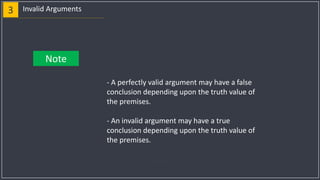
- A perfectly valid argument may have a false
conclusion depending upon the truth value of
the premises.
- An invalid argument may have a true
conclusion depending upon the truth value of
the premises.
3
Note
Examples
Invalid Arguments
3
Let us consider the following example:
Egyptions speak Arabic.
It can be rewritten as
“If someone is a citizen of Egypt, then they speak Arabic.”
(p→q) → (q→p)
Arguments
(p→q) V (q→p)
Invalid Arguments
3
An example of an invalid argument :
“If it is raining, then the streets are wet.
The streets are wet.
Therefore, it is raining.”
For convenience, we will represent this argument
symbolically as
[ ( p → q ) ∧ p ] → p
1.
Invalid Arguments
3
p q p→q (p→q)∧p [(p→q)∧p]→p
T T T T T
T F F F T
F T T F T
F F T F T
Invalid Arguments
3
p q p→q ~p ~q (p→q)∧∼p [(p→q)^~p]→~q
T T T F F F T
T F F F T F T
F T T T F T F
F F T T T T T
[ ( p → q ) ^ ~ p ] → ~ q
2.
THANK YOU
THANK YOU FOR WATCHING

Arguments.pptx

  • 1.
    ‫يم‬ ِ‫ح‬َّ‫الر‬ ِ‫ن‬ٰ‫حم‬َّ‫الر‬ ِ‫ہللا‬ ِ‫سم‬ِ‫ب‬
  • 2.
    1 Arguments 2Valid Arguments C O N T E N T S 3 Invalid Arguments Zofshan CS-79 Muqadas Javaid CS-76 Shaharmeer CS-2822 P R E S E N T E D B Y
  • 3.
  • 4.
    1 Arguments Arguments: The argumentscan be described as a series of statements or propositions. It usually has the premises and conclusion.  Permises: All the statement or proposition in an argument is called premises (or assumption or hypotheses) Expect for the final one. The premises will be represented by p1, p2, p3,....,pn.  Conclusion: The final statement is called conclusion. Statement is supported by atleast one permise. The symbol (...),which is read “therefore,” is normally placed just before the conlusion.
  • 5.
    1 Arguments Examples 1: “Ifyou have a current password ,then you can login into the network.” If you have a current password, then you can login into the network. You have a current password. Therefore, you can login into the network. If p, then q. p → q p. p Therefore,q. ...q P1, P2, ..., Pn → Q Where P1, P2...... Pn is the premises and Q is the conclusion.
  • 6.
    1 Arguments Examples 2: Everystudent of conputer science studies Dicrete Structures. Data structures necessarily contain the study of arguments. Therefore, every student of computer sciece studies arguments. Examples 3: Every parent is a mature person. Children should listen to mature people. Therefore, every child should listen to their parents.
  • 7.
    1 Arguments Rules OfInference:  The rules of inference are a logical form or guide consisting of premises (or hypotheses) and draws a conclusion.  Rules of inference are the tamplates for constructing valid arguments.  Deriving conclusion from the evidences.  The general form of the rule of inference is: (p1^p2^....^pn)→ c
  • 8.
    1 Arguments Types RulesOf Inference: 1. Modus Ponens: p→q p OR [(p→ q)^q]→q ...q P1 If p, then q. P2 p. C Therefore,q. Example: If it rain, then it is cloudy. It rains. Therefore, it is cloudy.
  • 9.
    1 Arguments Modus Ponens: p q p→q (p→ q)^q [(p→q)^q]→q T T T T T T F F F T F T T F T F F T F T
  • 10.
    1 Arguments Types RulesOf Inference: 1. Modus Tollens: p→q ~q OR [(p→ q)^~q]→~p ...~p P1 If p, then q. P2 ~q. C Therefore,~p. Example: If it rainI am the POTUS , then i’m an American citizen. I’m not an American citizen. Therefore, i’m not the POTUS.
  • 11.
    1 Arguments Modus Tollens: p q p→q ~p ~q (p→ q)^~q [(p→q)^~q]→~p T T T F F F T T F F F T F T F T T T F F T F F T T T T T
  • 12.
    1 Arguments Uses AndApplication:  Arguments are used in computer programming.  Arguments are used in critical thinking.  Arguments are used to test logical ability.  Arguments offer proof for a claim or conclusion.  Argument mapping is useful in philosophy, management reporting, military, and intelligence analysis, and public debates.
  • 13.
  • 14.
    Invalid Arguments An argumentis said to be an invalid argument if its conclusion can be false when its hypothesis is true. The main point regarding a valid argument is that it follows from the logical form itself and has nothing to do with the content. When a conclusion is reached using a valid argument
  • 15.
    How to CheckIf an Argument is Invalid?
  • 16.
    3 Invalid Arguments Totest whether or not an argument is invalid, we have to: Identify premises and conclusion Construct a truth table showing conclusion Look for all the rows where the premises are all true - (critical rows) If the conclusion is false in a critical row, then the argument is invalid. Otherwise, the argument is valid 2. 3. 1.
  • 17.
    Invalid Arguments In logic,the words “false” and “invalid” have very different meanings - false is talking about the statements making up an argument - invalidity is talking about whether the conclusion follows from the premises or not. 3 Warning
  • 18.
    Invalid Arguments - Aperfectly valid argument may have a false conclusion depending upon the truth value of the premises. - An invalid argument may have a true conclusion depending upon the truth value of the premises. 3 Note
  • 19.
  • 20.
    Invalid Arguments 3 Let usconsider the following example: Egyptions speak Arabic. It can be rewritten as “If someone is a citizen of Egypt, then they speak Arabic.” (p→q) → (q→p) Arguments (p→q) V (q→p)
  • 21.
    Invalid Arguments 3 An exampleof an invalid argument : “If it is raining, then the streets are wet. The streets are wet. Therefore, it is raining.” For convenience, we will represent this argument symbolically as [ ( p → q ) ∧ p ] → p 1.
  • 22.
    Invalid Arguments 3 p qp→q (p→q)∧p [(p→q)∧p]→p T T T T T T F F F T F T T F T F F T F T
  • 23.
    Invalid Arguments 3 p qp→q ~p ~q (p→q)∧∼p [(p→q)^~p]→~q T T T F F F T T F F F T F T F T T T F T F F F T T T T T [ ( p → q ) ^ ~ p ] → ~ q 2.
  • 24.
    THANK YOU THANK YOUFOR WATCHING