Adrenergic Agonists and 
Antagonists (for MD Pharmacology) 
Dr. Advaitha
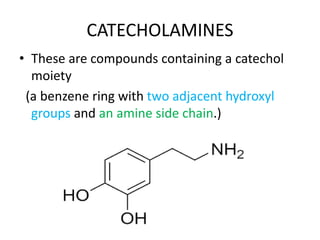
CATECHOLAMINES 
• These are compounds containing a catechol 
moiety 
(a benzene ring with two adjacent hydroxyl 
groups and an amine side chain.)
Dopamine : 
• It is the metabolic precursor of noradrenaline 
and adrenaline. 
• Main neurotransmitter in the Brain.
• Noradrenaline (norepinephrine) : a 
transmitter released by sympathetic nerve 
terminals. 
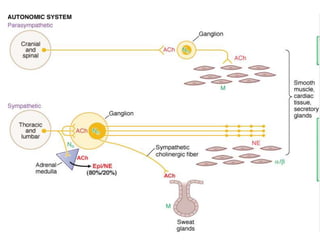
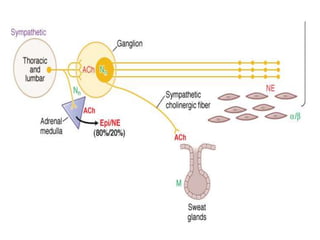
• Adrenaline (epinephrine): a hormone 
secreted by the adrenal medulla
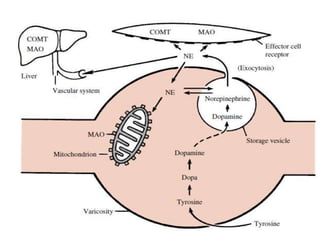
Synthesis, Storage, Release, and 
Removal of Norepinephrine 
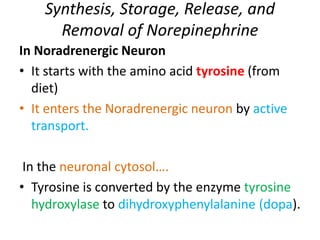
In Noradrenergic Neuron 
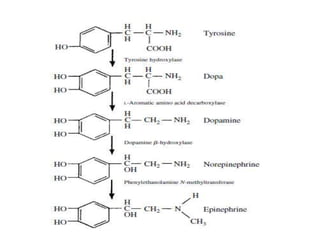
• It starts with the amino acid tyrosine (from 
diet) 
• It enters the Noradrenergic neuron by active 
transport. 
In the neuronal cytosol…. 
• Tyrosine is converted by the enzyme tyrosine 
hydroxylase to dihydroxyphenylalanine (dopa).
------------------------------- 
Drug : 
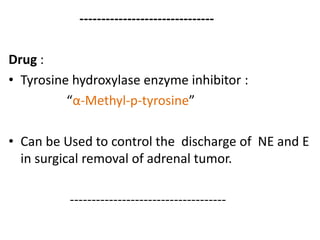
• Tyrosine hydroxylase enzyme inhibitor : 
“α-Methyl-p-tyrosine” 
• Can be Used to control the discharge of NE and E 
in surgical removal of adrenal tumor. 
------------------------------------
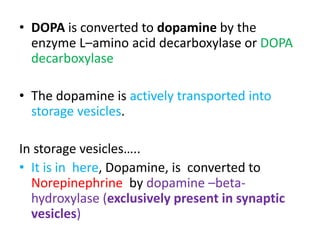
• DOPA is converted to dopamine by the 
enzyme L–amino acid decarboxylase or DOPA 
decarboxylase 
• The dopamine is actively transported into 
storage vesicles. 
In storage vesicles….. 
• It is in here, Dopamine, is converted to 
Norepinephrine by dopamine –beta-hydroxylase 
(exclusively present in synaptic 
vesicles)
In the adrenal medulla.. 
• The synthesis is carried one step further. 
• The enzyme phenyl-ethanolamine N-methyltransferase 
converts norepinephrine to 
epinephrine. 
• The human adrenal medulla contains 
approximately 80% epinephrine and 20% 
norepinephrine.
• NE is stored in the synaptic vesicles. 
• Noradrenergic transmitter is released during 
action potentials through exocytosis. 
Action Potential causes : Na+, Ca2+ and Cl- enter 
while K+ efflux… 
Ca2+ entry causes disruption of Vesicles to 
release NE
Drugs : 
• Release of NE is inhibited by bretylium and 
guanethidene. 
• Can be used in HTN (now obsolete)
• So.. after Action Potential and effect….. 
• There is removal of norepinephrine from 
Synapse. 
Three processes contribute : 
1. Transport back into the noradrenergic neuron 
(uptake1) 
• For vesicular storage or enzymatic inactivation 
by mitochondrial MAO.
------------------------------------------------ 
About , Monoamine Oxidase (MAO) and 
Catecholamine-O-Methyltransferase (COMT) : 
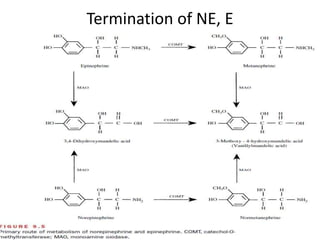
• Both enzymes inactivates NE and E. 
• Both are widely distributed (Liver, Intestine, 
Kidney, Brain) 
• However, COMT is absent In ADRENERGIC Neuron. 
• So it is only MAO which metabolises NE, 
intraneuronally… 
--------------------------------------------
2.Diffusion from the synapse into the 
circulation 
For ultimate enzymatic destruction in the liver 
( by COMT and MAO ) and renal excretion 
3. Active transport of the released transmitter 
into effector cells (extraneuronal uptake or 
uptake2) 
followed by enzymatic Inactivation by COMT
Drugs : 
• Neuronal reuptake (uptake1) inhibitors : 
Cocaine and Tricyclic antidepressants. 
-potentiates effect of NE and E 
• Vesicular reuptake inhibitors : Reserpine 
(used in HTN, obsolete)
• Inhibitors of MAO-A (present in Adrenergic 
neuron, intestine, liver, Kidney and Placenta) : 
Clorgyline and Meclobemide ( rarely used in 
depression) 
• Inhibitors of MAO-B (present in Dopaminergic 
neuron, brain, Platelets and Iiver) : 
Selegeline ( used in parkinson’s disease)
Termination of NE, E
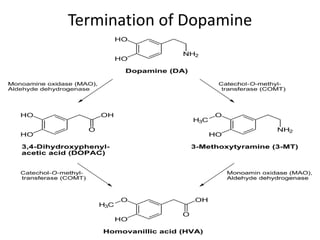
Termination of Dopamine
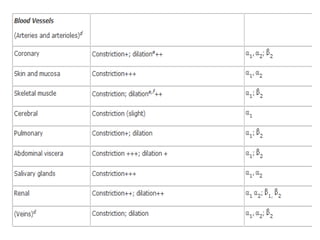
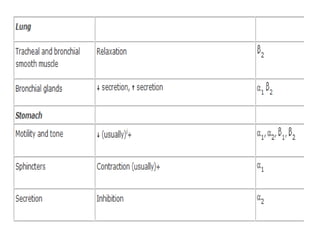
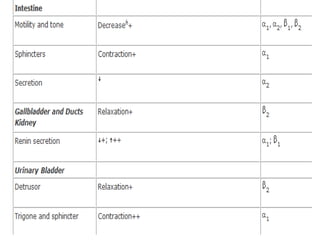
Adrenergic Receptors 
• The liberated NE at Synaptic junction 
stimulates postsynaptic adrenoreceptors--- 
Alpha1, Alpha2. Beta1, Beta2, Beta3 
to elicit end organ response. 
So what are the end organ responses of each 
receptor ????
• All belong to the superfamily of G-protein-coupled 
receptors 
• α1 receptors activate phospholipase C, producing 
inositol trisphosphate and diacylglycerol as 
second messengers 
• α2 receptors inhibit adenylyl cyclase, decreasing 
cAMP formation 
• All types of β receptor stimulate adenylyl cyclase
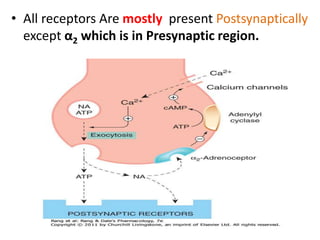
• All receptors Are mostly present Postsynaptically 
except α2 which is in Presynaptic region.
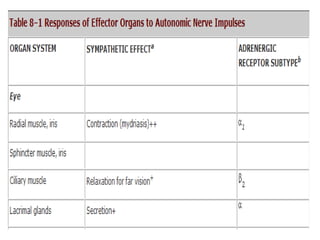
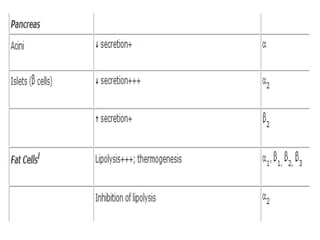
α1 Receptors 
• When activated produces Excitatory effects on 
in most organs. 
• E.g, Vascular smooth muscle, Salivary glands, 
Bronchi, Uterus, Radial muscle of iris etc. 
• Except in intestine where they produce 
Relaxation.
α2 Receptors 
• Present Presynaptically in Post ganglionic 
Adrenergic and Cholinergic (gut) Neuron. 
• When activated by NE in synaptic cleft- 
it inhibits further release of NE from 
presynaptic Adrenergic neuron.
They also inhibit Ach in cholinergic neuron (in gut) 
• They are also present Postsynaptically in blood 
vessels etc. where it behaves like α 1 
(vasoconstriction) 
In Brain, whether Pre or Post synaptically present 
it decreases sympathetic outflow.
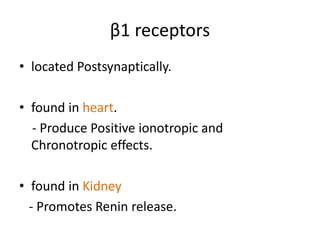
β1 receptors 
• located Postsynaptically. 
• found in heart. 
- Produce Positive ionotropic and 
Chronotropic effects. 
• found in Kidney 
- Promotes Renin release.
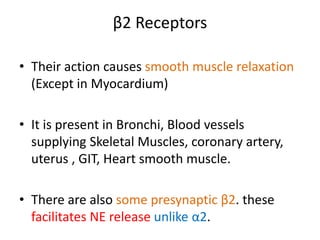
β2 Receptors 
• Their action causes smooth muscle relaxation 
(Except in Myocardium) 
• It is present in Bronchi, Blood vessels 
supplying Skeletal Muscles, coronary artery, 
uterus , GIT, Heart smooth muscle. 
• There are also some presynaptic β2. these 
facilitates NE release unlike α2.
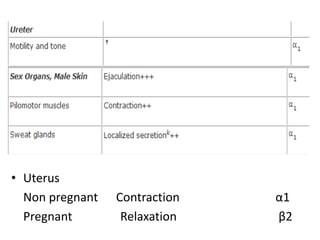
• Uterus 
Non pregnant Contraction α1 
Pregnant Relaxation β2
Classification of Sympathomimetic 
Drugs 
Classified as : 
• Direct-acting, 
• Indirect-acting, 
• Mixed-acting sympathomimetics.
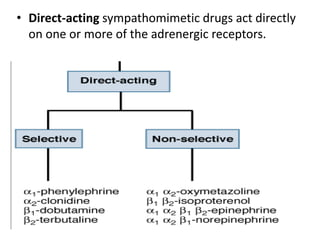
• Direct-acting sympathomimetic drugs act directly 
on one or more of the adrenergic receptors.
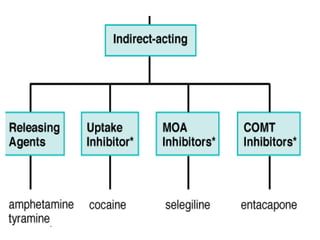
• Indirect-acting drugs are those increase the 
availability of norepinephrine (NE) or 
epinephrine to stimulate adrenergic receptors. 
By releasing or displacing NE from vesicles of 
sympathetic nerve varicosities
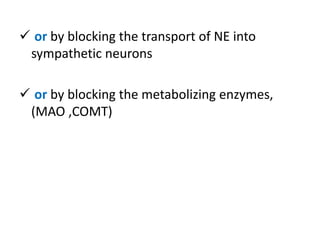
 or by blocking the transport of NE into 
sympathetic neurons 
 or by blocking the metabolizing enzymes, 
(MAO ,COMT)
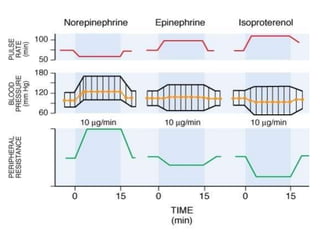
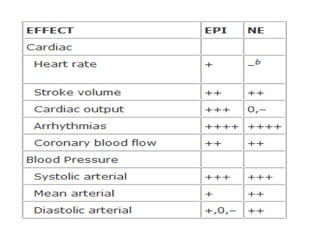
Epinehrine or Adrenaline 
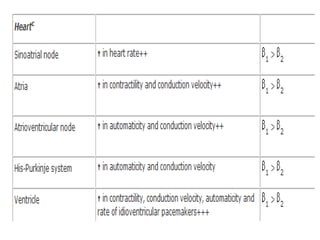
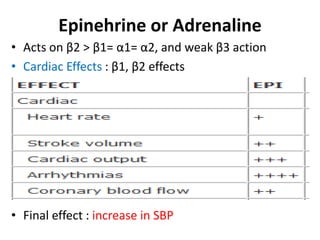
• Acts on β2 > β1= α1= α2, and weak β3 action 
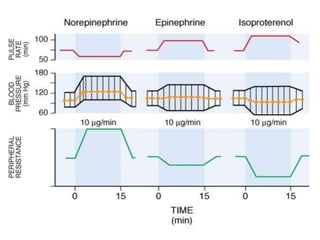
• Cardiac Effects : β1, β2 effects 
• Final effect : increase in SBP
Vascular Effects : 
• Constricton of arterioles in skin,mucous 
membrane, viscera and renal beds-- α1 effect 
• Dilation predominates in skeletal muscle, liver 
and coronaries– β2 effect. Decrease in 
peripheral vascular resistance 
• So the cumulative effect decease in DBP
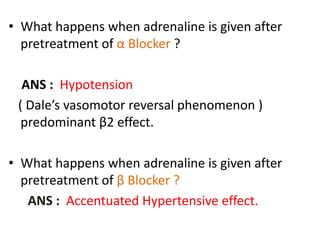
• What happens when adrenaline is given after 
pretreatment of α Blocker ? 
ANS : Hypotension 
( Dale’s vasomotor reversal phenomenon ) 
predominant β2 effect. 
• What happens when adrenaline is given after 
pretreatment of β Blocker ? 
ANS : Accentuated Hypertensive effect.
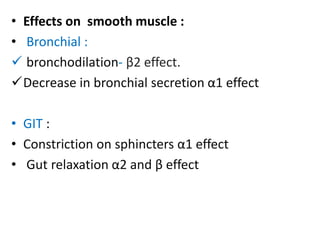
• Effects on smooth muscle : 
• Bronchial : 
 bronchodilation- β2 effect. 
Decrease in bronchial secretion α1 effect 
• GIT : 
• Constriction on sphincters α1 effect 
• Gut relaxation α2 and β effect
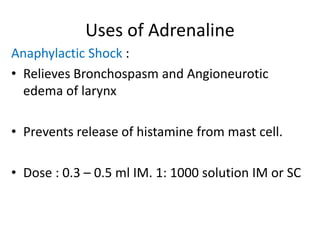
Uses of Adrenaline 
Anaphylactic Shock : 
• Relieves Bronchospasm and Angioneurotic 
edema of larynx 
• Prevents release of histamine from mast cell. 
• Dose : 0.3 – 0.5 ml IM. 1: 1000 solution IM or SC
• Bronchial Asthama : Rarely used. 
• Cardiac resusitation : Intracardiac route to 
reverse sudden cardiac arrest in drowning and 
electrocution 
(Absolute Containdication in Ventricular 
Fibrillation) 
• To prolong duration of loacal Anaesthetic agents. 
• To control Epistaxis : Rarely
Adverse effects 
• Cerebral Haemorrage 
• Angina 
• Palpitation 
• Arrhythmias 
• CNS side effects : Anxiety, tremors and 
headache.
Contraindications/ interactions 
• Angina and Hypertension 
• Hyperthyroidism ( upregulation of receptors) 
• Concomitant use of MAO
Noradrenaline 
• Acts on α1=α2>β1, β3. 
• Poor β2 action. 
Cardiovascular effects : 
• Raises both SBP and DBP. (because β1-SBP, 
α1-DBP )
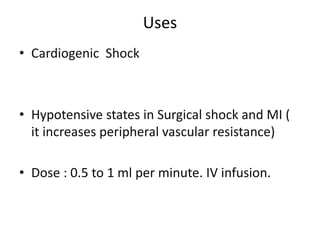
Uses 
• Cardiogenic Shock 
• Hypotensive states in Surgical shock and MI ( 
it increases peripheral vascular resistance) 
• Dose : 0.5 to 1 ml per minute. IV infusion.
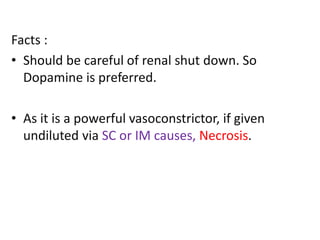
Facts : 
• Should be careful of renal shut down. So 
Dopamine is preferred. 
• As it is a powerful vasoconstrictor, if given 
undiluted via SC or IM causes, Necrosis.
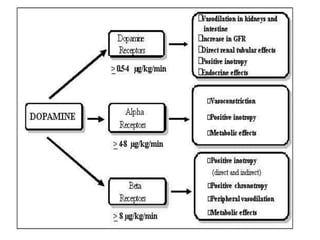
Dopamine 
• Acts on D1, D2, β1, little α action 
• No β2 and β3 action. 
• Does not enter the BBB when given 
Parentrally. 
• Effects : 
It is dose dependent.
Uses 
• Cardiogenic Shock 
• CCF, liver and renal failure 
• Hypotensive states (after correcting 
hypovolemia) 
• Dose is 5mcg-10mcg/kg/min IV
Adverse effects 
• Nausea vomitting 
• Tachycardia 
• Hypertension 
• Ectopic beats 
• Arrhythmias
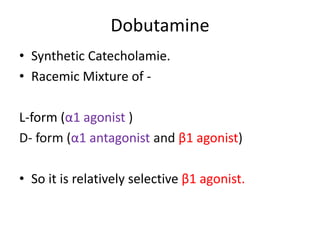
Dobutamine 
• Synthetic Catecholamie. 
• Racemic Mixture of - 
L-form (α1 agonist ) 
D- form (α1 antagonist and β1 agonist) 
• So it is relatively selective β1 agonist.
Effects : 
• More selective ionotropic and chronotropic 
effects. 
Uses : 
• Heart failure : it increases CO and stroke Volume 
without increasing Heart rate. 
Adverse effects : 
• Sharp rise in BP in HTN patients 
• Angina can be aggravated
Dopexamine 
• Synthetic Catecholamie. 
• Acts on D1, D2, and β2 receptors 
• Effects : Peripheral Vasodilation, increase Cardiac 
output and increased renal blood flow. 
• Uses : To provide Haemodynamic suppport in CCF and 
Shock 
Adverse Effects : 
• Tachycardia and Hypotension
Fenoldapam 
• Synthetic. Selective D1 agonist 
Effects : 
• vasodilation in peripheral arteriole, coronary, 
Renal and Mesentric vessels 
Uses : 
• Short term management of Severe Hypertension 
in Patients with severe Renal impairement. 
• Adverse Effects : Reflex Tachycardia, Headache.
“ α1 Selective agonists ” 
Phenylephrine 
• Non Catecholamine 
• So not metabolized by MAO or COMT 
• Effects : α1 stimulation increases Peripheral 
vascular resistance and BP ( associated with 
reflex Bradycardia) 
Uses : 
• Nasal decongestant 
• Mydriatic 
• Hypotension (rarely)
Other similar drugs are : 
• Oxymetaxoline 
• Xylometazoline 
• Midodrine 
• Naphazoline
α 2 Selective Agonist 
Clonidine 
Uses with MOA : 
1) Moderate Hypertension 
Mechanism : Not properly elucidated. 
• stimulates central α 2 receptors to decrease 
sympathetic outflow.
• Stimulates presynaptic α2 on postganglionic 
sympathetic neuron to supress NE release. 
---------------------------------- 
• When given I.V there is transient rise in BP 
( post syaptic α2 effect which causes 
vasoconstriction) and then Decrease. 
• However when given oral, there is only 
hypotensive effects 
• 100 % bioavailability.
• Dose :100-300 mcg BD. 
• Also available as Transdermal Patch. 
• Major limitation is Rebound Hypertension. 
2) In the Prophylaxis of migraine 
• It reduces cerebral blood flow 
3) Management of opiate, alcohol and Nicotine 
Withdrawl 
• It reduces sympathetic effects associated with 
withdrawl
4) Preanaesthetic Medication: 
• For its slightly sedative, anxiolytic and 
analgesic effect 
5)Menopausal Hot flushes : 
• For counteracting symptoms
6) To control diarrhoea in diabetic patients with 
autonomic neuropathy 
α2 in GIT decreases sodium,water retention 
and reduces motility by inhibiting Ach
Adverse Effects : 
• Dry mouth 
• Sedation 
• Nasal stuffiness 
• Constipation 
• Impotence 
• Contact dermatitis (in patch usage)
Newer congeners of clonidine 
• Moxonidine 
• Rilmenidine 
In these rebound hypertension is less frequent 
 longer acting than Clonidine 
----------------------------------
• Apraclonidine 
• Brimonidine 
Used in Glaucoma (reduces Aqueous Humor 
by α2 action in cilliary muscles)
β2 selective Agonists 
Salbutamol 
Effect : Produce relaxant effect on bronchi, 
uterus. 
• Has minimal cardiac stimulant property. 
• Half life : 4hr 
Uses : 
• Immediate relief of Asthama
• Dose : 100mcg in Metered dose inhaler 
• or 2-4 mg PO TDS 
• To arrest uncomplicated premature labour 
(inbetween 24 to 34 weks of gestation) by 
slow IV injection 
Adverse effects : 
• Tremors in hands, Palpitations, hypokalemia
• Terbutaline 
• Salmetrol and Formetrol ( longer acting 12hr) 
• Pirbuterol 
• Clenbuterol ( anabolic strength on skeletal 
muscle, illicit use in sports)
Indirectly acting drugs 
Tyramine 
• Not used clinically 
• It is found in cheese, beef, wine, beer, yoghurt 
yeast. 
• Metabolized by MAO. 
• Significance : If patient on MAO inhibitor, it 
can trigger hypertensive crisis
Amphetamine 
• Powerful CNS stimulant . 
CNS effects : 
Stimulation of 
• cortical region 
• Reticular activating system. 
• Medullary respiratory centre. 
Causes 
• Wakefullness 
• Alertness
• Decreased sense of fatigue 
• The performance of simple task increases but 
errors increase 
• Physical performance improves
CVS effects : 
• Increases SBP and DBP 
• Tachycardia followed by bradycardia 
Other effects 
• Suppression of appetite by depressing lateral 
hypothalamic centre
Uses : 
• Narcolepsy : prevents attacks of daytime time 
sleep 
• ADHD (excitability, impulsiveness, difficulty in 
sustaining attention) : Paradoxically improves 
with low dose 
• Weight reduction
Other Analogues… 
• Methylphenidate : more prominent action on 
mental function. 
• Methamphetamine : High potential of abuse 
• Pemoline : minimal CVS effects and longer 
plasma half life. Used in ADHD
Mixed Action drugs 
Ephedrine 
• Non catecholamine alkaloid 
• Has direct action on α and β. Also enhance NE 
release. 
• CNS : powerful stimulant 
• CVS: increase in BP, CO, HR. 
• RS : Bronchodilation.
Uses : Very restricted. 
• Hypotension following Spinal Anaesthesia 
• Chronic asthma. 
Adverse effects : 
• HTN, 
• Insomnia, 
• Tachyphylaxis.
Pseudoephedrine : 
• Stereoisomer of ephedrine used as nasal 
decongestant.
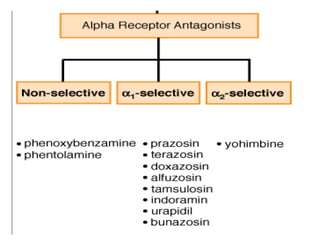
Adrenergic Antagonists
Phenoxybenzamine 
• Irreversible, nonselective, Non competitive 
Antagonist at α1,α2 
• Also inhibits reuptake of NE by adrenergic 
nerve terminal. 
• Crosses BBB. 
Effects : 
• Vasodilation 
• Decrease Peripheral vascular Resistance
• Hypotension ( this triggers baroreceptors 
causing sympathetic discharge) 
• Tachycardia (sympathetic discharge action on 
β 1 )
Uses : 
Treatment Phaeochromocytoma : 
• Controls episodes of severe hypertension 
during surgical manipulation . 
• Dose : 1mg /kg , slow IV infusion 
In Raynaud’s syndrome and 
Frostbite. 
Dose 10mg TDS PO
Adverse effects : 
• Marked Postural Hypotension with initial doses. 
• Tolerance develops later. 
• Inhibition of ejaculation 
• Salt and water retention 
• Sedation 
• Fatigue 
• Nausea
Phentolamine and Tolazoline 
• Competitive, Reversible antagonist of α1, α2. 
Effects : 
• Vasodilation 
• Decrease Peripheral vascular Resistance
• Hypotension ( this triggers baroreceptors 
causing sympathetic discharge) 
• Tachycardia (sympathetic discharge action on 
β 1 )
Other effects 
• Nasal stufiness 
• Miosis (loss of tone of radial muscles) 
• Failure of ejaculation 
• Nausea vomitting diarrhoea 
( inhibition of inhibitory sympathetic influence 
of GIT and agonist action on H2 receptors, 
Tolazoline)
Uses 
• Treatment Phaeochromocytoma. 
• In peripheral vascular disease 
• To prevent dermal necrosis ( after incidental 
extravasation of NE after IV infusion) 
• To treat hypertensive crisis
α1 selective blockers 
Prazosin 
Effects : 
• Peripheral vasodilation 
• Fall in arterial pressure 
• Lesser tachycardia 
 Because of lack α 2 blocking no promotion 
of NE release, so no β1 stimulation.
Also partly because it decreases sympathetic 
outflow from CNS 
It decreases cardiac preload 
• It is also potent phosphodiesterase inhibitor 
 this leads to rise in cAMP in smooth muscle 
So vasodilating effect. 
• It relaxes smooth muscle - in bladder neck 
Prostate capsule 
Prostatic urethra
• So improves urine outflow in BPH 
• Uses : 
• In Hypertension : oral dose is 1mg bed time to 
avoid postural hypotension 
• In BPH : 1-5 mg BD PO, however newer ones 
are preferred. 
• In raynaud’s disease : rarely, because CCB are 
preferred.
Adverse effects : 
• Postural hypotension 
• Impotence 
• Nasal congestion