Copyright © 2007 Pearson Education, Inc. Slide 11-2
Chapter 11: Further Topics in Algebra
11.1 Sequences and Series
11.2 Arithmetic Sequences and Series
11.3 Geometric Sequences and Series
11.4 The Binomial Theorem
11.5 Mathematical Induction
11.6 Counting Theory
11.7 Probability
Copyright © 2007 Pearson Education, Inc. Slide 11-3
11.4 The Binomial Theorem
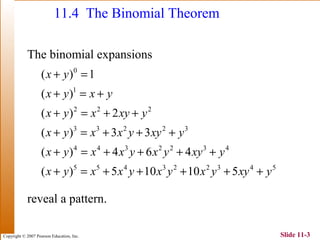
The binomial expansions
reveal a pattern.
0
1
2 2 2
3 3 2 2 3
4 4 3 2 2 3 4
5 5 4 3 2 2 3 4 5
( ) 1
( )
( ) 2
( ) 3 3
( ) 4 6 4
( ) 5 10 10 5
x y
x y x y
x y x xy y
x y x x y xy y
x y x x y x y xy y
x y x x y x y x y xy y
+ =
+ = +
+ = + +
+ = + + +
+ = + + + +
+ = + + + + +
Copyright © 2007 Pearson Education, Inc. Slide 11-4
11.4 A Binomial Expansion Pattern
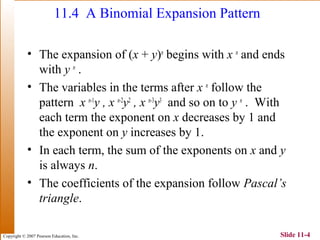
• The expansion of (x + y)n
begins with x n
and ends
with y n
.
• The variables in the terms after x n
follow the
pattern x n-1
y , x n-2
y2
, x n-3
y3
and so on to y n
. With
each term the exponent on x decreases by 1 and
the exponent on y increases by 1.
• In each term, the sum of the exponents on x and y
is always n.
• The coefficients of the expansion follow Pascal’s
triangle.
Copyright © 2007 Pearson Education, Inc. Slide 11-5
11.4 A Binomial Expansion Pattern
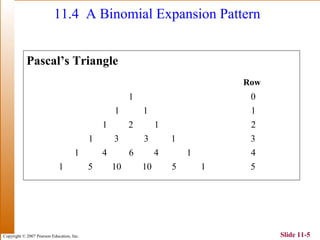
Pascal’s Triangle
Row
1 0
1 1 1
1 2 1 2
1 3 3 1 3
1 4 6 4 1 4
1 5 10 10 5 1 5
Copyright © 2007 Pearson Education, Inc. Slide 11-6
11.4 Pascal’s Triangle
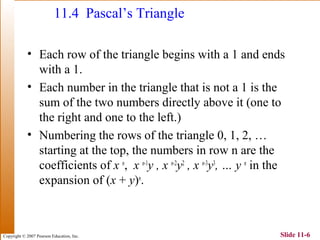
• Each row of the triangle begins with a 1 and ends
with a 1.
• Each number in the triangle that is not a 1 is the
sum of the two numbers directly above it (one to
the right and one to the left.)
• Numbering the rows of the triangle 0, 1, 2, …
starting at the top, the numbers in row n are the
coefficients of x n
, x n-1
y , x n-2
y2
, x n-3
y3
, … y n
in the
expansion of (x + y)n
.
Copyright © 2007 Pearson Education, Inc. Slide 11-7
11.4 n-Factorial
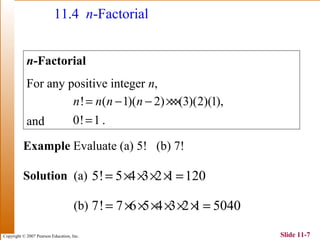
n-Factorial
For any positive integer n,
and
! ( 1)( 2) (3)(2)(1),
0! 1 .
n n n n= − − ×××
=
Example Evaluate (a) 5! (b) 7!
Solution (a)
(b)
5! 5 4 3 2 1 120= × × × × =
7! 7 6 5 4 3 2 1 5040= × × × × × × =
Copyright © 2007 Pearson Education, Inc. Slide 11-8
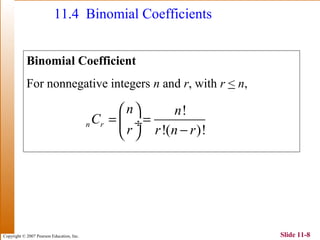
11.4 Binomial Coefficients
Binomial Coefficient
For nonnegative integers n and r, with r < n,
!
!( )!
n r
n n
C
r r n r
 
= = ÷
− 
Copyright © 2007 Pearson Education, Inc. Slide 11-9
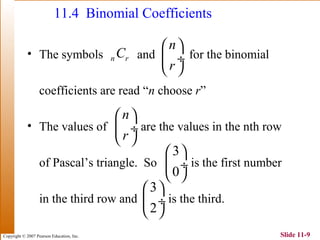
11.4 Binomial Coefficients
• The symbols and for the binomial
coefficients are read “n choose r”
• The values of are the values in the nth row
of Pascal’s triangle. So is the first number
in the third row and is the third.
n rC
n
r
 
 ÷
 
n
r
 
 ÷
 
3
0
 
 ÷
 
3
2
 
 ÷
 
Copyright © 2007 Pearson Education, Inc. Slide 11-10
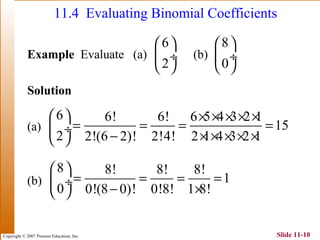
11.4 Evaluating Binomial Coefficients
Example Evaluate (a) (b)
Solution
(a)
(b)
6
2
 
 ÷
 
8
0
 
 ÷
 
6 6! 6! 6 5 4 3 2 1
15
2 2!(6 2)! 2!4! 2 1 4 3 2 1
  × × × × ×
= = = = ÷
− × × × × × 
8 8! 8! 8!
1
0 0!(8 0)! 0!8! 1 8!
 
= = = = ÷
− × 
Copyright © 2007 Pearson Education, Inc. Slide 11-11
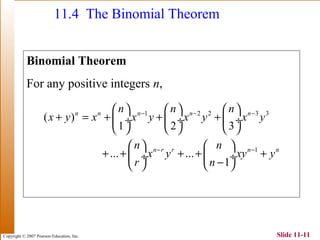
11.4 The Binomial Theorem
Binomial Theorem
For any positive integers n,
1 2 2 3 3
1
( )
1 2 3
... ...
1
n n n n n
n r r n n
n n n
x y x x y x y x y
n n
x y xy y
r n
− − −
− −
     
+ = + + + ÷  ÷  ÷
     
   
+ + + + + ÷  ÷
−   
Copyright © 2007 Pearson Education, Inc. Slide 11-12
11.4 Applying the Binomial Theorem
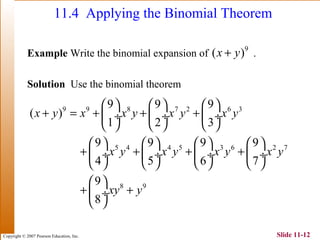
Example Write the binomial expansion of .
Solution Use the binomial theorem
9
( )x y+
9 9 8 7 2 6 3
5 4 4 5 3 6 2 7
8 9
9 9 9
( )
1 2 3
9 9 9 9
4 5 6 7
9
8
x y x x y x y x y
x y x y x y x y
xy y
     
+ = + + + ÷  ÷  ÷
     
       
+ + + + ÷  ÷  ÷  ÷
       
 
+ + ÷
 
Copyright © 2007 Pearson Education, Inc. Slide 11-13
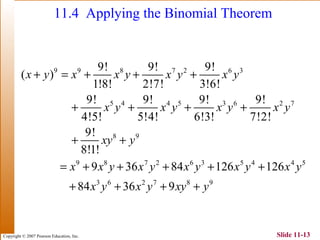
11.4 Applying the Binomial Theorem
9 9 8 7 2 6 3
5 4 4 5 3 6 2 7
8 9
9 8 7 2 6 3 5 4 4 5
3 6 2 7 8 9
9! 9! 9!
( )
1!8! 2!7! 3!6!
9! 9! 9! 9!
4!5! 5!4! 6!3! 7!2!
9!
8!1!
9 36 84 126 126
84 36 9
x y x x y x y x y
x y x y x y x y
xy y
x x y x y x y x y x y
x y x y xy y
+ = + + +
+ + + +
+ +
= + + + + +
+ + + +
Copyright © 2007 Pearson Education, Inc. Slide 11-14
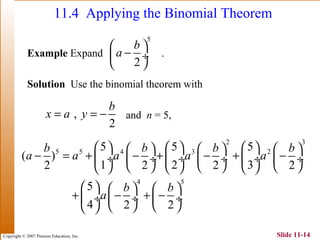
11.4 Applying the Binomial Theorem
Example Expand .
Solution Use the binomial theorem with
and n = 5,
5
2
b
a
 
− ÷
 
2 3
5 5 4 3 2
4 5
5 5 5
( )
1 2 32 2 2 2
5
4 2 2
b b b b
a a a a a
b b
a
          
− = + − + − + − ÷  ÷  ÷ ÷  ÷  ÷
          
     
+ − + − ÷  ÷  ÷
    
,
2
b
x a y= = −
Copyright © 2007 Pearson Education, Inc. Slide 11-15
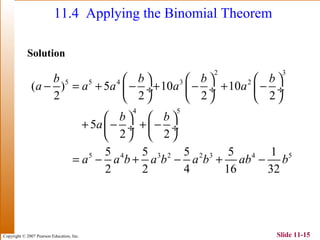
11.4 Applying the Binomial Theorem
Solution
2 3
5 5 4 3 2
4 5
5 4 3 2 2 3 4 5
( ) 5 10 10
2 2 2 2
5
2 2
5 5 5 5 1
2 2 4 16 32
b b b b
a a a a a
b b
a
a a b a b a b ab b
     
− = + − + − + − ÷  ÷  ÷
     
   
+ − + − ÷  ÷
   
= − + − + −
Copyright © 2007 Pearson Education, Inc. Slide 11-16
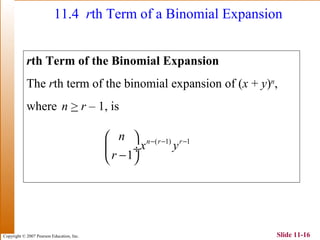
11.4 rth Term of a Binomial Expansion
rth Term of the Binomial Expansion
The rth term of the binomial expansion of (x + y)n
,
where n > r – 1, is
( 1) 1
1
n r rn
x y
r
− − − 
 ÷
− 
Copyright © 2007 Pearson Education, Inc. Slide 11-17
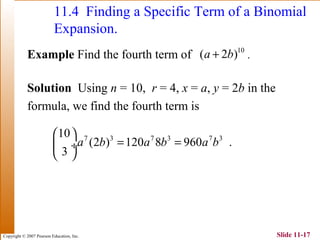
11.4 Finding a Specific Term of a Binomial
Expansion.
Example Find the fourth term of .
Solution Using n = 10, r = 4, x = a, y = 2b in the
formula, we find the fourth term is
10
( 2 )a b+
7 3 7 3 7 310
(2 ) 120 8 960 .
3
a b a b a b
 
= = ÷
 

1632 the binomial theorem-02

  • 2.
    Copyright © 2007Pearson Education, Inc. Slide 11-2 Chapter 11: Further Topics in Algebra 11.1 Sequences and Series 11.2 Arithmetic Sequences and Series 11.3 Geometric Sequences and Series 11.4 The Binomial Theorem 11.5 Mathematical Induction 11.6 Counting Theory 11.7 Probability
  • 3.
    Copyright © 2007Pearson Education, Inc. Slide 11-3 11.4 The Binomial Theorem The binomial expansions reveal a pattern. 0 1 2 2 2 3 3 2 2 3 4 4 3 2 2 3 4 5 5 4 3 2 2 3 4 5 ( ) 1 ( ) ( ) 2 ( ) 3 3 ( ) 4 6 4 ( ) 5 10 10 5 x y x y x y x y x xy y x y x x y xy y x y x x y x y xy y x y x x y x y x y xy y + = + = + + = + + + = + + + + = + + + + + = + + + + +
  • 4.
    Copyright © 2007Pearson Education, Inc. Slide 11-4 11.4 A Binomial Expansion Pattern • The expansion of (x + y)n begins with x n and ends with y n . • The variables in the terms after x n follow the pattern x n-1 y , x n-2 y2 , x n-3 y3 and so on to y n . With each term the exponent on x decreases by 1 and the exponent on y increases by 1. • In each term, the sum of the exponents on x and y is always n. • The coefficients of the expansion follow Pascal’s triangle.
  • 5.
    Copyright © 2007Pearson Education, Inc. Slide 11-5 11.4 A Binomial Expansion Pattern Pascal’s Triangle Row 1 0 1 1 1 1 2 1 2 1 3 3 1 3 1 4 6 4 1 4 1 5 10 10 5 1 5
  • 6.
    Copyright © 2007Pearson Education, Inc. Slide 11-6 11.4 Pascal’s Triangle • Each row of the triangle begins with a 1 and ends with a 1. • Each number in the triangle that is not a 1 is the sum of the two numbers directly above it (one to the right and one to the left.) • Numbering the rows of the triangle 0, 1, 2, … starting at the top, the numbers in row n are the coefficients of x n , x n-1 y , x n-2 y2 , x n-3 y3 , … y n in the expansion of (x + y)n .
  • 7.
    Copyright © 2007Pearson Education, Inc. Slide 11-7 11.4 n-Factorial n-Factorial For any positive integer n, and ! ( 1)( 2) (3)(2)(1), 0! 1 . n n n n= − − ××× = Example Evaluate (a) 5! (b) 7! Solution (a) (b) 5! 5 4 3 2 1 120= × × × × = 7! 7 6 5 4 3 2 1 5040= × × × × × × =
  • 8.
    Copyright © 2007Pearson Education, Inc. Slide 11-8 11.4 Binomial Coefficients Binomial Coefficient For nonnegative integers n and r, with r < n, ! !( )! n r n n C r r n r   = = ÷ − 
  • 9.
    Copyright © 2007Pearson Education, Inc. Slide 11-9 11.4 Binomial Coefficients • The symbols and for the binomial coefficients are read “n choose r” • The values of are the values in the nth row of Pascal’s triangle. So is the first number in the third row and is the third. n rC n r    ÷   n r    ÷   3 0    ÷   3 2    ÷  
  • 10.
    Copyright © 2007Pearson Education, Inc. Slide 11-10 11.4 Evaluating Binomial Coefficients Example Evaluate (a) (b) Solution (a) (b) 6 2    ÷   8 0    ÷   6 6! 6! 6 5 4 3 2 1 15 2 2!(6 2)! 2!4! 2 1 4 3 2 1   × × × × × = = = = ÷ − × × × × ×  8 8! 8! 8! 1 0 0!(8 0)! 0!8! 1 8!   = = = = ÷ − × 
  • 11.
    Copyright © 2007Pearson Education, Inc. Slide 11-11 11.4 The Binomial Theorem Binomial Theorem For any positive integers n, 1 2 2 3 3 1 ( ) 1 2 3 ... ... 1 n n n n n n r r n n n n n x y x x y x y x y n n x y xy y r n − − − − −       + = + + + ÷  ÷  ÷           + + + + + ÷  ÷ −   
  • 12.
    Copyright © 2007Pearson Education, Inc. Slide 11-12 11.4 Applying the Binomial Theorem Example Write the binomial expansion of . Solution Use the binomial theorem 9 ( )x y+ 9 9 8 7 2 6 3 5 4 4 5 3 6 2 7 8 9 9 9 9 ( ) 1 2 3 9 9 9 9 4 5 6 7 9 8 x y x x y x y x y x y x y x y x y xy y       + = + + + ÷  ÷  ÷               + + + + ÷  ÷  ÷  ÷           + + ÷  
  • 13.
    Copyright © 2007Pearson Education, Inc. Slide 11-13 11.4 Applying the Binomial Theorem 9 9 8 7 2 6 3 5 4 4 5 3 6 2 7 8 9 9 8 7 2 6 3 5 4 4 5 3 6 2 7 8 9 9! 9! 9! ( ) 1!8! 2!7! 3!6! 9! 9! 9! 9! 4!5! 5!4! 6!3! 7!2! 9! 8!1! 9 36 84 126 126 84 36 9 x y x x y x y x y x y x y x y x y xy y x x y x y x y x y x y x y x y xy y + = + + + + + + + + + = + + + + + + + + +
  • 14.
    Copyright © 2007Pearson Education, Inc. Slide 11-14 11.4 Applying the Binomial Theorem Example Expand . Solution Use the binomial theorem with and n = 5, 5 2 b a   − ÷   2 3 5 5 4 3 2 4 5 5 5 5 ( ) 1 2 32 2 2 2 5 4 2 2 b b b b a a a a a b b a            − = + − + − + − ÷  ÷  ÷ ÷  ÷  ÷                  + − + − ÷  ÷  ÷      , 2 b x a y= = −
  • 15.
    Copyright © 2007Pearson Education, Inc. Slide 11-15 11.4 Applying the Binomial Theorem Solution 2 3 5 5 4 3 2 4 5 5 4 3 2 2 3 4 5 ( ) 5 10 10 2 2 2 2 5 2 2 5 5 5 5 1 2 2 4 16 32 b b b b a a a a a b b a a a b a b a b ab b       − = + − + − + − ÷  ÷  ÷           + − + − ÷  ÷     = − + − + −
  • 16.
    Copyright © 2007Pearson Education, Inc. Slide 11-16 11.4 rth Term of a Binomial Expansion rth Term of the Binomial Expansion The rth term of the binomial expansion of (x + y)n , where n > r – 1, is ( 1) 1 1 n r rn x y r − − −   ÷ − 
  • 17.
    Copyright © 2007Pearson Education, Inc. Slide 11-17 11.4 Finding a Specific Term of a Binomial Expansion. Example Find the fourth term of . Solution Using n = 10, r = 4, x = a, y = 2b in the formula, we find the fourth term is 10 ( 2 )a b+ 7 3 7 3 7 310 (2 ) 120 8 960 . 3 a b a b a b   = = ÷  