INTRODUCTORY MATHEMATICALINTRODUCTORY MATHEMATICAL
ANALYSISANALYSISFor Business, Economics, and the Life and Social Sciences
©2007 Pearson Education Asia
Chapter 11Chapter 11
DifferentiationDifferentiation
©2007 Pearson Education Asia
INTRODUCTORY MATHEMATICAL
ANALYSIS
0. Review of Algebra
1. Applications and More Algebra
2. Functions and Graphs
3. Lines, Parabolas, and Systems
4. Exponential and Logarithmic Functions
5. Mathematics of Finance
6. Matrix Algebra
7. Linear Programming
8. Introduction to Probability and Statistics
©2007 Pearson Education Asia
9. Additional Topics in Probability
10. Limits and Continuity
11. Differentiation
12. Additional Differentiation Topics
13. Curve Sketching
14. Integration
15. Methods and Applications of Integration
16. Continuous Random Variables
17. Multivariable Calculus
INTRODUCTORY MATHEMATICAL
ANALYSIS
©2007 Pearson Education Asia
• To compute derivatives by using the limit
definition.
• To develop basic differentiation rules.
• To interpret the derivative as an instantaneous
rate of change.
• To apply the product and quotient rules.
• To apply the chain rule.
Chapter 11: Differentiation
Chapter ObjectivesChapter Objectives
©2007 Pearson Education Asia
The Derivative
Rules for Differentiation
The Derivative as a Rate of Change
The Product Rule and the Quotient Rule
The Chain Rule and the Power Rule
11.1)
11.2)
11.3)
Chapter 11: Differentiation
Chapter OutlineChapter Outline
11.4)
11.5)
©2007 Pearson Education Asia
Chapter 11: Differentiation
11.1 The Derivative11.1 The Derivative
• Tangent line at a point:
• The slope of a curve at P is the slope of the
tangent line at P.
• The slope of the tangent line at (a, f(a)) is
( ) ( ) ( ) ( )
h
afhaf
az
afzf
m
haz
−+
=
−
−
=
→→ 0
tan limlim
©2007 Pearson Education Asia
Chapter 11: Differentiation
11.1 The Derivative
Example 1 – Finding the Slope of a Tangent Line
Find the slope of the tangent line to the curve y = f(x)
= x2
at the point (1, 1).
Solution: Slope = ( ) ( ) ( ) ( ) 2
11
lim
11
lim
22
00
=
−+
=
−+
→→ h
h
h
fhf
hh
• The derivative of a function f is the function
denoted f’ and defined by
( ) ( ) ( ) ( ) ( )
h
xfhxf
xz
xfzf
xf
hxz
−+
=
−
−
=
→→ 0
limlim'
©2007 Pearson Education Asia
Chapter 11: Differentiation
11.1 The Derivative
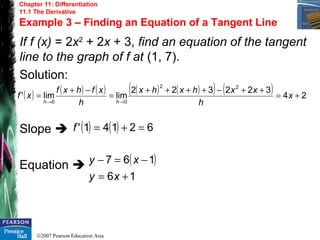
Example 3 – Finding an Equation of a Tangent Line
If f (x) = 2x2
+ 2x + 3, find an equation of the tangent
line to the graph of f at (1, 7).
Solution:
Slope 
Equation 
( ) ( ) ( ) ( ) ( )( ) ( ) 24
322322
limlim'
22
00
+=
++−++++
=
−+
=
→→
x
h
xxhxhx
h
xfhxf
xf
hh
( )
16
167
+=
−=−
xy
xy
( ) ( ) 62141' =+=f
©2007 Pearson Education Asia
Chapter 11: Differentiation
11.1 The Derivative
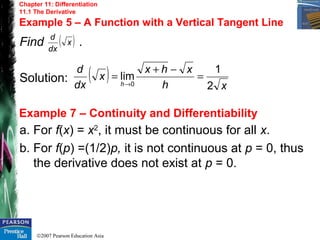
Example 5 – A Function with a Vertical Tangent Line
Example 7 – Continuity and Differentiability
Find .
Solution:
( )x
dx
d
( ) xh
xhx
x
dx
d
h 2
1
lim
0
=
−+
=
→
a. For f(x) = x2
, it must be continuous for all x.
b. For f(p) =(1/2)p, it is not continuous at p = 0, thus
the derivative does not exist at p = 0.
©2007 Pearson Education Asia
Chapter 11: Differentiation
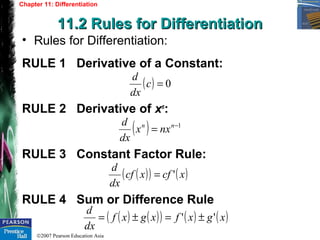
11.2 Rules for Differentiation11.2 Rules for Differentiation
• Rules for Differentiation:
RULE 1 Derivative of a Constant:
RULE 2 Derivative of xn
:
RULE 3 Constant Factor Rule:
RULE 4 Sum or Difference Rule
( ) 0=c
dx
d
( ) 1−
= nn
nxx
dx
d
( )( ) ( )xcfxcf
dx
d
'=
( ) ( )( ) ( ) ( )xgxfxgxf
dx
d
'' ±=±=
©2007 Pearson Education Asia
Chapter 11: Differentiation
11.2 Rules for Differentiation
Example 1 – Derivatives of Constant Functions
a.
b. If , then .
c. If , then .
( ) 03 =
dx
d
( ) 5=xg
( ) ( ) 4.807
623,938,1=ts
( ) 0' =xg
0=dt
ds
©2007 Pearson Education Asia
Chapter 11: Differentiation
11.2 Rules for Differentiation
Example 3 – Rewriting Functions in the Form xn
Differentiate the following functions:
Solution:
a.
b.
xy =
( )
x
x
dx
dy
2
1
2
1 12/1
== −
( )
xx
xh
1
=
( ) ( ) ( ) 2/512/32/3
2
3
2
3
' −−−−
−=−== xxx
dx
d
xh
©2007 Pearson Education Asia
Chapter 11: Differentiation
11.2 Rules for Differentiation
Example 5 – Differentiating Sums and Differences of Functions
Differentiate the following functions:
( ) xxxF += 5
3a.
( ) ( ) ( )
( ) ( )
x
xxx
x
dx
d
x
dx
d
xF
2
1
15
2
1
53
3'
42/14
2/15
+=+=
+=
−
( ) 3/1
4
5
4
b.
z
z
zf −=
( )
( ) 3/433/43
3/1
4
3
5
3
1
54
4
1
5
4
'
−−
+=





−−=






−





=
zzzz
zdz
dz
dz
d
zf
©2007 Pearson Education Asia
Chapter 11: Differentiation
11.2 Rules for Differentiation
Example 5 – Differentiating Sums and Differences of Functions
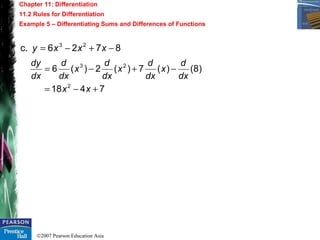
8726c. 23
−+−= xxxy
7418
)8()(7)(2)(6
2
23
+−=
−+−=
xx
dx
d
x
dx
d
x
dx
d
x
dx
d
dx
dy
©2007 Pearson Education Asia
Chapter 11: Differentiation
11.2 Rules for Differentiation
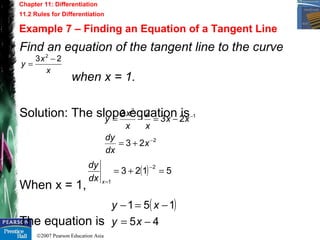
Example 7 – Finding an Equation of a Tangent Line
Find an equation of the tangent line to the curve
when x = 1.
Solution: The slope equation is
When x = 1,
The equation is
x
x
y
23 2
−
=
2
1
2
23
23
23
−
−
+=
−=−=
x
dx
dy
xx
xx
x
y
( ) 5123
2
1
=+=
−
=xdx
dy
( )
45
151
−=
−=−
xy
xy
©2007 Pearson Education Asia
Chapter 11: Differentiation
11.3 The Derivative as a Rate of Change11.3 The Derivative as a Rate of Change
Example 1 – Finding Average Velocity and Velocity
• Average velocity is given by
• Velocity at time t is given by
( ) ( )
t
tfttf
t
s
vave
∆
−∆+
=
∆
∆
=
( ) ( )
t
tfttf
v
t ∆
−∆+
=
→∆ 0
lim
Suppose the position function of an object moving
along a number line is given by s = f(t) = 3t2
+ 5,
where t is in seconds and s is in meters.
a.Find the average velocity over the interval [10,
10.1].
b. Find the velocity when t = 10.
©2007 Pearson Education Asia
Chapter 11: Differentiation
11.3 The Derivative as a Rate of Change
Example 1 – Finding Average Velocity and Velocity
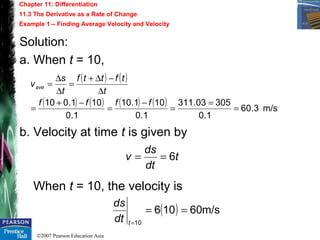
Solution:
a. When t = 10,
b. Velocity at time t is given by
When t = 10, the velocity is
( ) ( )
( ) ( ) ( ) ( ) m/s3.60
1.0
30503.311
1.0
101.10
1.0
101.010
=
=
=
−
=
−+
=
∆
−∆+
=
∆
∆
=
ffff
t
tfttf
t
s
vave
t
dt
ds
v 6==
( ) m/s60106
10
==
=tdt
ds
©2007 Pearson Education Asia
Chapter 11: Differentiation
11.3 The Derivative as a Rate of Change
Example 3 – Finding a Rate of Change
• If y = f(x),
then
( ) ( )





∆+
=
∆
−∆+
=
∆
∆
xxx
x
xfxxf
x
y
tofrominterval
theoverxtorespectwith
yofchangeofrateaverage



=
∆
∆
=
→∆ xrespect toy with
ofchangeofrateousinstantane
lim
0 x
y
dx
dy
x
Find the rate of change of y = x4
with respect to x,
and evaluate it when x = 2 and when x = −1.
Solution:
The rate of change is .
3
4x
dx
dy
=
©2007 Pearson Education Asia
Chapter 11: Differentiation
11.3 The Derivative as a Rate of Change
Example 5 – Rate of Change of Volume
A spherical balloon is being filled with air. Find the
rate of change of the volume of air in the balloon with
respect to its radius. Evaluate this rate of change
when the radius is 2 ft.
Solution: Rate of change of V with respect to r is
When r = 2 ft,
( ) 22
43
3
4
rr
dr
dV
ππ ==
( )
ft
ft
1624
3
2
2
ππ ==
=rdr
dV
©2007 Pearson Education Asia
Chapter 11: Differentiation
11.3 The Derivative as a Rate of Change
Applications of Rate of Change to Economics
• Total-cost function is c = f(q).
• Marginal cost is defined as .
• Total-revenue function is r = f(q).
• Marginal revenue is defined as .
dq
dc
dq
dr
Relative and Percentage Rates of Change
• The relative rate of change of f(x) is .
• The percentage rate of change of f (x) is
( )
( )xf
xf '
( )
( )
( )%100
'
xf
xf
©2007 Pearson Education Asia
Chapter 11: Differentiation
11.3 The Derivative as a Rate of Change
Example 7 – Marginal Cost
If a manufacturer’s average-cost equation is
find the marginal-cost function. What is the marginal
cost when 50 units are produced?
Solution: The cost is
Marginal cost when q = 50,
q
qqc
5000
502.00001.0 2
++−=
5000502.00001.0
5000
502.00001.0
23
2
++−=






++−==
qqq
q
qqqcqc
504.00003.0 2
+−= qq
dq
dc
( ) ( ) 75.355004.0500003.0
2
50
=+−=
=q
dq
dc
©2007 Pearson Education Asia
Chapter 11: Differentiation
11.3 The Derivative as a Rate of Change
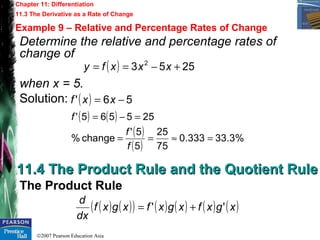
Example 9 – Relative and Percentage Rates of Change
11.4 The Product Rule and the Quotient Rule11.4 The Product Rule and the Quotient Rule
Determine the relative and percentage rates of
change of
when x = 5.
Solution:
( ) 2553 2
+−== xxxfy
( ) 56' −= xxf
( ) ( )
( )
( )
%3.33333.0
75
25
5
5'
change%
255565'
=≈==
=−=
f
f
f
The Product Rule
( ) ( )( ) ( ) ( ) ( ) ( )xgxfxgxfxgxf
dx
d
'' +=
©2007 Pearson Education Asia
Chapter 11: Differentiation
11.4 The Product and Quotient Rule
Example 1 – Applying the Product Rule
Example 3 – Differentiating a Product of Three Factors
Find F’(x).
( ) ( )( )
( ) ( ) ( ) ( ) ( )
( )( ) ( )( ) 153412435432
543543'
543
22
22
2
++=++++=






++++





+=
++=
xxxxxx
x
dx
d
xxxxx
dx
d
xF
xxxxF
Find y’.
( )( ) ( ) ( )( )( ) ( )
26183
432432'
)4)(3)(2(
2
++=






+++++





++=
+++=
xx
x
dx
d
xxxxx
dx
d
y
xxxy
©2007 Pearson Education Asia
Chapter 11: Differentiation
11.4 The Product and Quotient Rule
Example 5 – Applying the Quotient Rule
If , find F’(x).
Solution:
The Quotient Rule
( )
( )
( ) ( ) ( ) ( )
( )( )2
''
xg
xgxfxfxg
xg
xf
dx
d −
=





( )
12
34 2
−
+
=
x
x
xF
( )
( ) ( ) ( ) ( )
( )
( )( ) ( )( )
( )
( )( )
( )22
2
2
22
12
32122
12
234812
12
12343412
'
−
−+
=
−
+−−
=
−
−+−+−
=
x
xx
x
xxx
x
x
dx
d
xx
dx
d
x
xF
©2007 Pearson Education Asia
Chapter 11: Differentiation
11.4 The Product and Quotient Rule
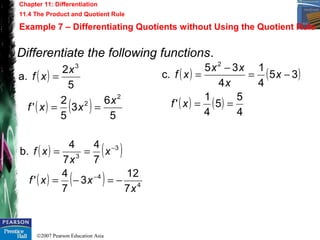
Example 7 – Differentiating Quotients without Using the Quotient Rule
Differentiate the following functions.
( )
( ) ( ) 5
6
3
5
2
'
5
2
a.
2
2
3
x
xxf
x
xf
==
=
( ) ( )
( ) ( ) 4
4
3
3
7
12
3
7
4
'
7
4
7
4
b.
x
xxf
x
x
xf
−=−=
==
−
−
( ) ( )
( ) ( )
4
5
5
4
1
'
35
4
1
4
35
c.
2
==
−=
−
=
xf
x
x
xx
xf
©2007 Pearson Education Asia
Chapter 11: Differentiation
11.4 The Product and Quotient Rule
Example 9 – Finding Marginal Propensities to Consume and to Save
If the consumption function is given by
determine the marginal propensity to consume and
the marginal propensity to save when I = 100.
Solution:
Consumption Function
dI
dC
consumetopropensityMarginal =
consumetopropensityMarginal-1savetopropensityMarginal =
( )
10
325 3
+
+
=
I
I
C
( ) ( ) ( ) ( )
( )
( )( ) ( )( )
( ) 







+
+−++
=












+
++−++
= 2
32/1
2
32/3
10
1323310
5
10
10323210
5
I
III
I
I
dI
d
II
dI
d
I
dI
dC
536.0
12100
1297
5
100
≈





=
=IdI
dC
©2007 Pearson Education Asia
Chapter 11: Differentiation
11.5 The Chain Rule and the Power Rule11.5 The Chain Rule and the Power Rule
Example 1 – Using the Chain Rule
a. If y = 2u2
− 3u − 2 and u = x2
+ 4, find dy/dx.
Solution:
Chain Rule:
Power Rule:
dx
du
du
dy
dx
dy
⋅=
( ) dx
du
nuu
dx
d nn 1−
=
( ) ( )
( )( )xu
x
dx
d
uu
du
d
dx
du
du
dy
dx
dy
234
4232 22
−=
+⋅−−=⋅=
( )[ ]( ) ( )[ ]( ) xxxxxx
dx
dy
26821342344 322
+=+=−+=
©2007 Pearson Education Asia
Chapter 11: Differentiation
11.5 The Chain Rule and the Power Rule
Example 1 – Using the Chain Rule
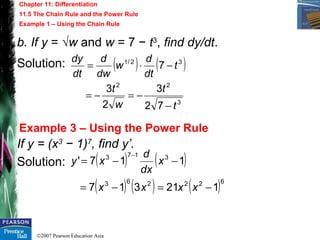
Example 3 – Using the Power Rule
b. If y = √w and w = 7 − t3
, find dy/dt.
Solution: ( ) ( )
3
22
32/1
72
3
2
3
7
t
t
w
t
t
dt
d
w
dw
d
dt
dy
−
−=−=
−⋅=
If y = (x3
− 1)7
, find y’.
Solution: ( ) ( )
( ) ( ) ( )622263
3173
121317
117'
−=−=
−−=
−
xxxx
x
dx
d
xy
©2007 Pearson Education Asia
Chapter 11: Differentiation
11.5 The Chain Rule and the Power Rule
Example 5 – Using the Power Rule
Example 7 – Differentiating a Product of Powers
If , find dy/dx.
Solution:
2
1
2
−
=
x
y
( )( ) ( )
( )22
2112
2
2
221
−
−=−−−=
−
x
x
x
dx
d
x
dx
dy
If , find y’.
Solution:
( ) ( )452
534 +−= xxy
( ) ( )( ) ( ) ( )( )
( ) ( ) ( ) ( )
( ) ( ) ( )2425215342
4531053412
453534'
2342
424352
524452
−++−=
−+++−=
−+++−=
xxxx
xxxxx
x
dx
d
xx
dx
d
xy

Introductory maths analysis chapter 11 official

  • 1.
    INTRODUCTORY MATHEMATICALINTRODUCTORY MATHEMATICAL ANALYSISANALYSISForBusiness, Economics, and the Life and Social Sciences ©2007 Pearson Education Asia Chapter 11Chapter 11 DifferentiationDifferentiation
  • 2.
    ©2007 Pearson EducationAsia INTRODUCTORY MATHEMATICAL ANALYSIS 0. Review of Algebra 1. Applications and More Algebra 2. Functions and Graphs 3. Lines, Parabolas, and Systems 4. Exponential and Logarithmic Functions 5. Mathematics of Finance 6. Matrix Algebra 7. Linear Programming 8. Introduction to Probability and Statistics
  • 3.
    ©2007 Pearson EducationAsia 9. Additional Topics in Probability 10. Limits and Continuity 11. Differentiation 12. Additional Differentiation Topics 13. Curve Sketching 14. Integration 15. Methods and Applications of Integration 16. Continuous Random Variables 17. Multivariable Calculus INTRODUCTORY MATHEMATICAL ANALYSIS
  • 4.
    ©2007 Pearson EducationAsia • To compute derivatives by using the limit definition. • To develop basic differentiation rules. • To interpret the derivative as an instantaneous rate of change. • To apply the product and quotient rules. • To apply the chain rule. Chapter 11: Differentiation Chapter ObjectivesChapter Objectives
  • 5.
    ©2007 Pearson EducationAsia The Derivative Rules for Differentiation The Derivative as a Rate of Change The Product Rule and the Quotient Rule The Chain Rule and the Power Rule 11.1) 11.2) 11.3) Chapter 11: Differentiation Chapter OutlineChapter Outline 11.4) 11.5)
  • 6.
    ©2007 Pearson EducationAsia Chapter 11: Differentiation 11.1 The Derivative11.1 The Derivative • Tangent line at a point: • The slope of a curve at P is the slope of the tangent line at P. • The slope of the tangent line at (a, f(a)) is ( ) ( ) ( ) ( ) h afhaf az afzf m haz −+ = − − = →→ 0 tan limlim
  • 7.
    ©2007 Pearson EducationAsia Chapter 11: Differentiation 11.1 The Derivative Example 1 – Finding the Slope of a Tangent Line Find the slope of the tangent line to the curve y = f(x) = x2 at the point (1, 1). Solution: Slope = ( ) ( ) ( ) ( ) 2 11 lim 11 lim 22 00 = −+ = −+ →→ h h h fhf hh • The derivative of a function f is the function denoted f’ and defined by ( ) ( ) ( ) ( ) ( ) h xfhxf xz xfzf xf hxz −+ = − − = →→ 0 limlim'
  • 8.
    ©2007 Pearson EducationAsia Chapter 11: Differentiation 11.1 The Derivative Example 3 – Finding an Equation of a Tangent Line If f (x) = 2x2 + 2x + 3, find an equation of the tangent line to the graph of f at (1, 7). Solution: Slope  Equation  ( ) ( ) ( ) ( ) ( )( ) ( ) 24 322322 limlim' 22 00 += ++−++++ = −+ = →→ x h xxhxhx h xfhxf xf hh ( ) 16 167 += −=− xy xy ( ) ( ) 62141' =+=f
  • 9.
    ©2007 Pearson EducationAsia Chapter 11: Differentiation 11.1 The Derivative Example 5 – A Function with a Vertical Tangent Line Example 7 – Continuity and Differentiability Find . Solution: ( )x dx d ( ) xh xhx x dx d h 2 1 lim 0 = −+ = → a. For f(x) = x2 , it must be continuous for all x. b. For f(p) =(1/2)p, it is not continuous at p = 0, thus the derivative does not exist at p = 0.
  • 10.
    ©2007 Pearson EducationAsia Chapter 11: Differentiation 11.2 Rules for Differentiation11.2 Rules for Differentiation • Rules for Differentiation: RULE 1 Derivative of a Constant: RULE 2 Derivative of xn : RULE 3 Constant Factor Rule: RULE 4 Sum or Difference Rule ( ) 0=c dx d ( ) 1− = nn nxx dx d ( )( ) ( )xcfxcf dx d '= ( ) ( )( ) ( ) ( )xgxfxgxf dx d '' ±=±=
  • 11.
    ©2007 Pearson EducationAsia Chapter 11: Differentiation 11.2 Rules for Differentiation Example 1 – Derivatives of Constant Functions a. b. If , then . c. If , then . ( ) 03 = dx d ( ) 5=xg ( ) ( ) 4.807 623,938,1=ts ( ) 0' =xg 0=dt ds
  • 12.
    ©2007 Pearson EducationAsia Chapter 11: Differentiation 11.2 Rules for Differentiation Example 3 – Rewriting Functions in the Form xn Differentiate the following functions: Solution: a. b. xy = ( ) x x dx dy 2 1 2 1 12/1 == − ( ) xx xh 1 = ( ) ( ) ( ) 2/512/32/3 2 3 2 3 ' −−−− −=−== xxx dx d xh
  • 13.
    ©2007 Pearson EducationAsia Chapter 11: Differentiation 11.2 Rules for Differentiation Example 5 – Differentiating Sums and Differences of Functions Differentiate the following functions: ( ) xxxF += 5 3a. ( ) ( ) ( ) ( ) ( ) x xxx x dx d x dx d xF 2 1 15 2 1 53 3' 42/14 2/15 +=+= += − ( ) 3/1 4 5 4 b. z z zf −= ( ) ( ) 3/433/43 3/1 4 3 5 3 1 54 4 1 5 4 ' −− +=      −−=       −      = zzzz zdz dz dz d zf
  • 14.
    ©2007 Pearson EducationAsia Chapter 11: Differentiation 11.2 Rules for Differentiation Example 5 – Differentiating Sums and Differences of Functions 8726c. 23 −+−= xxxy 7418 )8()(7)(2)(6 2 23 +−= −+−= xx dx d x dx d x dx d x dx d dx dy
  • 15.
    ©2007 Pearson EducationAsia Chapter 11: Differentiation 11.2 Rules for Differentiation Example 7 – Finding an Equation of a Tangent Line Find an equation of the tangent line to the curve when x = 1. Solution: The slope equation is When x = 1, The equation is x x y 23 2 − = 2 1 2 23 23 23 − − += −=−= x dx dy xx xx x y ( ) 5123 2 1 =+= − =xdx dy ( ) 45 151 −= −=− xy xy
  • 16.
    ©2007 Pearson EducationAsia Chapter 11: Differentiation 11.3 The Derivative as a Rate of Change11.3 The Derivative as a Rate of Change Example 1 – Finding Average Velocity and Velocity • Average velocity is given by • Velocity at time t is given by ( ) ( ) t tfttf t s vave ∆ −∆+ = ∆ ∆ = ( ) ( ) t tfttf v t ∆ −∆+ = →∆ 0 lim Suppose the position function of an object moving along a number line is given by s = f(t) = 3t2 + 5, where t is in seconds and s is in meters. a.Find the average velocity over the interval [10, 10.1]. b. Find the velocity when t = 10.
  • 17.
    ©2007 Pearson EducationAsia Chapter 11: Differentiation 11.3 The Derivative as a Rate of Change Example 1 – Finding Average Velocity and Velocity Solution: a. When t = 10, b. Velocity at time t is given by When t = 10, the velocity is ( ) ( ) ( ) ( ) ( ) ( ) m/s3.60 1.0 30503.311 1.0 101.10 1.0 101.010 = = = − = −+ = ∆ −∆+ = ∆ ∆ = ffff t tfttf t s vave t dt ds v 6== ( ) m/s60106 10 == =tdt ds
  • 18.
    ©2007 Pearson EducationAsia Chapter 11: Differentiation 11.3 The Derivative as a Rate of Change Example 3 – Finding a Rate of Change • If y = f(x), then ( ) ( )      ∆+ = ∆ −∆+ = ∆ ∆ xxx x xfxxf x y tofrominterval theoverxtorespectwith yofchangeofrateaverage    = ∆ ∆ = →∆ xrespect toy with ofchangeofrateousinstantane lim 0 x y dx dy x Find the rate of change of y = x4 with respect to x, and evaluate it when x = 2 and when x = −1. Solution: The rate of change is . 3 4x dx dy =
  • 19.
    ©2007 Pearson EducationAsia Chapter 11: Differentiation 11.3 The Derivative as a Rate of Change Example 5 – Rate of Change of Volume A spherical balloon is being filled with air. Find the rate of change of the volume of air in the balloon with respect to its radius. Evaluate this rate of change when the radius is 2 ft. Solution: Rate of change of V with respect to r is When r = 2 ft, ( ) 22 43 3 4 rr dr dV ππ == ( ) ft ft 1624 3 2 2 ππ == =rdr dV
  • 20.
    ©2007 Pearson EducationAsia Chapter 11: Differentiation 11.3 The Derivative as a Rate of Change Applications of Rate of Change to Economics • Total-cost function is c = f(q). • Marginal cost is defined as . • Total-revenue function is r = f(q). • Marginal revenue is defined as . dq dc dq dr Relative and Percentage Rates of Change • The relative rate of change of f(x) is . • The percentage rate of change of f (x) is ( ) ( )xf xf ' ( ) ( ) ( )%100 ' xf xf
  • 21.
    ©2007 Pearson EducationAsia Chapter 11: Differentiation 11.3 The Derivative as a Rate of Change Example 7 – Marginal Cost If a manufacturer’s average-cost equation is find the marginal-cost function. What is the marginal cost when 50 units are produced? Solution: The cost is Marginal cost when q = 50, q qqc 5000 502.00001.0 2 ++−= 5000502.00001.0 5000 502.00001.0 23 2 ++−=       ++−== qqq q qqqcqc 504.00003.0 2 +−= qq dq dc ( ) ( ) 75.355004.0500003.0 2 50 =+−= =q dq dc
  • 22.
    ©2007 Pearson EducationAsia Chapter 11: Differentiation 11.3 The Derivative as a Rate of Change Example 9 – Relative and Percentage Rates of Change 11.4 The Product Rule and the Quotient Rule11.4 The Product Rule and the Quotient Rule Determine the relative and percentage rates of change of when x = 5. Solution: ( ) 2553 2 +−== xxxfy ( ) 56' −= xxf ( ) ( ) ( ) ( ) %3.33333.0 75 25 5 5' change% 255565' =≈== =−= f f f The Product Rule ( ) ( )( ) ( ) ( ) ( ) ( )xgxfxgxfxgxf dx d '' +=
  • 23.
    ©2007 Pearson EducationAsia Chapter 11: Differentiation 11.4 The Product and Quotient Rule Example 1 – Applying the Product Rule Example 3 – Differentiating a Product of Three Factors Find F’(x). ( ) ( )( ) ( ) ( ) ( ) ( ) ( ) ( )( ) ( )( ) 153412435432 543543' 543 22 22 2 ++=++++=       ++++      += ++= xxxxxx x dx d xxxxx dx d xF xxxxF Find y’. ( )( ) ( ) ( )( )( ) ( ) 26183 432432' )4)(3)(2( 2 ++=       +++++      ++= +++= xx x dx d xxxxx dx d y xxxy
  • 24.
    ©2007 Pearson EducationAsia Chapter 11: Differentiation 11.4 The Product and Quotient Rule Example 5 – Applying the Quotient Rule If , find F’(x). Solution: The Quotient Rule ( ) ( ) ( ) ( ) ( ) ( ) ( )( )2 '' xg xgxfxfxg xg xf dx d − =      ( ) 12 34 2 − + = x x xF ( ) ( ) ( ) ( ) ( ) ( ) ( )( ) ( )( ) ( ) ( )( ) ( )22 2 2 22 12 32122 12 234812 12 12343412 ' − −+ = − +−− = − −+−+− = x xx x xxx x x dx d xx dx d x xF
  • 25.
    ©2007 Pearson EducationAsia Chapter 11: Differentiation 11.4 The Product and Quotient Rule Example 7 – Differentiating Quotients without Using the Quotient Rule Differentiate the following functions. ( ) ( ) ( ) 5 6 3 5 2 ' 5 2 a. 2 2 3 x xxf x xf == = ( ) ( ) ( ) ( ) 4 4 3 3 7 12 3 7 4 ' 7 4 7 4 b. x xxf x x xf −=−= == − − ( ) ( ) ( ) ( ) 4 5 5 4 1 ' 35 4 1 4 35 c. 2 == −= − = xf x x xx xf
  • 26.
    ©2007 Pearson EducationAsia Chapter 11: Differentiation 11.4 The Product and Quotient Rule Example 9 – Finding Marginal Propensities to Consume and to Save If the consumption function is given by determine the marginal propensity to consume and the marginal propensity to save when I = 100. Solution: Consumption Function dI dC consumetopropensityMarginal = consumetopropensityMarginal-1savetopropensityMarginal = ( ) 10 325 3 + + = I I C ( ) ( ) ( ) ( ) ( ) ( )( ) ( )( ) ( )         + +−++ =             + ++−++ = 2 32/1 2 32/3 10 1323310 5 10 10323210 5 I III I I dI d II dI d I dI dC 536.0 12100 1297 5 100 ≈      = =IdI dC
  • 27.
    ©2007 Pearson EducationAsia Chapter 11: Differentiation 11.5 The Chain Rule and the Power Rule11.5 The Chain Rule and the Power Rule Example 1 – Using the Chain Rule a. If y = 2u2 − 3u − 2 and u = x2 + 4, find dy/dx. Solution: Chain Rule: Power Rule: dx du du dy dx dy ⋅= ( ) dx du nuu dx d nn 1− = ( ) ( ) ( )( )xu x dx d uu du d dx du du dy dx dy 234 4232 22 −= +⋅−−=⋅= ( )[ ]( ) ( )[ ]( ) xxxxxx dx dy 26821342344 322 +=+=−+=
  • 28.
    ©2007 Pearson EducationAsia Chapter 11: Differentiation 11.5 The Chain Rule and the Power Rule Example 1 – Using the Chain Rule Example 3 – Using the Power Rule b. If y = √w and w = 7 − t3 , find dy/dt. Solution: ( ) ( ) 3 22 32/1 72 3 2 3 7 t t w t t dt d w dw d dt dy − −=−= −⋅= If y = (x3 − 1)7 , find y’. Solution: ( ) ( ) ( ) ( ) ( )622263 3173 121317 117' −=−= −−= − xxxx x dx d xy
  • 29.
    ©2007 Pearson EducationAsia Chapter 11: Differentiation 11.5 The Chain Rule and the Power Rule Example 5 – Using the Power Rule Example 7 – Differentiating a Product of Powers If , find dy/dx. Solution: 2 1 2 − = x y ( )( ) ( ) ( )22 2112 2 2 221 − −=−−−= − x x x dx d x dx dy If , find y’. Solution: ( ) ( )452 534 +−= xxy ( ) ( )( ) ( ) ( )( ) ( ) ( ) ( ) ( ) ( ) ( ) ( )2425215342 4531053412 453534' 2342 424352 524452 −++−= −+++−= −+++−= xxxx xxxxx x dx d xx dx d xy