Rational Algebraic Equations Transformable to Quadratic Equation.pptx
1.
MATHEMATICS 9
• SolvingEquations Transformable to Quadratic Equation Including Rational Algebraic Equations
• Lesson 1: Solving Quadratic Equations That Ar
e NotWritten In Standard F
o
r
m
• Lesson 2: Solving Rational Algebraic Equations
T
ransformable T
o Quadratic Equations
2.
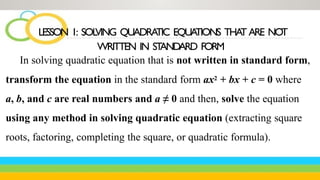
In solving quadraticequation that is not written in standard form,
transform the equation in the standard form ax2 + bx + c = 0 where
a, b, and c are real numbers and a ≠ 0 and then, solve the equation
using any method in solving quadratic equation (extracting square
roots, factoring, completing the square, or quadratic formula).
LESSON 1: SOL
VING QUADRA
TIC EQUA
TIONS THA
T ARE NOT
WRITTEN IN ST
ANDARD FORM
3.
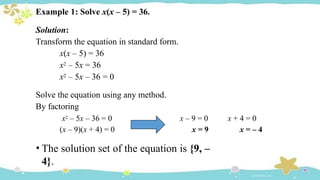
Example 1: Solvex(x – 5) = 36.
Solution:
Transform the equation in standard form.
x(x – 5) = 36
x2 – 5x = 36
x2 – 5x – 36 = 0
Solve the equation using any method.
By factoring
x2 – 5x – 36 = 0
(x – 9)(x + 4) = 0
x – 9 = 0
x = 9
x + 4 = 0
x = – 4
• The solution set of the equation is {9, –
4}.
4.
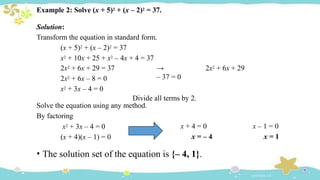
Example 2: Solve(x + 5)2 + (x – 2)2 = 37.
Solution:
Transform the equation in standard form.
(x + 5)2 + (x – 2)2 = 37
x2 + 10x + 25 + x2 – 4x + 4 = 37
2x2 + 6x + 29 = 37
2x2 + 6x – 8 = 0
x2 + 3x – 4 = 0
→ 2x2 + 6x + 29
– 37 = 0
Divide all terms by 2.
Solve the equation using any method.
By factoring
x2 + 3x – 4 = 0
(x + 4)(x – 1) = 0
x + 4 = 0
x = – 4
x – 1 = 0
x = 1
• The solution set of the equation is {– 4, 1}.
5.
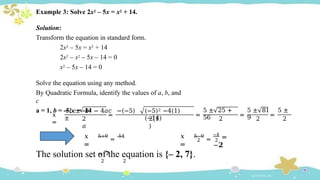
Example 3: Solve2x2 – 5x = x2 + 14.
Solution:
Transform the equation in standard form.
2x2 – 5x = x2 + 14
2x2 – x2 – 5x – 14 = 0
x2 – 5x – 14 = 0
Solve the equation using any method.
By Quadratic Formula, identify the values of a, b, and
c
a = 1, b = -5, c = -14
𝑥
=
2
𝑎
=
−𝑏 ± 𝑏2 − 4𝑎𝑐 −(−5)
±
(−5)2 −4(1)
(−14)
2(1
)
=
5 ± 25 +
56 2
=
2
=
5 ± 81 5 ±
9 2
𝑥
=
5+9
=
14
= 𝟕
2 2
𝑥
=
2
5−9
= 2
−4
=
−𝟐
The solution set of the equation is {– 2, 7}.
6.
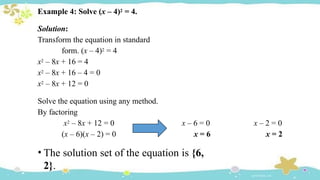
Example 4: Solve(x – 4)2 = 4.
Solution:
Transform the equation in standard
form. (x – 4)2 = 4
x2 – 8x + 16 = 4
x2 – 8x + 16 – 4 = 0
x2 – 8x + 12 = 0
Solve the equation using any method.
By factoring
x2 – 8x + 12 = 0
(x – 6)(x – 2) = 0
x – 6 = 0
x = 6
x – 2 = 0
x = 2
• The solution set of the equation is {6,
2}.
7.
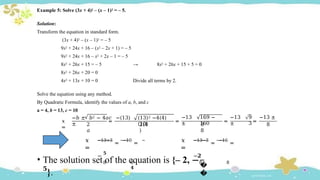
Example 5: Solve(3x + 4)2 – (x – 1)2 = – 5.
→ 8x2 + 26x + 15 + 5 = 0
Solution:
Transform the equation in standard form.
(3x + 4)2 – (x – 1)2 = – 5
9x2 + 24x + 16 – (x2 – 2x + 1) = – 5
9x2 + 24x + 16 – x2 + 2x – 1 = – 5
8x2 + 26x + 15 = – 5
8x2 + 26x + 20 = 0
4x2 + 13x + 10 = 0 Divide all terms by 2.
Solve the equation using any method.
By Quadratic Formula, identify the values of a, b, and c
a = 4, b = 13, c = 10
𝑥
=
2
𝑎
=
−𝑏 ± 𝑏2 − 4𝑎𝑐 −(13)
±
(13)2 −4(4)
(10)
2(4
)
=
−13
±
169 −
160 =
−13
±
8
8
=
9 −13 ±
3 8
𝑥
=
−13+3
=
−10
=
−
𝟓
8 8
𝟒
𝑥
=
−13−3
=
−16
=
−𝟐
8 8
�
�
• The solution set of the equation is {– 2, −
𝟓
}.
8.
Lesson 2: SolvingRational Algebraic Equations
Transformable T
o Quadratic
Equations
There are rational equations that can be transformed
into quadratic equation of the form ax2 + bx + c = 0 where a,
b and c are real numbers, and a ≠ 0 and it can be solved
using the different methods in solving quadratic equation.
9.
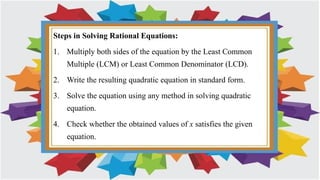
Steps in SolvingRational Equations:
1. Multiply both sides of the equation by the Least Common
Multiple (LCM) or Least Common Denominator (LCD).
2. Write the resulting quadratic equation in standard form.
3. Solve the equation using any method in solving quadratic
equation.
4. Check whether the obtained values of x satisfies the given
equation.
10.
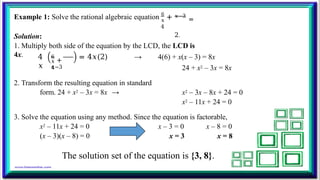
Example 1: Solvethe rational algebraic equation 6
+
𝑥
4
𝑥−3
=
2.
Solution:
1. Multiply both side of the equation by the LCD, the LCD is
4x. 4
𝑥
6
+
𝑥−3
𝑥
4
= 4𝑥(2) → 4(6) + x(x – 3) = 8x
24 + x2 – 3x = 8x
2. Transform the resulting equation in standard
form. 24 + x2 – 3x = 8x → x2 – 3x – 8x + 24 = 0
x2 – 11x + 24 = 0
3. Solve the equation using any method. Since the equation is factorable,
x2 – 11x + 24 = 0
(x – 3)(x – 8) = 0
x – 3 = 0
x = 3
x – 8 = 0
x = 8
The solution set of the equation is {3, 8}.
11.
1
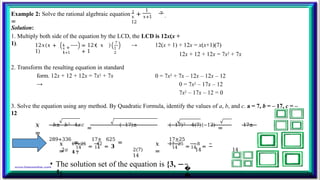
Example 2: Solvethe rational algebraic equation 1
+
=
𝑥 𝑥+1
12
7
.
Solution:
1. Multiply both side of the equation by the LCD, the LCD is 12x(x +
1). 12𝑥(𝑥 +
1)
1
+
1
𝑥
𝑥+1
= 12𝑥 𝑥
+ 1
7
1
2
→ 12(x + 1) + 12x = x(x+1)(7)
12x + 12 + 12x = 7x2 + 7x
2. Transform the resulting equation in standard
form. 12x + 12 + 12x = 7x2 + 7x
→
0 = 7x2 + 7x – 12x – 12x – 12
0 = 7x2 – 17x – 12
7x2 – 17x – 12 = 0
3. Solve the equation using any method. By Quadratic Formula, identify the values of a, b, and c. a = 7, b = – 17, c = –
12
𝑥
=
−𝑏± 𝑏2−4𝑎𝑐
=
−(−17)± (−17)2 −4(7)(−12)
=
17±
289+336
=
17± 625
=
17±25
2𝑎 2(7) 14 14
14
𝑥
=
𝑥
=
17+25
=
42
= 𝟑
17−25
=
−8
= −
𝟒
14 14 14 14
𝟕
�
�
• The solution set of the equation is {3, −
𝟒
}.
12.
8
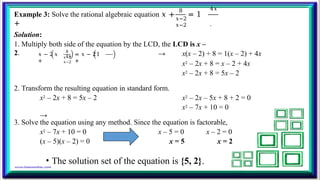
Example 3: Solvethe rational algebraic equation 𝑥 + = 1
+
𝑥−2
𝑥−2
4𝑥
.
Solution:
1. Multiply both side of the equation by the LCD, the LCD is x –
2. 𝑥 − 2 𝑥
+
= 𝑥 − 21
+
8
4𝑥
𝑥−2
𝑥−2
→ x(x – 2) + 8 = 1(x – 2) + 4x
x2 – 2x + 8 = x – 2 + 4x
x2 – 2x + 8 = 5x – 2
2. Transform the resulting equation in standard form.
x2 – 2x + 8 = 5x – 2
→
x2 – 2x – 5x + 8 + 2 = 0
x2 – 7x + 10 = 0
3. Solve the equation using any method. Since the equation is factorable,
x2 – 7x + 10 = 0
(x – 5)(x – 2) = 0
x – 5 = 0
x = 5
x – 2 = 0
x = 2
• The solution set of the equation is {5, 2}.
13.
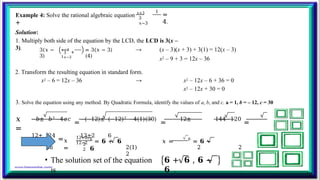
Example 4: Solvethe rational algebraic equation 𝑥+3
+
1
3
𝑥−3
=
4.
Solution:
1. Multiply both side of the equation by the LCD, the LCD is 3(x –
3). 3(𝑥 −
3)
𝑥+3
+
1
3
𝑥−3
= 3(𝑥 − 3)
(4)
→ (x – 3)(x + 3) + 3(1) = 12(x – 3)
x2 – 9 + 3 = 12x – 36
2. Transform the resulting equation in standard form.
x2 – 6 = 12x – 36 → x2 – 12x – 6 + 36 = 0
x2 – 12x + 30 = 0
3. Solve the equation using any method. By Quadratic Formula, identify the values of a, b, and c. a = 1, b = – 12, c = 30
𝑥
=
−𝑏± 𝑏2−4𝑎𝑐
=
−(−12)± (−12)2 −4(1)(30)
=
12± 144−120
=
12± 24
=
12±2 6
2𝑎 2(1) 2 2
2
𝑥
=
12+2
12−2
2
2
6
= 𝟔 + 𝟔 𝑥 = 6
= 𝟔 −
𝟔
• The solution set of the equation
is
𝟔 + 𝟔 , 𝟔 −
𝟔 .
14.
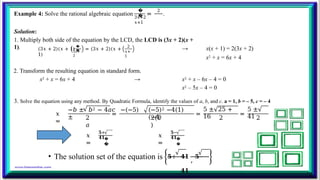
Example 4: Solvethe rational algebraic equation
�
�
2
3𝑥+2
𝑥+1
= .
Solution:
1. Multiply both side of the equation by the LCD, the LCD is (3x + 2)(x +
1). �
�
3𝑥+
2
(3𝑥 + 2)(𝑥 + 1) = (3𝑥 + 2)(𝑥 +
1)
2
𝑥+
1
→ x(x + 1) = 2(3x + 2)
x2 + x = 6x + 4
2. Transform the resulting equation in standard form.
x2 + x = 6x + 4 → x2 + x – 6x – 4 = 0
x2 – 5x – 4 = 0
3. Solve the equation using any method. By Quadratic Formula, identify the values of a, b, and c. a = 1, b = – 5, c = – 4
𝑥
=
2
𝑎
=
−𝑏 ± 𝑏2 − 4𝑎𝑐 −(−5)
±
(−5)2 −4(1)
(−4)
2(1
)
=
5 ± 25 +
16 2
=
5 ±
41 2
𝑥
=
𝟓+
𝟒𝟏�
�
𝑥
=
𝟓−
𝟒𝟏�
�
• The solution set of the equation is 𝟓+ 𝟒𝟏
,
𝟓−
𝟒𝟏
.
15.
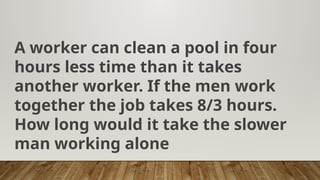
A worker canclean a pool in four
hours less time than it takes
another worker. If the men work
together the job takes 8/3 hours.
How long would it take the slower
man working alone