Lesson 1
Rational
Equations
Objectives
At the end of this lesson, the learner should be able to
● accurately define a rational equation, and solutions
and extraneous solutions of rational equations; and
● correctly solve rational equations.
Essential Questions
● What are rational equations?
● How do you solve rational equations?
● What is an extraneous solution of a rational equation?
Warm Up!
Before we learn how to solve rational equations, let us recall
how to get the least common multiple of polynomials by
watching a short clip.
(Click on the link to access the video clip)
“Finding LCM of Polynomials”. EvCCMath.
Retrieved 22 February 2019 from
https://www.youtube.com/watch?v=1E4foCjeNGw&feature=s
hare
Guide Questions
● How do we factor polynomials?
● How do you solve for the least common multiple of two
polynomials?
● When can we apply the process of finding the LCM of two
or more polynomials?
● What do we call the fractions that contain polynomial
expressions?
Learn about It!
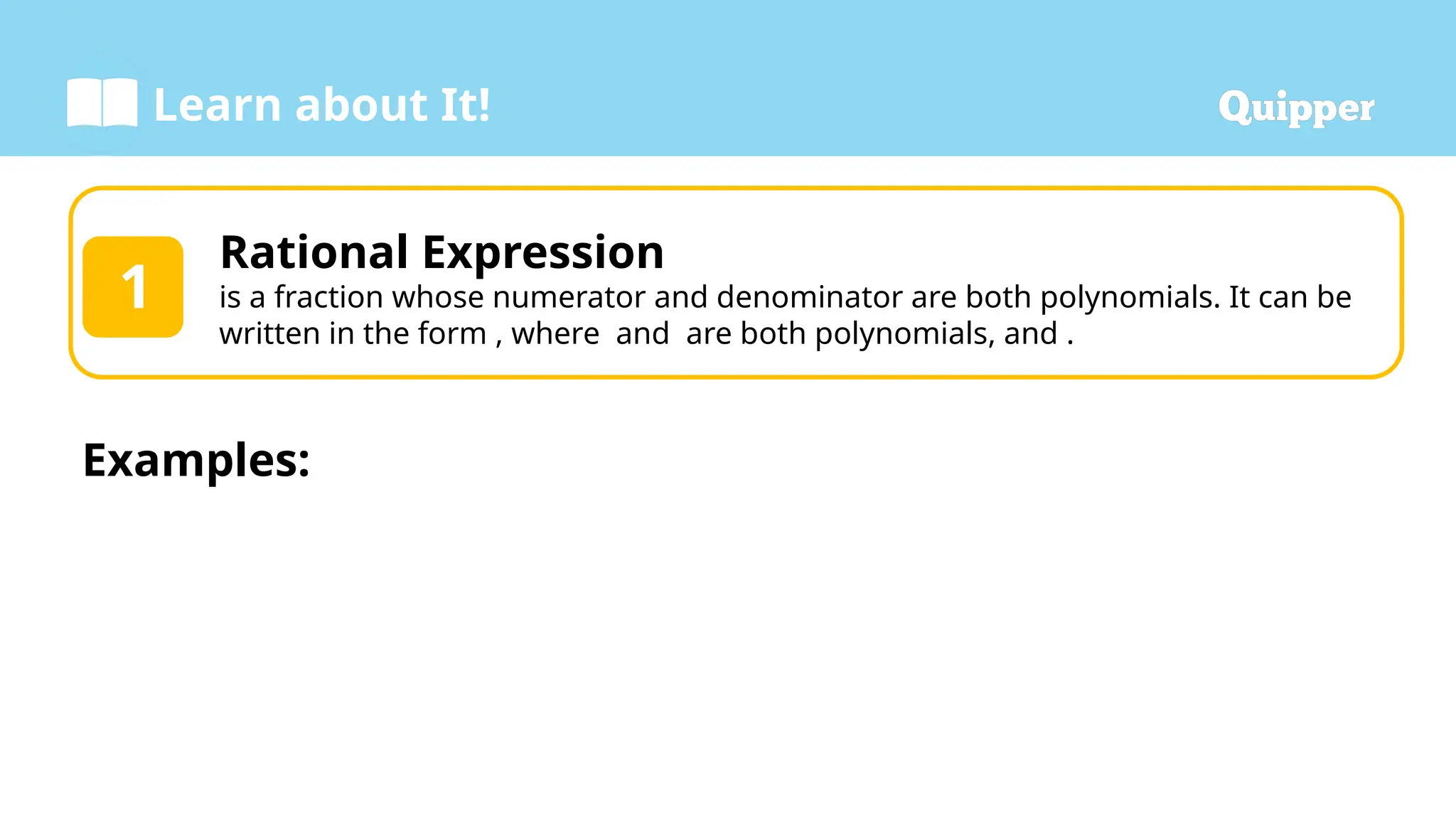
Rational Expression
is a fraction whose numerator and denominator are both polynomials. It can be
written in the form , where and are both polynomials, and .
1
Examples:
Learn about It!
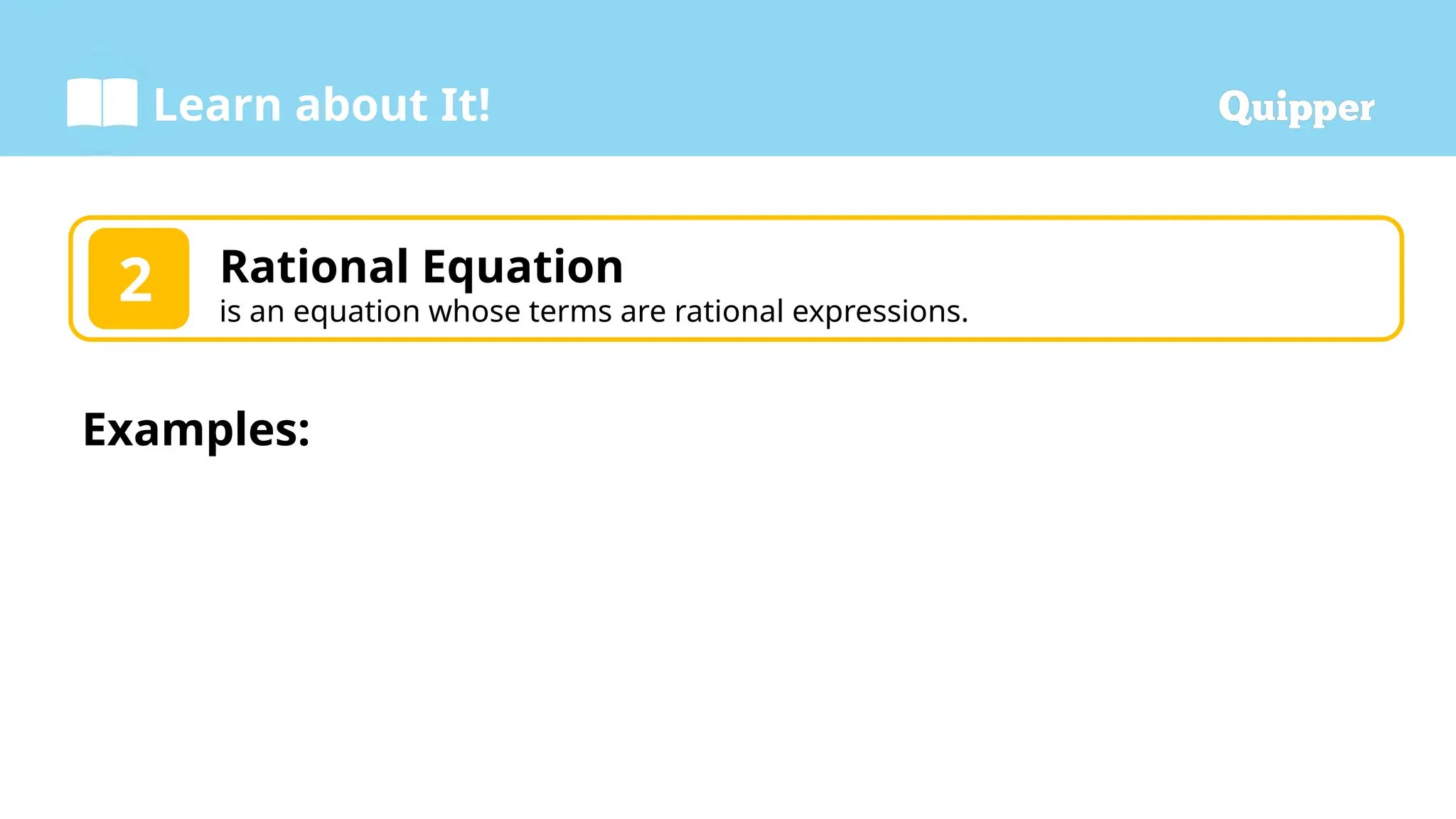
2 Rational Equation
is an equation whose terms are rational expressions.
Examples:
Learn about It!
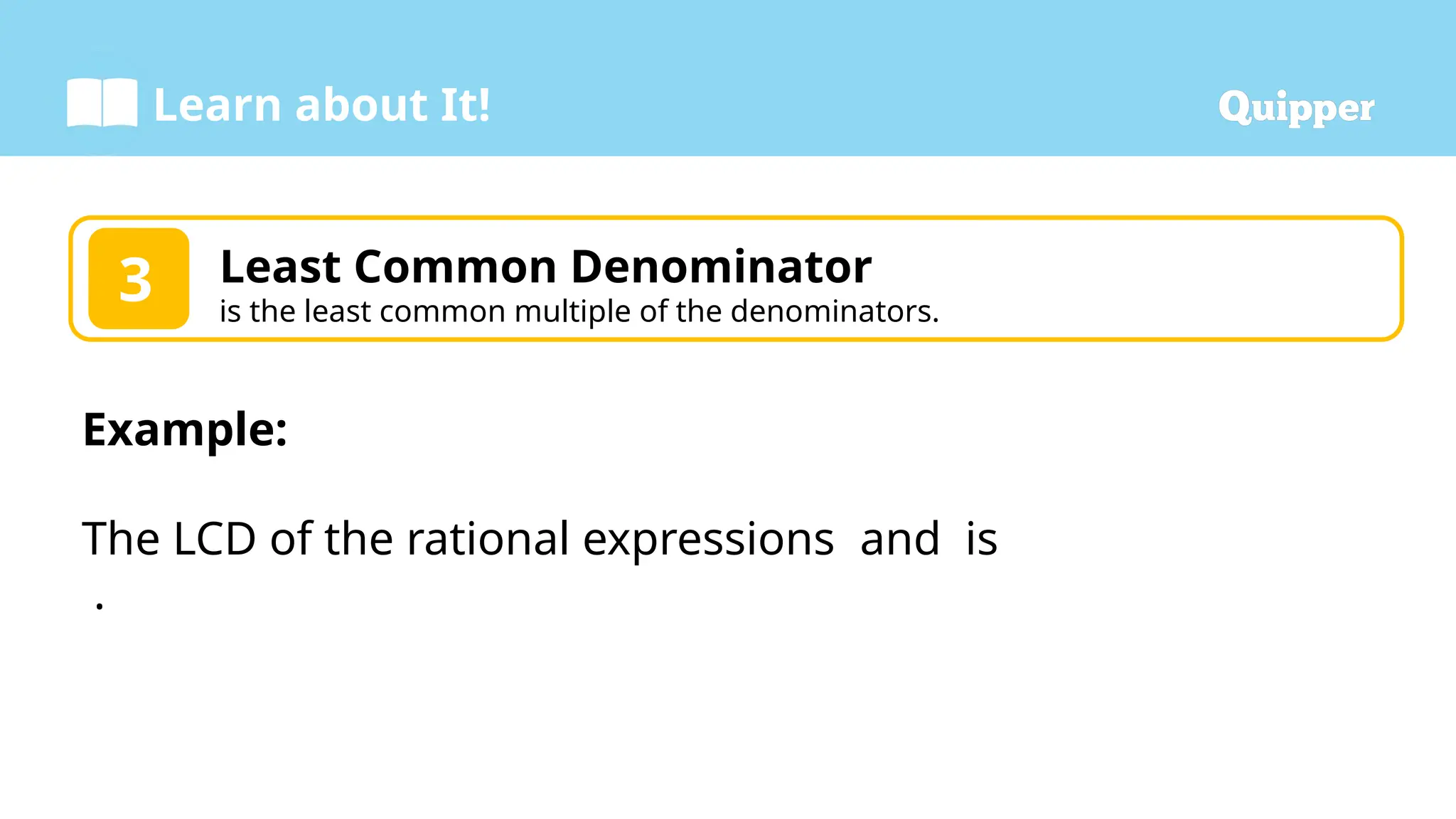
3 Least Common Denominator
is the least common multiple of the denominators.
Example:
The LCD of the rational expressions and is
.
Learn about It!
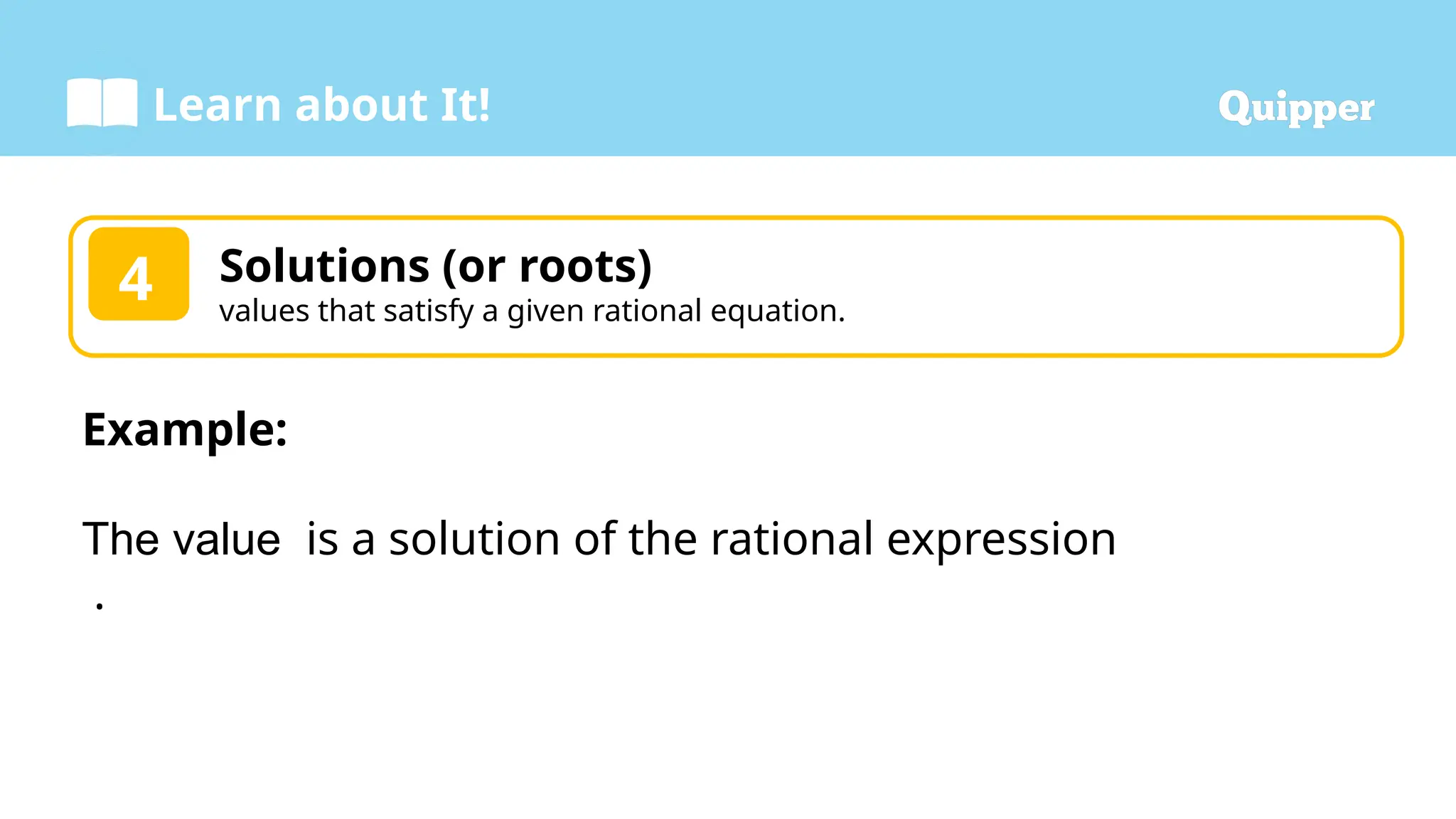
4 Solutions (or roots)
values that satisfy a given rational equation.
Example:
The value is a solution of the rational expression
.
Learn about It!
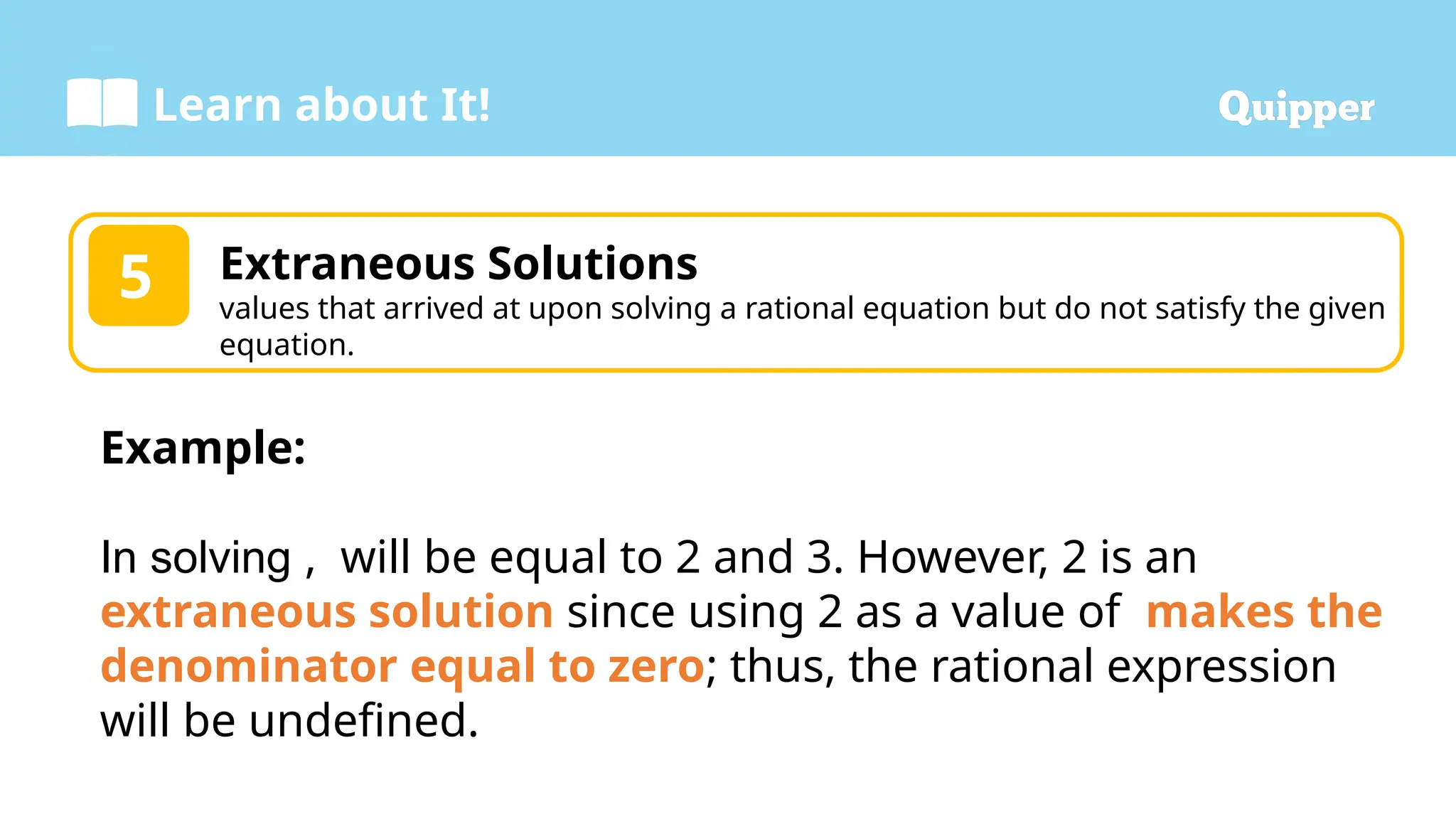
5 Extraneous Solutions
values that arrived at upon solving a rational equation but do not satisfy the given
equation.
Example:
In solving , will be equal to 2 and 3. However, 2 is an
extraneous solution since using 2 as a value of makes the
denominator equal to zero; thus, the rational expression
will be undefined.
Try It!
Example 1: Solve .
Solution:
1. Find the LCD.
The denominators are and . Both of these
expressions are completely factored already. Thus, the
LCD
of the terms of the equation is .
Try It!
2. Multiply both sides of the equation by the LCD to remove
the denominators then solve for the unknown variable.
(𝟑) ( 𝒙+𝟏)( 𝑥
𝑥+1 )=(4
3 )(𝟑) ( 𝒙+𝟏 )
3 𝑥=4 𝑥+4
Example 1: Solve .
− 𝑥=4
𝑥=− 4
Try It!
3. Verify your answer by substituting to the original
equation. Then, simplify.
Example 1: Solve .
− 4
−3
=
4
3
4
3
=
4
3
?
?

Try It!
Since it satisfies the equation, is the solution or root of the given
equation.
Example 1: Solve .
Try It!
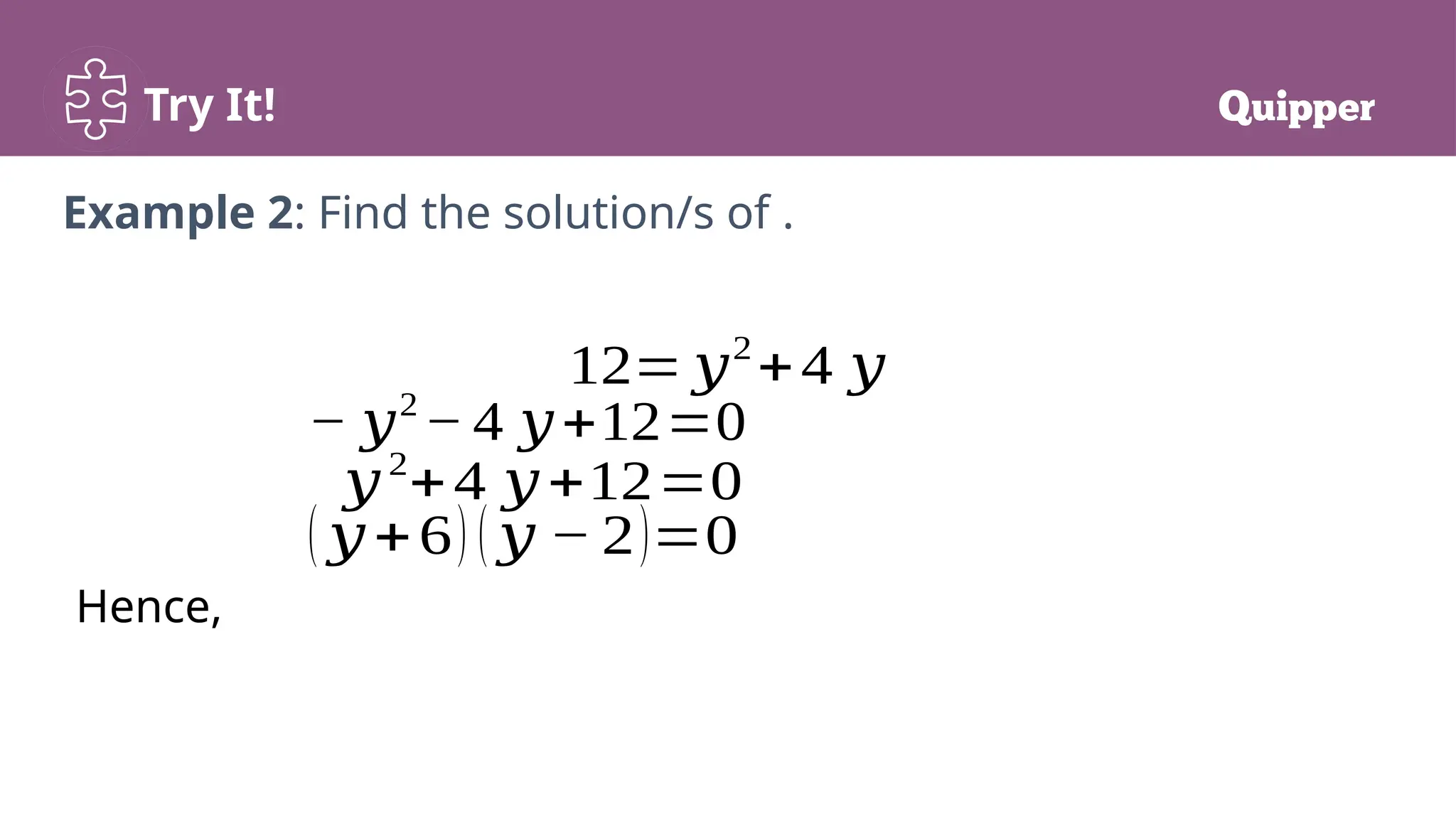
Example 2: Find the solution/s of .
Solution:
1. Find the LCD.
The denominators are and . Both of these
expressions are completely factored already. Thus, the
LCD of the given equation is .
Try It!
2. Multiply both sides of the equation by the LCD to remove
the denominators then solve for the unknown variable.
Example 2: Find the solution/s of .
(𝟑) ( 𝒚 +𝟒)( 4
𝑦+4 )=(𝑦
3 )(𝟑)( 𝒚 +𝟒)
12= 𝑦2
+4 𝑦
Try It!
Hence,
12= 𝑦2
+4 𝑦
Example 2: Find the solution/s of .
− 𝑦2
− 4 𝑦+12=0
𝑦2
+4 𝑦+12=0
( 𝑦+6) ( 𝑦 − 2)=0
Try It!
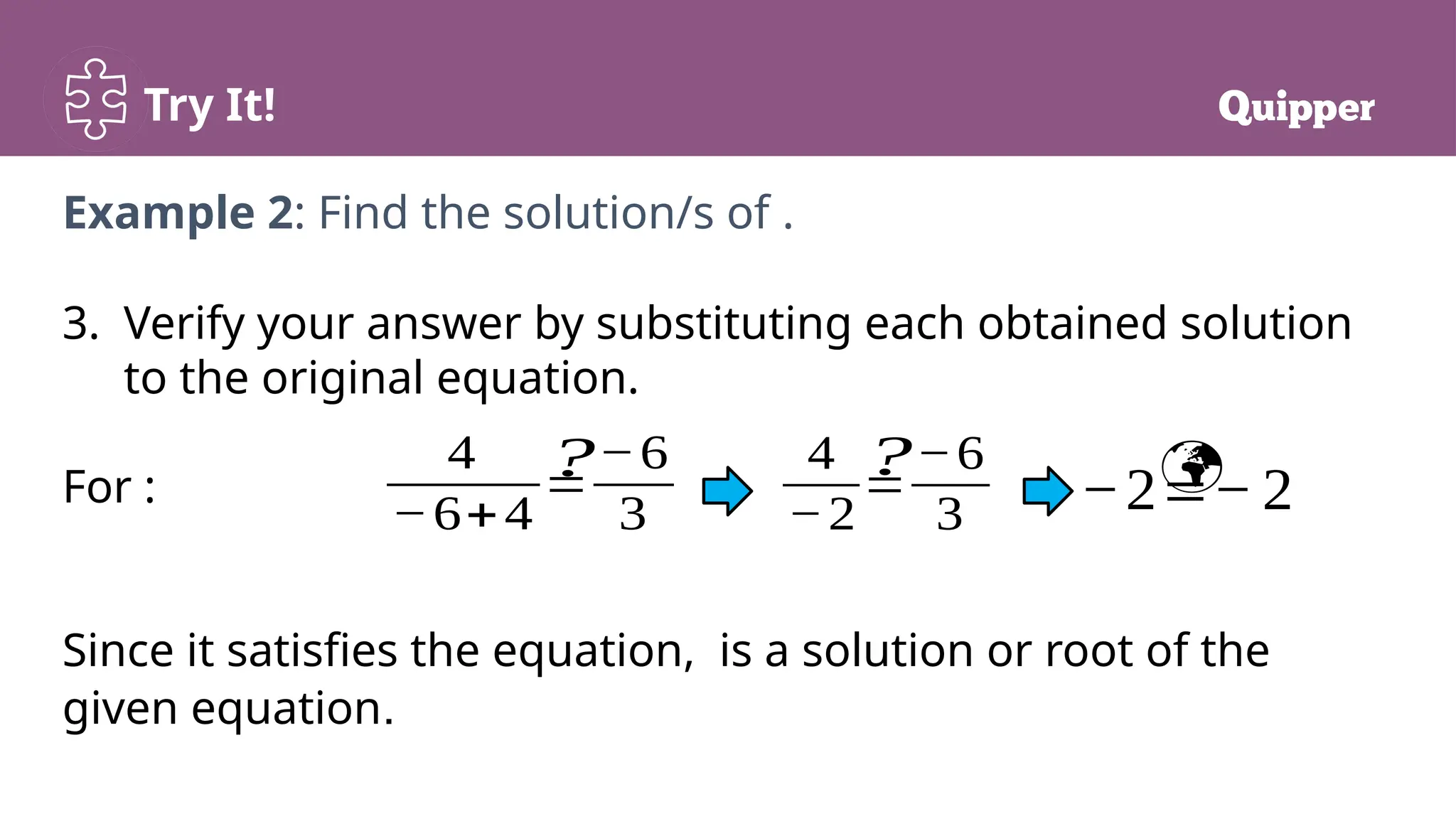
3. Verify your answer by substituting each obtained solution
to the original equation.
For :
Since it satisfies the equation, is a solution or root of the
given equation.
Example 2: Find the solution/s of .
4
−6+4
=
−6
3
4
−2
=
−6
3 −2=−2
? 
?
Try It!
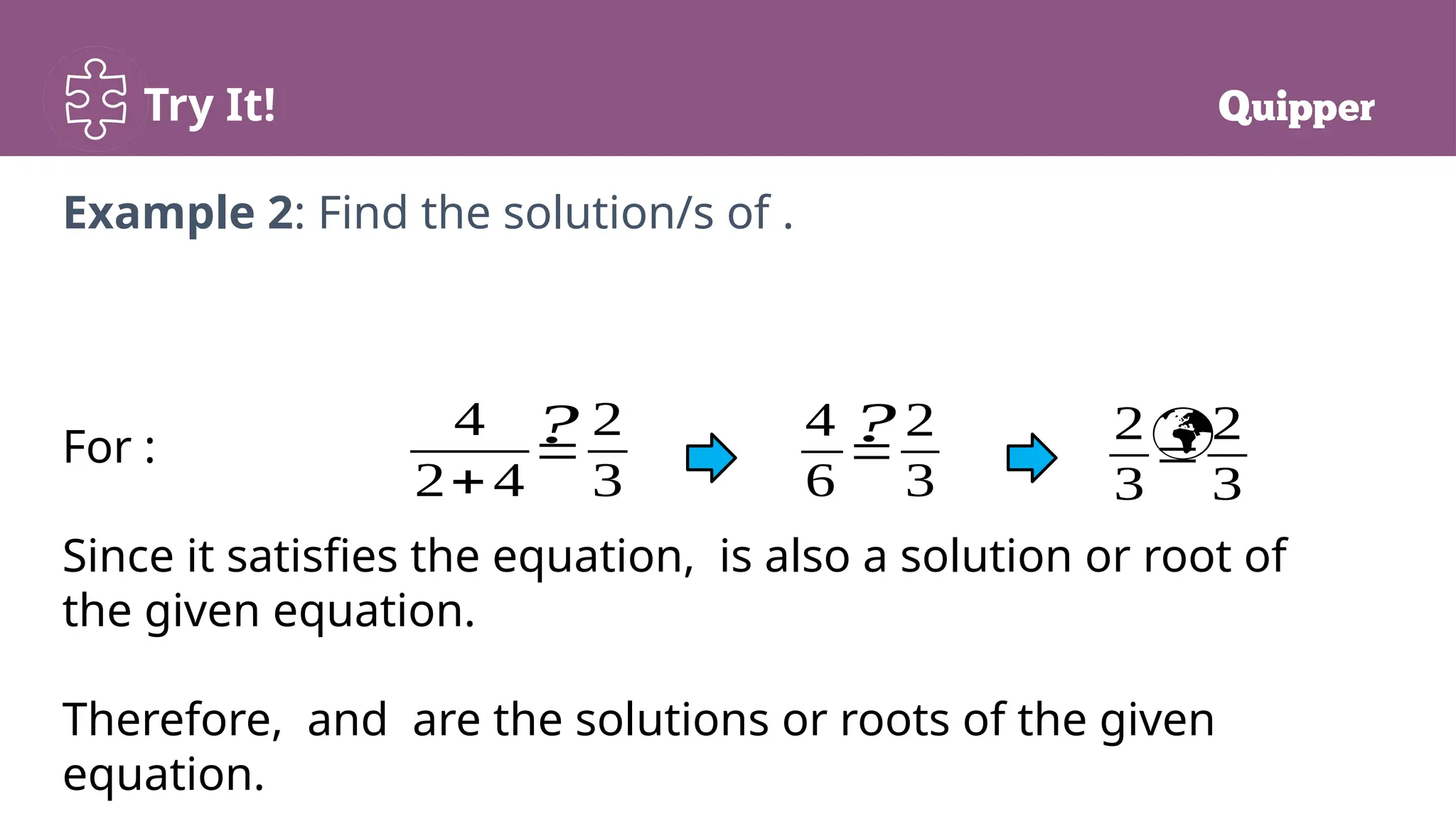
For :
Since it satisfies the equation, is also a solution or root of
the given equation.
Therefore, and are the solutions or roots of the given
equation.
Example 2: Find the solution/s of .
4
2+4
=
2
3
4
6
=
2
3
2
3
=
2
3
? 
?
Let’s Practice!
Individual Practice:
1. Solve .
2. Solve .
Let’s Practice!
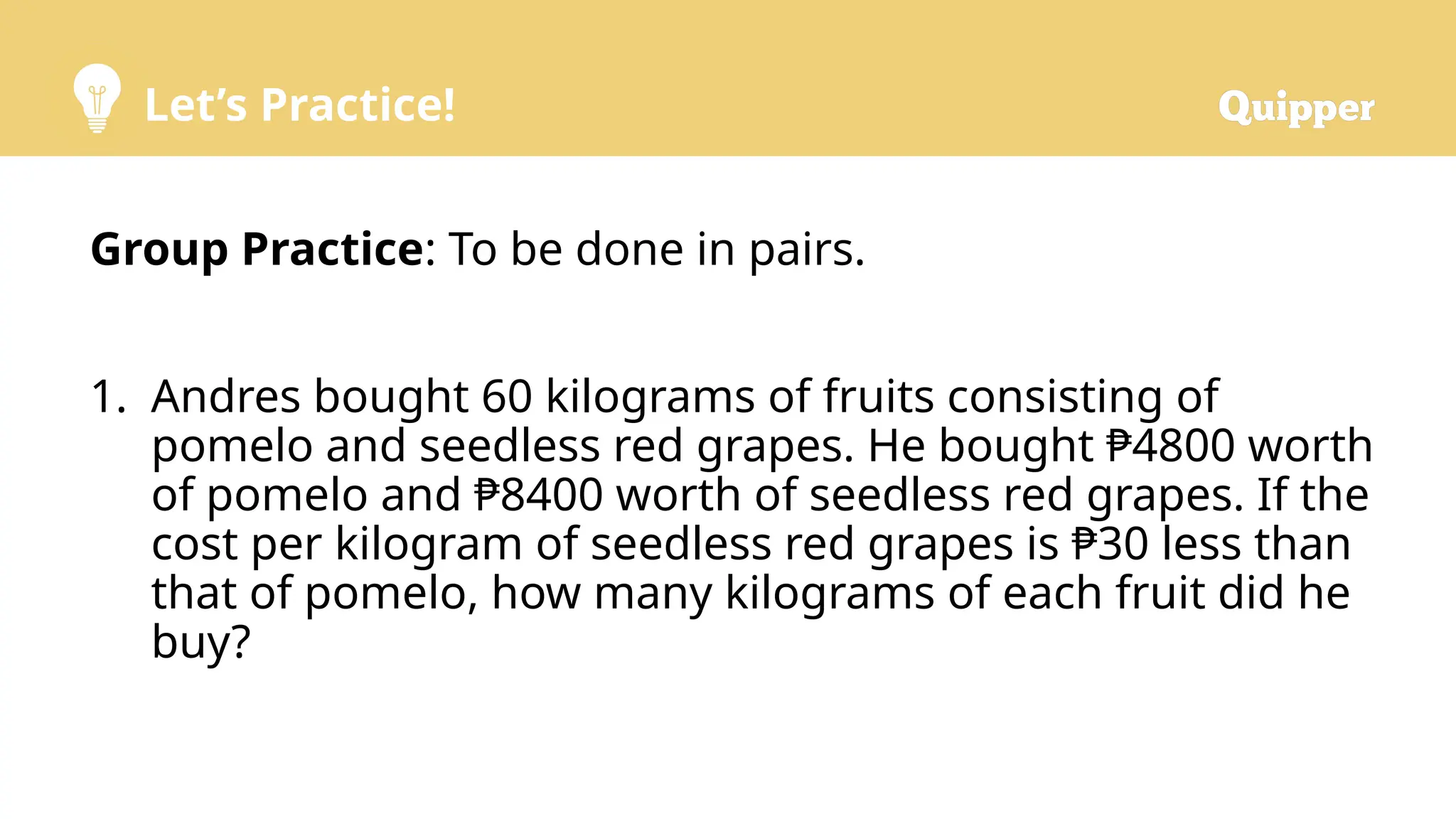
Group Practice: To be done in pairs.
1. Andres bought 60 kilograms of fruits consisting of
pomelo and seedless red grapes. He bought ₱4800 worth
of pomelo and ₱8400 worth of seedless red grapes. If the
cost per kilogram of seedless red grapes is ₱30 less than
that of pomelo, how many kilograms of each fruit did he
buy?
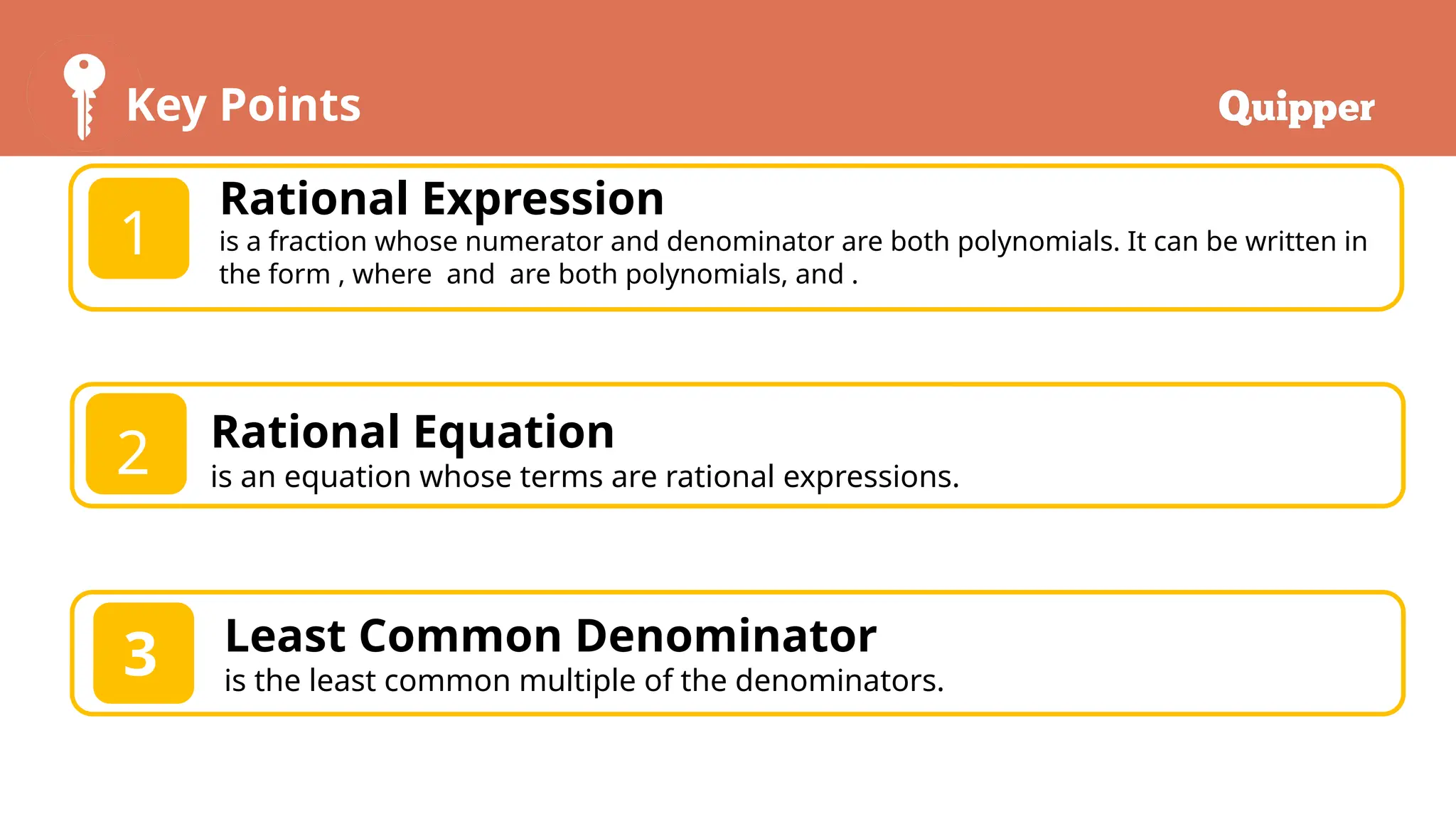
Key Points
1
2
Rational Expression
is a fraction whose numerator and denominator are both polynomials. It can be written in
the form , where and are both polynomials, and .
Rational Equation
is an equation whose terms are rational expressions.
3 Least Common Denominator
is the least common multiple of the denominators.
Key Points
1
2
4 Root or Solution
values that satisfy a given rational equation.
5
Extraneous Root or Solution
values that arrived at upon solving a rational equation but do not satisfy the given
equation.
Synthesis
● How do you solve rational equations?
● Why are rational equations important in our lives?
● What are some applications of rational equations?

Powerpoint presentation on rational equations

  • 1.
  • 2.
    Objectives At the endof this lesson, the learner should be able to ● accurately define a rational equation, and solutions and extraneous solutions of rational equations; and ● correctly solve rational equations.
  • 3.
    Essential Questions ● Whatare rational equations? ● How do you solve rational equations? ● What is an extraneous solution of a rational equation?
  • 4.
    Warm Up! Before welearn how to solve rational equations, let us recall how to get the least common multiple of polynomials by watching a short clip. (Click on the link to access the video clip) “Finding LCM of Polynomials”. EvCCMath. Retrieved 22 February 2019 from https://www.youtube.com/watch?v=1E4foCjeNGw&feature=s hare
  • 5.
    Guide Questions ● Howdo we factor polynomials? ● How do you solve for the least common multiple of two polynomials? ● When can we apply the process of finding the LCM of two or more polynomials? ● What do we call the fractions that contain polynomial expressions?
  • 6.
    Learn about It! RationalExpression is a fraction whose numerator and denominator are both polynomials. It can be written in the form , where and are both polynomials, and . 1 Examples:
  • 7.
    Learn about It! 2Rational Equation is an equation whose terms are rational expressions. Examples:
  • 8.
    Learn about It! 3Least Common Denominator is the least common multiple of the denominators. Example: The LCD of the rational expressions and is .
  • 9.
    Learn about It! 4Solutions (or roots) values that satisfy a given rational equation. Example: The value is a solution of the rational expression .
  • 10.
    Learn about It! 5Extraneous Solutions values that arrived at upon solving a rational equation but do not satisfy the given equation. Example: In solving , will be equal to 2 and 3. However, 2 is an extraneous solution since using 2 as a value of makes the denominator equal to zero; thus, the rational expression will be undefined.
  • 11.
    Try It! Example 1:Solve . Solution: 1. Find the LCD. The denominators are and . Both of these expressions are completely factored already. Thus, the LCD of the terms of the equation is .
  • 12.
    Try It! 2. Multiplyboth sides of the equation by the LCD to remove the denominators then solve for the unknown variable. (𝟑) ( 𝒙+𝟏)( 𝑥 𝑥+1 )=(4 3 )(𝟑) ( 𝒙+𝟏 ) 3 𝑥=4 𝑥+4 Example 1: Solve . − 𝑥=4 𝑥=− 4
  • 13.
    Try It! 3. Verifyyour answer by substituting to the original equation. Then, simplify. Example 1: Solve . − 4 −3 = 4 3 4 3 = 4 3 ? ? 
  • 14.
    Try It! Since itsatisfies the equation, is the solution or root of the given equation. Example 1: Solve .
  • 15.
    Try It! Example 2:Find the solution/s of . Solution: 1. Find the LCD. The denominators are and . Both of these expressions are completely factored already. Thus, the LCD of the given equation is .
  • 16.
    Try It! 2. Multiplyboth sides of the equation by the LCD to remove the denominators then solve for the unknown variable. Example 2: Find the solution/s of . (𝟑) ( 𝒚 +𝟒)( 4 𝑦+4 )=(𝑦 3 )(𝟑)( 𝒚 +𝟒) 12= 𝑦2 +4 𝑦
  • 17.
    Try It! Hence, 12= 𝑦2 +4𝑦 Example 2: Find the solution/s of . − 𝑦2 − 4 𝑦+12=0 𝑦2 +4 𝑦+12=0 ( 𝑦+6) ( 𝑦 − 2)=0
  • 18.
    Try It! 3. Verifyyour answer by substituting each obtained solution to the original equation. For : Since it satisfies the equation, is a solution or root of the given equation. Example 2: Find the solution/s of . 4 −6+4 = −6 3 4 −2 = −6 3 −2=−2 ?  ?
  • 19.
    Try It! For : Sinceit satisfies the equation, is also a solution or root of the given equation. Therefore, and are the solutions or roots of the given equation. Example 2: Find the solution/s of . 4 2+4 = 2 3 4 6 = 2 3 2 3 = 2 3 ?  ?
  • 20.
  • 21.
    Let’s Practice! Group Practice:To be done in pairs. 1. Andres bought 60 kilograms of fruits consisting of pomelo and seedless red grapes. He bought ₱4800 worth of pomelo and ₱8400 worth of seedless red grapes. If the cost per kilogram of seedless red grapes is ₱30 less than that of pomelo, how many kilograms of each fruit did he buy?
  • 22.
    Key Points 1 2 Rational Expression isa fraction whose numerator and denominator are both polynomials. It can be written in the form , where and are both polynomials, and . Rational Equation is an equation whose terms are rational expressions. 3 Least Common Denominator is the least common multiple of the denominators.
  • 23.
    Key Points 1 2 4 Rootor Solution values that satisfy a given rational equation. 5 Extraneous Root or Solution values that arrived at upon solving a rational equation but do not satisfy the given equation.
  • 24.
    Synthesis ● How doyou solve rational equations? ● Why are rational equations important in our lives? ● What are some applications of rational equations?