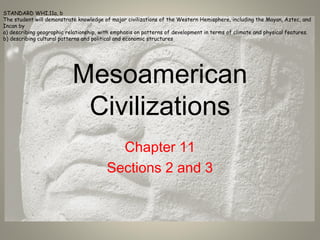
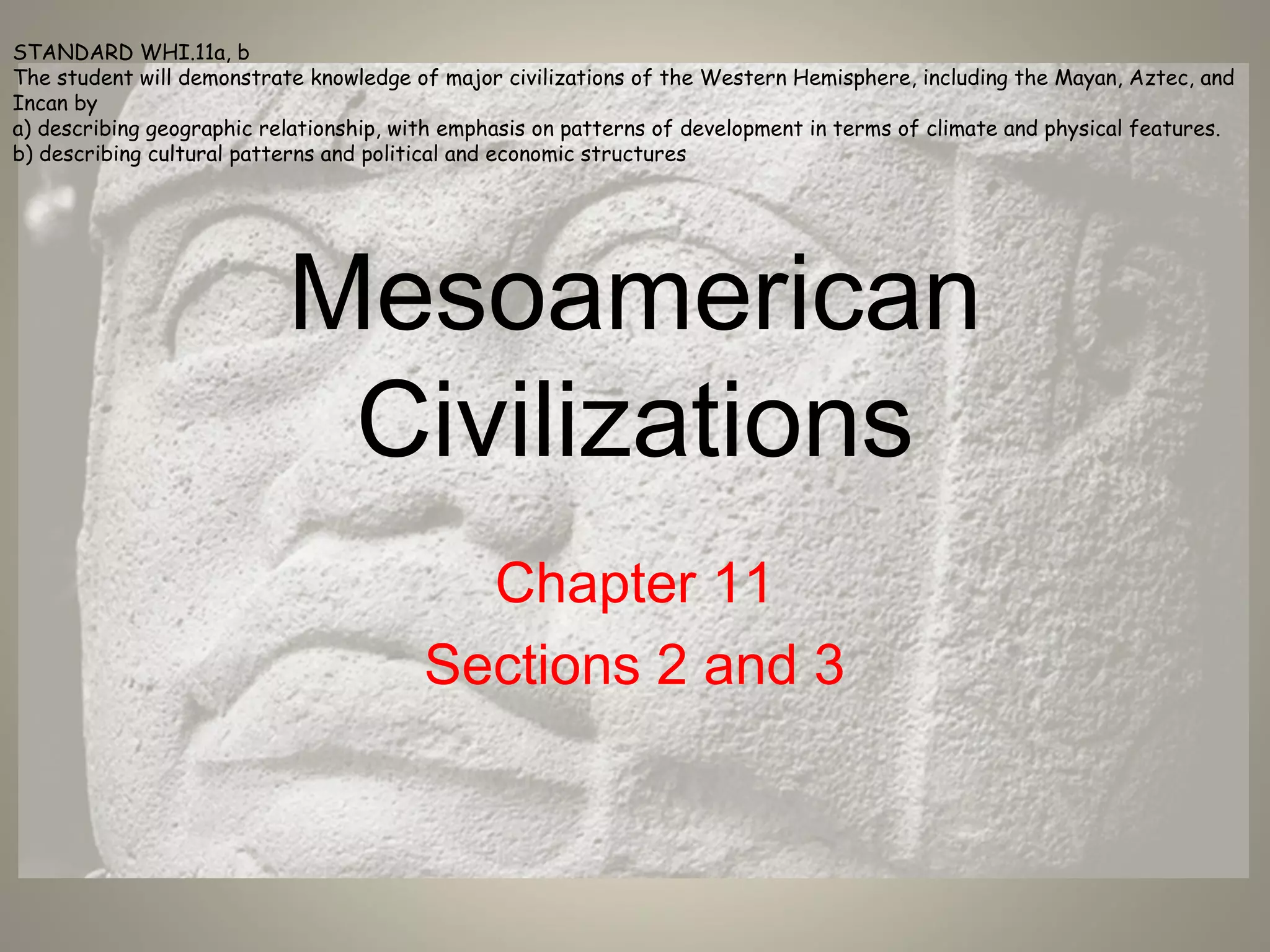
Mesoamerican
Civilizations
Chapter 11
Sections 2 and 3
STANDARD WHI.11a, b
The student will demonstrate knowledge of major civilizations of the Western Hemisphere, including the Mayan, Aztec, and
Incan by
a) describing geographic relationship, with emphasis on patterns of development in terms of climate and physical features.
b) describing cultural patterns and political and economic structures
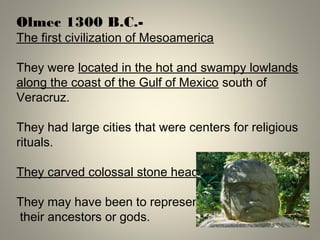
Olmec 1300 B.C.-
The first civilization of Mesoamerica
They were located in the hot and swampy lowlands
along the coast of the Gulf of Mexico south of
Veracruz.
They had large cities that were centers for religious
rituals.
They carved colossal stone heads
They may have been to represent
their ancestors or gods.
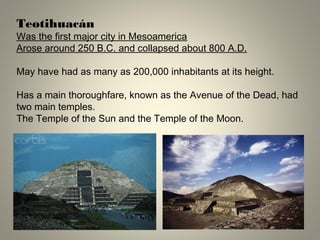
Teotihuacán
Was the first major city in Mesoamerica
Arose around 250 B.C. and collapsed about 800 A.D.
May have had as many as 200,000 inhabitants at its height.
Has a main thoroughfare, known as the Avenue of the Dead, had
two main temples.
The Temple of the Sun and the Temple of the Moon.
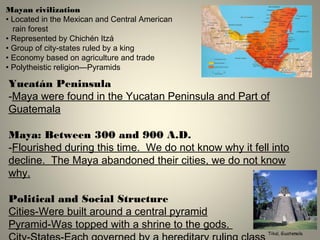
Mayan civilization
• Located in the Mexican and Central American
rain forest
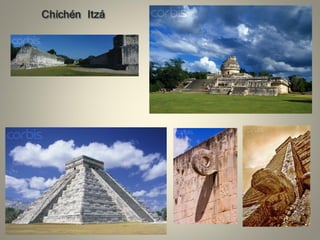
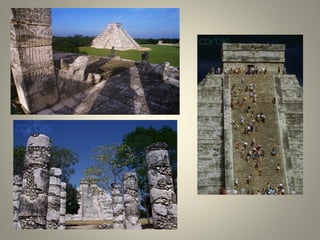
• Represented by Chichén Itzá
• Group of city-states ruled by a king
• Economy based on agriculture and trade
• Polytheistic religion—Pyramids
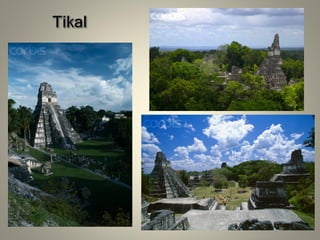
Tikal, Guatemala
Yucatán Peninsula
-Maya were found in the Yucatan Peninsula and Part of
Guatemala
Maya: Between 300 and 900 A.D.
-Flourished during this time. We do not know why it fell into
decline. The Maya abandoned their cities, we do not know
why.
Political and Social Structure
Cities-Were built around a central pyramid
Pyramid-Was topped with a shrine to the gods.
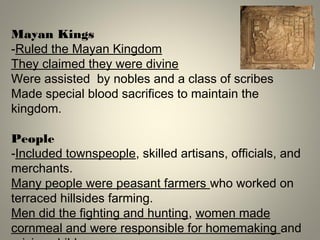
Mayan Kings
-Ruled the Mayan Kingdom
They claimed they were divine
Were assisted by nobles and a class of scribes
Made special blood sacrifices to maintain the
kingdom.
People
-Included townspeople, skilled artisans, officials, and
merchants.
Many people were peasant farmers who worked on
terraced hillsides farming.
Men did the fighting and hunting, women made
cornmeal and were responsible for homemaking and
Religion
The Maya were Polytheistic.
They believed that all of life was in the hands of a divine
power.
They were responsible for pleasing the gods.
Their gods were ranked in order of importance, the Jaguar
was the god of night and was seen as evil.
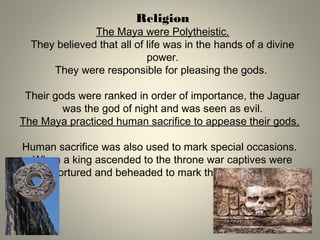
The Maya practiced human sacrifice to appease their gods.
Human sacrifice was also used to mark special occasions.
When a king ascended to the throne war captives were
tortured and beheaded to mark the occasion.
AccomplishmentsAccomplishments
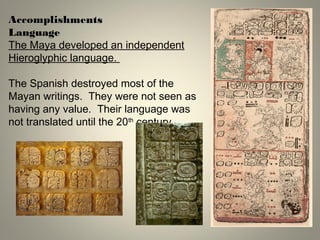
Language
The Maya developed an independent
Hieroglyphic language.
The Spanish destroyed most of the
Mayan writings. They were not seen as
having any value. Their language was
not translated until the 20th
century.
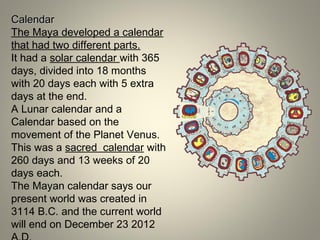
CalendarCalendar
The Maya developed a calendar
that had two different parts.
It had a solar calendar with 365
days, divided into 18 months
with 20 days each with 5 extra
days at the end.
A Lunar calendar and a
Calendar based on the
movement of the Planet Venus.
This was a sacred calendar with
260 days and 13 weeks of 20
days each.
The Mayan calendar says our
present world was created in
3114 B.C. and the current world
will end on December 23 2012
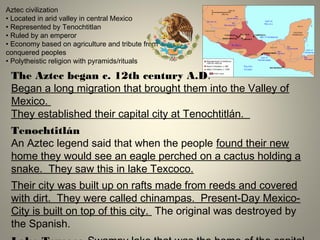
Aztec civilization
• Located in arid valley in central Mexico
• Represented by Tenochtitlan
• Ruled by an emperor
• Economy based on agriculture and tribute from
conquered peoples
• Polytheistic religion with pyramids/rituals
The Aztec began c. 12th century A.D.
Began a long migration that brought them into the Valley of
Mexico.
They established their capital city at Tenochtitlán.
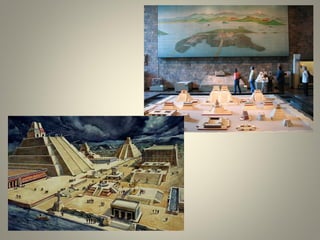
Tenochtitlán
An Aztec legend said that when the people found their new
home they would see an eagle perched on a cactus holding a
snake. They saw this in lake Texcoco.
Their city was built up on rafts made from reeds and covered
with dirt. They were called chinampas. Present-Day Mexico-
City is built on top of this city. The original was destroyed by
the Spanish.
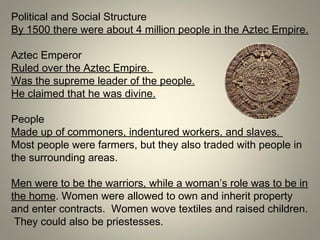
Political and Social Structure
By 1500 there were about 4 million people in the Aztec Empire.
Aztec Emperor
Ruled over the Aztec Empire.
Was the supreme leader of the people.
He claimed that he was divine.
People
Made up of commoners, indentured workers, and slaves.
Most people were farmers, but they also traded with people in
the surrounding areas.
Men were to be the warriors, while a woman’s role was to be in
the home. Women were allowed to own and inherit property
and enter contracts. Women wove textiles and raised children.
They could also be priestesses.
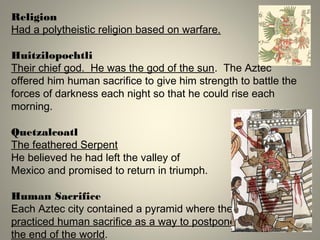
Religion
Had a polytheistic religion based on warfare.
Huitzilopochtli
Their chief god. He was the god of the sun. The Aztec
offered him human sacrifice to give him strength to battle the
forces of darkness each night so that he could rise each
morning.
Quetzalcoatl
The feathered Serpent
He believed he had left the valley of
Mexico and promised to return in triumph.
Human Sacrifice
Each Aztec city contained a pyramid where they
practiced human sacrifice as a way to postpone
the end of the world.
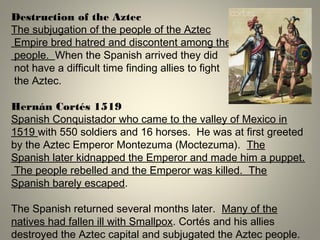
Destruction of the Aztec
The subjugation of the people of the Aztec
Empire bred hatred and discontent among the
people. When the Spanish arrived they did
not have a difficult time finding allies to fight
the Aztec.
Hernán Cortés 1519
Spanish Conquistador who came to the valley of Mexico in
1519 with 550 soldiers and 16 horses. He was at first greeted
by the Aztec Emperor Montezuma (Moctezuma). The
Spanish later kidnapped the Emperor and made him a puppet.
The people rebelled and the Emperor was killed. The
Spanish barely escaped.
The Spanish returned several months later. Many of the
natives had fallen ill with Smallpox. Cortés and his allies
destroyed the Aztec capital and subjugated the Aztec people.
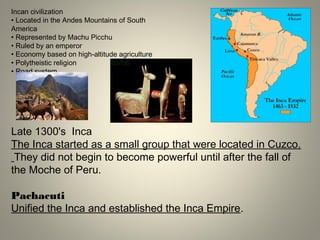
Incan civilization
• Located in the Andes Mountains of South
America
• Represented by Machu Picchu
• Ruled by an emperor
• Economy based on high-altitude agriculture
• Polytheistic religion
• Road system
Late 1300's Inca
The Inca started as a small group that were located in Cuzco.
They did not begin to become powerful until after the fall of
the Moche of Peru.
Pachacuti
Unified the Inca and established the Inca Empire.
Organization of the Empire
Incan state was built on war.
The conquered peoples were all taught the
same language.
Each region was appointed a governor who
answered to the Emperor.
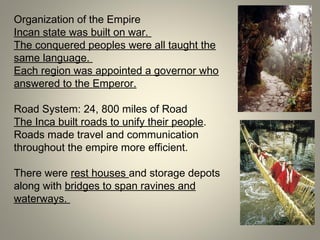
Road System: 24, 800 miles of Road
The Inca built roads to unify their people.
Roads made travel and communication
throughout the empire more efficient.
There were rest houses and storage depots
along with bridges to span ravines and
waterways.
CultureCulture
Were required to marry from within their own social group.
Women were expected to live at home, the only alternative
was to be a priestess.
Most people were farmers, they also herded llamas and
alpacas.
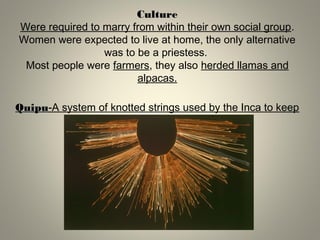
QuipuQuipu-A system of knotted strings used by the Inca to keep
records.
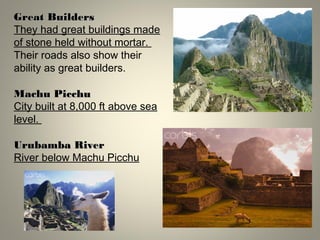
Great BuildersGreat Builders
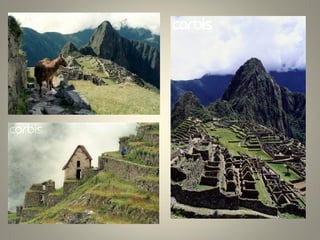
They had great buildings made
of stone held without mortar.
Their roads also show their
ability as great builders.
Machu PicchuMachu Picchu
City built at 8,000 ft above sea
level.
Urubamba RiverUrubamba River
River below Machu Picchu
Defeat
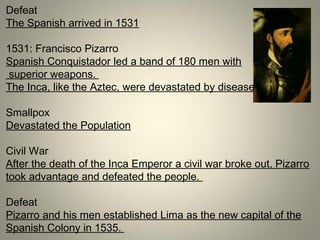
The Spanish arrived in 1531
1531: Francisco Pizarro
Spanish Conquistador led a band of 180 men with
superior weapons.
The Inca, like the Aztec, were devastated by disease.
Smallpox
Devastated the Population
Civil War
After the death of the Inca Emperor a civil war broke out, Pizarro
took advantage and defeated the people.
Defeat
Pizarro and his men established Lima as the new capital of the
Spanish Colony in 1535.
Achievements of Mayan, Aztec, and
Incan civilizations
• Calendars
• Mathematics
• Writing and other record-keeping
systems

Mesoamerican civilizations lined

  • 1.
    Mesoamerican Civilizations Chapter 11 Sections 2and 3 STANDARD WHI.11a, b The student will demonstrate knowledge of major civilizations of the Western Hemisphere, including the Mayan, Aztec, and Incan by a) describing geographic relationship, with emphasis on patterns of development in terms of climate and physical features. b) describing cultural patterns and political and economic structures
  • 2.
    Olmec 1300 B.C.- Thefirst civilization of Mesoamerica They were located in the hot and swampy lowlands along the coast of the Gulf of Mexico south of Veracruz. They had large cities that were centers for religious rituals. They carved colossal stone heads They may have been to represent their ancestors or gods.
  • 3.
    Teotihuacán Was the firstmajor city in Mesoamerica Arose around 250 B.C. and collapsed about 800 A.D. May have had as many as 200,000 inhabitants at its height. Has a main thoroughfare, known as the Avenue of the Dead, had two main temples. The Temple of the Sun and the Temple of the Moon.
  • 4.
    Mayan civilization • Locatedin the Mexican and Central American rain forest • Represented by Chichén Itzá • Group of city-states ruled by a king • Economy based on agriculture and trade • Polytheistic religion—Pyramids Tikal, Guatemala Yucatán Peninsula -Maya were found in the Yucatan Peninsula and Part of Guatemala Maya: Between 300 and 900 A.D. -Flourished during this time. We do not know why it fell into decline. The Maya abandoned their cities, we do not know why. Political and Social Structure Cities-Were built around a central pyramid Pyramid-Was topped with a shrine to the gods.
  • 5.
    Mayan Kings -Ruled theMayan Kingdom They claimed they were divine Were assisted by nobles and a class of scribes Made special blood sacrifices to maintain the kingdom. People -Included townspeople, skilled artisans, officials, and merchants. Many people were peasant farmers who worked on terraced hillsides farming. Men did the fighting and hunting, women made cornmeal and were responsible for homemaking and
  • 6.
    Religion The Maya werePolytheistic. They believed that all of life was in the hands of a divine power. They were responsible for pleasing the gods. Their gods were ranked in order of importance, the Jaguar was the god of night and was seen as evil. The Maya practiced human sacrifice to appease their gods. Human sacrifice was also used to mark special occasions. When a king ascended to the throne war captives were tortured and beheaded to mark the occasion.
  • 7.
    AccomplishmentsAccomplishments Language The Maya developedan independent Hieroglyphic language. The Spanish destroyed most of the Mayan writings. They were not seen as having any value. Their language was not translated until the 20th century.
  • 8.
    CalendarCalendar The Maya developeda calendar that had two different parts. It had a solar calendar with 365 days, divided into 18 months with 20 days each with 5 extra days at the end. A Lunar calendar and a Calendar based on the movement of the Planet Venus. This was a sacred calendar with 260 days and 13 weeks of 20 days each. The Mayan calendar says our present world was created in 3114 B.C. and the current world will end on December 23 2012
  • 12.
    Aztec civilization • Locatedin arid valley in central Mexico • Represented by Tenochtitlan • Ruled by an emperor • Economy based on agriculture and tribute from conquered peoples • Polytheistic religion with pyramids/rituals The Aztec began c. 12th century A.D. Began a long migration that brought them into the Valley of Mexico. They established their capital city at Tenochtitlán. Tenochtitlán An Aztec legend said that when the people found their new home they would see an eagle perched on a cactus holding a snake. They saw this in lake Texcoco. Their city was built up on rafts made from reeds and covered with dirt. They were called chinampas. Present-Day Mexico- City is built on top of this city. The original was destroyed by the Spanish.
  • 14.
    Political and SocialStructure By 1500 there were about 4 million people in the Aztec Empire. Aztec Emperor Ruled over the Aztec Empire. Was the supreme leader of the people. He claimed that he was divine. People Made up of commoners, indentured workers, and slaves. Most people were farmers, but they also traded with people in the surrounding areas. Men were to be the warriors, while a woman’s role was to be in the home. Women were allowed to own and inherit property and enter contracts. Women wove textiles and raised children. They could also be priestesses.
  • 15.
    Religion Had a polytheisticreligion based on warfare. Huitzilopochtli Their chief god. He was the god of the sun. The Aztec offered him human sacrifice to give him strength to battle the forces of darkness each night so that he could rise each morning. Quetzalcoatl The feathered Serpent He believed he had left the valley of Mexico and promised to return in triumph. Human Sacrifice Each Aztec city contained a pyramid where they practiced human sacrifice as a way to postpone the end of the world.
  • 16.
    Destruction of theAztec The subjugation of the people of the Aztec Empire bred hatred and discontent among the people. When the Spanish arrived they did not have a difficult time finding allies to fight the Aztec. Hernán Cortés 1519 Spanish Conquistador who came to the valley of Mexico in 1519 with 550 soldiers and 16 horses. He was at first greeted by the Aztec Emperor Montezuma (Moctezuma). The Spanish later kidnapped the Emperor and made him a puppet. The people rebelled and the Emperor was killed. The Spanish barely escaped. The Spanish returned several months later. Many of the natives had fallen ill with Smallpox. Cortés and his allies destroyed the Aztec capital and subjugated the Aztec people.
  • 18.
    Incan civilization • Locatedin the Andes Mountains of South America • Represented by Machu Picchu • Ruled by an emperor • Economy based on high-altitude agriculture • Polytheistic religion • Road system Late 1300's Inca The Inca started as a small group that were located in Cuzco. They did not begin to become powerful until after the fall of the Moche of Peru. Pachacuti Unified the Inca and established the Inca Empire.
  • 19.
    Organization of theEmpire Incan state was built on war. The conquered peoples were all taught the same language. Each region was appointed a governor who answered to the Emperor. Road System: 24, 800 miles of Road The Inca built roads to unify their people. Roads made travel and communication throughout the empire more efficient. There were rest houses and storage depots along with bridges to span ravines and waterways.
  • 20.
    CultureCulture Were required tomarry from within their own social group. Women were expected to live at home, the only alternative was to be a priestess. Most people were farmers, they also herded llamas and alpacas. QuipuQuipu-A system of knotted strings used by the Inca to keep records.
  • 21.
    Great BuildersGreat Builders Theyhad great buildings made of stone held without mortar. Their roads also show their ability as great builders. Machu PicchuMachu Picchu City built at 8,000 ft above sea level. Urubamba RiverUrubamba River River below Machu Picchu
  • 23.
    Defeat The Spanish arrivedin 1531 1531: Francisco Pizarro Spanish Conquistador led a band of 180 men with superior weapons. The Inca, like the Aztec, were devastated by disease. Smallpox Devastated the Population Civil War After the death of the Inca Emperor a civil war broke out, Pizarro took advantage and defeated the people. Defeat Pizarro and his men established Lima as the new capital of the Spanish Colony in 1535.
  • 24.
    Achievements of Mayan,Aztec, and Incan civilizations • Calendars • Mathematics • Writing and other record-keeping systems