Phosphorus by Amber,Shayne,and Makhmud
 
facts       Facts:          - Component of DNA, RNA, ATP, proteins and enzymes            - Cycles in a sedimentary cylce            - A good example of how a mineral element becomes part of an               organism.            - The source of Phosphorus (P) is rock.            - It is released into the cylce through erosion or mining.            - It is soluble in H2O as phosphate (PO4)            - It is taken up by plant roots, then travels through food chains.            - It is returned to sediment
information Phosphorus enters the environment from rocks or deposits laid down on the earth many years ago. The phosphate rock is commercially available form is called apatite. Other deposits may be from fossilized bone or bird droppings called guano. Weathering and erosion of rocks gradually releases phosphorus as phosphate ions which are soluble in water. Land plants need phosphate as a fertilizer or nutrient.  Phosphate is incorporated into many molecules essential for life such as ATP, adenosine triphosphate, which is important in the storage and use of energy. It is also in the backbone of DNA and RNA which is involved with coding for genetics.
When plant materials and waste products decay through bacterial action, the phosphate is released and returned to the environment for reuse.  Much of the phosphate eventually is washed into the water from erosion and leaching. Again water plants and algae utilize the phosphate as a nutrient. Studies have shown that phosphate is the limiting agent in the growth of plants and algae. If not enough is present, the plants are slow growing or stunted. If too much phosphate is present excess growth may occur, particularly in algae.  A large percentage of the phosphate in water is precipitated from the water as iron phosphate which is insoluble. If the phosphate is in shallow sediments, it may be readily recycled back into the water for further reuse. In deeper sediments in water, it is available for use only as part of a general uplifting of rock formations for the cycle to repeat itself.
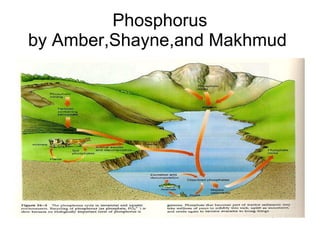
Phosphorus cycle The phosphorus cycle differs from the nitrogen and carbon cycles because phosphorus is unable to achieve the gaseous state in the atmosphere. Phosphorus is mainly found in water, soil and sediments. In the atmosphere, phosphorus is found as fine dust particles. The phosphorous used by plants is predominantly in the form of phosphate salts.  Phosphate salts are released when  phosphate rocks  are eroded by rainfall, weathering and  runoffs . The release of phosphate salts into the soil results in a constant phosphorus supply for plants. Phosphate salts are absorbed through the roots of plants and used to make organic compounds. As animals eat these plants, phosphorus is also consumed and passed up the food chain. The decomposition of these animals or the excretion of organic phosphate returns phosphorus into the soil or water thereby completing the cycle.                In comparison to nitrogen and carbon, the rate at which phosphate salts are released is extremely slow.  Phosphorus can remain in rocks or sediments for millions of years. In addition, the competition between  mineralization and immobilization  of organic phosphorus helps to delay the amount of phosphates available for use. As a result, the need for plant growth outweighs the amount of phosphate salts being released. To alleviate the phosphate demand, the addition of phosphate fertilizers has become the solution humans employ to maintain and increase crop production.
 

Phosphorus Project

  • 1.
  • 2.
  • 3.
    facts      Facts:       - Component of DNA, RNA, ATP, proteins and enzymes         - Cycles in a sedimentary cylce         - A good example of how a mineral element becomes part of an            organism.         - The source of Phosphorus (P) is rock.         - It is released into the cylce through erosion or mining.         - It is soluble in H2O as phosphate (PO4)         - It is taken up by plant roots, then travels through food chains.         - It is returned to sediment
  • 4.
    information Phosphorus entersthe environment from rocks or deposits laid down on the earth many years ago. The phosphate rock is commercially available form is called apatite. Other deposits may be from fossilized bone or bird droppings called guano. Weathering and erosion of rocks gradually releases phosphorus as phosphate ions which are soluble in water. Land plants need phosphate as a fertilizer or nutrient. Phosphate is incorporated into many molecules essential for life such as ATP, adenosine triphosphate, which is important in the storage and use of energy. It is also in the backbone of DNA and RNA which is involved with coding for genetics.
  • 5.
    When plant materialsand waste products decay through bacterial action, the phosphate is released and returned to the environment for reuse. Much of the phosphate eventually is washed into the water from erosion and leaching. Again water plants and algae utilize the phosphate as a nutrient. Studies have shown that phosphate is the limiting agent in the growth of plants and algae. If not enough is present, the plants are slow growing or stunted. If too much phosphate is present excess growth may occur, particularly in algae. A large percentage of the phosphate in water is precipitated from the water as iron phosphate which is insoluble. If the phosphate is in shallow sediments, it may be readily recycled back into the water for further reuse. In deeper sediments in water, it is available for use only as part of a general uplifting of rock formations for the cycle to repeat itself.
  • 6.
    Phosphorus cycle Thephosphorus cycle differs from the nitrogen and carbon cycles because phosphorus is unable to achieve the gaseous state in the atmosphere. Phosphorus is mainly found in water, soil and sediments. In the atmosphere, phosphorus is found as fine dust particles. The phosphorous used by plants is predominantly in the form of phosphate salts.  Phosphate salts are released when phosphate rocks are eroded by rainfall, weathering and runoffs . The release of phosphate salts into the soil results in a constant phosphorus supply for plants. Phosphate salts are absorbed through the roots of plants and used to make organic compounds. As animals eat these plants, phosphorus is also consumed and passed up the food chain. The decomposition of these animals or the excretion of organic phosphate returns phosphorus into the soil or water thereby completing the cycle.               In comparison to nitrogen and carbon, the rate at which phosphate salts are released is extremely slow.  Phosphorus can remain in rocks or sediments for millions of years. In addition, the competition between mineralization and immobilization of organic phosphorus helps to delay the amount of phosphates available for use. As a result, the need for plant growth outweighs the amount of phosphate salts being released. To alleviate the phosphate demand, the addition of phosphate fertilizers has become the solution humans employ to maintain and increase crop production.
  • 7.