INDIRA GANDHI AGRICULTURE UNIVERSITY
COLLEGE OF AGRICULTURE RAIPUR
2018-19
Course no. : AGRON-502
Course title: SOIL FERTILITY AND NUTRIENT MANAGEMENT
assignment on:
TRANSFORMATION AND DYNAMICS OF
POTASSIUM
submitted to: submitted by:
Dr.(Mrs) Ambika Tandon Sushmita Garg
Dept of Agronomy MSc(Ag) Previous
BEFORE WE START
 What does the topic is actually referring to?
 Gist on what will be covered under this topic:
Different forms of potassium in soil.
Process of conversion from unavailable to
available form.
Fate of potassium fertilization.
Factors affecting K availability to plants.
Quantifying available K
The Potassium cycle.
INTRODUCTION
Potassium – a byte on this essential plant
nutrient
It is never incorporated in any organic
compound. Even in the plant system it
remains as K+ ion.
Its behavior in the soil is not at all
affected by micro-organisms.
It does not form any gas that could be
lost to the atmosphere.
It does not cause eutrophication. When
left in the ecosystem as such, it is not at
all toxic.
OCCURRENCE OF POTASSIUM IN SOIL
 Potassium is an element for which Indian soils
form a luxuriant source except for those
consisting of quartz sand and the organic soils.
 Amount of potassium as great as 30000-50000
kg/ha in the upper 15 cm of soil is very common.
 Despite this fact, farmers have to fertilize the soil
to get a good crop and this is attributed to the
diversity in forms of potassium in soil.
FORMS OF POTASSIUM IN SOIL
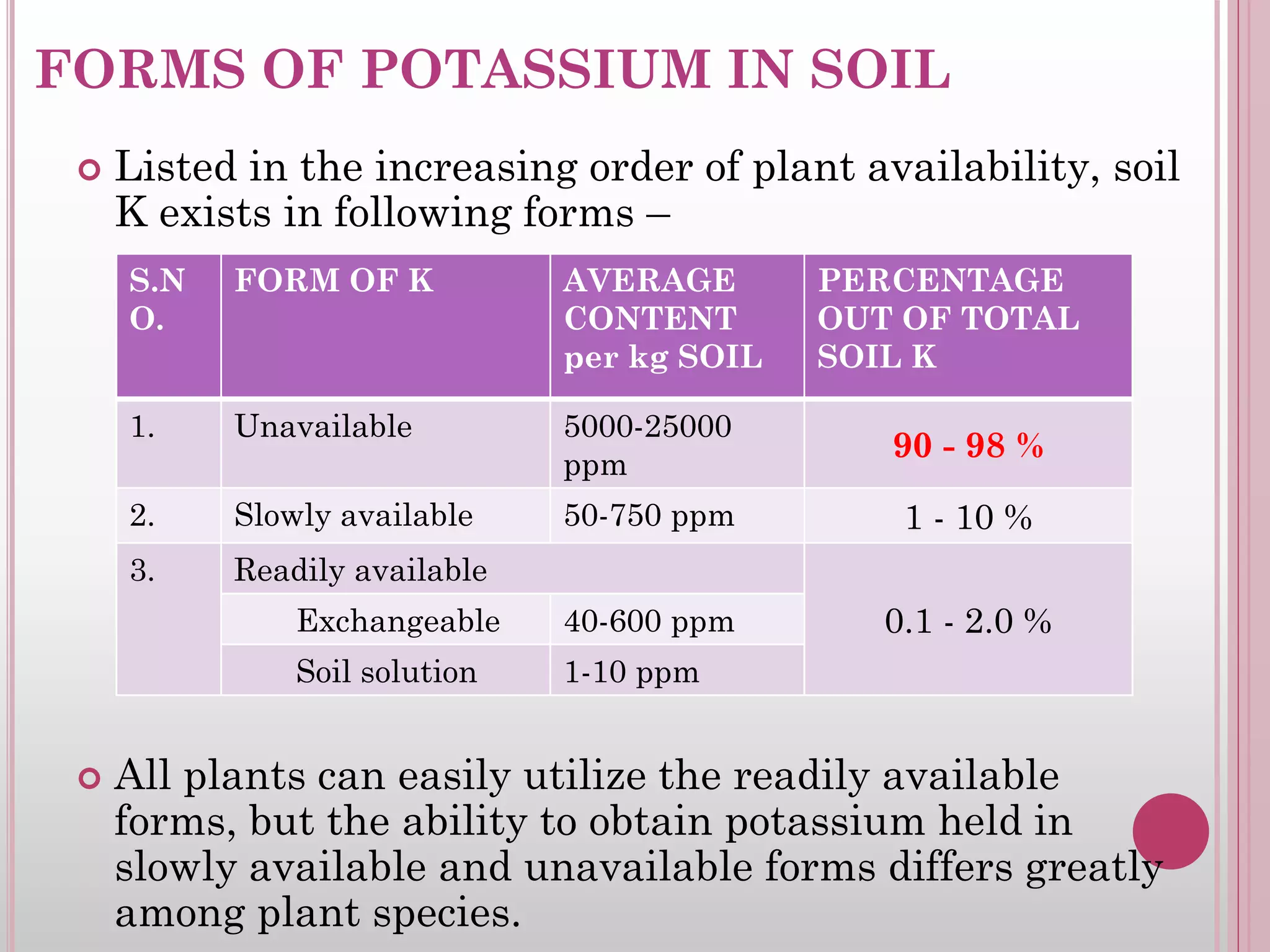
 Listed in the increasing order of plant availability, soil
K exists in following forms –
 All plants can easily utilize the readily available
forms, but the ability to obtain potassium held in
slowly available and unavailable forms differs greatly
among plant species.
S.N
O.
FORM OF K AVERAGE
CONTENT
per kg SOIL
PERCENTAGE
OUT OF TOTAL
SOIL K
1. Unavailable 5000-25000
ppm
90 - 98 %
2. Slowly available 50-750 ppm 1 - 10 %
3. Readily available
0.1 - 2.0 %Exchangeable 40-600 ppm
Soil solution 1-10 ppm
UNAVAILABLE FORM
 Also known as Mineral K, this is the major natural source of potassium in soil.
 It is found on crystal structures of primary minerals like –
 Micas – Micas are 2:1 layer silicates where K+ resides mainly between
the layer silicates
• Muscovite : [KAl3Si3O10(OH)2]
• Biotite : [K(Mg,Fe)3 AlSi3O10(OH)2]
• Phlogopite : [KMg2Al2Si3O10(OH)2]
 Feldspars – Feldspars are 3-dimensional crystal structure with K
located throughout the mineral lattice. They are the largest natural
potassium reserve.
• Orthoclase
• Microcline : KAlSi3O8
 The potassium from this source can be released only through weathering. Thus, they
supply very small quantities of potassium during a given growing season.
 Only their cumulative release over a period of years is of some importance which is
enhanced by the solvent action of carbonic acid, stronger organic acid, inorganic
acids, acidic clays and humus.
 Order of primary minerals in the ease of weathering is as follows:
Biotite > Muscovite > K-feldspars > Phlogopite
 The release of K from these minerals is also geared by the dissolution of the mineral
from the roots of certain plants like elephant grass.
SLOWLY AVAILABLE FORM
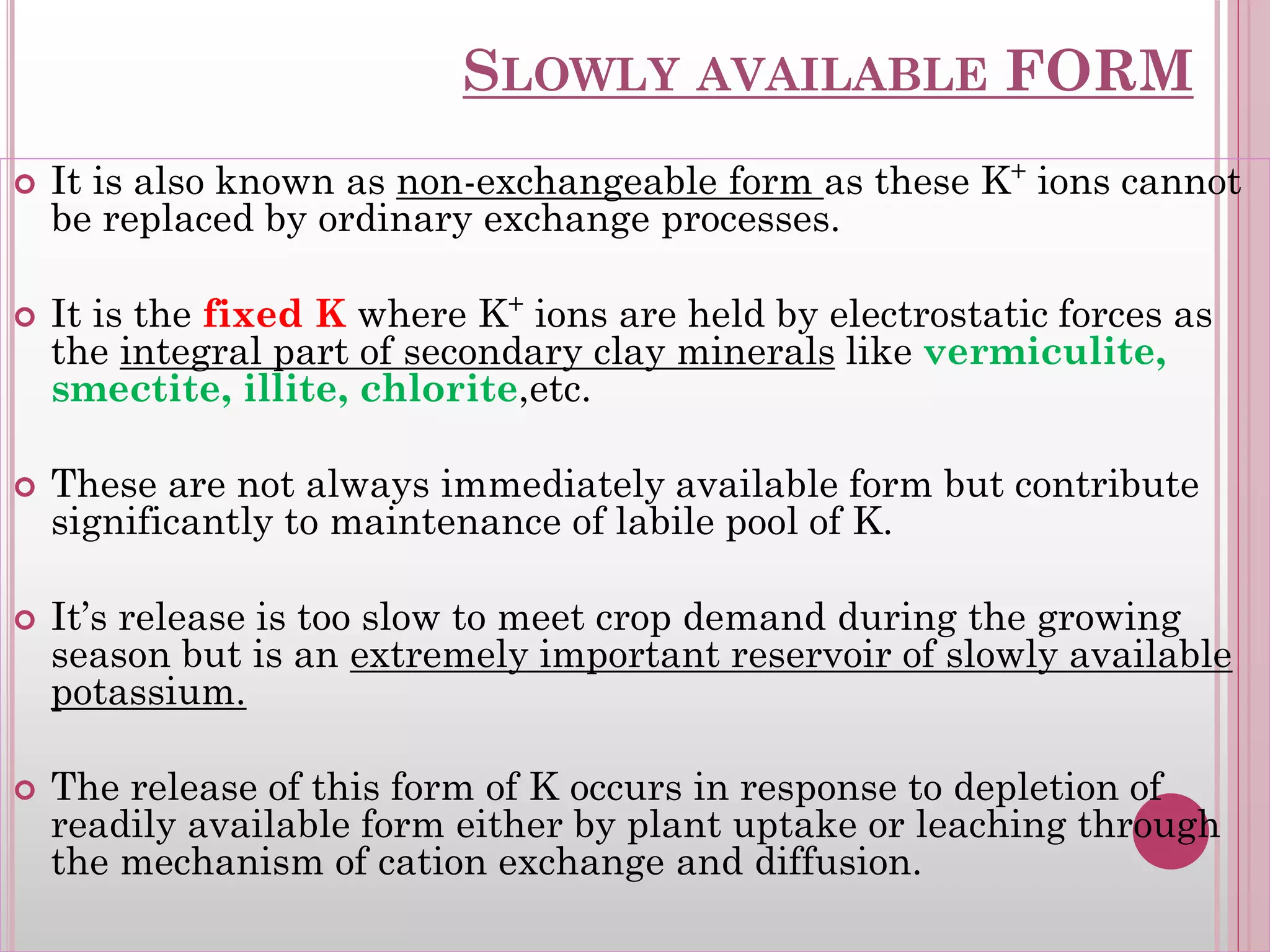
 It is also known as non-exchangeable form as these K+
ions cannot
be replaced by ordinary exchange processes.
 It is the fixed K where K+
ions are held by electrostatic forces as
the integral part of secondary clay minerals like vermiculite,
smectite, illite, chlorite,etc.
 These are not always immediately available form but contribute
significantly to maintenance of labile pool of K.
 It’s release is too slow to meet crop demand during the growing
season but is an extremely important reservoir of slowly available
potassium.
 The release of this form of K occurs in response to depletion of
readily available form either by plant uptake or leaching through
the mechanism of cation exchange and diffusion.
READILY AVAILABLE FORM
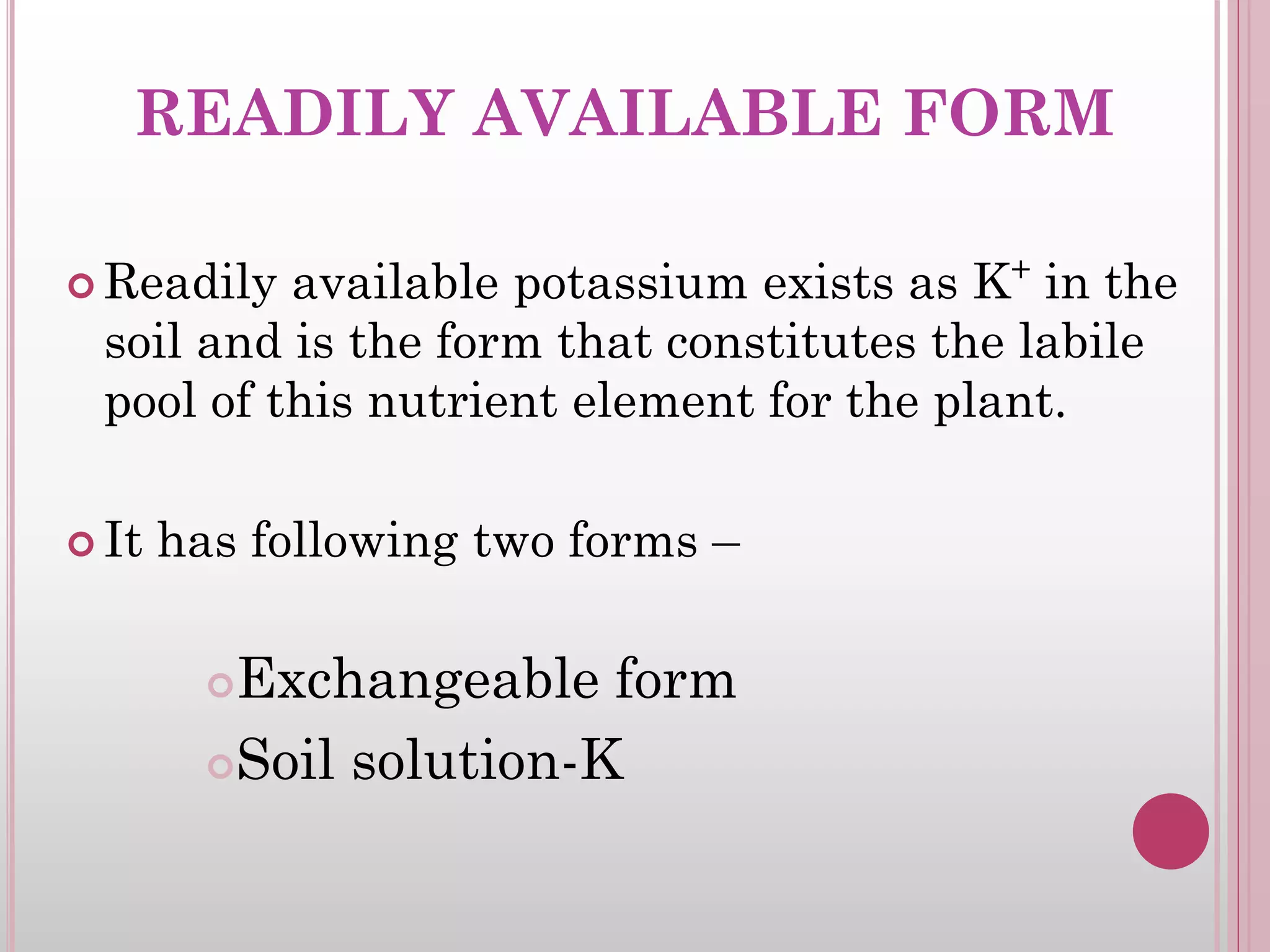
 Readily available potassium exists as K+
in the
soil and is the form that constitutes the labile
pool of this nutrient element for the plant.
 It has following two forms –
Exchangeable form
Soil solution-K
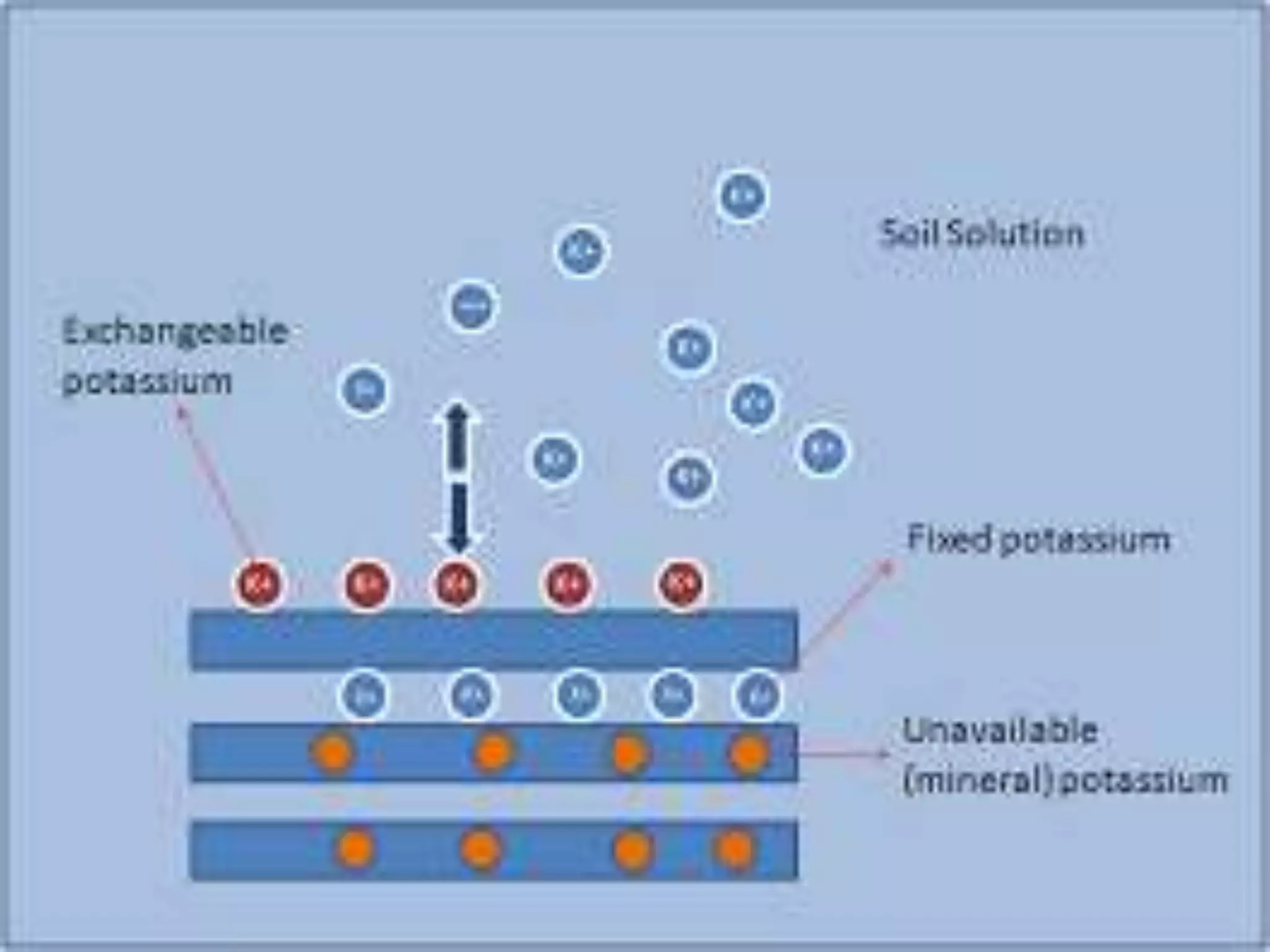
1. EXCHANGEABLE POTASSIUM
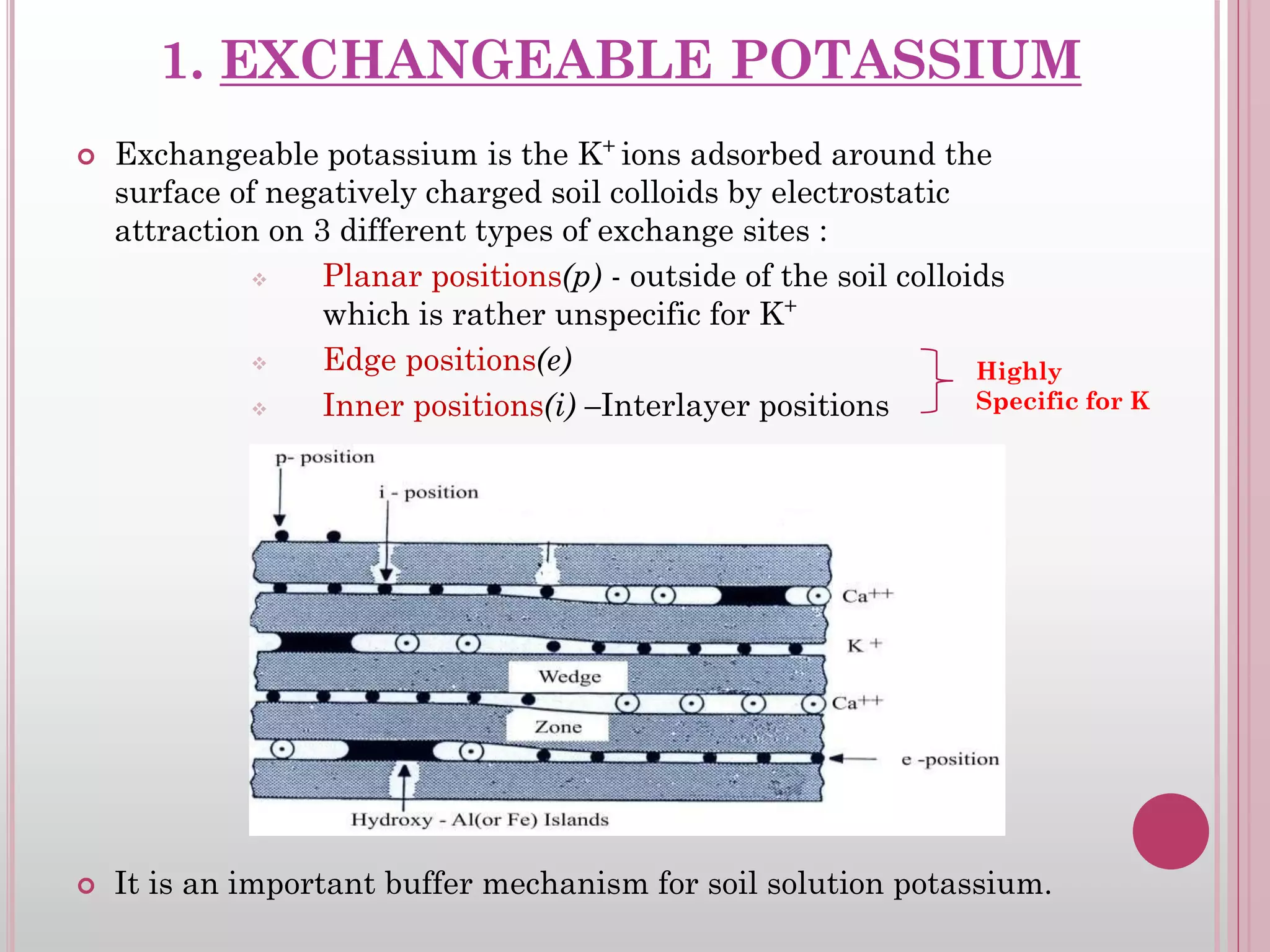
 Exchangeable potassium is the K+
ions adsorbed around the
surface of negatively charged soil colloids by electrostatic
attraction on 3 different types of exchange sites :
 Planar positions(p) - outside of the soil colloids
which is rather unspecific for K+
 Edge positions(e)
 Inner positions(i) –Interlayer positions
 It is an important buffer mechanism for soil solution potassium.
Highly
Specific for K
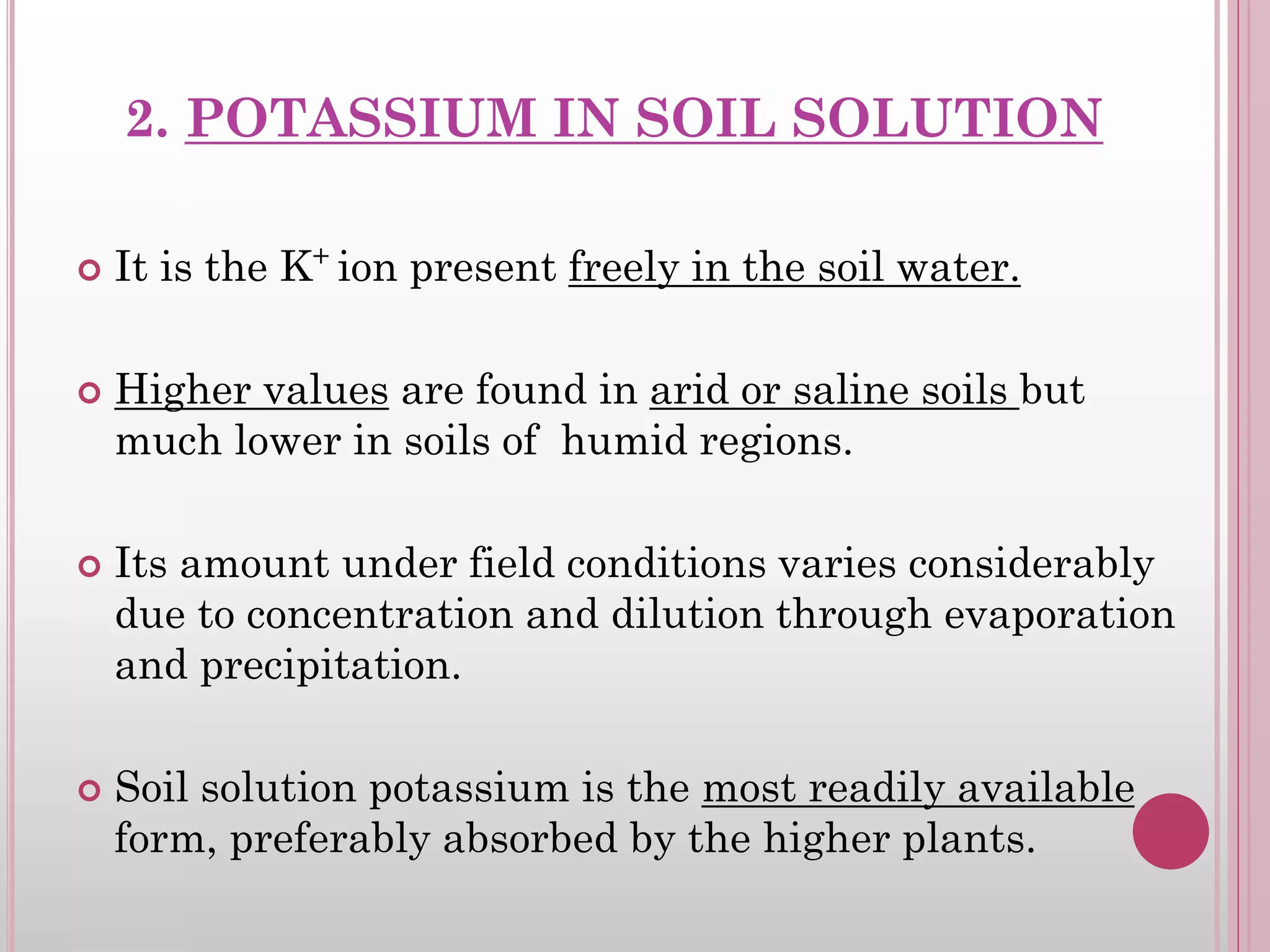
2. POTASSIUM IN SOIL SOLUTION
 It is the K+
ion present freely in the soil water.
 Higher values are found in arid or saline soils but
much lower in soils of humid regions.
 Its amount under field conditions varies considerably
due to concentration and dilution through evaporation
and precipitation.
 Soil solution potassium is the most readily available
form, preferably absorbed by the higher plants.
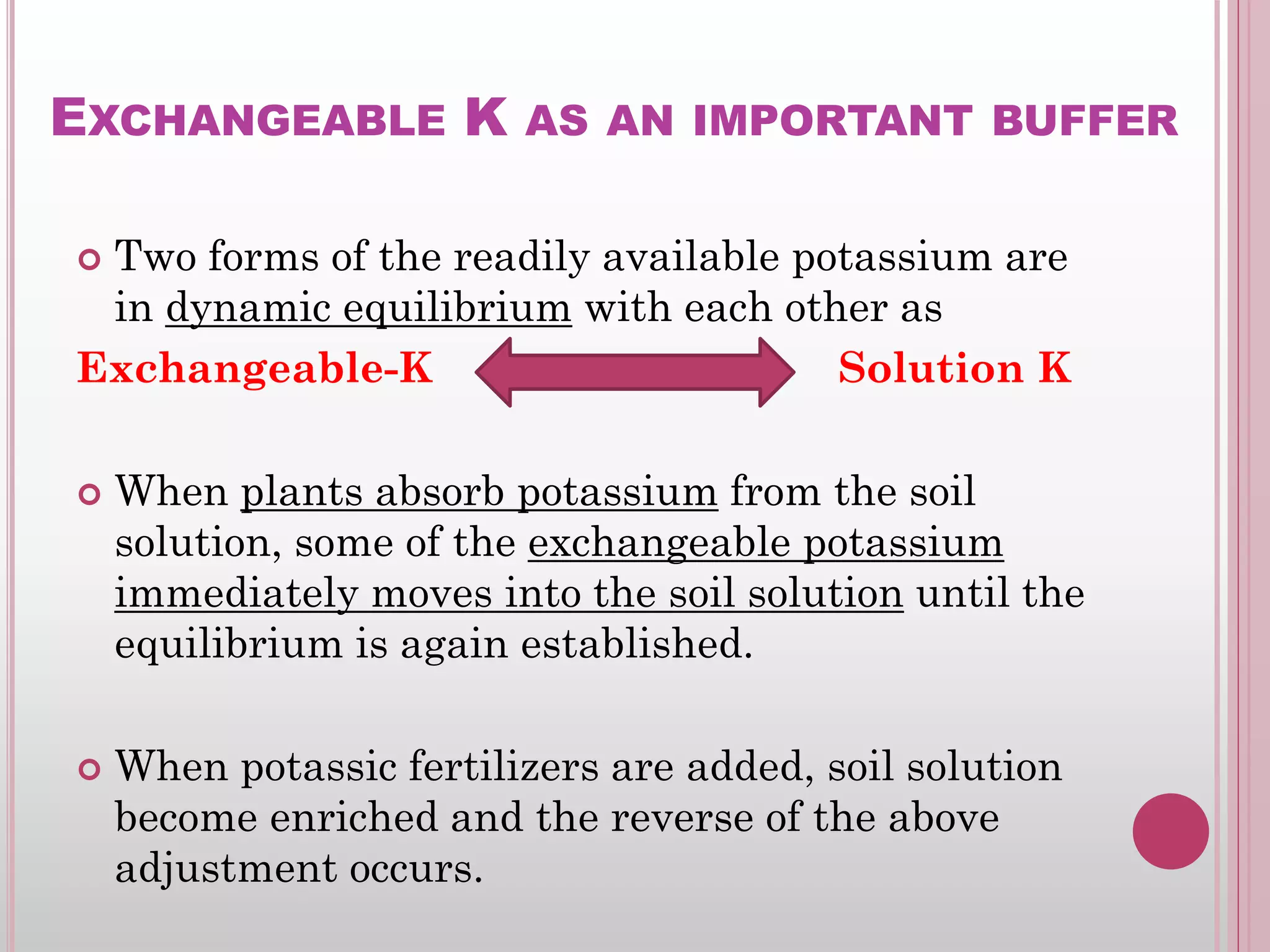
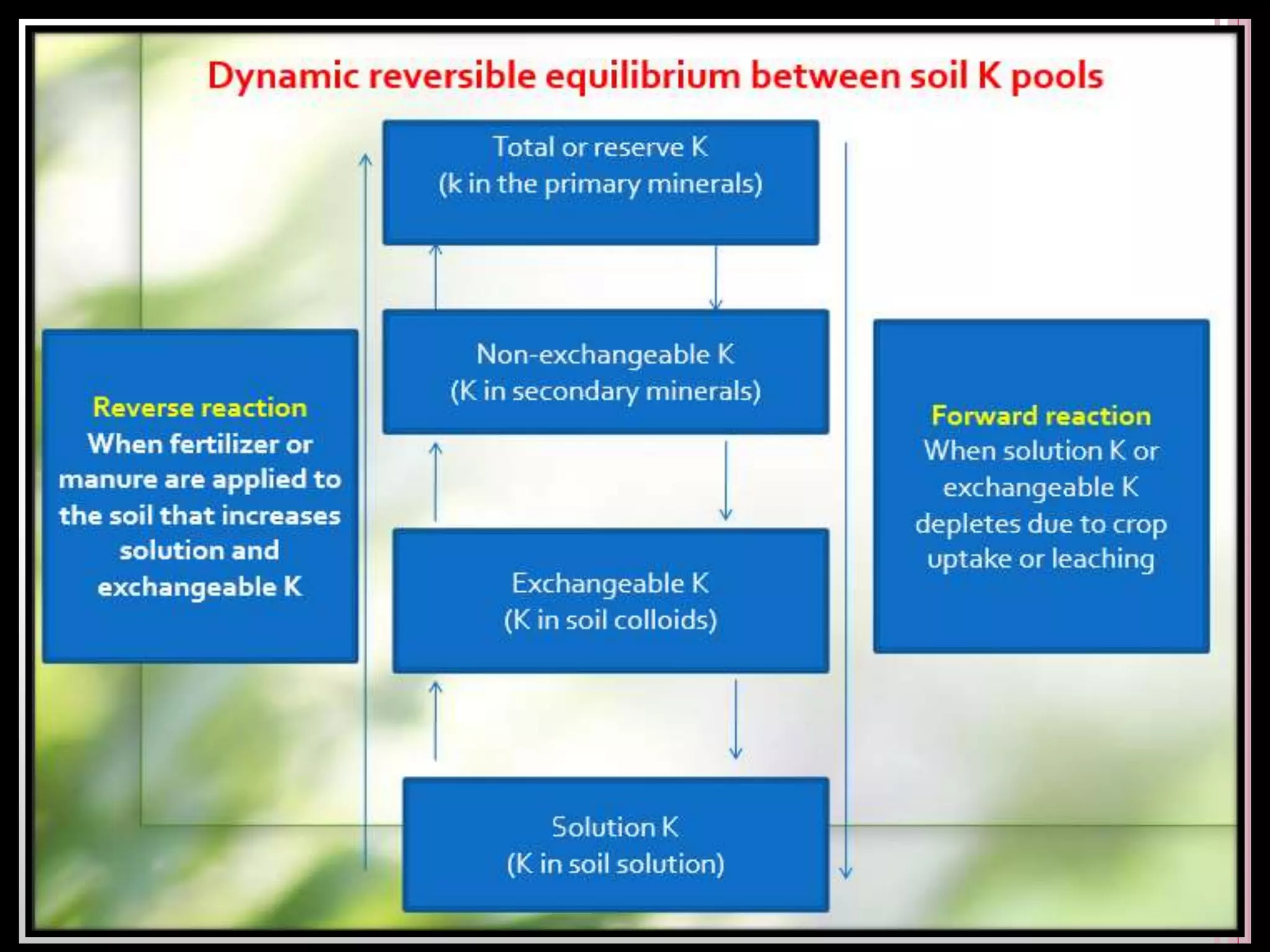
EXCHANGEABLE K AS AN IMPORTANT BUFFER
 Two forms of the readily available potassium are
in dynamic equilibrium with each other as
Exchangeable-K Solution K
 When plants absorb potassium from the soil
solution, some of the exchangeable potassium
immediately moves into the soil solution until the
equilibrium is again established.
 When potassic fertilizers are added, soil solution
become enriched and the reverse of the above
adjustment occurs.
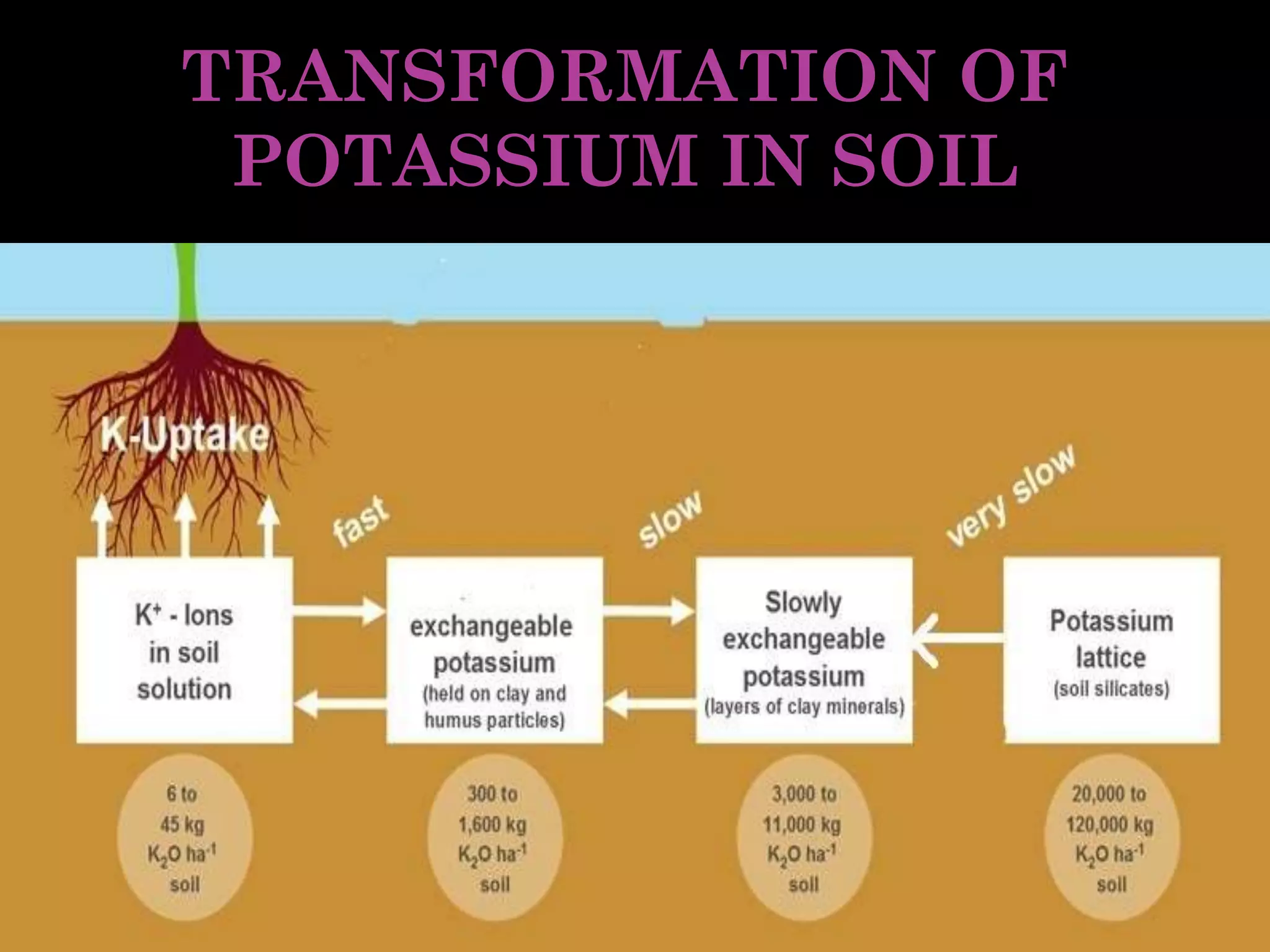
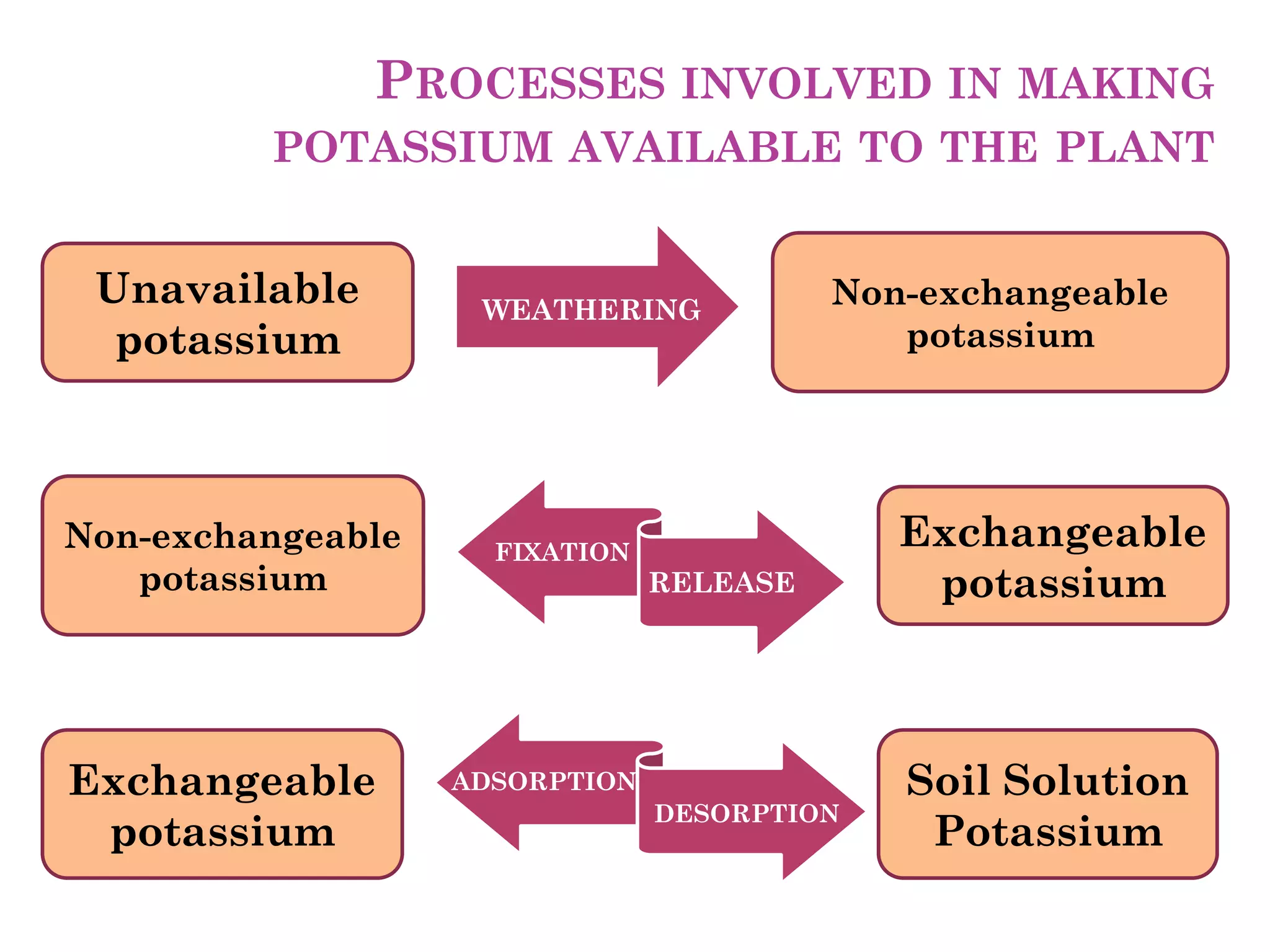
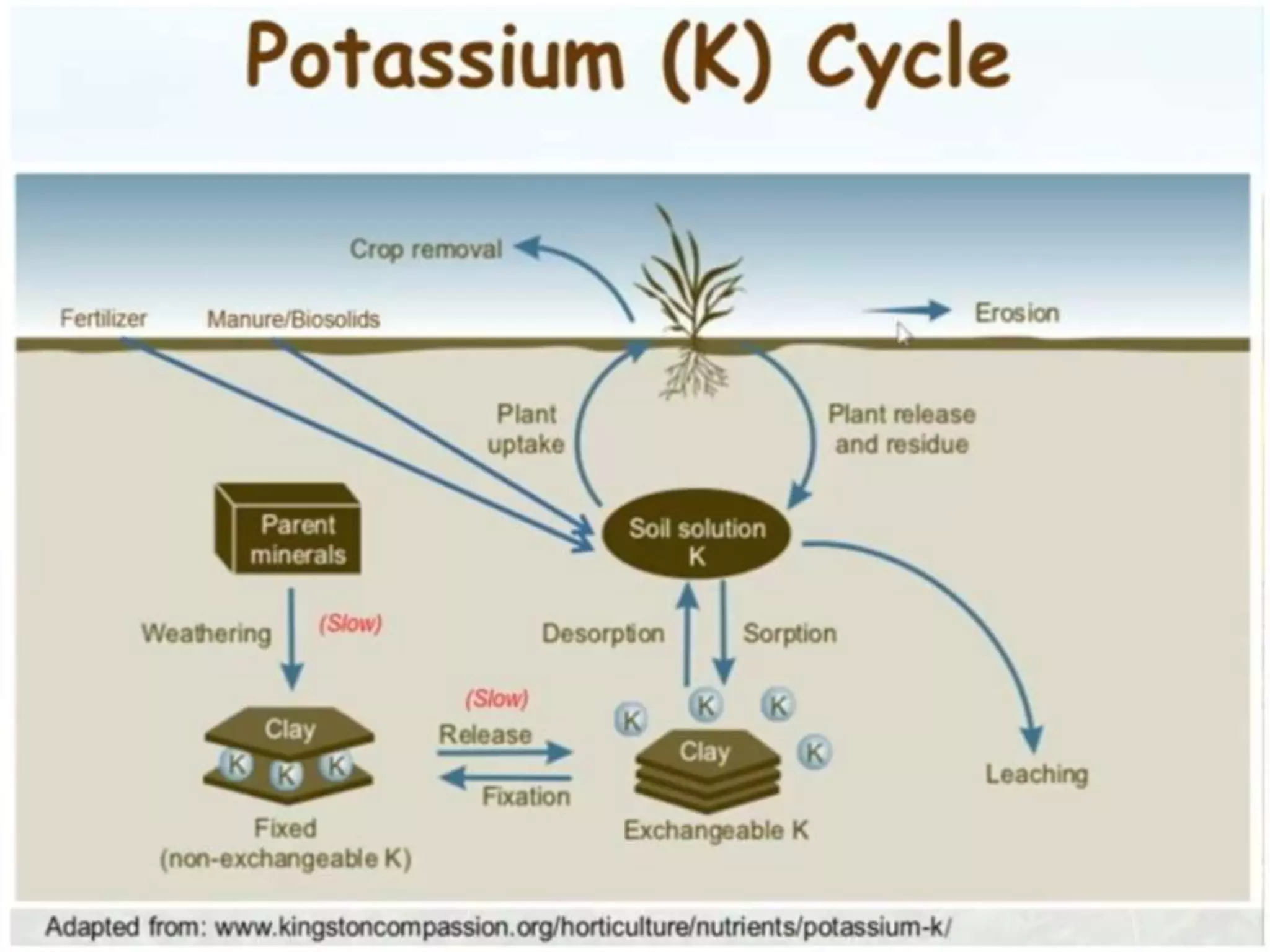
TRANSFORMATION OF
POTASSIUM IN SOIL
ADSORPTION
DESORPTION
FIXATION
RELEASE
Non-exchangeable
potassium
Exchangeable
potassium
Soil Solution
Potassium
Exchangeable
potassium
Unavailable
potassium
Non-exchangeable
potassium
WEATHERING
PROCESSES INVOLVED IN MAKING
POTASSIUM AVAILABLE TO THE PLANT
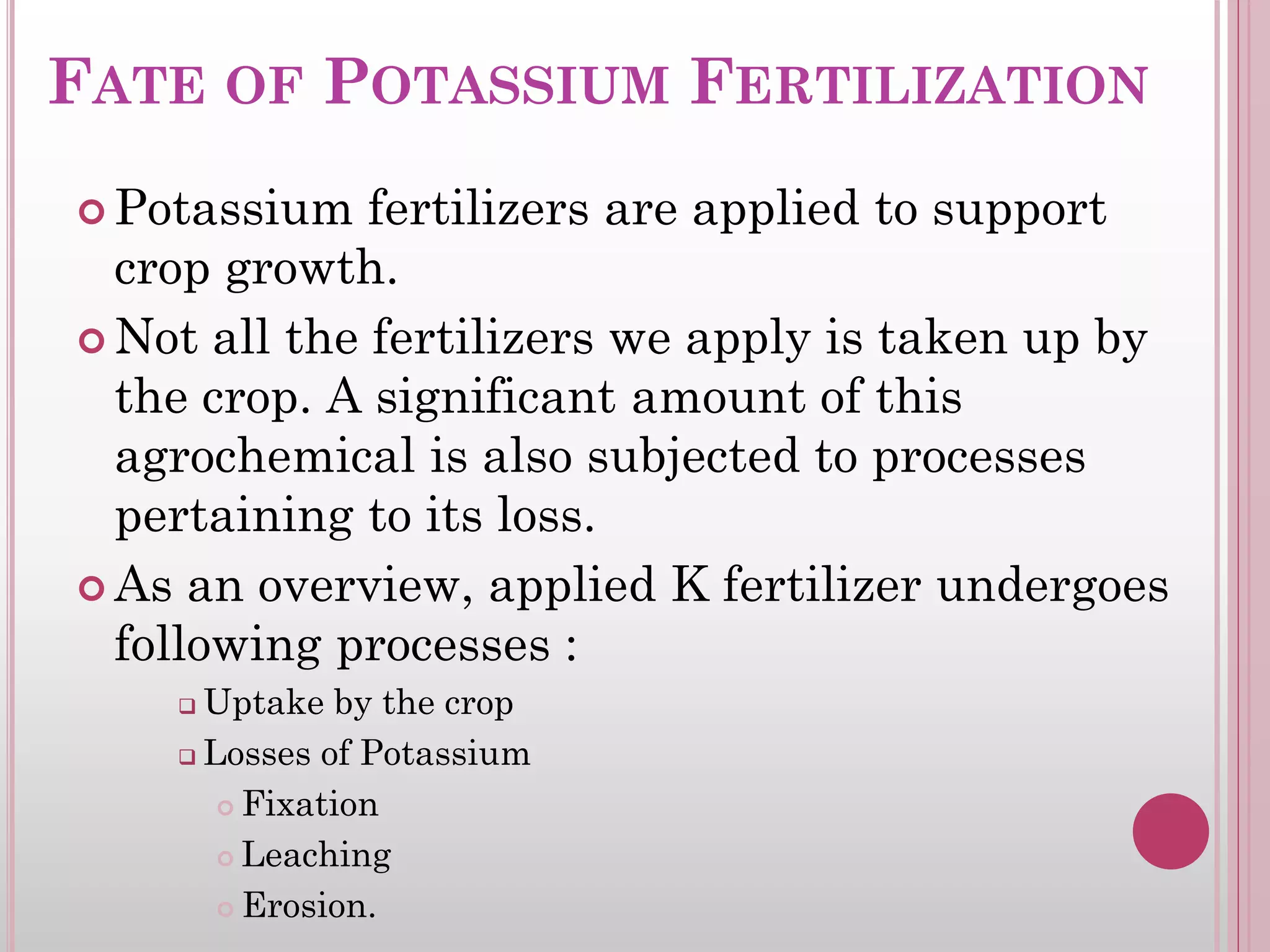
FATE OF POTASSIUM FERTILIZATION
 Potassium fertilizers are applied to support
crop growth.
 Not all the fertilizers we apply is taken up by
the crop. A significant amount of this
agrochemical is also subjected to processes
pertaining to its loss.
 As an overview, applied K fertilizer undergoes
following processes :
 Uptake by the crop
 Losses of Potassium
 Fixation
 Leaching
 Erosion.
UPTAKE BY THE PLANTS
 Potassium is transported to the root surface of
plants by diffusion and mass flow.
 Mass flow contributes 10% of crop K
requirement.
 Diffusion contributes 90% of crop K
requirement.
 Mass flow could supply more K when solution K
is high either naturally or increased due to
fertilizer application.
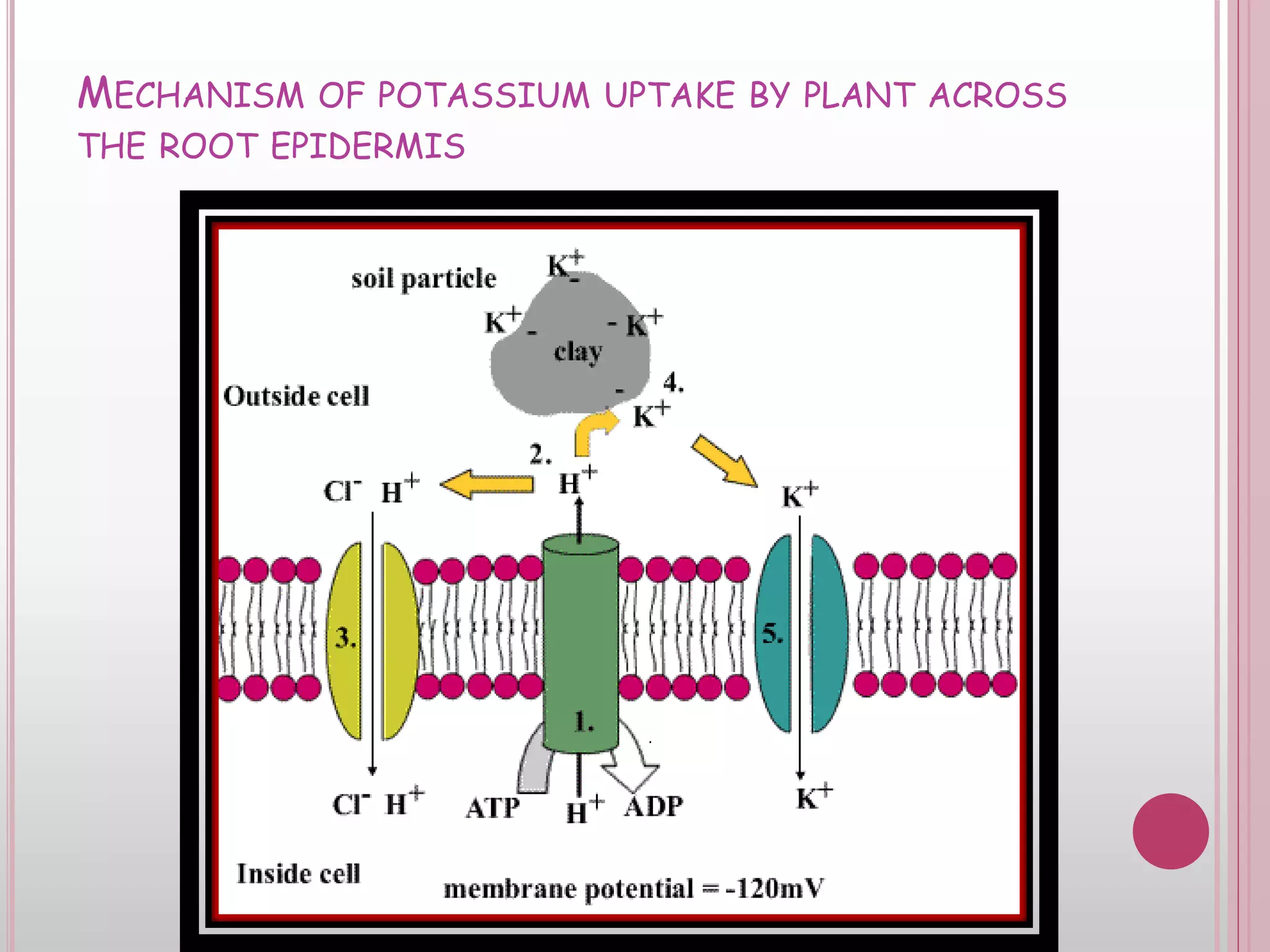
MECHANISM OF POTASSIUM UPTAKE BY PLANT ACROSS
THE ROOT EPIDERMIS
LEACHING LOSSES OF K
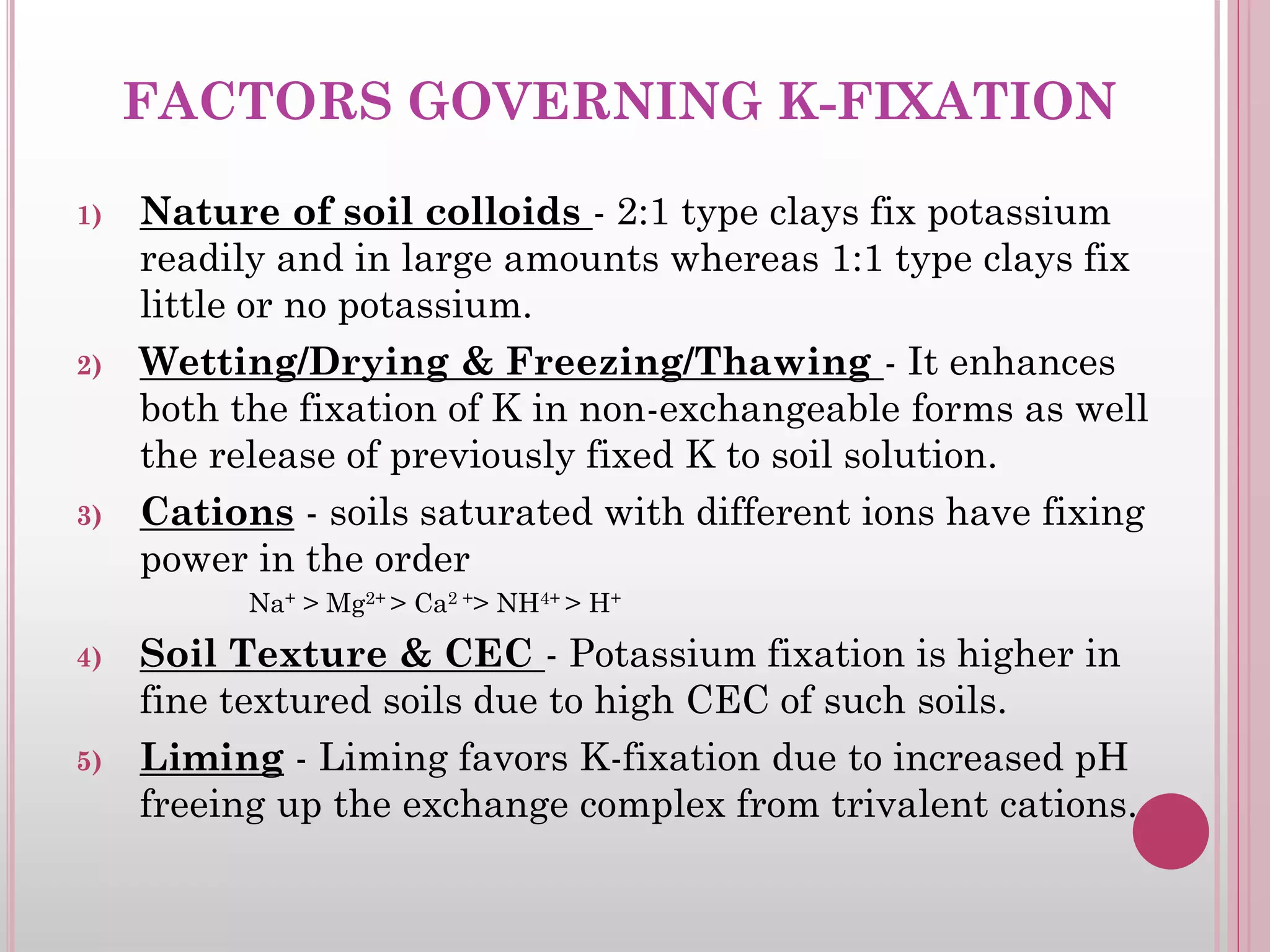
 Potassium is more readily lost by leaching than
Phosphorus.
 Annual loss of K by leaching is about 25-50 kg/ha.
 Greater values are seen typically for acid & sandy soils.
 In acid soils, higher levels of exchangeable trivalent Al3+
saturate the exchange complex leaving K+ less likely to be
adsorbed.
 Liming of acid soils significantly reduce leaching losses
because in limed soils, higher levels of exchangeable Ca2 +
& Mg2+ are present which the monovalent K+ ions are
better able to replace on the exchange complex.
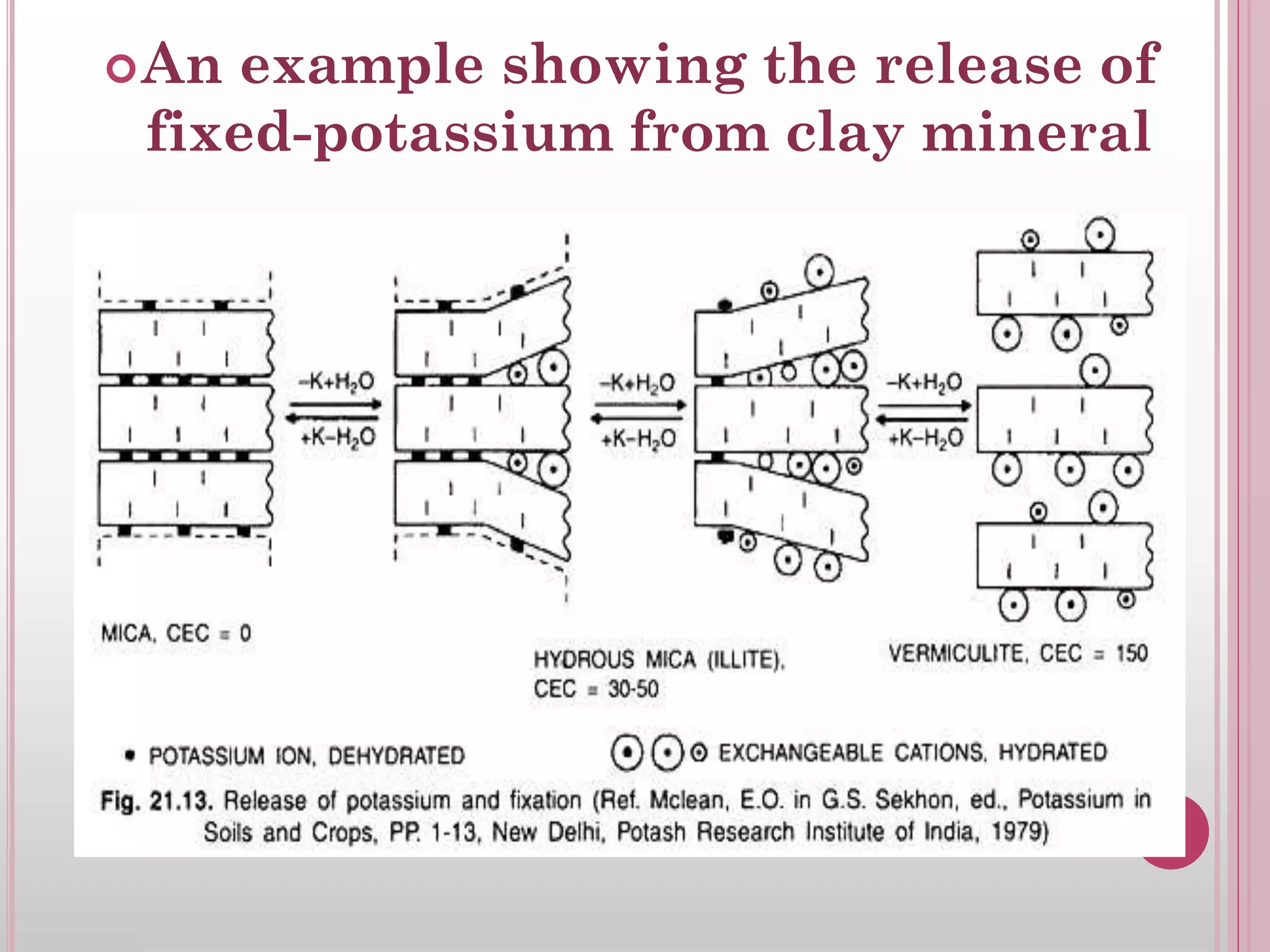
POTASSIUM FIXATION
 Potassium fixation represents entrapment of K+
between the adjoining layers of silica sheets of 2:1
type clays.
 1:1 clay minerals such as kaolinite do not fix K.
 Cause of fixation :
a) Potassium do not have high affinity for water like other
cations. Thus it is easily dehydrated.
b) It's sufficiently small ionic radius allow K+ to fit snugly
in the interlayer region of clay minerals where it is
firmly held by electrostatic forces.
 SIGNIFICANCE OF FIXATION : Potassium
fixation results in conservation of K, which can
become available over a long period of time and thus
is not entirely a loss to the plants.
FACTORS GOVERNING K-FIXATION
1) Nature of soil colloids - 2:1 type clays fix potassium
readily and in large amounts whereas 1:1 type clays fix
little or no potassium.
2) Wetting/Drying & Freezing/Thawing - It enhances
both the fixation of K in non-exchangeable forms as well
the release of previously fixed K to soil solution.
3) Cations - soils saturated with different ions have fixing
power in the order
Na+ > Mg2+ > Ca2 +> NH4+ > H+
4) Soil Texture & CEC - Potassium fixation is higher in
fine textured soils due to high CEC of such soils.
5) Liming - Liming favors K-fixation due to increased pH
freeing up the exchange complex from trivalent cations.
An example showing the release of
fixed-potassium from clay mineral
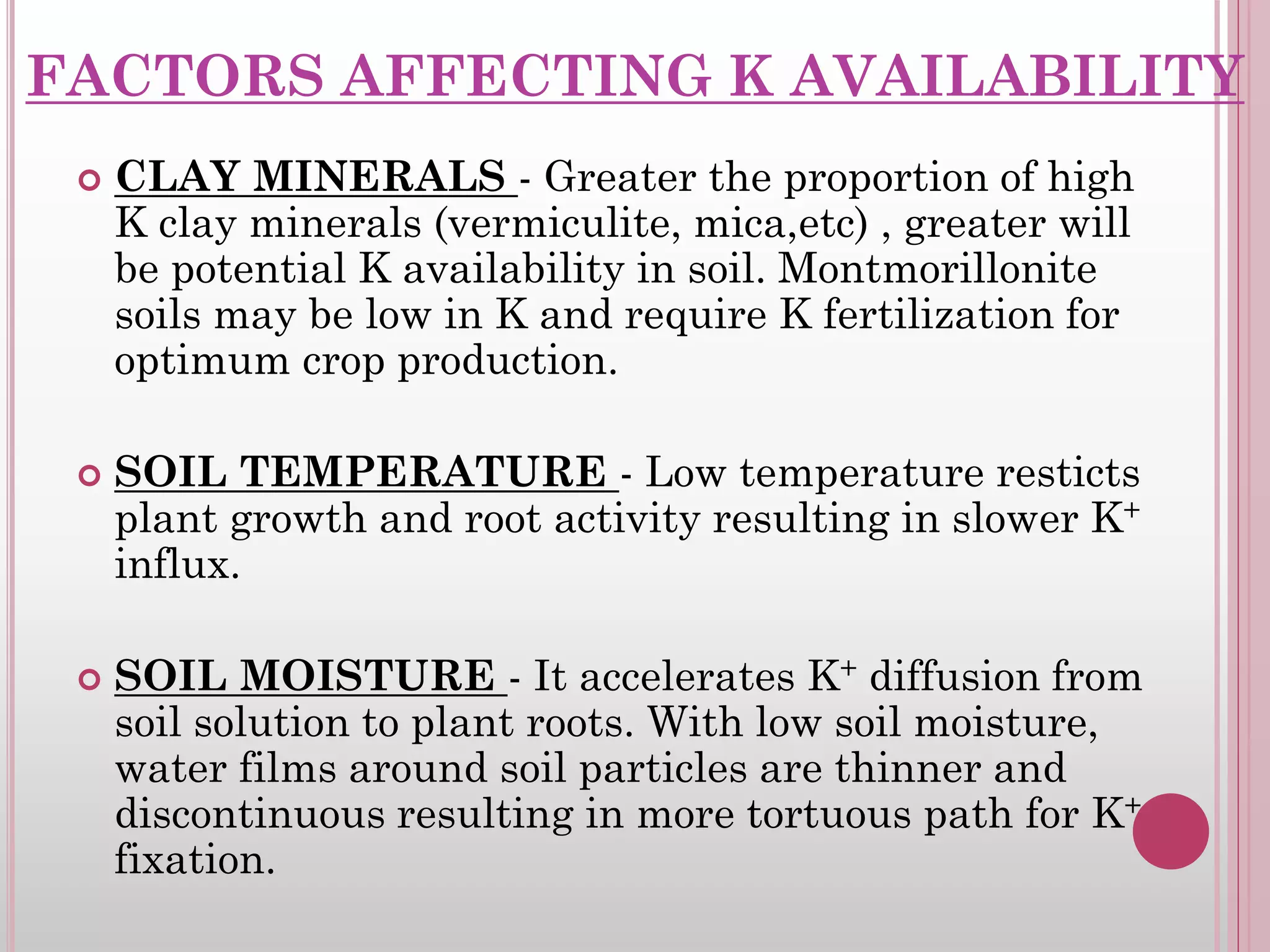
FACTORS AFFECTING K AVAILABILITY
 CLAY MINERALS - Greater the proportion of high
K clay minerals (vermiculite, mica,etc) , greater will
be potential K availability in soil. Montmorillonite
soils may be low in K and require K fertilization for
optimum crop production.
 SOIL TEMPERATURE - Low temperature resticts
plant growth and root activity resulting in slower K+
influx.
 SOIL MOISTURE - It accelerates K+ diffusion from
soil solution to plant roots. With low soil moisture,
water films around soil particles are thinner and
discontinuous resulting in more tortuous path for K+
fixation.
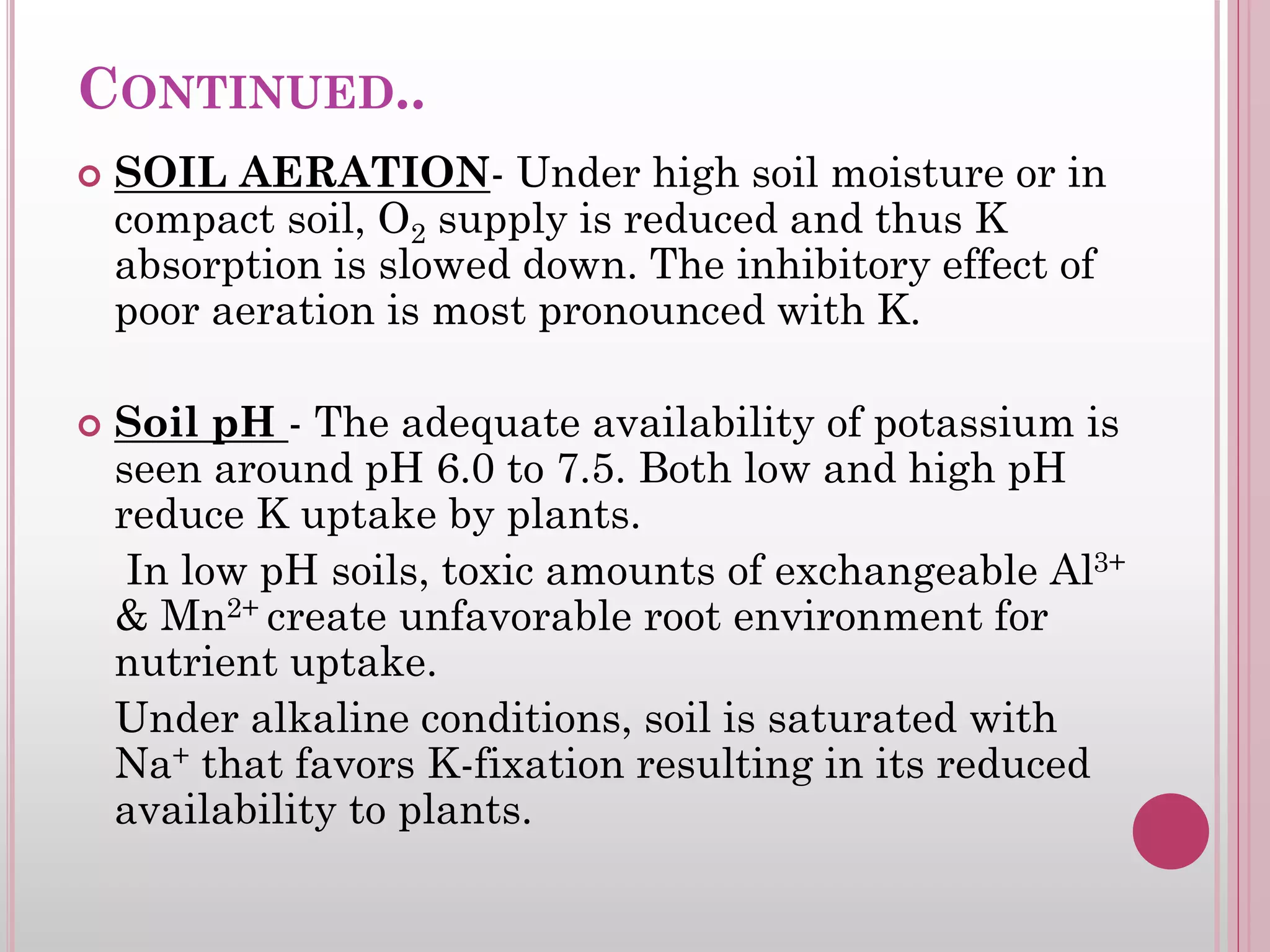
CONTINUED..
 SOIL AERATION- Under high soil moisture or in
compact soil, O2 supply is reduced and thus K
absorption is slowed down. The inhibitory effect of
poor aeration is most pronounced with K.
 Soil pH - The adequate availability of potassium is
seen around pH 6.0 to 7.5. Both low and high pH
reduce K uptake by plants.
In low pH soils, toxic amounts of exchangeable Al3+
& Mn2+ create unfavorable root environment for
nutrient uptake.
Under alkaline conditions, soil is saturated with
Na+ that favors K-fixation resulting in its reduced
availability to plants.
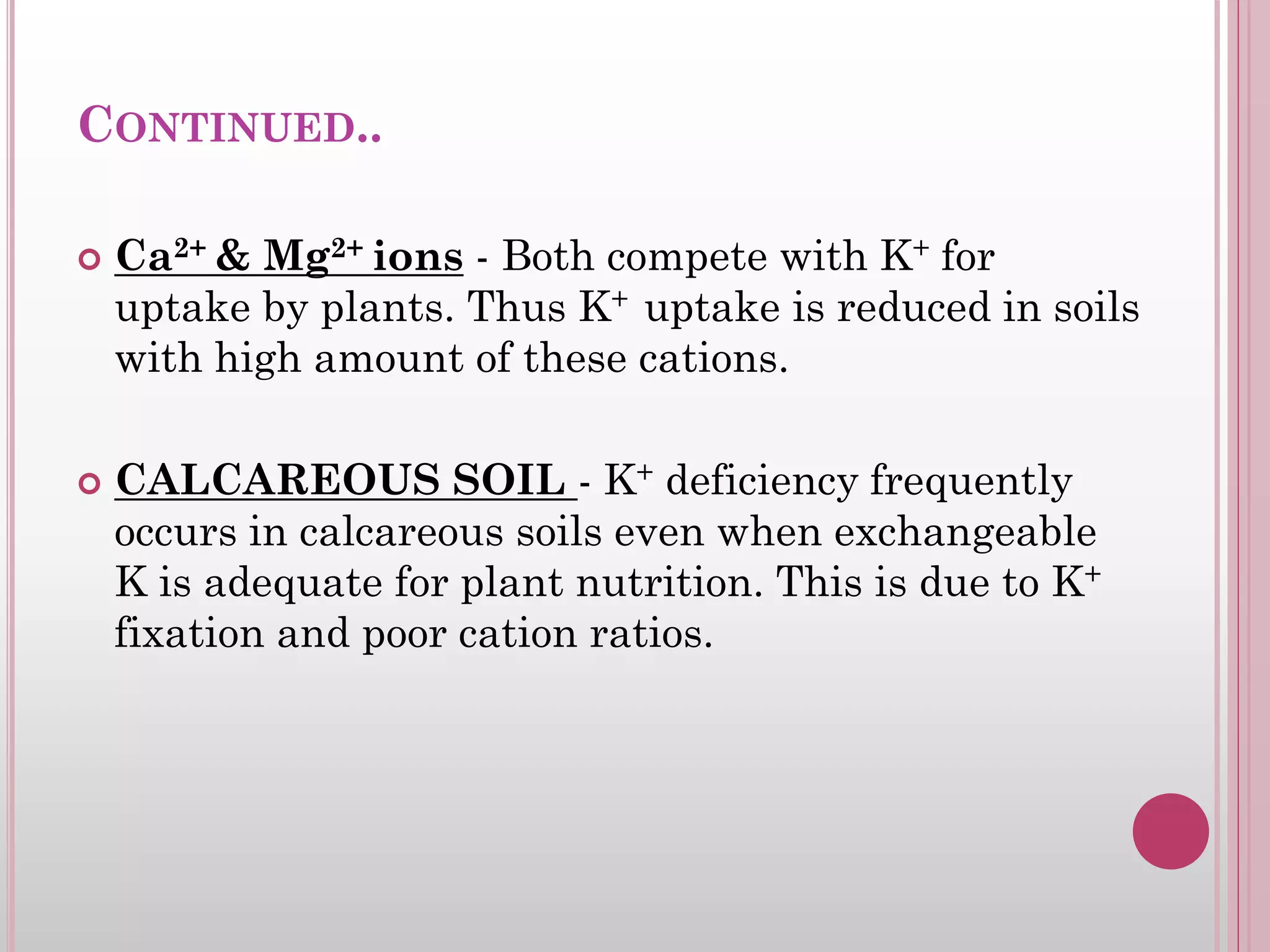
CONTINUED..
 Ca2+ & Mg2+ ions - Both compete with K+ for
uptake by plants. Thus K+ uptake is reduced in soils
with high amount of these cations.
 CALCAREOUS SOIL - K+ deficiency frequently
occurs in calcareous soils even when exchangeable
K is adequate for plant nutrition. This is due to K+
fixation and poor cation ratios.
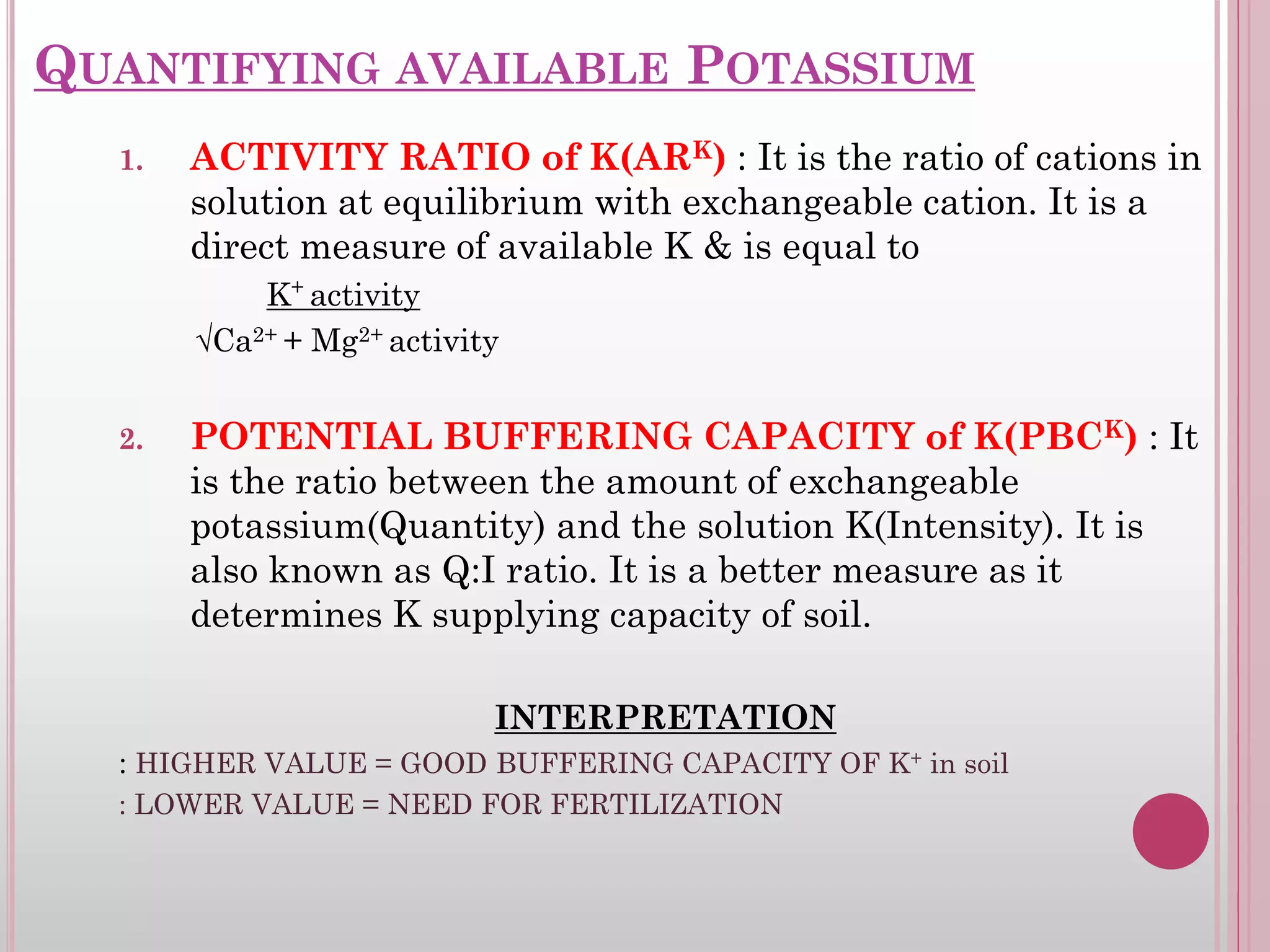
QUANTIFYING AVAILABLE POTASSIUM
1. ACTIVITY RATIO of K(ARK) : It is the ratio of cations in
solution at equilibrium with exchangeable cation. It is a
direct measure of available K & is equal to
K+
activity
√Ca2+ + Mg2+ activity
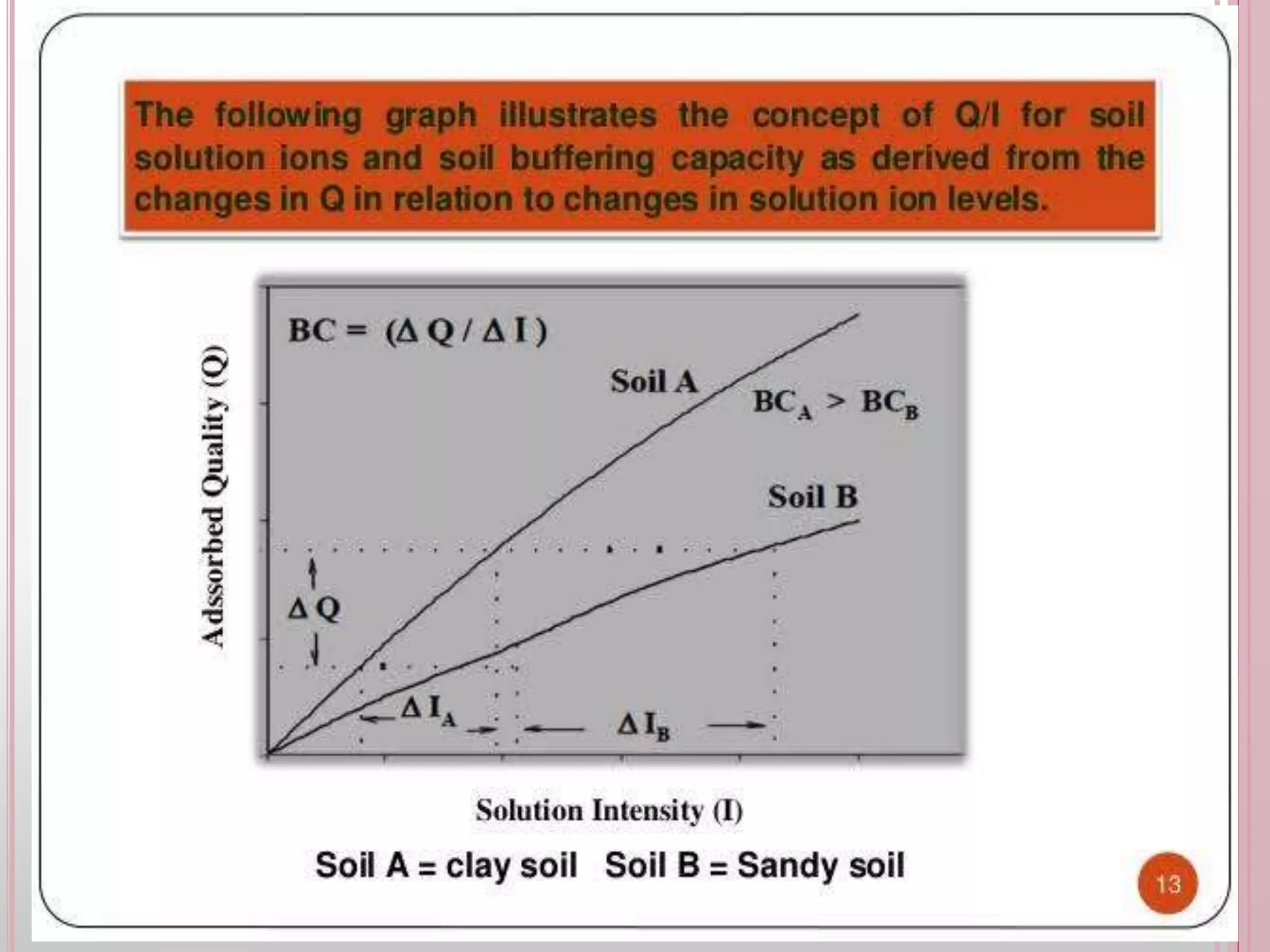
2. POTENTIAL BUFFERING CAPACITY of K(PBCK) : It
is the ratio between the amount of exchangeable
potassium(Quantity) and the solution K(Intensity). It is
also known as Q:I ratio. It is a better measure as it
determines K supplying capacity of soil.
INTERPRETATION
: HIGHER VALUE = GOOD BUFFERING CAPACITY OF K+ in soil
: LOWER VALUE = NEED FOR FERTILIZATION
REFERENCE :
 Brady N.C. and Ray R.Weil , The nature and
properties of Soils , Dorling Kindersley (India)
Pvt. Ltd. , 2014, Fourteenth edition
 Das D.K. , Introductory Soil Science , Kalyani
Publishers, 2015 , Fifth edition
 Havlin JL, Beaton JD, Tisdale SL & Nelson WL.
2006. Soil Fertility and Fertilizers.
 https://www.researchgate.net>publication
THANK
YOU

Transformations and dynamics of potassium

  • 1.
    INDIRA GANDHI AGRICULTUREUNIVERSITY COLLEGE OF AGRICULTURE RAIPUR 2018-19 Course no. : AGRON-502 Course title: SOIL FERTILITY AND NUTRIENT MANAGEMENT assignment on: TRANSFORMATION AND DYNAMICS OF POTASSIUM submitted to: submitted by: Dr.(Mrs) Ambika Tandon Sushmita Garg Dept of Agronomy MSc(Ag) Previous
  • 2.
    BEFORE WE START What does the topic is actually referring to?  Gist on what will be covered under this topic: Different forms of potassium in soil. Process of conversion from unavailable to available form. Fate of potassium fertilization. Factors affecting K availability to plants. Quantifying available K The Potassium cycle.
  • 3.
    INTRODUCTION Potassium – abyte on this essential plant nutrient It is never incorporated in any organic compound. Even in the plant system it remains as K+ ion. Its behavior in the soil is not at all affected by micro-organisms. It does not form any gas that could be lost to the atmosphere. It does not cause eutrophication. When left in the ecosystem as such, it is not at all toxic.
  • 4.
    OCCURRENCE OF POTASSIUMIN SOIL  Potassium is an element for which Indian soils form a luxuriant source except for those consisting of quartz sand and the organic soils.  Amount of potassium as great as 30000-50000 kg/ha in the upper 15 cm of soil is very common.  Despite this fact, farmers have to fertilize the soil to get a good crop and this is attributed to the diversity in forms of potassium in soil.
  • 5.
    FORMS OF POTASSIUMIN SOIL  Listed in the increasing order of plant availability, soil K exists in following forms –  All plants can easily utilize the readily available forms, but the ability to obtain potassium held in slowly available and unavailable forms differs greatly among plant species. S.N O. FORM OF K AVERAGE CONTENT per kg SOIL PERCENTAGE OUT OF TOTAL SOIL K 1. Unavailable 5000-25000 ppm 90 - 98 % 2. Slowly available 50-750 ppm 1 - 10 % 3. Readily available 0.1 - 2.0 %Exchangeable 40-600 ppm Soil solution 1-10 ppm
  • 6.
    UNAVAILABLE FORM  Alsoknown as Mineral K, this is the major natural source of potassium in soil.  It is found on crystal structures of primary minerals like –  Micas – Micas are 2:1 layer silicates where K+ resides mainly between the layer silicates • Muscovite : [KAl3Si3O10(OH)2] • Biotite : [K(Mg,Fe)3 AlSi3O10(OH)2] • Phlogopite : [KMg2Al2Si3O10(OH)2]  Feldspars – Feldspars are 3-dimensional crystal structure with K located throughout the mineral lattice. They are the largest natural potassium reserve. • Orthoclase • Microcline : KAlSi3O8  The potassium from this source can be released only through weathering. Thus, they supply very small quantities of potassium during a given growing season.  Only their cumulative release over a period of years is of some importance which is enhanced by the solvent action of carbonic acid, stronger organic acid, inorganic acids, acidic clays and humus.  Order of primary minerals in the ease of weathering is as follows: Biotite > Muscovite > K-feldspars > Phlogopite  The release of K from these minerals is also geared by the dissolution of the mineral from the roots of certain plants like elephant grass.
  • 7.
    SLOWLY AVAILABLE FORM It is also known as non-exchangeable form as these K+ ions cannot be replaced by ordinary exchange processes.  It is the fixed K where K+ ions are held by electrostatic forces as the integral part of secondary clay minerals like vermiculite, smectite, illite, chlorite,etc.  These are not always immediately available form but contribute significantly to maintenance of labile pool of K.  It’s release is too slow to meet crop demand during the growing season but is an extremely important reservoir of slowly available potassium.  The release of this form of K occurs in response to depletion of readily available form either by plant uptake or leaching through the mechanism of cation exchange and diffusion.
  • 8.
    READILY AVAILABLE FORM Readily available potassium exists as K+ in the soil and is the form that constitutes the labile pool of this nutrient element for the plant.  It has following two forms – Exchangeable form Soil solution-K
  • 9.
    1. EXCHANGEABLE POTASSIUM Exchangeable potassium is the K+ ions adsorbed around the surface of negatively charged soil colloids by electrostatic attraction on 3 different types of exchange sites :  Planar positions(p) - outside of the soil colloids which is rather unspecific for K+  Edge positions(e)  Inner positions(i) –Interlayer positions  It is an important buffer mechanism for soil solution potassium. Highly Specific for K
  • 10.
    2. POTASSIUM INSOIL SOLUTION  It is the K+ ion present freely in the soil water.  Higher values are found in arid or saline soils but much lower in soils of humid regions.  Its amount under field conditions varies considerably due to concentration and dilution through evaporation and precipitation.  Soil solution potassium is the most readily available form, preferably absorbed by the higher plants.
  • 11.
    EXCHANGEABLE K ASAN IMPORTANT BUFFER  Two forms of the readily available potassium are in dynamic equilibrium with each other as Exchangeable-K Solution K  When plants absorb potassium from the soil solution, some of the exchangeable potassium immediately moves into the soil solution until the equilibrium is again established.  When potassic fertilizers are added, soil solution become enriched and the reverse of the above adjustment occurs.
  • 13.
  • 14.
  • 16.
    FATE OF POTASSIUMFERTILIZATION  Potassium fertilizers are applied to support crop growth.  Not all the fertilizers we apply is taken up by the crop. A significant amount of this agrochemical is also subjected to processes pertaining to its loss.  As an overview, applied K fertilizer undergoes following processes :  Uptake by the crop  Losses of Potassium  Fixation  Leaching  Erosion.
  • 17.
    UPTAKE BY THEPLANTS  Potassium is transported to the root surface of plants by diffusion and mass flow.  Mass flow contributes 10% of crop K requirement.  Diffusion contributes 90% of crop K requirement.  Mass flow could supply more K when solution K is high either naturally or increased due to fertilizer application.
  • 18.
    MECHANISM OF POTASSIUMUPTAKE BY PLANT ACROSS THE ROOT EPIDERMIS
  • 19.
    LEACHING LOSSES OFK  Potassium is more readily lost by leaching than Phosphorus.  Annual loss of K by leaching is about 25-50 kg/ha.  Greater values are seen typically for acid & sandy soils.  In acid soils, higher levels of exchangeable trivalent Al3+ saturate the exchange complex leaving K+ less likely to be adsorbed.  Liming of acid soils significantly reduce leaching losses because in limed soils, higher levels of exchangeable Ca2 + & Mg2+ are present which the monovalent K+ ions are better able to replace on the exchange complex.
  • 20.
    POTASSIUM FIXATION  Potassiumfixation represents entrapment of K+ between the adjoining layers of silica sheets of 2:1 type clays.  1:1 clay minerals such as kaolinite do not fix K.  Cause of fixation : a) Potassium do not have high affinity for water like other cations. Thus it is easily dehydrated. b) It's sufficiently small ionic radius allow K+ to fit snugly in the interlayer region of clay minerals where it is firmly held by electrostatic forces.  SIGNIFICANCE OF FIXATION : Potassium fixation results in conservation of K, which can become available over a long period of time and thus is not entirely a loss to the plants.
  • 21.
    FACTORS GOVERNING K-FIXATION 1)Nature of soil colloids - 2:1 type clays fix potassium readily and in large amounts whereas 1:1 type clays fix little or no potassium. 2) Wetting/Drying & Freezing/Thawing - It enhances both the fixation of K in non-exchangeable forms as well the release of previously fixed K to soil solution. 3) Cations - soils saturated with different ions have fixing power in the order Na+ > Mg2+ > Ca2 +> NH4+ > H+ 4) Soil Texture & CEC - Potassium fixation is higher in fine textured soils due to high CEC of such soils. 5) Liming - Liming favors K-fixation due to increased pH freeing up the exchange complex from trivalent cations.
  • 22.
    An example showingthe release of fixed-potassium from clay mineral
  • 23.
    FACTORS AFFECTING KAVAILABILITY  CLAY MINERALS - Greater the proportion of high K clay minerals (vermiculite, mica,etc) , greater will be potential K availability in soil. Montmorillonite soils may be low in K and require K fertilization for optimum crop production.  SOIL TEMPERATURE - Low temperature resticts plant growth and root activity resulting in slower K+ influx.  SOIL MOISTURE - It accelerates K+ diffusion from soil solution to plant roots. With low soil moisture, water films around soil particles are thinner and discontinuous resulting in more tortuous path for K+ fixation.
  • 24.
    CONTINUED..  SOIL AERATION-Under high soil moisture or in compact soil, O2 supply is reduced and thus K absorption is slowed down. The inhibitory effect of poor aeration is most pronounced with K.  Soil pH - The adequate availability of potassium is seen around pH 6.0 to 7.5. Both low and high pH reduce K uptake by plants. In low pH soils, toxic amounts of exchangeable Al3+ & Mn2+ create unfavorable root environment for nutrient uptake. Under alkaline conditions, soil is saturated with Na+ that favors K-fixation resulting in its reduced availability to plants.
  • 25.
    CONTINUED..  Ca2+ &Mg2+ ions - Both compete with K+ for uptake by plants. Thus K+ uptake is reduced in soils with high amount of these cations.  CALCAREOUS SOIL - K+ deficiency frequently occurs in calcareous soils even when exchangeable K is adequate for plant nutrition. This is due to K+ fixation and poor cation ratios.
  • 26.
    QUANTIFYING AVAILABLE POTASSIUM 1.ACTIVITY RATIO of K(ARK) : It is the ratio of cations in solution at equilibrium with exchangeable cation. It is a direct measure of available K & is equal to K+ activity √Ca2+ + Mg2+ activity 2. POTENTIAL BUFFERING CAPACITY of K(PBCK) : It is the ratio between the amount of exchangeable potassium(Quantity) and the solution K(Intensity). It is also known as Q:I ratio. It is a better measure as it determines K supplying capacity of soil. INTERPRETATION : HIGHER VALUE = GOOD BUFFERING CAPACITY OF K+ in soil : LOWER VALUE = NEED FOR FERTILIZATION
  • 29.
    REFERENCE :  BradyN.C. and Ray R.Weil , The nature and properties of Soils , Dorling Kindersley (India) Pvt. Ltd. , 2014, Fourteenth edition  Das D.K. , Introductory Soil Science , Kalyani Publishers, 2015 , Fifth edition  Havlin JL, Beaton JD, Tisdale SL & Nelson WL. 2006. Soil Fertility and Fertilizers.  https://www.researchgate.net>publication
  • 30.