Abstract—The paper presents the converter topology for single
to three phase matrix converter for the ac traction drives. The
converter analysis is presented with source separation and link
approach. The conventional carrier based control is employed for
the converter to control the output voltage and frequency. The
operational feasibility with the three phase ac traction motor (850
kW) is presented. The performance of the converter with the
motor is simulated in the PSIM. The results indicate the feasibility
of the matrix converter application to retrofit the existing (AC-
DC-AC) to (AC-AC) traction drive system.
Index Terms—Matrix Converters, Sinusoidal Pulse Width
Modulation, Traction Motors, Variable Speed Drives.
I. INTRODUCTION
ELECTRIC traction in most of the country have single
phase 25 kV, 50 Hz AC or 3kV DC power supply systems.
The conventional locomotives have a transformer with a tap
changer or a step- down transformer with semiconductor
devices, like power diodes, GTOs, IGBTs, etc.
Fig. 1: Conventional Single-to-three phase ac Traction.
Those are used for ac- to- dc and dc-to-three-phase ac power
conversion and to charge the intermediate dc-link capacitors
for energy storage elements. The locomotives have Bo-Bo (4-
TM on 4 axles) or Co-Co (6-TM on 6 axles) type bogie
1
Bhimrao S. Gajbhiye is research scholar at Visvesvaraya National
Institute of Technology, Nagpur, Maharashtra, India. (e-mail-
bsgajbhiye@gmail.com)
2
Dr. M. V. Aware is member IEEE and professor atVisvesvarayaNational
Institute of Technology, Nagpur, Maharashtra, India. (e-mail-
mva_win@yahoo.com)
3
Dr. B. S. Umre is member IEEE and assistant professor at Visvesvaraya
National Institute of Technology, Nagpur, Maharashtra, India. (e-mail-
bsumre@rediffmail.com)
4
Rajesh Patil is IRSEE Batch-1992 currently working as Sr.D.E.E.(Trd.)at
Central Railways, Nagpur,Maharashtra, India. (e-mail- rajpat@gmail.com)
arrangements. The traction motor (TM) is a three phase
induction motor operated with variable voltage and frequency
converter in conventional speed control mode as shown in
figure 1.
The converter without dc link will be preferred over the two
stage ac-dc-ac conversion in the existing power conversion
arrangements in the ac traction drives. The matrix converters
(MC) is a direct ac-to-ac converter, replaces the multiple
conversion stages and the intermediate energy storage
elements (dc-link) thus being a single stage converter as
shown in figure 2. The different topologies, single phase to
single phase and three phase to three phase with bi-directional
switches are analyzed and results are presented [1]-[2].The
phase transformation from single to three phase with three
legged six bi-directional switch converter having simple
control given for the three phase balanced loads [3]-[6].This
control suffers lower voltage utilization and requires
additional matching transformer. The matrix converter
topology could be analyzed through the separation and link
technique [4]. This analysis incorporates the back–to-back
common emitter bi-directional switch cells configuration is
shown in figure 2 with fictitious dc link to understand the
operation of matrix converter [5].
S1 S3
S6S4
Vs (t)
S5
S2
Sc1
Sc2
Sc1d
Sc2d
M
Ii (t)
a
b
c
A
B
C
+
Source Matrix converter Traction motor
Fig. 2: Proposed single-to-three phase ac Traction converter.
The paper proposes the single phase to three phase matrix
converter topology for traction drives. The operation of the
converter is analyzed using the separation and link approach.
The control is built by using the sinusoidal pulse width
modulation (SPWM) for the bi-directional switches in this
converter. This single phase to three phase converter has
following merits.
-This replaces the conventional ac-dc-ac stages so the
effective energy conversion is efficient.
-The control is conventional carrier based SPWM.
The known pattern of harmonics predicts the de-rating and
operational efficiency of the induction motor.
Single phase to three phase ac Matrix Converter
for Traction Drives
Bhimrao.S.Gajbhiye1
, M.V.Aware2
, B.S.Umre3
, Rajesh Patil4
25kV ac supply AC-DC conversion DC-Link DC-AC conversion
Resonant circuit DC-Link capacitor Overvoltage/brake chopper
II. MATRIX CONVERTER ANALYSIS
Vs
Sb1 Sc1
Sa3 Sb3 Sc3
Sb4d Sc4d
A
B
C
Sa1
Sa2d
(a) + 100 ( 612 )
Ii
Sa4 Sb4 Sc4
Sa2 Sb2 Sc2
Vs
Sb1 Sc1
Sb2d
Sa3 Sb3 Sc3
Sa4d Sb4d Sc4d
A
B
C
Sa1
Sa2d
(b) + 011 ( 345 )
Ii
Sa4 Sb4 Sc4
Sa2 Sb2 Sc2
Sc2d
Sc3d
Vs
Sb1 Sc1
Sa3 Sb3 Sc3
Sb4d Sc4d
A
B
C
Sa1
Sa2d
(c) + 010 ( 234 )
Ii
Sa4 Sb4 Sc4
Sa2 Sb2 Sc2
Vs
Sb1 Sc1
Sb2d
Sa3 Sb3 Sc3
Sa4d Sb4d Sc4d
A
B
C
Sa1
Sa2d
(d) + 101 ( 561 )
Ii
Sa4 Sb4 Sc4
Sa2 Sb2 Sc2
Sc2d
Sc3d
Vs
Sb1 Sc1
Sa3 Sb3 Sc3
Sa4d Sb4d Sc4d
A
B
C
Sa1
Sa2d
(e) + 001 ( 456 )
Ii
Sa4 Sb4 Sc4
Sa2 Sb2 Sc2
Vs
Sb1 Sc1
Sb2d
Sa3 Sb3 Sc3
Sa4d Sb4d Sc4d
A
B
C
Sa1
Sa2d
(f) + 110 ( 123 )
Ii
Sa4 Sb4 Sc4
Sa2 Sb2 Sc2
Sc2d
Sc3d
Sc2d
S1 S3 S5
S4 S6 S2
S1 S3 S5
S4 S6 S2
S1 S3 S5
S4 S6 S2
S1 S3 S5
S4 S6 S2
S4
S1 S3 S5
S6 S2 S2S6S4
S1 S3 S5
-
+ +
-
+
-
+
-
+
-
+
-
Vs
Sb1 Sc1
Sa3 Sb3 Sc3
Sb4d Sc4d
A
B
C
Sa1
Sa2d
(a) - 100
Ii
Sa4 Sb4 Sc4
Sa2 Sb2 Sc2
(b) - 011
Vs
Sb1 Sc1
Sa3 Sb3 Sc3
Sb4d Sc4d
A
B
C
Sa1
Sa2d
Ii
Sa4 Sb4 Sc4
Sa2 Sb2 Sc2
(c) - 010
Vs
Sb1 Sc1
Sa3 Sb3 Sc3
Sb4d Sc4d
A
B
C
Sa1
Sa2d
Ii
Sa4 Sb4 Sc4
Sa2 Sb2 Sc2
(d) - 101
Vs
Sb1 Sc1
Sa3 Sb3 Sc3
Sb4d Sc4d
A
B
C
Sa1
Sa2d
Ii
Sa4 Sb4 Sc4
Sa2 Sb2 Sc2
(e) - 001
Vs
Sb1 Sc1
Sa3 Sb3 Sc3
Sb4d Sc4d
A
B
C
Sa1
Sa2d
Ii
Sa4 Sb4 Sc4
Sa2 Sb2 Sc2
(f) - 110
Vs
Sb1 Sc1
Sa3 Sb3 Sc3
Sb4d Sc4d
A
B
C
Sa1
Sa2d
Ii
Sa4 Sb4 Sc4
Sa2 Sb2 Sc2
--
- -
--
++
+ +
+ +
S1 S3 S5
S4 S6 S2 S4 S2S6
S5S3S1
S6 S6
S6 S6
S1 S1
S1 S1
S3
S3
S3
S3
S5 S5
S5 S5
S4 S4
S4 S4
S2 S2
S2 S2
Vs
Sb1 Sc1
Sa3 Sb3 Sc3
Sb4d Sc4d
A
B
C
Sa1
Sa2d
(g) + 000
Sa4 Sb4 Sc4
Sa2 Sb2 Sc2
Vs
Sb1 Sc1
Sb2d
Sa3 Sb3 Sc3
Sa4d Sb4d Sc4d
A
B
C
Sa1
Sa2d
(h) + 111
Ii
Sa4 Sb4 Sc4
Sa2 Sb2 Sc2
Sc2d
Sc3d
S1 S3 S5
S4 S6 S2
S1 S3 S5
S4 S6 S2
+
-
+
-
Vs
Sb1 Sc1
Sa3 Sb3 Sc3
Sb4d Sc4d
A
B
C
Sa1
Sa2d
(g) - 000
Sa4 Sb4 Sc4
Sa2 Sb2 Sc2
Vs
Sb1 Sc1
Sb2d
Sa3 Sb3 Sc3
Sa4d Sb4d Sc4d
A
B
C
Sa1
Sa2d
(h) - 111
Sa4 Sb4 Sc4
Sa2 Sb2 Sc2
Sc2d
Sc3d
S1S1 S3 S3 S5S5
S4S4 S6S6 S2S2
-
+ +
-
(a) (b)
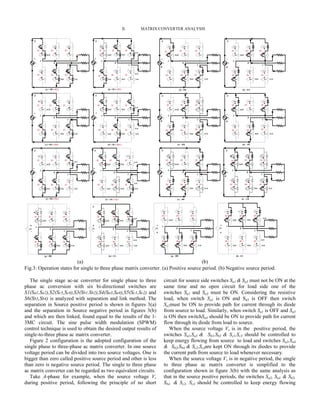
Fig.3: Operation states for single to three phase matrix converter. (a) Positive source period. (b) Negative source period.
The single stage ac-ac converter for single phase to three
phase ac conversion with six bi-directional switches are
S1(Sa1,Sa2),S2(Sc3,Sc4),S3(Sb1.Sb2),S4(Sa3,Sa4),S5(Sc1,Sc2) and
S6(Sb3,Sb4) is analyzed with separation and link method. The
separation in Source positive period is shown in figures 3(a)
and the separation in Source negative period in figures 3(b)
and which are then linked, found equal to the results of the 1-
3MC circuit. The sine pulse width modulation (SPWM)
control technique is used to obtain the desired output results of
single-to-three phase ac matrix converter.
Figure 2 configuration is the adopted configuration of the
single phase to three-phase ac matrix converter. In one source
voltage period can be divided into two source voltages. One is
bigger than zero called positive source period and other is less
than zero is negative source period. The single to three phase
ac matrix converter can be regarded as two equivalent circuits.
Take A-phase for example, when the source voltage Vs
during positive period, following the principle of no short
circuit for source side switches Sa1 & Sa3 must not be ON at the
same time and no open circuit for load side one of the
switches Sa1 and Sa3 must be ON. Considering the resistive
load, when switch Sa1 is ON and Sa3 is OFF then switch
Sa2must be ON to provide path for current through its diode
from source to load. Similarly, when switch Sa1 is OFF and Sa3
is ON then switchSa4 should be ON to provide path for current
flow through its diode from load to source.
When the source voltage Vs is in the positive period, the
switches Sa1,Sa3 & Sb1,Sb3 & Sc1,Sc3 should be controlled to
keep energy flowing from source to load and switches Sa2,Sa4
& Sb2,Sb4 & Sc2,Sc4are kept ON through its diodes to provide
the current path from source to load whenever necessary.
When the source voltage Vs is in negative period, the single
to three phase ac matrix converter is simplified to the
configuration shown in figure 3(b) with the same analysis as
that in the source positive periods, the switches Sa2, Sa4 & Sb2,
Sb4 & Sc2, Sc4 should be controlled to keep energy flowing
from load to source and switches Sa1, Sa3 & Sb1, Sb3 & Sc1, Sc3
are kept ON through its diodes to provide the current path
from load to source whenever is necessary.
There are total 16-operating states shown in TABLE-I for
one complete cycle of operation. The six operating states
(+100 to +110) and two null states (+000 and +111) during
source positive period are shown in figure 3(a). Similarly, we
can draw another six operating states (-100 to -110) and two
null states (-000 and -111) for source negative period, but the
direction of current flow should be reversed are shown in
figure 3(b). Similarly, all analysis for phase B and C is
adopted.
TABLE-I
SWITCHING OPERATION STATES FOR1-3MC
Considering the states of the controlled switches, it can be
defined as,
, ,
1,2,3,4
1
0
where‘+’ denotes the source positive period and ‘−’ denotes
the source negative period. Sx1, Sx2, Sx3 and Sx4 are the
controlled switches of the three phases A, B and C
respectively. The subscript ‘d’ denotes the anti- parallel diodes
to that switches written as Sx1d , Sx2d , Sx3d and Sx4das shown in
TABLE-I.
III. SPWM CONTROL OF MATRIX CONVERTER
When sine pulse width modulation (SPWM) is adopted,
as usual, the analysis for conventional converter, the switch
control signals for single phase to three phase ac matrix
converter can be understood from figure 4. Suppose A = 1
denotes the source is during the positive period and A = 0
denotes the source is during the negative period. B = 1 denotes
SPWM signal is positive and B = 0 denotes SPWM signal is
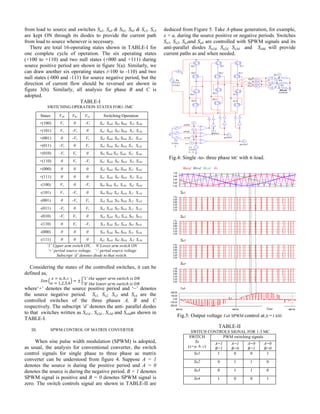
zero. The switch controls signal are shown in TABLE-II are
deduced from Figure 5. Take A-phase generation, for example,
x = a, during the source positive or negative periods. Switches
Sa1, Sa2, Sa3and Sa4 are controlled with SPWM signals and its
anti-parallel diodes Sa1d, Sa2d, Sa3d and Sa4d will provide
current paths as and when needed.
Fig.4: Single -to- three phase MC with R-load.
Fig.5: Output voltage Vab SPWM control at fc=1 kHz
TABLE-II
SWITCH CONTROLS SIGNAL FOR 1-3 MC
SWITCH
Sx
(x=a. b. c)
PWM switching signals
A=1
B=1
A=1
B=0
A=0
B=1
A=0
B=0
Sx1 1 0 0 1
Sx2 0 1 1 0
Sx3 0 1 1 0
Sx4 1 0 0 1
States Vab Vbc Vca Switching Operation
+(100) Vs 0 -Vs Sa1 Sa2d Sb3 Sb4d Sc3 Sc4d
+(101) Vs -Vs 0 Sa1 Sa2d Sb3 Sb4d Sc1 Sc2d
+(001) 0 -Vs Vs Sa3 Sa4d Sb3 Sb4d Sc1 Sc2d
+(011) -Vs 0 Vs Sa3 Sa4d Sb1 Sb2d Sc1 Sc2d
+(010) -Vs Vs 0 Sb1 Sb2d Sa3 Sa4d Sc3 Sc4d
+(110) 0 Vs -Vs Sa1 Sa2d Sb1 Sb2d Sc3 Sc4d
+(000) 0 0 0 Sa3 Sa4d Sb3 Sb4d Sc3 Sc4d
+(111) 0 0 0 Sa1 Sa2d Sb1 Sb2d Sc1 Sc2d
-(100) Vs 0 -Vs Sb4 Sb3d Sc4 Sc3d Sa2 Sa1d
-(101) Vs -Vs 0 Sb4 Sb3d Sa2 Sa1d Sc2 Sc1d
-(001) 0 -Vs Vs Sa4 Sa3d Sb4 Sb3d Sc2 Sc1d
-(011) -Vs 0 Vs Sa4 Sa3d Sb2 Sb1d Sc2 Sc1d
-(010) -Vs Vs 0 Sa4 Sa3d Sc4 Sc3d Sb2 Sb1d
-(110) 0 Vs -Vs Sc4 Sc3d Sa2 Sa1d Sb2 Sb1d
-(000) 0 0 0 Sa4 Sa3d Sb4 Sb3d Sc4 Sc3d
-(111) 0 0 0 Sa2 Sa1d Sb2 Sb1d Sc2 Sc1d
‘1’ Upper arm switch ON, ‘0‘Lower arm switch ON
‘+’ period source voltage, ‘-‘ period source voltage
Subscript ‘d’ denotes diode to that switch.
Sa1
Sa2
Sa3
Sa4
Vab
uaref ubref ucref uc
Time
The results of line voltage Vab is obtained as shown in
Figure 5 and also the same results can be obtained for other
phase B and C.
IV. OPERATION WITH A TRACTION MOTOR
To verify the operation strategy, the proposed 1-3 phase ac
matrix converter with a three-phase ac asynchronous traction
motor (TM), Type [ABB-6FRA6068] is simulated by PSIM
software. The three-phase resistive load is changed to three-
phase star wounded induction motor. The traction motor
parameters are given in TABLE-III.
TABLE-III
TRACTION MOTOR PARAMETERS
Type: ABB-6FRA6068
Parameters Symbols Rating
Supply Voltage
Supply Frequency
Output Frequency
Speed
Power (KW)
current
Max. Current
Stator Resistance
Stator Inductance
Rotor Resistance
Rotor Inductance
Mutual
Inductance
Motor Inertia
Vab
f i
fo
N
P
I
Imax
Rs
Ls
R’r
Lr
Lm
J
2180 V
50 Hz
65 – 170 Hz
1283 rpm
850 Kw
270 A
393 A
0.0727 Ω
1.312 m H
0.0641 Ω
2.716 m H
41.982 m H
19.1 Kgm2
The single-to-three phase ac Matrix Converter circuit is
three legged A, B and C with Six bi-directional switches are
S1 (Sa1- Sa2), S2 (Sc3- Sc4), S3 (Sb1- Sb2), S4 (Sa3- Sa4), S5 (Sc1- Sc2)
and S6 (Sb3- Sb4).The simulation circuit is shown in Figure 6.
Fig.6: Simulation circuit for 1-3 MC with a TM.
The simulation is presented by using SPWM control
technique The Simulation of circuit is simulated with traction
motor parameters by PSIM/MATLAB software packages. The
single phase ac source voltage Vs taken as 1269V and source
frequency fi is 50Hz. When 150 Hz output frequency is
demanded, the simulated results are obtained shows the three
phase output voltages found approximately equal to 2180 V
and three phase output currents are nearly 270 A and also
following 120 degree phase sequence. The input current Ii is
found nearly sinusoidal as expected is shown in Figure 7.
Where, Vab, Vbc and Vca are the line voltages and Va, Vb
and Vc are phase voltages. Ia, Ib and Ic are the output currents
Fig.7: Output waveforms of 1-3MC with a TM.
Fig. 8: Speed-torque-load currents of 1-3 MC with a TM
It can be seen that the Torque-Speed response of the Traction
Motor during motoring operation, the shaft torque Tem and
speed Nis shown in Figure 8 at an accelerating mode.
It is also found that the output voltage parts at the
frequencies | fo− 2 fi | and | fo+ 2 fi | possess big proportions
besides the frequency fo, where, fo is the fundamental
frequency of the output voltage and fi is the frequency of the
source voltage, which implied the influence of the input
supply frequency.
Time
Vab Vbc Vca
Va Vb Vc
Ia Ib Ic
Vs Ii
Speed
Torque
Ia Ib Ic Three phase ac motor currents
Time (s)
Fig. 9: FFT of input current and output voltages of 1-3 MC
At the same time the amplitudes of the output voltages
fluctuate at about 100Hz, the Fast Fourier Transform (FFT)
taken after simulation is shown in Figure 9, which is twice the
source frequency fi. This fluctuating is due to the SPWM
control signals having relation only with the sign of the source
voltage but not with the instantaneous value of the source
voltage. The instantaneous value of the source voltage
influences the output voltage directly. The low voltage ratio is
the weakness of the matrix converter, which should be
improved with some other efficient methods like SVPWM
(space vector PWM), Fuzzy logic, etc.
V. CONCLUSION
The proposed matrix converter topology for single phase to
three phase ac conversion is used for traction drives. This is
analyzed to indicate the operational features of MC with six
bidirectional switches. The operation of this MC with SPWM
is verified with simulation. This simplified control approach is
suitable for general purpose implementation. The three phase
traction motor drives performance indicates the satisfactory
operation of this converter. This 1-3MC is a direct single stage
ac-ac converter topology could be used to retrofit the existing
two stage ac-dc-ac converter with dc link traction drives. This
is also suitable for conversion of single phase transmission
lines into three phase ac lines for Domestic, Industrial and
Agricultural applications at remote places.
REFERENCES
[1] Satya Sahitya Sekhar Nuka.; Dr. R. Saravana Kumar, “Implementation
of Sinusoidal PWM Technique for AC-AC Matrix Converter Using
PSIM” 978-1-4244-7926-9/11/$26.00©2011IEEE.
[2] Ashwin Kumar Sahoo.; Meenakshe,; S. S Dash.; and T. Thyagarajan,
“Analysis and simulation of Matrix Converter Using PSIM.”The 7th
International Conference on Power Electronics -October 22-26, 2007/
EXCO, Daegu, Korea.978-1-4244-1872-5/08 IEEE.
[3] S. I. Kahn, P. D. Ziogas and M. H. Rashid, “A Novel single to three
phase static converter,” IEEE Transactions on Industry Applications,
1989, Vol. 25, No.1, pp. 143-152.
[4] Jianmin Xiao.; Wei Zhang.; Hideki Omori,;Keizo Matsui,“A Novel
Operation Strategy for Single-to Three-Phase Matrix Converter”
Electrical Machines and systems,2009,ICMES-2009/5382800,page 1-
6,Cited by:3
[5] P. Wheeler, J. Rodriguez, J. Clare, Empringham and A. Weinstein.,
"Matrix converters: A Technology Review," IEEE Transactions on
Industrial Electronics, vol. 49, no. 2, April 2002,pp. 276 - 288.
[6] Milan, G; Mohamadian, M.;Dehghan, S.M.; Seifi, E,Yazdian, A.,”A
Novel SPWM strategy for single to three-phase matrix converter.”2nd
PEDSTC-2011,IEEE 10.1109/PEDSTC.2011.5742469,Page(s) 495-500,
[7] A. Zuckerberger, D. Weinstock, A. Alexandrovitz, "Simulation of three-
phase loaded matrix converter," in Proc. on Electric Power
Applications, vol. 143, no. 4, July 1996, pp. 294-300.
Bhimrao S. Gajbhiye is research scholar (B.E., M.Tech.
(Power Electronics and Drives)),since 1994 he is working in
Indian Railway’s Research Designs and Standards Organization
(RDSO), Lucknow, (India) and currently he is working in
electric loco shed, central railways , Ajani (Nagpur, Maharashtra State.); as a
senior section engineer. His main research interests are power electronics,
matrix Converters based electrical drives for Railway traction, industrial,
agricultural, and domestic applications.
Dr. M.V.Aware, Professor,(M. Tech., Ph.D.) in VNIT,
Nagpur(India) in Electrical Engineering Department.
Area of Interest: Power electronics, Electrical machines Drives.
Dr. B S. Umre, Assistant Professor,(M. Tech., Ph. D.) in VNIT,
Nagpur(India) in Electrical Engineering Department.
Area of Interest: Torsional Oscillation, Power System,
Electrical Machines.
Rajesh Patil, B.E, M.Tech. IRSEE-1992 batch of Indian
Railways; presently working as Sr.D.E.E.(Traction distribution)
in Central Railways, Nagpur (India).
Area of Interest: Traction drives
Frequency (kHz)
Ii
Va
Vab
fo

1569637039

  • 1.
    Abstract—The paper presentsthe converter topology for single to three phase matrix converter for the ac traction drives. The converter analysis is presented with source separation and link approach. The conventional carrier based control is employed for the converter to control the output voltage and frequency. The operational feasibility with the three phase ac traction motor (850 kW) is presented. The performance of the converter with the motor is simulated in the PSIM. The results indicate the feasibility of the matrix converter application to retrofit the existing (AC- DC-AC) to (AC-AC) traction drive system. Index Terms—Matrix Converters, Sinusoidal Pulse Width Modulation, Traction Motors, Variable Speed Drives. I. INTRODUCTION ELECTRIC traction in most of the country have single phase 25 kV, 50 Hz AC or 3kV DC power supply systems. The conventional locomotives have a transformer with a tap changer or a step- down transformer with semiconductor devices, like power diodes, GTOs, IGBTs, etc. Fig. 1: Conventional Single-to-three phase ac Traction. Those are used for ac- to- dc and dc-to-three-phase ac power conversion and to charge the intermediate dc-link capacitors for energy storage elements. The locomotives have Bo-Bo (4- TM on 4 axles) or Co-Co (6-TM on 6 axles) type bogie 1 Bhimrao S. Gajbhiye is research scholar at Visvesvaraya National Institute of Technology, Nagpur, Maharashtra, India. (e-mail- bsgajbhiye@gmail.com) 2 Dr. M. V. Aware is member IEEE and professor atVisvesvarayaNational Institute of Technology, Nagpur, Maharashtra, India. (e-mail- mva_win@yahoo.com) 3 Dr. B. S. Umre is member IEEE and assistant professor at Visvesvaraya National Institute of Technology, Nagpur, Maharashtra, India. (e-mail- bsumre@rediffmail.com) 4 Rajesh Patil is IRSEE Batch-1992 currently working as Sr.D.E.E.(Trd.)at Central Railways, Nagpur,Maharashtra, India. (e-mail- rajpat@gmail.com) arrangements. The traction motor (TM) is a three phase induction motor operated with variable voltage and frequency converter in conventional speed control mode as shown in figure 1. The converter without dc link will be preferred over the two stage ac-dc-ac conversion in the existing power conversion arrangements in the ac traction drives. The matrix converters (MC) is a direct ac-to-ac converter, replaces the multiple conversion stages and the intermediate energy storage elements (dc-link) thus being a single stage converter as shown in figure 2. The different topologies, single phase to single phase and three phase to three phase with bi-directional switches are analyzed and results are presented [1]-[2].The phase transformation from single to three phase with three legged six bi-directional switch converter having simple control given for the three phase balanced loads [3]-[6].This control suffers lower voltage utilization and requires additional matching transformer. The matrix converter topology could be analyzed through the separation and link technique [4]. This analysis incorporates the back–to-back common emitter bi-directional switch cells configuration is shown in figure 2 with fictitious dc link to understand the operation of matrix converter [5]. S1 S3 S6S4 Vs (t) S5 S2 Sc1 Sc2 Sc1d Sc2d M Ii (t) a b c A B C + Source Matrix converter Traction motor Fig. 2: Proposed single-to-three phase ac Traction converter. The paper proposes the single phase to three phase matrix converter topology for traction drives. The operation of the converter is analyzed using the separation and link approach. The control is built by using the sinusoidal pulse width modulation (SPWM) for the bi-directional switches in this converter. This single phase to three phase converter has following merits. -This replaces the conventional ac-dc-ac stages so the effective energy conversion is efficient. -The control is conventional carrier based SPWM. The known pattern of harmonics predicts the de-rating and operational efficiency of the induction motor. Single phase to three phase ac Matrix Converter for Traction Drives Bhimrao.S.Gajbhiye1 , M.V.Aware2 , B.S.Umre3 , Rajesh Patil4 25kV ac supply AC-DC conversion DC-Link DC-AC conversion Resonant circuit DC-Link capacitor Overvoltage/brake chopper
  • 2.
    II. MATRIX CONVERTERANALYSIS Vs Sb1 Sc1 Sa3 Sb3 Sc3 Sb4d Sc4d A B C Sa1 Sa2d (a) + 100 ( 612 ) Ii Sa4 Sb4 Sc4 Sa2 Sb2 Sc2 Vs Sb1 Sc1 Sb2d Sa3 Sb3 Sc3 Sa4d Sb4d Sc4d A B C Sa1 Sa2d (b) + 011 ( 345 ) Ii Sa4 Sb4 Sc4 Sa2 Sb2 Sc2 Sc2d Sc3d Vs Sb1 Sc1 Sa3 Sb3 Sc3 Sb4d Sc4d A B C Sa1 Sa2d (c) + 010 ( 234 ) Ii Sa4 Sb4 Sc4 Sa2 Sb2 Sc2 Vs Sb1 Sc1 Sb2d Sa3 Sb3 Sc3 Sa4d Sb4d Sc4d A B C Sa1 Sa2d (d) + 101 ( 561 ) Ii Sa4 Sb4 Sc4 Sa2 Sb2 Sc2 Sc2d Sc3d Vs Sb1 Sc1 Sa3 Sb3 Sc3 Sa4d Sb4d Sc4d A B C Sa1 Sa2d (e) + 001 ( 456 ) Ii Sa4 Sb4 Sc4 Sa2 Sb2 Sc2 Vs Sb1 Sc1 Sb2d Sa3 Sb3 Sc3 Sa4d Sb4d Sc4d A B C Sa1 Sa2d (f) + 110 ( 123 ) Ii Sa4 Sb4 Sc4 Sa2 Sb2 Sc2 Sc2d Sc3d Sc2d S1 S3 S5 S4 S6 S2 S1 S3 S5 S4 S6 S2 S1 S3 S5 S4 S6 S2 S1 S3 S5 S4 S6 S2 S4 S1 S3 S5 S6 S2 S2S6S4 S1 S3 S5 - + + - + - + - + - + - Vs Sb1 Sc1 Sa3 Sb3 Sc3 Sb4d Sc4d A B C Sa1 Sa2d (a) - 100 Ii Sa4 Sb4 Sc4 Sa2 Sb2 Sc2 (b) - 011 Vs Sb1 Sc1 Sa3 Sb3 Sc3 Sb4d Sc4d A B C Sa1 Sa2d Ii Sa4 Sb4 Sc4 Sa2 Sb2 Sc2 (c) - 010 Vs Sb1 Sc1 Sa3 Sb3 Sc3 Sb4d Sc4d A B C Sa1 Sa2d Ii Sa4 Sb4 Sc4 Sa2 Sb2 Sc2 (d) - 101 Vs Sb1 Sc1 Sa3 Sb3 Sc3 Sb4d Sc4d A B C Sa1 Sa2d Ii Sa4 Sb4 Sc4 Sa2 Sb2 Sc2 (e) - 001 Vs Sb1 Sc1 Sa3 Sb3 Sc3 Sb4d Sc4d A B C Sa1 Sa2d Ii Sa4 Sb4 Sc4 Sa2 Sb2 Sc2 (f) - 110 Vs Sb1 Sc1 Sa3 Sb3 Sc3 Sb4d Sc4d A B C Sa1 Sa2d Ii Sa4 Sb4 Sc4 Sa2 Sb2 Sc2 -- - - -- ++ + + + + S1 S3 S5 S4 S6 S2 S4 S2S6 S5S3S1 S6 S6 S6 S6 S1 S1 S1 S1 S3 S3 S3 S3 S5 S5 S5 S5 S4 S4 S4 S4 S2 S2 S2 S2 Vs Sb1 Sc1 Sa3 Sb3 Sc3 Sb4d Sc4d A B C Sa1 Sa2d (g) + 000 Sa4 Sb4 Sc4 Sa2 Sb2 Sc2 Vs Sb1 Sc1 Sb2d Sa3 Sb3 Sc3 Sa4d Sb4d Sc4d A B C Sa1 Sa2d (h) + 111 Ii Sa4 Sb4 Sc4 Sa2 Sb2 Sc2 Sc2d Sc3d S1 S3 S5 S4 S6 S2 S1 S3 S5 S4 S6 S2 + - + - Vs Sb1 Sc1 Sa3 Sb3 Sc3 Sb4d Sc4d A B C Sa1 Sa2d (g) - 000 Sa4 Sb4 Sc4 Sa2 Sb2 Sc2 Vs Sb1 Sc1 Sb2d Sa3 Sb3 Sc3 Sa4d Sb4d Sc4d A B C Sa1 Sa2d (h) - 111 Sa4 Sb4 Sc4 Sa2 Sb2 Sc2 Sc2d Sc3d S1S1 S3 S3 S5S5 S4S4 S6S6 S2S2 - + + - (a) (b) Fig.3: Operation states for single to three phase matrix converter. (a) Positive source period. (b) Negative source period. The single stage ac-ac converter for single phase to three phase ac conversion with six bi-directional switches are S1(Sa1,Sa2),S2(Sc3,Sc4),S3(Sb1.Sb2),S4(Sa3,Sa4),S5(Sc1,Sc2) and S6(Sb3,Sb4) is analyzed with separation and link method. The separation in Source positive period is shown in figures 3(a) and the separation in Source negative period in figures 3(b) and which are then linked, found equal to the results of the 1- 3MC circuit. The sine pulse width modulation (SPWM) control technique is used to obtain the desired output results of single-to-three phase ac matrix converter. Figure 2 configuration is the adopted configuration of the single phase to three-phase ac matrix converter. In one source voltage period can be divided into two source voltages. One is bigger than zero called positive source period and other is less than zero is negative source period. The single to three phase ac matrix converter can be regarded as two equivalent circuits. Take A-phase for example, when the source voltage Vs during positive period, following the principle of no short circuit for source side switches Sa1 & Sa3 must not be ON at the same time and no open circuit for load side one of the switches Sa1 and Sa3 must be ON. Considering the resistive load, when switch Sa1 is ON and Sa3 is OFF then switch Sa2must be ON to provide path for current through its diode from source to load. Similarly, when switch Sa1 is OFF and Sa3 is ON then switchSa4 should be ON to provide path for current flow through its diode from load to source. When the source voltage Vs is in the positive period, the switches Sa1,Sa3 & Sb1,Sb3 & Sc1,Sc3 should be controlled to keep energy flowing from source to load and switches Sa2,Sa4 & Sb2,Sb4 & Sc2,Sc4are kept ON through its diodes to provide the current path from source to load whenever necessary. When the source voltage Vs is in negative period, the single to three phase ac matrix converter is simplified to the configuration shown in figure 3(b) with the same analysis as that in the source positive periods, the switches Sa2, Sa4 & Sb2, Sb4 & Sc2, Sc4 should be controlled to keep energy flowing
  • 3.
    from load tosource and switches Sa1, Sa3 & Sb1, Sb3 & Sc1, Sc3 are kept ON through its diodes to provide the current path from load to source whenever is necessary. There are total 16-operating states shown in TABLE-I for one complete cycle of operation. The six operating states (+100 to +110) and two null states (+000 and +111) during source positive period are shown in figure 3(a). Similarly, we can draw another six operating states (-100 to -110) and two null states (-000 and -111) for source negative period, but the direction of current flow should be reversed are shown in figure 3(b). Similarly, all analysis for phase B and C is adopted. TABLE-I SWITCHING OPERATION STATES FOR1-3MC Considering the states of the controlled switches, it can be defined as, , , 1,2,3,4 1 0 where‘+’ denotes the source positive period and ‘−’ denotes the source negative period. Sx1, Sx2, Sx3 and Sx4 are the controlled switches of the three phases A, B and C respectively. The subscript ‘d’ denotes the anti- parallel diodes to that switches written as Sx1d , Sx2d , Sx3d and Sx4das shown in TABLE-I. III. SPWM CONTROL OF MATRIX CONVERTER When sine pulse width modulation (SPWM) is adopted, as usual, the analysis for conventional converter, the switch control signals for single phase to three phase ac matrix converter can be understood from figure 4. Suppose A = 1 denotes the source is during the positive period and A = 0 denotes the source is during the negative period. B = 1 denotes SPWM signal is positive and B = 0 denotes SPWM signal is zero. The switch controls signal are shown in TABLE-II are deduced from Figure 5. Take A-phase generation, for example, x = a, during the source positive or negative periods. Switches Sa1, Sa2, Sa3and Sa4 are controlled with SPWM signals and its anti-parallel diodes Sa1d, Sa2d, Sa3d and Sa4d will provide current paths as and when needed. Fig.4: Single -to- three phase MC with R-load. Fig.5: Output voltage Vab SPWM control at fc=1 kHz TABLE-II SWITCH CONTROLS SIGNAL FOR 1-3 MC SWITCH Sx (x=a. b. c) PWM switching signals A=1 B=1 A=1 B=0 A=0 B=1 A=0 B=0 Sx1 1 0 0 1 Sx2 0 1 1 0 Sx3 0 1 1 0 Sx4 1 0 0 1 States Vab Vbc Vca Switching Operation +(100) Vs 0 -Vs Sa1 Sa2d Sb3 Sb4d Sc3 Sc4d +(101) Vs -Vs 0 Sa1 Sa2d Sb3 Sb4d Sc1 Sc2d +(001) 0 -Vs Vs Sa3 Sa4d Sb3 Sb4d Sc1 Sc2d +(011) -Vs 0 Vs Sa3 Sa4d Sb1 Sb2d Sc1 Sc2d +(010) -Vs Vs 0 Sb1 Sb2d Sa3 Sa4d Sc3 Sc4d +(110) 0 Vs -Vs Sa1 Sa2d Sb1 Sb2d Sc3 Sc4d +(000) 0 0 0 Sa3 Sa4d Sb3 Sb4d Sc3 Sc4d +(111) 0 0 0 Sa1 Sa2d Sb1 Sb2d Sc1 Sc2d -(100) Vs 0 -Vs Sb4 Sb3d Sc4 Sc3d Sa2 Sa1d -(101) Vs -Vs 0 Sb4 Sb3d Sa2 Sa1d Sc2 Sc1d -(001) 0 -Vs Vs Sa4 Sa3d Sb4 Sb3d Sc2 Sc1d -(011) -Vs 0 Vs Sa4 Sa3d Sb2 Sb1d Sc2 Sc1d -(010) -Vs Vs 0 Sa4 Sa3d Sc4 Sc3d Sb2 Sb1d -(110) 0 Vs -Vs Sc4 Sc3d Sa2 Sa1d Sb2 Sb1d -(000) 0 0 0 Sa4 Sa3d Sb4 Sb3d Sc4 Sc3d -(111) 0 0 0 Sa2 Sa1d Sb2 Sb1d Sc2 Sc1d ‘1’ Upper arm switch ON, ‘0‘Lower arm switch ON ‘+’ period source voltage, ‘-‘ period source voltage Subscript ‘d’ denotes diode to that switch. Sa1 Sa2 Sa3 Sa4 Vab uaref ubref ucref uc Time
  • 4.
    The results ofline voltage Vab is obtained as shown in Figure 5 and also the same results can be obtained for other phase B and C. IV. OPERATION WITH A TRACTION MOTOR To verify the operation strategy, the proposed 1-3 phase ac matrix converter with a three-phase ac asynchronous traction motor (TM), Type [ABB-6FRA6068] is simulated by PSIM software. The three-phase resistive load is changed to three- phase star wounded induction motor. The traction motor parameters are given in TABLE-III. TABLE-III TRACTION MOTOR PARAMETERS Type: ABB-6FRA6068 Parameters Symbols Rating Supply Voltage Supply Frequency Output Frequency Speed Power (KW) current Max. Current Stator Resistance Stator Inductance Rotor Resistance Rotor Inductance Mutual Inductance Motor Inertia Vab f i fo N P I Imax Rs Ls R’r Lr Lm J 2180 V 50 Hz 65 – 170 Hz 1283 rpm 850 Kw 270 A 393 A 0.0727 Ω 1.312 m H 0.0641 Ω 2.716 m H 41.982 m H 19.1 Kgm2 The single-to-three phase ac Matrix Converter circuit is three legged A, B and C with Six bi-directional switches are S1 (Sa1- Sa2), S2 (Sc3- Sc4), S3 (Sb1- Sb2), S4 (Sa3- Sa4), S5 (Sc1- Sc2) and S6 (Sb3- Sb4).The simulation circuit is shown in Figure 6. Fig.6: Simulation circuit for 1-3 MC with a TM. The simulation is presented by using SPWM control technique The Simulation of circuit is simulated with traction motor parameters by PSIM/MATLAB software packages. The single phase ac source voltage Vs taken as 1269V and source frequency fi is 50Hz. When 150 Hz output frequency is demanded, the simulated results are obtained shows the three phase output voltages found approximately equal to 2180 V and three phase output currents are nearly 270 A and also following 120 degree phase sequence. The input current Ii is found nearly sinusoidal as expected is shown in Figure 7. Where, Vab, Vbc and Vca are the line voltages and Va, Vb and Vc are phase voltages. Ia, Ib and Ic are the output currents Fig.7: Output waveforms of 1-3MC with a TM. Fig. 8: Speed-torque-load currents of 1-3 MC with a TM It can be seen that the Torque-Speed response of the Traction Motor during motoring operation, the shaft torque Tem and speed Nis shown in Figure 8 at an accelerating mode. It is also found that the output voltage parts at the frequencies | fo− 2 fi | and | fo+ 2 fi | possess big proportions besides the frequency fo, where, fo is the fundamental frequency of the output voltage and fi is the frequency of the source voltage, which implied the influence of the input supply frequency. Time Vab Vbc Vca Va Vb Vc Ia Ib Ic Vs Ii Speed Torque Ia Ib Ic Three phase ac motor currents Time (s)
  • 5.
    Fig. 9: FFTof input current and output voltages of 1-3 MC At the same time the amplitudes of the output voltages fluctuate at about 100Hz, the Fast Fourier Transform (FFT) taken after simulation is shown in Figure 9, which is twice the source frequency fi. This fluctuating is due to the SPWM control signals having relation only with the sign of the source voltage but not with the instantaneous value of the source voltage. The instantaneous value of the source voltage influences the output voltage directly. The low voltage ratio is the weakness of the matrix converter, which should be improved with some other efficient methods like SVPWM (space vector PWM), Fuzzy logic, etc. V. CONCLUSION The proposed matrix converter topology for single phase to three phase ac conversion is used for traction drives. This is analyzed to indicate the operational features of MC with six bidirectional switches. The operation of this MC with SPWM is verified with simulation. This simplified control approach is suitable for general purpose implementation. The three phase traction motor drives performance indicates the satisfactory operation of this converter. This 1-3MC is a direct single stage ac-ac converter topology could be used to retrofit the existing two stage ac-dc-ac converter with dc link traction drives. This is also suitable for conversion of single phase transmission lines into three phase ac lines for Domestic, Industrial and Agricultural applications at remote places. REFERENCES [1] Satya Sahitya Sekhar Nuka.; Dr. R. Saravana Kumar, “Implementation of Sinusoidal PWM Technique for AC-AC Matrix Converter Using PSIM” 978-1-4244-7926-9/11/$26.00©2011IEEE. [2] Ashwin Kumar Sahoo.; Meenakshe,; S. S Dash.; and T. Thyagarajan, “Analysis and simulation of Matrix Converter Using PSIM.”The 7th International Conference on Power Electronics -October 22-26, 2007/ EXCO, Daegu, Korea.978-1-4244-1872-5/08 IEEE. [3] S. I. Kahn, P. D. Ziogas and M. H. Rashid, “A Novel single to three phase static converter,” IEEE Transactions on Industry Applications, 1989, Vol. 25, No.1, pp. 143-152. [4] Jianmin Xiao.; Wei Zhang.; Hideki Omori,;Keizo Matsui,“A Novel Operation Strategy for Single-to Three-Phase Matrix Converter” Electrical Machines and systems,2009,ICMES-2009/5382800,page 1- 6,Cited by:3 [5] P. Wheeler, J. Rodriguez, J. Clare, Empringham and A. Weinstein., "Matrix converters: A Technology Review," IEEE Transactions on Industrial Electronics, vol. 49, no. 2, April 2002,pp. 276 - 288. [6] Milan, G; Mohamadian, M.;Dehghan, S.M.; Seifi, E,Yazdian, A.,”A Novel SPWM strategy for single to three-phase matrix converter.”2nd PEDSTC-2011,IEEE 10.1109/PEDSTC.2011.5742469,Page(s) 495-500, [7] A. Zuckerberger, D. Weinstock, A. Alexandrovitz, "Simulation of three- phase loaded matrix converter," in Proc. on Electric Power Applications, vol. 143, no. 4, July 1996, pp. 294-300. Bhimrao S. Gajbhiye is research scholar (B.E., M.Tech. (Power Electronics and Drives)),since 1994 he is working in Indian Railway’s Research Designs and Standards Organization (RDSO), Lucknow, (India) and currently he is working in electric loco shed, central railways , Ajani (Nagpur, Maharashtra State.); as a senior section engineer. His main research interests are power electronics, matrix Converters based electrical drives for Railway traction, industrial, agricultural, and domestic applications. Dr. M.V.Aware, Professor,(M. Tech., Ph.D.) in VNIT, Nagpur(India) in Electrical Engineering Department. Area of Interest: Power electronics, Electrical machines Drives. Dr. B S. Umre, Assistant Professor,(M. Tech., Ph. D.) in VNIT, Nagpur(India) in Electrical Engineering Department. Area of Interest: Torsional Oscillation, Power System, Electrical Machines. Rajesh Patil, B.E, M.Tech. IRSEE-1992 batch of Indian Railways; presently working as Sr.D.E.E.(Traction distribution) in Central Railways, Nagpur (India). Area of Interest: Traction drives Frequency (kHz) Ii Va Vab fo