Download to read offline
![International Research Journal of Engineering and Technology (IRJET) e-ISSN: 2395-0056
Volume: 06 Issue: 11 | Nov 2019 www.irjet.net p-ISSN: 2395-0072
© 2019, IRJET | Impact Factor value: 7.34 | ISO 9001:2008 Certified Journal | Page 1781
SINGLE PHASE PWM BASED INVERTING BUCK-BOOST AC-AC
CONVERTER
Mr. R. VINOTH KUMAR,
Assistant Professor, Department Of Electronics and Instrumentation, Hindusthan College Of Engineering and
Technology, Coimbatore, Tamilnadu, India.
----------------------------------------------------------------------***---------------------------------------------------------------------
ABSTRACT - A single-phase inverting buck-boost ac-ac
converter is proposed in this paper. The proposed converter
has no shoot-through and dead time problems and, like
conventional dc-dc converters, it can be operated with
simple PWM control. It offers high frequency and high
efficiency operation because high speed MOSFET can be
used as switching device without the reverse recovery issues
and losses of its body diode. The proposed converter features
quasi continuous input and output currents, high input
power factor, low total harmonic distortion of input and
output currents, and high efficiency. Experimental results
confirmed that the proposed converter can obtain 97 %
efficiency at 60 kHz switching frequency.
Keywords- ac-acconverter, buck-boost capability,
Matrix converter, Matlab
I. INTRODUCTION
AC–AC line conditioners are often implemented
using ac thyristors power controllers, which use the phase
angle control or integral cycle control [1] to obtain a
desired output voltage. They are more immune to
electromagnetic interference (EMI) noise and have large
current handling capability. However, they have low input
power factor, poor power transfer efficiency, and high
total harmonic distortion (THD) in input current. The
pulse width modulation (PWM) ac-ac converters are used
to replace the aforementioned ac controllers, because of
high efficiency, better power factor, low
THD in source current, and ease of control [2] for the PWM
converters. For the ac-ac power conversion, indirect ac-ac
converters, direct ac-ac converters, and matrix converters
are the popular topologies. For applications in which only
voltage regulation is desirable, the direct PWM ac-ac
converters are preferred [3-8]. In addition to the power
regulation, they can perform input power filtering,
isolating and conditioning [4].
II. MATRIX CONVERTER TOPOLOGY
The matrix converter is a forced commutated
converter which uses an array of controlled bidirectional
switches as the main power elements to create a variable
output voltage system with unrestricted frequency. It does
not have any dc link circuit and does not need any large
energy storage elements. The matrix converter has several
advantages over traditional rectifier-inverter type power
frequency converters. It provides sinusoidal input and
output waveforms, with minimal higher order harmonics
and no sub harmonics; it has inherent bi-directional
energy flow capability; the input power factor can be fully
controlled. Last but not least, it has minimal energy
storage requirements, which allows to get rid of bulky and
lifetime-limited energy-storing capacitors. The key
features of matrix converter are Simple and compact
power circuit, Generation of load voltage with arbitrary
amplitude and frequency, Sinusoidal input and output
currents, Operation with unity power factor for any load,
Regeneration capability.
Figure (I) Matrix Converter Schematic Diagram
A. SEQUENCE OF SWITCHING CONTROL:
The output frequency is synthesized in multiples
of input frequency of 50Hz (say 60Hz, 100Hz and 150Hz).
The sequences of switching are dependent on the time
interval and state of the driver circuit.
Consider the output frequency is 50 Hz. To
achieve this, when the supply voltage is positive the switch
is in state 1(Sla and S4a are turned ON). On the other hand
switching state 2 are used during negative cycle to
produce the next half Cycle.
Figure (II) Switching Characteristics](https://image.slidesharecdn.com/irjet-v6i11179-200122093730/85/IRJET-Single-Phase-PWM-based-Inverting-Buck-Boost-AC-AC-Converter-1-320.jpg)
![International Research Journal of Engineering and Technology (IRJET) e-ISSN: 2395-0056
Volume: 06 Issue: 11 | Nov 2019 www.irjet.net p-ISSN: 2395-0072
© 2019, IRJET | Impact Factor value: 7.34 | ISO 9001:2008 Certified Journal | Page 1781
SINGLE PHASE PWM BASED INVERTING BUCK-BOOST AC-AC
CONVERTER
Mr. R. VINOTH KUMAR,
Assistant Professor, Department Of Electronics and Instrumentation, Hindusthan College Of Engineering and
Technology, Coimbatore, Tamilnadu, India.
----------------------------------------------------------------------***---------------------------------------------------------------------
ABSTRACT - A single-phase inverting buck-boost ac-ac
converter is proposed in this paper. The proposed converter
has no shoot-through and dead time problems and, like
conventional dc-dc converters, it can be operated with
simple PWM control. It offers high frequency and high
efficiency operation because high speed MOSFET can be
used as switching device without the reverse recovery issues
and losses of its body diode. The proposed converter features
quasi continuous input and output currents, high input
power factor, low total harmonic distortion of input and
output currents, and high efficiency. Experimental results
confirmed that the proposed converter can obtain 97 %
efficiency at 60 kHz switching frequency.
Keywords- ac-acconverter, buck-boost capability,
Matrix converter, Matlab
I. INTRODUCTION
AC–AC line conditioners are often implemented
using ac thyristors power controllers, which use the phase
angle control or integral cycle control [1] to obtain a
desired output voltage. They are more immune to
electromagnetic interference (EMI) noise and have large
current handling capability. However, they have low input
power factor, poor power transfer efficiency, and high
total harmonic distortion (THD) in input current. The
pulse width modulation (PWM) ac-ac converters are used
to replace the aforementioned ac controllers, because of
high efficiency, better power factor, low
THD in source current, and ease of control [2] for the PWM
converters. For the ac-ac power conversion, indirect ac-ac
converters, direct ac-ac converters, and matrix converters
are the popular topologies. For applications in which only
voltage regulation is desirable, the direct PWM ac-ac
converters are preferred [3-8]. In addition to the power
regulation, they can perform input power filtering,
isolating and conditioning [4].
II. MATRIX CONVERTER TOPOLOGY
The matrix converter is a forced commutated
converter which uses an array of controlled bidirectional
switches as the main power elements to create a variable
output voltage system with unrestricted frequency. It does
not have any dc link circuit and does not need any large
energy storage elements. The matrix converter has several
advantages over traditional rectifier-inverter type power
frequency converters. It provides sinusoidal input and
output waveforms, with minimal higher order harmonics
and no sub harmonics; it has inherent bi-directional
energy flow capability; the input power factor can be fully
controlled. Last but not least, it has minimal energy
storage requirements, which allows to get rid of bulky and
lifetime-limited energy-storing capacitors. The key
features of matrix converter are Simple and compact
power circuit, Generation of load voltage with arbitrary
amplitude and frequency, Sinusoidal input and output
currents, Operation with unity power factor for any load,
Regeneration capability.
Figure (I) Matrix Converter Schematic Diagram
A. SEQUENCE OF SWITCHING CONTROL:
The output frequency is synthesized in multiples
of input frequency of 50Hz (say 60Hz, 100Hz and 150Hz).
The sequences of switching are dependent on the time
interval and state of the driver circuit.
Consider the output frequency is 50 Hz. To
achieve this, when the supply voltage is positive the switch
is in state 1(Sla and S4a are turned ON). On the other hand
switching state 2 are used during negative cycle to
produce the next half Cycle.
Figure (II) Switching Characteristics](https://image.slidesharecdn.com/irjet-v6i11179-200122093730/75/IRJET-Single-Phase-PWM-based-Inverting-Buck-Boost-AC-AC-Converter-1-2048.jpg)
![International Research Journal of Engineering and Technology (IRJET) e-ISSN: 2395-0056
Volume: 06 Issue: 11 | Nov 2019 www.irjet.net p-ISSN: 2395-0072
© 2019, IRJET | Impact Factor value: 7.34 | ISO 9001:2008 Certified Journal | Page 1783
Figure (VII) Low Frequency Output Voltage Graph
Figure (VIII) High Frequency Output Voltage
V. SIMULATION RESULTS
The SPMC was simulated with switching strategy
being implemented on all the four states and the results of
SPMC model are done for 60Hz, 100Hz, 150Hz, that were
synthesized from a supply operating at fundamental
frequency of 60Hz. The simulation model could be used to
study the behavior of the SPMC as an AC-AC converter
under a variety of operating conditions, including different
reference frequency.
VI. CONCLUSION
The designed converter has no shoot-through and
dead time problems and, like conventional dc-dc
converters, it can be operated with simple PWM control. It
offers high frequency and high efficiency operation
because high speed MOSFET can be used as switching
device without the reverse recovery issues and losses of
its body diode. Experimental results confirmed that the
proposed converter can obtain 97% efficiency at 60 kHz
switching frequency. These simulated results of SPMC
illustrates that it is feasible to realize the matrix converter
as a frequency step-up converter. Further works are
required to implement low-pass filter at the output to
ensure continuous waveforms that are desirable in actual
applications. Also when using with RL load, Undesirable
spikes seem to appear with a reasonable degree of
magnitude that requires elimination. This probably could
be solved using novel commutation strategies.
VII. REFERENCES
[1] B. W. Williams, “Asymmetrically modulated AC
chopper,” IEEE Trans. Ind. Electron., vol. 29, pp.
181–185, June 1982.
[2] P. N. Enjeti and C. Sewan, “An approach to realize
higher power PWM AC controller,” in Proc. 8th
Annu. Appl. Power Electron. Conf. Expo., 1993, pp.
323–327.
[3] J. Kolar, T. Friedli, J. Rodriguez, and P. Wheeler,
“Review of three-phase PWM AC–AC converter
topologies,” IEEE Trans. Ind. Electron., vol. 58, no.
11, pp. 4988–5006, Nov. 2011.
[4] F. Z. Peng, L. Chen, and F. Zhang, “Simple
topologies of PWM ac–ac converters,” IEEE Power
Electron. Lett., vol. 1, no. 1, pp. 10–13, Mar. 2003.
[5] Abdollah Koei & Subbaraya Yuvarajan, "Single-
Phase AC-AC converter Using Power Mosfet's,"
IEEE Transaction on industrial Electronics, Vol.
35, No.3, August 1988, pp.442-443.
[6] Biaajjerg F, Casadei D, Klumpner C, and Matteini,
“Comparision of two current modulation
strategies for matrix converters under
unbalanced input voltage conditions,” IEEE
Transactions on Industrial Electronics, Vol.49,
April 2002, pp 289 – 296.
[7] Cho, J.G., and Cho, G.H., “ Soft-switched Matrix
Converters for High Frequency direct AC to AC
Power Conversions,” Int, J.Electron., 1992, 72,(4),
pp. 669 – 680.
[8] Firdaus,S., Hamzah, M.K., “Modelling and
Simulation of a single-phase AC-AC matrix
converter usig SPWM”, Proceedings on Student
Conference on Research and Development, 16-17
July 2002, pp. 286 – 289.](https://image.slidesharecdn.com/irjet-v6i11179-200122093730/85/IRJET-Single-Phase-PWM-based-Inverting-Buck-Boost-AC-AC-Converter-3-320.jpg)

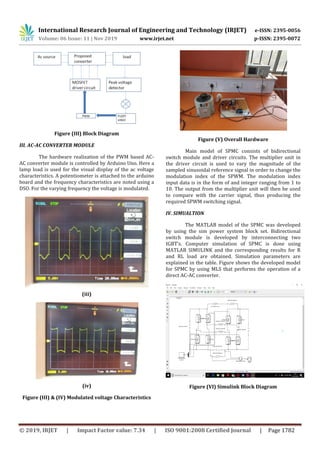
This document presents a single-phase inverting buck-boost AC-AC converter. The proposed converter uses PWM control which offers high frequency operation with high efficiency compared to traditional AC controllers. It provides quasi continuous input and output currents with high input power factor and low THD. Simulation results showed the converter can achieve 97% efficiency at 60 kHz switching frequency. The converter was modeled in MATLAB Simulink to verify its operation as an AC-AC converter at different output frequencies synthesized from a 60 Hz supply frequency. Experimental results confirmed the feasibility of realizing the converter with simple PWM control.

![Automatic power factor_improvement_and_monitoring_by_using_plc[1]](https://cdn.slidesharecdn.com/ss_thumbnails/automaticpowerfactorimprovementandmonitoringbyusingplc1-190905054934-thumbnail.jpg?width=640&height=640&fit=bounds)


