1.5 Portable Communication
Devices
These are devices
that can be carried
on one’s person.
These devices
have been
included that
communicate with
us and not just
devices that we
use to
communicate with
other people.
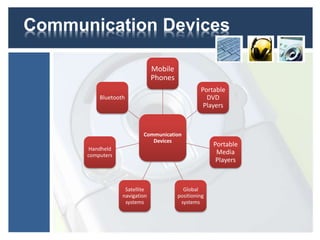
Communication Devices
Communication
Devices
Mobile
Phones
Portable
DVD
Players
Portable
Media
Players
Global
positioning
systems
Satellite
navigation
systems
Handheld
computers
Bluetooth
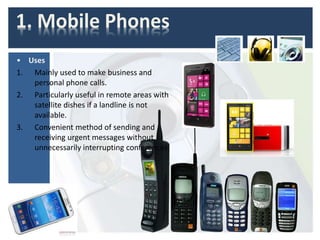
1. Mobile Phones
• Uses
1. Mainly used to make business and
personal phone calls.
2. Particularly useful in remote areas with
satellite dishes if a landline is not
available.
3. Convenient method of sending and
receiving urgent messages without
unnecessarily interrupting conferences.
Advantages Disadvantages
• Can be used while
travelling.
• Cost more to use than a landline.
• Can be used to send
photographs/video
footage.
• Quality of video/photographs can
be poor.
• Can lose connection if travelling
through a ‘blindspot’.
• Smaller displays compared to
other devices.
• Limited battery life.
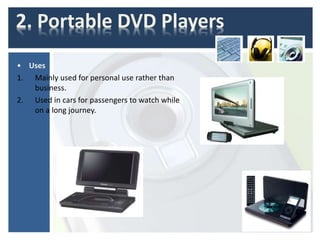
2. Portable DVD Players
• Uses
1. Mainly used for personal use rather than
business.
2. Used in cars for passengers to watch while
on a long journey.
Advantages Disadvantages
• Small and compact. • Low screen resolution can affect
the quality of viewing.
• Can play music from CDs. • Small screen size makes it difficult
to view.
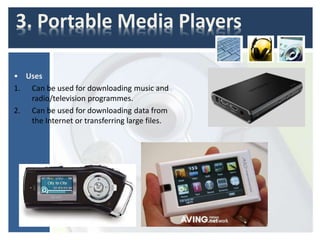
3. Portable Media Players
• Uses
1. Can be used for downloading music and
radio/television programmes.
2. Can be used for downloading data from
the Internet or transferring large files.
Advantages Disadvantages
• Small and compact. • Have very small screens.
• Hold up to 100GB of data. • Earphones supplied with the
product may not be of high
quality.
5. Global Positioning systems
The Global Positioning System (GPS) is a space-based satellite navigation system that
provides location and time information in all weather, anywhere on or near the Earth,
where there is an unobstructed line of sight to four or more GPS satellites. It is maintained
by the United States government and is freely accessible to anyone with a GPS receiver.
The GPS program provides critical capabilities to military, civil and commercial users
around the world. In addition, GPS is the backbone for modernizing the global air traffic
system.
The GPS project was developed in 1973 to overcome the limitations of previous
navigation systems, integrating ideas from several predecessors, including a number of
classified engineering design studies from the 1960s. GPS was created and realized by
the U.S. Department of Defense (DoD) and was originally run with 24 satellites. It became
fully operational in 1994.
Advances in technology and new demands on the existing system have now led to efforts
to modernize the GPS system and implement the next generation of GPS III satellites and
Next Generation Operational Control System (OCX). Announcements from the Vice
President and the White House in 1998 initiated these changes. In 2000, U.S. Congress
authorized the modernization effort, referred to as GPS III.
In addition to GPS, other systems are in use or under development. The Russian GLObal
NAvigation Satellite System (GLONASS) was in use by only the Russian military, until it
was made fully available to civilians in 2007. There are also the planned European Union
Galileo positioning system, Chinese Compass navigation system, and Indian Regional
Navigational Satellite System.
Advantages Disadvantages
• Positioning and distance
travelled can be achieved
easily.
• Data transmission can be a little
slow at times, leading to
inaccuracies.
• Greater accuracy for
measuring distances.
• Are expensive devices.
• Uses
1. GPS can be used by runners to pinpoint
their position, distance travelled and
speed.
2. Also used by surveyors.
6. Satellite navigation systems
A satellite navigation or SAT NAV system is a system of satellites that provide
autonomous geo-spatial positioning with global coverage. It allows small
electronic receivers to determine their location (longitude, latitude, and
altitude) to within a few metres using time signals transmitted along a line-of-
sight by radio from satellites. Receivers calculate the precise time as well as
position, which can be used as a reference for scientific experiments. A
satellite navigation system with global coverage may be termed a global
navigation satellite system or GNSS.
As of October 2011, only the United States NAVSTAR Global Positioning
System (GPS) and the Russian GLONASS are fully globally operational GNSSs.
China is in the process of expanding its regional Beidou navigation system into
the global Compass navigation system by 2020. The European Union's Galileo
positioning system is a GNSS in initial deployment phase, scheduled to be fully
operational by 2020 at the earliest. Several countries including France[, Japan
and India are in the process of developing regional navigation systems.
Global coverage for each system is generally achieved by a satellite
constellation of 20–30 medium Earth orbit (MEO) satellites spread between
several orbital planes. The actual systems vary, but use orbit inclinations of
>50° and orbital periods of roughly twelve hours (at an altitude of about
20,000 kilometres (12,000 mi)).
Advantages Disadvantages
• Quicker to use than a
normal road map.
• Small display.
• Receive up-to-date traffic
conditions
• Unsuitable roads can be
recommended.
• Uses
1. Used by drivers to produce a route for
their cars or lorries, including alternative
routes in the case of a traffic jam.
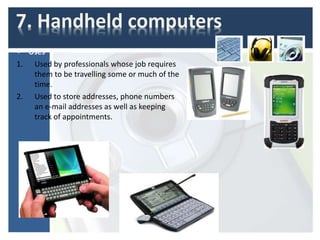
7. Handheld computers
• Uses
1. Used by professionals whose job requires
them to be travelling some or much of the
time.
2. Used to store addresses, phone numbers
an e-mail addresses as well as keeping
track of appointments.
Advantages Disadvantages
• Can be used remotely from
the place of work.
• Difficult to enter much text.
• Easier to carry than
laptops.
• About as expensive as laptops.
8. Bluetooth
Bluetooth was developed by a Scandinivian company and was named
after King Harald Batan of Denmark who was nicknamed “Bluetooth”.
The word "Bluetooth" is an anglicised version of the Scandinavian
Blåtand/Blåtann, the epithet of the tenth-century King Harald I of Denmark
and parts of Norway who united dissonant Danish tribes into a single kingdom.
The idea of this name was proposed by Jim Kardach who developed a system
that would allow mobile phones to communicate with computers (at the time
he was reading Frans Gunnar Bengtsson's historical novel The Long Ships about
Vikings and King Harald Batan Bluetooth). The implication is that Bluetooth
does the same with communications protocols, uniting them into one universal
standard.
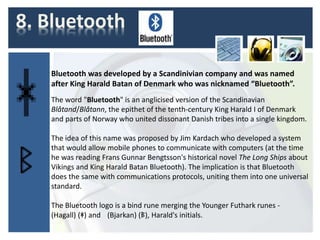
The Bluetooth logo is a bind rune merging the Younger Futhark runes -
(Hagall) (ᚼ) and (Bjarkan) (ᛒ), Harald's initials.
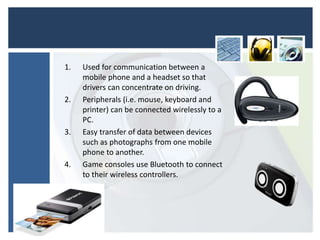
• Uses
1. Used for communication between a
mobile phone and a headset so that
drivers can concentrate on driving.
2. Peripherals (i.e. mouse, keyboard and
printer) can be connected wirelessly to a
PC.
3. Easy transfer of data between devices
such as photographs from one mobile
phone to another.
4. Game consoles use Bluetooth to connect
to their wireless controllers.
Advantages Disadvantages
• Can be used for a variety
of applications whereas
WiFi is only used in local
area networks (LANs).
• Data transfer rate is slower than
with WiFi.
• Has cheaper hardware
requirements than WiFi.
• Covers smaller distances than
WiFi.
• Consumes less power than
WiFi.

1.5 portable communication devices

  • 1.
    1.5 Portable Communication Devices Theseare devices that can be carried on one’s person. These devices have been included that communicate with us and not just devices that we use to communicate with other people.
  • 2.
  • 3.
    1. Mobile Phones •Uses 1. Mainly used to make business and personal phone calls. 2. Particularly useful in remote areas with satellite dishes if a landline is not available. 3. Convenient method of sending and receiving urgent messages without unnecessarily interrupting conferences.
  • 4.
    Advantages Disadvantages • Canbe used while travelling. • Cost more to use than a landline. • Can be used to send photographs/video footage. • Quality of video/photographs can be poor. • Can lose connection if travelling through a ‘blindspot’. • Smaller displays compared to other devices. • Limited battery life.
  • 5.
    2. Portable DVDPlayers • Uses 1. Mainly used for personal use rather than business. 2. Used in cars for passengers to watch while on a long journey.
  • 6.
    Advantages Disadvantages • Smalland compact. • Low screen resolution can affect the quality of viewing. • Can play music from CDs. • Small screen size makes it difficult to view.
  • 7.
    3. Portable MediaPlayers • Uses 1. Can be used for downloading music and radio/television programmes. 2. Can be used for downloading data from the Internet or transferring large files.
  • 8.
    Advantages Disadvantages • Smalland compact. • Have very small screens. • Hold up to 100GB of data. • Earphones supplied with the product may not be of high quality.
  • 9.
    5. Global Positioningsystems The Global Positioning System (GPS) is a space-based satellite navigation system that provides location and time information in all weather, anywhere on or near the Earth, where there is an unobstructed line of sight to four or more GPS satellites. It is maintained by the United States government and is freely accessible to anyone with a GPS receiver. The GPS program provides critical capabilities to military, civil and commercial users around the world. In addition, GPS is the backbone for modernizing the global air traffic system. The GPS project was developed in 1973 to overcome the limitations of previous navigation systems, integrating ideas from several predecessors, including a number of classified engineering design studies from the 1960s. GPS was created and realized by the U.S. Department of Defense (DoD) and was originally run with 24 satellites. It became fully operational in 1994. Advances in technology and new demands on the existing system have now led to efforts to modernize the GPS system and implement the next generation of GPS III satellites and Next Generation Operational Control System (OCX). Announcements from the Vice President and the White House in 1998 initiated these changes. In 2000, U.S. Congress authorized the modernization effort, referred to as GPS III. In addition to GPS, other systems are in use or under development. The Russian GLObal NAvigation Satellite System (GLONASS) was in use by only the Russian military, until it was made fully available to civilians in 2007. There are also the planned European Union Galileo positioning system, Chinese Compass navigation system, and Indian Regional Navigational Satellite System.
  • 10.
    Advantages Disadvantages • Positioningand distance travelled can be achieved easily. • Data transmission can be a little slow at times, leading to inaccuracies. • Greater accuracy for measuring distances. • Are expensive devices. • Uses 1. GPS can be used by runners to pinpoint their position, distance travelled and speed. 2. Also used by surveyors.
  • 11.
    6. Satellite navigationsystems A satellite navigation or SAT NAV system is a system of satellites that provide autonomous geo-spatial positioning with global coverage. It allows small electronic receivers to determine their location (longitude, latitude, and altitude) to within a few metres using time signals transmitted along a line-of- sight by radio from satellites. Receivers calculate the precise time as well as position, which can be used as a reference for scientific experiments. A satellite navigation system with global coverage may be termed a global navigation satellite system or GNSS. As of October 2011, only the United States NAVSTAR Global Positioning System (GPS) and the Russian GLONASS are fully globally operational GNSSs. China is in the process of expanding its regional Beidou navigation system into the global Compass navigation system by 2020. The European Union's Galileo positioning system is a GNSS in initial deployment phase, scheduled to be fully operational by 2020 at the earliest. Several countries including France[, Japan and India are in the process of developing regional navigation systems. Global coverage for each system is generally achieved by a satellite constellation of 20–30 medium Earth orbit (MEO) satellites spread between several orbital planes. The actual systems vary, but use orbit inclinations of >50° and orbital periods of roughly twelve hours (at an altitude of about 20,000 kilometres (12,000 mi)).
  • 12.
    Advantages Disadvantages • Quickerto use than a normal road map. • Small display. • Receive up-to-date traffic conditions • Unsuitable roads can be recommended. • Uses 1. Used by drivers to produce a route for their cars or lorries, including alternative routes in the case of a traffic jam.
  • 13.
    7. Handheld computers •Uses 1. Used by professionals whose job requires them to be travelling some or much of the time. 2. Used to store addresses, phone numbers an e-mail addresses as well as keeping track of appointments.
  • 14.
    Advantages Disadvantages • Canbe used remotely from the place of work. • Difficult to enter much text. • Easier to carry than laptops. • About as expensive as laptops.
  • 15.
    8. Bluetooth Bluetooth wasdeveloped by a Scandinivian company and was named after King Harald Batan of Denmark who was nicknamed “Bluetooth”. The word "Bluetooth" is an anglicised version of the Scandinavian Blåtand/Blåtann, the epithet of the tenth-century King Harald I of Denmark and parts of Norway who united dissonant Danish tribes into a single kingdom. The idea of this name was proposed by Jim Kardach who developed a system that would allow mobile phones to communicate with computers (at the time he was reading Frans Gunnar Bengtsson's historical novel The Long Ships about Vikings and King Harald Batan Bluetooth). The implication is that Bluetooth does the same with communications protocols, uniting them into one universal standard. The Bluetooth logo is a bind rune merging the Younger Futhark runes - (Hagall) (ᚼ) and (Bjarkan) (ᛒ), Harald's initials.
  • 16.
    • Uses 1. Usedfor communication between a mobile phone and a headset so that drivers can concentrate on driving. 2. Peripherals (i.e. mouse, keyboard and printer) can be connected wirelessly to a PC. 3. Easy transfer of data between devices such as photographs from one mobile phone to another. 4. Game consoles use Bluetooth to connect to their wireless controllers.
  • 17.
    Advantages Disadvantages • Canbe used for a variety of applications whereas WiFi is only used in local area networks (LANs). • Data transfer rate is slower than with WiFi. • Has cheaper hardware requirements than WiFi. • Covers smaller distances than WiFi. • Consumes less power than WiFi.