
IoT COAP
A Novel Constrained Application Protocol (CoAP)
Implementation for Embedding RESTful Web Services in
Wireless Sensor Networks Based on TinyOS
2
Interlogicx - India
OBJECTIVE
To design and implementation of the Constrained application Protocol (CoAP) for
TinyOS, which we refer to as TinyCoAP. CoAP seeks to apply the same application
transfer paradigm and basic features of HTTP to constrained networks, while maintaining
a simple design and low overhead.
The design constraints of Wireless Sensor Networks (WSNs) require special attention in
the design process of the CoAP implementation.
TinyOS already includes in its distribution an implementation of CoAP called CoapBlip.
INTRODUCTION(1/1)
The main interest in making WSNs part of the Internet is to allow both to interact with each
other using the existing Web technologies
The information provided by sensors could be distributed through standard Web
mechanisms, and sensors would be considered like any other Web resource. From this
perspective, WSNs would no longer be stand-alone networks but part of ubiquitous
networks. We refer to this new approach as the Web of Things (WoT)
6LoWPAN enables the transmission of IPv6 packets in networks adopting the IEEE
802.15.4 standard
CoAP seeks to apply the same application transfer paradigm and basic features of HTTP to
constrained networks, while maintaining a simple design and low overhead.
INTRODUCTION(1/2)
Unlike HTTP, CoAP uses UDP as transport protocol. This choice would enable CoAP to
have a low impact on the limited bandwidth of the 802.15.4 wireless links. However, since
UDP is an unreliable protocol, CoAP has to implement its own mechanisms in order to
guarantee reliability to those applications that use it.
Typical WSNs nodes are battery-powered and often deployed in unattended environment,
therefore software applications should be optimized concerning lowest energy consumption
and reliable execution.
The reduction of energy consumption is mainly achieved using radio duty cycling protocols.
Further reduction can be reached through effective memory management.
The optimization process of our CoAP implementation is focused in developing an efficient
and safe use of memory. The results obtained in our tests prove the importance that memory
management has on performance and resource consumption.
CONSTRAINED APPLICATION PROTOCOL(2/1)
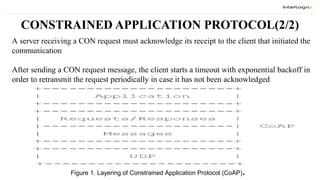
CoAP can be regarded as a two-layer protocol
A message layer is used to deal with UDP, while the other layer is used for request/response interactions
using methods and response codes, as done in HTTP
Reliability is provided by the message layer and is activated when Confirmable (CON) messages are
used
CoAP is able to match requests to responses so that it can detect if a message is duplicated
CoAP also defines Non-confirmable (NON) messages to allow sending requests that does not require
reliability. The detection of duplicated messages is available in CON as well as in NON messages
A server receiving a CON request must acknowledge its receipt to the client that initiated the
communication
After sending a CON request message, the client starts a timeout with exponential backoff in order to
retransmit the request periodically in case it has not been acknowledged
CONSTRAINED APPLICATION PROTOCOL(2/2)
A server receiving a CON request must acknowledge its receipt to the client that initiated the
communication
After sending a CON request message, the client starts a timeout with exponential backoff in
order to retransmit the request periodically in case it has not been acknowledged
Figure 1. Layering of Constrained Application Protocol (CoAP).
CONSTRAINED APPLICATION PROTOCOL(2/3)
Finally, a server might send a RST response to indicate that it is not able to process the CON
request. NON messages are used when reliability is not required.
Request methods are constrained to GET, POST, PUT and DELETE methods of HTTP. As
regards the response codes, CoAP defines its own codes and also uses a small subset of the
HTTP codes.
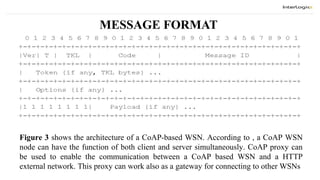
The CoAP message is composed of a header, options and a payload; the header has a length
fixed to five bytes, while the options may have a variable length
MESSAGE FORMAT
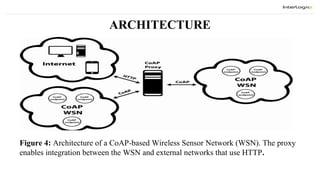
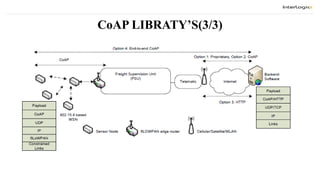
Figure 3 shows the architecture of a CoAP-based WSN. According to , a CoAP WSN
node can have the function of both client and server simultaneously. CoAP proxy can
be used to enable the communication between a CoAP based WSN and a HTTP
external network. This proxy can work also as a gateway for connecting to other WSNs
ARCHITECTURE
Figure 4: Architecture of a CoAP-based Wireless Sensor Network (WSN). The proxy
enables integration between the WSN and external networks that use HTTP.
CoAP MAIN FEATURES
 Low header overhead and complexity
 Constrained web protocol fulfilling M2M requirements
 Asynchronous message exchange (Deferred)
 URI (Uniform Resource Identifier) and content-type support
 Mapping to HTTP by use of proxies
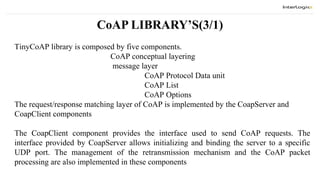
CoAP IMPLEMENTATION
TinyCoAP implements all the features of CoAP except for the blockwise transfer. The goal
of our implementation is to minimize the resource consumption by developing a lightweight
and efficient code optimized for the OS in use
TinyOS is an embedded OS for WSNs designed to meet the requirements of constrained
networks and devices
TinyOS is implemented in the NesC language . NesC is a C dialect designed to improve
code efficiency and robustness in embedded software applications
Besides NesC, TinyOS allows using more complex languages such as Java, Python or C
CoAP LIBRARY’S(3/1)
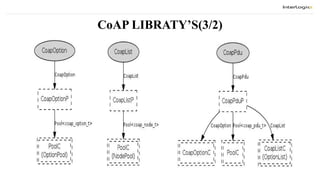
TinyCoAP library is composed by five components.
CoAP conceptual layering
message layer
CoAP Protocol Data unit
CoAP List
CoAP Options
The request/response matching layer of CoAP is implemented by the CoapServer and
CoapClient components
The CoapClient component provides the interface used to send CoAP requests. The
interface provided by CoapServer allows initializing and binding the server to a specific
UDP port. The management of the retransmission mechanism and the CoAP packet
processing are also implemented in these components
CoAP LIBRATY’S(3/2)
CoAP LIBRATY’S(3/3)
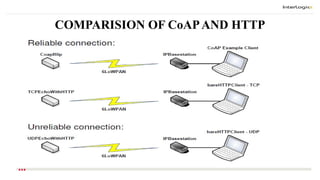
COMPARISION OF CoAPAND HTTP
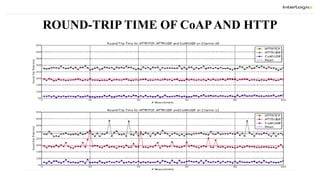
ROUND-TRIP TIME OF CoAPAND HTTP
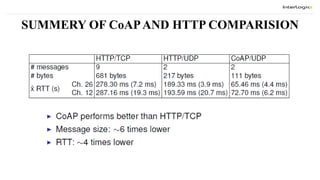
SUMMERY OF CoAPAND HTTP COMPARISION
END TO END SOLUTION PROVIDER
rajanikanth.uppara@interlogicx.org
THANK YOU

IoT Coap

  • 1.
  • 2.
    A Novel ConstrainedApplication Protocol (CoAP) Implementation for Embedding RESTful Web Services in Wireless Sensor Networks Based on TinyOS 2 Interlogicx - India
  • 3.
    OBJECTIVE To design andimplementation of the Constrained application Protocol (CoAP) for TinyOS, which we refer to as TinyCoAP. CoAP seeks to apply the same application transfer paradigm and basic features of HTTP to constrained networks, while maintaining a simple design and low overhead. The design constraints of Wireless Sensor Networks (WSNs) require special attention in the design process of the CoAP implementation. TinyOS already includes in its distribution an implementation of CoAP called CoapBlip.
  • 4.
    INTRODUCTION(1/1) The main interestin making WSNs part of the Internet is to allow both to interact with each other using the existing Web technologies The information provided by sensors could be distributed through standard Web mechanisms, and sensors would be considered like any other Web resource. From this perspective, WSNs would no longer be stand-alone networks but part of ubiquitous networks. We refer to this new approach as the Web of Things (WoT) 6LoWPAN enables the transmission of IPv6 packets in networks adopting the IEEE 802.15.4 standard CoAP seeks to apply the same application transfer paradigm and basic features of HTTP to constrained networks, while maintaining a simple design and low overhead.
  • 5.
    INTRODUCTION(1/2) Unlike HTTP, CoAPuses UDP as transport protocol. This choice would enable CoAP to have a low impact on the limited bandwidth of the 802.15.4 wireless links. However, since UDP is an unreliable protocol, CoAP has to implement its own mechanisms in order to guarantee reliability to those applications that use it. Typical WSNs nodes are battery-powered and often deployed in unattended environment, therefore software applications should be optimized concerning lowest energy consumption and reliable execution. The reduction of energy consumption is mainly achieved using radio duty cycling protocols. Further reduction can be reached through effective memory management. The optimization process of our CoAP implementation is focused in developing an efficient and safe use of memory. The results obtained in our tests prove the importance that memory management has on performance and resource consumption.
  • 6.
    CONSTRAINED APPLICATION PROTOCOL(2/1) CoAPcan be regarded as a two-layer protocol A message layer is used to deal with UDP, while the other layer is used for request/response interactions using methods and response codes, as done in HTTP Reliability is provided by the message layer and is activated when Confirmable (CON) messages are used CoAP is able to match requests to responses so that it can detect if a message is duplicated CoAP also defines Non-confirmable (NON) messages to allow sending requests that does not require reliability. The detection of duplicated messages is available in CON as well as in NON messages A server receiving a CON request must acknowledge its receipt to the client that initiated the communication After sending a CON request message, the client starts a timeout with exponential backoff in order to retransmit the request periodically in case it has not been acknowledged
  • 7.
    CONSTRAINED APPLICATION PROTOCOL(2/2) Aserver receiving a CON request must acknowledge its receipt to the client that initiated the communication After sending a CON request message, the client starts a timeout with exponential backoff in order to retransmit the request periodically in case it has not been acknowledged Figure 1. Layering of Constrained Application Protocol (CoAP).
  • 8.
    CONSTRAINED APPLICATION PROTOCOL(2/3) Finally,a server might send a RST response to indicate that it is not able to process the CON request. NON messages are used when reliability is not required. Request methods are constrained to GET, POST, PUT and DELETE methods of HTTP. As regards the response codes, CoAP defines its own codes and also uses a small subset of the HTTP codes. The CoAP message is composed of a header, options and a payload; the header has a length fixed to five bytes, while the options may have a variable length
  • 9.
    MESSAGE FORMAT Figure 3shows the architecture of a CoAP-based WSN. According to , a CoAP WSN node can have the function of both client and server simultaneously. CoAP proxy can be used to enable the communication between a CoAP based WSN and a HTTP external network. This proxy can work also as a gateway for connecting to other WSNs
  • 10.
    ARCHITECTURE Figure 4: Architectureof a CoAP-based Wireless Sensor Network (WSN). The proxy enables integration between the WSN and external networks that use HTTP.
  • 11.
    CoAP MAIN FEATURES Low header overhead and complexity  Constrained web protocol fulfilling M2M requirements  Asynchronous message exchange (Deferred)  URI (Uniform Resource Identifier) and content-type support  Mapping to HTTP by use of proxies
  • 12.
    CoAP IMPLEMENTATION TinyCoAP implementsall the features of CoAP except for the blockwise transfer. The goal of our implementation is to minimize the resource consumption by developing a lightweight and efficient code optimized for the OS in use TinyOS is an embedded OS for WSNs designed to meet the requirements of constrained networks and devices TinyOS is implemented in the NesC language . NesC is a C dialect designed to improve code efficiency and robustness in embedded software applications Besides NesC, TinyOS allows using more complex languages such as Java, Python or C
  • 13.
    CoAP LIBRARY’S(3/1) TinyCoAP libraryis composed by five components. CoAP conceptual layering message layer CoAP Protocol Data unit CoAP List CoAP Options The request/response matching layer of CoAP is implemented by the CoapServer and CoapClient components The CoapClient component provides the interface used to send CoAP requests. The interface provided by CoapServer allows initializing and binding the server to a specific UDP port. The management of the retransmission mechanism and the CoAP packet processing are also implemented in these components
  • 14.
  • 15.
  • 16.
  • 17.
    ROUND-TRIP TIME OFCoAPAND HTTP
  • 18.
    SUMMERY OF CoAPANDHTTP COMPARISION
  • 19.
    END TO ENDSOLUTION PROVIDER rajanikanth.uppara@interlogicx.org THANK YOU