Infectious Waste
Management
Dr. Faisal N. Kordy, MD, CIC
Consultant, Pediatric Infectious Diseases and Infection Control
Introduction
• Over the years, a considerable amount of concern and
confusion has existed regarding the risks associated with the
disposal of hospital wastes.
• Absence of a specific definition of ‘‘infectious waste,’’
Introduction
• What is the definition of “infectious waste”?

NO specific definition of ‘‘infectious waste’’
Introduction
• CDC published the following statement:
– There is no epidemiologic evidence to suggest that most hospital waste
is any more infectious than residential waste.
– There is no epidemiologic evidence that hospital waste disposal
practices have caused disease in the community;
– Identifying wastes for which special precautions are indicated is a
matter of judgment about relative risks of disease transmission.
Introduction
• Microbiological waste, blood/ body fluids, sharps,
pathological wastes, and certain wastes from patients who are
placed in isolation for specific diseases have always been
treated as occupational hazards within healthcare facilities.
This may help to explain the absence of transmission in the
community.
Introduction
• biomedical waste,
• medical waste,
• infectious waste
Definitions
‘‘Infectious wastes are all the types of wastes
produced by hospitals, clinics and other
medical and research facilities.”
Definitions
‘‘any solid waste which is generated in the diagnosis,
treatment or immunization of human beings or animals, in
research pertaining thereto, or in the production or testing of
biologicals.’’
Pathogenesis
• For a waste to be capable of causing infection, the following
specific factors are necessary:
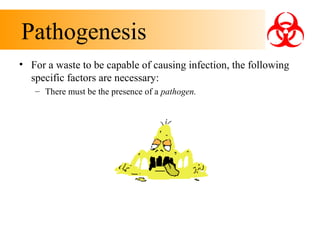
– There must be the presence of a pathogen.
Pathogenesis
• For a waste to be capable of causing infection, the following
specific factors are necessary:
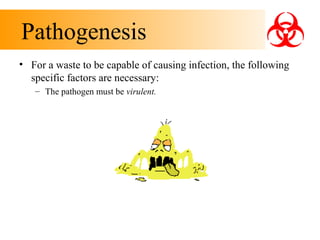
– The pathogen must be virulent.
Pathogenesis
• For a waste to be capable of causing infection, the following
specific factors are necessary:
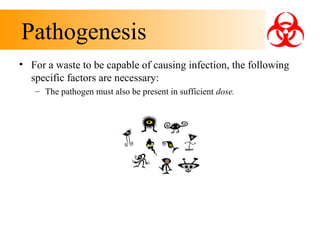
– The pathogen must also be present in sufficient dose.
Pathogenesis
• For a waste to be capable of causing infection, the following
specific factors are necessary:
– The organisms must have a portal of entry.
Pathogenesis
• For a waste to be capable of causing infection, the following
specific factors are necessary:
– There must be a susceptible host. (unimmunized, careless,
unfamiliar…)
Where do we find germs in the hospital?
•
•
•
•
•
•
•
•

Bed linens,
soiled diapers,
unwashed hands,
Key boards,
Door knobs,
Bedrails,
Patients’ charts
……
What wastes are we interested in?
1. Contaminated sharps.
All discarded sharps (e.g., needles, scalpels) that have
come into contact with infectious materials should be
considered infectious waste.
What wastes are we interested in?
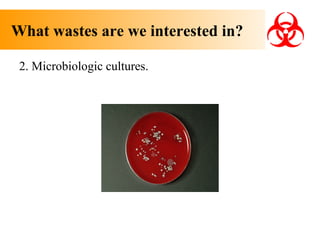
2. Microbiologic cultures.
What wastes are we interested in?
3. Animal wastes.
What wastes are we interested in?
4. Blood and blood products.
What wastes are we interested in?
5. ‘‘Selected’’ isolation wastes. (Ebola, Dengue, …)
What wastes are we interested in?
6. Pathology wastes. (They do not usually fit the
definition of infectious waste outlined above. There is
an absence of a portal of entry; most of these
materials have been soaked in alcohol or
formaldehyde and seldom contain pathogens).
What wastes are we interested in?
• Wastes from surgery and dialysis, with the exception
of contaminated sharps, bulk blood, and blood-tinged
suction fluids, need not be considered infectious
wastes. Once they are properly contained, they are no
more infectious than any residential waste.
• For the same reason isolation trash is not considered
infectious waste.
Remember
• Most persons with
infectious diseases are
not hospitalized.
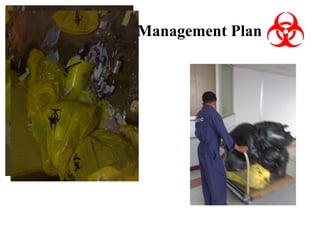
Infectious Waste Management Plan
• Once a facility has a working definition of
what constitutes ‘‘infectious waste,’’ a prudent
next step to take is to develop a program or
plan for managing these materials.
Infectious Waste Management Plan
• Written plan for infectious waste management
include:
- Objectives:
- rendering infectious waste safe for disposal,
- insuring that there is minimal risk to patients, personnel,
visitors and the community from exposure to pathogenic
organisms associated with waste generated in the
hospital,
- educating the healthcare staff regarding the
management plan and the real versus the perceived risk
associated with ‘‘infectious waste.’’
Infectious Waste Management Plan
• Written plan for infectious waste management
include:
-

Designation,
Segregation,
Packaging,
Storage,
Transport,
Treatment or disposal,
Contingency planning,
Staff training.
Infectious Waste Management Plan
• Designation
– Designate waste as infectious or noninfectious.
Infectious Waste Management Plan
• Segregation
– segregate infectious waste at the point of origin.
– waste should then be placed into appropriate
designated containers.
Infectious Waste Management Plan
• Packaging
– Infectious waste must be packaged properly to
protect patients, staff, visitors and the public from
potential exposure to infectious materials and to
facilitate the proper handling, storage, treatment
and /or disposal of the waste.
Infectious Waste Management Plan
• Packaging
– Selection of the packaging must be appropriate for
the type of waste being contained to maintain the
integrity of the packaging during collection,
transport and storage.
Infectious Waste Management Plan
• Packaging
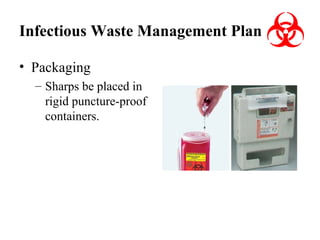
– Sharps be placed in
rigid puncture-proof
containers.
Infectious Waste Management Plan
• Packaging
– Infectious waste must be properly identified as a
biohazard.
Infectious Waste Management Plan
• Packaging
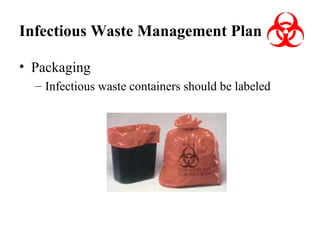
– Infectious waste containers should be labeled
Infectious Waste Management Plan
• Packaging
– Potentially infectious liquid wastes can be
carefully poured down the drain.
Infectious Waste Management Plan
• Storage
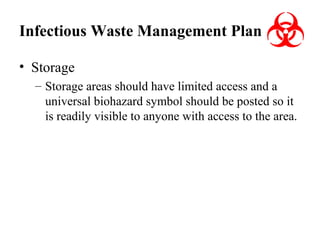
– Storage areas should have limited access and a
universal biohazard symbol should be posted so it
is readily visible to anyone with access to the area.
Infectious Waste Management Plan
• Storage
– A system for immediate spill containment and
clean up should be available in the storage area
(e.g., hose connected to steam line, etc.).
Infectious Waste Management Plan
• Transport
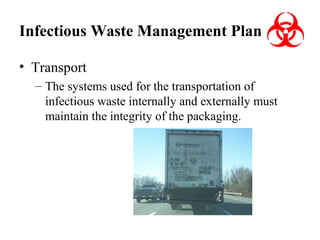
– The systems used for the transportation of
infectious waste internally and externally must
maintain the integrity of the packaging.
Infectious Waste Management Plan
• Transport
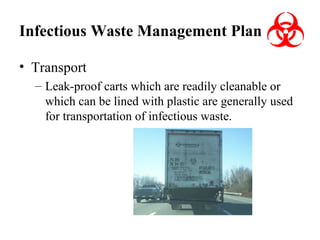
– Leak-proof carts which are readily cleanable or
which can be lined with plastic are generally used
for transportation of infectious waste.
Infectious Waste Management Plan
• Transport
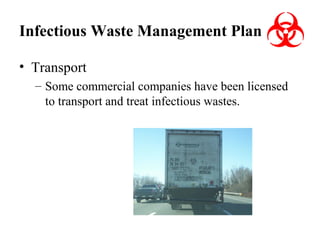
– Some commercial companies have been licensed
to transport and treat infectious wastes.
Infectious Waste Management Plan
• Treatment.
– The treatment selected should be based upon the
type of waste generated and the suitability of
available options.
Infectious Waste Management Plan
• Disposal
– The direct disposal of infectious waste at a
properly sited landfill does not in fact present a
threat to public health and safety, according to
many experts, and is still acceptable in many areas.
Infectious Waste Management Plan
• Disposal
– However, perceived risk concerns and the
nationwide movement away from land disposal
have resulted in widespread landfill prohibitions
on the disposal of untreated infectious waste in
landfills.
Infectious Waste Management Plan
• Disposal
– After treatment, medical waste are usually
disposed of in a sanitary landfill.
Infectious Waste Management Plan
• Contingency planning
– Systems should be in place to address unforeseen
events, which may disrupt the normal treatment,
transportation and disposal of these materials.
Infectious Waste Management Plan
• Contingency planning
– Emergency spill procedures should also be in place
for both on-site and off-site emergencies.
Infectious Waste Management Plan
• Training
– Training of all personnel involved in:
•
•
•
•

generation,
handling,
transporting,
treatment or disposal of infectious waste.
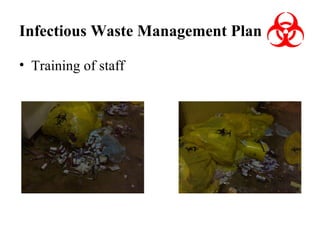
Infectious Waste Management Plan
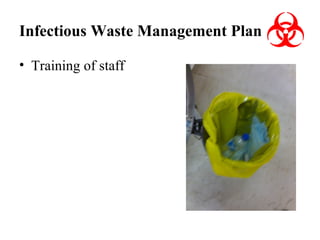
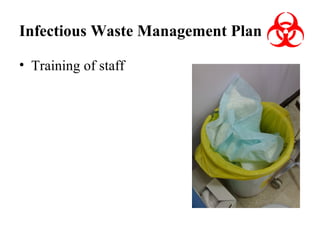
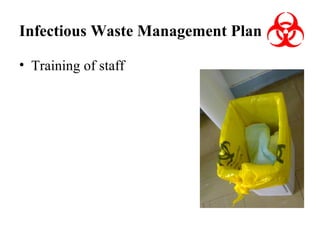
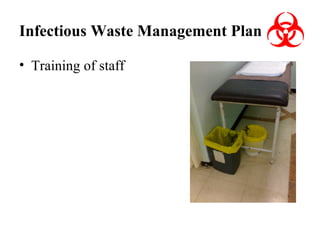
• Training of staff
–
–
–
–

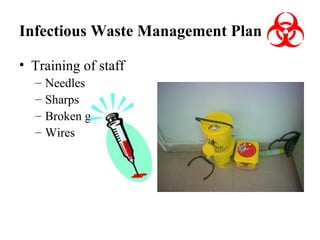
Needles
Sharps
Broken glass
Wires
Infectious Waste Management Plan
• Training of staff
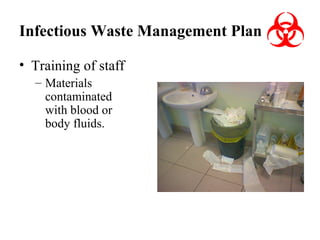
– Materials
contaminated
with blood or
body fluids.
Infectious Waste Management Plan
• Training of staff
Infectious Waste Management Plan
• Training of staff
Infectious Waste Management Plan
• Training of staff
Infectious Waste Management Plan
• Training of staff
Infectious Waste Management Plan
• Training of staff
Infectious Waste Management Plan
• Training of staff
– Materials
contaminated
with blood or
body fluids.
Infectious Waste Management Plan
• Training of staff
Infection Control Implications
In most healthcare facilities, the infection
control professional is responsible for
developing and overseeing the infectious
waste management plan.
Infection Control Implications
The role of the infection control professional is
to develop a safe and effective infectious
waste management plan and to assure that it is
based on sound scientific information and is
consistent with MOH regulations.
Infection Control Implications
• Rutala et al. have recently published several
important facts that should be kept in mind
during the development of infectious waste
policies or rules and regulations.

Rutala WA, Odette RI, Samsa GP.Management of infectious waste by United States hospitals. JAMA 1989;262:1635–1640
Rutala WA. Disinfection, sterilization and waste disposal—medical waste. In: Wenzel RP, ed. Prevention and Control of Nosocomial Infections.
2nd ed. Baltimore, MD: Williams and Wilkins;1993:483–487
Infection Control Implications
• Several of these facts include:
– Hospitalized patients generate approximately 6.8
kilograms of hospital waste per day.
Infection Control Implications
• Several of these facts include:
– About 15% of the total hospital waste by weight is
considered ‘‘infectious waste’’.
Infection Control Implications
• Several of these facts include:
– The cost of disposing infectious waste is 5–20
times that of other hospital wastes.
Infection Control Implications
• Several of these facts include:
– With the exception of ‘‘sharps’’ such as needles,
which have caused disease only in an occupational
setting, there is no scientific evidence that medical
waste has caused disease in the hospital or in the
community.
Infection Control Implications
• Several of these facts include:
– Household waste contains on average 100 times as
many human pathogens than medical waste.
Infection Control Implications
• Several of these facts include:
– The beach wash-ups of syringe related materials
which created nationwide concern about medical
waste were found to come from illegal drug use
and home healthcare.
Infection Control Implications
• When regulations are not based on sound
science, ICPs are encouraged to become
involved in assisting regulators by providing
scientific input as well as basic ‘‘common
sense.’’
Thanks

15 infectious waste management

  • 1.
    Infectious Waste Management Dr. FaisalN. Kordy, MD, CIC Consultant, Pediatric Infectious Diseases and Infection Control
  • 2.
    Introduction • Over theyears, a considerable amount of concern and confusion has existed regarding the risks associated with the disposal of hospital wastes. • Absence of a specific definition of ‘‘infectious waste,’’
  • 3.
    Introduction • What isthe definition of “infectious waste”? NO specific definition of ‘‘infectious waste’’
  • 4.
    Introduction • CDC publishedthe following statement: – There is no epidemiologic evidence to suggest that most hospital waste is any more infectious than residential waste. – There is no epidemiologic evidence that hospital waste disposal practices have caused disease in the community; – Identifying wastes for which special precautions are indicated is a matter of judgment about relative risks of disease transmission.
  • 5.
    Introduction • Microbiological waste,blood/ body fluids, sharps, pathological wastes, and certain wastes from patients who are placed in isolation for specific diseases have always been treated as occupational hazards within healthcare facilities. This may help to explain the absence of transmission in the community.
  • 6.
    Introduction • biomedical waste, •medical waste, • infectious waste
  • 7.
    Definitions ‘‘Infectious wastes areall the types of wastes produced by hospitals, clinics and other medical and research facilities.”
  • 8.
    Definitions ‘‘any solid wastewhich is generated in the diagnosis, treatment or immunization of human beings or animals, in research pertaining thereto, or in the production or testing of biologicals.’’
  • 9.
    Pathogenesis • For awaste to be capable of causing infection, the following specific factors are necessary: – There must be the presence of a pathogen.
  • 10.
    Pathogenesis • For awaste to be capable of causing infection, the following specific factors are necessary: – The pathogen must be virulent.
  • 11.
    Pathogenesis • For awaste to be capable of causing infection, the following specific factors are necessary: – The pathogen must also be present in sufficient dose.
  • 12.
    Pathogenesis • For awaste to be capable of causing infection, the following specific factors are necessary: – The organisms must have a portal of entry.
  • 13.
    Pathogenesis • For awaste to be capable of causing infection, the following specific factors are necessary: – There must be a susceptible host. (unimmunized, careless, unfamiliar…)
  • 14.
    Where do wefind germs in the hospital?
  • 15.
    Where do wefind germs in the hospital? • • • • • • • • Bed linens, soiled diapers, unwashed hands, Key boards, Door knobs, Bedrails, Patients’ charts ……
  • 16.
    What wastes arewe interested in? 1. Contaminated sharps. All discarded sharps (e.g., needles, scalpels) that have come into contact with infectious materials should be considered infectious waste.
  • 17.
    What wastes arewe interested in? 2. Microbiologic cultures.
  • 18.
    What wastes arewe interested in? 3. Animal wastes.
  • 19.
    What wastes arewe interested in? 4. Blood and blood products.
  • 20.
    What wastes arewe interested in? 5. ‘‘Selected’’ isolation wastes. (Ebola, Dengue, …)
  • 21.
    What wastes arewe interested in? 6. Pathology wastes. (They do not usually fit the definition of infectious waste outlined above. There is an absence of a portal of entry; most of these materials have been soaked in alcohol or formaldehyde and seldom contain pathogens).
  • 22.
    What wastes arewe interested in? • Wastes from surgery and dialysis, with the exception of contaminated sharps, bulk blood, and blood-tinged suction fluids, need not be considered infectious wastes. Once they are properly contained, they are no more infectious than any residential waste. • For the same reason isolation trash is not considered infectious waste.
  • 23.
    Remember • Most personswith infectious diseases are not hospitalized.
  • 24.
    Infectious Waste ManagementPlan • Once a facility has a working definition of what constitutes ‘‘infectious waste,’’ a prudent next step to take is to develop a program or plan for managing these materials.
  • 25.
    Infectious Waste ManagementPlan • Written plan for infectious waste management include: - Objectives: - rendering infectious waste safe for disposal, - insuring that there is minimal risk to patients, personnel, visitors and the community from exposure to pathogenic organisms associated with waste generated in the hospital, - educating the healthcare staff regarding the management plan and the real versus the perceived risk associated with ‘‘infectious waste.’’
  • 26.
    Infectious Waste ManagementPlan • Written plan for infectious waste management include: - Designation, Segregation, Packaging, Storage, Transport, Treatment or disposal, Contingency planning, Staff training.
  • 27.
    Infectious Waste ManagementPlan • Designation – Designate waste as infectious or noninfectious.
  • 28.
    Infectious Waste ManagementPlan • Segregation – segregate infectious waste at the point of origin. – waste should then be placed into appropriate designated containers.
  • 29.
    Infectious Waste ManagementPlan • Packaging – Infectious waste must be packaged properly to protect patients, staff, visitors and the public from potential exposure to infectious materials and to facilitate the proper handling, storage, treatment and /or disposal of the waste.
  • 30.
    Infectious Waste ManagementPlan • Packaging – Selection of the packaging must be appropriate for the type of waste being contained to maintain the integrity of the packaging during collection, transport and storage.
  • 31.
    Infectious Waste ManagementPlan • Packaging – Sharps be placed in rigid puncture-proof containers.
  • 32.
    Infectious Waste ManagementPlan • Packaging – Infectious waste must be properly identified as a biohazard.
  • 33.
    Infectious Waste ManagementPlan • Packaging – Infectious waste containers should be labeled
  • 34.
    Infectious Waste ManagementPlan • Packaging – Potentially infectious liquid wastes can be carefully poured down the drain.
  • 35.
    Infectious Waste ManagementPlan • Storage – Storage areas should have limited access and a universal biohazard symbol should be posted so it is readily visible to anyone with access to the area.
  • 36.
    Infectious Waste ManagementPlan • Storage – A system for immediate spill containment and clean up should be available in the storage area (e.g., hose connected to steam line, etc.).
  • 37.
    Infectious Waste ManagementPlan • Transport – The systems used for the transportation of infectious waste internally and externally must maintain the integrity of the packaging.
  • 38.
    Infectious Waste ManagementPlan • Transport – Leak-proof carts which are readily cleanable or which can be lined with plastic are generally used for transportation of infectious waste.
  • 39.
    Infectious Waste ManagementPlan • Transport – Some commercial companies have been licensed to transport and treat infectious wastes.
  • 40.
    Infectious Waste ManagementPlan • Treatment. – The treatment selected should be based upon the type of waste generated and the suitability of available options.
  • 41.
    Infectious Waste ManagementPlan • Disposal – The direct disposal of infectious waste at a properly sited landfill does not in fact present a threat to public health and safety, according to many experts, and is still acceptable in many areas.
  • 42.
    Infectious Waste ManagementPlan • Disposal – However, perceived risk concerns and the nationwide movement away from land disposal have resulted in widespread landfill prohibitions on the disposal of untreated infectious waste in landfills.
  • 43.
    Infectious Waste ManagementPlan • Disposal – After treatment, medical waste are usually disposed of in a sanitary landfill.
  • 44.
    Infectious Waste ManagementPlan • Contingency planning – Systems should be in place to address unforeseen events, which may disrupt the normal treatment, transportation and disposal of these materials.
  • 45.
    Infectious Waste ManagementPlan • Contingency planning – Emergency spill procedures should also be in place for both on-site and off-site emergencies.
  • 46.
    Infectious Waste ManagementPlan • Training – Training of all personnel involved in: • • • • generation, handling, transporting, treatment or disposal of infectious waste.
  • 47.
    Infectious Waste ManagementPlan • Training of staff – – – – Needles Sharps Broken glass Wires
  • 48.
    Infectious Waste ManagementPlan • Training of staff – Materials contaminated with blood or body fluids.
  • 49.
    Infectious Waste ManagementPlan • Training of staff
  • 50.
    Infectious Waste ManagementPlan • Training of staff
  • 51.
    Infectious Waste ManagementPlan • Training of staff
  • 52.
    Infectious Waste ManagementPlan • Training of staff
  • 53.
    Infectious Waste ManagementPlan • Training of staff
  • 54.
    Infectious Waste ManagementPlan • Training of staff – Materials contaminated with blood or body fluids.
  • 55.
    Infectious Waste ManagementPlan • Training of staff
  • 56.
    Infection Control Implications Inmost healthcare facilities, the infection control professional is responsible for developing and overseeing the infectious waste management plan.
  • 57.
    Infection Control Implications Therole of the infection control professional is to develop a safe and effective infectious waste management plan and to assure that it is based on sound scientific information and is consistent with MOH regulations.
  • 58.
    Infection Control Implications •Rutala et al. have recently published several important facts that should be kept in mind during the development of infectious waste policies or rules and regulations. Rutala WA, Odette RI, Samsa GP.Management of infectious waste by United States hospitals. JAMA 1989;262:1635–1640 Rutala WA. Disinfection, sterilization and waste disposal—medical waste. In: Wenzel RP, ed. Prevention and Control of Nosocomial Infections. 2nd ed. Baltimore, MD: Williams and Wilkins;1993:483–487
  • 59.
    Infection Control Implications •Several of these facts include: – Hospitalized patients generate approximately 6.8 kilograms of hospital waste per day.
  • 60.
    Infection Control Implications •Several of these facts include: – About 15% of the total hospital waste by weight is considered ‘‘infectious waste’’.
  • 61.
    Infection Control Implications •Several of these facts include: – The cost of disposing infectious waste is 5–20 times that of other hospital wastes.
  • 62.
    Infection Control Implications •Several of these facts include: – With the exception of ‘‘sharps’’ such as needles, which have caused disease only in an occupational setting, there is no scientific evidence that medical waste has caused disease in the hospital or in the community.
  • 63.
    Infection Control Implications •Several of these facts include: – Household waste contains on average 100 times as many human pathogens than medical waste.
  • 64.
    Infection Control Implications •Several of these facts include: – The beach wash-ups of syringe related materials which created nationwide concern about medical waste were found to come from illegal drug use and home healthcare.
  • 65.
    Infection Control Implications •When regulations are not based on sound science, ICPs are encouraged to become involved in assisting regulators by providing scientific input as well as basic ‘‘common sense.’’
  • 66.