Healthcare Waste
Management
Types of healthcare waste
• Among all the categories for HCW produced in the
medical institutions, the large hospitals (Referral,
Regional and District), in which almost all the ranges of
medical activities are practiced, produce the following
categories of HCW:
• Non – risk HCW or domestic waste made of all wasted
that are not contaminated with infectious or pathogen
agents (food residues, paper, cardboard and plastic
wrapping );
• Pathological waste, infectious waste as well as items that
have been used for medical care and also not necessarily
contaminated that have been collected together. Some
interlocutors call these categories of waste “soft waste” or
clinical waste
Types of healthcare waste
• Anatomical waste and placenta that are
managed separately form the clinical waste;
• Sharps, mainly, but not exclusively, auto-
disable or disposal syringes with needles that
are collected in general in separate cardboard
boxes;
• Pharmaceutical waste that consists in
outdated drugs. They are specifically
managed by the Medical Stores Department
(MSD);
• Specific hazardous HCW (radioactive,
cytotoxic) that are produced in a limited
number of specialized medical institutions.
Sources of
hospital waste
• The sources of health-care waste can be
classified as
• MAJOR or
• MINOR
• according to the quantities produced.
Major
sources
Hospitals
• University hospital
• General hospital
• District hospital
Other health-care establishments —
• Emergency medical care services —
• Health-care centers and dispensaries —
• Obstetric and maternity clinics —
• Outpatient clinics —
• Dialysis centers —
• First-aid posts —
• Transfusion centers —
• Military medical services
Major
Sources
• Related laboratories and research centers
Medical and biomedical laboratories
Biotechnology laboratories and institutions
Medical research centers
• Mortuary and autopsy centers
• Animal research and testing
• Blood banks and blood collection services
• Nursing homes for the elderly
Minor sources
• Small health-care establishments
• Physicians’ offices
• Dental clinics
• Acupuncturists
• Chiropractors
• Specialized health-care establishments
and institutions with low waste
generation
• nursing homes
• Psychiatric hospitals
• Disabled persons’ institutions
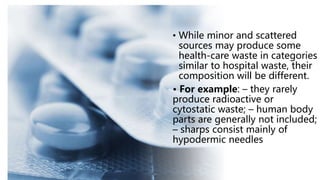
• While minor and scattered
sources may produce some
health-care waste in categories
similar to hospital waste, their
composition will be different.
• For example: – they rarely
produce radioactive or
cytostatic waste; – human body
parts are generally not included;
– sharps consist mainly of
hypodermic needles
HEALTH HAZARDS
OF HOSPITAL WASTE
• Waste is hazardous if it exhibits one or more of
the following four characteristics:
• IGNITABILITY : waste capable of burning or
causing fire. They can irritate the skin, eyes, and
lungs and may give harmful vapors. Examples
include gasoline, industrial alcohols, paint,
furniture polish.
• CORROSIVITY : waste capable of corroding metals
and burning human tissues on contact. E.g.
alkaline cleaners, some chlorides, fluorides, and
HEALTH HAZARDS
OF HOSPITAL WASTE
• REACTIVITY : materials capable of
reacting with other chemicals in air or
water, causing an explosion or release of
poisonous fumes. E.g. peroxides,
isocyanides, cyanides, and chlorine.
• TOXICITY: toxic wastes are harmful or
fatal when ingested or absorbed.
E.g. heavy metals such as lead and
mercury, and pesticide wastes.
HEALTH HAZARDS
OF HOSPITAL WASTE
• If hospital waste is not managed properly it proves to
be harmful to the environment.
• It not only poses a threat to the employees working
in the hospital, but also to the people surrounding
that area.
• Infectious waste can cause diseases like Hepatitis A &
B, AIDS, Typhoid, Boils, etc.

• Exposure to hazardous hospital waste can result in
disease or injury
• Hospital waste contaminated by chemicals used in
hospitals is considered hazardous.
HEALTH HAZARDS
OF HOSPITAL
WASTE
• These chemicals include formaldehyde and phenols, which are
used as disinfectants, and mercury, which is used in
thermometers.
• All individuals exposed to hazardous health- care waste are
potentially at risk, including those within health-care
establishments that generate hazardous waste, and those
outside these sources who either handle such waste or are
exposed to it as a consequence of careless management.
• The main groups at risk are: – medical doctors, nurses,
health-care auxiliaries, hospital maintenance personnel,
workers in support services allied to health-care
establishments, such as laundries, waste handling, and
transportation, workers in waste disposal facilities (such as
landfills or incinerators), including scavengers. – patients in
Hospital
Waste
Management
(HWM)
• HWM means the supervision of waste produced by hospitals
using techniques that will help to check the spread of diseases
through it.
• The management of waste poses to be a major problem in most
of the countries, especially hospital waste. It is an ongoing
problem for many countries. In recent years, medical waste
disposal has posed even more difficulties with the appearance of
disposable needles, syringes, and other similar items.
• Single use, or disposable, health care products help hospitals
avoid the environmental problems with laundry and sterilizing
operations associated with traditional products, which consume
chemical and energy resources and emit waste water and
greenhouse gases
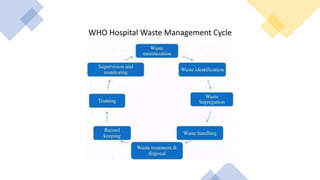
Hospital Waste Management (HWM)
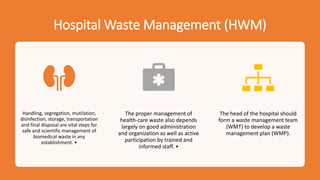
Handling, segregation, mutilation,
disinfection, storage, transportation
and final disposal are vital steps for
safe and scientific management of
biomedical waste in any
establishment. •
The proper management of
health-care waste also depends
largely on good administration
and organization as well as active
participation by trained and
informed staff. •
The head of the hospital should
form a waste management team
(WMT) to develop a waste
management plan (WMP).
DEVELOPMENT OF A WASTE
MANAGEMENT PLAN
• Waste management plan should address the following
issues:
• Existing situation (waste management practices,
personnel and equipment involved)
• Quantities of waste generated
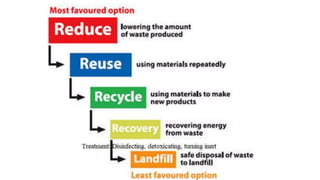
• Possibilities for waste minimization, reuse, and recycling
• On-site handling, transport, and storage practices
• Training for personnel involved
• Estimation of costs relating to actual situation and
proposed options
Development
of a waste
management
plan
WHAT ARE THE CHARACTERISTICS OF
A GOOD PLAN?
A good waste management plan shall
include but not restricted to the
following;
• Waste segregation: careful
segregation (separation) of waste
matter into different categories helps
to minimize the quantities of
hazardous waste.
• Segregation is one of the most
important steps to successfully
manage Hospital wastes
Development
of a waste
management
plan
• Given the fact that only about 10-25% of the
hospital wastes is hazardous, treatment and
disposal costs could be greatly reduced if a
proper segregation were performed.
• Segregating hazardous from non-hazardous
waste reduces also greatly the risks of infecting
workers handling hospital wastes.
• Actually, the part that is hazardous and requires
special treatment could be reduced to some 2-
5% if the hazardous part were immediately
separated from the other waste.
• The segregation consists in separating the
different waste streams based on the hazardous
properties of the waste by sorting the waste
into color-coded and well-labeled bags or
containers
• All the specific procedures of hospital wastes
segregation, packaging and labeling should
be explained to the medical and ancillary
staff and displayed in each department on
charts located on the walls nearby the
hospital wastes containers that should be
specifically suited for each category of
waste.
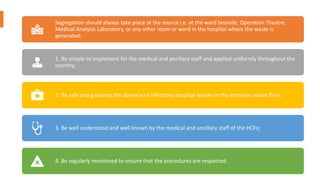
Segregation should always take place at the source i.e. at the ward bedside, Operation Theatre,
Medical Analysis Laboratory, or any other room or ward in the hospital where the waste is
generated;
1. Be simple to implement for the medical and ancillary staff and applied uniformly throughout the
country;
2. Be safe and guaranty the absence of infectious hospital wastes in the domestic waste flow;
3. Be well understood and well known by the medical and ancillary staff of the HCFs;
4. Be regularly monitored to ensure that the procedures are respected.
• The key to minimization and effective
management of health- care waste is
segregation (separation) and identification of
the waste.
• Appropriate handling, treatment, and disposal
of waste by type reduces costs and does much
to protect public health.
• Segregation should always be the responsibility
of the waste producer, should take place as
close as possible to where the waste is
generated, and should be maintained in storage
areas and during transport.
• The most appropriate way of identifying the
categories of health-care waste is by sorting the
waste into colour-coded plastic bags or
containers.
WASTE
MINIMIZATION
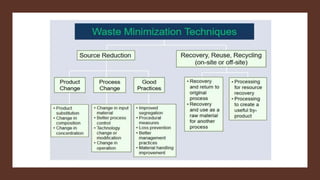
• May be encouraged by the implementation of
certain policies and practices, including the
following:
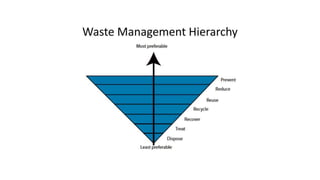
• Source reduction: measures such as purchasing
restrictions to ensure the selection of methods
or supplies generate less hazardous waste.
• Recyclable products: use of materials that may
be recycled, either on-site or off-site. Good
management and control practices: apply
particularly to the purchase and use of
• RECYCLING AND REUSE: Medical equipment's
used in a health-care establishment may be
reused provided that they are designed for that
purpose and will withstand the sterilization
process. E.g. scalpels, syringes, glass bottles.
Health Impacts of Biomedical waste
Occupational health hazards
The health hazards due to improper waste management can affect:
• The occupants in institutions and spread in the vicinity of the institutions
• People happened to be in contact with the institution like laundry workers, nurses,
emergency medical personnel, and refuse workers.
• Risks of infections outside hospital for waste handlers, scavengers and (eventually) the
general public
• Risks associated with hazardous chemicals, drugs, being handled by persons handling
wastes at all levels
• Injuries from sharps and exposure to harmful chemical waste and radioactive waste also
cause health hazards to employees.
Hazards to the general public
The general public’s health can also be adversely affected by bio-medical waste.
• Improper practices such as dumping of bio-medical waste in municipal dustbins, open
spaces, water bodies etc. leads to the spread of diseases.
• Emissions from incinerators and open burning also lead to exposure to harmful gases
which can cause cancer and respiratory diseases.
• Exposure to radioactive waste in the waste stream can also cause serious health hazards.
• An often-ignored area is the increase of in-home healthcare activities. An increase in the
number of diabetics who inject themselves with insulin, home nurses taking care of
terminally ill patients etc. all generate bio-medical waste, which can cause health hazards.
Hazards to animals and birds
Plastic waste can choke
animals, which
scavenge on open
dumps.
Injuries from sharps are
common feature
affecting animals.
Harmful chemicals such
as dioxins and furans
can cause serious
health hazards to
animals and birds.
Heavy metals can even
affect the reproductive
health of the animals
Change in microbial
ecology, spread of
antibiotic resistance.
What you can do?
Use only disposable
syringes. After use
throw the syringes
after breaking them.
Bandages, cotton
and other blood-
stained materials
should not be
thrown with general
garbage.
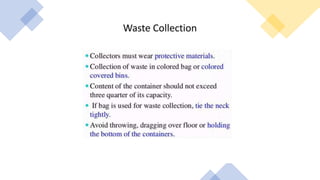
Use color coded
plastic bags to
dispose biomedical
wastes.
Keep trash out of
reach of small
children and infants.
Drugs that are past
date of expiry must
never be used.
Ensure
That the used
product is
mutilated.
01
That the used
product is treated
prior to disposal.
02
That the used
product is
segregated.
03
Do not
Reuse plastic
equipment.
Mix plastic
equipment with
other wastes.
Burn plastic
waste.
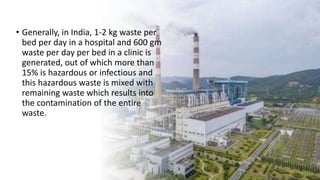
• Generally, in India, 1-2 kg waste per
bed per day in a hospital and 600 gm
waste per day per bed in a clinic is
generated, out of which more than
15% is hazardous or infectious and
this hazardous waste is mixed with
remaining waste which results into
the contamination of the entire
waste.

Hospital waste management.pptx

  • 1.
  • 2.
    Types of healthcarewaste • Among all the categories for HCW produced in the medical institutions, the large hospitals (Referral, Regional and District), in which almost all the ranges of medical activities are practiced, produce the following categories of HCW: • Non – risk HCW or domestic waste made of all wasted that are not contaminated with infectious or pathogen agents (food residues, paper, cardboard and plastic wrapping ); • Pathological waste, infectious waste as well as items that have been used for medical care and also not necessarily contaminated that have been collected together. Some interlocutors call these categories of waste “soft waste” or clinical waste
  • 3.
    Types of healthcarewaste • Anatomical waste and placenta that are managed separately form the clinical waste; • Sharps, mainly, but not exclusively, auto- disable or disposal syringes with needles that are collected in general in separate cardboard boxes; • Pharmaceutical waste that consists in outdated drugs. They are specifically managed by the Medical Stores Department (MSD); • Specific hazardous HCW (radioactive, cytotoxic) that are produced in a limited number of specialized medical institutions.
  • 4.
    Sources of hospital waste •The sources of health-care waste can be classified as • MAJOR or • MINOR • according to the quantities produced.
  • 5.
    Major sources Hospitals • University hospital •General hospital • District hospital Other health-care establishments — • Emergency medical care services — • Health-care centers and dispensaries — • Obstetric and maternity clinics — • Outpatient clinics — • Dialysis centers — • First-aid posts — • Transfusion centers — • Military medical services
  • 6.
    Major Sources • Related laboratoriesand research centers Medical and biomedical laboratories Biotechnology laboratories and institutions Medical research centers • Mortuary and autopsy centers • Animal research and testing • Blood banks and blood collection services • Nursing homes for the elderly
  • 7.
    Minor sources • Smallhealth-care establishments • Physicians’ offices • Dental clinics • Acupuncturists • Chiropractors • Specialized health-care establishments and institutions with low waste generation • nursing homes • Psychiatric hospitals • Disabled persons’ institutions
  • 8.
    • While minorand scattered sources may produce some health-care waste in categories similar to hospital waste, their composition will be different. • For example: – they rarely produce radioactive or cytostatic waste; – human body parts are generally not included; – sharps consist mainly of hypodermic needles
  • 9.
    HEALTH HAZARDS OF HOSPITALWASTE • Waste is hazardous if it exhibits one or more of the following four characteristics: • IGNITABILITY : waste capable of burning or causing fire. They can irritate the skin, eyes, and lungs and may give harmful vapors. Examples include gasoline, industrial alcohols, paint, furniture polish. • CORROSIVITY : waste capable of corroding metals and burning human tissues on contact. E.g. alkaline cleaners, some chlorides, fluorides, and
  • 10.
    HEALTH HAZARDS OF HOSPITALWASTE • REACTIVITY : materials capable of reacting with other chemicals in air or water, causing an explosion or release of poisonous fumes. E.g. peroxides, isocyanides, cyanides, and chlorine. • TOXICITY: toxic wastes are harmful or fatal when ingested or absorbed. E.g. heavy metals such as lead and mercury, and pesticide wastes.
  • 11.
    HEALTH HAZARDS OF HOSPITALWASTE • If hospital waste is not managed properly it proves to be harmful to the environment. • It not only poses a threat to the employees working in the hospital, but also to the people surrounding that area. • Infectious waste can cause diseases like Hepatitis A & B, AIDS, Typhoid, Boils, etc. • Exposure to hazardous hospital waste can result in disease or injury • Hospital waste contaminated by chemicals used in hospitals is considered hazardous.
  • 12.
    HEALTH HAZARDS OF HOSPITAL WASTE •These chemicals include formaldehyde and phenols, which are used as disinfectants, and mercury, which is used in thermometers. • All individuals exposed to hazardous health- care waste are potentially at risk, including those within health-care establishments that generate hazardous waste, and those outside these sources who either handle such waste or are exposed to it as a consequence of careless management. • The main groups at risk are: – medical doctors, nurses, health-care auxiliaries, hospital maintenance personnel, workers in support services allied to health-care establishments, such as laundries, waste handling, and transportation, workers in waste disposal facilities (such as landfills or incinerators), including scavengers. – patients in
  • 13.
    Hospital Waste Management (HWM) • HWM meansthe supervision of waste produced by hospitals using techniques that will help to check the spread of diseases through it. • The management of waste poses to be a major problem in most of the countries, especially hospital waste. It is an ongoing problem for many countries. In recent years, medical waste disposal has posed even more difficulties with the appearance of disposable needles, syringes, and other similar items. • Single use, or disposable, health care products help hospitals avoid the environmental problems with laundry and sterilizing operations associated with traditional products, which consume chemical and energy resources and emit waste water and greenhouse gases
  • 15.
    Hospital Waste Management(HWM) Handling, segregation, mutilation, disinfection, storage, transportation and final disposal are vital steps for safe and scientific management of biomedical waste in any establishment. • The proper management of health-care waste also depends largely on good administration and organization as well as active participation by trained and informed staff. • The head of the hospital should form a waste management team (WMT) to develop a waste management plan (WMP).
  • 19.
    DEVELOPMENT OF AWASTE MANAGEMENT PLAN • Waste management plan should address the following issues: • Existing situation (waste management practices, personnel and equipment involved) • Quantities of waste generated • Possibilities for waste minimization, reuse, and recycling • On-site handling, transport, and storage practices • Training for personnel involved • Estimation of costs relating to actual situation and proposed options
  • 20.
    Development of a waste management plan WHATARE THE CHARACTERISTICS OF A GOOD PLAN? A good waste management plan shall include but not restricted to the following; • Waste segregation: careful segregation (separation) of waste matter into different categories helps to minimize the quantities of hazardous waste. • Segregation is one of the most important steps to successfully manage Hospital wastes
  • 21.
    Development of a waste management plan •Given the fact that only about 10-25% of the hospital wastes is hazardous, treatment and disposal costs could be greatly reduced if a proper segregation were performed. • Segregating hazardous from non-hazardous waste reduces also greatly the risks of infecting workers handling hospital wastes. • Actually, the part that is hazardous and requires special treatment could be reduced to some 2- 5% if the hazardous part were immediately separated from the other waste. • The segregation consists in separating the different waste streams based on the hazardous properties of the waste by sorting the waste into color-coded and well-labeled bags or containers
  • 22.
    • All thespecific procedures of hospital wastes segregation, packaging and labeling should be explained to the medical and ancillary staff and displayed in each department on charts located on the walls nearby the hospital wastes containers that should be specifically suited for each category of waste.
  • 25.
    Segregation should alwaystake place at the source i.e. at the ward bedside, Operation Theatre, Medical Analysis Laboratory, or any other room or ward in the hospital where the waste is generated; 1. Be simple to implement for the medical and ancillary staff and applied uniformly throughout the country; 2. Be safe and guaranty the absence of infectious hospital wastes in the domestic waste flow; 3. Be well understood and well known by the medical and ancillary staff of the HCFs; 4. Be regularly monitored to ensure that the procedures are respected.
  • 26.
    • The keyto minimization and effective management of health- care waste is segregation (separation) and identification of the waste. • Appropriate handling, treatment, and disposal of waste by type reduces costs and does much to protect public health. • Segregation should always be the responsibility of the waste producer, should take place as close as possible to where the waste is generated, and should be maintained in storage areas and during transport. • The most appropriate way of identifying the categories of health-care waste is by sorting the waste into colour-coded plastic bags or containers.
  • 28.
    WASTE MINIMIZATION • May beencouraged by the implementation of certain policies and practices, including the following: • Source reduction: measures such as purchasing restrictions to ensure the selection of methods or supplies generate less hazardous waste. • Recyclable products: use of materials that may be recycled, either on-site or off-site. Good management and control practices: apply particularly to the purchase and use of • RECYCLING AND REUSE: Medical equipment's used in a health-care establishment may be reused provided that they are designed for that purpose and will withstand the sterilization process. E.g. scalpels, syringes, glass bottles.
  • 38.
    Health Impacts ofBiomedical waste Occupational health hazards The health hazards due to improper waste management can affect: • The occupants in institutions and spread in the vicinity of the institutions • People happened to be in contact with the institution like laundry workers, nurses, emergency medical personnel, and refuse workers. • Risks of infections outside hospital for waste handlers, scavengers and (eventually) the general public • Risks associated with hazardous chemicals, drugs, being handled by persons handling wastes at all levels • Injuries from sharps and exposure to harmful chemical waste and radioactive waste also cause health hazards to employees.
  • 39.
    Hazards to thegeneral public The general public’s health can also be adversely affected by bio-medical waste. • Improper practices such as dumping of bio-medical waste in municipal dustbins, open spaces, water bodies etc. leads to the spread of diseases. • Emissions from incinerators and open burning also lead to exposure to harmful gases which can cause cancer and respiratory diseases. • Exposure to radioactive waste in the waste stream can also cause serious health hazards. • An often-ignored area is the increase of in-home healthcare activities. An increase in the number of diabetics who inject themselves with insulin, home nurses taking care of terminally ill patients etc. all generate bio-medical waste, which can cause health hazards.
  • 40.
    Hazards to animalsand birds Plastic waste can choke animals, which scavenge on open dumps. Injuries from sharps are common feature affecting animals. Harmful chemicals such as dioxins and furans can cause serious health hazards to animals and birds. Heavy metals can even affect the reproductive health of the animals Change in microbial ecology, spread of antibiotic resistance.
  • 41.
    What you cando? Use only disposable syringes. After use throw the syringes after breaking them. Bandages, cotton and other blood- stained materials should not be thrown with general garbage. Use color coded plastic bags to dispose biomedical wastes. Keep trash out of reach of small children and infants. Drugs that are past date of expiry must never be used.
  • 42.
    Ensure That the used productis mutilated. 01 That the used product is treated prior to disposal. 02 That the used product is segregated. 03
  • 43.
    Do not Reuse plastic equipment. Mixplastic equipment with other wastes. Burn plastic waste.
  • 45.
    • Generally, inIndia, 1-2 kg waste per bed per day in a hospital and 600 gm waste per day per bed in a clinic is generated, out of which more than 15% is hazardous or infectious and this hazardous waste is mixed with remaining waste which results into the contamination of the entire waste.