HOSPITAL ADMINISTRATION FASEELA JALEEL MSW 114
HOSPITALS Formal institutions developed by the society for patient care Intended to meet the complex health needs of its members Individual-sick or injured has access to centralized medical knowledge & technology Society-it protects the family from many of the disruptive effects of caring for the ill in the home and making the problems less disruptive for the society as a whole
At Present…. Hospital is a place for the diagnosis and treatment of human ills and restoration of health and well-beings of those temporarily deprived of these. Professionally & technically skilled people apply their knowledge and skill with the help of complicated equipment and appliances - to provide quality care for the patient
Training Medical Research Health Education Patient care HOSPITAL  FUNCTIONS
HOSPITAL ORGANIZATION A hospital is a multifaceted organization comprising many committees, departments, types of personnel, and services.  It requires highly trained employees, efficient systems and controls, necessary supplies, adequate equipment and facilities, and, of course, physicians and patients.  It is a business as well as a caring, people-oriented institution and it has a similar structure and hierarchy of authority as any large business.
Board of Trustees. The "board of trustees," or governing board, operates the hospital in trust for the community and has a fiduciary duty to protect the assets of the hospital through efficient operation.  The trustees are responsible for establishing the hospital's mission and establishing its bylaws and strategic policies.  Trustees select the administrative leader of the hospital and delegate the hospital's daily operations and budgeting to the appointed executive.
Executive Administration The chief executive officer (CEO) reports to the governing board and provides leadership in implementing the strategic goals and decisions set by the Board.  The CEO also represents the hospital to the external environment and the community.  In these tasks, the CEO must coordinate the collective effort of the hospital's personnel.
The Medical Staff The physician is the leader of the clinical team and the major agent working on behalf of the patient.  The physician's responsibility is to diagnose the patient's condition accurately and to prescribe the best and most cost-effective treatment plan. The medical staff is a formally organized self-governing unit within the hospital, primarily comprised of physicians, but may also include other doctoral level health care professionals such as dentists or psychologists.
Nursing Services Nursing services employees are responsible for carrying out the treatment plan developed by the physician.  Nursing services, also called patient care services, is the largest component of the hospital.
Allied Health Services A number of departments perform support functions that help with diagnosis and treatment.  The clinical laboratory is a diagnostic center that performs a variety of functions, including autopsy, clinical cytology, and clinical pathology  Also medical technologists, radiology department and rehabilitation services
Clinical Support Services The hospital pharmacy purchases and dispenses all the medications used to treat patients in the hospital.  The pharmacist works directly with the medical staff in establishing a formulary, the listing of drugs chosen to be included in the pharmacy.
Administrative Support Services Non-medical administrative services are necessary to the hospital's business and physical plant management. The CEO leads these administrative services and is directly responsible for the day-to-day operations of the facility. Business services manages the hospital's admitting and discharge functions, records charges to a patient's account, and handles accounts receivables with third-party payers such as insurance companies. The finance department advises the CEO on financial policy and long-range planning, establishes procedures for accounting functions, receives and deposits all monies received by the hospital, and approves the payments of salaries and other expenditures.
Cont…… Accounting  is central to the hospital's financial business. Detailed and sound accounting practices are fundamental to maintaining important organizational statistics for administrative decision-making  Admitting services  is often where the patient first has contact with the hospital. The sensitivity and efficiency of this department can greatly influence the patient's perception of the quality of care received. Information services and medical record maintenance  are core functions of hospital management  The human resources department  interacts with all departments in the hospital to ensure the quality and motivation of personnel working at the hospital.  Other important administrative and business functions may include marketing and planning, public relations, plant and materials management, fund-raising, housekeeping, and security.
CLASSIFICATION OF HOSPITALS
Acc to OBJECTIVES Teaching-cum-Research Hospitals Eg: AIIMS General Hospitals – To provide medical care. Eg. District, Taluk, PHCs Special Hospitals – Concentrate on a particular aspect or organ of the body and provide medical care. Eg. Cancer, Dental, Psychiatry, T.B etc.
On the basis of OWNERSHIP Government hospitals Semi-Government hospitals Voluntary Agencies’ hospitals Private / Charitable hospitals
Acc to System of Medicine Allopathic hospitals Ayurvedic hospitals Homeopathic hospitals Unani hospitals Hospitals of other systems of medicine
Acc to Size Teaching Hospitals:- 500 beds District Hospitals:- 200 beds Taluk Hospitals:- 50 beds PHCs:- 6 beds
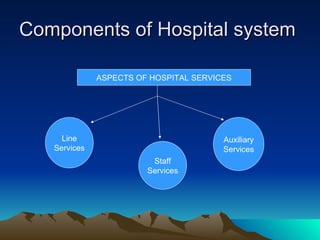
Components of Hospital system Line Services Staff Services Auxiliary Services ASPECTS OF HOSPITAL SERVICES
Line Services Emergency services Diagnosis & treatment of illness of an urgent nature & injuries from accidents Out-Patient services Provision of diagnostic, curative, preventive and rehabilitative services In-patient services (Wards)
Cont… Intensive care unit Those who need Acute, multidisciplinary and intensive observation and treatment Operation theatres Should have a pre-anaesthesia room and sterilisation room and a scrub room for doctors and nurses
Supportive (staff) services Central sterile Supply Services Management Diet Management (Catering dept.) Pharmacy Services Management Laundry Laboratory facilities Radiology Nursing services
Elements for Organization of nursing services Provision of effective centralized facilities to permit top-grade monitoring of all patients Providing adequate nursing staff levels to meet the demands of clinical activities normally encountered Making adjustments to provide for specialized nursing requirements, which might be needed
Auxiliary Services Registration and indoor case records Stores Transport Mortuary Dietary services Engineering and maintenance services Hospital security
 

Hospital Administration

  • 1.
  • 2.
    HOSPITALS Formal institutionsdeveloped by the society for patient care Intended to meet the complex health needs of its members Individual-sick or injured has access to centralized medical knowledge & technology Society-it protects the family from many of the disruptive effects of caring for the ill in the home and making the problems less disruptive for the society as a whole
  • 3.
    At Present…. Hospitalis a place for the diagnosis and treatment of human ills and restoration of health and well-beings of those temporarily deprived of these. Professionally & technically skilled people apply their knowledge and skill with the help of complicated equipment and appliances - to provide quality care for the patient
  • 4.
    Training Medical ResearchHealth Education Patient care HOSPITAL FUNCTIONS
  • 5.
    HOSPITAL ORGANIZATION Ahospital is a multifaceted organization comprising many committees, departments, types of personnel, and services. It requires highly trained employees, efficient systems and controls, necessary supplies, adequate equipment and facilities, and, of course, physicians and patients. It is a business as well as a caring, people-oriented institution and it has a similar structure and hierarchy of authority as any large business.
  • 6.
    Board of Trustees.The "board of trustees," or governing board, operates the hospital in trust for the community and has a fiduciary duty to protect the assets of the hospital through efficient operation. The trustees are responsible for establishing the hospital's mission and establishing its bylaws and strategic policies. Trustees select the administrative leader of the hospital and delegate the hospital's daily operations and budgeting to the appointed executive.
  • 7.
    Executive Administration Thechief executive officer (CEO) reports to the governing board and provides leadership in implementing the strategic goals and decisions set by the Board. The CEO also represents the hospital to the external environment and the community. In these tasks, the CEO must coordinate the collective effort of the hospital's personnel.
  • 8.
    The Medical StaffThe physician is the leader of the clinical team and the major agent working on behalf of the patient. The physician's responsibility is to diagnose the patient's condition accurately and to prescribe the best and most cost-effective treatment plan. The medical staff is a formally organized self-governing unit within the hospital, primarily comprised of physicians, but may also include other doctoral level health care professionals such as dentists or psychologists.
  • 9.
    Nursing Services Nursingservices employees are responsible for carrying out the treatment plan developed by the physician. Nursing services, also called patient care services, is the largest component of the hospital.
  • 10.
    Allied Health ServicesA number of departments perform support functions that help with diagnosis and treatment. The clinical laboratory is a diagnostic center that performs a variety of functions, including autopsy, clinical cytology, and clinical pathology Also medical technologists, radiology department and rehabilitation services
  • 11.
    Clinical Support ServicesThe hospital pharmacy purchases and dispenses all the medications used to treat patients in the hospital. The pharmacist works directly with the medical staff in establishing a formulary, the listing of drugs chosen to be included in the pharmacy.
  • 12.
    Administrative Support ServicesNon-medical administrative services are necessary to the hospital's business and physical plant management. The CEO leads these administrative services and is directly responsible for the day-to-day operations of the facility. Business services manages the hospital's admitting and discharge functions, records charges to a patient's account, and handles accounts receivables with third-party payers such as insurance companies. The finance department advises the CEO on financial policy and long-range planning, establishes procedures for accounting functions, receives and deposits all monies received by the hospital, and approves the payments of salaries and other expenditures.
  • 13.
    Cont…… Accounting is central to the hospital's financial business. Detailed and sound accounting practices are fundamental to maintaining important organizational statistics for administrative decision-making Admitting services is often where the patient first has contact with the hospital. The sensitivity and efficiency of this department can greatly influence the patient's perception of the quality of care received. Information services and medical record maintenance are core functions of hospital management The human resources department interacts with all departments in the hospital to ensure the quality and motivation of personnel working at the hospital. Other important administrative and business functions may include marketing and planning, public relations, plant and materials management, fund-raising, housekeeping, and security.
  • 14.
  • 15.
    Acc to OBJECTIVESTeaching-cum-Research Hospitals Eg: AIIMS General Hospitals – To provide medical care. Eg. District, Taluk, PHCs Special Hospitals – Concentrate on a particular aspect or organ of the body and provide medical care. Eg. Cancer, Dental, Psychiatry, T.B etc.
  • 16.
    On the basisof OWNERSHIP Government hospitals Semi-Government hospitals Voluntary Agencies’ hospitals Private / Charitable hospitals
  • 17.
    Acc to Systemof Medicine Allopathic hospitals Ayurvedic hospitals Homeopathic hospitals Unani hospitals Hospitals of other systems of medicine
  • 18.
    Acc to SizeTeaching Hospitals:- 500 beds District Hospitals:- 200 beds Taluk Hospitals:- 50 beds PHCs:- 6 beds
  • 19.
    Components of Hospitalsystem Line Services Staff Services Auxiliary Services ASPECTS OF HOSPITAL SERVICES
  • 20.
    Line Services Emergencyservices Diagnosis & treatment of illness of an urgent nature & injuries from accidents Out-Patient services Provision of diagnostic, curative, preventive and rehabilitative services In-patient services (Wards)
  • 21.
    Cont… Intensive careunit Those who need Acute, multidisciplinary and intensive observation and treatment Operation theatres Should have a pre-anaesthesia room and sterilisation room and a scrub room for doctors and nurses
  • 22.
    Supportive (staff) servicesCentral sterile Supply Services Management Diet Management (Catering dept.) Pharmacy Services Management Laundry Laboratory facilities Radiology Nursing services
  • 23.
    Elements for Organizationof nursing services Provision of effective centralized facilities to permit top-grade monitoring of all patients Providing adequate nursing staff levels to meet the demands of clinical activities normally encountered Making adjustments to provide for specialized nursing requirements, which might be needed
  • 24.
    Auxiliary Services Registrationand indoor case records Stores Transport Mortuary Dietary services Engineering and maintenance services Hospital security
  • 25.