EPIDEMIOLOGICAL
STUDIES
By
A.P. Kulkarni
WHAT IS RESEARCH?
 Research produces findings that are not
determined in advance.
 Produce findings that are applicable beyond the
immediate boundaries of the study. (External
validation)
Rese
arch
Meth
odol
ogy
WHAT IS RESEARCH?
 Seeks answer to a question. This is the RQ.
Uncertainty that researcher wants to clear. It is also
a knowledge gap that the researcher wants to fill.
 Systematically uses a predefined set of procedures
to answer the question. Study design that the
researcher uses and material and methods that are
explained therein.
 Collects evidence: In the form of data, variables
and statistics. (Descriptive or inferential)
Rese
arch
Meth
odol
ogy
RESEARCH QUESTION
Question that epidemiologist is seeking
answer to
RQ1: What is prevalence of diabetes in
allopathic doctors in Maharashtra?
Good RQ:
Variable: Prevalence of diabetes
Population: (Participants) Allopathic
doctors in Maharashtra
RESEARCH QUESTION
Question that epidemiologist is seeking
answer to
RQ2: What is the average daily intake of
proteins and calories in male and female
students of PIMS DU?
Variable: i. Average daily intake of proteins
ii. Average daily intake of calories
Population: (Participants) i. Male students
of PIMS DU, ii) Female students of PIMS
DU
VARIABLES
PRIMARY VARIABLES:
 Variables in RQ
 Prevalence of diabetes in RQ1, Average
daily intake of Calories and proteins in
RQ2
SECONDARY VARIABLES
 Variables in NOT in RQ, but in study
 Eg. Gender, Years of practice, Specialty,
Residence (R/U) in RQ1
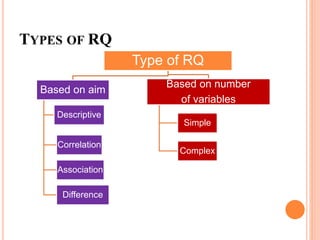
TYPES OF RQ
Type of RQ
Based on aim
Descriptive
Correlation
Association
Difference
Based on number
of variables
Simple
Complex
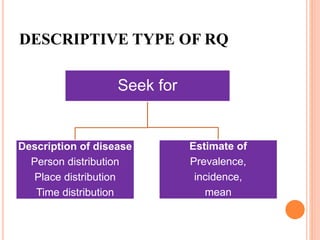
DESCRIPTIVE TYPE OF RQ
Seek for
Description of disease
Person distribution
Place distribution
Time distribution
Estimate of
Prevalence,
incidence,
mean
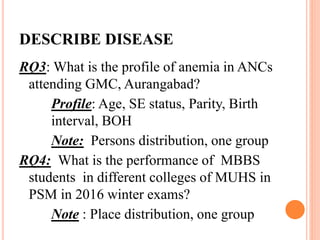
DESCRIBE DISEASE
RQ3: What is the profile of anemia in ANCs
attending GMC, Aurangabad?
Profile: Age, SE status, Parity, Birth
interval, BOH
Note: Persons distribution, one group
RQ4: What is the performance of MBBS
students in different colleges of MUHS in
PSM in 2016 winter exams?
Note : Place distribution, one group
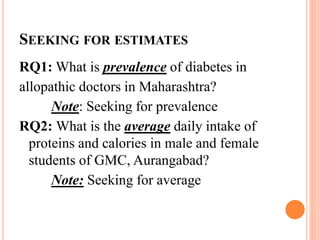
SEEKING FOR ESTIMATES
RQ1: What is prevalence of diabetes in
allopathic doctors in Maharashtra?
Note: Seeking for prevalence
RQ2: What is the average daily intake of
proteins and calories in male and female
students of GMC, Aurangabad?
Note: Seeking for average
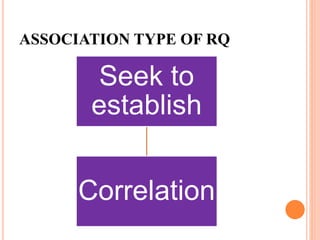
ASSOCIATION TYPE OF RQ
Seek to
establish
Correlation
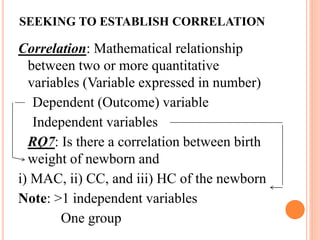
SEEKING TO ESTABLISH CORRELATION
Correlation: Mathematical relationship
between two or more quantitative
variables (Variable expressed in number)
Dependent (Outcome) variable
Independent variables
RQ7: Is there a correlation between birth
weight of newborn and
i) MAC, ii) CC, and iii) HC of the newborn
Note: >1 independent variables
One group
ASSOCIATION TYPE OF RQ
Seek to
establish
Association
ASSOCIATION
Relationship of one qualitative variable
with one or more qualitative variables
 Disease or health related event is the one
of interest and is called OUTCOME or
Dependent variable
 Other variables with which association of
outcome is to be tested are called RISK
FACTORS or Independent variables
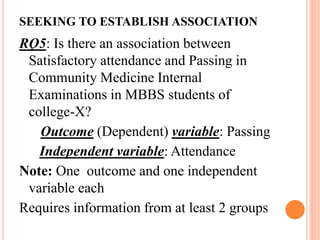
SEEKING TO ESTABLISH ASSOCIATION
RQ5: Is there an association between
Satisfactory attendance and Passing in
Community Medicine Internal
Examinations in MBBS students of
college-X?
Outcome (Dependent) variable: Passing
Independent variable: Attendance
Note: One outcome and one independent
variable each
Requires information from at least 2 groups
SEEKING TO ESTABLISH
ASSOCIATION
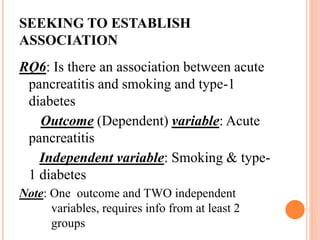
RQ6: Is there an association between acute
pancreatitis and smoking and type-1
diabetes
Outcome (Dependent) variable: Acute
pancreatitis
Independent variable: Smoking & type-
1 diabetes
Note: One outcome and TWO independent
variables, requires info from at least 2
groups
DIFFERENCE TYPE OF RQ
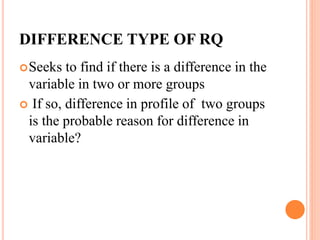
Seeks to find if there is a difference in the
variable in two or more groups
 If so, difference in profile of two groups
is the probable reason for difference in
variable?
DIFFERENCE TYPE OF RQ
Difference of a variable in 2 or more
groups
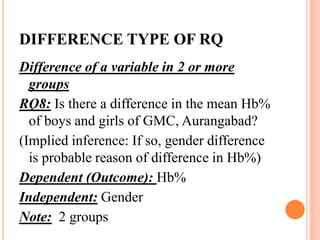
RQ8: Is there a difference in the mean Hb%
of boys and girls of GMC, Aurangabad?
(Implied inference: If so, gender difference
is probable reason of difference in Hb%)
Dependent (Outcome): Hb%
Independent: Gender
Note: 2 groups
DIFFERENCE TYPE OF RQ
Difference of a variable in 2 or more
groups
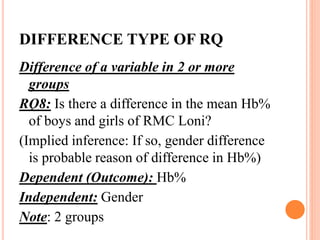
RQ8: Is there a difference in the mean Hb%
of boys and girls of RMC Loni?
(Implied inference: If so, gender difference
is probable reason of difference in Hb%)
Dependent (Outcome): Hb%
Independent: Gender
Note: 2 groups
DIFFERENCE TYPE OF RQ
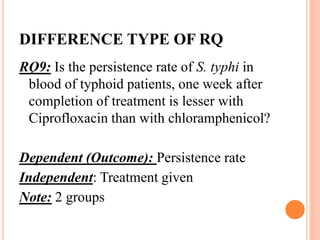
RQ9: Is the persistence rate of S. typhi in
blood of typhoid patients, one week after
completion of treatment is lesser with
Ciprofloxacin than with chloramphenicol?
Dependent (Outcome): Persistence rate
Independent: Treatment given
Note: 2 groups
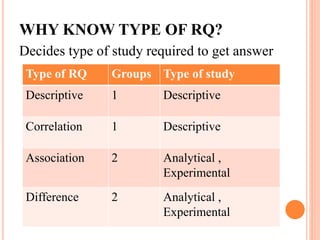
WHY KNOW TYPE OF RQ?
Decides type of study required to get answer
Type of RQ Groups Type of study
Descriptive 1 Descriptive
Correlation 1 Descriptive
Association 2 Analytical ,
Experimental
Difference 2 Analytical ,
Experimental
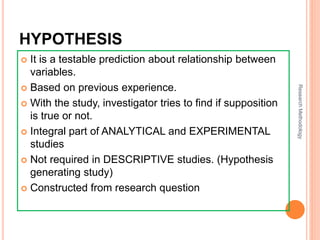
HYPOTHESISESIS
 It is a testable prediction about relationship between
variables.
 Based on previous experience.
 With the study, investigator tries to find if supposition
is true or not.
 Integral part of ANALYTICAL and EXPERIMENTAL
studies
 Not required in DESCRIPTIVE studies. (Hypothesis
generating study)
 Constructed from research question
ResearchMethodology
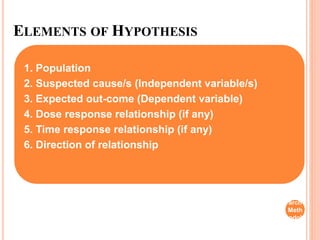
ELEMENTS OF HYPOTHESIS
1. Population
2. Suspected cause/s (Independent variable/s)
3. Expected out-come (Dependent variable)
4. Dose response relationship (if any)
5. Time response relationship (if any)
6. Direction of relationship
Rese
arch
Meth
odol
ogy
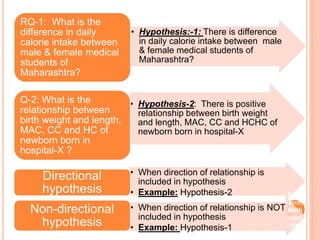
• Hypothesis:-1: There is difference
in daily calorie intake between male
& female medical students of
Maharashtra?
RQ-1: What is the
difference in daily
calorie intake between
male & female medical
students of
Maharashtra?
• Hypothesis-2: There is positive
relationship between birth weight
and length, MAC, CC and HCHC of
newborn born in hospital-X
Q-2: What is the
relationship between
birth weight and length,
MAC, CC and HC of
newborn born in
hospital-X ?
• When direction of relationship is
included in hypothesis
• Example: Hypothesis-2
Directional
hypothesis
• When direction of relationship is NOT
included in hypothesis
• Example: Hypothesis-1
Non-directional
hypothesis
Rese
arch
Meth
odol
ogy
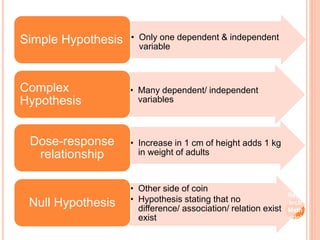
• Only one dependent & independent
variable
Simple Hypothesis
• Many dependent/ independent
variables
Complex
Hypothesis
• Increase in 1 cm of height adds 1 kg
in weight of adults
Dose-response
relationship
• Other side of coin
• Hypothesis stating that no
difference/ association/ relation exist
exist
Null Hypothesis
Rese
arch
Meth
odol
ogy
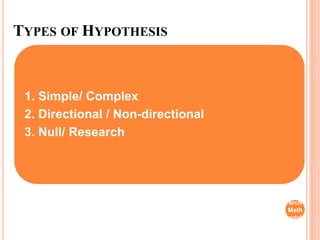
TYPES OF HYPOTHESIS
1. Simple/ Complex
2. Directional / Non-directional
3. Null/ Research
Rese
arch
Meth
odol
ogy
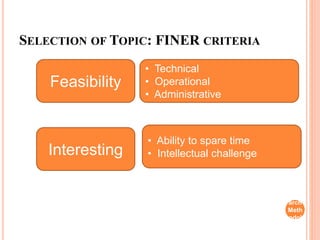
SELECTION OF TOPIC: FINER CRITERIA
Feasibility
• Technical
• Operational
• Administrative
Interesting
• Ability to spare time
• Intellectual challenge
Rese
arch
Meth
odol
ogy
SELECTION OF TOPIC: FINER CRITERIA
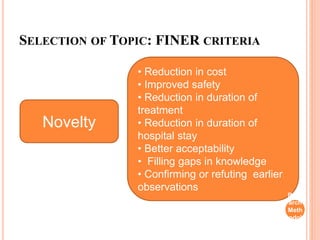
Novelty
• Reduction in cost
• Improved safety
• Reduction in duration of
treatment
• Reduction in duration of
hospital stay
• Better acceptability
• Filling gaps in knowledge
• Confirming or refuting earlier
observations
Rese
arch
Meth
odol
ogy
SELECTION OF TOPIC: FINER CRITERIA
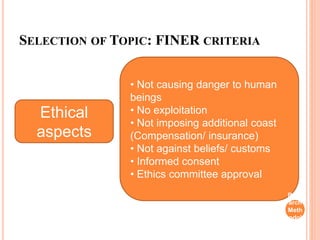
Ethical
aspects
• Not causing danger to human
beings
• No exploitation
• Not imposing additional coast
(Compensation/ insurance)
• Not against beliefs/ customs
• Informed consent
• Ethics committee approval
Rese
arch
Meth
odol
ogy
SELECTION OF TOPIC: FINER CRITERIA
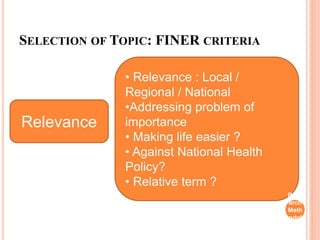
Relevance
• Relevance : Local /
Regional / National
•Addressing problem of
importance
• Making life easier ?
• Against National Health
Policy?
• Relative term ?
Rese
arch
Meth
odol
ogy
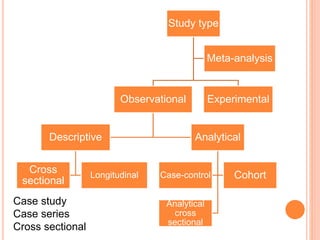
Study type
Observational
Descriptive
Cross
sectional
Longitudinal
Analytical
Case-control Cohort
Analytical
cross
sectional
Experimental
Meta-analysis
Case study
Case series
Cross sectional

1. introduction-v2

  • 1.
  • 2.
    WHAT IS RESEARCH? Research produces findings that are not determined in advance.  Produce findings that are applicable beyond the immediate boundaries of the study. (External validation) Rese arch Meth odol ogy
  • 3.
    WHAT IS RESEARCH? Seeks answer to a question. This is the RQ. Uncertainty that researcher wants to clear. It is also a knowledge gap that the researcher wants to fill.  Systematically uses a predefined set of procedures to answer the question. Study design that the researcher uses and material and methods that are explained therein.  Collects evidence: In the form of data, variables and statistics. (Descriptive or inferential) Rese arch Meth odol ogy
  • 4.
    RESEARCH QUESTION Question thatepidemiologist is seeking answer to RQ1: What is prevalence of diabetes in allopathic doctors in Maharashtra? Good RQ: Variable: Prevalence of diabetes Population: (Participants) Allopathic doctors in Maharashtra
  • 5.
    RESEARCH QUESTION Question thatepidemiologist is seeking answer to RQ2: What is the average daily intake of proteins and calories in male and female students of PIMS DU? Variable: i. Average daily intake of proteins ii. Average daily intake of calories Population: (Participants) i. Male students of PIMS DU, ii) Female students of PIMS DU
  • 6.
    VARIABLES PRIMARY VARIABLES:  Variablesin RQ  Prevalence of diabetes in RQ1, Average daily intake of Calories and proteins in RQ2 SECONDARY VARIABLES  Variables in NOT in RQ, but in study  Eg. Gender, Years of practice, Specialty, Residence (R/U) in RQ1
  • 7.
    TYPES OF RQ Typeof RQ Based on aim Descriptive Correlation Association Difference Based on number of variables Simple Complex
  • 8.
    DESCRIPTIVE TYPE OFRQ Seek for Description of disease Person distribution Place distribution Time distribution Estimate of Prevalence, incidence, mean
  • 9.
    DESCRIBE DISEASE RQ3: Whatis the profile of anemia in ANCs attending GMC, Aurangabad? Profile: Age, SE status, Parity, Birth interval, BOH Note: Persons distribution, one group RQ4: What is the performance of MBBS students in different colleges of MUHS in PSM in 2016 winter exams? Note : Place distribution, one group
  • 10.
    SEEKING FOR ESTIMATES RQ1:What is prevalence of diabetes in allopathic doctors in Maharashtra? Note: Seeking for prevalence RQ2: What is the average daily intake of proteins and calories in male and female students of GMC, Aurangabad? Note: Seeking for average
  • 11.
    ASSOCIATION TYPE OFRQ Seek to establish Correlation
  • 12.
    SEEKING TO ESTABLISHCORRELATION Correlation: Mathematical relationship between two or more quantitative variables (Variable expressed in number) Dependent (Outcome) variable Independent variables RQ7: Is there a correlation between birth weight of newborn and i) MAC, ii) CC, and iii) HC of the newborn Note: >1 independent variables One group
  • 13.
    ASSOCIATION TYPE OFRQ Seek to establish Association
  • 14.
    ASSOCIATION Relationship of onequalitative variable with one or more qualitative variables  Disease or health related event is the one of interest and is called OUTCOME or Dependent variable  Other variables with which association of outcome is to be tested are called RISK FACTORS or Independent variables
  • 15.
    SEEKING TO ESTABLISHASSOCIATION RQ5: Is there an association between Satisfactory attendance and Passing in Community Medicine Internal Examinations in MBBS students of college-X? Outcome (Dependent) variable: Passing Independent variable: Attendance Note: One outcome and one independent variable each Requires information from at least 2 groups
  • 16.
    SEEKING TO ESTABLISH ASSOCIATION RQ6:Is there an association between acute pancreatitis and smoking and type-1 diabetes Outcome (Dependent) variable: Acute pancreatitis Independent variable: Smoking & type- 1 diabetes Note: One outcome and TWO independent variables, requires info from at least 2 groups
  • 17.
    DIFFERENCE TYPE OFRQ Seeks to find if there is a difference in the variable in two or more groups  If so, difference in profile of two groups is the probable reason for difference in variable?
  • 18.
    DIFFERENCE TYPE OFRQ Difference of a variable in 2 or more groups RQ8: Is there a difference in the mean Hb% of boys and girls of GMC, Aurangabad? (Implied inference: If so, gender difference is probable reason of difference in Hb%) Dependent (Outcome): Hb% Independent: Gender Note: 2 groups
  • 19.
    DIFFERENCE TYPE OFRQ Difference of a variable in 2 or more groups RQ8: Is there a difference in the mean Hb% of boys and girls of RMC Loni? (Implied inference: If so, gender difference is probable reason of difference in Hb%) Dependent (Outcome): Hb% Independent: Gender Note: 2 groups
  • 20.
    DIFFERENCE TYPE OFRQ RQ9: Is the persistence rate of S. typhi in blood of typhoid patients, one week after completion of treatment is lesser with Ciprofloxacin than with chloramphenicol? Dependent (Outcome): Persistence rate Independent: Treatment given Note: 2 groups
  • 21.
    WHY KNOW TYPEOF RQ? Decides type of study required to get answer Type of RQ Groups Type of study Descriptive 1 Descriptive Correlation 1 Descriptive Association 2 Analytical , Experimental Difference 2 Analytical , Experimental
  • 22.
    HYPOTHESISESIS  It isa testable prediction about relationship between variables.  Based on previous experience.  With the study, investigator tries to find if supposition is true or not.  Integral part of ANALYTICAL and EXPERIMENTAL studies  Not required in DESCRIPTIVE studies. (Hypothesis generating study)  Constructed from research question ResearchMethodology
  • 23.
    ELEMENTS OF HYPOTHESIS 1.Population 2. Suspected cause/s (Independent variable/s) 3. Expected out-come (Dependent variable) 4. Dose response relationship (if any) 5. Time response relationship (if any) 6. Direction of relationship Rese arch Meth odol ogy
  • 24.
    • Hypothesis:-1: Thereis difference in daily calorie intake between male & female medical students of Maharashtra? RQ-1: What is the difference in daily calorie intake between male & female medical students of Maharashtra? • Hypothesis-2: There is positive relationship between birth weight and length, MAC, CC and HCHC of newborn born in hospital-X Q-2: What is the relationship between birth weight and length, MAC, CC and HC of newborn born in hospital-X ? • When direction of relationship is included in hypothesis • Example: Hypothesis-2 Directional hypothesis • When direction of relationship is NOT included in hypothesis • Example: Hypothesis-1 Non-directional hypothesis Rese arch Meth odol ogy
  • 25.
    • Only onedependent & independent variable Simple Hypothesis • Many dependent/ independent variables Complex Hypothesis • Increase in 1 cm of height adds 1 kg in weight of adults Dose-response relationship • Other side of coin • Hypothesis stating that no difference/ association/ relation exist exist Null Hypothesis Rese arch Meth odol ogy
  • 26.
    TYPES OF HYPOTHESIS 1.Simple/ Complex 2. Directional / Non-directional 3. Null/ Research Rese arch Meth odol ogy
  • 27.
    SELECTION OF TOPIC:FINER CRITERIA Feasibility • Technical • Operational • Administrative Interesting • Ability to spare time • Intellectual challenge Rese arch Meth odol ogy
  • 28.
    SELECTION OF TOPIC:FINER CRITERIA Novelty • Reduction in cost • Improved safety • Reduction in duration of treatment • Reduction in duration of hospital stay • Better acceptability • Filling gaps in knowledge • Confirming or refuting earlier observations Rese arch Meth odol ogy
  • 29.
    SELECTION OF TOPIC:FINER CRITERIA Ethical aspects • Not causing danger to human beings • No exploitation • Not imposing additional coast (Compensation/ insurance) • Not against beliefs/ customs • Informed consent • Ethics committee approval Rese arch Meth odol ogy
  • 30.
    SELECTION OF TOPIC:FINER CRITERIA Relevance • Relevance : Local / Regional / National •Addressing problem of importance • Making life easier ? • Against National Health Policy? • Relative term ? Rese arch Meth odol ogy
  • 31.