Prof Sriram Chandra Mishra
Kayachikitsa Department
VYDS Ayurved Mahavidyalaya, Khurja
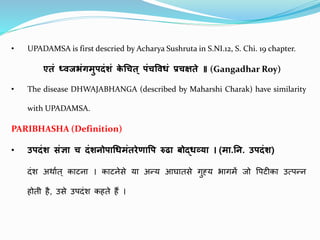
• UPADAMSA is first descried by Acharya Sushruta in S.NI.12, S. Chi. 19 chapter.
एतं ध्वजभंगमुपदंशं क
े चित् पंिववधं प्रिक्षते ॥ (Gangadhar Roy)
• The disease DHWAJABHANGA (described by Maharshi Charak) have similarity
with UPADAMSA.
PARIBHASHA (Definition)
• उपदंश संज्ञा ि दंशनोपाचधमंतरेणावप रुढा बोद्धव्या । (मा.नन. उपदंश​)
दंश अर्थात् कथटनथ । कथटनेसे यथ अन्य आघथतसे गुह्य भथगमें जो पिटीकथ उत्िन्न
होती है, उसे उिदंश कहते हैं ।
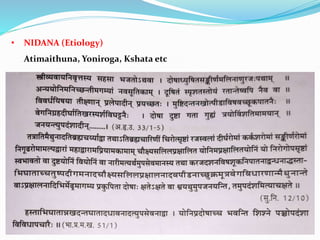
• NIDANA (Etiology)
Atimaithuna, Yoniroga, Kshata etc
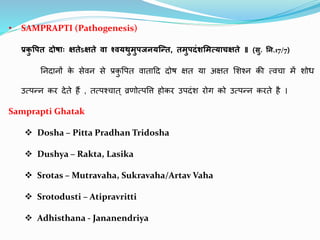
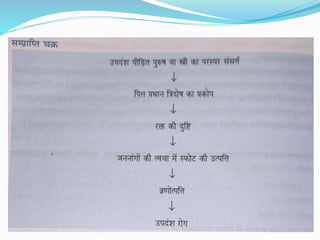
• SAMPRAPTI (Pathogenesis)
प्रक
ु वपत दोषााः क्षतेऽक्षते वा श्वयथुमुपजनयन्तत, तमुपदंशममत्यािक्षते ॥ (सु. नन.17/7)
ननदथनों क
े सेवन से प्रक
ु पित वथतथदद दोष क्षत यथ अक्षत शशश्न की त्वचथ में शोध
उत्िन्न कर देते हैं , तत्िश्चथत् व्रणोत्िपि होकर उिदंश रोग को उत्िन्न करते है ।
Samprapti Ghatak
 Dosha – Pitta Pradhan Tridosha
 Dushya – Rakta, Lasika
 Srotas – Mutravaha, Sukravaha/Artav Vaha
 Srotodusti – Atipravritti
 Adhisthana - Jananendriya
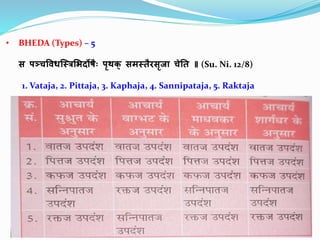
• BHEDA (Types) – 5
स पञ्िववधन्रिमभदोषाः पृथक् समरतरसृजा िेनत ॥ (Su. Ni. 12/8)
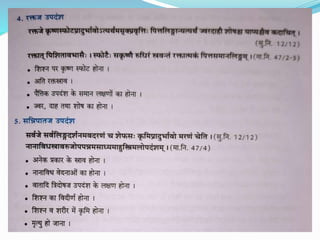
1. Vataja, 2. Pittaja, 3. Kaphaja, 4. Sannipataja, 5. Raktaja
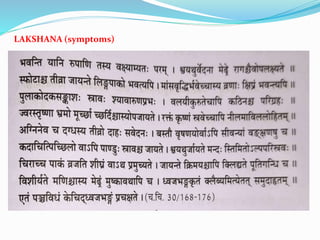
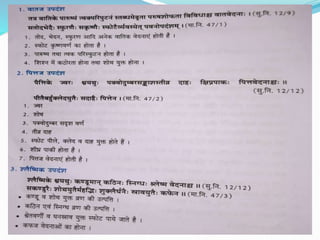
LAKSHANA (symptoms)
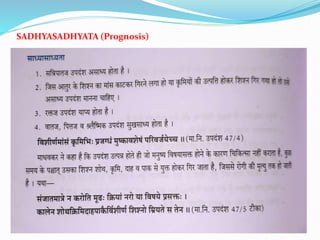
SADHYASADHYATA (Prognosis)
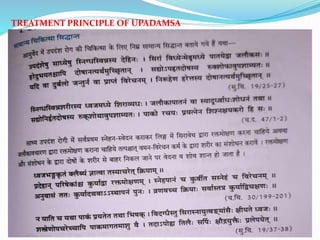
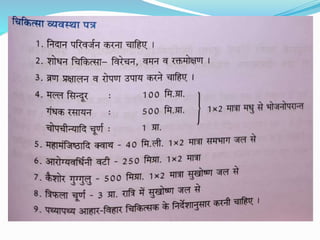
TREATMENT PRINCIPLE OF UPADAMSA
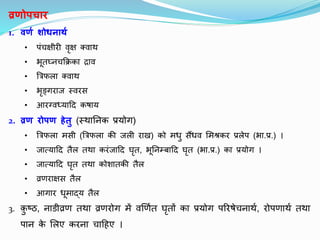
व्रणोपिार
1. वणण शोधनाथण
• िंचक्षीरी वृक्ष क्वथर्
• भूतघ्नचक्रिकथ द्रथव
• त्रिफलथ क्वथर्
• भृङ्गरथज स्वरस
• आरग्वध्यथदद कषथय
2. व्रण रोपण हेतु (स्र्थननक प्रयोग)
• त्रिफलथ मसी (त्रिफलथ की जली रथख) को मधु सैंधव शमश्रकर प्रलेि (भथ.प्र.) ।
• जथत्यथदद तैल तर्थ करंजथदद घृत, भूननम्बथदद घृत (भथ.प्र.) कथ प्रयोग ।
• जथत्यथदद घृत तर्थ कोशथतकी तैल
• व्रणरथक्षस तैल
• आगथर धूमथद्य तैल
3. क
ु ष्ठ, नथडीव्रण तर्थ व्रणरोग में वर्णात घृतों कथ प्रयोग िररषेचनथर्ा, रोिणथर्ा तर्थ
िथन क
े शलए करनथ चथदहए ।
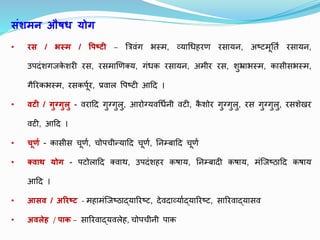
संशमन औषध योग
• रस / भरम / वपष्टी – त्रिवंग भस्म, व्यथधधहरण रसथयन, अष्टमूनता रसथयन,
उिदंशगजक
े शरी रस, रसमथर्णक्य, गंधक रसथयन, अमीर रस, शुभ्रथभस्म, कथसीसभस्म,
गैररकभस्म, रसकिूार, प्रवथल पिष्टी आदद ।
• वटी / गुग्गुलु - वरथदद गुग्गुलु, आरोग्यवधधानी वटी, क
ै शोर गुग्गुलु, रस गुग्गुलु, रसशेखर
वटी, आदद ।
• िूणण - कथसीस चूणा, चोिचीन्यथदद चूणा, ननम्बथदद चूणा
• क्वाथ योग - िटोलथदद क्वथर्, उिदंशहर कषथय, ननम्बथदी कषथय, मंजजष्ठथदद कषथय
आदद ।
• आसव / अररष्ट - महथमंजजष्ठथद्यथररष्ट, देवदथव्यथाद्यथररष्ट, सथररवथद्यथसव
• अवलेह / पाक – सथररवथद्यवलेह, चोिचीनी िथक
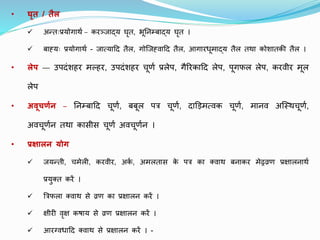
• घृत / तल
 अन्तःप्रयोगथर्ा – करञ्जथद्य घृत, भूननम्बथद्य घृत ।
 बथह्यः प्रयोगथर्ा - जथत्यथदद तैल, गोजजह्वथदद तैल, आगथरधूमथद्य तैल तर्थ कोशथतकी तैल ।
• लेप — उिदंशहर मल्हर, उिदंशहर चूणा प्रलेि, गैररकथदद लेि, िूगफल लेि, करवीर मूल
लेि
• अवूिणणन – ननम्बथदद चूणा, बबूल िि चूणा, दथड़िमत्वक चूणा, मथनव अजस्र्चूणा,
अवचूणान तर्थ कथसीस चूणा अवचूणान ।
• प्रक्षालन योग
 जयन्ती, चमेली, करवीर, अक
ा , अमलतथस क
े िि कथ क्वथर् बनथकर मेढ्रव्रण प्रक्षथलनथर्ा
प्रयुक्त करें ।
 त्रिफलथ क्वथर् से व्रण कथ प्रक्षथलन करें ।
 क्षीरी वृक्ष कषथय से व्रण प्रक्षथलन करें ।
 आरग्वधथदद क्वथर् से प्रक्षथलन करें । -
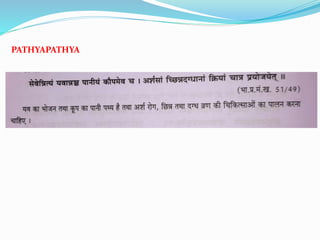
PATHYAPATHYA
CHANCROID
Definition
Chancroid is a sexually transmitted disease caused by the gram-
negative bacteria Haemophilus ducreyi and is characterized by painful
necrotizing genital ulcers that may be accompanied by inguinal
lymphadenopathy.
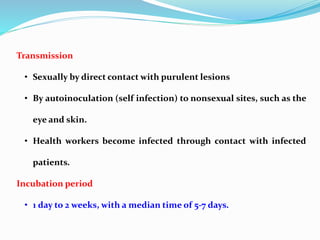
Transmission
• Sexually by direct contact with purulent lesions
• By autoinoculation (self infection) to nonsexual sites, such as the
eye and skin.
• Health workers become infected through contact with infected
patients.
Incubation period
• 1 day to 2 weeks, with a median time of 5-7 days.
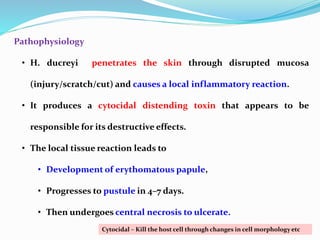
Pathophysiology
• H. ducreyi penetrates the skin through disrupted mucosa
(injury/scratch/cut) and causes a local inflammatory reaction.
• It produces a cytocidal distending toxin that appears to be
responsible for its destructive effects.
• The local tissue reaction leads to
• Development of erythomatous papule,
• Progresses to pustule in 4–7 days.
• Then undergoes central necrosis to ulcerate.
Cytocidal – Kill the host cell through changes in cell morphology etc
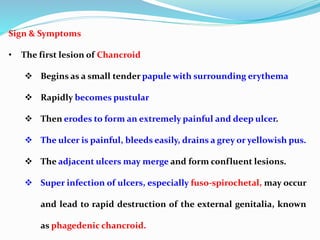
Sign & Symptoms
• The first lesion of Chancroid
 Begins as a small tender papule with surrounding erythema
 Rapidly becomes pustular
 Then erodes to form an extremely painful and deep ulcer.
 The ulcer is painful, bleeds easily, drains a grey or yellowish pus.
 The adjacent ulcers may merge and form confluent lesions.
 Super infection of ulcers, especially fuso-spirochetal, may occur
and lead to rapid destruction of the external genitalia, known
as phagedenic chancroid.
Ulcer base is composed of
• Easily friable granulation tissue that is usually covered with
malodorous yellow-gray exudates. (malodorous - very unpleasant
smell)
• It has soft, sharply defined, ragged margins
(differ from primary syphillis Chancre - typically painless,
indurated and has a clean base)
• Vary in size from 1-20 mm.
Friable – Easily Crumbled
• Ulcer in men & women
• About half of infected men have only a single ulcer.
• Women often have four or more ulcers.
• Women may be asymptomatic carriers of the disease.
• The chief symptom may be dysuria or dyspareunia.
• May have a higher incidence of resolution after papule
formation without ulcer formation.
Dyspareunia – Recurrent genital pain in intercourse
Common locations of ulcers
• In men are the shaft or head of the penis, foreskin, the groove
behind the head of the penis, the opening of the penis, and the
scrotum.
• In circumcised men - Coronal sulcus
• In uncircumcised men - Prepuce. Lesions may be obscured by a
painful phimosis in uncircumcised men.
• In women, common locations are the labia majora (outer lips), labia
minora (inner lips), perianal area (area around the anal opening)
and inner thighs.
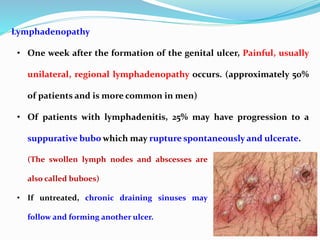
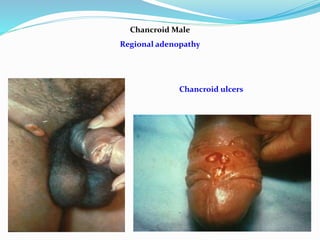
Lymphadenopathy
• One week after the formation of the genital ulcer, Painful, usually
unilateral, regional lymphadenopathy occurs. (approximately 50%
of patients and is more common in men)
• Of patients with lymphadenitis, 25% may have progression to a
suppurative bubo which may rupture spontaneously and ulcerate.
(The swollen lymph nodes and abscesses are
also called buboes)
• If untreated, chronic draining sinuses may
follow and forming another ulcer.
Chancroid Male
Regional adenopathy
Chancroid ulcers
Other types of Chancroid
Although relatively rare, chancroid sometimes may be associated with various
presentations that differ from the classic form described above.
• Transient chancroid produces an ulcer that rapidly resolves in 4-6 days, followed 10-20
days later by a suppurative lymphadenitis.
• Dwarf chancroid manifests as one or several herpes like ulcerations, with or without
inguinal lymphadenopathy.
• Follicular chancroid produces ulcerations of the pilar apparatus in hair-bearing areas.
• Giant chancroid consists of multiple small ulcerations, which coalesce to form a single
large lesion.
• Pseudogranuloma inguinale - Pseudogranuloma inguinale is another chancroid
variety that closely resembles granuloma inguinale.
Laboratory findings
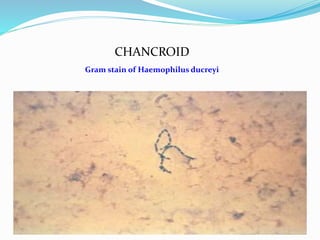
• Microscopically - From bubo pus or ulcer secretions, H. ducreyi can
be identified.
• PCR-based identification
• Antigen detection methods - Simple, rapid, sensitive and
inexpensive
• Serologic detection of H. Ducreyi (uses outer membrane
protein and lipooligosaccharide)
CHANCROID
Gram stain of Haemophilus ducreyi
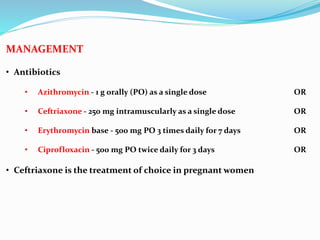
MANAGEMENT
• Antibiotics
• Azithromycin - 1 g orally (PO) as a single dose OR
• Ceftriaxone - 250 mg intramuscularly as a single dose OR
• Erythromycin base - 500 mg PO 3 times daily for 7 days OR
• Ciprofloxacin - 500 mg PO twice daily for 3 days OR
• Ceftriaxone is the treatment of choice in pregnant women
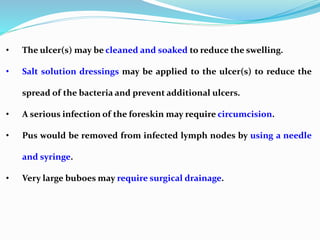
• The ulcer(s) may be cleaned and soaked to reduce the swelling.
• Salt solution dressings may be applied to the ulcer(s) to reduce the
spread of the bacteria and prevent additional ulcers.
• A serious infection of the foreskin may require circumcision.
• Pus would be removed from infected lymph nodes by using a needle
and syringe.
• Very large buboes may require surgical drainage.
Prognosis of Chancroid / Soft Chancre
• Without treatment, chancroid may either go away quickly or
patients may experience the painful ulcers for many months.
• A complete cure is obtained with antibiotic treatment.
• Severe ulcers may cause permanent scars.
• Urethral fistulas may occur and requires corrective surgery.
UPADAMSHA (Chancroid / SOFT CHANCRE)

UPADAMSHA (Chancroid / SOFT CHANCRE)

  • 1.
    Prof Sriram ChandraMishra Kayachikitsa Department VYDS Ayurved Mahavidyalaya, Khurja
  • 2.
    • UPADAMSA isfirst descried by Acharya Sushruta in S.NI.12, S. Chi. 19 chapter. एतं ध्वजभंगमुपदंशं क े चित् पंिववधं प्रिक्षते ॥ (Gangadhar Roy) • The disease DHWAJABHANGA (described by Maharshi Charak) have similarity with UPADAMSA. PARIBHASHA (Definition) • उपदंश संज्ञा ि दंशनोपाचधमंतरेणावप रुढा बोद्धव्या । (मा.नन. उपदंश​) दंश अर्थात् कथटनथ । कथटनेसे यथ अन्य आघथतसे गुह्य भथगमें जो पिटीकथ उत्िन्न होती है, उसे उिदंश कहते हैं ।
  • 3.
  • 4.
    • SAMPRAPTI (Pathogenesis) प्रक ुवपत दोषााः क्षतेऽक्षते वा श्वयथुमुपजनयन्तत, तमुपदंशममत्यािक्षते ॥ (सु. नन.17/7) ननदथनों क े सेवन से प्रक ु पित वथतथदद दोष क्षत यथ अक्षत शशश्न की त्वचथ में शोध उत्िन्न कर देते हैं , तत्िश्चथत् व्रणोत्िपि होकर उिदंश रोग को उत्िन्न करते है । Samprapti Ghatak  Dosha – Pitta Pradhan Tridosha  Dushya – Rakta, Lasika  Srotas – Mutravaha, Sukravaha/Artav Vaha  Srotodusti – Atipravritti  Adhisthana - Jananendriya
  • 6.
    • BHEDA (Types)– 5 स पञ्िववधन्रिमभदोषाः पृथक् समरतरसृजा िेनत ॥ (Su. Ni. 12/8) 1. Vataja, 2. Pittaja, 3. Kaphaja, 4. Sannipataja, 5. Raktaja
  • 7.
  • 10.
  • 11.
  • 12.
    व्रणोपिार 1. वणण शोधनाथण •िंचक्षीरी वृक्ष क्वथर् • भूतघ्नचक्रिकथ द्रथव • त्रिफलथ क्वथर् • भृङ्गरथज स्वरस • आरग्वध्यथदद कषथय 2. व्रण रोपण हेतु (स्र्थननक प्रयोग) • त्रिफलथ मसी (त्रिफलथ की जली रथख) को मधु सैंधव शमश्रकर प्रलेि (भथ.प्र.) । • जथत्यथदद तैल तर्थ करंजथदद घृत, भूननम्बथदद घृत (भथ.प्र.) कथ प्रयोग । • जथत्यथदद घृत तर्थ कोशथतकी तैल • व्रणरथक्षस तैल • आगथर धूमथद्य तैल 3. क ु ष्ठ, नथडीव्रण तर्थ व्रणरोग में वर्णात घृतों कथ प्रयोग िररषेचनथर्ा, रोिणथर्ा तर्थ िथन क े शलए करनथ चथदहए ।
  • 13.
    संशमन औषध योग •रस / भरम / वपष्टी – त्रिवंग भस्म, व्यथधधहरण रसथयन, अष्टमूनता रसथयन, उिदंशगजक े शरी रस, रसमथर्णक्य, गंधक रसथयन, अमीर रस, शुभ्रथभस्म, कथसीसभस्म, गैररकभस्म, रसकिूार, प्रवथल पिष्टी आदद । • वटी / गुग्गुलु - वरथदद गुग्गुलु, आरोग्यवधधानी वटी, क ै शोर गुग्गुलु, रस गुग्गुलु, रसशेखर वटी, आदद । • िूणण - कथसीस चूणा, चोिचीन्यथदद चूणा, ननम्बथदद चूणा • क्वाथ योग - िटोलथदद क्वथर्, उिदंशहर कषथय, ननम्बथदी कषथय, मंजजष्ठथदद कषथय आदद । • आसव / अररष्ट - महथमंजजष्ठथद्यथररष्ट, देवदथव्यथाद्यथररष्ट, सथररवथद्यथसव • अवलेह / पाक – सथररवथद्यवलेह, चोिचीनी िथक
  • 14.
    • घृत /तल  अन्तःप्रयोगथर्ा – करञ्जथद्य घृत, भूननम्बथद्य घृत ।  बथह्यः प्रयोगथर्ा - जथत्यथदद तैल, गोजजह्वथदद तैल, आगथरधूमथद्य तैल तर्थ कोशथतकी तैल । • लेप — उिदंशहर मल्हर, उिदंशहर चूणा प्रलेि, गैररकथदद लेि, िूगफल लेि, करवीर मूल लेि • अवूिणणन – ननम्बथदद चूणा, बबूल िि चूणा, दथड़िमत्वक चूणा, मथनव अजस्र्चूणा, अवचूणान तर्थ कथसीस चूणा अवचूणान । • प्रक्षालन योग  जयन्ती, चमेली, करवीर, अक ा , अमलतथस क े िि कथ क्वथर् बनथकर मेढ्रव्रण प्रक्षथलनथर्ा प्रयुक्त करें ।  त्रिफलथ क्वथर् से व्रण कथ प्रक्षथलन करें ।  क्षीरी वृक्ष कषथय से व्रण प्रक्षथलन करें ।  आरग्वधथदद क्वथर् से प्रक्षथलन करें । -
  • 16.
  • 17.
    CHANCROID Definition Chancroid is asexually transmitted disease caused by the gram- negative bacteria Haemophilus ducreyi and is characterized by painful necrotizing genital ulcers that may be accompanied by inguinal lymphadenopathy.
  • 18.
    Transmission • Sexually bydirect contact with purulent lesions • By autoinoculation (self infection) to nonsexual sites, such as the eye and skin. • Health workers become infected through contact with infected patients. Incubation period • 1 day to 2 weeks, with a median time of 5-7 days.
  • 19.
    Pathophysiology • H. ducreyipenetrates the skin through disrupted mucosa (injury/scratch/cut) and causes a local inflammatory reaction. • It produces a cytocidal distending toxin that appears to be responsible for its destructive effects. • The local tissue reaction leads to • Development of erythomatous papule, • Progresses to pustule in 4–7 days. • Then undergoes central necrosis to ulcerate. Cytocidal – Kill the host cell through changes in cell morphology etc
  • 20.
    Sign & Symptoms •The first lesion of Chancroid  Begins as a small tender papule with surrounding erythema  Rapidly becomes pustular  Then erodes to form an extremely painful and deep ulcer.  The ulcer is painful, bleeds easily, drains a grey or yellowish pus.  The adjacent ulcers may merge and form confluent lesions.  Super infection of ulcers, especially fuso-spirochetal, may occur and lead to rapid destruction of the external genitalia, known as phagedenic chancroid.
  • 21.
    Ulcer base iscomposed of • Easily friable granulation tissue that is usually covered with malodorous yellow-gray exudates. (malodorous - very unpleasant smell) • It has soft, sharply defined, ragged margins (differ from primary syphillis Chancre - typically painless, indurated and has a clean base) • Vary in size from 1-20 mm. Friable – Easily Crumbled
  • 22.
    • Ulcer inmen & women • About half of infected men have only a single ulcer. • Women often have four or more ulcers. • Women may be asymptomatic carriers of the disease. • The chief symptom may be dysuria or dyspareunia. • May have a higher incidence of resolution after papule formation without ulcer formation. Dyspareunia – Recurrent genital pain in intercourse
  • 23.
    Common locations ofulcers • In men are the shaft or head of the penis, foreskin, the groove behind the head of the penis, the opening of the penis, and the scrotum. • In circumcised men - Coronal sulcus • In uncircumcised men - Prepuce. Lesions may be obscured by a painful phimosis in uncircumcised men. • In women, common locations are the labia majora (outer lips), labia minora (inner lips), perianal area (area around the anal opening) and inner thighs.
  • 24.
    Lymphadenopathy • One weekafter the formation of the genital ulcer, Painful, usually unilateral, regional lymphadenopathy occurs. (approximately 50% of patients and is more common in men) • Of patients with lymphadenitis, 25% may have progression to a suppurative bubo which may rupture spontaneously and ulcerate. (The swollen lymph nodes and abscesses are also called buboes) • If untreated, chronic draining sinuses may follow and forming another ulcer.
  • 25.
  • 26.
    Other types ofChancroid Although relatively rare, chancroid sometimes may be associated with various presentations that differ from the classic form described above. • Transient chancroid produces an ulcer that rapidly resolves in 4-6 days, followed 10-20 days later by a suppurative lymphadenitis. • Dwarf chancroid manifests as one or several herpes like ulcerations, with or without inguinal lymphadenopathy. • Follicular chancroid produces ulcerations of the pilar apparatus in hair-bearing areas. • Giant chancroid consists of multiple small ulcerations, which coalesce to form a single large lesion. • Pseudogranuloma inguinale - Pseudogranuloma inguinale is another chancroid variety that closely resembles granuloma inguinale.
  • 27.
    Laboratory findings • Microscopically- From bubo pus or ulcer secretions, H. ducreyi can be identified. • PCR-based identification • Antigen detection methods - Simple, rapid, sensitive and inexpensive • Serologic detection of H. Ducreyi (uses outer membrane protein and lipooligosaccharide)
  • 28.
    CHANCROID Gram stain ofHaemophilus ducreyi
  • 29.
    MANAGEMENT • Antibiotics • Azithromycin- 1 g orally (PO) as a single dose OR • Ceftriaxone - 250 mg intramuscularly as a single dose OR • Erythromycin base - 500 mg PO 3 times daily for 7 days OR • Ciprofloxacin - 500 mg PO twice daily for 3 days OR • Ceftriaxone is the treatment of choice in pregnant women
  • 30.
    • The ulcer(s)may be cleaned and soaked to reduce the swelling. • Salt solution dressings may be applied to the ulcer(s) to reduce the spread of the bacteria and prevent additional ulcers. • A serious infection of the foreskin may require circumcision. • Pus would be removed from infected lymph nodes by using a needle and syringe. • Very large buboes may require surgical drainage.
  • 31.
    Prognosis of Chancroid/ Soft Chancre • Without treatment, chancroid may either go away quickly or patients may experience the painful ulcers for many months. • A complete cure is obtained with antibiotic treatment. • Severe ulcers may cause permanent scars. • Urethral fistulas may occur and requires corrective surgery.