Quiz
• Pick up quiz and handout on your way in.
• Start at 1pm
• Finish at 1:10pm

• The quiz is not for a grade, but I will be
  collecting it.
Stat 310
Bivariate Change of Variables


    Garrett Grolemund
1. Review of distribution function
   techniques
2. Change of variables technique
3. Determining independence
4. Simulating transformations
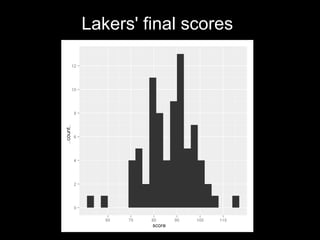
Lakers' final scores
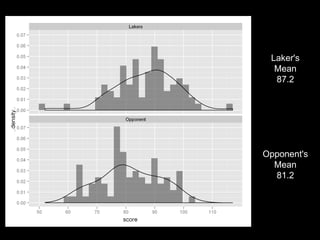
Laker's
  Mean
  87.2


Opponent's
  Mean
  81.2
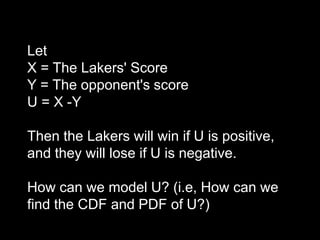
Let
X = The Lakers' Score
Y = The opponent's score
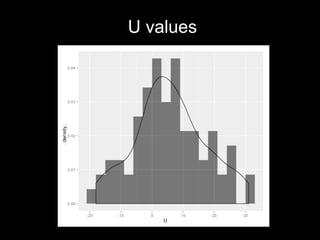
U = X -Y

Then the Lakers will win if U is positive,
and they will lose if U is negative.

How can we model U? (i.e, How can we
find the CDF and PDF of U?)
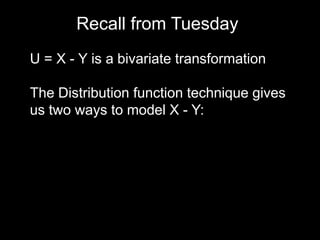
Recall from Tuesday
U = X - Y is a bivariate transformation

The Distribution function technique gives
us two ways to model X - Y:
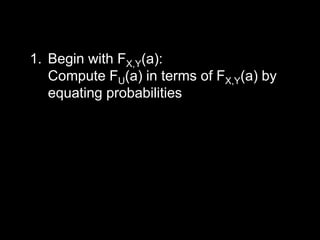
1. Begin with FX,Y(a):
   Compute FU(a) in terms of FX,Y(a) by
   equating probabilities
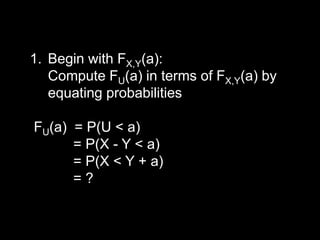
1. Begin with FX,Y(a):
   Compute FU(a) in terms of FX,Y(a) by
   equating probabilities

FU(a) = P(U < a)
      = P(X - Y < a)
      = P(X < Y + a)
      =?
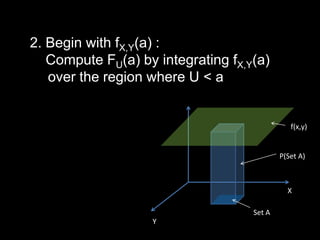
2. Begin with fX,Y(a) :
   Compute FU(a) by integrating fX,Y(a)
   over the region where U < a


                                               f(x,y)


                                            P(Set A)


                                              X

                                    Set A
                   Y
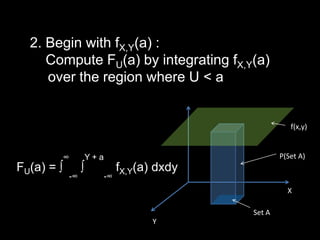
2. Begin with fX,Y(a) :
     Compute FU(a) by integrating fX,Y(a)
     over the region where U < a


                                                          f(x,y)


            ∞        Y+a                               P(Set A)
FU(a) = ∫        ∫              fX,Y(a) dxdy
            -∞             -∞
                                                         X

                                               Set A
                                       Y
Change of variables
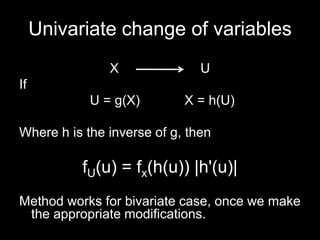
Univariate change of variables
               X               U
If
            U = g(X)        X = h(U)

Where h is the inverse of g, then

           fU(u) = fx(h(u)) |h'(u)|
Method works for bivariate case, once we make
 the appropriate modifications.
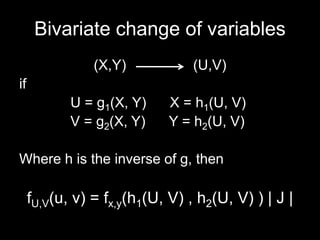
Bivariate change of variables
                (X,Y)            (U,V)
if
            U = g1(X, Y)    X = h1(U, V)
            V = g2(X, Y)    Y = h2(U, V)

Where h is the inverse of g, then

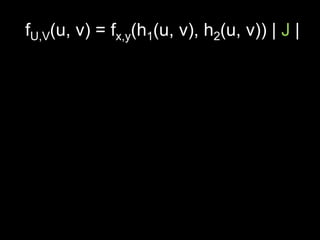
     fU,V(u, v) = fx,y(h1(U, V) , h2(U, V) ) | J |
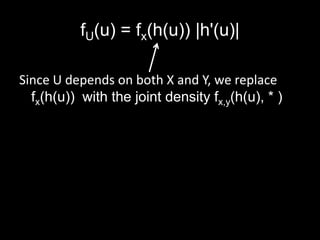
fU(u) = fx(h(u)) |h'(u)|

Since U depends on both X and Y, we replace
  fx(h(u)) with the joint density fx,y(h(u), * )
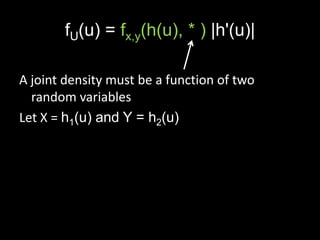
fU(u) = fx,y(h(u), * ) |h'(u)|

A joint density must be a function of two
  random variables
Let X = h1(u) and Y = h2(u)
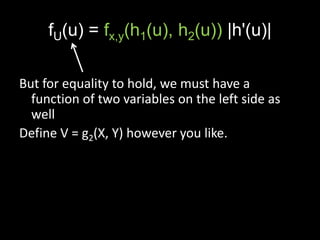
fU(u) = fx,y(h1(u), h2(u)) |h'(u)|

But for equality to hold, we must have a
  function of two variables on the left side as
  well
Define V = g2(X, Y) however you like.
fU,V(u, v) = fx,y(h1(u, v), h2(u, v)) |h'(u)|

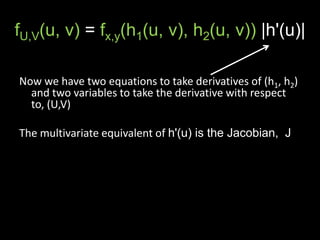
Now we have two equations to take derivatives of (h1, h2)
  and two variables to take the derivative with respect
  to, (U,V)

The multivariate equivalent of h'(u) is the Jacobian, J
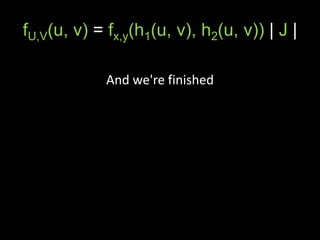
fU,V(u, v) = fx,y(h1(u, v), h2(u, v)) | J |

             And we're finished
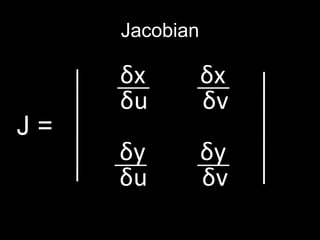
Jacobian

     δx         δx
     δu         δv
J=
     δy         δy
     δu         δv
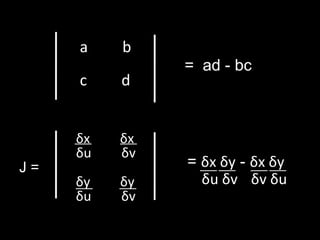
a    b
               = ad - bc
     c    d


     δx   δx
     δu   δv
J=             = δx δy - δx δy
     δy   δy     δu δv δv δu
     δu   δv
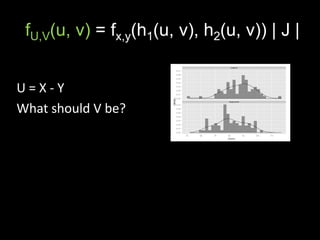
fU,V(u, v) = fx,y(h1(u, v), h2(u, v)) | J |


U=X-Y
What should V be?
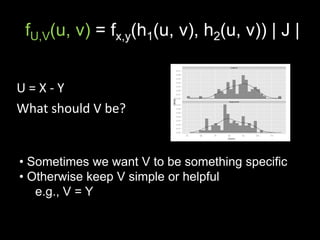
fU,V(u, v) = fx,y(h1(u, v), h2(u, v)) | J |


U=X-Y
What should V be?


• Sometimes we want V to be something specific
• Otherwise keep V simple or helpful
   e.g., V = Y
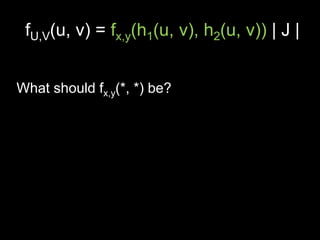
fU,V(u, v) = fx,y(h1(u, v), h2(u, v)) | J |


What should fx,y(*, *) be?
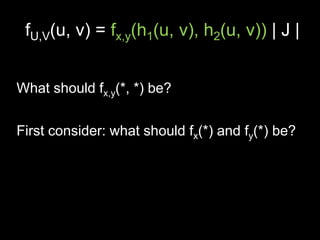
fU,V(u, v) = fx,y(h1(u, v), h2(u, v)) | J |


What should fx,y(*, *) be?

First consider: what should fx(*) and fy(*) be?
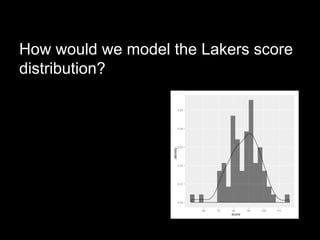
How would we model the Lakers score
distribution?
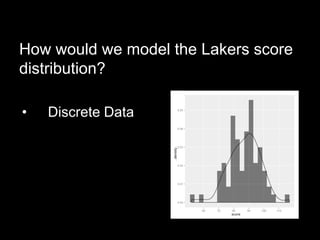
How would we model the Lakers score
distribution?

•   Discrete Data
How would we model the Lakers score
distribution?

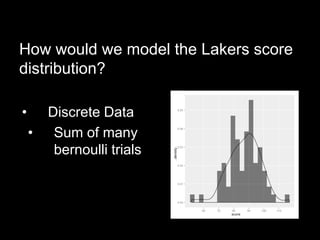
•       Discrete Data
    •    Sum of many
         bernoulli trials
How would we model the Lakers score
distribution?

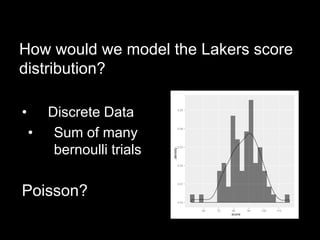
•       Discrete Data
    •    Sum of many
         bernoulli trials

Poisson?
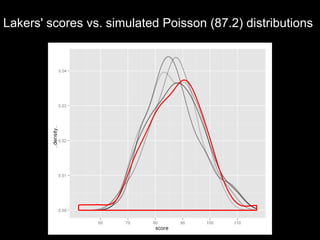
Lakers' scores vs. simulated Poisson (87.2) distributions
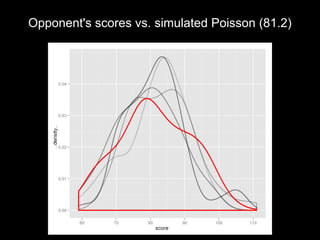
Opponent's scores vs. simulated Poisson (81.2)
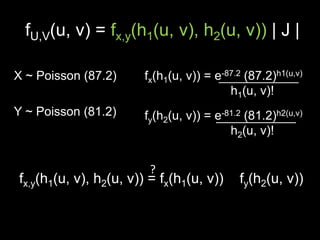
fU,V(u, v) = fx,y(h1(u, v), h2(u, v)) | J |

X ~ Poisson (87.2)     fx(h1(u, v)) = e-87.2 (87.2)h1(u,v)
                                         h1(u, v)!
Y ~ Poisson (81.2)     fy(h2(u, v)) = e-81.2 (81.2)h2(u,v)
                                         h2(u, v)!


                        ?
fx,y(h1(u, v), h2(u, v)) = fx(h1(u, v))     fy(h2(u, v))
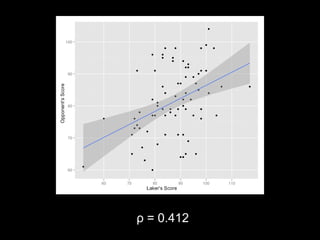
ρ = 0.412
fU,V(u, v) = fx,y(h1(u, v), h2(u, v)) | J |
Your Turn
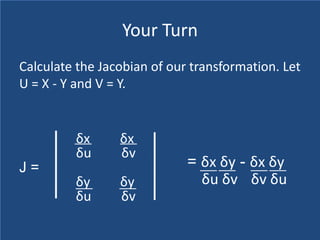
Calculate the Jacobian of our transformation. Let
U = X - Y and V = Y.


         δx      δx
         δu      δv
J=                           = δx δy - δx δy
         δy      δy            δu δv δv δu
         δu      δv
Your Turn
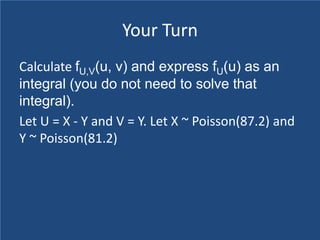
Calculate fU,V(u, v) and express fU(u) as an
integral (you do not need to solve that
integral).
Let U = X - Y and V = Y. Let X ~ Poisson(87.2) and
Y ~ Poisson(81.2)
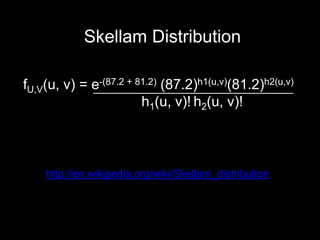
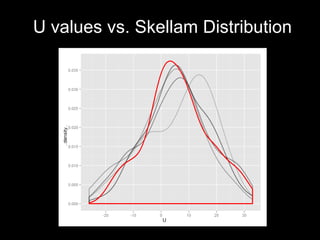
Skellam Distribution

fU,V(u, v) = e-(87.2 + 81.2) (87.2)h1(u,v)(81.2)h2(u,v)
                        h1(u, v)! h2(u, v)!


    http://en.wikipedia.org/wiki/Skellam_distribution
U values
U values vs. Skellam Distribution
Testing Independence
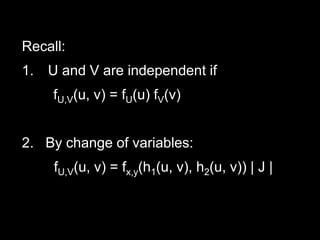
Recall:
1. U and V are independent if
     fU,V(u, v) = fU(u) fV(v)


2. By change of variables:
     fU,V(u, v) = fx,y(h1(u, v), h2(u, v)) | J |
Complete the proof
Complete the handout to show that U = X + Y and
V = X - Y are independent when X, Y ~ N(0, 1).
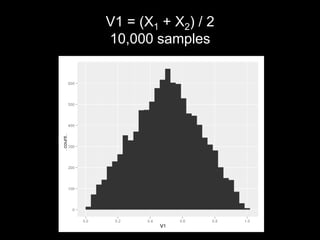
Simulation
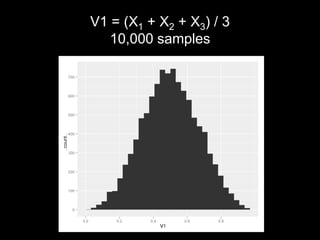
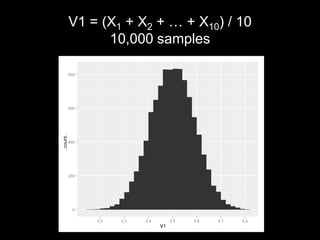
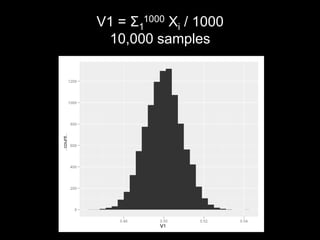
We can also learn a lot about the distribution of
 a random variable by simulating it.

Let Xi ~ Uniform (0,1)
Let U = (X1 + X2 ) / 2

If we generate a 100 pairs of X1 and X2 and plot
   (X1 + X2 ) / 2 for each pair, we will have a
   simulation of the distribution of U

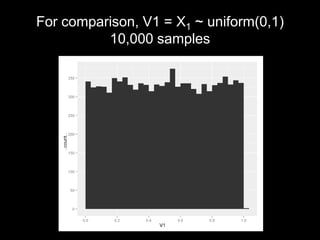
For comparison, V1 = X1 ~ uniform(0,1)
          10,000 samples
V1 = (X1 + X2) / 2
10,000 samples
V1 = (X1 + X2 + X3) / 3
   10,000 samples
V1 = (X1 + X2 + … + X10) / 10
      10,000 samples
V1 = Σ11000 Xi / 1000
 10,000 samples

15 Bivariate Change Of Variables

  • 1.
    Quiz • Pick upquiz and handout on your way in. • Start at 1pm • Finish at 1:10pm • The quiz is not for a grade, but I will be collecting it.
  • 2.
    Stat 310 Bivariate Changeof Variables Garrett Grolemund
  • 3.
    1. Review ofdistribution function techniques 2. Change of variables technique 3. Determining independence 4. Simulating transformations
  • 4.
  • 5.
    Laker's Mean 87.2 Opponent's Mean 81.2
  • 6.
    Let X = TheLakers' Score Y = The opponent's score U = X -Y Then the Lakers will win if U is positive, and they will lose if U is negative. How can we model U? (i.e, How can we find the CDF and PDF of U?)
  • 7.
    Recall from Tuesday U= X - Y is a bivariate transformation The Distribution function technique gives us two ways to model X - Y:
  • 8.
    1. Begin withFX,Y(a): Compute FU(a) in terms of FX,Y(a) by equating probabilities
  • 9.
    1. Begin withFX,Y(a): Compute FU(a) in terms of FX,Y(a) by equating probabilities FU(a) = P(U < a) = P(X - Y < a) = P(X < Y + a) =?
  • 10.
    2. Begin withfX,Y(a) : Compute FU(a) by integrating fX,Y(a) over the region where U < a f(x,y) P(Set A) X Set A Y
  • 11.
    2. Begin withfX,Y(a) : Compute FU(a) by integrating fX,Y(a) over the region where U < a f(x,y) ∞ Y+a P(Set A) FU(a) = ∫ ∫ fX,Y(a) dxdy -∞ -∞ X Set A Y
  • 12.
  • 13.
    Univariate change ofvariables X U If U = g(X) X = h(U) Where h is the inverse of g, then fU(u) = fx(h(u)) |h'(u)| Method works for bivariate case, once we make the appropriate modifications.
  • 14.
    Bivariate change ofvariables (X,Y) (U,V) if U = g1(X, Y) X = h1(U, V) V = g2(X, Y) Y = h2(U, V) Where h is the inverse of g, then fU,V(u, v) = fx,y(h1(U, V) , h2(U, V) ) | J |
  • 15.
    fU(u) = fx(h(u))|h'(u)| Since U depends on both X and Y, we replace fx(h(u)) with the joint density fx,y(h(u), * )
  • 16.
    fU(u) = fx,y(h(u),* ) |h'(u)| A joint density must be a function of two random variables Let X = h1(u) and Y = h2(u)
  • 17.
    fU(u) = fx,y(h1(u),h2(u)) |h'(u)| But for equality to hold, we must have a function of two variables on the left side as well Define V = g2(X, Y) however you like.
  • 18.
    fU,V(u, v) =fx,y(h1(u, v), h2(u, v)) |h'(u)| Now we have two equations to take derivatives of (h1, h2) and two variables to take the derivative with respect to, (U,V) The multivariate equivalent of h'(u) is the Jacobian, J
  • 19.
    fU,V(u, v) =fx,y(h1(u, v), h2(u, v)) | J | And we're finished
  • 20.
    Jacobian δx δx δu δv J= δy δy δu δv
  • 21.
    a b = ad - bc c d δx δx δu δv J= = δx δy - δx δy δy δy δu δv δv δu δu δv
  • 22.
    fU,V(u, v) =fx,y(h1(u, v), h2(u, v)) | J | U=X-Y What should V be?
  • 23.
    fU,V(u, v) =fx,y(h1(u, v), h2(u, v)) | J | U=X-Y What should V be? • Sometimes we want V to be something specific • Otherwise keep V simple or helpful e.g., V = Y
  • 24.
    fU,V(u, v) =fx,y(h1(u, v), h2(u, v)) | J | What should fx,y(*, *) be?
  • 25.
    fU,V(u, v) =fx,y(h1(u, v), h2(u, v)) | J | What should fx,y(*, *) be? First consider: what should fx(*) and fy(*) be?
  • 26.
    How would wemodel the Lakers score distribution?
  • 27.
    How would wemodel the Lakers score distribution? • Discrete Data
  • 28.
    How would wemodel the Lakers score distribution? • Discrete Data • Sum of many bernoulli trials
  • 29.
    How would wemodel the Lakers score distribution? • Discrete Data • Sum of many bernoulli trials Poisson?
  • 30.
    Lakers' scores vs.simulated Poisson (87.2) distributions
  • 31.
    Opponent's scores vs.simulated Poisson (81.2)
  • 32.
    fU,V(u, v) =fx,y(h1(u, v), h2(u, v)) | J | X ~ Poisson (87.2) fx(h1(u, v)) = e-87.2 (87.2)h1(u,v) h1(u, v)! Y ~ Poisson (81.2) fy(h2(u, v)) = e-81.2 (81.2)h2(u,v) h2(u, v)! ? fx,y(h1(u, v), h2(u, v)) = fx(h1(u, v)) fy(h2(u, v))
  • 33.
  • 34.
    fU,V(u, v) =fx,y(h1(u, v), h2(u, v)) | J |
  • 35.
    Your Turn Calculate theJacobian of our transformation. Let U = X - Y and V = Y. δx δx δu δv J= = δx δy - δx δy δy δy δu δv δv δu δu δv
  • 36.
    Your Turn Calculate fU,V(u,v) and express fU(u) as an integral (you do not need to solve that integral). Let U = X - Y and V = Y. Let X ~ Poisson(87.2) and Y ~ Poisson(81.2)
  • 37.
    Skellam Distribution fU,V(u, v)= e-(87.2 + 81.2) (87.2)h1(u,v)(81.2)h2(u,v) h1(u, v)! h2(u, v)! http://en.wikipedia.org/wiki/Skellam_distribution
  • 38.
  • 39.
    U values vs.Skellam Distribution
  • 40.
  • 41.
    Recall: 1. U andV are independent if fU,V(u, v) = fU(u) fV(v) 2. By change of variables: fU,V(u, v) = fx,y(h1(u, v), h2(u, v)) | J |
  • 42.
    Complete the proof Completethe handout to show that U = X + Y and V = X - Y are independent when X, Y ~ N(0, 1).
  • 43.
  • 44.
    We can alsolearn a lot about the distribution of a random variable by simulating it. Let Xi ~ Uniform (0,1) Let U = (X1 + X2 ) / 2 If we generate a 100 pairs of X1 and X2 and plot (X1 + X2 ) / 2 for each pair, we will have a simulation of the distribution of U

  • 45.
    For comparison, V1= X1 ~ uniform(0,1) 10,000 samples
  • 46.
    V1 = (X1+ X2) / 2 10,000 samples
  • 47.
    V1 = (X1+ X2 + X3) / 3 10,000 samples
  • 48.
    V1 = (X1+ X2 + … + X10) / 10 10,000 samples
  • 49.
    V1 = Σ11000Xi / 1000 10,000 samples