Module III
Stochastic Processes
1
Vector Random Variable
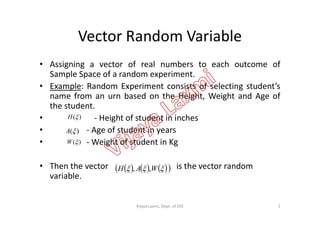
• Assigning a vector of real numbers to each outcome of
Sample Space of a random experiment.
• Example: Random Experiment consists of selecting student’s
name from an urn based on the Height, Weight and Age of
the student.
• - Height of student in inches• - Height of student in inches
• - Age of student in years
• - Weight of student in Kg
• Then the vector is the vector random
variable.
)(H
)(A
)(W
       WAH ,,
2Vijaya Laxmi, Dept. of EEE
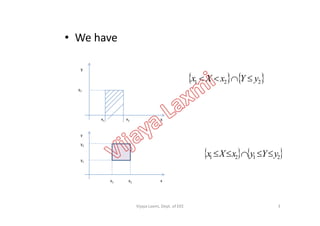
• We have
y
y2
   221 yYxXx 
x1 x2 x
x
y1
y2
y
x2x1
   2121 yYyxXx 
3Vijaya Laxmi, Dept. of EEE
y
y2
y1
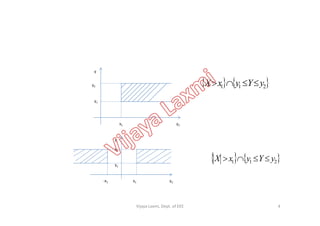
   211 yYyxX 
x1 y2
y
y2
y1
y2x1-x1
   211 yYyxX 
4Vijaya Laxmi, Dept. of EEE
MULTIPLE RANDOM VARIABLESMULTIPLE RANDOM VARIABLES
5Vijaya Laxmi, Dept. of EEE
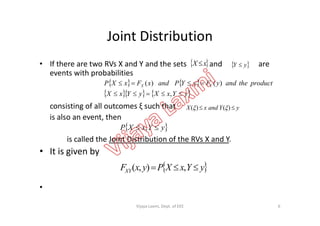
Joint Distribution
• If there are two RVs X and Y and the sets and are
events with probabilities
consisting of all outcomes ξ such that
is also an event, then
 xX   yY 
   
    yYxXyYxX
producttheandyFyYPandxFxXP YX


,
)()(
yYandxX  )()( 
is also an event, then
is called the Joint Distribution of the RVs X and Y.
• It is given by
•
 yYxXP  ,
 yYxXPyxFXY  ,),(
6Vijaya Laxmi, Dept. of EEE
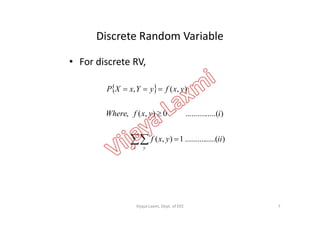
Discrete Random Variable
• For discrete RV,
 


iyxfWhere
yxfyYxXP
).....(..........0),(,
),(,
 

x y
iiyxf
iyxfWhere
).....(..........1),(
).....(..........0),(,
7Vijaya Laxmi, Dept. of EEE
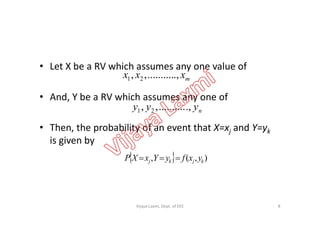
• Let X be a RV which assumes any one value of
• And, Y be a RV which assumes any one of
mxxx .,..........,, 21
nyyy .,..........,, 21
• Then, the probability of an event that X=xj and Y=yk
is given by
n21
  ),(, kjkj yxfyYxXP 
8Vijaya Laxmi, Dept. of EEE
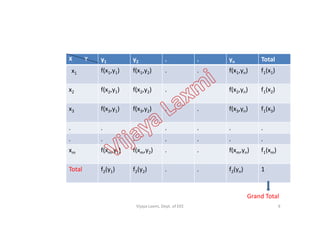
X Y y1 y2 . . yn Total
f(x1,y1) f(x1,y2) . . f(x1,yn) f1(x1)
x2 f(x2,y1) f(x2,y2) . . f(x2,yn) f1(x2)
x3 f(x3,y1) f(x3,y2) . . f(x3,yn) f1(x3)
x1
. . . . . . .
. . . . . . .
xm f(xm,y1) f(xm,y2) . . f(xm,yn) f1(xm)
Total f2(y1) f2(y2) . . f2(yn) 1
Grand Total
9Vijaya Laxmi, Dept. of EEE
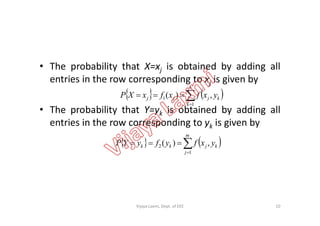
• The probability that X=xj is obtained by adding all
entries in the row corresponding to xj is given by
• The probability that Y=yk is obtained by adding all
   

n
k
kjjj yxfxfxXP
1
1 ,)(
• The probability that Y=yk is obtained by adding all
entries in the row corresponding to yk is given by
   

m
j
kjkk yxfyfyYP
1
2 ,)(
10Vijaya Laxmi, Dept. of EEE
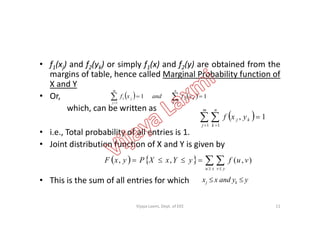
• f1(xj) and f2(yk) or simply f1(x) and f2(y) are obtained from the
margins of table, hence called Marginal Probability function of
X and Y
• Or,
which, can be written as
    11
1 1
21   
m
j
n
k
kj yfandxf
  1,  
m n
yxf
which, can be written as
• i.e., Total probability of all entries is 1.
• Joint distribution function of X and Y is given by
• This is the sum of all entries for which
  1,
1 1
  j k
kj yxf
      

xu yv
vufyYxXPyxF ),(,,
yyandxx kj 
11Vijaya Laxmi, Dept. of EEE
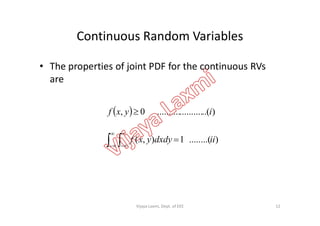
Continuous Random Variables
• The properties of joint PDF for the continuous RVs
are
  )..(....................0, iyxf   )..(....................0, iyxf 
12
)........(1),( iidxdyyxf 





Vijaya Laxmi, Dept. of EEE
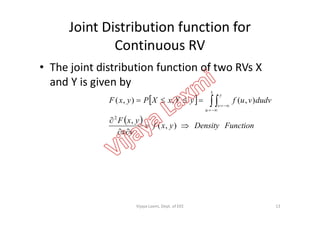
Joint Distribution function for
Continuous RV
• The joint distribution function of two RVs X
and Y is given by
 
 
dudvvufyYxXPyxF
x
u
y
v
 

),(,),(
  FunctionDensityyxf
yx
yxF



),(
,2
13Vijaya Laxmi, Dept. of EEE
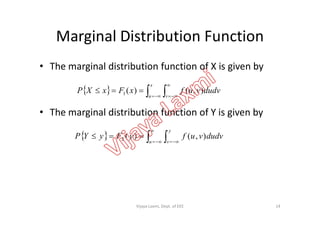
Marginal Distribution Function
• The marginal distribution function of X is given by
• The marginal distribution function of Y is given by
   



x
u v
dudvvufxFxXP ),()(1
• The marginal distribution function of Y is given by
   

 

u
y
v
dudvvufyFyYP ),()(2
14Vijaya Laxmi, Dept. of EEE
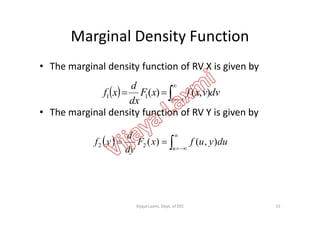
Marginal Density Function
• The marginal density function of RV X is given by
• The marginal density function of RV Y is given by
  



v
dvvxfxF
dx
d
xf ),()(11
• The marginal density function of RV Y is given by
  



u
duyufxF
dy
d
yf ),()(22
15Vijaya Laxmi, Dept. of EEE
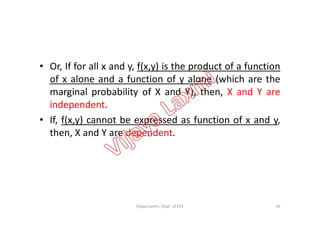
• Or, If for all x and y, f(x,y) is the product of a function
of x alone and a function of y alone (which are the
marginal probability of X and Y), then, X and Y are
independent.
• If, f(x,y) cannot be expressed as function of x and y,
then, X and Y are dependent.
16Vijaya Laxmi, Dept. of EEE
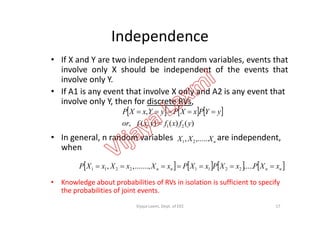
Independence
• If X and Y are two independent random variables, events that
involve only X should be independent of the events that
involve only Y.
• If A1 is any event that involve X only and A2 is any event that
involve only Y, then for discrete RVs,
     , yYPxXPyYxXP 
• In general, n random variables are independent,
when
• Knowledge about probabilities of RVs in isolation is sufficient to specify
the probabilities of joint events.
     
)()(),(,
,
21 yfxfyxfor
yYPxXPyYxXP


nXXX ,......, 21
       nnnn xXPxXPxXPxXxXxXP  ............,,, 22112211
17Vijaya Laxmi, Dept. of EEE
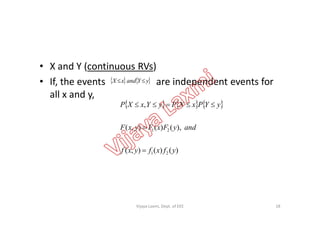
• X and Y (continuous RVs)
• If, the events are independent events for
all x and y,
   yYandxX 
     , yYPxXPyYxXP 
)()(),(
),()(),(
21
21
yfxfyxf
andyFxFyxF


18Vijaya Laxmi, Dept. of EEE
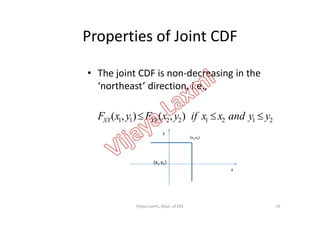
Properties of Joint CDF
• The joint CDF is non-decreasing in the
‘northeast’ direction, i.e.,
),(),( yyandxxifyxFyxF  21212211 ),(),( yyandxxifyxFyxF XYXY 
(x1,y1)
(x2,y2)
x
y
19Vijaya Laxmi, Dept. of EEE
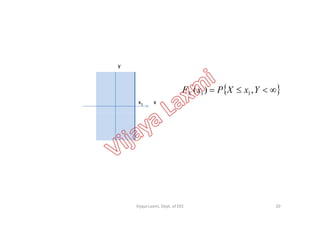
x
y
x1
  YxXPxFX ,)( 11
20Vijaya Laxmi, Dept. of EEE
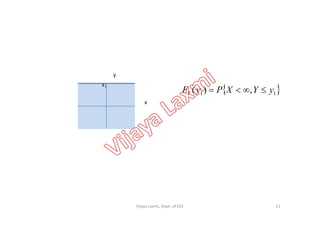
x
y
y1
 11 ,)( yYXPyFY 
21Vijaya Laxmi, Dept. of EEE
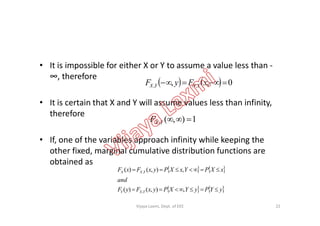
• It is impossible for either X or Y to assume a value less than -
∞, therefore
• It is certain that X and Y will assume values less than infinity,
therefore
    0,, ,,  xFyF YXYX
therefore
• If, one of the variables approach infinity while keeping the
other fixed, marginal cumulative distribution functions are
obtained as
1),(, YXF
   
   yYPyYXPyxFyF
and
xXPYxXPyxFxF
YXY
YXX


,),()(
,),()(
,
,
22Vijaya Laxmi, Dept. of EEE
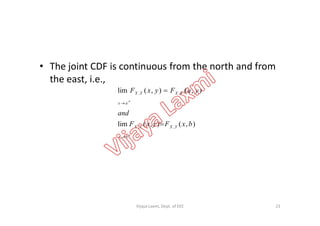
• The joint CDF is continuous from the north and from
the east, i.e.,


ax
YXYX
and
yaFyxF ),(),(lim ,,


by
YXYX bxFyxF
and
),(),(lim ,,
23Vijaya Laxmi, Dept. of EEE
Problem
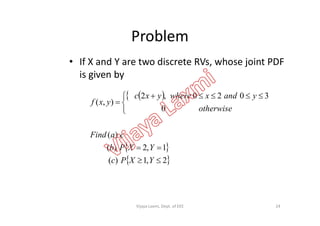
• If X and Y are two discrete RVs, whose joint PDF
is given by
 
0
3020,2
),(


 

otherwise
yandxwhereyxc
yxf
 
 2,1)(
1,2)(
)(
0



YXPc
YXPb
caFind
otherwise
24Vijaya Laxmi, Dept. of EEE
Solution: (a)
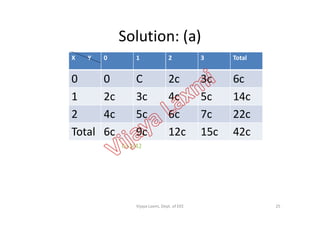
• We haveX Y 0 1 2 3 Total
0 0 C 2c 3c 6c
1 2c 3c 4c 5c 14c
2 4c 5c 6c 7c 22c2 4c 5c 6c 7c 22c
Total 6c 9c 12c 15c 42c
C=1/42
25Vijaya Laxmi, Dept. of EEE
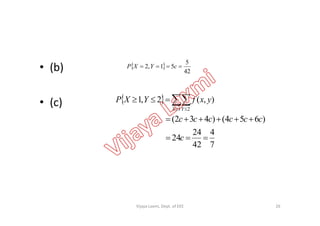
• (b)
• (c)
 
42
5
51,2  cYXP
  ),(2,1
1 2

  
yxfYXP
X Y
7
4
42
24
24
)654()432(


c
cccccc
26Vijaya Laxmi, Dept. of EEE
Problem
• Find the marginal probability of (a) X and (b) Y
27Vijaya Laxmi, Dept. of EEE
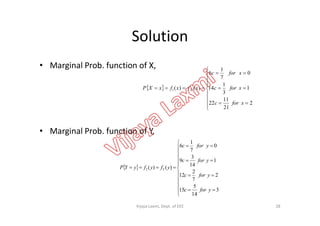
Solution
• Marginal Prob. function of X,
 













2
21
11
22
1
3
1
14
0
7
1
6
)()(1
xforc
xforc
xforc
xfxfxXP X
• Marginal Prob. function of Y,
 
















3
14
5
15
2
7
2
12
1
14
3
9
0
7
1
6
)()(2
yforc
yforc
yforc
yforc
yfyfyYP Y
28Vijaya Laxmi, Dept. of EEE
Problem
• Show that the RVs X and Y are dependent
29Vijaya Laxmi, Dept. of EEE
Solution
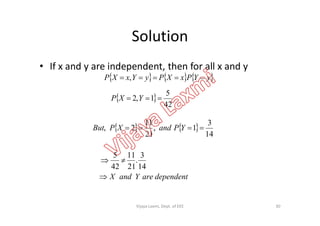
• If x and y are independent, then for all x and y
     yYPxXPyYxXP  ,
 
42
5
1,2  YXP
30
   
14
3
1,
21
11
2,  YPandXPBut
dependentareYandX

14
3
.
21
11
42
5
Vijaya Laxmi, Dept. of EEE
Problem
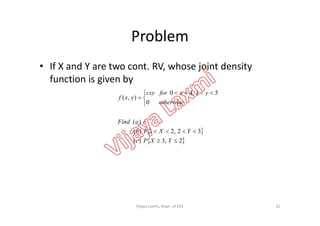
• If X and Y are two cont. RV, whose joint density
function is given by
0
51,40
),(


 

otherwise
yxforcxy
yxf
 
 2,3)(
32,21)(
)(


YXPc
YXPb
caFind
31Vijaya Laxmi, Dept. of EEE
Solution
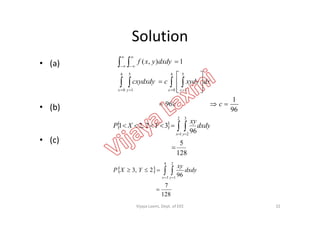
• (a)
• (b) 96
1
96
1),(
4
0
5
1
4
0
5
1











  
 
  




cc
dxxydyccxydxdy
dxdyyxf
x yx y
• (c)
 
128
5
96
32,21
2
1
3
2

   x y
dxdy
xy
YXP
 
128
7
96
2,3
4
3
2
1

   x y
dxdy
xy
YXP
32Vijaya Laxmi, Dept. of EEE
Problem
• Find the Marginal distribution function of X
and Y
33Vijaya Laxmi, Dept. of EEE
Solution
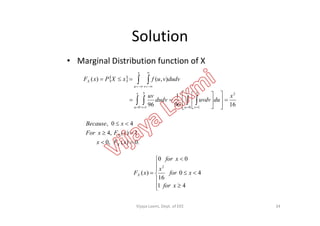
• Marginal Distribution function of X
 
1696
1
96
),()(
2
0
5
10
5
1
x
duuvdvdudv
uv
dudvvufxXPxF
x
u v
x
u v
x
u v
X

















  
 
  



34
.0)(,0
1)(,4
40,



xFx
xFxFor
xBecause
X
X











41
40
16
00
)(
2
xfor
xfor
x
xfor
xFX
Vijaya Laxmi, Dept. of EEE
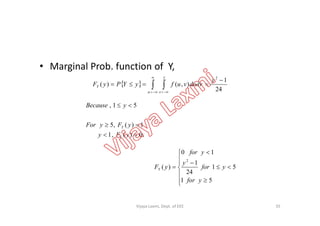
• Marginal Prob. function of Y,
   

 


u
y
v
Y
y
dudvvufyYPyF
24
1
),()(
2
51,  yBecause
35
.0)(,1
1)(,5


yFy
yFyFor
Y
Y












51
51
24
1
10
)(
2
yfor
yfor
y
yfor
yFY
Vijaya Laxmi, Dept. of EEE
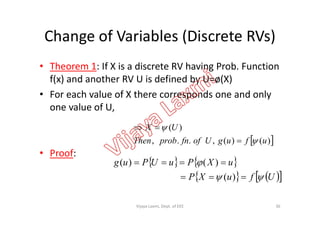
Change of Variables (Discrete RVs)
• Theorem 1: If X is a discrete RV having Prob. Function
f(x) and another RV U is defined by U=ø(X)
• For each value of X there corresponds one and only
one value of U,one value of U,
• Proof:
 )()(,..,
)(
ufugUoffnprobThen
UX




   
    UfuXP
uXPuUPug




)(
)()(
36Vijaya Laxmi, Dept. of EEE
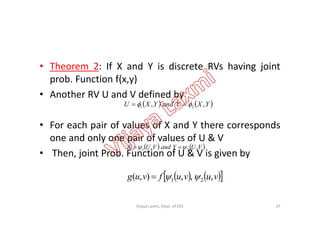
• Theorem 2: If X and Y is discrete RVs having joint
prob. Function f(x,y)
• Another RV U and V defined by
   YXVandYXU ,, 21  
• For each pair of values of X and Y there corresponds
one and only one pair of values of U & V
• Then, joint Prob. Function of U & V is given by
   VUYandVUX ,, 21  
    vuvufvug ,,,),( 21 
37Vijaya Laxmi, Dept. of EEE
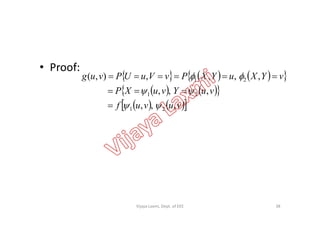
• Proof:
      
    
    vuvuf
vuYvuXP
vYXuYXPvVuUPvug
,,,
,,,
,,,,),(
21
21
21






38Vijaya Laxmi, Dept. of EEE
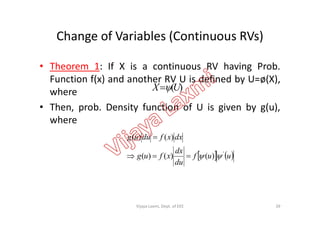
Change of Variables (Continuous RVs)
• Theorem 1: If X is a continuous RV having Prob.
Function f(x) and another RV U is defined by U=ø(X),
where
• Then, prob. Density function of U is given by g(u),
)(UX 
Then, prob. Density function of U is given by g(u),
where
   uuf
du
dx
xfug
dxxfduug
'
)()()(
)()(


39Vijaya Laxmi, Dept. of EEE
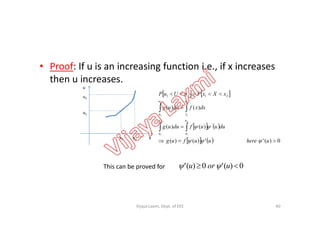
• Proof: If u is an increasing function i.e., if x increases
then u increases.
u
u2
u1
   
)()(
2 2
2121


  dxxfduug
xXxPuUuP
u
u
v
v
x1 x2
u1
x
   
    0)('')()(
)()(
2
1
2
1
1 1
'

 
 
uhereuufug
duuufduug
u
u
u
u
u v


This can be proved for 0)('0)('  uoru 
40Vijaya Laxmi, Dept. of EEE
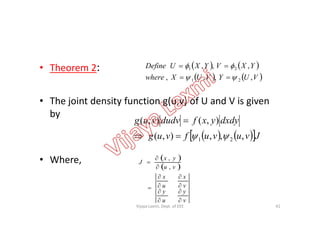
• Theorem 2:
• The joint density function g(u,v) of U and V is given
by
   
   VUYVUXwhere
YXVYXUDefine
,,,,
,,,
21
21




by
• Where,
    Jvuvufvug
dxdyyxfdudvvug
,,,),(
),(),(
21 

 
 
v
y
u
y
v
x
u
x
vu
yx
J












,
,
41Vijaya Laxmi, Dept. of EEE
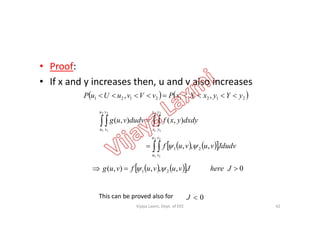
• Proof:
• If x and y increases then, u and v also increases
   21212121 ,, yYyxXxPvVvuUuP 
2 22 2 x yu v
This can be proved also for 0J
42
    
 


2
1
2
1
2
1
2
1
2
1
2
1
,,,
),(),(
21
u
u
v
v
x
x
y
y
u
u
v
v
Jdudvvuvuf
dxdyyxfdudvvug

     0,,,),( 21  JhereJvuvufvug 
Vijaya Laxmi, Dept. of EEE
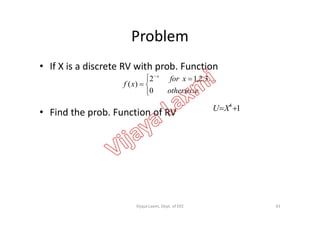
Problem
• If X is a discrete RV with prob. Function
• Find the prob. Function of RV


 


otherwise
xfor
xf
x
0
....3,2,12
)(
14
XU
• Find the prob. Function of RV
43Vijaya Laxmi, Dept. of EEE
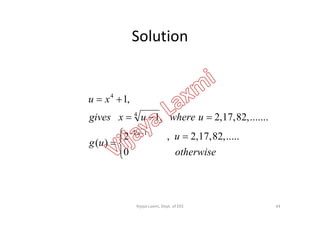
Solution


uwhereuxgives
xu
.......,82,17,2,1
,1
4
4



 



otherwise
u
ug
uwhereuxgives
u
0
.....,82,17,2,2
)(
.......,82,17,2,1
4
1
4
44Vijaya Laxmi, Dept. of EEE
Problem
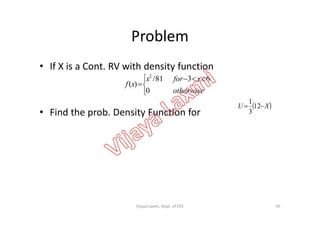
• If X is a Cont. RV with density function
• Find the prob. Density Function for


 

otherwise
xforx
xf
0
6381/
)(
2
 XU  12
3
1
• Find the prob. Density Function for 3
45Vijaya Laxmi, Dept. of EEE
Solution
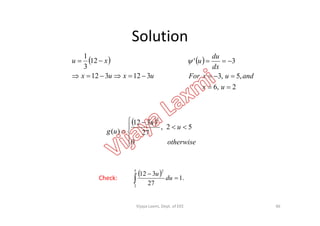
 
2,6
,5,3
3'



ux
anduxFor
dx
du
u 
uxux
xu
312312
12
3
1


Check:
 
 

5
2
2
.1
27
312
du
u
46
 








otherwise
u
u
ug
0
52,
27
312
)(
2
Vijaya Laxmi, Dept. of EEE
Problem
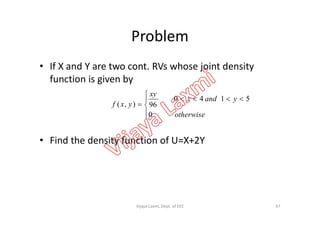
• If X and Y are two cont. RVs whose joint density
function is given by






otherwise
yandx
xy
yxf
0
5140
96),(
• Find the density function of U=X+2Y
 otherwise0
47Vijaya Laxmi, Dept. of EEE
Solution
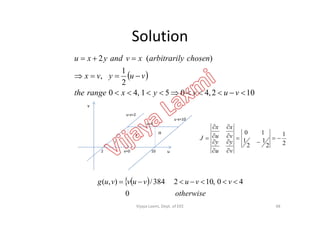
 
102,4051,40
2
1
,
)(2



vuvyxrangethe
vuyvx
chosenyarbitrarilxvandyxu
v
u-v=2
u
u-v=2
u-v=10
v=4
v=0 102
I
II
III
2
1
2
1
2
1
10












v
y
u
y
v
x
u
x
J
 
otherwise
vvuvuvvug
0
40,102384/),( 
48Vijaya Laxmi, Dept. of EEE
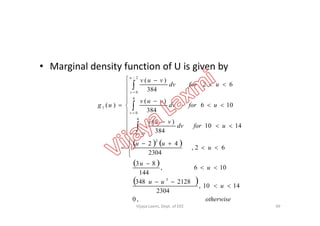
• Marginal density function of U is given by
ufordv
vuv
ufordv
vuv
ug
v
u
v
106
384
)(
62
384
)(
)(
4
0
2
0
1










 




   
 
 
otherwise
u
uu
u
u
u
uu
ufordv
vuv
uv
v
,0
1410,
2304
2128348
106,
144
83
62,
2304
42
1410
384
)(
384
3
2
4
10
0







 










49Vijaya Laxmi, Dept. of EEE
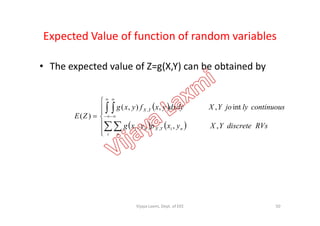
Expected Value of function of random variables
• The expected value of Z=g(X,Y) can be obtained by
 



 
 
continuouslyjoYXdxdyyxfyxg
ZE
YX int,,),(
)(
,
   






  
RVsdiscreteYXyxpyxg
ZE
i
niYX
n
ni ,,,
)(
,
50Vijaya Laxmi, Dept. of EEE
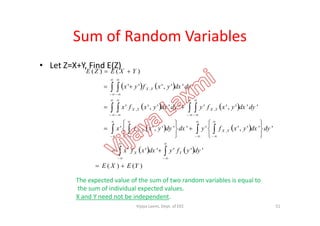
Sum of Random Variables
• Let Z=X+Y, Find E(Z)
    






''','''
)()(
, dydxyxfyx
YXEZE
YX
     








 ''',''''','' ,, dydxyxfydydxyxfx YXYX
The expected value of the sum of two random variables is equal to
the sum of individual expected values.
X and Y need not be independent.
51
     
  








  













 ''',''''','' ,, dydxyxfydxdyyxfx YXYX
   
)()(
''''''
YEXE
dyyfydxxfx YX

 




Vijaya Laxmi, Dept. of EEE
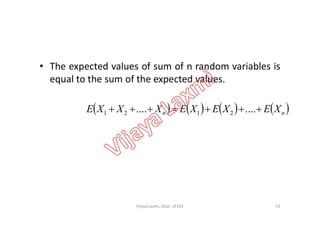
• The expected values of sum of n random variables is
equal to the sum of the expected values.
       nn XEXEXEXXXE  ........ 2121       nn XEXEXEXXXE  ........ 2121
52Vijaya Laxmi, Dept. of EEE
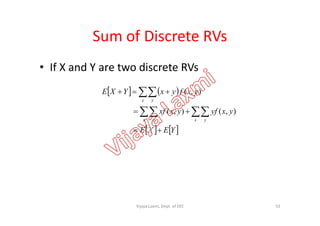
Sum of Discrete RVs
• If X and Y are two discrete RVs
   
yxyfyxxf
yxfyxYXE
x y




),(),(
),(
   YEXE
yxyfyxxf
x yx y

  ),(),(
53Vijaya Laxmi, Dept. of EEE
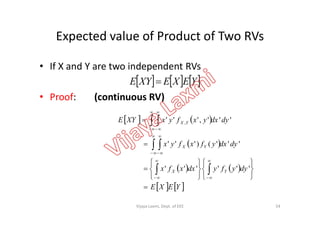
Expected value of Product of Two RVs
• If X and Y are two independent RVs
• Proof: (continuous RV)
     YEXEXYE 
   
 
   
 
   
   YEXE
dyyfydxxfx
dydxyfxfyx
dydxyxfyxXYE
YX
YX
YX

















 
 












''''''
'''()'''
''',''' ,
54Vijaya Laxmi, Dept. of EEE
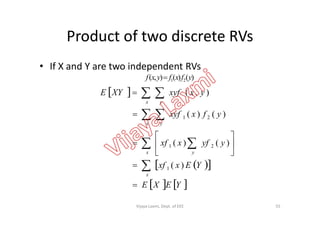
Product of two discrete RVs
• If X and Y are two independent RVs
)()(),( 21 yfxfyxf 
 
 
 


x y
yfxxyf
yxxyfXYE
)()(
),(
 
x y
yfxxyf )()( 21
55
  
   YEXE
YExxf
yyfxxf
x
x y










 
)(
)()(
1
21
Vijaya Laxmi, Dept. of EEE
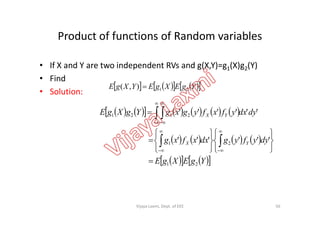
Product of functions of Random variables
• If X and Y are two independent RVs and g(X,Y)=g1(X)g2(Y)
• Find
• Solution:
             dydxyfxfygxgYgXgE YX2121 ''''''  
 
       YgEXgEYXgE 21),( 
            
       
     YgEXgE
dyyfygdxxfxg
dydxyfxfygxgYgXgE
YX
YX
21
21
2121
''''''
''''''
















 




 
56Vijaya Laxmi, Dept. of EEE
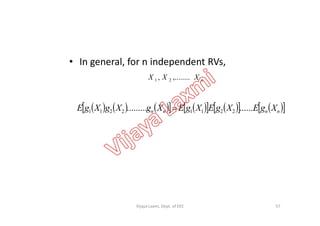
• In general, for n independent RVs,
nXXX ,........, 21
               nnnn XgEXgEXgEXgXgXgE ................. 22112211                nnnn 22112211
57Vijaya Laxmi, Dept. of EEE
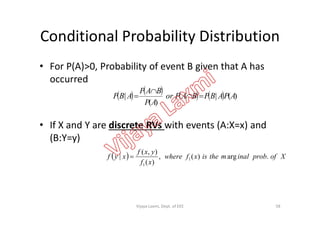
Conditional Probability Distribution
• For P(A)>0, Probability of event B given that A has
occurred
        )(|
)(
| APABPBAPor
AP
BAP
ABP 


• If X and Y are discrete RVs with events (A:X=x) and
(B:Y=y)
  Xofprobinalmtheisxfwhere
xf
yxf
xyf .arg)(,
)(
),(
| 1
1

58Vijaya Laxmi, Dept. of EEE
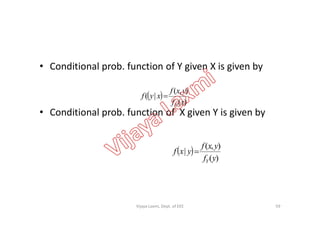
• Conditional prob. function of Y given X is given by
• Conditional prob. function of X given Y is given by
 
)(
),(
|(
xf
yxf
xyf
X

• Conditional prob. function of X given Y is given by
 
)(
),(
|
yf
yxf
yxf
Y

59Vijaya Laxmi, Dept. of EEE
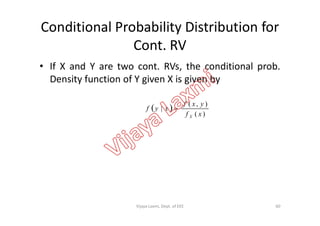
Conditional Probability Distribution for
Cont. RV
• If X and Y are two cont. RVs, the conditional prob.
Density function of Y given X is given by
 
)(
),(
|
xf
yxf
xyf 
)( xf X
60Vijaya Laxmi, Dept. of EEE
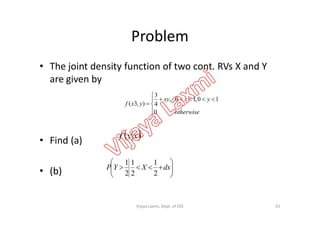
Problem
• The joint density function of two cont. RVs X and Y
are given by






otherwise
yxxy
yxf
0
10,10,
4
3
),3(
• Find (a)
• (b)
 otherwise0
 xyf






 dxXYP
2
1
2
1
2
1
61Vijaya Laxmi, Dept. of EEE
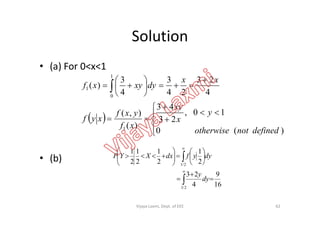
Solution
• (a) For 0<x<1
  











 
10,
43
),(
4
23
24
3
4
3
)(
1
0
1
y
xy
yxf
xx
dyxyxf
• (b)
 





)(0
10,
23
)(
),(
1
definednototherwise
y
x
xf
yxf
xyf
16
9
4
23
2
1
2
1
2
1
2
1
2/1
2/1




















dy
y
dyyfdxXYP
62Vijaya Laxmi, Dept. of EEE
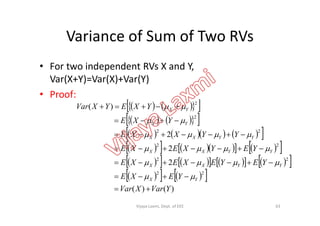
Variance of Sum of Two RVs
• For two independent RVs X and Y,
Var(X+Y)=Var(X)+Var(Y)
• Proof:
     
     
)(
2
YXEYXVar YX  
     
       
         
           
     
)()(
2
2
2
22
22
22
22
2
YVarXVar
YEXE
YEYEXEXE
YEYXEXE
YYXXE
YXE
YX
YYXX
YYXX
YYXX
YX











63Vijaya Laxmi, Dept. of EEE
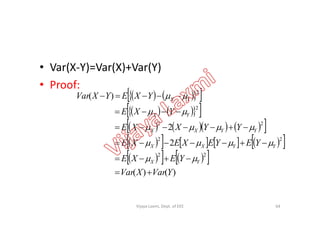
• Var(X-Y)=Var(X)+Var(Y)
• Proof:
     
     
)(
2
2
YXE
YXEYXVar
YX
YX




     
       
         
     
)()(
2
2
22
22
22
YVarXVar
YEXE
YEYEXEXE
YYXXE
YXE
YX
YYXX
YYXX
YX









64Vijaya Laxmi, Dept. of EEE
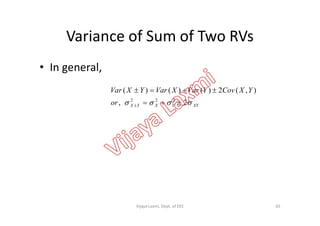
Variance of Sum of Two RVs
• In general,
XYYXYXor
YXCovYVarXVarYXVar
 2,
),(2)()()(
222



65Vijaya Laxmi, Dept. of EEE
Correlation and Covariance of Two RVs
• The jkth joint moment of two RVs X and Y is defined
as
   
 
 









kj
YX
kjKj
ContinuouslyjoYandXFordxdyyxfyxYXE int,,
 
i n
niYX
k
n
j
i RVsdiscreteYandXyxpyx ,,
If j=0, moments of Y are obtained
If k=0, moments of X are obtained
If j=k=1, E[XY] gives the correlation of X and Y
IF E[XY]=0, X and Y are orthogonal
66Vijaya Laxmi, Dept. of EEE
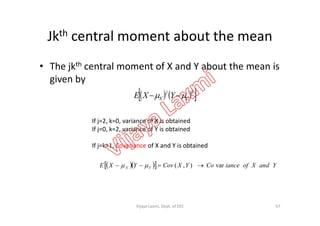
Jkth central moment about the mean
• The jkth central moment of X and Y about the mean is
given by
    k
Y
j
X YXE  
If j=2, k=0, variance of X is obtained
If j=0, k=2, variance of Y is obtained
If j=k=1, Covariance of X and Y is obtained
    YandXofianceCoYXCovYXE YX var),(  
67Vijaya Laxmi, Dept. of EEE
Covariance of Two RVs
   
 
     
         YEXEYEXEXYE
YEXEXYE
YXXYE
YXEYXCov
YXXY
YXXY
YX




2
),(



         
     YEXEXYE
YEXEYEXEXYE

 2
Hence,
Cov(X,Y)=E[XY], if either of the RVs has mean value equal to zero
68Vijaya Laxmi, Dept. of EEE
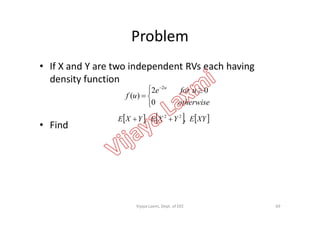
Problem
• If X and Y are two independent RVs each having
density function


 


otherwise
ufore
uf
u
0
02
)(
2
• Find
     XYEYXEYXE ,, 22

69Vijaya Laxmi, Dept. of EEE
Solution
     
1
2.2.
0
2
0
2








dyeydxex
YEXEYXE
yx
  1
4 22
  
 

dxdyexyeXYE yx
Check E[X+Y]=E[X]+E[Y]
E[XY]=E[X]E[Y]
70
 
4
4
0 0
22
  

dxdyexyeXYE yx
  122
0
22
0
2222
 




dyeydxexYXE yx
Vijaya Laxmi, Dept. of EEE
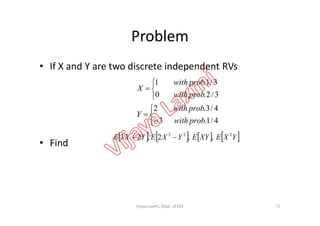
Problem
• If X and Y are two discrete independent RVs







4/3.2
3/2.0
3/1.1
probwith
Y
probwith
probwith
X
• Find





4/1.3 probwith
Y
       YXEXYEYXEYXE 222
,,2,23 
71Vijaya Laxmi, Dept. of EEE
Solution
     
3
1
0
3
2
1
3
1
XE
     
4
3
3
4
1
2
4
3
YE
72
     
2
5
4
3
2
3
1
3
2323













 YEXEYXE
Vijaya Laxmi, Dept. of EEE
     22
 YEXEYXE
     
4
1
4
3
.
3
1

 YEXEXYE
     
4
1
4
3
.
3
1

 YEXEYXE
73Vijaya Laxmi, Dept. of EEE
     
3
1
0
3
2
1
3
1 22
XE
     
4
21
4
9
33
4
1
2
4
3 222
YE
74
     
12
55
4
21
3
2
4
21
3
1
2
22 2222













 YEXEYXE
Vijaya Laxmi, Dept. of EEE
Problem
• If X and Y are two independent RVs, find the Covariance
• Solution:
   
     
0
),(



YX
YX
YEXE
YXEYXCov


0
For the pairs of independent RVs, Covariance is zero.
75Vijaya Laxmi, Dept. of EEE
Correlation Coefficient of X and Y
• The correlation coefficient between the two RVs, X and Y is
given by
     YEXEXYEYXCov
YXYX
YX
),(
,






deviationdardSYVarandXVarwhere YX tan)()(,  
11 ,  YX
X and Y are uncorrelated, if 0, YX
If X and Y are independent, Cov(X,Y)=0, 0,  YX
If X and Y are independent, they are uncorrelated.
-------From Theorem 4
76Vijaya Laxmi, Dept. of EEE
Theorems on Covariance
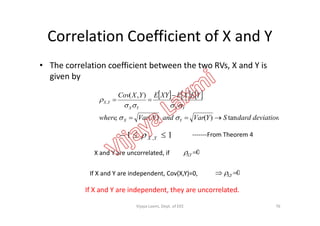
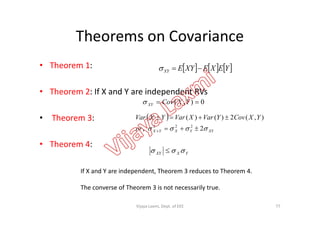
• Theorem 1:
• Theorem 2: If X and Y are independent RVs
• Theorem 3:
     YEXEXYEXY 
0),(  YXCovXY
• Theorem 3:
• Theorem 4:
 
XYYXYXor
YXCovYVarXVarYXVar
 2,
),(2)()(
222



YXXY  
If X and Y are independent, Theorem 3 reduces to Theorem 4.
The converse of Theorem 3 is not necessarily true.
77Vijaya Laxmi, Dept. of EEE
Problem
• If X and Y are two discrete RVs, whose joint density function is
given by
• Find E[X], E[Y], E[XY], E[X2], E[Y2], Var(X), Var(Y), Cov(X,Y) and
 
otherwise
yxforyxcyxf
0
30,202),( 
• Find E[X], E[Y], E[XY], E[X2], E[Y2], Var(X), Var(Y), Cov(X,Y) and
correlation coeff.
78Vijaya Laxmi, Dept. of EEE
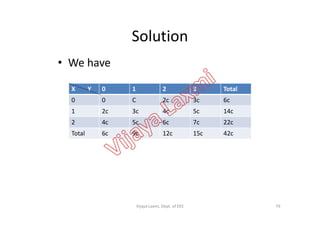
Solution
• We have
X Y 0 1 2 3 Total
0 0 C 2c 3c 6c
1 2c 3c 4c 5c 14c1 2c 3c 4c 5c 14c
2 4c 5c 6c 7c 22c
Total 6c 9c 12c 15c 42c
79Vijaya Laxmi, Dept. of EEE
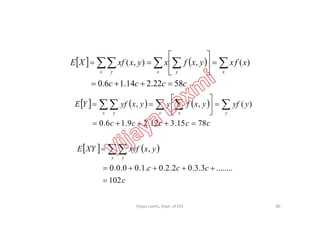
   
cccc
xfxyxfxyxxfXE
x y xx y
5822.214.16.0
)(,),(







   
      yyfyxfyyxyfYE
x y yy x
)(,, 





   
80
ccccc
x y yy x
7815.312.29.16.0 

   
c
ccc
yxxyfXYE
x y
102
........3.3.02.2.0.1.00.0.0
,


 
Vijaya Laxmi, Dept. of EEE
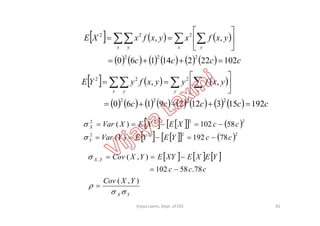
     
                ccccc
yxfyyxfyYE
x y y x
1921531229160
,,
2222
222







   
     
            cccc
yxfxyxfxXE
x y x y
10222214160
,,
222
222







   
81
      
      2222
2222
78192)(
58102)(
ccYEYEYVar
ccXEXEXVar
Y
X




     
YX
YX
YXCov
ccc
YEXEXYEYXCov



),(
78.58102
),(,



Vijaya Laxmi, Dept. of EEE
Problem
• If X and Y are two Cont. RVs
• Find (a) c
• (b) E[X]
 
 


 

otherwise
yxforyxc
yxf
0
50,622
,
• (c) E[Y]
• (d) E[XY]
• (e) E[Y2]
• (f) Var(X)
• (g) Var(Y)
• (h) Cov(X,Y)
• (i) Correlation Coeff.
82Vijaya Laxmi, Dept. of EEE
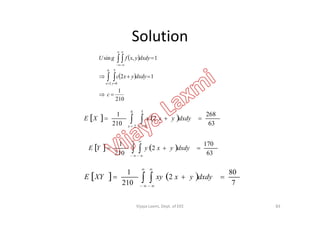
Solution
 
 
210
1
12
1,sin
6
2
5
0



 
 
 




c
dxdyyxc
dxdyyxfgU
x y
    2681
6 5
 
83
   
63
268
2
210
1
6
2
5
0
   x y
dxdyyxxXE
   
7
80
2
210
1
  




dxdyyxxyXYE
   
63
170
2
210
1
  




dxdyyxyYE
Vijaya Laxmi, Dept. of EEE
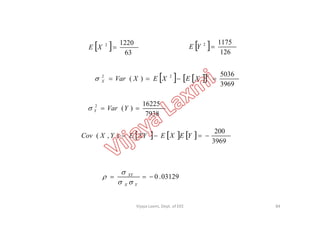
  63
12202
XE
    
3969
5036
)(
222
 XEXEXVarX
7938
16225
)(2
 YVarY
  126
11752
YE
84
     
3969
200
),(  YEXEXYEYXCov
03129.0
YX
XY



7938
Y
Vijaya Laxmi, Dept. of EEE
Problem
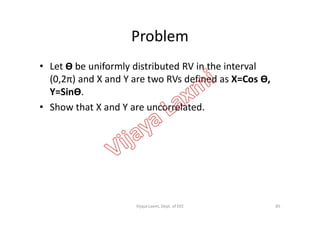
• Let Ɵ be uniformly distributed RV in the interval
(0,2π) and X and Y are two RVs defined as X=Cos Ɵ,
Y=SinƟ.
• Show that X and Y are uncorrelated.Show that X and Y are uncorrelated.
85Vijaya Laxmi, Dept. of EEE
Solution
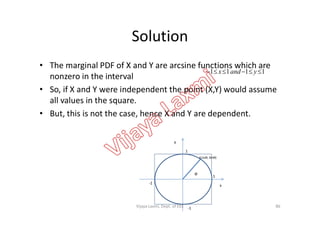
• The marginal PDF of X and Y are arcsine functions which are
nonzero in the interval
• So, if X and Y were independent the point (X,Y) would assume
all values in the square.
• But, this is not the case, hence X and Y are dependent.
1111  yandx
• But, this is not the case, hence X and Y are dependent.
(CosƟ, SinƟ)
Ɵ
y
x
1
-1
-1
1
86Vijaya Laxmi, Dept. of EEE
   
02
4
1
2
1
2
0
2
0











dSin
dCosSinCosSinEXYE
Since E[X]=E[Y]=0, X and Y are uncorrelated
Uncorrelated but dependent Random Variables
87Vijaya Laxmi, Dept. of EEE
Conditional Expectation, Variance and
Moments
• The conditional expectation of a RV Y given X is expressed as
• Properties:
 If X and Y are independent,
    dxxXxmeansxXwheredyxyyfxXYE  


,
 If X and Y are independent,

   YExXYE 
        XYEEdxxfxXYEYE  


1
88Vijaya Laxmi, Dept. of EEE
• Hence,
         YoffunctionaisYhwhereXYhEEYhE ,
    
and
thKKK
,

89
     origintheaboutmomentktheisYwhereXYEEYE thKKK
,
Vijaya Laxmi, Dept. of EEE
Theorem
    XYEEYE 
Proof:
      
   






dxxfXYE
dxxfXYEXYEERHS
X
:
   
 dxxfXYE X
90
   
 
 
  
 










dxdyxf
xf
yxf
y
dxxfdyxyyf
XY
XY
,
 
   YEdyyyf
dxdyyxfy



 






,
Vijaya Laxmi, Dept. of EEE
Problem
• If X and Y are two RVs whose density function is
given by
   
otherwise
yxforyxcyxf
0
30,202, 
• Find E[Y|X=2]
91Vijaya Laxmi, Dept. of EEE
Solution
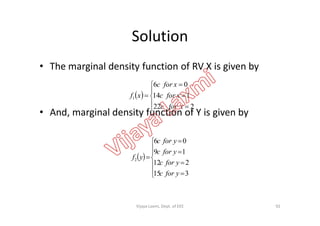
• The marginal density function of RV X is given by
• And, marginal density function of Y is given by
 









222
114
06
1
xforc
xforc
xforc
xf
• And, marginal density function of Y is given by
 












315
212
19
06
2
yforc
yforc
yforc
yforc
yf
92Vijaya Laxmi, Dept. of EEE
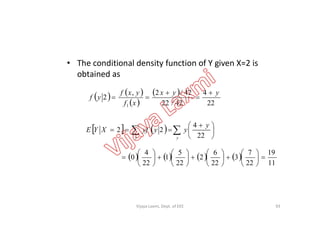
• The conditional density function of Y given X=2 is
obtained as
   
 
 
22
4
42/22
42/2,
2
1
yyx
xf
yxf
yf




93
     




 

yy
y
yyyfXYE
22
4
22
       
11
19
22
7
3
22
6
2
22
5
1
22
4
0 
























Vijaya Laxmi, Dept. of EEE
Problem
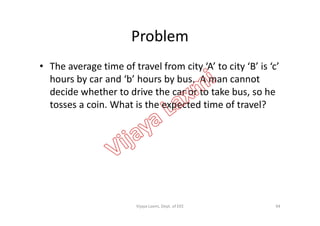
• The average time of travel from city ‘A’ to city ‘B’ is ‘c’
hours by car and ‘b’ hours by bus. A man cannot
decide whether to drive the car or to take bus, so he
tosses a coin. What is the expected time of travel?
94Vijaya Laxmi, Dept. of EEE
Solution
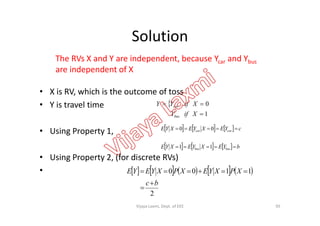
• X is RV, which is the outcome of toss
• Y is travel time 
1
0


XifY
XifYY car
The RVs X and Y are independent, because Ycar and Ybus
are independent of X
• Using Property 1,
• Using Property 2, (for discrete RVs)
•
1XifYbus
     
      bYEXYEXYE
cYEXYEXYE
busbus
carcar


11
00
         
2
1100
bc
XPXYEXPXYEYE



95Vijaya Laxmi, Dept. of EEE
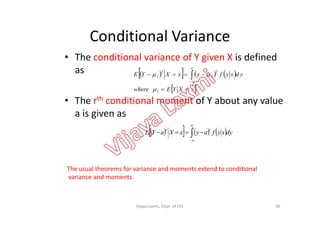
Conditional Variance
• The conditional variance of Y given X is defined
as
• The rth conditional moment of Y about any value
a is given as
      
 xXYEwhere
ydxyfyxXYE

 


2
2
2
2
2


a is given as
      


 dyxyfayxXaYE
rr
The usual theorems for variance and moments extend to conditional
variance and moments.
96Vijaya Laxmi, Dept. of EEE
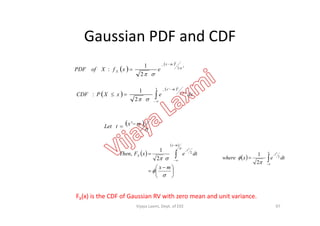
Gaussian PDF and CDF
 
 
2
2
2
2
1
: 

mx
X exfXofPDF


 
 



x mx
dxexXPCDF '
2
1
:
2
2
2
'


FX(x) is the CDF of Gaussian RV with zero mean and unit variance.
97
 

mxtLet  '
 
 





 

 







mx
dtexFThen
mx
t
X
2
2
2
1
,
  


x
t
dtexwhere 2
2
2
1


Vijaya Laxmi, Dept. of EEE
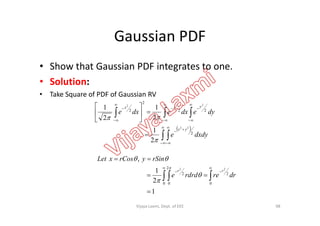
Gaussian PDF
• Show that Gaussian PDF integrates to one.
• Solution:
• Take Square of PDF of Gaussian RV











dyedxedxe
yxx
22
2
2
222
11

 
 












dxdye
dyedxedxe
yx
2
22
2
1
22


98
1
2
1
,
0
2
0
2
0
2
22



 




drrerdrde
rSinyrCosxLet
rr




Vijaya Laxmi, Dept. of EEE
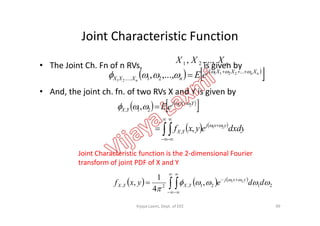
Joint Characteristic Function
• The Joint Ch. Fn of n RVs, is given by
• And, the joint ch. fn. of two RVs X and Y is given by
   
 nn
n
XXXj
nXXX eE 
 
 ...
21.....
2211
21
,...,,
nXXX ,...,, 21
   
 
 eE YXj
YX
21
, 21,


   
 





 dxdyeyxf yxj
YX
21
,,

Joint Characteristic function is the 2-dimensional Fourier
transform of joint PDF of X and Y
     
 





 2121,2,
21
,
4
1
, 


ddeyxf yxj
YXYX
99Vijaya Laxmi, Dept. of EEE
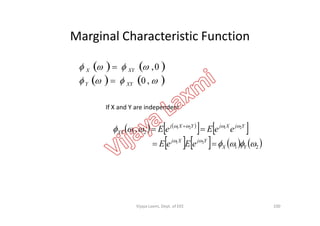
Marginal Characteristic Function
   
   

,0
0,
XYY
XYX


If X and Y are independent
   
   
       21
21
21
2121
,




YX
YjXj
YjXjYXj
XY
eEeE
eeEeE

 
100Vijaya Laxmi, Dept. of EEE
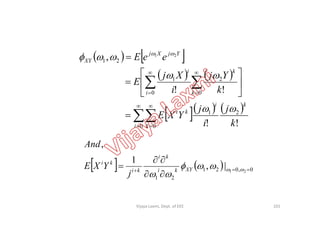
   
   
    


 













21
0
2
0
1
21
!!
, 21
ki
ki
k
k
i
i
YjXj
XY
jj
YXE
k
Yj
i
Xj
E
eeE


 
    
 

0 0
21
!!i k
ki
k
j
i
j
YXE

101
    0,021
21
21
|,
1
,



 

XYki
ki
ki
ki
j
YXE
And
Vijaya Laxmi, Dept. of EEE
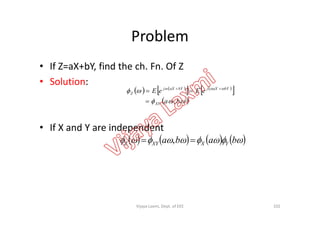
Problem
• If Z=aX+bY, find the ch. Fn. Of Z
• Solution:
   
   
 
 
 
ba
eEeE
XY
bYaXjbYaXj
Z
,
 
• If X and Y are independent
        baba YXXYZ  ,
102Vijaya Laxmi, Dept. of EEE
Problem
• If U and V are independent zero mean, unit
variance Gaussian RV, and
• X=U+V and Y=2U+V
• Find the joint ch. Fn of X and Y and find E[XY]• Find the joint ch. Fn of X and Y and find E[XY]
103Vijaya Laxmi, Dept. of EEE
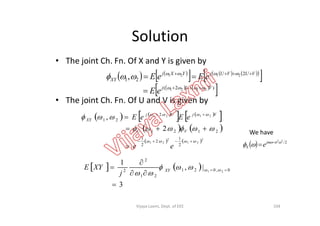
Solution
• The joint Ch. Fn. Of X and Y is given by
• The joint Ch. Fn. Of U and V is given by
   
      
 
   
 )2(
2
21
2121
2121
,
VUj
VUVUjYXj
XY
eE
eEeE







   
   
 2
, 
 
 eEeE VjUj
   
   
 
   
   2
21
2
21
2121
2
1
2
2
1
2121
2
21
2
,









ee
eEeE
VU
VjUj
XY
  2/22

 
 jm
X e
104
   
3
|,
1
0,021
21
2
2 21



  
 XY
j
XYE
We have
Vijaya Laxmi, Dept. of EEE
Jointly Gaussian RV
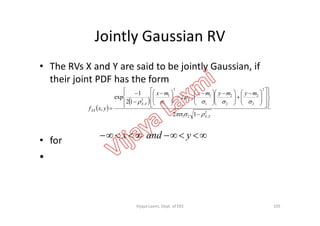
• The RVs X and Y are said to be jointly Gaussian, if
their joint PDF has the form
 
 
2
2
2
2
2
2
1
1
,
2
1
1
2
,
12
2
12
1
exp
,
YX
YX
XY
mymymxmx
yxf


























 





 





 





 



• for
•
2
,21 12 YX 
 yandx
105Vijaya Laxmi, Dept. of EEE
Problem
• The PDF for jointly Gaussian RVs is given by
 








16168
3
8
3
16
3
4
2
1
,
22
2
1
,
yx
xy
yx
YX eyxf

• Find E[X], E[Y], Var(X), Var(Y) and Cov(X,Y)
106Vijaya Laxmi, Dept. of EEE
Problem
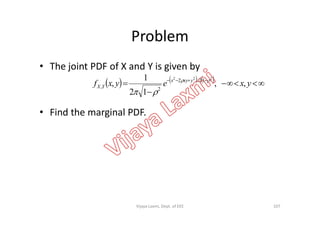
• The joint PDF of X and Y is given by
• Find the marginal PDF.
      

 
yxeyxf yxyx
YX ,,
12
1
,
222
12/2
2,


• Find the marginal PDF.
107Vijaya Laxmi, Dept. of EEE
Solution
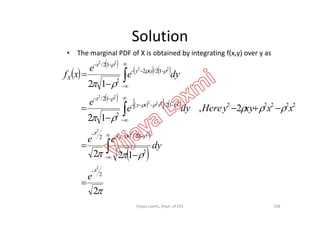
• The marginal PDF of X is obtained by integrating f(x,y) over y as
 
 
   
 
     






2,
12
12
2222212/
2
12/
12/2
2
12/
2222
22
22
22
xxy
x
xyy
x
X
xxxyyHeredye
e
dye
e
xf














   
 





2
122
2,
12
2
2
12/2
2
2
22
2
x
xy
x
e
dy
ee
xxxyyHeredye













108Vijaya Laxmi, Dept. of EEE
• Hence
 The last integral equals one because its integrand is a Gaussian
PDF with mean and variance
 The marginal PDF of X is a one-dimensional Gaussian PDF with mean
x 2
1 
 The marginal PDF of X is a one-dimensional Gaussian PDF with mean
0 and variance 1. Form symmetry, the marginal PDF of Y will also be a
Gaussian PDF with mean 0 and variance 1.
109Vijaya Laxmi, Dept. of EEE
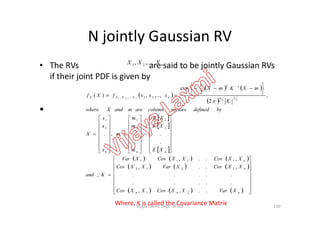
N jointly Gaussian RV
• The RVs are said to be jointly Gaussian RVs
if their joint PDF is given by
•
nXXX ,...,, 21
 
   
 
 









n
T
nXXXX
bydefinedvectorscolumnaremandXwhere
K
mXKmX
xxxfXf n
,
2
2
1
exp
,...,,)(
2
1
2
1
21,...,, 21

•
 
 
 
     
     
      



































































nnn
n
n
nnn
XVarXXCovXXCov
XXCovXVarXXCov
XXCovXXCovXVar
Kand
XE
XE
XE
m
m
m
m
x
x
x
X
..,,
.....
.....
,..,
,..,
,
.
.
.
.,
.
.
21
2212
1211
2
1
2
1
2
1
Where, K is called the Covariance Matrix 110Vijaya Laxmi, Dept. of EEE

Module iii sp

  • 1.
  • 2.
    Vector Random Variable •Assigning a vector of real numbers to each outcome of Sample Space of a random experiment. • Example: Random Experiment consists of selecting student’s name from an urn based on the Height, Weight and Age of the student. • - Height of student in inches• - Height of student in inches • - Age of student in years • - Weight of student in Kg • Then the vector is the vector random variable. )(H )(A )(W        WAH ,, 2Vijaya Laxmi, Dept. of EEE
  • 3.
    • We have y y2   221 yYxXx  x1 x2 x x y1 y2 y x2x1    2121 yYyxXx  3Vijaya Laxmi, Dept. of EEE
  • 4.
    y y2 y1   211 yYyxX  x1 y2 y y2 y1 y2x1-x1    211 yYyxX  4Vijaya Laxmi, Dept. of EEE
  • 5.
    MULTIPLE RANDOM VARIABLESMULTIPLERANDOM VARIABLES 5Vijaya Laxmi, Dept. of EEE
  • 6.
    Joint Distribution • Ifthere are two RVs X and Y and the sets and are events with probabilities consisting of all outcomes ξ such that is also an event, then  xX   yY          yYxXyYxX producttheandyFyYPandxFxXP YX   , )()( yYandxX  )()(  is also an event, then is called the Joint Distribution of the RVs X and Y. • It is given by •  yYxXP  ,  yYxXPyxFXY  ,),( 6Vijaya Laxmi, Dept. of EEE
  • 7.
    Discrete Random Variable •For discrete RV,     iyxfWhere yxfyYxXP ).....(..........0),(, ),(,    x y iiyxf iyxfWhere ).....(..........1),( ).....(..........0),(, 7Vijaya Laxmi, Dept. of EEE
  • 8.
    • Let Xbe a RV which assumes any one value of • And, Y be a RV which assumes any one of mxxx .,..........,, 21 nyyy .,..........,, 21 • Then, the probability of an event that X=xj and Y=yk is given by n21   ),(, kjkj yxfyYxXP  8Vijaya Laxmi, Dept. of EEE
  • 9.
    X Y y1y2 . . yn Total f(x1,y1) f(x1,y2) . . f(x1,yn) f1(x1) x2 f(x2,y1) f(x2,y2) . . f(x2,yn) f1(x2) x3 f(x3,y1) f(x3,y2) . . f(x3,yn) f1(x3) x1 . . . . . . . . . . . . . . xm f(xm,y1) f(xm,y2) . . f(xm,yn) f1(xm) Total f2(y1) f2(y2) . . f2(yn) 1 Grand Total 9Vijaya Laxmi, Dept. of EEE
  • 10.
    • The probabilitythat X=xj is obtained by adding all entries in the row corresponding to xj is given by • The probability that Y=yk is obtained by adding all      n k kjjj yxfxfxXP 1 1 ,)( • The probability that Y=yk is obtained by adding all entries in the row corresponding to yk is given by      m j kjkk yxfyfyYP 1 2 ,)( 10Vijaya Laxmi, Dept. of EEE
  • 11.
    • f1(xj) andf2(yk) or simply f1(x) and f2(y) are obtained from the margins of table, hence called Marginal Probability function of X and Y • Or, which, can be written as     11 1 1 21    m j n k kj yfandxf   1,   m n yxf which, can be written as • i.e., Total probability of all entries is 1. • Joint distribution function of X and Y is given by • This is the sum of all entries for which   1, 1 1   j k kj yxf         xu yv vufyYxXPyxF ),(,, yyandxx kj  11Vijaya Laxmi, Dept. of EEE
  • 12.
    Continuous Random Variables •The properties of joint PDF for the continuous RVs are   )..(....................0, iyxf   )..(....................0, iyxf  12 )........(1),( iidxdyyxf       Vijaya Laxmi, Dept. of EEE
  • 13.
    Joint Distribution functionfor Continuous RV • The joint distribution function of two RVs X and Y is given by     dudvvufyYxXPyxF x u y v    ),(,),(   FunctionDensityyxf yx yxF    ),( ,2 13Vijaya Laxmi, Dept. of EEE
  • 14.
    Marginal Distribution Function •The marginal distribution function of X is given by • The marginal distribution function of Y is given by        x u v dudvvufxFxXP ),()(1 • The marginal distribution function of Y is given by         u y v dudvvufyFyYP ),()(2 14Vijaya Laxmi, Dept. of EEE
  • 15.
    Marginal Density Function •The marginal density function of RV X is given by • The marginal density function of RV Y is given by       v dvvxfxF dx d xf ),()(11 • The marginal density function of RV Y is given by       u duyufxF dy d yf ),()(22 15Vijaya Laxmi, Dept. of EEE
  • 16.
    • Or, Iffor all x and y, f(x,y) is the product of a function of x alone and a function of y alone (which are the marginal probability of X and Y), then, X and Y are independent. • If, f(x,y) cannot be expressed as function of x and y, then, X and Y are dependent. 16Vijaya Laxmi, Dept. of EEE
  • 17.
    Independence • If Xand Y are two independent random variables, events that involve only X should be independent of the events that involve only Y. • If A1 is any event that involve X only and A2 is any event that involve only Y, then for discrete RVs,      , yYPxXPyYxXP  • In general, n random variables are independent, when • Knowledge about probabilities of RVs in isolation is sufficient to specify the probabilities of joint events.       )()(),(, , 21 yfxfyxfor yYPxXPyYxXP   nXXX ,......, 21        nnnn xXPxXPxXPxXxXxXP  ............,,, 22112211 17Vijaya Laxmi, Dept. of EEE
  • 18.
    • X andY (continuous RVs) • If, the events are independent events for all x and y,    yYandxX       , yYPxXPyYxXP  )()(),( ),()(),( 21 21 yfxfyxf andyFxFyxF   18Vijaya Laxmi, Dept. of EEE
  • 19.
    Properties of JointCDF • The joint CDF is non-decreasing in the ‘northeast’ direction, i.e., ),(),( yyandxxifyxFyxF  21212211 ),(),( yyandxxifyxFyxF XYXY  (x1,y1) (x2,y2) x y 19Vijaya Laxmi, Dept. of EEE
  • 20.
    x y x1   YxXPxFX,)( 11 20Vijaya Laxmi, Dept. of EEE
  • 21.
    x y y1  11 ,)(yYXPyFY  21Vijaya Laxmi, Dept. of EEE
  • 22.
    • It isimpossible for either X or Y to assume a value less than - ∞, therefore • It is certain that X and Y will assume values less than infinity, therefore     0,, ,,  xFyF YXYX therefore • If, one of the variables approach infinity while keeping the other fixed, marginal cumulative distribution functions are obtained as 1),(, YXF        yYPyYXPyxFyF and xXPYxXPyxFxF YXY YXX   ,),()( ,),()( , , 22Vijaya Laxmi, Dept. of EEE
  • 23.
    • The jointCDF is continuous from the north and from the east, i.e.,   ax YXYX and yaFyxF ),(),(lim ,,   by YXYX bxFyxF and ),(),(lim ,, 23Vijaya Laxmi, Dept. of EEE
  • 24.
    Problem • If Xand Y are two discrete RVs, whose joint PDF is given by   0 3020,2 ),(      otherwise yandxwhereyxc yxf    2,1)( 1,2)( )( 0    YXPc YXPb caFind otherwise 24Vijaya Laxmi, Dept. of EEE
  • 25.
    Solution: (a) • WehaveX Y 0 1 2 3 Total 0 0 C 2c 3c 6c 1 2c 3c 4c 5c 14c 2 4c 5c 6c 7c 22c2 4c 5c 6c 7c 22c Total 6c 9c 12c 15c 42c C=1/42 25Vijaya Laxmi, Dept. of EEE
  • 26.
    • (b) • (c)  42 5 51,2  cYXP   ),(2,1 1 2     yxfYXP X Y 7 4 42 24 24 )654()432(   c cccccc 26Vijaya Laxmi, Dept. of EEE
  • 27.
    Problem • Find themarginal probability of (a) X and (b) Y 27Vijaya Laxmi, Dept. of EEE
  • 28.
    Solution • Marginal Prob.function of X,                2 21 11 22 1 3 1 14 0 7 1 6 )()(1 xforc xforc xforc xfxfxXP X • Marginal Prob. function of Y,                   3 14 5 15 2 7 2 12 1 14 3 9 0 7 1 6 )()(2 yforc yforc yforc yforc yfyfyYP Y 28Vijaya Laxmi, Dept. of EEE
  • 29.
    Problem • Show thatthe RVs X and Y are dependent 29Vijaya Laxmi, Dept. of EEE
  • 30.
    Solution • If xand y are independent, then for all x and y      yYPxXPyYxXP  ,   42 5 1,2  YXP 30     14 3 1, 21 11 2,  YPandXPBut dependentareYandX  14 3 . 21 11 42 5 Vijaya Laxmi, Dept. of EEE
  • 31.
    Problem • If Xand Y are two cont. RV, whose joint density function is given by 0 51,40 ),(      otherwise yxforcxy yxf    2,3)( 32,21)( )(   YXPc YXPb caFind 31Vijaya Laxmi, Dept. of EEE
  • 32.
    Solution • (a) • (b)96 1 96 1),( 4 0 5 1 4 0 5 1                        cc dxxydyccxydxdy dxdyyxf x yx y • (c)   128 5 96 32,21 2 1 3 2     x y dxdy xy YXP   128 7 96 2,3 4 3 2 1     x y dxdy xy YXP 32Vijaya Laxmi, Dept. of EEE
  • 33.
    Problem • Find theMarginal distribution function of X and Y 33Vijaya Laxmi, Dept. of EEE
  • 34.
    Solution • Marginal Distributionfunction of X   1696 1 96 ),()( 2 0 5 10 5 1 x duuvdvdudv uv dudvvufxXPxF x u v x u v x u v X                             34 .0)(,0 1)(,4 40,    xFx xFxFor xBecause X X            41 40 16 00 )( 2 xfor xfor x xfor xFX Vijaya Laxmi, Dept. of EEE
  • 35.
    • Marginal Prob.function of Y,          u y v Y y dudvvufyYPyF 24 1 ),()( 2 51,  yBecause 35 .0)(,1 1)(,5   yFy yFyFor Y Y             51 51 24 1 10 )( 2 yfor yfor y yfor yFY Vijaya Laxmi, Dept. of EEE
  • 36.
    Change of Variables(Discrete RVs) • Theorem 1: If X is a discrete RV having Prob. Function f(x) and another RV U is defined by U=ø(X) • For each value of X there corresponds one and only one value of U,one value of U, • Proof:  )()(,.., )( ufugUoffnprobThen UX             UfuXP uXPuUPug     )( )()( 36Vijaya Laxmi, Dept. of EEE
  • 37.
    • Theorem 2:If X and Y is discrete RVs having joint prob. Function f(x,y) • Another RV U and V defined by    YXVandYXU ,, 21   • For each pair of values of X and Y there corresponds one and only one pair of values of U & V • Then, joint Prob. Function of U & V is given by    VUYandVUX ,, 21       vuvufvug ,,,),( 21  37Vijaya Laxmi, Dept. of EEE
  • 38.
    • Proof:                vuvuf vuYvuXP vYXuYXPvVuUPvug ,,, ,,, ,,,,),( 21 21 21       38Vijaya Laxmi, Dept. of EEE
  • 39.
    Change of Variables(Continuous RVs) • Theorem 1: If X is a continuous RV having Prob. Function f(x) and another RV U is defined by U=ø(X), where • Then, prob. Density function of U is given by g(u), )(UX  Then, prob. Density function of U is given by g(u), where    uuf du dx xfug dxxfduug ' )()()( )()(   39Vijaya Laxmi, Dept. of EEE
  • 40.
    • Proof: Ifu is an increasing function i.e., if x increases then u increases. u u2 u1     )()( 2 2 2121     dxxfduug xXxPuUuP u u v v x1 x2 u1 x         0)('')()( )()( 2 1 2 1 1 1 '      uhereuufug duuufduug u u u u u v   This can be proved for 0)('0)('  uoru  40Vijaya Laxmi, Dept. of EEE
  • 41.
    • Theorem 2: •The joint density function g(u,v) of U and V is given by        VUYVUXwhere YXVYXUDefine ,,,, ,,, 21 21     by • Where,     Jvuvufvug dxdyyxfdudvvug ,,,),( ),(),( 21       v y u y v x u x vu yx J             , , 41Vijaya Laxmi, Dept. of EEE
  • 42.
    • Proof: • Ifx and y increases then, u and v also increases    21212121 ,, yYyxXxPvVvuUuP  2 22 2 x yu v This can be proved also for 0J 42          2 1 2 1 2 1 2 1 2 1 2 1 ,,, ),(),( 21 u u v v x x y y u u v v Jdudvvuvuf dxdyyxfdudvvug       0,,,),( 21  JhereJvuvufvug  Vijaya Laxmi, Dept. of EEE
  • 43.
    Problem • If Xis a discrete RV with prob. Function • Find the prob. Function of RV       otherwise xfor xf x 0 ....3,2,12 )( 14 XU • Find the prob. Function of RV 43Vijaya Laxmi, Dept. of EEE
  • 44.
  • 45.
    Problem • If Xis a Cont. RV with density function • Find the prob. Density Function for      otherwise xforx xf 0 6381/ )( 2  XU  12 3 1 • Find the prob. Density Function for 3 45Vijaya Laxmi, Dept. of EEE
  • 46.
    Solution   2,6 ,5,3 3'    ux anduxFor dx du u  uxux xu 312312 12 3 1   Check:     5 2 2 .1 27 312 du u 46           otherwise u u ug 0 52, 27 312 )( 2 Vijaya Laxmi, Dept. of EEE
  • 47.
    Problem • If Xand Y are two cont. RVs whose joint density function is given by       otherwise yandx xy yxf 0 5140 96),( • Find the density function of U=X+2Y  otherwise0 47Vijaya Laxmi, Dept. of EEE
  • 48.
  • 49.
    • Marginal densityfunction of U is given by ufordv vuv ufordv vuv ug v u v 106 384 )( 62 384 )( )( 4 0 2 0 1                         otherwise u uu u u u uu ufordv vuv uv v ,0 1410, 2304 2128348 106, 144 83 62, 2304 42 1410 384 )( 384 3 2 4 10 0                    49Vijaya Laxmi, Dept. of EEE
  • 50.
    Expected Value offunction of random variables • The expected value of Z=g(X,Y) can be obtained by          continuouslyjoYXdxdyyxfyxg ZE YX int,,),( )( ,              RVsdiscreteYXyxpyxg ZE i niYX n ni ,,, )( , 50Vijaya Laxmi, Dept. of EEE
  • 51.
    Sum of RandomVariables • Let Z=X+Y, Find E(Z)            ''',''' )()( , dydxyxfyx YXEZE YX                ''',''''','' ,, dydxyxfydydxyxfx YXYX The expected value of the sum of two random variables is equal to the sum of individual expected values. X and Y need not be independent. 51                                   ''',''''','' ,, dydxyxfydxdyyxfx YXYX     )()( '''''' YEXE dyyfydxxfx YX        Vijaya Laxmi, Dept. of EEE
  • 52.
    • The expectedvalues of sum of n random variables is equal to the sum of the expected values.        nn XEXEXEXXXE  ........ 2121       nn XEXEXEXXXE  ........ 2121 52Vijaya Laxmi, Dept. of EEE
  • 53.
    Sum of DiscreteRVs • If X and Y are two discrete RVs     yxyfyxxf yxfyxYXE x y     ),(),( ),(    YEXE yxyfyxxf x yx y    ),(),( 53Vijaya Laxmi, Dept. of EEE
  • 54.
    Expected value ofProduct of Two RVs • If X and Y are two independent RVs • Proof: (continuous RV)      YEXEXYE                     YEXE dyyfydxxfx dydxyfxfyx dydxyxfyxXYE YX YX YX                                  '''''' '''()''' ''',''' , 54Vijaya Laxmi, Dept. of EEE
  • 55.
    Product of twodiscrete RVs • If X and Y are two independent RVs )()(),( 21 yfxfyxf          x y yfxxyf yxxyfXYE )()( ),(   x y yfxxyf )()( 21 55       YEXE YExxf yyfxxf x x y             )( )()( 1 21 Vijaya Laxmi, Dept. of EEE
  • 56.
    Product of functionsof Random variables • If X and Y are two independent RVs and g(X,Y)=g1(X)g2(Y) • Find • Solution:              dydxyfxfygxgYgXgE YX2121 ''''''            YgEXgEYXgE 21),(                            YgEXgE dyyfygdxxfxg dydxyfxfygxgYgXgE YX YX 21 21 2121 '''''' ''''''                         56Vijaya Laxmi, Dept. of EEE
  • 57.
    • In general,for n independent RVs, nXXX ,........, 21                nnnn XgEXgEXgEXgXgXgE ................. 22112211                nnnn 22112211 57Vijaya Laxmi, Dept. of EEE
  • 58.
    Conditional Probability Distribution •For P(A)>0, Probability of event B given that A has occurred         )(| )( | APABPBAPor AP BAP ABP    • If X and Y are discrete RVs with events (A:X=x) and (B:Y=y)   Xofprobinalmtheisxfwhere xf yxf xyf .arg)(, )( ),( | 1 1  58Vijaya Laxmi, Dept. of EEE
  • 59.
    • Conditional prob.function of Y given X is given by • Conditional prob. function of X given Y is given by   )( ),( |( xf yxf xyf X  • Conditional prob. function of X given Y is given by   )( ),( | yf yxf yxf Y  59Vijaya Laxmi, Dept. of EEE
  • 60.
    Conditional Probability Distributionfor Cont. RV • If X and Y are two cont. RVs, the conditional prob. Density function of Y given X is given by   )( ),( | xf yxf xyf  )( xf X 60Vijaya Laxmi, Dept. of EEE
  • 61.
    Problem • The jointdensity function of two cont. RVs X and Y are given by       otherwise yxxy yxf 0 10,10, 4 3 ),3( • Find (a) • (b)  otherwise0  xyf        dxXYP 2 1 2 1 2 1 61Vijaya Laxmi, Dept. of EEE
  • 62.
    Solution • (a) For0<x<1                 10, 43 ),( 4 23 24 3 4 3 )( 1 0 1 y xy yxf xx dyxyxf • (b)        )(0 10, 23 )( ),( 1 definednototherwise y x xf yxf xyf 16 9 4 23 2 1 2 1 2 1 2 1 2/1 2/1                     dy y dyyfdxXYP 62Vijaya Laxmi, Dept. of EEE
  • 63.
    Variance of Sumof Two RVs • For two independent RVs X and Y, Var(X+Y)=Var(X)+Var(Y) • Proof:             )( 2 YXEYXVar YX                                             )()( 2 2 2 22 22 22 22 2 YVarXVar YEXE YEYEXEXE YEYXEXE YYXXE YXE YX YYXX YYXX YYXX YX            63Vijaya Laxmi, Dept. of EEE
  • 64.
    • Var(X-Y)=Var(X)+Var(Y) • Proof:            )( 2 2 YXE YXEYXVar YX YX                                   )()( 2 2 22 22 22 YVarXVar YEXE YEYEXEXE YYXXE YXE YX YYXX YYXX YX          64Vijaya Laxmi, Dept. of EEE
  • 65.
    Variance of Sumof Two RVs • In general, XYYXYXor YXCovYVarXVarYXVar  2, ),(2)()()( 222    65Vijaya Laxmi, Dept. of EEE
  • 66.
    Correlation and Covarianceof Two RVs • The jkth joint moment of two RVs X and Y is defined as                  kj YX kjKj ContinuouslyjoYandXFordxdyyxfyxYXE int,,   i n niYX k n j i RVsdiscreteYandXyxpyx ,, If j=0, moments of Y are obtained If k=0, moments of X are obtained If j=k=1, E[XY] gives the correlation of X and Y IF E[XY]=0, X and Y are orthogonal 66Vijaya Laxmi, Dept. of EEE
  • 67.
    Jkth central momentabout the mean • The jkth central moment of X and Y about the mean is given by     k Y j X YXE   If j=2, k=0, variance of X is obtained If j=0, k=2, variance of Y is obtained If j=k=1, Covariance of X and Y is obtained     YandXofianceCoYXCovYXE YX var),(   67Vijaya Laxmi, Dept. of EEE
  • 68.
    Covariance of TwoRVs                      YEXEYEXEXYE YEXEXYE YXXYE YXEYXCov YXXY YXXY YX     2 ),(                   YEXEXYE YEXEYEXEXYE   2 Hence, Cov(X,Y)=E[XY], if either of the RVs has mean value equal to zero 68Vijaya Laxmi, Dept. of EEE
  • 69.
    Problem • If Xand Y are two independent RVs each having density function       otherwise ufore uf u 0 02 )( 2 • Find      XYEYXEYXE ,, 22  69Vijaya Laxmi, Dept. of EEE
  • 70.
    Solution      1 2.2. 0 2 0 2         dyeydxex YEXEYXE yx   1 4 22       dxdyexyeXYE yx Check E[X+Y]=E[X]+E[Y] E[XY]=E[X]E[Y] 70   4 4 0 0 22     dxdyexyeXYE yx   122 0 22 0 2222       dyeydxexYXE yx Vijaya Laxmi, Dept. of EEE
  • 71.
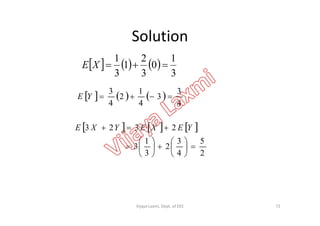
    Problem • If Xand Y are two discrete independent RVs        4/3.2 3/2.0 3/1.1 probwith Y probwith probwith X • Find      4/1.3 probwith Y        YXEXYEYXEYXE 222 ,,2,23  71Vijaya Laxmi, Dept. of EEE
  • 72.
    Solution      3 1 0 3 2 1 3 1 XE       4 3 3 4 1 2 4 3 YE 72       2 5 4 3 2 3 1 3 2323               YEXEYXE Vijaya Laxmi, Dept. of EEE
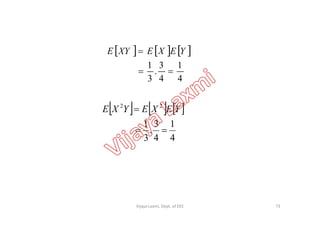
  • 73.
        22  YEXEYXE       4 1 4 3 . 3 1   YEXEXYE       4 1 4 3 . 3 1   YEXEYXE 73Vijaya Laxmi, Dept. of EEE
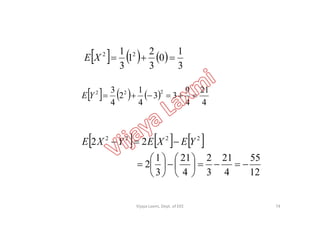
  • 74.
         3 1 0 3 2 1 3 1 22 XE       4 21 4 9 33 4 1 2 4 3 222 YE 74       12 55 4 21 3 2 4 21 3 1 2 22 2222               YEXEYXE Vijaya Laxmi, Dept. of EEE
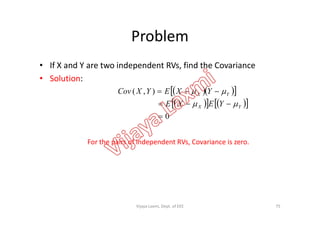
  • 75.
    Problem • If Xand Y are two independent RVs, find the Covariance • Solution:           0 ),(    YX YX YEXE YXEYXCov   0 For the pairs of independent RVs, Covariance is zero. 75Vijaya Laxmi, Dept. of EEE
  • 76.
    Correlation Coefficient ofX and Y • The correlation coefficient between the two RVs, X and Y is given by      YEXEXYEYXCov YXYX YX ),( ,       deviationdardSYVarandXVarwhere YX tan)()(,   11 ,  YX X and Y are uncorrelated, if 0, YX If X and Y are independent, Cov(X,Y)=0, 0,  YX If X and Y are independent, they are uncorrelated. -------From Theorem 4 76Vijaya Laxmi, Dept. of EEE
  • 77.
    Theorems on Covariance •Theorem 1: • Theorem 2: If X and Y are independent RVs • Theorem 3:      YEXEXYEXY  0),(  YXCovXY • Theorem 3: • Theorem 4:   XYYXYXor YXCovYVarXVarYXVar  2, ),(2)()( 222    YXXY   If X and Y are independent, Theorem 3 reduces to Theorem 4. The converse of Theorem 3 is not necessarily true. 77Vijaya Laxmi, Dept. of EEE
  • 78.
    Problem • If Xand Y are two discrete RVs, whose joint density function is given by • Find E[X], E[Y], E[XY], E[X2], E[Y2], Var(X), Var(Y), Cov(X,Y) and   otherwise yxforyxcyxf 0 30,202),(  • Find E[X], E[Y], E[XY], E[X2], E[Y2], Var(X), Var(Y), Cov(X,Y) and correlation coeff. 78Vijaya Laxmi, Dept. of EEE
  • 79.
    Solution • We have XY 0 1 2 3 Total 0 0 C 2c 3c 6c 1 2c 3c 4c 5c 14c1 2c 3c 4c 5c 14c 2 4c 5c 6c 7c 22c Total 6c 9c 12c 15c 42c 79Vijaya Laxmi, Dept. of EEE
  • 80.
       cccc xfxyxfxyxxfXE x y xx y 5822.214.16.0 )(,),(                  yyfyxfyyxyfYE x y yy x )(,,           80 ccccc x y yy x 7815.312.29.16.0       c ccc yxxyfXYE x y 102 ........3.3.02.2.0.1.00.0.0 ,     Vijaya Laxmi, Dept. of EEE
  • 81.
                         ccccc yxfyyxfyYE x y y x 1921531229160 ,, 2222 222                              cccc yxfxyxfxXE x y x y 10222214160 ,, 222 222            81              2222 2222 78192)( 58102)( ccYEYEYVar ccXEXEXVar Y X           YX YX YXCov ccc YEXEXYEYXCov    ),( 78.58102 ),(,    Vijaya Laxmi, Dept. of EEE
  • 82.
    Problem • If Xand Y are two Cont. RVs • Find (a) c • (b) E[X]          otherwise yxforyxc yxf 0 50,622 , • (c) E[Y] • (d) E[XY] • (e) E[Y2] • (f) Var(X) • (g) Var(Y) • (h) Cov(X,Y) • (i) Correlation Coeff. 82Vijaya Laxmi, Dept. of EEE
  • 83.
    Solution     210 1 12 1,sin 6 2 5 0             c dxdyyxc dxdyyxfgU x y     2681 6 5   83     63 268 2 210 1 6 2 5 0    x y dxdyyxxXE     7 80 2 210 1        dxdyyxxyXYE     63 170 2 210 1        dxdyyxyYE Vijaya Laxmi, Dept. of EEE
  • 84.
      63 12202 XE     3969 5036 )( 222  XEXEXVarX 7938 16225 )(2  YVarY   126 11752 YE 84       3969 200 ),(  YEXEXYEYXCov 03129.0 YX XY    7938 Y Vijaya Laxmi, Dept. of EEE
  • 85.
    Problem • Let Ɵbe uniformly distributed RV in the interval (0,2π) and X and Y are two RVs defined as X=Cos Ɵ, Y=SinƟ. • Show that X and Y are uncorrelated.Show that X and Y are uncorrelated. 85Vijaya Laxmi, Dept. of EEE
  • 86.
    Solution • The marginalPDF of X and Y are arcsine functions which are nonzero in the interval • So, if X and Y were independent the point (X,Y) would assume all values in the square. • But, this is not the case, hence X and Y are dependent. 1111  yandx • But, this is not the case, hence X and Y are dependent. (CosƟ, SinƟ) Ɵ y x 1 -1 -1 1 86Vijaya Laxmi, Dept. of EEE
  • 87.
       02 4 1 2 1 2 0 2 0            dSin dCosSinCosSinEXYE Since E[X]=E[Y]=0, X and Y are uncorrelated Uncorrelated but dependent Random Variables 87Vijaya Laxmi, Dept. of EEE
  • 88.
    Conditional Expectation, Varianceand Moments • The conditional expectation of a RV Y given X is expressed as • Properties:  If X and Y are independent,     dxxXxmeansxXwheredyxyyfxXYE     ,  If X and Y are independent,     YExXYE          XYEEdxxfxXYEYE     1 88Vijaya Laxmi, Dept. of EEE
  • 89.
    • Hence,         YoffunctionaisYhwhereXYhEEYhE ,      and thKKK ,  89      origintheaboutmomentktheisYwhereXYEEYE thKKK , Vijaya Laxmi, Dept. of EEE
  • 90.
    Theorem    XYEEYE  Proof:                  dxxfXYE dxxfXYEXYEERHS X :      dxxfXYE X 90                        dxdyxf xf yxf y dxxfdyxyyf XY XY ,      YEdyyyf dxdyyxfy            , Vijaya Laxmi, Dept. of EEE
  • 91.
    Problem • If Xand Y are two RVs whose density function is given by     otherwise yxforyxcyxf 0 30,202,  • Find E[Y|X=2] 91Vijaya Laxmi, Dept. of EEE
  • 92.
    Solution • The marginaldensity function of RV X is given by • And, marginal density function of Y is given by            222 114 06 1 xforc xforc xforc xf • And, marginal density function of Y is given by               315 212 19 06 2 yforc yforc yforc yforc yf 92Vijaya Laxmi, Dept. of EEE
  • 93.
    • The conditionaldensity function of Y given X=2 is obtained as         22 4 42/22 42/2, 2 1 yyx xf yxf yf     93              yy y yyyfXYE 22 4 22         11 19 22 7 3 22 6 2 22 5 1 22 4 0                          Vijaya Laxmi, Dept. of EEE
  • 94.
    Problem • The averagetime of travel from city ‘A’ to city ‘B’ is ‘c’ hours by car and ‘b’ hours by bus. A man cannot decide whether to drive the car or to take bus, so he tosses a coin. What is the expected time of travel? 94Vijaya Laxmi, Dept. of EEE
  • 95.
    Solution • X isRV, which is the outcome of toss • Y is travel time  1 0   XifY XifYY car The RVs X and Y are independent, because Ycar and Ybus are independent of X • Using Property 1, • Using Property 2, (for discrete RVs) • 1XifYbus             bYEXYEXYE cYEXYEXYE busbus carcar   11 00           2 1100 bc XPXYEXPXYEYE    95Vijaya Laxmi, Dept. of EEE
  • 96.
    Conditional Variance • Theconditional variance of Y given X is defined as • The rth conditional moment of Y about any value a is given as         xXYEwhere ydxyfyxXYE      2 2 2 2 2   a is given as           dyxyfayxXaYE rr The usual theorems for variance and moments extend to conditional variance and moments. 96Vijaya Laxmi, Dept. of EEE
  • 97.
    Gaussian PDF andCDF     2 2 2 2 1 :   mx X exfXofPDF          x mx dxexXPCDF ' 2 1 : 2 2 2 '   FX(x) is the CDF of Gaussian RV with zero mean and unit variance. 97    mxtLet  '                      mx dtexFThen mx t X 2 2 2 1 ,      x t dtexwhere 2 2 2 1   Vijaya Laxmi, Dept. of EEE
  • 98.
    Gaussian PDF • Showthat Gaussian PDF integrates to one. • Solution: • Take Square of PDF of Gaussian RV            dyedxedxe yxx 22 2 2 222 11                  dxdye dyedxedxe yx 2 22 2 1 22   98 1 2 1 , 0 2 0 2 0 2 22          drrerdrde rSinyrCosxLet rr     Vijaya Laxmi, Dept. of EEE
  • 99.
    Joint Characteristic Function •The Joint Ch. Fn of n RVs, is given by • And, the joint ch. fn. of two RVs X and Y is given by      nn n XXXj nXXX eE     ... 21..... 2211 21 ,...,, nXXX ,...,, 21        eE YXj YX 21 , 21,               dxdyeyxf yxj YX 21 ,,  Joint Characteristic function is the 2-dimensional Fourier transform of joint PDF of X and Y               2121,2, 21 , 4 1 ,    ddeyxf yxj YXYX 99Vijaya Laxmi, Dept. of EEE
  • 100.
    Marginal Characteristic Function         ,0 0, XYY XYX   If X and Y are independent                21 21 21 2121 ,     YX YjXj YjXjYXj XY eEeE eeEeE    100Vijaya Laxmi, Dept. of EEE
  • 101.
                                 21 0 2 0 1 21 !! , 21 ki ki k k i i YjXj XY jj YXE k Yj i Xj E eeE             0 0 21 !!i k ki k j i j YXE  101     0,021 21 21 |, 1 ,       XYki ki ki ki j YXE And Vijaya Laxmi, Dept. of EEE
  • 102.
    Problem • If Z=aX+bY,find the ch. Fn. Of Z • Solution:               ba eEeE XY bYaXjbYaXj Z ,   • If X and Y are independent         baba YXXYZ  , 102Vijaya Laxmi, Dept. of EEE
  • 103.
    Problem • If Uand V are independent zero mean, unit variance Gaussian RV, and • X=U+V and Y=2U+V • Find the joint ch. Fn of X and Y and find E[XY]• Find the joint ch. Fn of X and Y and find E[XY] 103Vijaya Laxmi, Dept. of EEE
  • 104.
    Solution • The jointCh. Fn. Of X and Y is given by • The joint Ch. Fn. Of U and V is given by                   )2( 2 21 2121 2121 , VUj VUVUjYXj XY eE eEeE                 2 ,     eEeE VjUj                  2 21 2 21 2121 2 1 2 2 1 2121 2 21 2 ,          ee eEeE VU VjUj XY   2/22     jm X e 104     3 |, 1 0,021 21 2 2 21        XY j XYE We have Vijaya Laxmi, Dept. of EEE
  • 105.
    Jointly Gaussian RV •The RVs X and Y are said to be jointly Gaussian, if their joint PDF has the form     2 2 2 2 2 2 1 1 , 2 1 1 2 , 12 2 12 1 exp , YX YX XY mymymxmx yxf                                                     • for • 2 ,21 12 YX   yandx 105Vijaya Laxmi, Dept. of EEE
  • 106.
    Problem • The PDFfor jointly Gaussian RVs is given by           16168 3 8 3 16 3 4 2 1 , 22 2 1 , yx xy yx YX eyxf  • Find E[X], E[Y], Var(X), Var(Y) and Cov(X,Y) 106Vijaya Laxmi, Dept. of EEE
  • 107.
    Problem • The jointPDF of X and Y is given by • Find the marginal PDF.           yxeyxf yxyx YX ,, 12 1 , 222 12/2 2,   • Find the marginal PDF. 107Vijaya Laxmi, Dept. of EEE
  • 108.
    Solution • The marginalPDF of X is obtained by integrating f(x,y) over y as                       2, 12 12 2222212/ 2 12/ 12/2 2 12/ 2222 22 22 22 xxy x xyy x X xxxyyHeredye e dye e xf                          2 122 2, 12 2 2 12/2 2 2 22 2 x xy x e dy ee xxxyyHeredye              108Vijaya Laxmi, Dept. of EEE
  • 109.
    • Hence  Thelast integral equals one because its integrand is a Gaussian PDF with mean and variance  The marginal PDF of X is a one-dimensional Gaussian PDF with mean x 2 1   The marginal PDF of X is a one-dimensional Gaussian PDF with mean 0 and variance 1. Form symmetry, the marginal PDF of Y will also be a Gaussian PDF with mean 0 and variance 1. 109Vijaya Laxmi, Dept. of EEE
  • 110.
    N jointly GaussianRV • The RVs are said to be jointly Gaussian RVs if their joint PDF is given by • nXXX ,...,, 21                    n T nXXXX bydefinedvectorscolumnaremandXwhere K mXKmX xxxfXf n , 2 2 1 exp ,...,,)( 2 1 2 1 21,...,, 21  •                                                                                             nnn n n nnn XVarXXCovXXCov XXCovXVarXXCov XXCovXXCovXVar Kand XE XE XE m m m m x x x X ..,, ..... ..... ,.., ,.., , . . . ., . . 21 2212 1211 2 1 2 1 2 1 Where, K is called the Covariance Matrix 110Vijaya Laxmi, Dept. of EEE