F i n a l - E N G R 371 - D e c e m b e r 1997

Pens, pencils, erasers, and straight edges allowed. No books. No crib sheets. Calcu-
lators allowed.
    If you have a difficulty you may try making REASONABLE assumptions. State
the assumption and how that assumption limits your answer. Show all your work and
justify all your answers. Marks are given for how an answer is arrived at not just the
answer itself.
    Do only S E V E N of the following eight questions. If you attempt all eight clearly
indicate in your exam book which seven you want marked, otherwise the first seven
that you attempt will be marked.

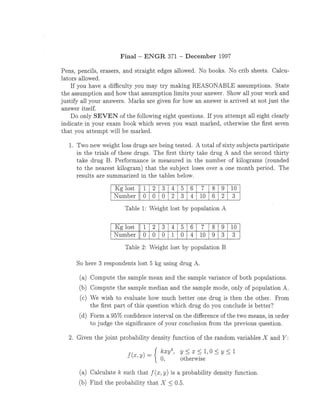
   1. Two new weight loss drugs are being tested. A total of sixty subjects participate
      in the trials of these drugs. The first thirty take drug A and the second thirty
      take drug B. Performance is measured in the number of kilograms (rounded
      to the nearest kilogram) that the subject loses over a one month period. The
      results are summarized in the tables below.

                    Kg lost                 1   2   3       4   5   6   7    8   9   10
                    Number                  0   0   0       2   3   4   10   6   2   3

                        Table 1: Weight lost by population A


                    Kg lost                 1   2   3       4   5   6   7    8   9   10
                    Number                  0   0   0       1   0   4   10   9   3   3

                        Table 2: Weight lost by population B


      So here 3 respondents lost 5 kg using drug A.

       (a) Compute the sample mean and the sample variance of both populations.
       (b) Compute the sample median and the sample mode, only of population A.
       (c) We wish to evaluate how much better one drug is then the other. From
           the first part of this question which drug do you conclude is better?
       (d) Form a 95% confidence interval on the difference of the two means, in order
           to judge the significance of your conclusion from the previous question.

   2. Given the joint probability density function of the random variables X and Y:

                             f/              — j kxy '.3
                                                                y < x < 1,0 < y < 1
                         }
                              ^   X ) V )
                                              ~  0,            otherwise

       (a) Calculate k such that f(x,y)                     is a probability density function.
       (b) Find the probability that X < 0.5.
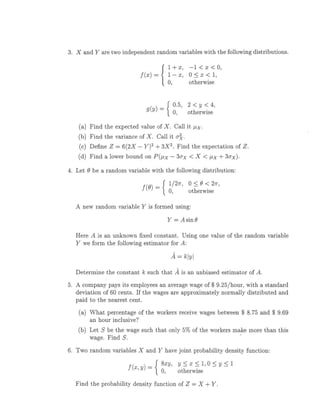
3. X and Y are two independent random variables with the following distributions.

                                     1 +x,                - 1 < x < 0,
                          /(ar) = < 1 - x ,
                                   {                      0 < z < 1,
                                     0,                   otherwise


                                             0.5,          2<y<4,
                             0(2/)           0,           otherwise

    (a) Find the expected value of X.          Call it /JLX-
   (b) Find the variance of X.       Call it     a.
                                                  2
                                                      x


    (c) Define Z = 6{2X - Yf     + 3X .  2
                                                Find the expectation of Z.
   (d) Find a lower bound on P(/J>X —                     < X < [i x   + 3&x)-

4. Let 9 be a random variable with the following distribution:

                                 =     r I/2TT    5       o < e < 2TT,
                            ^          [0,                otherwise

  A new random variable Y is formed using:

                                         Y = AsinO


  Here A is an unknown fixed constant. Using one value of the random variable
  Y we form the following estimator for A:

                                             A = ky

  Determine the constant k such that A is an unbiased estimator of A.

5. A company pays its employees an average wage of $ 9.25/hour, with a standard
   deviation of 60 cents. If the wages are approximately normally distributed and
   paid to the nearest cent.

    (a) What percentage of the workers receive wages between $ 8.75 and $ 9.69
        an hour inclusive?
   (b) Let S be the wage such that only 5% of the workers make more than this
       wage. Find S.

6. Two random variables X and Y have joint probability density function:

                                      8xy,                     y<x<l,Q<y<l
                      f(x,v) =        0,        otherwise

  Find the probability density function of Z — X + Y.
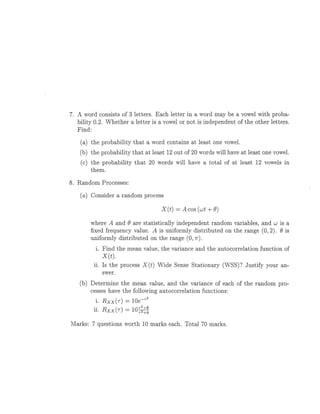
7. A word consists of 3 letters. Each letter in a word may be a vowel with proba-
   bility 0.2. Whether a letter is a vowel or not is independent of the other letters.
   Find:

    (a) the probability that a word contains at least one vowel.
    (b) the probability that at least 12 out of 20 words will have at least one vowel.
    (c) the probability that 20 words will have a total of at least 12 vowels in
        them.

8. Random Processes:

    (a) Consider a random process

                                       X{t)   = A cos (ujt + 9)

        where A and 9 are statistically independent random variables, and UJ is a
        fixed frequency value. A is uniformly distributed on the range (0,2). 9 is
        uniformly distributed on the range ( 0 , 7 r ) .

          i. Find the mean value, the variance and the autocorrelation function of
             X(t).
         ii. Is the process X(t)      Wide Sense Stationary (WSS)? Justify your an-
            swer.
    (b) Determine the mean value, and the variance of each of the random pro-
        cesses have the following autocorrelation functions:
                                  2
          i- Rxxij)   = 10e-— T
         ii. Rxx(r)   = 10< + 4
                          r 2


Marks   7 questions worth 10 marks each. Total 70 marks.

Engr 371 final exam december 1997

  • 1.
    F i na l - E N G R 371 - D e c e m b e r 1997 Pens, pencils, erasers, and straight edges allowed. No books. No crib sheets. Calcu- lators allowed. If you have a difficulty you may try making REASONABLE assumptions. State the assumption and how that assumption limits your answer. Show all your work and justify all your answers. Marks are given for how an answer is arrived at not just the answer itself. Do only S E V E N of the following eight questions. If you attempt all eight clearly indicate in your exam book which seven you want marked, otherwise the first seven that you attempt will be marked. 1. Two new weight loss drugs are being tested. A total of sixty subjects participate in the trials of these drugs. The first thirty take drug A and the second thirty take drug B. Performance is measured in the number of kilograms (rounded to the nearest kilogram) that the subject loses over a one month period. The results are summarized in the tables below. Kg lost 1 2 3 4 5 6 7 8 9 10 Number 0 0 0 2 3 4 10 6 2 3 Table 1: Weight lost by population A Kg lost 1 2 3 4 5 6 7 8 9 10 Number 0 0 0 1 0 4 10 9 3 3 Table 2: Weight lost by population B So here 3 respondents lost 5 kg using drug A. (a) Compute the sample mean and the sample variance of both populations. (b) Compute the sample median and the sample mode, only of population A. (c) We wish to evaluate how much better one drug is then the other. From the first part of this question which drug do you conclude is better? (d) Form a 95% confidence interval on the difference of the two means, in order to judge the significance of your conclusion from the previous question. 2. Given the joint probability density function of the random variables X and Y: f/ — j kxy '.3 y < x < 1,0 < y < 1 } ^ X ) V ) ~ 0, otherwise (a) Calculate k such that f(x,y) is a probability density function. (b) Find the probability that X < 0.5.
  • 2.
    3. X andY are two independent random variables with the following distributions. 1 +x, - 1 < x < 0, /(ar) = < 1 - x , { 0 < z < 1, 0, otherwise 0.5, 2<y<4, 0(2/) 0, otherwise (a) Find the expected value of X. Call it /JLX- (b) Find the variance of X. Call it a. 2 x (c) Define Z = 6{2X - Yf + 3X . 2 Find the expectation of Z. (d) Find a lower bound on P(/J>X — < X < [i x + 3&x)- 4. Let 9 be a random variable with the following distribution: = r I/2TT 5 o < e < 2TT, ^ [0, otherwise A new random variable Y is formed using: Y = AsinO Here A is an unknown fixed constant. Using one value of the random variable Y we form the following estimator for A: A = ky Determine the constant k such that A is an unbiased estimator of A. 5. A company pays its employees an average wage of $ 9.25/hour, with a standard deviation of 60 cents. If the wages are approximately normally distributed and paid to the nearest cent. (a) What percentage of the workers receive wages between $ 8.75 and $ 9.69 an hour inclusive? (b) Let S be the wage such that only 5% of the workers make more than this wage. Find S. 6. Two random variables X and Y have joint probability density function: 8xy, y<x<l,Q<y<l f(x,v) = 0, otherwise Find the probability density function of Z — X + Y.
  • 3.
    7. A wordconsists of 3 letters. Each letter in a word may be a vowel with proba- bility 0.2. Whether a letter is a vowel or not is independent of the other letters. Find: (a) the probability that a word contains at least one vowel. (b) the probability that at least 12 out of 20 words will have at least one vowel. (c) the probability that 20 words will have a total of at least 12 vowels in them. 8. Random Processes: (a) Consider a random process X{t) = A cos (ujt + 9) where A and 9 are statistically independent random variables, and UJ is a fixed frequency value. A is uniformly distributed on the range (0,2). 9 is uniformly distributed on the range ( 0 , 7 r ) . i. Find the mean value, the variance and the autocorrelation function of X(t). ii. Is the process X(t) Wide Sense Stationary (WSS)? Justify your an- swer. (b) Determine the mean value, and the variance of each of the random pro- cesses have the following autocorrelation functions: 2 i- Rxxij) = 10e-— T ii. Rxx(r) = 10< + 4 r 2 Marks 7 questions worth 10 marks each. Total 70 marks.