European Finite Element Fair 4
ETH Z¨urich, 2-3 June 2006
A natural finite element for axisymmetric problem
Fran¸cois Dubois
CNAM Paris and University Paris South, Orsay
conjoint work with
Stefan Duprey
University Henri Poincar´e Nancy and EADS Suresnes.
A natural finite element for axisymmetric problem 
1) Axi-symmetric model problem
2) Axi-Sobolev spaces
3) Discrete formulation
4) Numerical results for an analytic test case
5) About Cl´ement’s interpolation
6) Numerical analysis
7) Conclusion
ETH Z¨urich, 2-3 June 2006
Axi-symmetric model problem 
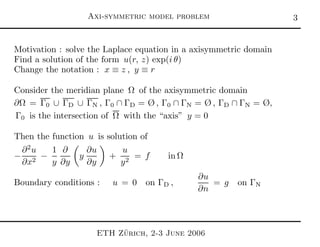
Motivation : solve the Laplace equation in a axisymmetric domain
Find a solution of the form u(r, z) exp(i θ)
Change the notation : x ≡ z , y ≡ r
Consider the meridian plane Ω of the axisymmetric domain
∂Ω = Γ0 ∪ ΓD ∪ ΓN , Γ0 ∩ ΓD = Ø , Γ0 ∩ ΓN = Ø , ΓD ∩ ΓN = Ø,
Γ0 is the intersection of Ω with the “axis” y = 0
Then the function u is solution of
−
∂2
u
∂x2
−
1
y
∂
∂y
y
∂u
∂y
+
u
y2
= f in Ω
Boundary conditions : u = 0 on ΓD ,
∂u
∂n
= g on ΓN
ETH Z¨urich, 2-3 June 2006
Axi-Sobolev spaces 
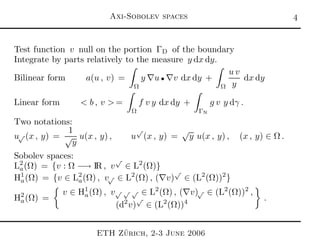
Test function v null on the portion ΓD of the boundary
Integrate by parts relatively to the measure y dx dy.
Bilinear form a(u , v) =
Ω
y ∇u • ∇v dx dy +
Ω
u v
y
dx dy
Linear form < b , v > =
Ω
f v y dx dy +
ΓN
g v y dγ .
Two notations:
u√ (x , y) =
1
√
y
u(x , y) , u
√
(x , y) =
√
y u(x , y) , (x , y) ∈ Ω .
Sobolev spaces:
L2
a(Ω) = {v : Ω −→ IR , v
√
∈ L2
(Ω)}
H1
a(Ω) = {v ∈ L2
a(Ω) , v√ ∈ L2
(Ω) , (∇v)
√
∈ (L2
(Ω))2
}
H2
a(Ω) =
v ∈ H1
a(Ω) , v√ √ √ ∈ L2
(Ω) , (∇v)√ ∈ (L2
(Ω))2
,
(d2
v)
√
∈ (L2
(Ω))4
.
ETH Z¨urich, 2-3 June 2006
Axi-Sobolev spaces 
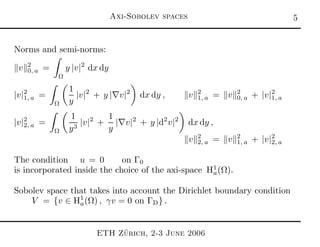
Norms and semi-norms:
v 2
0, a =
Ω
y |v|2
dx dy
|v|2
1, a =
Ω
1
y
|v|2
+ y |∇v|2
dx dy , v 2
1, a = v 2
0, a + |v|2
1, a
|v|2
2, a =
Ω
1
y3
|v|2
+
1
y
|∇v|2
+ y |d2
v|2
dx dy ,
v 2
2, a = v 2
1, a + |v|2
2, a
The condition u = 0 on Γ0
is incorporated inside the choice of the axi-space H1
a(Ω).
Sobolev space that takes into account the Dirichlet boundary condition
V = {v ∈ H1
a(Ω) , γv = 0 on ΓD} .
ETH Z¨urich, 2-3 June 2006
Axi-Sobolev spaces 
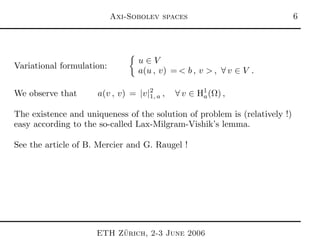
Variational formulation:
u ∈ V
a(u , v) = < b , v > , ∀ v ∈ V .
We observe that a(v , v) = |v|2
1, a , ∀ v ∈ H1
a(Ω) ,
The existence and uniqueness of the solution of problem is (relatively !)
easy according to the so-called Lax-Milgram-Vishik’s lemma.
See the article of B. Mercier and G. Raugel !
ETH Z¨urich, 2-3 June 2006
Discrete formulation 
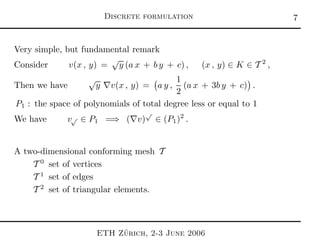
Very simple, but fundamental remark
Consider v(x , y) =
√
y (a x + b y + c) , (x , y) ∈ K ∈ T 2
,
Then we have
√
y ∇v(x , y) = a y ,
1
2
(a x + 3b y + c) .
P1 : the space of polynomials of total degree less or equal to 1
We have v√ ∈ P1 =⇒ (∇v)
√
∈ (P1)2
.
A two-dimensional conforming mesh T
T 0
set of vertices
T 1
set of edges
T 2
set of triangular elements.
ETH Z¨urich, 2-3 June 2006
Discrete formulation 
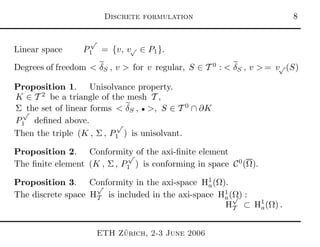
Linear space P
√
1 = {v, v√ ∈ P1}.
Degrees of freedom < δS , v > for v regular, S ∈ T 0
: < δS , v > = v√ (S)
Proposition 1. Unisolvance property.
K ∈ T 2
be a triangle of the mesh T ,
Σ the set of linear forms < δS , • >, S ∈ T 0
∩ ∂K
P
√
1 defined above.
Then the triple (K , Σ , P
√
1 ) is unisolvant.
Proposition 2. Conformity of the axi-finite element
The finite element (K , Σ , P
√
1 ) is conforming in space C0
(Ω).
Proposition 3. Conformity in the axi-space H1
a(Ω).
The discrete space H
√
T is included in the axi-space H1
a(Ω) :
H
√
T ⊂ H1
a(Ω) .
ETH Z¨urich, 2-3 June 2006
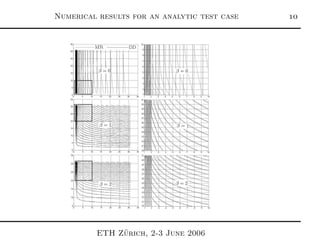
Numerical results for an analytic test case 
Ω =]0, 1[2
, ΓD = Ø
Parameters α > 0, β > 0,
Right hand side: f (y, x) ≡ yα
α2
− 1
xβ
y2
+ β(β − 1)xβ−2
Neumann datum:
g(x, y) = α if y = 1, −βyα
xβ−1
if x = 0, βyα
if x = 1.
Solution: u(x, y) ≡ yα
xβ
.
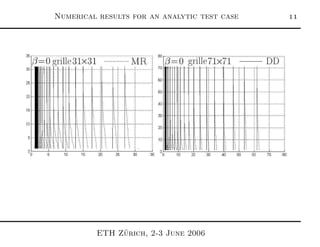
Comparison between
the present method (DD)
the use of classical P1 finite elements (MR)
ETH Z¨urich, 2-3 June 2006
Numerical results for an analytic test case 
ETH Z¨urich, 2-3 June 2006
Numerical results for an analytic test case 
ETH Z¨urich, 2-3 June 2006
Numerical results for an analytic test case 
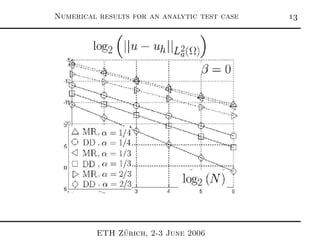
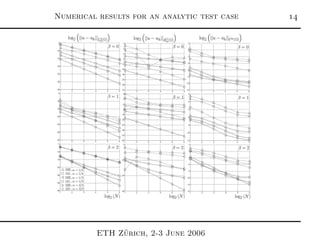
Numerical study of the convergence properties
Test cases :
α = 1/4, α = 1/3, α = 2/3
β = 0, β = 1, β = 2
Three norms: v 0, a |v|1, a v ℓ∞
Order of convergence easy (?) to see.
Example : β = 0 and α = 2/3:
our axi-finite element has a rate of convergence ≃ 3 for the • 0, a norm.
Synthesis of these experiments:
same order of convergence than with the classical approach
errors much more smaller!
ETH Z¨urich, 2-3 June 2006
Numerical results for an analytic test case 
ETH Z¨urich, 2-3 June 2006
Numerical results for an analytic test case 
ETH Z¨urich, 2-3 June 2006
Analysis ? 
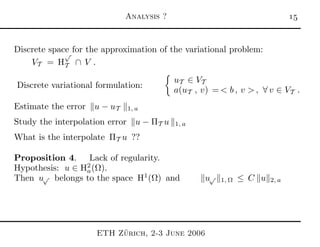
Discrete space for the approximation of the variational problem:
VT = H
√
T ∩ V .
Discrete variational formulation:
uT ∈ VT
a(uT , v) = < b , v > , ∀ v ∈ VT .
Estimate the error u − uT 1, a
Study the interpolation error u − ΠT u 1, a
What is the interpolate ΠT u ??
Proposition 4. Lack of regularity.
Hypothesis: u ∈ H2
a(Ω).
Then u√ belongs to the space H1
(Ω) and u√
1, Ω ≤ C u 2, a
ETH Z¨urich, 2-3 June 2006
Analysis ? 
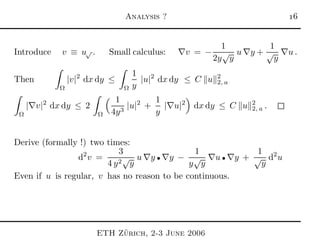
Introduce v ≡ u√ . Small calculus: ∇v = −
1
2y
√
y
u ∇y +
1
√
y
∇u .
Then
Ω
|v|2
dx dy ≤
Ω
1
y
|u|2
dx dy ≤ C u 2
2, a
Ω
|∇v|2
dx dy ≤ 2
Ω
1
4y3
|u|2
+
1
y
|∇u|2
dx dy ≤ C u 2
2, a .
Derive (formally !) two times:
d2
v =
3
4 y2√
y
u ∇y • ∇y −
1
y
√
y
∇u • ∇y +
1
√
y
d2
u
Even if u is regular, v has no reason to be continuous.
ETH Z¨urich, 2-3 June 2006
About Cl´ement’s interpolation 
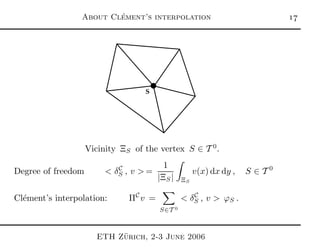
S
Vicinity ΞS of the vertex S ∈ T 0
.
Degree of freedom < δC
S , v > =
1
|ΞS| ΞS
v(x) dx dy , S ∈ T 0
Cl´ement’s interpolation: ΠC
v =
S∈T 0
< δC
S , v > ϕS .
ETH Z¨urich, 2-3 June 2006
About Cl´ement’s interpolation 
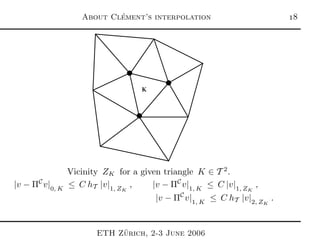
K
Vicinity ZK for a given triangle K ∈ T 2
.
|v − ΠC
v|0, K
≤ C hT |v|1, ZK
, |v − ΠC
v|1, K
≤ C |v|1, ZK
,
|v − ΠC
v|1, K
≤ C hT |v|2, ZK
.
ETH Z¨urich, 2-3 June 2006
Numerical analysis 
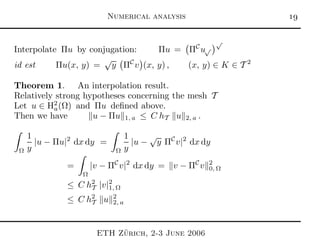
Interpolate Πu by conjugation: Πu = ΠC
u√
√
id est Πu(x, y) =
√
y ΠC
v (x, y) , (x, y) ∈ K ∈ T 2
Theorem 1. An interpolation result.
Relatively strong hypotheses concerning the mesh T
Let u ∈ H2
a(Ω) and Πu defined above.
Then we have u − Πu 1, a ≤ C hT u 2, a .
Ω
1
y
|u − Πu|2
dx dy =
Ω
1
y
|u −
√
y ΠC
v|2
dx dy
=
Ω
|v − ΠC
v|2
dx dy = v − ΠC
v 2
0, Ω
≤ C h2
T |v|2
1, Ω
≤ C h2
T u 2
2, a
ETH Z¨urich, 2-3 June 2006
Numerical analysis 
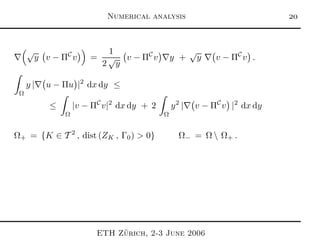
∇
√
y v − ΠC
v =
1
2
√
y
v − ΠC
v ∇y +
√
y ∇ v − ΠC
v .
Ω
y |∇ u − Πu |2
dx dy ≤
≤
Ω
|v − ΠC
v|2
dx dy + 2
Ω
y2
|∇ v − ΠC
v |2
dx dy
Ω+ = {K ∈ T 2
, dist (ZK , Γ0) > 0} Ω− = Ω  Ω+ .
ETH Z¨urich, 2-3 June 2006
Numerical analysis 
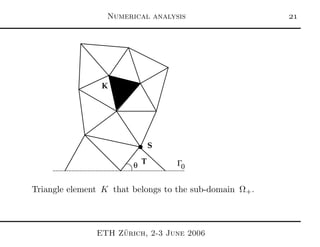
S
0ΓTθ
K
Triangle element K that belongs to the sub-domain Ω+.
ETH Z¨urich, 2-3 June 2006
Numerical analysis 
Theorem 2. First order approximation
relatively strong hypotheses concerning the mesh T
u solution of the continuous problem: u ∈ H2
a(Ω) ,
Then we have u − uT 1, a ≤ C hT u 2, a .
Proof: classical with Cea’s lemma!
ETH Z¨urich, 2-3 June 2006
Conclusion 
“Axi-finite element”
Interpolation properties founded of the underlying axi-Sobolev space
First numerical tests: good convergence properties
Numerical analysis based on Mercier-Raugel contribution (1982)
See also Gmati (1992), Bernardi et al. (1999)
May be all the material presented here is well known ?!
ETH Z¨urich, 2-3 June 2006

A new axisymmetric finite element

  • 1.
    European Finite ElementFair 4 ETH Z¨urich, 2-3 June 2006 A natural finite element for axisymmetric problem Fran¸cois Dubois CNAM Paris and University Paris South, Orsay conjoint work with Stefan Duprey University Henri Poincar´e Nancy and EADS Suresnes.
  • 2.
    A natural finiteelement for axisymmetric problem  1) Axi-symmetric model problem 2) Axi-Sobolev spaces 3) Discrete formulation 4) Numerical results for an analytic test case 5) About Cl´ement’s interpolation 6) Numerical analysis 7) Conclusion ETH Z¨urich, 2-3 June 2006
  • 3.
    Axi-symmetric model problem Motivation : solve the Laplace equation in a axisymmetric domain Find a solution of the form u(r, z) exp(i θ) Change the notation : x ≡ z , y ≡ r Consider the meridian plane Ω of the axisymmetric domain ∂Ω = Γ0 ∪ ΓD ∪ ΓN , Γ0 ∩ ΓD = Ø , Γ0 ∩ ΓN = Ø , ΓD ∩ ΓN = Ø, Γ0 is the intersection of Ω with the “axis” y = 0 Then the function u is solution of − ∂2 u ∂x2 − 1 y ∂ ∂y y ∂u ∂y + u y2 = f in Ω Boundary conditions : u = 0 on ΓD , ∂u ∂n = g on ΓN ETH Z¨urich, 2-3 June 2006
  • 4.
    Axi-Sobolev spaces  Testfunction v null on the portion ΓD of the boundary Integrate by parts relatively to the measure y dx dy. Bilinear form a(u , v) = Ω y ∇u • ∇v dx dy + Ω u v y dx dy Linear form < b , v > = Ω f v y dx dy + ΓN g v y dγ . Two notations: u√ (x , y) = 1 √ y u(x , y) , u √ (x , y) = √ y u(x , y) , (x , y) ∈ Ω . Sobolev spaces: L2 a(Ω) = {v : Ω −→ IR , v √ ∈ L2 (Ω)} H1 a(Ω) = {v ∈ L2 a(Ω) , v√ ∈ L2 (Ω) , (∇v) √ ∈ (L2 (Ω))2 } H2 a(Ω) = v ∈ H1 a(Ω) , v√ √ √ ∈ L2 (Ω) , (∇v)√ ∈ (L2 (Ω))2 , (d2 v) √ ∈ (L2 (Ω))4 . ETH Z¨urich, 2-3 June 2006
  • 5.
    Axi-Sobolev spaces  Normsand semi-norms: v 2 0, a = Ω y |v|2 dx dy |v|2 1, a = Ω 1 y |v|2 + y |∇v|2 dx dy , v 2 1, a = v 2 0, a + |v|2 1, a |v|2 2, a = Ω 1 y3 |v|2 + 1 y |∇v|2 + y |d2 v|2 dx dy , v 2 2, a = v 2 1, a + |v|2 2, a The condition u = 0 on Γ0 is incorporated inside the choice of the axi-space H1 a(Ω). Sobolev space that takes into account the Dirichlet boundary condition V = {v ∈ H1 a(Ω) , γv = 0 on ΓD} . ETH Z¨urich, 2-3 June 2006
  • 6.
    Axi-Sobolev spaces  Variationalformulation: u ∈ V a(u , v) = < b , v > , ∀ v ∈ V . We observe that a(v , v) = |v|2 1, a , ∀ v ∈ H1 a(Ω) , The existence and uniqueness of the solution of problem is (relatively !) easy according to the so-called Lax-Milgram-Vishik’s lemma. See the article of B. Mercier and G. Raugel ! ETH Z¨urich, 2-3 June 2006
  • 7.
    Discrete formulation  Verysimple, but fundamental remark Consider v(x , y) = √ y (a x + b y + c) , (x , y) ∈ K ∈ T 2 , Then we have √ y ∇v(x , y) = a y , 1 2 (a x + 3b y + c) . P1 : the space of polynomials of total degree less or equal to 1 We have v√ ∈ P1 =⇒ (∇v) √ ∈ (P1)2 . A two-dimensional conforming mesh T T 0 set of vertices T 1 set of edges T 2 set of triangular elements. ETH Z¨urich, 2-3 June 2006
  • 8.
    Discrete formulation  Linearspace P √ 1 = {v, v√ ∈ P1}. Degrees of freedom < δS , v > for v regular, S ∈ T 0 : < δS , v > = v√ (S) Proposition 1. Unisolvance property. K ∈ T 2 be a triangle of the mesh T , Σ the set of linear forms < δS , • >, S ∈ T 0 ∩ ∂K P √ 1 defined above. Then the triple (K , Σ , P √ 1 ) is unisolvant. Proposition 2. Conformity of the axi-finite element The finite element (K , Σ , P √ 1 ) is conforming in space C0 (Ω). Proposition 3. Conformity in the axi-space H1 a(Ω). The discrete space H √ T is included in the axi-space H1 a(Ω) : H √ T ⊂ H1 a(Ω) . ETH Z¨urich, 2-3 June 2006
  • 9.
    Numerical results foran analytic test case  Ω =]0, 1[2 , ΓD = Ø Parameters α > 0, β > 0, Right hand side: f (y, x) ≡ yα α2 − 1 xβ y2 + β(β − 1)xβ−2 Neumann datum: g(x, y) = α if y = 1, −βyα xβ−1 if x = 0, βyα if x = 1. Solution: u(x, y) ≡ yα xβ . Comparison between the present method (DD) the use of classical P1 finite elements (MR) ETH Z¨urich, 2-3 June 2006
  • 10.
    Numerical results foran analytic test case  ETH Z¨urich, 2-3 June 2006
  • 11.
    Numerical results foran analytic test case  ETH Z¨urich, 2-3 June 2006
  • 12.
    Numerical results foran analytic test case  Numerical study of the convergence properties Test cases : α = 1/4, α = 1/3, α = 2/3 β = 0, β = 1, β = 2 Three norms: v 0, a |v|1, a v ℓ∞ Order of convergence easy (?) to see. Example : β = 0 and α = 2/3: our axi-finite element has a rate of convergence ≃ 3 for the • 0, a norm. Synthesis of these experiments: same order of convergence than with the classical approach errors much more smaller! ETH Z¨urich, 2-3 June 2006
  • 13.
    Numerical results foran analytic test case  ETH Z¨urich, 2-3 June 2006
  • 14.
    Numerical results foran analytic test case  ETH Z¨urich, 2-3 June 2006
  • 15.
    Analysis ?  Discretespace for the approximation of the variational problem: VT = H √ T ∩ V . Discrete variational formulation: uT ∈ VT a(uT , v) = < b , v > , ∀ v ∈ VT . Estimate the error u − uT 1, a Study the interpolation error u − ΠT u 1, a What is the interpolate ΠT u ?? Proposition 4. Lack of regularity. Hypothesis: u ∈ H2 a(Ω). Then u√ belongs to the space H1 (Ω) and u√ 1, Ω ≤ C u 2, a ETH Z¨urich, 2-3 June 2006
  • 16.
    Analysis ?  Introducev ≡ u√ . Small calculus: ∇v = − 1 2y √ y u ∇y + 1 √ y ∇u . Then Ω |v|2 dx dy ≤ Ω 1 y |u|2 dx dy ≤ C u 2 2, a Ω |∇v|2 dx dy ≤ 2 Ω 1 4y3 |u|2 + 1 y |∇u|2 dx dy ≤ C u 2 2, a . Derive (formally !) two times: d2 v = 3 4 y2√ y u ∇y • ∇y − 1 y √ y ∇u • ∇y + 1 √ y d2 u Even if u is regular, v has no reason to be continuous. ETH Z¨urich, 2-3 June 2006
  • 17.
    About Cl´ement’s interpolation S Vicinity ΞS of the vertex S ∈ T 0 . Degree of freedom < δC S , v > = 1 |ΞS| ΞS v(x) dx dy , S ∈ T 0 Cl´ement’s interpolation: ΠC v = S∈T 0 < δC S , v > ϕS . ETH Z¨urich, 2-3 June 2006
  • 18.
    About Cl´ement’s interpolation K Vicinity ZK for a given triangle K ∈ T 2 . |v − ΠC v|0, K ≤ C hT |v|1, ZK , |v − ΠC v|1, K ≤ C |v|1, ZK , |v − ΠC v|1, K ≤ C hT |v|2, ZK . ETH Z¨urich, 2-3 June 2006
  • 19.
    Numerical analysis  InterpolateΠu by conjugation: Πu = ΠC u√ √ id est Πu(x, y) = √ y ΠC v (x, y) , (x, y) ∈ K ∈ T 2 Theorem 1. An interpolation result. Relatively strong hypotheses concerning the mesh T Let u ∈ H2 a(Ω) and Πu defined above. Then we have u − Πu 1, a ≤ C hT u 2, a . Ω 1 y |u − Πu|2 dx dy = Ω 1 y |u − √ y ΠC v|2 dx dy = Ω |v − ΠC v|2 dx dy = v − ΠC v 2 0, Ω ≤ C h2 T |v|2 1, Ω ≤ C h2 T u 2 2, a ETH Z¨urich, 2-3 June 2006
  • 20.
    Numerical analysis  ∇ √ yv − ΠC v = 1 2 √ y v − ΠC v ∇y + √ y ∇ v − ΠC v . Ω y |∇ u − Πu |2 dx dy ≤ ≤ Ω |v − ΠC v|2 dx dy + 2 Ω y2 |∇ v − ΠC v |2 dx dy Ω+ = {K ∈ T 2 , dist (ZK , Γ0) > 0} Ω− = Ω Ω+ . ETH Z¨urich, 2-3 June 2006
  • 21.
    Numerical analysis  S 0ΓTθ K Triangleelement K that belongs to the sub-domain Ω+. ETH Z¨urich, 2-3 June 2006
  • 22.
    Numerical analysis  Theorem2. First order approximation relatively strong hypotheses concerning the mesh T u solution of the continuous problem: u ∈ H2 a(Ω) , Then we have u − uT 1, a ≤ C hT u 2, a . Proof: classical with Cea’s lemma! ETH Z¨urich, 2-3 June 2006
  • 23.
    Conclusion  “Axi-finite element” Interpolationproperties founded of the underlying axi-Sobolev space First numerical tests: good convergence properties Numerical analysis based on Mercier-Raugel contribution (1982) See also Gmati (1992), Bernardi et al. (1999) May be all the material presented here is well known ?! ETH Z¨urich, 2-3 June 2006