www.expedeon.com
info@expedeon.com
Release 1. © EXPEDEON. January 2018
INTRODUCTION
NVoy technology is a quantum leap in protein processing, production
and analysis. It uses proprietary NV polymers to enhance protein
solubility and stability through the formation of multi-point reversible
complexes with proteins without altering their structure.
APPLICATION
A stable and reproducible protein standard curve is essential for
applications such as enzyme production and ELISA assays.
Unfortunately, some proteins have poor stability within the working
range of the standard activity assay. The addition of NVoy Polymer,
NV10, to enzyme or protein standard stocks can stabilise standards
and contribute towards long term reliability, without compromising
activity or protein structure.
PROTOCOL
Stability is very protein specific, but a general protocol is given below:
1. Determine the protein concentration (using eg. Expedeons
BradfordUltra Assay, BCA assay, absorbance at 280nm).
2. Typically, a fivefold excess, by mass, of NV10 will protect
the target protein. For example, use 200 µg/ml NV10 for
40 µg/ml protein.
3. Each Stabil-P.A.C. tube contains 10mg NV10 as a
lyophilised powder (40mg per tube in a Stabil-PAC MAXI).
4. Add the protein solution to NV10 in Stabil-P.A.C. tubes to
get the desired concentration, or make up a stock solution
(e.g. 5 mg/ml NV10) by adding buffer or distilled water to
each Stabil-P.A.C. tube and then add this stock to the
protein solution.
5. This protein / NV10 stock solution can now be used in
subsequent dilutions to prepare sets of protein standards.
6. NV10 stock solutions (up to 10 mg/ml) can be stored for
up to 1 week at 4oC or for longer term at -20ºC. More
concentrated stock solutions should be used immediately.
TROUBLESHOOTING
• If the protein shows signs of aggregation or heavy losses the
NV10 to protein concentration ratio can be increased, ie
increase NV10 concentration and / or reduce protein
concentration.
• Alternatively, a lower NV10 to protein ratio can be used with
proteins which have no history of aggregation.
• Always measure assay blanks with buffer containing NV10.
EXAMPLE
Use of NV10 to Improve Enzyme Stability
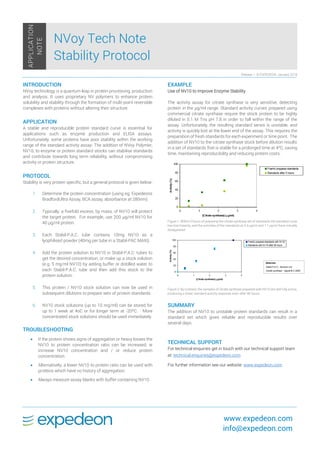
The activity assay for citrate synthase is very sensitive, detecting
protein in the µg/ml range. Standard activity curves prepared using
commercial citrate synthase require the stock protein to be highly
diluted in 0.1 M Tris pH 7.8 in order to fall within the range of the
assay. Unfortunately, the resulting standard series is unstable, and
activity is quickly lost at the lower end of the assay. This requires the
preparation of fresh standards for each experiment or time point. The
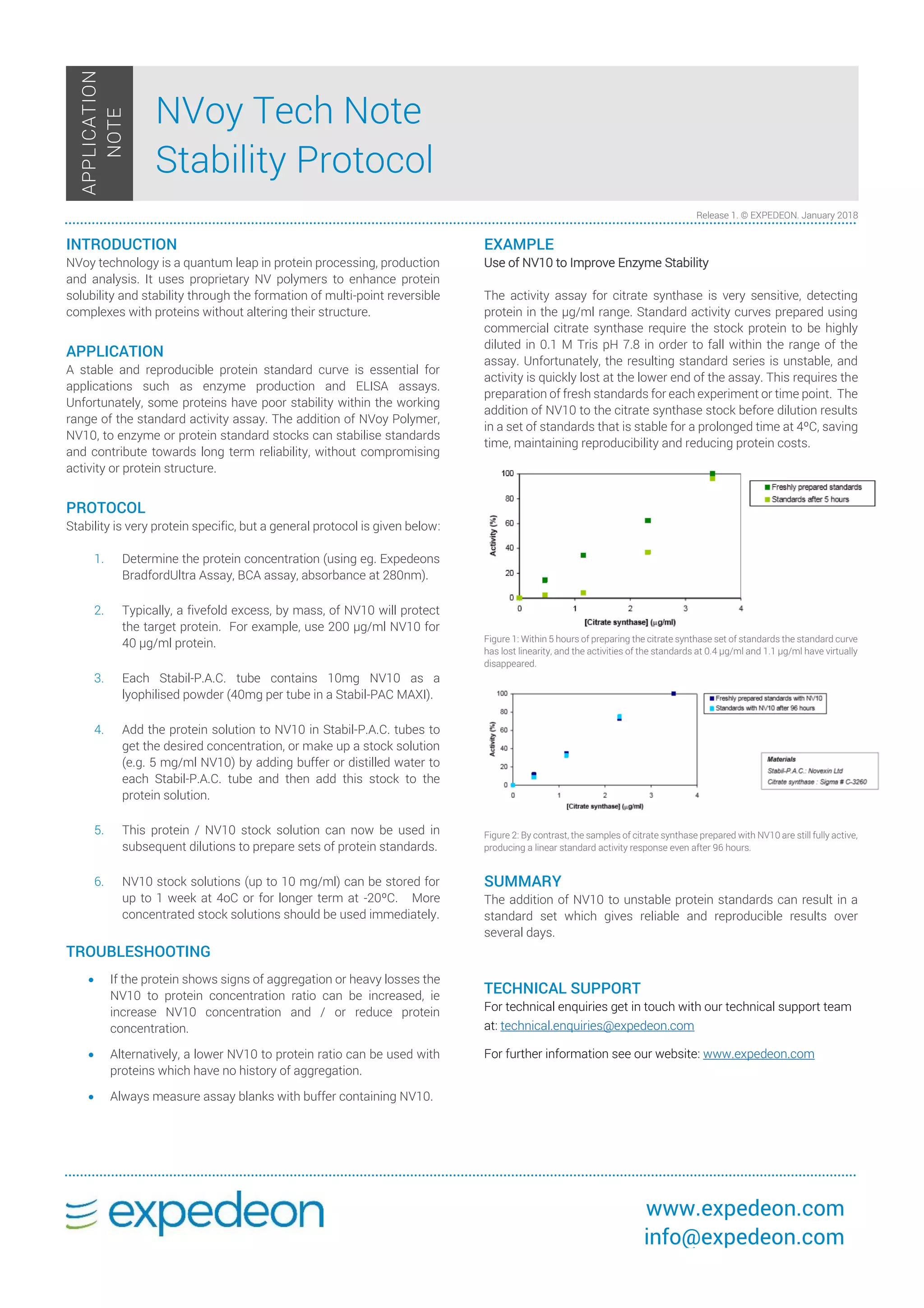
addition of NV10 to the citrate synthase stock before dilution results
in a set of standards that is stable for a prolonged time at 4ºC, saving
time, maintaining reproducibility and reducing protein costs.
Figure 1: Within 5 hours of preparing the citrate synthase set of standards the standard curve
has lost linearity, and the activities of the standards at 0.4 µg/ml and 1.1 µg/ml have virtually
disappeared.
Figure 2: By contrast, the samples of citrate synthase prepared with NV10 are still fully active,
producing a linear standard activity response even after 96 hours.
SUMMARY
The addition of NV10 to unstable protein standards can result in a
standard set which gives reliable and reproducible results over
several days.
TECHNICAL SUPPORT
For technical enquiries get in touch with our technical support team
at: technical.enquiries@expedeon.com
For further information see our website: www.expedeon.com
NVoy Tech Note
Stability Protocol
APPLICATION
NOTE

Nvoy Tech Note - Stability Protocol

  • 1.
    www.expedeon.com info@expedeon.com Release 1. ©EXPEDEON. January 2018 INTRODUCTION NVoy technology is a quantum leap in protein processing, production and analysis. It uses proprietary NV polymers to enhance protein solubility and stability through the formation of multi-point reversible complexes with proteins without altering their structure. APPLICATION A stable and reproducible protein standard curve is essential for applications such as enzyme production and ELISA assays. Unfortunately, some proteins have poor stability within the working range of the standard activity assay. The addition of NVoy Polymer, NV10, to enzyme or protein standard stocks can stabilise standards and contribute towards long term reliability, without compromising activity or protein structure. PROTOCOL Stability is very protein specific, but a general protocol is given below: 1. Determine the protein concentration (using eg. Expedeons BradfordUltra Assay, BCA assay, absorbance at 280nm). 2. Typically, a fivefold excess, by mass, of NV10 will protect the target protein. For example, use 200 µg/ml NV10 for 40 µg/ml protein. 3. Each Stabil-P.A.C. tube contains 10mg NV10 as a lyophilised powder (40mg per tube in a Stabil-PAC MAXI). 4. Add the protein solution to NV10 in Stabil-P.A.C. tubes to get the desired concentration, or make up a stock solution (e.g. 5 mg/ml NV10) by adding buffer or distilled water to each Stabil-P.A.C. tube and then add this stock to the protein solution. 5. This protein / NV10 stock solution can now be used in subsequent dilutions to prepare sets of protein standards. 6. NV10 stock solutions (up to 10 mg/ml) can be stored for up to 1 week at 4oC or for longer term at -20ºC. More concentrated stock solutions should be used immediately. TROUBLESHOOTING • If the protein shows signs of aggregation or heavy losses the NV10 to protein concentration ratio can be increased, ie increase NV10 concentration and / or reduce protein concentration. • Alternatively, a lower NV10 to protein ratio can be used with proteins which have no history of aggregation. • Always measure assay blanks with buffer containing NV10. EXAMPLE Use of NV10 to Improve Enzyme Stability The activity assay for citrate synthase is very sensitive, detecting protein in the µg/ml range. Standard activity curves prepared using commercial citrate synthase require the stock protein to be highly diluted in 0.1 M Tris pH 7.8 in order to fall within the range of the assay. Unfortunately, the resulting standard series is unstable, and activity is quickly lost at the lower end of the assay. This requires the preparation of fresh standards for each experiment or time point. The addition of NV10 to the citrate synthase stock before dilution results in a set of standards that is stable for a prolonged time at 4ºC, saving time, maintaining reproducibility and reducing protein costs. Figure 1: Within 5 hours of preparing the citrate synthase set of standards the standard curve has lost linearity, and the activities of the standards at 0.4 µg/ml and 1.1 µg/ml have virtually disappeared. Figure 2: By contrast, the samples of citrate synthase prepared with NV10 are still fully active, producing a linear standard activity response even after 96 hours. SUMMARY The addition of NV10 to unstable protein standards can result in a standard set which gives reliable and reproducible results over several days. TECHNICAL SUPPORT For technical enquiries get in touch with our technical support team at: technical.enquiries@expedeon.com For further information see our website: www.expedeon.com NVoy Tech Note Stability Protocol APPLICATION NOTE