www.expedeon.com
info@expedeon.com
Release 1. © EXPEDEON. January 2018
INTRODUCTION
NVoy technology is a quantum leap in protein processing, production
and analysis. It uses proprietary NV polymers to enhance protein
solubility and stability through the formation of multi-point reversible
complexes with proteins without altering their structure.
NVOY POLYMER, NV10, IMPROVES PROTEIN
RECOVERY AFTER DIALYSIS
Protein dialysis is a useful technique to enable a gentle change in
protein buffer composition, the adjustment of salt and additive
concentrations or the removal of low molecular weight impurities.
Potential disadvantages of the technique include the loss of protein
due to non-specific binding onto the dialysis membrane, and loss due
to protein aggregation and instability during the intermediate stages
of buffer exchange. The addition of NV10 to proteins before dialysis
can minimise protein losses due to these factors and help to
maximise protein recovery. NV10 is a large, linear polymer which
dynamically associates with the target protein, masking any surface
exposed patches of hydrophobicity, protecting it from aggregation
and non-specific binding and improve protein stability. Although
NV10 is in dynamic equilibrium with the protein its large size
(Hydrodynamic radius around 18 kDa) means that it is typically
retained within the dialysis membrane and is therefore not required in
the dialysis buffer
PROTOCOL
Aggregation, non-specific binding and stability are very protein
specific, but a general protocol is given below:
1. Determine the starting protein concentration (using eg.
Expedeon’s BradfordUltra assay, BCA assay, absorbance at
280 nm).
Typically, a fivefold excess, by mass, of NV10 will protect
the target protein. For example, use 100 µg/ml NVoy for 20
µg/ml protein.
2. Each Stabil-P.A.C. tube contains 10mg NV10 as a
lyophilised powder (40mg per tube in a Stabil-PAC MAXI).
3. Add the protein solution to NVoy in Stabil-P.A.C. tubes to
get the desired concentration, or make up a stock solution
(e.g. 5 mg/ml NV10) by adding buffer or distilled water to
each Stabil-P.A.C. tube and then add this stock to the
protein solution.
4. Dialyse this protein / NVoy solution.
5. NVoy associates with the protein in solution and is retained
by the membrane during dialysis to give continuing
protection further downstream.
6. NV10 stock solutions (up to 10 mg/ml) can be stored for
up to 1 week at 4oC or for longer term at -20ºC. More
concentrated stock solutions should be used immediately.
TROUBLESHOOTING
• If the protein shows signs of aggregation or heavy losses the
relative NV10 concentration can be increased, ie increase
NV10 concentration and / or reduce protein concentration.
• Alternatively, a lower NV10 to protein ratio can be used with
proteins that have no history of aggregation.
• Protein solutions dialysed using membranes with pore sizes
of greater than 10,000 kDa may gradually lose NV10 into the
dialysis buffer.
EXAMPLE
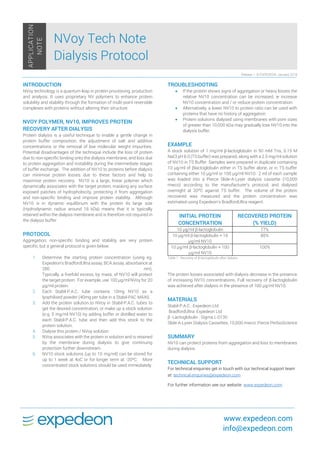
A stock solution of 1 mg/ml β-lactoglobulin in 50 mM Tris, 0.15 M
NaCl pH 8.0 (TS buffer) was prepared, along with a 2.5 mg/ml solution
of NV10 in TS Buffer. Samples were prepared in duplicate containing
10 µg/ml of βlactoglobulin either in TS buffer alone, or in TS buffer
containing either 10 µg/ml or 100 µg/ml NV10. 2 ml of each sample
was loaded into a Pierce Slide-A-Lyser dialysis cassette (10,000
mwco) according to the manufacturer’s protocol, and dialysed
overnight at 20ºC against TS buffer. The volume of the protein
recovered was measured and the protein concentration was
estimated using Expedeon’s BradfordUltra reagent.
INITIAL PROTEIN
CONCENTRATION
RECOVERED PROTEIN
(% YIELD)
10 µg/ml β-lactoglobulin 77%
10 µg/ml β-lactoglobulin + 10
µg/ml NV10
85%
10 µg/ml β-lactoglobulin + 100
µg/ml NV10
100%
Table 1 : Recovery of β-lactoglobulin after dialysis
The protein losses associated with dialysis decrease in the presence
of increasing NV10 concentrations. Full recovery of β-lactoglobulin
was achieved after dialysis in the presence of 100 µg/ml NV10.
MATERIALS
Stabil-P.A.C.: Expedeon Ltd
BradfordUltra: Expedeon Ltd
β -Lactoglobulin : Sigma L-0130
Slide-A-Lyser Dialysis Cassettes, 10,000 mwco: Pierce PerbioScience
SUMMARY
NV10 can protect proteins from aggregation and loss to membranes
during dialysis.
TECHNICAL SUPPORT
For technical enquiries get in touch with our technical support team
at: technical.enquiries@expedeon.com
For further information see our website: www.expedeon.com
NVoy Tech Note
Dialysis Protocol
APPLICATION
NOTE

Nvoy Tech Note - Dialysis-Protocol

  • 1.
    www.expedeon.com info@expedeon.com Release 1. ©EXPEDEON. January 2018 INTRODUCTION NVoy technology is a quantum leap in protein processing, production and analysis. It uses proprietary NV polymers to enhance protein solubility and stability through the formation of multi-point reversible complexes with proteins without altering their structure. NVOY POLYMER, NV10, IMPROVES PROTEIN RECOVERY AFTER DIALYSIS Protein dialysis is a useful technique to enable a gentle change in protein buffer composition, the adjustment of salt and additive concentrations or the removal of low molecular weight impurities. Potential disadvantages of the technique include the loss of protein due to non-specific binding onto the dialysis membrane, and loss due to protein aggregation and instability during the intermediate stages of buffer exchange. The addition of NV10 to proteins before dialysis can minimise protein losses due to these factors and help to maximise protein recovery. NV10 is a large, linear polymer which dynamically associates with the target protein, masking any surface exposed patches of hydrophobicity, protecting it from aggregation and non-specific binding and improve protein stability. Although NV10 is in dynamic equilibrium with the protein its large size (Hydrodynamic radius around 18 kDa) means that it is typically retained within the dialysis membrane and is therefore not required in the dialysis buffer PROTOCOL Aggregation, non-specific binding and stability are very protein specific, but a general protocol is given below: 1. Determine the starting protein concentration (using eg. Expedeon’s BradfordUltra assay, BCA assay, absorbance at 280 nm). Typically, a fivefold excess, by mass, of NV10 will protect the target protein. For example, use 100 µg/ml NVoy for 20 µg/ml protein. 2. Each Stabil-P.A.C. tube contains 10mg NV10 as a lyophilised powder (40mg per tube in a Stabil-PAC MAXI). 3. Add the protein solution to NVoy in Stabil-P.A.C. tubes to get the desired concentration, or make up a stock solution (e.g. 5 mg/ml NV10) by adding buffer or distilled water to each Stabil-P.A.C. tube and then add this stock to the protein solution. 4. Dialyse this protein / NVoy solution. 5. NVoy associates with the protein in solution and is retained by the membrane during dialysis to give continuing protection further downstream. 6. NV10 stock solutions (up to 10 mg/ml) can be stored for up to 1 week at 4oC or for longer term at -20ºC. More concentrated stock solutions should be used immediately. TROUBLESHOOTING • If the protein shows signs of aggregation or heavy losses the relative NV10 concentration can be increased, ie increase NV10 concentration and / or reduce protein concentration. • Alternatively, a lower NV10 to protein ratio can be used with proteins that have no history of aggregation. • Protein solutions dialysed using membranes with pore sizes of greater than 10,000 kDa may gradually lose NV10 into the dialysis buffer. EXAMPLE A stock solution of 1 mg/ml β-lactoglobulin in 50 mM Tris, 0.15 M NaCl pH 8.0 (TS buffer) was prepared, along with a 2.5 mg/ml solution of NV10 in TS Buffer. Samples were prepared in duplicate containing 10 µg/ml of βlactoglobulin either in TS buffer alone, or in TS buffer containing either 10 µg/ml or 100 µg/ml NV10. 2 ml of each sample was loaded into a Pierce Slide-A-Lyser dialysis cassette (10,000 mwco) according to the manufacturer’s protocol, and dialysed overnight at 20ºC against TS buffer. The volume of the protein recovered was measured and the protein concentration was estimated using Expedeon’s BradfordUltra reagent. INITIAL PROTEIN CONCENTRATION RECOVERED PROTEIN (% YIELD) 10 µg/ml β-lactoglobulin 77% 10 µg/ml β-lactoglobulin + 10 µg/ml NV10 85% 10 µg/ml β-lactoglobulin + 100 µg/ml NV10 100% Table 1 : Recovery of β-lactoglobulin after dialysis The protein losses associated with dialysis decrease in the presence of increasing NV10 concentrations. Full recovery of β-lactoglobulin was achieved after dialysis in the presence of 100 µg/ml NV10. MATERIALS Stabil-P.A.C.: Expedeon Ltd BradfordUltra: Expedeon Ltd β -Lactoglobulin : Sigma L-0130 Slide-A-Lyser Dialysis Cassettes, 10,000 mwco: Pierce PerbioScience SUMMARY NV10 can protect proteins from aggregation and loss to membranes during dialysis. TECHNICAL SUPPORT For technical enquiries get in touch with our technical support team at: technical.enquiries@expedeon.com For further information see our website: www.expedeon.com NVoy Tech Note Dialysis Protocol APPLICATION NOTE