Get Homework Done
Homeworkping.com
Homework Help
https://www.homeworkping.com/
Research Paper help
https://www.homeworkping.com/
Online Tutoring
https://www.homeworkping.com/
click here for freelancing tutoring sites
UNIT-IV
SAFETY IN MATERIAL HANDLING
I.AS/RS SYSTEM
An automated storage and retrieval system (ASRS or AS/RS) consists of a variety of computer-
controlled methods for automatically placing and retrieving loads from specific storage locations.
[1]
Automated storage and retrieval systems (AS/RS) are typically used in applications where: there is a
very high volume of loads being moved into and out of storage; storage density is important because of
space constraints; no value adding content is present in this process; accuracy is critical because of
potential expensive damages to the load. AS/RS can be used with standard loads as well as
nonstandard loads.[2]
]Overview
AS/RS systems are devices designed for automated storage and retrieval of parts and items in
manufacturing, distribution, retail, wholesale and institutions. They first originated in the 1980s.[citation
needed]
They are compact units that utilize the unused overhead space of a plant or warehouse, and
convert to live storage of product. Items can be placed on trays or hang from bars, which are attached
to chains/drives in order to move up and down. They focus on bringing "goods to the man" rather than
manual walking and searching. Space savings, increased productivity/reduced labor, increased
accuracy and reduced inventory levels are some of the primary benefits. Ideal for lean
manufacturing, sustainability, Six Sigma, Kanban, JIT and other value added methodologies and
processes. The equipment required for an AS/RS include a storage & retrieval machine (SRM) that is
used for rapid storage and retrieval of material. SRMs are used to move loads vertically or horizontally,
and can also move laterally to place objects in the correct storage location.[3]
The traditional vending machine is the most common and familiar AS/RS system but because the
application is to do with retail sales, the logistic concept of a vending machine is missed.
The trend towards just in time production often requires sub-pallet level availability of production inputs,
and AS/RS is a much faster way of organizing the storage of smaller items next to production lines.
Traditional high bay warehouses are designed with pallet storage in mind, and if goods are being
delivered in sub pallet quantities, high bay warehouses are problematic.
Material Handling Institute of America (MHIA), the non-profit trade association for the material handling
world, and its members have broken AS/RS into two primary segments: Fixed Aisle and
Carousels/Vertical Lift Modules (VLMs). Both sets of technologies provide automated storage and
retrieval for parts and items, but use different technologies. Each technology has its unique set of
benefits and disadvantages (like everything in the world). Fixed Aisle systems are characteristically
larger systems whereas carousels and Vertical Lift Modules are used individually or grouped, but in
small to medium-sized applications.
Fixed-aisle AS/RS is categorized into three main types: single-masted, double masted, and man-
aboard. Most are supported on a track and ceiling guided at the top by guide rails or channels to ensure
accurate vertical alignment, although some are suspended from the ceiling. The 'shuttles' that make up
the system travel between fixed storage shelves to deposit or retrieve a requested load (ranging from a
single book in a library system to a several ton pallet of goods in a warehouse system). As well as
moving along the ground, the shuttles are able to telescope up to the necessary height to reach the
load, and can store or retrieve loads that are several positions deep in the shelving. A semi-automated
system can be achieved by utilizing only specialized shuttles within an existing rack system.
To provide a method for accomplishing throughput to and from the AS/RS and the supporting
transportation system, stations are provided to precisely position inbound and outbound loads for
pickup and delivery by the crane.
In addition, there are five types of AS/RS devices called Unit-load AS/RS, Mini-load AS/RS, Vertical Lift
Modules (VLMs), Horizontal Carousels and Vertical Carousels. These systems are used either as
stand-alone units or in integrated workstations called pods or systems. These units are usually
integrated with various types of pick to light systems and use either a microprocessor controller for
basic usage or inventory management software. These systems are ideal for increasing space
utilization up to 90%, productivity levels by 90%, accuracy to 99.9%+ levels and throughput up to 750
lines per hour/per operator or more depending on the configuration of the system.
]Advantages
An effective automated storage and retrieval system provides several benefits for supply chain
management:
• An efficient AS/RS system helps companies cut expenses by minimizing the amount of
unnecessary parts and products instorage, and improving organization of the contents of a
warehouse. Due to automated processes, it also allows for more storage space due to high-density
storage, narrower aisles, etc.[4]
• Automation reduces labor costs while lowering workforce requirements and increasing safety.[5]
• Modeling and managing the logical representation of the physical storage facilities (e.g. racking,
etc.). For example, if certain products are often sold together or are more popular than others,
those products can be grouped together or placed near the delivery area to speed up the process
of picking, packing and shipping to customers.
• Enabling a seamless link to order processing and logistics management in order to pick, pack,
and ship product out of the facility.
• Tracking where products are stocked, which suppliers they come from, and the length of time
they are stored. By analysing such data, companies can control inventory levels and maximize the
use of warehouse space. Furthermore, firms are more prepared for the demands and supplies of
the market, especially during special circumstances such as a peak season on a particular month.
Through the reports generated by an AS/RS system, firms are also able to gather important data
that may be put in a model for it to be analyzed.[6]
Man-aboard AS/RS
A man-aboard AS/RS offers significant floorspace savings. This is due to the fact that the storage
system heights are no longer limited by the reach height of the order picker. Shelves or storage
cabinets can be stacked as high as floor loading, weight capacity, throughput requirements, and/or
ceiling heights will permit. Man-aboard automated storage and retrieval systems are far and away the
most expensive picker-to-stock equipment alternative. Aisle-captive storage/retrieval machines reaching
heights up to 40 feet cost around $125,000. Hence, there must be enough storage density and/or
productivity improvement over cart and tote picking to justify the investment. Also, because vertical
travel is slow compared to horizontal travel, typical picking rates in man-aboard operations range
between 40 and 250 lines per person-hour. The range is large because there is a wide variety of
operating schemes for man-aboard systems. Man-aboard systems are typically appropriate for slow-
moving items where space is fairly expensive.
[edit]Vertical lift module
The VLM is a board controlled automated vertical lift module. Inventory within the VLM is stored on front
and rear tray locations or rails. When a tray is requested, either by entering a tray number in the built in
control pad or by requesting a part through software, an extractor travels vertically between the two
columns of trays and pulls the requested tray from its location and brings it to an access point. The
operator then picks or replenishes stock and the tray is returned to its home upon confirmation.
VLM systems are sold in numerous configurations, which could be applied in different industries,
logistics, as well as office settings. The VLM systems could be customized to fully utilize the height of
the facility, even through multiple floors. With the capability of multiple access openings on different
floors, the VLM system is able to provide an innovative storage and retrieval solution. The rapid
movement of the extractor as well as inventory management software can dramatically increase the
efficiency of the picking process. This occurs by simultaneously retrieving and storing trays in multiple
units. Unlike large AS/RS systems, which require a complete overhaul of the warehouse or production
line, the vertical lift modules are modularized, which can be easily integrated into the existing system, or
to be rolled out in gradually over different phases.
Most common applications include: MRO, order picking, consolidation, kitting, parts handling, buffering,
inventory storage, WIP, buffer storage, and many more.
VLMs provide floor space savings, increased labor productivity, improved worker ergonomics, and
controlled process.
Most VLMs offer dynamic space storage which measures the tray every time it's returned to the unit to
optimize space, safety features and some offer tilt tray delivery for increased ergonomic accessibility,
and laser pointers which indicate the exact item to be picked on each tray.
[edit]Horizontal carousels
A horizontal carousel is a series of bins which rotate on an oval track. Every bin has shelves which are
adjustable to .75" and can be configured for a myriad of standard and special applications. An operator
simply inputs a bin number, part number or cell location and the carousel will rotate via the shortest
path. Multiple horizontal carousels integrated with pick to light technology and inventory management
software (a pod of carousels) are used for order fulfillment.
A wave of orders are sent to the pod. A group of orders are selected to create a batch. The operator
simply follows the lights and pick round robin from the carousels and place items in a batch station
behind them. Each carousel pre-positions and rotates when picked. By applying the "product to picker"
principle, operators do not have to move from their position to prepare the order.
When the batch is complete, a new batch is inducted and the process repeated until the wave is
complete. Horizontal carousels can save up to 75% of floorspace, increase productivity by 2/3,
accuracy levels to 99.9%+ levels and throughput up to 750 lines per hour/operator.
Horizontal carousel systems generally outperform robotic systems for a fraction of the cost. Horizontal
carousels are the most cost effective AS/RS system available.[citation needed]
On a simplistic level, horizontal carousels are also often used as "rotating shelving." 'With simple "fetch"
command items are brought to the operator and otherwise wasted space is eliminated.
[edit]Installed applications
Installed applications of this technology can be wide ranging. In some libraries, such as at UNR library,
such a system is employed to retrieve books. Still others in use involve retrieval of bicycles from
a bicycle tree, as in the case of systems in Japan.
nvolving the moving, handling, and storing of materials. Whether moving materials manually or
mechanically, your employees should know and understand the potential hazards associated with the
task at hand and how to control their workplaces to minimize the danger.
Because numerous injuries can result from improperly handling and storing materials, workers should
also be aware of accidents that may result from the unsafe or improper handling of equipment as well
as from improper work practices. In addition, workers should be able to recognize the methods for
eliminating—or at least minimizing—the occurrence of such accidents. Employers and employees
should examine their workplaces to detect any unsafe or unhealthful conditions, practices, or equipment
and take corrective action.
What are the potential hazards for workers?
Workers frequently cite the weight and bulkiness of objects that they lift as major contributing factors to
their injuries. In 1999, for example, more than 420,000 workplace accidents resulted in back injuries.
Bending, followed by twisting and turning, were the more commonly cited movements that caused back
injuries.
Other hazards include falling objects, improperly stacked materials, and various types of equipment.
You should make your employees aware of potential injuries that can occur when manually moving
materials, including the following:
 Strains and sprains from lifting loads improperly or from carrying loads that are either too large
or too heavy,
 Fractures and bruises caused by being struck by materials or by being caught in pinch points,
and
 Cuts and bruises caused by falling materials that have been improperly stored or by incorrectly
cutting ties or other securing devices.
What precautions should workers take when moving materials manually?
When moving materials manually, workers should attach handles or holders to loads. In addition,
workers should always wear appropriate personal protective equipment and use proper lifting
techniques. To prevent injury from oversize loads, workers should seek help in the following:
 When a load is so bulky that employees cannot properly grasp or lift it,
 When employees cannot see around or over a load, or
 When employees cannot safely handle a load.
Using the following personal protective equipment prevents needless injuries when manually moving
materials:
 Hand and forearm protection, such as gloves, for loads with sharp or rough edges.
 Eye protection.
 Steel-toed safety shoes or boots.
 Metal, fiber, or plastic metatarsal guards to protect the instep area from impact or compression.
See OSHA's booklet, Personal Protective Equipment (OSHA 3077), for additional information.
Employees should use blocking materials to manage loads safely. Workers should also be cautious
when placing blocks under a raised load to ensure that the load is not released before removing their
hands from under the load. Blocking materials and timbers should be large and strong enough to
support the load safely. In addition to materials with cracks, workers should not use materials with
rounded corners, splintered pieces, or dry rot for blocking.
What precautions should workers take when moving materials mechanically?
Using mechanical equipment to move and store materials increases the potential for employee injuries.
Workers must be aware of both manual handling safety concerns and safe equipment operating
techniques. Employees should avoid overloading equipment when moving materials mechanically by
letting the weight, size, and shape of the material being moved dictate the type of equipment used. All
materials-handling equipment has rated capacities that determine the maximum weight the equipment
can safely handle and the conditions under which it can handle that weight. Employers must ensure that
the equipment-rated capacity is displayed on each piece of equipment and is not exceeded except for
load testing.
Although workers may be knowledgeable about powered equipment, they should take precautions
when stacking and storing material. When picking up items with a powered industrial truck, workers
must do the following:
 Center the load on the forks as close to the mast as possible to minimize the potential for the
truck tipping or the load falling,
 Avoid overloading a lift truck because it impairs control and causes tipping over,
 Do not place extra weight on the rear of a counterbalanced forklift to allow an overload,
 Adjust the load to the lowest position when traveling,
 Follow the truck manufacturer's operational requirements, and
 Pile and cross-tier all stacked loads correctly when possible.
What precautions must workers take to avoid storage hazards?
Stored materials must not create a hazard for employees. Employers should make workers aware of
such factors as the materials' height and weight, how accessible the stored materials are to the user,
and the condition of the containers where the materials are being stored when stacking and piling
materials. To prevent creating hazards when storing materials, employers must do the following:
 Keep storage areas free from accumulated materials that cause tripping, fires, or explosions, or
that may contribute to the harboring of rats and other pests;
 Place stored materials inside buildings that are under construction and at least 6 feet from hoist
ways, or inside floor openings and at least 10 feet away from exterior walls;
 Separate noncompatible material; and
 Equip employees who work on stored grain in silos, hoppers, or tanks, with lifelines and safety
belts.
In addition, workers should consider placing bound material on racks, and secure it by stacking,
blocking, or interlocking to prevent it from sliding, falling, or collapsing.
What safeguards must workers follow when stacking materials?
Stacking materials can be dangerous if workers do not follow safety guidelines. Falling materials and
collapsing loads can crush or pin workers, causing injuries or death. To help prevent injuries when
stacking materials, workers must do the following:
 Stack lumber no more than 16 feet high if it is handled manually, and no more than 20 feet if
using a forklift;
 Remove all nails from used lumber before stacking;
 Stack and level lumber on solidly supported bracing;
 Ensure that stacks are stable and self-supporting;
 Do not store pipes and bars in racks that face main aisles to avoid creating a hazard to
passersby when r
SAFETY PRECAUTIONS
Wear safety shoes and helmets.2. Do not wear rings.3. Use the
accommodation ladder or brow for boarding or leaving the ship.4. Use
the ladders in the square of the hatch only when the hoist is not in
motion.5. Use the walkway on the ship’s side away from the side
on which cargois being worked.6. Secure all lashings to permanent
deck fastenings. Never depend on movableobjects lying on deck
(dunnage, hatch covers, and so forth).7. Secure hatch rollers
properly.8. Lower blocks, crowbars, slings, bridles, and other objects
into the hoIdby cargo falls or other lines. Do not drop or throw.9.
Stack hatch covers in an orderly manner. Disorderly piles create
trippingand stumbling hazards.10. Lay strongbacks flat to prevent
tipping over.11. When removing or replacing strongbacks, keep
them between you andthe open hatch.12. Stand in the clear away
from suspended loads.13. When steadying loads, always face them and
keep your feet in the clear.14. Stand clear of slings being pulled from
under loads.15. Stand clear when strongbacks and hatch covers are
handled on the deck above.16. Be particularly careful when handling
objects with sharp or rough edges.17. Learn and practice proper lifting
techniques to prevent strains and sprains.18. Never walk
backwards.19. Step down from elevators, do not jump.20. Report all
defects in tools, materials, and equipment.21. Report all injuries,
however slight, and get immediate first aid or medicalattention.22. Do
not smoke in holds and storerooms.23. Know the location of fire-
fighting equipment.24. Do not engage in horseplay, practical jokes, or
arguments while workingcargo.
ection One: Gravity Conveyors
Section Two: Powered Belt Conveyors
Section Three: Live Roller Conveyors
Section Four: Chain Conveyors
Section Five: Supports
Section Six: Couplings
Section Seven: Accessories
Section Eight: Useful Formulas
Section Nine: Essential Information Required
Section Ten: A Brief History of Conveyor
FORWARD
The package conveyor business has been in existence for almost
one hundred years.
Material handling engineering, in an over-simplified, basically,
consists of determining "how a product should be moved from one
place to another, within the shortest allowable period of time, for
the least cost and with the least amount of manual effort".
We hope that this publication will help to guide you to the best
possible solution to the many material handling problems, which
you may encounter.
It is extremely difficult to put in to writing the many years of
problem solving experienced by "old-timers" in this industry, no
two solutions are identical. This publication will merely give you an
idea of the uses of the many different types of conveyors available,
and, it will be up to you to sift through to determine the best
conveyor for your particular application.
SECTION ONE
GRAVITY
APPLICATION
Probably no other type of conveyor is applied to so many gravity
materials handling uses as roller and wheel conveyor, handling
various packaged materials efficiently for distances as short as 2 ft.
or as long as 100 ft. or more. Any item from light bulbs to bagged
cement to heavy castings can be moved on gravity.
Most items are best handled on roller conveyor, however, wheel
conveyor may be substituted where a portable type gravity
conveyor is required, where light weight containers (38 lbs. per ft.
in steel, 18 lbs. per ft. in aluminum) are to be handled and where
semi-rigid filled multi-wall paper bags or bales are to be handled.
In general, roller conveyor should not be used for conveying burlap
bags of coffee beans, paper or cotton bags of rice, cotton bags of
flour or freshly filled paper bags of cement because the type of
material mentioned has a tendency to drape over rollers.
Conveyors, when properly applied, confine the flow of materials
A forklift truck (also called a lift truck, a fork truck, or a forklift) is a powered industrialtruck used to
lift and transport materials. The modern forklift was developed in the 1960s by various companies
including the transmission manufacturing company Clark and the hoist company Yale & Towne
Manufacturing.[1]
The forklift has since become an indispensable piece of equipment in manufacturing
and warehousing operations.
Fork lift trucks
• Hand pallet truck - no power system of any kind
• Walkie low lift truck[5]
- powered pallet truck, usually Electrically Powered[citation needed]
• Rider low lift truck[5]
- usually Electrically Powered
• Towing tractor[5]
- Maybe Internal Combustion Engine or Electric Powered
• Walkie stacker[5]
- usually Electrically Powered
• Rider stacker[5]
- usually Electrically Powered
• Reach truck [5]
- Variant on a Rider Stacker forklift, designed for small aisles, usually Electrically
Powered, named because the forks can extend to reach the load. There are two variants, moving
carriage, which are common in North America, and moving mast which are common in the rest of
the world, and generally regarded as safer[citation needed]
• Electric Counterbalanced truck[5]
- comes in Stand on End Control, Stand on Center Control, and
Sit Down Center Control, which is the most numerous[citation needed]
• Internal Combustion Engine Powered Counterbalanced Forklift[5]
- comes in Stand on End
Control, Stand on Center Control, and Sit Down Center Control, which is the most numerous.
Engines may be diesel, kerosene, gasoline, natural gas, butane, or propane fueled, and may be
either Two Stroke Spark Ignition, Four Stroke Spark Ignition (common), Two Stroke Compression
Ignition, and Four Stroke Compression Ignition (common). North American Engines come with
advanced emission control systems. Forklifts built in countries like Iran or Russia will typically have
no emission control systems.[citation needed]
• Electric Forklifts - Powered by lead-acid batteries, several types of forklifts are electric: cushion
tire forklifts, scissor lifts, order pickers, stackers, reach trucks and pallet jacks. Electric forklifts are
primarily used indoors on flat, even surfaces. Electric forklift batteries last 6 consecutive hours or
througho
A pallet jack, also known as a pallet truck, pump truck, or jigger is a tool used to lift and
move pallets.
The front wheels are mounted inside the end of the forks, and as the hydraulic jack is raised, the forks
are separated vertically from the front wheels, forcing the load upward until it clears the floor. The pallet
is only lifted enough to clear the floor for subsequent tras
Safe workload of wire rea
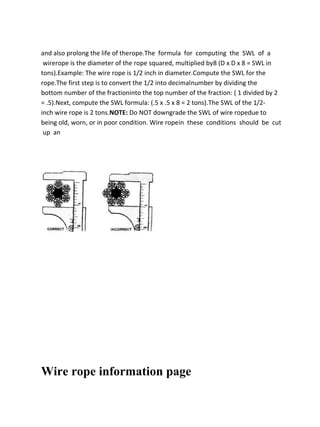
WIRE ROPE SAFE WORKING LOADThe term safe working load (SWL) of wire
ropemeans the load that can be applied and still obtain themost efficient service
and also prolong the life of therope.The formula for computing the SWL of a
wirerope is the diameter of the rope squared, multiplied by8 (D x D x 8 = SWL in
tons).Example: The wire rope is 1/2 inch in diameter.Compute the SWL for the
rope.The first step is to convert the 1/2 into decimalnumber by dividing the
bottom number of the fractioninto the top number of the fraction: ( 1 divided by 2
= .5).Next, compute the SWL formula: (.5 x .5 x 8 = 2 tons).The SWL of the 1/2-
inch wire rope is 2 tons.NOTE: Do NOT downgrade the SWL of wire ropedue to
being old, worn, or in poor condition. Wire ropein these conditions should be cut
up an
Wire rope information page
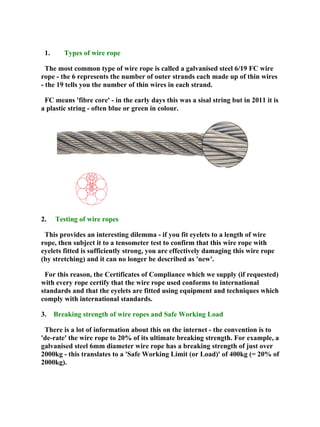
1. Types of wire rope
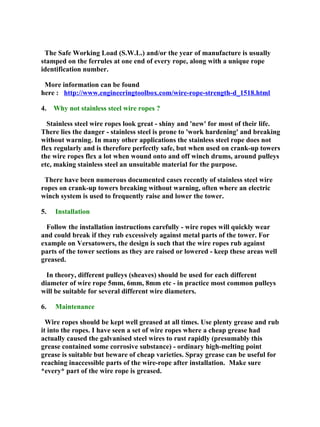
The most common type of wire rope is called a galvanised steel 6/19 FC wire
rope - the 6 represents the number of outer strands each made up of thin wires
- the 19 tells you the number of thin wires in each strand.
FC means 'fibre core' - in the early days this was a sisal string but in 2011 it is
a plastic string - often blue or green in colour.
2. Testing of wire ropes
This provides an interesting dilemma - if you fit eyelets to a length of wire
rope, then subject it to a tensometer test to confirm that this wire rope with
eyelets fitted is sufficiently strong, you are effectively damaging this wire rope
(by stretching) and it can no longer be described as 'new'.
For this reason, the Certificates of Compliance which we supply (if requested)
with every rope certify that the wire rope used conforms to international
standards and that the eyelets are fitted using equipment and techniques which
comply with international standards.
3. Breaking strength of wire ropes and Safe Working Load
There is a lot of information about this on the internet - the convention is to
'de-rate' the wire rope to 20% of its ultimate breaking strength. For example, a
galvanised steel 6mm diameter wire rope has a breaking strength of just over
2000kg - this translates to a 'Safe Working Limit (or Load)' of 400kg (= 20% of
2000kg).
The Safe Working Load (S.W.L.) and/or the year of manufacture is usually
stamped on the ferrules at one end of every rope, along with a unique rope
identification number.
More information can be found
here : http://www.engineeringtoolbox.com/wire-rope-strength-d_1518.html
4. Why not stainless steel wire ropes ?
Stainless steel wire ropes look great - shiny and 'new' for most of their life.
There lies the danger - stainless steel is prone to 'work hardening' and breaking
without warning. In many other applications the stainless steel rope does not
flex regularly and is therefore perfectly safe, but when used on crank-up towers
the wire ropes flex a lot when wound onto and off winch drums, around pulleys
etc, making stainless steel an unsuitable material for the purpose.
There have been numerous documented cases recently of stainless steel wire
ropes on crank-up towers breaking without warning, often where an electric
winch system is used to frequently raise and lower the tower.
5. Installation
Follow the installation instructions carefully - wire ropes will quickly wear
and could break if they rub excessively against metal parts of the tower. For
example on Versatowers, the design is such that the wire ropes rub against
parts of the tower sections as they are raised or lowered - keep these areas well
greased.
In theory, different pulleys (sheaves) should be used for each different
diameter of wire rope 5mm, 6mm, 8mm etc - in practice most common pulleys
will be suitable for several different wire diameters.
6. Maintenance
Wire ropes should be kept well greased at all times. Use plenty grease and rub
it into the ropes. I have seen a set of wire ropes where a cheap grease had
actually caused the galvanised steel wires to rust rapidly (presumably this
grease contained some corrosive substance) - ordinary high-melting point
grease is suitable but beware of cheap varieties. Spray grease can be useful for
reaching inaccessible parts of the wire-rope after installation. Make sure
*every* part of the wire rope is greased.
7. Inspection and replacement
A well-maintained set of wire ropes should last at least 5 years or more
(depending on correct installation, correct loading for the wire diameter,
frequency of use, local weather conditions, etc) - the most common indicator of
when a wire rope needs replacement is when one or more of the thin outer
wires break - often these small sharp wire ends are difficult to see (especially
with a grease covering) so the only way to detect them may be to run your hand
along the rope and feel for them (caution - can/will be painful !)
Don't hesitate - if you feel even 1 small outer wire broken, the rope is
potentially dangerous and should be replaced immediately.
Another area where wire ropes fray and show signs of wear is just beside the
eyelets/ferrules at the ends. Again look/feel for small broken wires.
________________________________________________
Wire rope information page
1. Types of wire rope
The most common type of wire rope is called a galvanised steel 6/19 FC wire
rope - the 6 represents the number of outer strands each made up of thin wires
- the 19 tells you the number of thin wires in each strand.
FC means 'fibre core' - in the early days this was a sisal string but in 2011 it is
a plastic string - often blue or green in colour.
2. Testing of wire ropes
This provides an interesting dilemma - if you fit eyelets to a length of wire
rope, then subject it to a tensometer test to confirm that this wire rope with
eyelets fitted is sufficiently strong, you are effectively damaging this wire rope
(by stretching) and it can no longer be described as 'new'.
For this reason, the Certificates of Compliance which we supply (if requested)
with every rope certify that the wire rope used conforms to international
standards and that the eyelets are fitted using equipment and techniques which
comply with international standards.
3. Breaking strength of wire ropes and Safe Working Load
There is a lot of information about this on the internet - the convention is to
'de-rate' the wire rope to 20% of its ultimate breaking strength. For example, a
galvanised steel 6mm diameter wire rope has a breaking strength of just over
2000kg - this translates to a 'Safe Working Limit (or Load)' of 400kg (= 20% of
2000kg).
The Safe Working Load (S.W.L.) and/or the year of manufacture is usually
stamped on the ferrules at one end of every rope, along with a unique rope
identification number.
More information can be found
here : http://www.engineeringtoolbox.com/wire-rope-strength-d_1518.html
4. Why not stainless steel wire ropes ?
Stainless steel wire ropes look great - shiny and 'new' for most of their life.
There lies the danger - stainless steel is prone to 'work hardening' and breaking
without warning. In many other applications the stainless steel rope does not
flex regularly and is therefore perfectly safe, but when used on crank-up towers
the wire ropes flex a lot when wound onto and off winch drums, around pulleys
etc, making stainless steel an unsuitable material for the purpose.
There have been numerous documented cases recently of stainless steel wire
ropes on crank-up towers breaking without warning, often where an electric
winch system is used to frequently raise and lower the tower.
5. Installation
Follow the installation instructions carefully - wire ropes will quickly wear
and could break if they rub excessively against metal parts of the tower. For
example on Versatowers, the design is such that the wire ropes rub against
parts of the tower sections as they are raised or lowered - keep these areas well
greased.
In theory, different pulleys (sheaves) should be used for each different
diameter of wire rope 5mm, 6mm, 8mm etc - in practice most common pulleys
will be suitable for several different wire diameters.
6. Maintenance
Wire ropes should be kept well greased at all times. Use plenty grease and rub
it into the ropes. I have seen a set of wire ropes where a cheap grease had
actually caused the galvanised steel wires to rust rapidly (presumably this
grease contained some corrosive substance) - ordinary high-melting point
grease is suitable but beware of cheap varieties. Spray grease can be useful for
reaching inaccessible parts of the wire-rope after installation. Make sure
*every* part of the wire rope is greased.
7. Inspection and replacement
A well-maintained set of wire ropes should last at least 5 years or more
(depending on correct installation, correct loading for the wire diameter,
frequency of use, local weather conditions, etc) - the most common indicator of
when a wire rope needs replacement is when one or more of the thin outer
wires break - often these small sharp wire ends are difficult to see (especially
with a grease covering) so the only way to detect them may be to run your hand
along the rope and feel for them (caution - can/will be painful !)
Don't hesitate - if you feel even 1 small outer wire broken, the rope is
potentially dangerous and should be replaced immediately.
Another area where wire ropes fray and show signs of wear is just beside the
eyelets/ferrules at the ends. Again look/feel for small broken wires.
________________________________________________
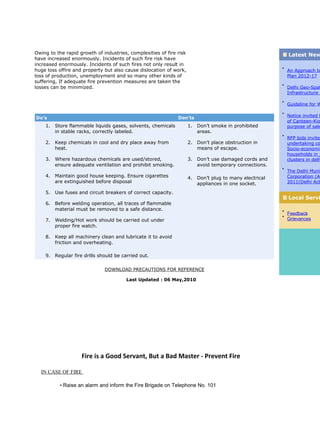
Owing to the rapid growth of industries, complexities of fire risk
have increased enormously. Incidents of such fire risk have
increased enormously. Incidents of such fires not only result in
huge loss offire and property but also cause dislocation of work,
loss of production, unemployment and so many other kinds of
suffering, If adequate fire prevention measures are taken the
losses can be minimized.
Do’s Don’ts
1. Store flammable liquids gases, solvents, chemicals
in stable racks, correctly labeled.
2. Keep chemicals in cool and dry place away from
heat.
3. Where hazardous chemicals are used/stored,
ensure adequate ventilation and prohibit smoking.
4. Maintain good house keeping. Ensure cigarettes
are extinguished before disposal
5. Use fuses and circuit breakers of correct capacity.
6. Before welding operation, all traces of flammable
material must be removed to a safe distance.
7. Welding/Hot work should be carried out under
proper fire watch.
8. Keep all machinery clean and lubricate it to avoid
friction and overheating.
9. Regular fire drills should be carried out.
1. Don’t smoke in prohibited
areas.
2. Don’t place obstruction in
means of escape.
3. Don’t use damaged cords and
avoid temporary connections.
4. Don’t plug to many electrical
appliances in one socket.
DOWNLOAD PRECAUTIONS FOR REFERENCE
Latest New
An Approach to
Plan 2012-17
Delhi Geo-Spat
Infrastructure A
Guideline for W
Notice invited f
of Canteen-Kio
purpose of sale
RFP bids invited
undertaking co
Socio-economic
households in j
clusters in delh
The Delhi Muni
Corporation (Am
2011(Delhi Act
Local Servi
Feedback
Grievances
Last Updated : 06 May,2010
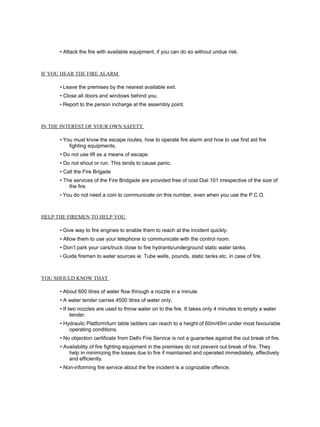
Fire is a Good Servant, But a Bad Master - Prevent Fire
IN CASE OF FIRE
• Raise an alarm and inform the Fire Brigade on Telephone No. 101
• Attack the fire with available equipment, if you can do so without undue risk.
IF YOU HEAR THE FIRE ALARM
• Leave the premises by the nearest available exit.
• Close all doors and windows behind you.
• Report to the person incharge at the assembly point.
IN THE INTEREST OF YOUR OWN SAFETY
• You must know the escape routes, how to operate fire alarm and how to use first aid fire
fighting equipments.
• Do not use lift as a means of escape.
• Do not shout or run. This tends to cause panic.
• Call the Fire Brigade
• The services of the Fire Bridgade are provided free of cost Dial 101 irrespective of the size of
the fire.
• You do not need a coin to communicate on this number, even when you use the P.C.O.
HELP THE FIREMEN TO HELP YOU
• Give way to fire engines to enable them to reach at the incident quickly.
• Allow them to use your telephone to communicate with the control room.
• Don’t park your cars/truck close to fire hydrants/underground static water tanks.
• Guide firemen to water sources ie. Tube wells, pounds, static tanks etc. in case of fire.
YOU SHOULD KNOW THAT
• About 600 litres of water flow through a nozzle in a minute.
• A water tender carries 4500 litres of water only.
• If two nozzles are used to throw water on to the fire. It takes only 4 minutes to empty a water
tender.
• Hydraulic Platform/turn table ladders can reach to a height of 60m/45m under most favourable
operating conditions.
• No objection certificate from Delhi Fire Service is not a guarantee against the out break of fire.
• Availability of fire fighting equipment in the premises do not prevent out break of fire. They
help in minimizing the losses due to fire if maintained and operated immediately, effectively
and efficiently.
• Non-informing fire service about the fire incident is a cognizable offence.
Fire is a Good Servant, But a Bad Master - Prevent Fire
IN CASE OF FIRE
• Raise an alarm and inform the Fire Brigade on Telephone No. 101
• Attack the fire with available equipment, if you can do so without undue risk.
IF YOU HEAR THE FIRE ALARM
• Leave the premises by the nearest available exit.
• Close all doors and windows behind you.
• Report to the person incharge at the assembly point.
IN THE INTEREST OF YOUR OWN SAFETY
• You must know the escape routes, how to operate fire alarm and how to use first aid fire
fighting equipments.
• Do not use lift as a means of escape.
• Do not shout or run. This tends to cause panic.
• Call the Fire Brigade
• The services of the Fire Bridgade are provided free of cost Dial 101 irrespective of the size of
the fire.
• You do not need a coin to communicate on this number, even when you use the P.C.O.
HELP THE FIREMEN TO HELP YOU
• Give way to fire engines to enable them to reach at the incident quickly.
• Allow them to use your telephone to communicate with the control room.
• Don’t park your cars/truck close to fire hydrants/underground static water tanks.
• Guide firemen to water sources ie. Tube wells, pounds, static tanks etc. in case of fire.
YOU SHOULD KNOW THAT
• About 600 litres of water flow through a nozzle in a minute.
• A water tender carries 4500 litres of water only.
• If two nozzles are used to throw water on to the fire. It takes only 4 minutes to empty a water
tender.
• Hydraulic Platform/turn table ladders can reach to a height of 60m/45m under most favourable
operating conditions.
• No objection certificate from Delhi Fire Service is not a guarantee against the out break of fire.
• Availability of fire fighting equipment in the premises do not prevent out break of fire. They
help in minimizing the losses due to fire if maintained and operated immediately, effectively
and efficiently.
• Non-informing fire service about the fire incident is a cognizable offence.
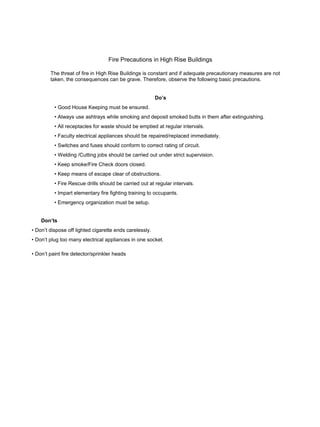
Fire Precautions in High Rise Buildings
The threat of fire in High Rise Buildings is constant and if adequate precautionary measures are not
taken, the consequences can be grave. Therefore, observe the following basic precautions.
Do’s
• Good House Keeping must be ensured.
• Always use ashtrays while smoking and deposit smoked butts in them after extinguishing.
• All receptacles for waste should be emptied at regular intervals.
• Faculty electrical appliances should be repaired/replaced immediately.
• Switches and fuses should conform to correct rating of circuit.
• Welding /Cutting jobs should be carried out under strict supervision.
• Keep smoke/Fire Check doors closed.
• Keep means of escape clear of obstructions.
• Fire Rescue drills should be carried out at regular intervals.
• Impart elementary fire fighting training to occupants.
• Emergency organization must be setup.
Don’ts
• Don’t dispose off lighted cigarette ends carelessly.
• Don’t plug too many electrical appliances in one socket.
• Don’t paint fire detector/sprinkler heads
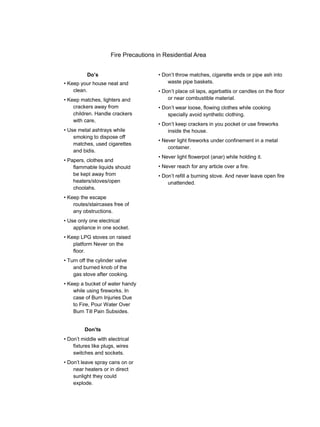
Fire Precautions in Residential Area
Do’s
• Keep your house neat and
clean.
• Keep matches, lighters and
crackers away from
children. Handle crackers
with care,
• Use metal ashtrays while
smoking to dispose off
matches, used cigarettes
and bidis.
• Papers, clothes and
flammable liquids should
be kept away from
heaters/stoves/open
choolahs.
• Keep the escape
routes/staircases free of
any obstructions.
• Use only one electrical
appliance in one socket.
• Keep LPG stoves on raised
platform Never on the
floor.
• Turn off the cylinder valve
and burned knob of the
gas stove after cooking.
• Keep a bucket of water handy
while using fireworks. In
case of Burn Injuries Due
to Fire, Pour Water Over
Burn Till Pain Subsides.
Don’ts
• Don’t middle with electrical
fixtures like plugs, wires
switches and sockets.
• Don’t leave spray cans on or
near heaters or in direct
sunlight they could
explode.
• Don’t throw matches, cigarette ends or pipe ash into
waste pipe baskets.
• Don’t place oil laps, agarbattis or candles on the floor
or near combustible material.
• Don’t wear loose, flowing clothes while cooking
specially avoid synthetic clothing.
• Don’t keep crackers in you pocket or use fireworks
inside the house.
• Never light fireworks under confinement in a metal
container.
• Never light flowerpot (anar) while holding it.
• Never reach for any article over a fire.
• Don’t refill a burning stove. And never leave open fire
unattended.
Fire Safety Precautions Against
Electricity
About 60% fires are of electric origin on account of electric short circuit, overheating,
overloading, use or nonstandard appliances, illegal tapping of electrical wires, improper electrical
wiring, carelessness and ignorance etc. It can lead to serious fire and fatal accidents, if proper
instructions are not followed. Such incidents can be minimized to a great extent if adequate fire
precautions are observed. Electrical fires spread rapidly especially in buildings and cause loss of
lives and property. It is, therefore, necessary to act fast. Raise an alarm for help. Switch off
power supply to de-energise the equipment. Use dry sand, CO2, dry powder or Halon
extinguishers.
Do’s
• Use I.S.I. certified appliances.
• Use good quality fuses of correct rating, miniature circuit breakers and earth leakage circuit
breakers.
• Use one socket for one appliance.
• Switch off the electric supply of the fire affected areas.
• Fuses and switches should be mounted on metallic cubicles for greater safety against fire.
• Replace broken plugs and switches.
• Keep the electrical wires away from hot and wet surface.
• Switch off appliance after use and remove the plug from the socket. • Switch off he ‘Main’ switch
when leaving home for a long duration.Don’ts
• Don’t use substandard fixtures, appliances.
• Never have temporary or naked joints on wiring.
• Don’t lay wires under carpets, mats or doorways. They get crushed, resulting in short circuiting.
• Don’t allow appliances cords to dangle.
• Don’t place bare wire ends in a socket.
Instruction for Fire Safety in Respect of Temporary Structures/Pandals
• The height of the ceiling of the pandal should not be less than 3 metres.
• No synthetic materials or synthetic ropes should be used in such structures.
• Margins of at least 3 metres should be kept on all sides-away from any preexisting walls or
buildings.
• No structure should be erected underneath any live electrical line.
• Structure should be erected reasonably away from railway lines, electric substations, furnaces or
other hazardous places and a minimum distance of 15 metres should be maintained.
• Exits on all sides of the pandal shall be kept sufficiently wide (minimum 1.5 metres).There should
be provision for stand by emergency light.
• First-aid fire extinguishers or water buckets must be installed at strategic points inside and outside
of the pandal.
• No combustible material like wood shavings, straw, flammable and explosive chemicals and
similar materials should be permitted to be stored in the vicinity or inside the pandal.
• No fireworks display with open flames of any kind should be permitted close to the temporary
structure/pandal. Kitchen must be segregated by providing separation walls of noncombustible
material (G.I. Sheets) from the remaining area of the temporary structure.
• The height of the ceiling of the pandal should not be less than 3 metres.
• No synthetic materials or synthetic ropes should be used in such structures.
• Margins of at least 3 metres should be kept on all sides-away from any preexisting walls or
buildings.
• No structure should be erected underneath any live electrical line.
• Structure should be erected reasonably away from railway lines, electric substations, furnaces or
other hazardous places and a minimum distance of 15 metres should be maintained.
• Exits on all sides of the pandal shall be kept sufficiently wide (minimum 1.5 metres). • There
should be provision for stand by emergency light. First-aid fire extinguishers or water buckets
must be installed at strategic points inside and outside of the pandal.
• No combustible material like wood shavings, straw, flammable and explosive chemicals and
similar materials should be permitted to be stored in the vicinity or inside the pandal.
• No fireworks display with open flames of any kind should be permitted close to the temporary
structure/pandal.
• Kitchen must be segregated by providing separation walls of noncombustible material (G.I.
Sheets) from the remaining area of the temporary structure
Fire safety during public/private functions
Frequent requests are received by Delhi Fire Service for providing fire safety for providing fire safety
cover in the public/private functions. The fire engines are provided, subject to availability on
payment of prescribed charges which at present is Rs. 3000/ per day or part thereof. Rs. 200/
enhances these charges on 1st April every year as per the present policy.
The public should ensure that the auditorium/stadiums, which they are booking for various functions
are having valid No Objection certificate from fire department. Therefore, such functions be held in
those premises only, which are having clearance from fire service
Fire Protections in Industries
Owing to the rapid growth of industries, complexities of fire risk have increased enormously.
Incidents of such fire risk have increased enormously. Incidents of such fires not only result in huge
loss of fire and property but also cause dislocation of work, loss of production, unemployment and so
many other kinds of suffering, If adequate fire prevention measures are taken the losses can be
minimized.
Do’s
• Store flammable liquids gases, solvents, chemicals in stable racks, correctly labeled.
• Keep chemicals in cool and dry place away from heat.
• Where hazardous chemicals are used/stored, ensure adequate ventilation and prohibit smoking.
• Maintain good house keeping. Ensure cigarettes are extinguished before disposal
• Use fuses and circuit breakers of correct capacity.
• Before welding operation, all traces of flammable material must be removed to a safe distance.
• Welding/Hot work should be carried out under proper fire watch.
• Keep all machinery clean and lubricate it to avoid friction and overheating.
• Regular fire drills should be carried out
Don’ts
• Don’t smoke in prohibited areas.
• Don’t place obstruction in means of escape.
• Don’t use damaged cords and avoid temporary connections.
• Don’t plug to many electrical appliances in one socket.
Basic Fire Precautions in Rural Areas
Every year thousands of fires occur in villages and farms resulting in heavy losses and depletion of
stock of the most valuable and vitally required harvested crops meant for caving the teaming
million from starvation. In many cases, even lives are lost. Such incidents can be minimized if the
following fine precautions are observed.
Do’s
• Extinguish cigarette/bidi ends and match sticks before disposal.
• Keep combustible materials such as fuel wood, oil paints, spirits etc. in a separate room.
• The dwellings and huts should be constructed as far as possible with noncombustible materials.
• Electric installations should be carried out by a qualified electrician.
• Burning of waste material, grass land, rubbish, stubble etc. should always be done away from the
residence under proper supervision.
• Provide spark arrestors on Tractor Exhaust pipe.
• While building up hay stacks, ensure that
o (i) A minimum distance of 20m from stack to stack or stack to residences is maintained
o (ii) Height of stack should not be more than 8m.
o (iii) Limit one stack to a maximum of 20 tonnes
o (iv) Keep water drums and few buckets near hay stacks.
o (v) If possible, build up the stacks near tube wells, ponds, river or other water sources.
FACTORIES ACT
The object of the Factories Act is to regulate the conditions of work in
manufacturing establishments coming within the definition of the term "factory" as used
in the Act.
The first Act, in India, relating to the subject was passed in 1881. This was
followed by new Acts in 1891, 1911, 1922, 1934 and 1948. The Act of 1948 is more
comprehensive than the previous Acts. It contains detailed provisions regarding the
health, safety and welfare
of workers inside factories, the hours of work, the minimum age 6f, workers, leave with
pay etc. The Act has been amended several times.
The Act is based on the .provisions of the Factories Act of Great
Britain passed in 1937.
In 1976 the Act was amended extensively. The provisions of the Amendment have
been quoted and summarised at the appropriate .places in this chapter.
APPLICATION OF THE ACT
The Factories Act of 1948 came into force on 1st April 1949; It applies to
factories, as defined in. the Act, all over India, including the State of Jammu and
Kashmir.
Unless 'otherwise provided, the Factories Act applies to factories belonging to the
Central or any State Government.--Sec. 116.
DEFINITIONS UNDER THE FACTORIES ACT
.Factory. The term Factory is defined in Section 2 (m) of the Act as follows:
"Factory means any premises including the precincts thereof- .
(i). whereon ten or more workers are working, or were working on any day of
the preceding twelve months, and in
any part of which a manufacturing process is being carried on with the aid
of power or is ordinarily so
carried on, or
(ii) whereon twenty or more workers are working, or were working on any day of
the preceding twelve months, and in any part of which a manufacturing process
is being carried on without the aid of power, or is ordinarily so carried on,___
but does not include a mine subject to the operation of the Indian Mines Act, 1952 (Act
XXXV of 1952), or a mobile unit belonging to the armed forces of the Union, a railway
running shed or a hotel, restaurant or eating place.
Explanation.-For computing the number of workers for the purposes of this clause
all the workers in different relays in a day shall. be taken into account.
[Clause 2(m) as amended in 1976.]
Under Section 85, the State Government is empowered to declare any
establishment carrying on a manufacturing process to be a factory for the purposes of
the Act even though it employs less than the prescribed minimum number of workers,
provided that the manufacturing process is not being carried on by the owner only with
the aid of his family.
Summary: From Sec. 2(m) of the Act it follows that m establishment comes within
the definition of a Factory if the conditions stated below are satisfied :
1. It is a place where a "manufacturing process" is carried on.
2. It employs the prescribed minimum number of "workers"
viz., ten if "'power" is used, and twenty if no "power" is used. It is sufficient if the
prescribed number of workers were employed on any day of the preceding twelve
months.
3. . It is not a mine coming within the purview of the Indian Mines Act of 1952, a
railway running shed, mobile unit belonging to the armed forces of the Union, a hotel,
restaurant or eating place.
Manufacturing Process. This term is defined in Section 2(k) in a very wide sense.
It iIicludes :
(i) making, altering, ornamenting, finishing, packing, oiling, washing, cleaning,
breaking up, demolishing, or otherwise treating or adopting any article or
substance with a view to its use, sale, transport, delivery or disposal; or
(ii)pumping oil, water, sewage or any other substance; or (Hi) generating,
transforming or transmitting power; or
(iii) (iv) composing types for printing, printing by letter press, lithography,
photogravure or other similar processes or book binding ; or
(v) constructing, reconstructing, repairing, refitting, finishing or breaking up
ships or vessels ; or
(vi) preserving or storing any article in cold storage.
For the corresponding section of the English Act, it was held that the different
processes enumerated in the clauses are merely illustrative so that laundries,
,carpet beating, or bottle washing works come within the Act, if mechanical power is
used. Patterson v. Hune
The following undertakings have been held to be manufacturing processes-
bidi-making; conversion of raw-films into finished products; the preparation of
eatables in the kitchen of a restaurant ; use of a refrigerator for adapting any article
with a view to its sale.
The scraping out of salt and grading them, even though done by, manual labour,
is a manufacturing process.
Worker. "Worker means a person employed, directly or by or through any
agency (including a contractor) with or without the knowledge of the principal
employer, whether for remuneration or not in any manufacturing process, or in
cleaning any part of the machinery or premises used for a manufacturing process,
or in any other kind of work incidental to, or connected 'with, the manufacturing
process" or the subject of the manufacturing process but does not include any
member of the armed forces of the Union."-Sec. 2(1), as amended in 1976.
Explanation: Worker means any person engaged in any work connected with or
incidental to a manufacturing .process. Thus the definition is wide. The term includes
persons engaged directly and, also those who are engaged through an agency
(including a contractor with or without the knowledge of the principal employer). The
term includes clerical workers and persons paid by piece rates in a factory.
The term 'worker' does not include any member of the armed forces of Union. ., ,
, In case of a factory worker there must be a relationship between
the employer and the employed. "
Apprentices, whether remunerated or not, are workers within the meaning of the
Act.
Power. "Power means electrical energy, or any other form of energy which is
mechanically transmitted and is not generated by human or animal agency."--Sec. 2(g).
Prime mover. "Prime mover means any engine, motor or other appliance which
generates or otherwise provides power."--Sec. 2(h).
Transmission machinery. "Transmission machinery means any shaft, wheel, drum
pulley, system of pulleys, coupling, clutch,'driving belt or other appliance or device by
which the motion of a prime mover is transmitted to or received by any machinery or
appliance".--Sec. 2(i).
Machinery. "Machinery includes prime movers, transmission machinery and all other
appliances whereby power is generated, transformed, transmitted or applied."--Sec. 2(j).
Adult. "Adult means a person who has completed his eighteenth year of age".--Sec.
2(a). °
Adolescent. "Adolescent means a person who ha$ completed his fifteenth year of age
°but has not completed his eighteenth year."Sec. 2(b).
Child. ''Child means a person who has net completed his fifteenth year of age." --Sec. 2
( c) .
Young Person. "Young Person means a person who is either a child or an
adolescent."--Sec. 2(d).
Calendar Year. "Calendar Year means the period of twelve months beginning with the
first day of January in any year."
Sec. 2(dd). °
Day. "Day means a period of twenty four hours beginning at midnight." --Sec. 2 ( e) .
References to the time of the day in the ° Act are to the Indian Standard Time. In areas
where the I.S.T. is not observed, the State Government can by rules define the local
mean time.--Sec. 3.
Week. "Week means a period of seven days beginning 'at midnight on Saturday night
or such other night as may be approved in writing Jar a particular area by the Chief
Inspector of Factories." --Sec. 2(f).
Shift and Relay. Where work of the same kind is carried out by two or more sets of
workers working during different periods of the day, each of such sets is called a "relay"
and each of such periods is called a "shift."-Sec. 2(r).
Occupier. "Occupier" of a factory means the person who has ultimate control over the
affairs of the factory, and where the said affairs are entrusted to a managing agent,
such agent shall be deemed to be the occupier of the factory.--Sec. 2(n).
In case of a ship, which is being repaired or on maintenance work is being carried
out in dry dock which is available for hire, the following persons for certain section of the
Act will be deemed to be occupier (i) the owner of the dock, and (ii) the owner of the
ship or his agent or master or other officers-in-charge in the ship or any person who
contracts with such owner, agent or master or other officers-in-charge to carry out the
repair or maintenance work.-Sec. 2(n) added by The Factories (Amendment) Act, 1976.
The Act imposes several duties and responsibilities on the occupier of the
factory. (See below).
An occupier of factory may be an owner, a lessee or a mere licensee but he must
have the right to occupy the property. He should also control the management.
APPROVAL, LICENCING AND REGISTRATION
It is necessary to obtain a" licence before a factory is started. Section 6 provides
that the State Government may make rules requiring, for the purposes of this Act, the
submission of. plans or any class or description of factories to the Chief Inspector or the
State Government, and the plans and specifications of a factory and its location.
The Amendment of 1976 provides that any replacement and addition to the factory will
not be allowed if it does not reduce the I minimum clear space required for safe working
around the plant or machinery or adversely affect the environmental conditions from the
evolution or emission of steam, heat or dust or fumes injurious to health.
Notice by occupier. Section 7 provides that the occupier of a factory must, at
least 15 days before he begins to occupy or use any premises as a factory; send to
the Chief Inspector of Factories a written notice containing the following particulars:
( 1 ) the name and situation of factory ;
(2) the name and address of the occupier ;
(3) the name and address of the owner of the premises or building (including the
precincts thereof) ;
( 4) the address to which communications relating to factory may be sent ;
(5) the nature of the manufacturing process to be carried on in the factory during the
next twelve months ;
( 6) the total rated horse power installed or to be installed in the factory, which shall not
include the rated – horse power or any separate stand-by plant;
(7) the name of the manager of the factory for the purposes of this Act ;
(8) the number of workers likely to be employed in the factory ;
(9) such other particulars as may be prescribed.
The rules stated above are enforced . because the plans and specifications of the
factory must insure proper measures of health, safety and welfare of the . workers.
THE INSPECTI0N STAFF
The Factories Act empowers the State Government to appoint Inspectors, Chief
Inspectors of Factories, Additional Chief Inspectors, Joint Chief Inspectors and Deputy
Chief Inspectors. Every District
Magistrate is an Inspector for his district. No person can act as an Inspector if .he is or
becomes directly or indirectly interested in a factory or in any process or business
carried on therein or in any patent or machinery connected therewith. .
Powers of Inspectors. Section 9 provides that subject to any rules made in this
behalf, an Inspector may exercise the following powers within the local limits for which
he is appointed :
(a) enter, with such assistants, being persons in the service of the Government or any
local or other public authority, as
he thinks fit, and place which is used, or which he has reason to believe is used,
as a. factory ;
(b) make examination of the premises, plant and machinery;
(c) require the production of any prescribed register and any other document relating to
the factory, and take on the spot or otherwise statements of any person which he may
consider necessary for carrying out the purposes of the Act; and .(d) exercise such
other powers as may be prescribed for carry ing out the purposes of this Act.
No person shall be compelled under this section to answer any question or give
any evidence tending to incriminate himself.
Under Section 91, an Inspector may take a sample of any substance, used or
intended to be used in a factory, for the purpose of finding out whether the substance
is injurious and if the factory is violating any of the provisions of the Act.
Obstructing an Inspector. Whoever wilfully obstructs an Inspector in the exercise of
any power conferred on him by or under this Act, or fails to produce on demand by an
Inspector any registers Of other documents in his custody kept in pursuance of this Act
or of any ru.!es made thereunder, or conceals or prevents any worker in a factory from
appearing before, or being examined by, an Inspector, shall be punishable ~with
imprisonment for a term which may extend to three months or with fine which may
extend to Rs. 300 or with both.-Sec. 95. .
The onus is on the prosecution to show that a person has obstructed an inspector.
Duties of Inspector. It is the duty of factory inspectors to enforce the provisions of
the Factories Act and other industrial laws. For this purpose they inspect factories
periodically. If any rule is violated they take steps like prosecuting the guilty persons etc.
CERTIFYING SURGEONS
Section 10 provides that the State Government may appoint qualified medical
practitioners to .be certifying surgeons for the purposes of the Act for specified local
areas or for specified factories or class of factories.
No person can be a certifying surgeon for a factory or industry in which he is
interested .directly or indirectly.-Sec. 10(3).
The State Government may by order in writing and subject to specified conditions,
exempt any person or class of persons from the provisions of this sub-section in respect
of any factory or class or description of factories.
Duties. The certifying surgeon has the following duties under the Act and the rules
framed under it.
1. The examination and certification .of young persons.
2. The examination of persons engaged in factories in dangerous
occupations or processes. .
3. Medical supervision of factories in cases where such supervision had been
prescribed owing to the dangerous nature of the work carried on or for any other
reason, viz.,
(i) cases of illness have occurred which it is reasonable to believe are due to the nature
of the manufacturing process carried on,. or other conditions of work prevailing therein;
(ii) by reason of any change in the manufacturing process carried on or in the
substances used therein there is a likelihood of injury to the health of workers
employed in that manufacturing process ;
(iii) young persons are, or about to be employed in any work which is likely to cause
injury to their health.
(iv)
PROVISIONS REGARDING THE HEALTH OF WORKERS
Sections 11 to 20 of the Act contain certain provisions intended to ensure that the
conditions under .which work is carried on in factories do not affect the health of the
workers injuriously. The summary of the provisions are explained below :
Summary of the provisions of the Factories Act. relating -to the health of workers
are stated below.
1. Cleanliness. Every factory shall be kept clean and free from dirt, and the outflow
of drains etc. The floors must be cleaned. Drainage shall be provided. Inside walls,
partitions and ceilings must be repainted at least once in five years. When washable
water paint is used they must be painted once every three years and washed at least
every period of six months.-Sec. 11,' as amended in 1976.
2. Disposal of wastes and effluents. The waste materials produced from the
manufacturing process must be effectively disposed off-Sec. 12.
3. Ventilation 'and Temperature. There must be provision for adequate ventilation by
the circulation of fresh air: The temperature
must be kept at a comfortable level. Hot parts of machines must be
'separated and insulated.-Sec. 13.
4. Dust and Fume. If the .manufacturing process used. gives off injurious or offensive
dust and fume steps must be taken so that they are not inhaled or accumulated. The
exhaust fumes of internal combustion engines must be conducted outside the
factory.--Sec. 14.
5. Artificial humidification. The water used for this purpose must be pure. It must be.
taken from some source of drinking water supply. The State Government can frame
rules .regarding the process of humidification etc.-8ec. 15. .
6. OverCrowding. There must be no overcrowding in a factory. In factories existing
before the commencement of the Act there must be at least 350 c.ft. (~r 55 cubic
metres) of space per worker. For factories built afterwards, there must be at least 500
c.ft. (or 75 cubic metres) of space. In calculating the space, an account is to be taken
of space above 14 ft. (or 5 metres) from the floor.-Sec. 16.
7. Lighting. Factories must be well lighted. Effective measures must be adopted to
prevent glare or formation of shadows which might cause eyestrain.-sec. 17.
8. Drinking water. Arrangements must be made to provide a sufficient supply of
wholesome drinking water. All supply' points of such water must be marked "drinking
water". No such points shall be within 20 ft. (or 7.5 metres) of any latrine, washing place
etc. Factories employing more than 250 workers must cool the water during the hot
weather.-Sec. 18. .
9. Latrines and Urinals. Every factory must provide' sufficient number of latrines and
urinals. There must be separate provision for male and female workers. Latrine and
urinals must be kept in a clean and sanitary condition. In factories. employing more
than 250 workers, they shall be of prescribed sanitary types.--sec. 19.
PROVISIONS REGARDING THE SAFETY OF WORKERS
Sections 21 to 40A, 40B and 41 of the Act lay down rules for the purpose of
securing the safety of workers. Summary of the provisions of the Factories Act
regarding the safety of the workers are stated below: (Sections 2l to 41) .
1. Fencing ot machinery. All dangerous machinery must be securely fenced e.g.,
moving .parts- of prime movers and flywheels connected to every prime mover. electric
generators. etc.-Sec. 2l.
2. Work on or near machinery in motion. Work on or near machinery in motion
must be carried out only by specially trained adult male workers wearing tightly fitting
c1othes.-Sec. 22.
3. Employment of young persons on dangerous machines. No young person
shall work at any danger()us machine' unless he has been specially instructed as to
the dangers and the precautions to be observed. has received sufficient training about
th~ work. and is under the supervision of some person having thorough knowledge and
experience of the machine.-Sec. 23.
4. Striking gear and devices for cutting off power. In every factory suitable
devices for cutting off power in emergencies from running machinery shall be provided
and maintained in every workroom.~. 24.
5. Self-acting machines. Moving parts of a self-acting machine must not be
allowed to come within 45 cms. of any fixed structure which is not part of the machine.-
Sec. 25.
6. Casing of new machinery. In all machinery installed after the commencement
of the Act. certain parts must be sunk, encased or otherwise effectively guarded e.g..
set screw. bolt. toothed gearing etc. -sec. 26.
7. Women and children near cotton Openers. Women and children must not be
allowed to work near cot/On openers, except In certain cases.-Sec. 27
8. Hoists, lifts, chains etc, Every hoist and lift must be so constructed as to be safe.
There are detailed rules as to how such safety is to be secured. There are similar
provisions regarding lifting machines. chains, ropes and lifting tackle .Sec. 28. 29.
9. .Revolving machinery. Where grinding is . carried on the maximum safe
working speed of every revolving machinery connected therewith must be notified.
Steps must be taken to see that the safe speed is not exceeded.-Sec. 30.
10. Pressure plant. Where any operation is carried on at a pressure higher than
the atmospheric pressure, steps must be taken to ensure that the safe working
pressure is not exceed~cL-.sec. 31.
. 11. Floors, stairs and means of access. All floors, steps, stairs, passage and
gangways shall be of sound construction and properly maintained. Handrails shall be
provided where necessary. Safe means of access shall be provided to the place where
the worker will carry on any work.-Sec. 32.
12. Pits, sumps. openings in floors etc. Pits. sumps. openings in floors etc.
must be securely covered or fenced.-Sec. 33.
13. Excessive weights. No worker shall be made to carry a load so heavy as to
cause him injury.-8ec. 34.
14. Protection of eyes. Effective screen or suitable goggles shall be provided to
protect the eyes of the worker from fragments thrown off in course of any manufacturing
process and from excessive light if any.-Sec. 35.
15. Precautions against dangerous fumes. No person shall be allowed to enter
any chamber. tank etc. where dangerous fumes are likely to ,be present. unless it is
equipped with a manhole or other means of going out. In such space no portable
electric light of more than 24 ,volts shall be used. Only a lamp or light of flame proof
construction can be used in such space. For people entering such space suitable
breathing apparatus, reviving apparatus etc. shall be provided. Such places shall be
cooled by ventilation before any person is allowed to enter.-8ecs. 36 and 36A.
16. Explosive or inflammable gas etc. where a manufacturing process
produces inflammable gas. dust. fume. etc. steps must be taken to enclose the
machine concerned, prevent the accumulation of substances and exclude all possible
sources of ignition. Extra precautionary measures are to be taken where such
substances are worked at greater than the atmospheric. pressure.-Sec. 37.
17. Precaution in case of fire. Fire escapes shall be provided. Windows and
doors shall be constructed to open outwards. The means of exit in case of the fire shall
be clearly marked in red letters. Arrangements must be made to give warning in case
or fire -sec. 38
18. Specifications of defectives etc. and safety of buildings and machinery.
If any building or machine is in a defective or dangerous condition, the inspector of
factories can ask fer the holding of tests to determine how they can be made safe. He
can also direct the adoption of the measure necessary to make them safe. In case of
immediate danger, the use of the building or machine can be prohibited.-Secs. 39. 40.
19. Maintenance of Buildings. If the Inspector of Factories thinks that any
building in a factory, or any. part of it. is in such a state of disrepair that it is likely to
affect the health and welfare of the workers. he may serve on the occupier or manager
or both in writing specifying the measures to be done before the specified date. Sec.
4OA.
20. Safety Officers. The State Government may notify to the occupier to employ a
number of Safety Officers in a factory (i) wherein one thousand or more workers are
ordinarily employed. or (ii) wherein any manufacturing process or operation which
involves the risk of bodily injury, poisoning. disease or any other hazard to health of the
persons employed in the factory .-Sec. 40B.
21. Rules. The State Government may make rules providing for the use of such
further devices for safety as may be necessary. Sec. 41.
Don’ts
• Don’t be careless about disposal of cigarettes/bidi butts.
• Naked lamps or kitchen fires should never be allowed to burn while retiring to bed.
• Electric wiring should not pass over hay stacks.
• Hay stacks should not be built up near the railway lines or roads.
Fire Precautions for Children
Children are our most valued possessions. They are also among the most vulnerable to accidents and
fire. The following safety hints shall be borne in mind
Never leave children alone near an open fire, heater or in a kitchen. Elder children may use fire or
play with matches. The results can be disastrous. Keep matches and cigarette lighters out of reach
of children.
If young children are playing in a room fitted with a Combustion heater or other heating appliance,
ensure that the appliance is screened so that children cannot crawl or put their hands on hot elements
or hot materials. sockets are covered so that children cannot put wires, metal instruments, their
fingers into sockets.
Fire Precautions in High Rise Buildings
The threat of fire in High Rise Buildings is constant and if adequate precautionary measures are not
taken, the consequences can be grave. Therefore, observe the following basic precautions.
Do’s
• Good House Keeping must be ensured.
• Always use ashtrays while smoking and deposit smoked butts in them after extinguishing.
• All receptacles for waste should be emptied at regular intervals.
• Faculty electrical appliances should be repaired/replaced immediately.
• Switches and fuses should conform to correct rating of circuit.
• Welding /Cutting jobs should be carried out under strict supervision.
• Keep smoke/Fire Check doors closed.
• Keep means of escape clear of obstructions.
• Fire Rescue drills should be carried out at regular intervals.
• Impart elementary fire fighting training to occupants.
• Emergency organization must be setup.
Don’ts
• Don’t dispose off lighted cigarette ends carelessly.
• Don’t plug too many electrical appliances in one socket.
• Don’t paint fire detector/sprinkler

148906906 safety-study-material

  • 1.
    Get Homework Done Homeworkping.com HomeworkHelp https://www.homeworkping.com/ Research Paper help https://www.homeworkping.com/ Online Tutoring https://www.homeworkping.com/ click here for freelancing tutoring sites UNIT-IV SAFETY IN MATERIAL HANDLING I.AS/RS SYSTEM An automated storage and retrieval system (ASRS or AS/RS) consists of a variety of computer- controlled methods for automatically placing and retrieving loads from specific storage locations. [1] Automated storage and retrieval systems (AS/RS) are typically used in applications where: there is a very high volume of loads being moved into and out of storage; storage density is important because of space constraints; no value adding content is present in this process; accuracy is critical because of
  • 2.
    potential expensive damagesto the load. AS/RS can be used with standard loads as well as nonstandard loads.[2] ]Overview AS/RS systems are devices designed for automated storage and retrieval of parts and items in manufacturing, distribution, retail, wholesale and institutions. They first originated in the 1980s.[citation needed] They are compact units that utilize the unused overhead space of a plant or warehouse, and convert to live storage of product. Items can be placed on trays or hang from bars, which are attached to chains/drives in order to move up and down. They focus on bringing "goods to the man" rather than manual walking and searching. Space savings, increased productivity/reduced labor, increased accuracy and reduced inventory levels are some of the primary benefits. Ideal for lean manufacturing, sustainability, Six Sigma, Kanban, JIT and other value added methodologies and processes. The equipment required for an AS/RS include a storage & retrieval machine (SRM) that is used for rapid storage and retrieval of material. SRMs are used to move loads vertically or horizontally, and can also move laterally to place objects in the correct storage location.[3] The traditional vending machine is the most common and familiar AS/RS system but because the application is to do with retail sales, the logistic concept of a vending machine is missed. The trend towards just in time production often requires sub-pallet level availability of production inputs, and AS/RS is a much faster way of organizing the storage of smaller items next to production lines. Traditional high bay warehouses are designed with pallet storage in mind, and if goods are being delivered in sub pallet quantities, high bay warehouses are problematic. Material Handling Institute of America (MHIA), the non-profit trade association for the material handling world, and its members have broken AS/RS into two primary segments: Fixed Aisle and Carousels/Vertical Lift Modules (VLMs). Both sets of technologies provide automated storage and retrieval for parts and items, but use different technologies. Each technology has its unique set of benefits and disadvantages (like everything in the world). Fixed Aisle systems are characteristically larger systems whereas carousels and Vertical Lift Modules are used individually or grouped, but in small to medium-sized applications. Fixed-aisle AS/RS is categorized into three main types: single-masted, double masted, and man- aboard. Most are supported on a track and ceiling guided at the top by guide rails or channels to ensure accurate vertical alignment, although some are suspended from the ceiling. The 'shuttles' that make up the system travel between fixed storage shelves to deposit or retrieve a requested load (ranging from a single book in a library system to a several ton pallet of goods in a warehouse system). As well as
  • 3.
    moving along theground, the shuttles are able to telescope up to the necessary height to reach the load, and can store or retrieve loads that are several positions deep in the shelving. A semi-automated system can be achieved by utilizing only specialized shuttles within an existing rack system. To provide a method for accomplishing throughput to and from the AS/RS and the supporting transportation system, stations are provided to precisely position inbound and outbound loads for pickup and delivery by the crane. In addition, there are five types of AS/RS devices called Unit-load AS/RS, Mini-load AS/RS, Vertical Lift Modules (VLMs), Horizontal Carousels and Vertical Carousels. These systems are used either as stand-alone units or in integrated workstations called pods or systems. These units are usually integrated with various types of pick to light systems and use either a microprocessor controller for basic usage or inventory management software. These systems are ideal for increasing space utilization up to 90%, productivity levels by 90%, accuracy to 99.9%+ levels and throughput up to 750 lines per hour/per operator or more depending on the configuration of the system. ]Advantages An effective automated storage and retrieval system provides several benefits for supply chain management: • An efficient AS/RS system helps companies cut expenses by minimizing the amount of unnecessary parts and products instorage, and improving organization of the contents of a warehouse. Due to automated processes, it also allows for more storage space due to high-density storage, narrower aisles, etc.[4] • Automation reduces labor costs while lowering workforce requirements and increasing safety.[5] • Modeling and managing the logical representation of the physical storage facilities (e.g. racking, etc.). For example, if certain products are often sold together or are more popular than others, those products can be grouped together or placed near the delivery area to speed up the process of picking, packing and shipping to customers. • Enabling a seamless link to order processing and logistics management in order to pick, pack, and ship product out of the facility. • Tracking where products are stocked, which suppliers they come from, and the length of time they are stored. By analysing such data, companies can control inventory levels and maximize the use of warehouse space. Furthermore, firms are more prepared for the demands and supplies of the market, especially during special circumstances such as a peak season on a particular month.
  • 4.
    Through the reportsgenerated by an AS/RS system, firms are also able to gather important data that may be put in a model for it to be analyzed.[6] Man-aboard AS/RS A man-aboard AS/RS offers significant floorspace savings. This is due to the fact that the storage system heights are no longer limited by the reach height of the order picker. Shelves or storage cabinets can be stacked as high as floor loading, weight capacity, throughput requirements, and/or ceiling heights will permit. Man-aboard automated storage and retrieval systems are far and away the most expensive picker-to-stock equipment alternative. Aisle-captive storage/retrieval machines reaching heights up to 40 feet cost around $125,000. Hence, there must be enough storage density and/or productivity improvement over cart and tote picking to justify the investment. Also, because vertical travel is slow compared to horizontal travel, typical picking rates in man-aboard operations range between 40 and 250 lines per person-hour. The range is large because there is a wide variety of operating schemes for man-aboard systems. Man-aboard systems are typically appropriate for slow- moving items where space is fairly expensive. [edit]Vertical lift module The VLM is a board controlled automated vertical lift module. Inventory within the VLM is stored on front and rear tray locations or rails. When a tray is requested, either by entering a tray number in the built in control pad or by requesting a part through software, an extractor travels vertically between the two columns of trays and pulls the requested tray from its location and brings it to an access point. The operator then picks or replenishes stock and the tray is returned to its home upon confirmation. VLM systems are sold in numerous configurations, which could be applied in different industries, logistics, as well as office settings. The VLM systems could be customized to fully utilize the height of the facility, even through multiple floors. With the capability of multiple access openings on different floors, the VLM system is able to provide an innovative storage and retrieval solution. The rapid movement of the extractor as well as inventory management software can dramatically increase the efficiency of the picking process. This occurs by simultaneously retrieving and storing trays in multiple units. Unlike large AS/RS systems, which require a complete overhaul of the warehouse or production line, the vertical lift modules are modularized, which can be easily integrated into the existing system, or to be rolled out in gradually over different phases. Most common applications include: MRO, order picking, consolidation, kitting, parts handling, buffering, inventory storage, WIP, buffer storage, and many more. VLMs provide floor space savings, increased labor productivity, improved worker ergonomics, and controlled process.
  • 5.
    Most VLMs offerdynamic space storage which measures the tray every time it's returned to the unit to optimize space, safety features and some offer tilt tray delivery for increased ergonomic accessibility, and laser pointers which indicate the exact item to be picked on each tray. [edit]Horizontal carousels A horizontal carousel is a series of bins which rotate on an oval track. Every bin has shelves which are adjustable to .75" and can be configured for a myriad of standard and special applications. An operator simply inputs a bin number, part number or cell location and the carousel will rotate via the shortest path. Multiple horizontal carousels integrated with pick to light technology and inventory management software (a pod of carousels) are used for order fulfillment. A wave of orders are sent to the pod. A group of orders are selected to create a batch. The operator simply follows the lights and pick round robin from the carousels and place items in a batch station behind them. Each carousel pre-positions and rotates when picked. By applying the "product to picker" principle, operators do not have to move from their position to prepare the order. When the batch is complete, a new batch is inducted and the process repeated until the wave is complete. Horizontal carousels can save up to 75% of floorspace, increase productivity by 2/3, accuracy levels to 99.9%+ levels and throughput up to 750 lines per hour/operator. Horizontal carousel systems generally outperform robotic systems for a fraction of the cost. Horizontal carousels are the most cost effective AS/RS system available.[citation needed] On a simplistic level, horizontal carousels are also often used as "rotating shelving." 'With simple "fetch" command items are brought to the operator and otherwise wasted space is eliminated. [edit]Installed applications Installed applications of this technology can be wide ranging. In some libraries, such as at UNR library, such a system is employed to retrieve books. Still others in use involve retrieval of bicycles from a bicycle tree, as in the case of systems in Japan. nvolving the moving, handling, and storing of materials. Whether moving materials manually or mechanically, your employees should know and understand the potential hazards associated with the task at hand and how to control their workplaces to minimize the danger. Because numerous injuries can result from improperly handling and storing materials, workers should also be aware of accidents that may result from the unsafe or improper handling of equipment as well as from improper work practices. In addition, workers should be able to recognize the methods for eliminating—or at least minimizing—the occurrence of such accidents. Employers and employees should examine their workplaces to detect any unsafe or unhealthful conditions, practices, or equipment
  • 6.
    and take correctiveaction. What are the potential hazards for workers? Workers frequently cite the weight and bulkiness of objects that they lift as major contributing factors to their injuries. In 1999, for example, more than 420,000 workplace accidents resulted in back injuries. Bending, followed by twisting and turning, were the more commonly cited movements that caused back injuries. Other hazards include falling objects, improperly stacked materials, and various types of equipment. You should make your employees aware of potential injuries that can occur when manually moving materials, including the following:  Strains and sprains from lifting loads improperly or from carrying loads that are either too large or too heavy,  Fractures and bruises caused by being struck by materials or by being caught in pinch points, and  Cuts and bruises caused by falling materials that have been improperly stored or by incorrectly cutting ties or other securing devices. What precautions should workers take when moving materials manually? When moving materials manually, workers should attach handles or holders to loads. In addition, workers should always wear appropriate personal protective equipment and use proper lifting techniques. To prevent injury from oversize loads, workers should seek help in the following:  When a load is so bulky that employees cannot properly grasp or lift it,  When employees cannot see around or over a load, or  When employees cannot safely handle a load. Using the following personal protective equipment prevents needless injuries when manually moving materials:  Hand and forearm protection, such as gloves, for loads with sharp or rough edges.  Eye protection.  Steel-toed safety shoes or boots.  Metal, fiber, or plastic metatarsal guards to protect the instep area from impact or compression.
  • 7.
    See OSHA's booklet,Personal Protective Equipment (OSHA 3077), for additional information. Employees should use blocking materials to manage loads safely. Workers should also be cautious when placing blocks under a raised load to ensure that the load is not released before removing their hands from under the load. Blocking materials and timbers should be large and strong enough to support the load safely. In addition to materials with cracks, workers should not use materials with rounded corners, splintered pieces, or dry rot for blocking. What precautions should workers take when moving materials mechanically? Using mechanical equipment to move and store materials increases the potential for employee injuries. Workers must be aware of both manual handling safety concerns and safe equipment operating techniques. Employees should avoid overloading equipment when moving materials mechanically by letting the weight, size, and shape of the material being moved dictate the type of equipment used. All materials-handling equipment has rated capacities that determine the maximum weight the equipment can safely handle and the conditions under which it can handle that weight. Employers must ensure that the equipment-rated capacity is displayed on each piece of equipment and is not exceeded except for load testing. Although workers may be knowledgeable about powered equipment, they should take precautions when stacking and storing material. When picking up items with a powered industrial truck, workers must do the following:  Center the load on the forks as close to the mast as possible to minimize the potential for the truck tipping or the load falling,  Avoid overloading a lift truck because it impairs control and causes tipping over,  Do not place extra weight on the rear of a counterbalanced forklift to allow an overload,  Adjust the load to the lowest position when traveling,  Follow the truck manufacturer's operational requirements, and  Pile and cross-tier all stacked loads correctly when possible. What precautions must workers take to avoid storage hazards? Stored materials must not create a hazard for employees. Employers should make workers aware of such factors as the materials' height and weight, how accessible the stored materials are to the user, and the condition of the containers where the materials are being stored when stacking and piling materials. To prevent creating hazards when storing materials, employers must do the following:
  • 8.
     Keep storageareas free from accumulated materials that cause tripping, fires, or explosions, or that may contribute to the harboring of rats and other pests;  Place stored materials inside buildings that are under construction and at least 6 feet from hoist ways, or inside floor openings and at least 10 feet away from exterior walls;  Separate noncompatible material; and  Equip employees who work on stored grain in silos, hoppers, or tanks, with lifelines and safety belts. In addition, workers should consider placing bound material on racks, and secure it by stacking, blocking, or interlocking to prevent it from sliding, falling, or collapsing. What safeguards must workers follow when stacking materials? Stacking materials can be dangerous if workers do not follow safety guidelines. Falling materials and collapsing loads can crush or pin workers, causing injuries or death. To help prevent injuries when stacking materials, workers must do the following:  Stack lumber no more than 16 feet high if it is handled manually, and no more than 20 feet if using a forklift;  Remove all nails from used lumber before stacking;  Stack and level lumber on solidly supported bracing;  Ensure that stacks are stable and self-supporting;  Do not store pipes and bars in racks that face main aisles to avoid creating a hazard to passersby when r SAFETY PRECAUTIONS Wear safety shoes and helmets.2. Do not wear rings.3. Use the accommodation ladder or brow for boarding or leaving the ship.4. Use the ladders in the square of the hatch only when the hoist is not in motion.5. Use the walkway on the ship’s side away from the side on which cargois being worked.6. Secure all lashings to permanent deck fastenings. Never depend on movableobjects lying on deck (dunnage, hatch covers, and so forth).7. Secure hatch rollers properly.8. Lower blocks, crowbars, slings, bridles, and other objects into the hoIdby cargo falls or other lines. Do not drop or throw.9.
  • 9.
    Stack hatch coversin an orderly manner. Disorderly piles create trippingand stumbling hazards.10. Lay strongbacks flat to prevent tipping over.11. When removing or replacing strongbacks, keep them between you andthe open hatch.12. Stand in the clear away from suspended loads.13. When steadying loads, always face them and keep your feet in the clear.14. Stand clear of slings being pulled from under loads.15. Stand clear when strongbacks and hatch covers are handled on the deck above.16. Be particularly careful when handling objects with sharp or rough edges.17. Learn and practice proper lifting techniques to prevent strains and sprains.18. Never walk backwards.19. Step down from elevators, do not jump.20. Report all defects in tools, materials, and equipment.21. Report all injuries, however slight, and get immediate first aid or medicalattention.22. Do not smoke in holds and storerooms.23. Know the location of fire- fighting equipment.24. Do not engage in horseplay, practical jokes, or arguments while workingcargo.
  • 10.
    ection One: GravityConveyors Section Two: Powered Belt Conveyors Section Three: Live Roller Conveyors Section Four: Chain Conveyors Section Five: Supports Section Six: Couplings Section Seven: Accessories Section Eight: Useful Formulas Section Nine: Essential Information Required Section Ten: A Brief History of Conveyor FORWARD The package conveyor business has been in existence for almost one hundred years. Material handling engineering, in an over-simplified, basically, consists of determining "how a product should be moved from one place to another, within the shortest allowable period of time, for the least cost and with the least amount of manual effort". We hope that this publication will help to guide you to the best possible solution to the many material handling problems, which you may encounter. It is extremely difficult to put in to writing the many years of problem solving experienced by "old-timers" in this industry, no two solutions are identical. This publication will merely give you an idea of the uses of the many different types of conveyors available, and, it will be up to you to sift through to determine the best conveyor for your particular application. SECTION ONE GRAVITY APPLICATION Probably no other type of conveyor is applied to so many gravity materials handling uses as roller and wheel conveyor, handling various packaged materials efficiently for distances as short as 2 ft. or as long as 100 ft. or more. Any item from light bulbs to bagged cement to heavy castings can be moved on gravity. Most items are best handled on roller conveyor, however, wheel conveyor may be substituted where a portable type gravity conveyor is required, where light weight containers (38 lbs. per ft. in steel, 18 lbs. per ft. in aluminum) are to be handled and where semi-rigid filled multi-wall paper bags or bales are to be handled. In general, roller conveyor should not be used for conveying burlap bags of coffee beans, paper or cotton bags of rice, cotton bags of flour or freshly filled paper bags of cement because the type of material mentioned has a tendency to drape over rollers. Conveyors, when properly applied, confine the flow of materials
  • 11.
    A forklift truck(also called a lift truck, a fork truck, or a forklift) is a powered industrialtruck used to lift and transport materials. The modern forklift was developed in the 1960s by various companies including the transmission manufacturing company Clark and the hoist company Yale & Towne Manufacturing.[1] The forklift has since become an indispensable piece of equipment in manufacturing and warehousing operations. Fork lift trucks • Hand pallet truck - no power system of any kind • Walkie low lift truck[5] - powered pallet truck, usually Electrically Powered[citation needed] • Rider low lift truck[5] - usually Electrically Powered
  • 12.
    • Towing tractor[5] -Maybe Internal Combustion Engine or Electric Powered • Walkie stacker[5] - usually Electrically Powered • Rider stacker[5] - usually Electrically Powered • Reach truck [5] - Variant on a Rider Stacker forklift, designed for small aisles, usually Electrically Powered, named because the forks can extend to reach the load. There are two variants, moving carriage, which are common in North America, and moving mast which are common in the rest of the world, and generally regarded as safer[citation needed] • Electric Counterbalanced truck[5] - comes in Stand on End Control, Stand on Center Control, and Sit Down Center Control, which is the most numerous[citation needed] • Internal Combustion Engine Powered Counterbalanced Forklift[5] - comes in Stand on End Control, Stand on Center Control, and Sit Down Center Control, which is the most numerous. Engines may be diesel, kerosene, gasoline, natural gas, butane, or propane fueled, and may be either Two Stroke Spark Ignition, Four Stroke Spark Ignition (common), Two Stroke Compression Ignition, and Four Stroke Compression Ignition (common). North American Engines come with advanced emission control systems. Forklifts built in countries like Iran or Russia will typically have no emission control systems.[citation needed] • Electric Forklifts - Powered by lead-acid batteries, several types of forklifts are electric: cushion tire forklifts, scissor lifts, order pickers, stackers, reach trucks and pallet jacks. Electric forklifts are primarily used indoors on flat, even surfaces. Electric forklift batteries last 6 consecutive hours or througho A pallet jack, also known as a pallet truck, pump truck, or jigger is a tool used to lift and move pallets. The front wheels are mounted inside the end of the forks, and as the hydraulic jack is raised, the forks are separated vertically from the front wheels, forcing the load upward until it clears the floor. The pallet is only lifted enough to clear the floor for subsequent tras Safe workload of wire rea WIRE ROPE SAFE WORKING LOADThe term safe working load (SWL) of wire ropemeans the load that can be applied and still obtain themost efficient service
  • 13.
    and also prolongthe life of therope.The formula for computing the SWL of a wirerope is the diameter of the rope squared, multiplied by8 (D x D x 8 = SWL in tons).Example: The wire rope is 1/2 inch in diameter.Compute the SWL for the rope.The first step is to convert the 1/2 into decimalnumber by dividing the bottom number of the fractioninto the top number of the fraction: ( 1 divided by 2 = .5).Next, compute the SWL formula: (.5 x .5 x 8 = 2 tons).The SWL of the 1/2- inch wire rope is 2 tons.NOTE: Do NOT downgrade the SWL of wire ropedue to being old, worn, or in poor condition. Wire ropein these conditions should be cut up an Wire rope information page
  • 14.
    1. Types ofwire rope The most common type of wire rope is called a galvanised steel 6/19 FC wire rope - the 6 represents the number of outer strands each made up of thin wires - the 19 tells you the number of thin wires in each strand. FC means 'fibre core' - in the early days this was a sisal string but in 2011 it is a plastic string - often blue or green in colour. 2. Testing of wire ropes This provides an interesting dilemma - if you fit eyelets to a length of wire rope, then subject it to a tensometer test to confirm that this wire rope with eyelets fitted is sufficiently strong, you are effectively damaging this wire rope (by stretching) and it can no longer be described as 'new'. For this reason, the Certificates of Compliance which we supply (if requested) with every rope certify that the wire rope used conforms to international standards and that the eyelets are fitted using equipment and techniques which comply with international standards. 3. Breaking strength of wire ropes and Safe Working Load There is a lot of information about this on the internet - the convention is to 'de-rate' the wire rope to 20% of its ultimate breaking strength. For example, a galvanised steel 6mm diameter wire rope has a breaking strength of just over 2000kg - this translates to a 'Safe Working Limit (or Load)' of 400kg (= 20% of 2000kg).
  • 15.
    The Safe WorkingLoad (S.W.L.) and/or the year of manufacture is usually stamped on the ferrules at one end of every rope, along with a unique rope identification number. More information can be found here : http://www.engineeringtoolbox.com/wire-rope-strength-d_1518.html 4. Why not stainless steel wire ropes ? Stainless steel wire ropes look great - shiny and 'new' for most of their life. There lies the danger - stainless steel is prone to 'work hardening' and breaking without warning. In many other applications the stainless steel rope does not flex regularly and is therefore perfectly safe, but when used on crank-up towers the wire ropes flex a lot when wound onto and off winch drums, around pulleys etc, making stainless steel an unsuitable material for the purpose. There have been numerous documented cases recently of stainless steel wire ropes on crank-up towers breaking without warning, often where an electric winch system is used to frequently raise and lower the tower. 5. Installation Follow the installation instructions carefully - wire ropes will quickly wear and could break if they rub excessively against metal parts of the tower. For example on Versatowers, the design is such that the wire ropes rub against parts of the tower sections as they are raised or lowered - keep these areas well greased. In theory, different pulleys (sheaves) should be used for each different diameter of wire rope 5mm, 6mm, 8mm etc - in practice most common pulleys will be suitable for several different wire diameters. 6. Maintenance Wire ropes should be kept well greased at all times. Use plenty grease and rub it into the ropes. I have seen a set of wire ropes where a cheap grease had actually caused the galvanised steel wires to rust rapidly (presumably this grease contained some corrosive substance) - ordinary high-melting point grease is suitable but beware of cheap varieties. Spray grease can be useful for reaching inaccessible parts of the wire-rope after installation. Make sure *every* part of the wire rope is greased.
  • 16.
    7. Inspection andreplacement A well-maintained set of wire ropes should last at least 5 years or more (depending on correct installation, correct loading for the wire diameter, frequency of use, local weather conditions, etc) - the most common indicator of when a wire rope needs replacement is when one or more of the thin outer wires break - often these small sharp wire ends are difficult to see (especially with a grease covering) so the only way to detect them may be to run your hand along the rope and feel for them (caution - can/will be painful !) Don't hesitate - if you feel even 1 small outer wire broken, the rope is potentially dangerous and should be replaced immediately. Another area where wire ropes fray and show signs of wear is just beside the eyelets/ferrules at the ends. Again look/feel for small broken wires. ________________________________________________ Wire rope information page 1. Types of wire rope The most common type of wire rope is called a galvanised steel 6/19 FC wire rope - the 6 represents the number of outer strands each made up of thin wires - the 19 tells you the number of thin wires in each strand. FC means 'fibre core' - in the early days this was a sisal string but in 2011 it is a plastic string - often blue or green in colour. 2. Testing of wire ropes
  • 17.
    This provides aninteresting dilemma - if you fit eyelets to a length of wire rope, then subject it to a tensometer test to confirm that this wire rope with eyelets fitted is sufficiently strong, you are effectively damaging this wire rope (by stretching) and it can no longer be described as 'new'. For this reason, the Certificates of Compliance which we supply (if requested) with every rope certify that the wire rope used conforms to international standards and that the eyelets are fitted using equipment and techniques which comply with international standards. 3. Breaking strength of wire ropes and Safe Working Load There is a lot of information about this on the internet - the convention is to 'de-rate' the wire rope to 20% of its ultimate breaking strength. For example, a galvanised steel 6mm diameter wire rope has a breaking strength of just over 2000kg - this translates to a 'Safe Working Limit (or Load)' of 400kg (= 20% of 2000kg). The Safe Working Load (S.W.L.) and/or the year of manufacture is usually stamped on the ferrules at one end of every rope, along with a unique rope identification number. More information can be found here : http://www.engineeringtoolbox.com/wire-rope-strength-d_1518.html 4. Why not stainless steel wire ropes ? Stainless steel wire ropes look great - shiny and 'new' for most of their life. There lies the danger - stainless steel is prone to 'work hardening' and breaking without warning. In many other applications the stainless steel rope does not flex regularly and is therefore perfectly safe, but when used on crank-up towers the wire ropes flex a lot when wound onto and off winch drums, around pulleys etc, making stainless steel an unsuitable material for the purpose. There have been numerous documented cases recently of stainless steel wire ropes on crank-up towers breaking without warning, often where an electric winch system is used to frequently raise and lower the tower. 5. Installation Follow the installation instructions carefully - wire ropes will quickly wear and could break if they rub excessively against metal parts of the tower. For
  • 18.
    example on Versatowers,the design is such that the wire ropes rub against parts of the tower sections as they are raised or lowered - keep these areas well greased. In theory, different pulleys (sheaves) should be used for each different diameter of wire rope 5mm, 6mm, 8mm etc - in practice most common pulleys will be suitable for several different wire diameters. 6. Maintenance Wire ropes should be kept well greased at all times. Use plenty grease and rub it into the ropes. I have seen a set of wire ropes where a cheap grease had actually caused the galvanised steel wires to rust rapidly (presumably this grease contained some corrosive substance) - ordinary high-melting point grease is suitable but beware of cheap varieties. Spray grease can be useful for reaching inaccessible parts of the wire-rope after installation. Make sure *every* part of the wire rope is greased. 7. Inspection and replacement A well-maintained set of wire ropes should last at least 5 years or more (depending on correct installation, correct loading for the wire diameter, frequency of use, local weather conditions, etc) - the most common indicator of when a wire rope needs replacement is when one or more of the thin outer wires break - often these small sharp wire ends are difficult to see (especially with a grease covering) so the only way to detect them may be to run your hand along the rope and feel for them (caution - can/will be painful !) Don't hesitate - if you feel even 1 small outer wire broken, the rope is potentially dangerous and should be replaced immediately. Another area where wire ropes fray and show signs of wear is just beside the eyelets/ferrules at the ends. Again look/feel for small broken wires. ________________________________________________
  • 19.
    Owing to therapid growth of industries, complexities of fire risk have increased enormously. Incidents of such fire risk have increased enormously. Incidents of such fires not only result in huge loss offire and property but also cause dislocation of work, loss of production, unemployment and so many other kinds of suffering, If adequate fire prevention measures are taken the losses can be minimized. Do’s Don’ts 1. Store flammable liquids gases, solvents, chemicals in stable racks, correctly labeled. 2. Keep chemicals in cool and dry place away from heat. 3. Where hazardous chemicals are used/stored, ensure adequate ventilation and prohibit smoking. 4. Maintain good house keeping. Ensure cigarettes are extinguished before disposal 5. Use fuses and circuit breakers of correct capacity. 6. Before welding operation, all traces of flammable material must be removed to a safe distance. 7. Welding/Hot work should be carried out under proper fire watch. 8. Keep all machinery clean and lubricate it to avoid friction and overheating. 9. Regular fire drills should be carried out. 1. Don’t smoke in prohibited areas. 2. Don’t place obstruction in means of escape. 3. Don’t use damaged cords and avoid temporary connections. 4. Don’t plug to many electrical appliances in one socket. DOWNLOAD PRECAUTIONS FOR REFERENCE Latest New An Approach to Plan 2012-17 Delhi Geo-Spat Infrastructure A Guideline for W Notice invited f of Canteen-Kio purpose of sale RFP bids invited undertaking co Socio-economic households in j clusters in delh The Delhi Muni Corporation (Am 2011(Delhi Act Local Servi Feedback Grievances Last Updated : 06 May,2010 Fire is a Good Servant, But a Bad Master - Prevent Fire IN CASE OF FIRE • Raise an alarm and inform the Fire Brigade on Telephone No. 101
  • 20.
    • Attack thefire with available equipment, if you can do so without undue risk. IF YOU HEAR THE FIRE ALARM • Leave the premises by the nearest available exit. • Close all doors and windows behind you. • Report to the person incharge at the assembly point. IN THE INTEREST OF YOUR OWN SAFETY • You must know the escape routes, how to operate fire alarm and how to use first aid fire fighting equipments. • Do not use lift as a means of escape. • Do not shout or run. This tends to cause panic. • Call the Fire Brigade • The services of the Fire Bridgade are provided free of cost Dial 101 irrespective of the size of the fire. • You do not need a coin to communicate on this number, even when you use the P.C.O. HELP THE FIREMEN TO HELP YOU • Give way to fire engines to enable them to reach at the incident quickly. • Allow them to use your telephone to communicate with the control room. • Don’t park your cars/truck close to fire hydrants/underground static water tanks. • Guide firemen to water sources ie. Tube wells, pounds, static tanks etc. in case of fire. YOU SHOULD KNOW THAT • About 600 litres of water flow through a nozzle in a minute. • A water tender carries 4500 litres of water only. • If two nozzles are used to throw water on to the fire. It takes only 4 minutes to empty a water tender. • Hydraulic Platform/turn table ladders can reach to a height of 60m/45m under most favourable operating conditions. • No objection certificate from Delhi Fire Service is not a guarantee against the out break of fire. • Availability of fire fighting equipment in the premises do not prevent out break of fire. They help in minimizing the losses due to fire if maintained and operated immediately, effectively and efficiently. • Non-informing fire service about the fire incident is a cognizable offence.
  • 21.
    Fire is aGood Servant, But a Bad Master - Prevent Fire IN CASE OF FIRE • Raise an alarm and inform the Fire Brigade on Telephone No. 101 • Attack the fire with available equipment, if you can do so without undue risk. IF YOU HEAR THE FIRE ALARM • Leave the premises by the nearest available exit. • Close all doors and windows behind you. • Report to the person incharge at the assembly point. IN THE INTEREST OF YOUR OWN SAFETY • You must know the escape routes, how to operate fire alarm and how to use first aid fire fighting equipments. • Do not use lift as a means of escape. • Do not shout or run. This tends to cause panic. • Call the Fire Brigade • The services of the Fire Bridgade are provided free of cost Dial 101 irrespective of the size of the fire. • You do not need a coin to communicate on this number, even when you use the P.C.O. HELP THE FIREMEN TO HELP YOU • Give way to fire engines to enable them to reach at the incident quickly. • Allow them to use your telephone to communicate with the control room. • Don’t park your cars/truck close to fire hydrants/underground static water tanks. • Guide firemen to water sources ie. Tube wells, pounds, static tanks etc. in case of fire. YOU SHOULD KNOW THAT • About 600 litres of water flow through a nozzle in a minute. • A water tender carries 4500 litres of water only. • If two nozzles are used to throw water on to the fire. It takes only 4 minutes to empty a water tender. • Hydraulic Platform/turn table ladders can reach to a height of 60m/45m under most favourable operating conditions. • No objection certificate from Delhi Fire Service is not a guarantee against the out break of fire.
  • 22.
    • Availability offire fighting equipment in the premises do not prevent out break of fire. They help in minimizing the losses due to fire if maintained and operated immediately, effectively and efficiently. • Non-informing fire service about the fire incident is a cognizable offence.
  • 23.
    Fire Precautions inHigh Rise Buildings The threat of fire in High Rise Buildings is constant and if adequate precautionary measures are not taken, the consequences can be grave. Therefore, observe the following basic precautions. Do’s • Good House Keeping must be ensured. • Always use ashtrays while smoking and deposit smoked butts in them after extinguishing. • All receptacles for waste should be emptied at regular intervals. • Faculty electrical appliances should be repaired/replaced immediately. • Switches and fuses should conform to correct rating of circuit. • Welding /Cutting jobs should be carried out under strict supervision. • Keep smoke/Fire Check doors closed. • Keep means of escape clear of obstructions. • Fire Rescue drills should be carried out at regular intervals. • Impart elementary fire fighting training to occupants. • Emergency organization must be setup. Don’ts • Don’t dispose off lighted cigarette ends carelessly. • Don’t plug too many electrical appliances in one socket. • Don’t paint fire detector/sprinkler heads
  • 24.
    Fire Precautions inResidential Area Do’s • Keep your house neat and clean. • Keep matches, lighters and crackers away from children. Handle crackers with care, • Use metal ashtrays while smoking to dispose off matches, used cigarettes and bidis. • Papers, clothes and flammable liquids should be kept away from heaters/stoves/open choolahs. • Keep the escape routes/staircases free of any obstructions. • Use only one electrical appliance in one socket. • Keep LPG stoves on raised platform Never on the floor. • Turn off the cylinder valve and burned knob of the gas stove after cooking. • Keep a bucket of water handy while using fireworks. In case of Burn Injuries Due to Fire, Pour Water Over Burn Till Pain Subsides. Don’ts • Don’t middle with electrical fixtures like plugs, wires switches and sockets. • Don’t leave spray cans on or near heaters or in direct sunlight they could explode. • Don’t throw matches, cigarette ends or pipe ash into waste pipe baskets. • Don’t place oil laps, agarbattis or candles on the floor or near combustible material. • Don’t wear loose, flowing clothes while cooking specially avoid synthetic clothing. • Don’t keep crackers in you pocket or use fireworks inside the house. • Never light fireworks under confinement in a metal container. • Never light flowerpot (anar) while holding it. • Never reach for any article over a fire. • Don’t refill a burning stove. And never leave open fire unattended.
  • 25.
    Fire Safety PrecautionsAgainst Electricity
  • 26.
    About 60% firesare of electric origin on account of electric short circuit, overheating, overloading, use or nonstandard appliances, illegal tapping of electrical wires, improper electrical wiring, carelessness and ignorance etc. It can lead to serious fire and fatal accidents, if proper instructions are not followed. Such incidents can be minimized to a great extent if adequate fire precautions are observed. Electrical fires spread rapidly especially in buildings and cause loss of lives and property. It is, therefore, necessary to act fast. Raise an alarm for help. Switch off power supply to de-energise the equipment. Use dry sand, CO2, dry powder or Halon extinguishers. Do’s • Use I.S.I. certified appliances. • Use good quality fuses of correct rating, miniature circuit breakers and earth leakage circuit breakers. • Use one socket for one appliance. • Switch off the electric supply of the fire affected areas. • Fuses and switches should be mounted on metallic cubicles for greater safety against fire. • Replace broken plugs and switches. • Keep the electrical wires away from hot and wet surface. • Switch off appliance after use and remove the plug from the socket. • Switch off he ‘Main’ switch when leaving home for a long duration.Don’ts • Don’t use substandard fixtures, appliances. • Never have temporary or naked joints on wiring. • Don’t lay wires under carpets, mats or doorways. They get crushed, resulting in short circuiting. • Don’t lay wires under carpets, mats or doorways. They get crushed, resulting in short circuiting. • Don’t allow appliances cords to dangle. • Don’t place bare wire ends in a socket. Instruction for Fire Safety in Respect of Temporary Structures/Pandals • The height of the ceiling of the pandal should not be less than 3 metres. • No synthetic materials or synthetic ropes should be used in such structures. • Margins of at least 3 metres should be kept on all sides-away from any preexisting walls or buildings. • No structure should be erected underneath any live electrical line. • Structure should be erected reasonably away from railway lines, electric substations, furnaces or other hazardous places and a minimum distance of 15 metres should be maintained.
  • 27.
    • Exits onall sides of the pandal shall be kept sufficiently wide (minimum 1.5 metres).There should be provision for stand by emergency light. • First-aid fire extinguishers or water buckets must be installed at strategic points inside and outside of the pandal. • No combustible material like wood shavings, straw, flammable and explosive chemicals and similar materials should be permitted to be stored in the vicinity or inside the pandal.
  • 28.
    • No fireworksdisplay with open flames of any kind should be permitted close to the temporary structure/pandal. Kitchen must be segregated by providing separation walls of noncombustible material (G.I. Sheets) from the remaining area of the temporary structure. • The height of the ceiling of the pandal should not be less than 3 metres. • No synthetic materials or synthetic ropes should be used in such structures. • Margins of at least 3 metres should be kept on all sides-away from any preexisting walls or buildings. • No structure should be erected underneath any live electrical line. • Structure should be erected reasonably away from railway lines, electric substations, furnaces or other hazardous places and a minimum distance of 15 metres should be maintained. • Exits on all sides of the pandal shall be kept sufficiently wide (minimum 1.5 metres). • There should be provision for stand by emergency light. First-aid fire extinguishers or water buckets must be installed at strategic points inside and outside of the pandal. • No combustible material like wood shavings, straw, flammable and explosive chemicals and similar materials should be permitted to be stored in the vicinity or inside the pandal. • No fireworks display with open flames of any kind should be permitted close to the temporary structure/pandal. • Kitchen must be segregated by providing separation walls of noncombustible material (G.I. Sheets) from the remaining area of the temporary structure Fire safety during public/private functions Frequent requests are received by Delhi Fire Service for providing fire safety for providing fire safety cover in the public/private functions. The fire engines are provided, subject to availability on payment of prescribed charges which at present is Rs. 3000/ per day or part thereof. Rs. 200/ enhances these charges on 1st April every year as per the present policy. The public should ensure that the auditorium/stadiums, which they are booking for various functions are having valid No Objection certificate from fire department. Therefore, such functions be held in those premises only, which are having clearance from fire service
  • 29.
    Fire Protections inIndustries Owing to the rapid growth of industries, complexities of fire risk have increased enormously. Incidents of such fire risk have increased enormously. Incidents of such fires not only result in huge loss of fire and property but also cause dislocation of work, loss of production, unemployment and so many other kinds of suffering, If adequate fire prevention measures are taken the losses can be minimized. Do’s • Store flammable liquids gases, solvents, chemicals in stable racks, correctly labeled. • Keep chemicals in cool and dry place away from heat. • Where hazardous chemicals are used/stored, ensure adequate ventilation and prohibit smoking. • Maintain good house keeping. Ensure cigarettes are extinguished before disposal • Use fuses and circuit breakers of correct capacity. • Before welding operation, all traces of flammable material must be removed to a safe distance. • Welding/Hot work should be carried out under proper fire watch. • Keep all machinery clean and lubricate it to avoid friction and overheating. • Regular fire drills should be carried out Don’ts • Don’t smoke in prohibited areas. • Don’t place obstruction in means of escape. • Don’t use damaged cords and avoid temporary connections. • Don’t plug to many electrical appliances in one socket. Basic Fire Precautions in Rural Areas Every year thousands of fires occur in villages and farms resulting in heavy losses and depletion of stock of the most valuable and vitally required harvested crops meant for caving the teaming million from starvation. In many cases, even lives are lost. Such incidents can be minimized if the following fine precautions are observed. Do’s • Extinguish cigarette/bidi ends and match sticks before disposal. • Keep combustible materials such as fuel wood, oil paints, spirits etc. in a separate room. • The dwellings and huts should be constructed as far as possible with noncombustible materials. • Electric installations should be carried out by a qualified electrician.
  • 30.
    • Burning ofwaste material, grass land, rubbish, stubble etc. should always be done away from the residence under proper supervision. • Provide spark arrestors on Tractor Exhaust pipe. • While building up hay stacks, ensure that o (i) A minimum distance of 20m from stack to stack or stack to residences is maintained o (ii) Height of stack should not be more than 8m. o (iii) Limit one stack to a maximum of 20 tonnes o (iv) Keep water drums and few buckets near hay stacks. o (v) If possible, build up the stacks near tube wells, ponds, river or other water sources. FACTORIES ACT The object of the Factories Act is to regulate the conditions of work in manufacturing establishments coming within the definition of the term "factory" as used in the Act. The first Act, in India, relating to the subject was passed in 1881. This was followed by new Acts in 1891, 1911, 1922, 1934 and 1948. The Act of 1948 is more comprehensive than the previous Acts. It contains detailed provisions regarding the health, safety and welfare of workers inside factories, the hours of work, the minimum age 6f, workers, leave with pay etc. The Act has been amended several times. The Act is based on the .provisions of the Factories Act of Great Britain passed in 1937. In 1976 the Act was amended extensively. The provisions of the Amendment have been quoted and summarised at the appropriate .places in this chapter. APPLICATION OF THE ACT The Factories Act of 1948 came into force on 1st April 1949; It applies to factories, as defined in. the Act, all over India, including the State of Jammu and Kashmir. Unless 'otherwise provided, the Factories Act applies to factories belonging to the Central or any State Government.--Sec. 116. DEFINITIONS UNDER THE FACTORIES ACT .Factory. The term Factory is defined in Section 2 (m) of the Act as follows: "Factory means any premises including the precincts thereof- . (i). whereon ten or more workers are working, or were working on any day of the preceding twelve months, and in any part of which a manufacturing process is being carried on with the aid of power or is ordinarily so carried on, or (ii) whereon twenty or more workers are working, or were working on any day of the preceding twelve months, and in any part of which a manufacturing process is being carried on without the aid of power, or is ordinarily so carried on,___
  • 31.
    but does notinclude a mine subject to the operation of the Indian Mines Act, 1952 (Act XXXV of 1952), or a mobile unit belonging to the armed forces of the Union, a railway running shed or a hotel, restaurant or eating place. Explanation.-For computing the number of workers for the purposes of this clause all the workers in different relays in a day shall. be taken into account. [Clause 2(m) as amended in 1976.] Under Section 85, the State Government is empowered to declare any establishment carrying on a manufacturing process to be a factory for the purposes of the Act even though it employs less than the prescribed minimum number of workers, provided that the manufacturing process is not being carried on by the owner only with the aid of his family. Summary: From Sec. 2(m) of the Act it follows that m establishment comes within the definition of a Factory if the conditions stated below are satisfied : 1. It is a place where a "manufacturing process" is carried on. 2. It employs the prescribed minimum number of "workers" viz., ten if "'power" is used, and twenty if no "power" is used. It is sufficient if the prescribed number of workers were employed on any day of the preceding twelve months. 3. . It is not a mine coming within the purview of the Indian Mines Act of 1952, a railway running shed, mobile unit belonging to the armed forces of the Union, a hotel, restaurant or eating place. Manufacturing Process. This term is defined in Section 2(k) in a very wide sense. It iIicludes : (i) making, altering, ornamenting, finishing, packing, oiling, washing, cleaning, breaking up, demolishing, or otherwise treating or adopting any article or substance with a view to its use, sale, transport, delivery or disposal; or (ii)pumping oil, water, sewage or any other substance; or (Hi) generating, transforming or transmitting power; or (iii) (iv) composing types for printing, printing by letter press, lithography, photogravure or other similar processes or book binding ; or (v) constructing, reconstructing, repairing, refitting, finishing or breaking up ships or vessels ; or (vi) preserving or storing any article in cold storage. For the corresponding section of the English Act, it was held that the different processes enumerated in the clauses are merely illustrative so that laundries, ,carpet beating, or bottle washing works come within the Act, if mechanical power is used. Patterson v. Hune The following undertakings have been held to be manufacturing processes- bidi-making; conversion of raw-films into finished products; the preparation of eatables in the kitchen of a restaurant ; use of a refrigerator for adapting any article with a view to its sale. The scraping out of salt and grading them, even though done by, manual labour, is a manufacturing process. Worker. "Worker means a person employed, directly or by or through any agency (including a contractor) with or without the knowledge of the principal employer, whether for remuneration or not in any manufacturing process, or in
  • 32.
    cleaning any partof the machinery or premises used for a manufacturing process, or in any other kind of work incidental to, or connected 'with, the manufacturing process" or the subject of the manufacturing process but does not include any member of the armed forces of the Union."-Sec. 2(1), as amended in 1976. Explanation: Worker means any person engaged in any work connected with or incidental to a manufacturing .process. Thus the definition is wide. The term includes persons engaged directly and, also those who are engaged through an agency (including a contractor with or without the knowledge of the principal employer). The term includes clerical workers and persons paid by piece rates in a factory. The term 'worker' does not include any member of the armed forces of Union. ., , , In case of a factory worker there must be a relationship between the employer and the employed. " Apprentices, whether remunerated or not, are workers within the meaning of the Act. Power. "Power means electrical energy, or any other form of energy which is mechanically transmitted and is not generated by human or animal agency."--Sec. 2(g). Prime mover. "Prime mover means any engine, motor or other appliance which generates or otherwise provides power."--Sec. 2(h). Transmission machinery. "Transmission machinery means any shaft, wheel, drum pulley, system of pulleys, coupling, clutch,'driving belt or other appliance or device by which the motion of a prime mover is transmitted to or received by any machinery or appliance".--Sec. 2(i). Machinery. "Machinery includes prime movers, transmission machinery and all other appliances whereby power is generated, transformed, transmitted or applied."--Sec. 2(j). Adult. "Adult means a person who has completed his eighteenth year of age".--Sec. 2(a). ° Adolescent. "Adolescent means a person who ha$ completed his fifteenth year of age °but has not completed his eighteenth year."Sec. 2(b). Child. ''Child means a person who has net completed his fifteenth year of age." --Sec. 2 ( c) . Young Person. "Young Person means a person who is either a child or an adolescent."--Sec. 2(d). Calendar Year. "Calendar Year means the period of twelve months beginning with the first day of January in any year." Sec. 2(dd). ° Day. "Day means a period of twenty four hours beginning at midnight." --Sec. 2 ( e) . References to the time of the day in the ° Act are to the Indian Standard Time. In areas where the I.S.T. is not observed, the State Government can by rules define the local mean time.--Sec. 3. Week. "Week means a period of seven days beginning 'at midnight on Saturday night or such other night as may be approved in writing Jar a particular area by the Chief Inspector of Factories." --Sec. 2(f). Shift and Relay. Where work of the same kind is carried out by two or more sets of workers working during different periods of the day, each of such sets is called a "relay" and each of such periods is called a "shift."-Sec. 2(r). Occupier. "Occupier" of a factory means the person who has ultimate control over the
  • 33.
    affairs of thefactory, and where the said affairs are entrusted to a managing agent, such agent shall be deemed to be the occupier of the factory.--Sec. 2(n). In case of a ship, which is being repaired or on maintenance work is being carried out in dry dock which is available for hire, the following persons for certain section of the Act will be deemed to be occupier (i) the owner of the dock, and (ii) the owner of the ship or his agent or master or other officers-in-charge in the ship or any person who contracts with such owner, agent or master or other officers-in-charge to carry out the repair or maintenance work.-Sec. 2(n) added by The Factories (Amendment) Act, 1976. The Act imposes several duties and responsibilities on the occupier of the factory. (See below). An occupier of factory may be an owner, a lessee or a mere licensee but he must have the right to occupy the property. He should also control the management. APPROVAL, LICENCING AND REGISTRATION It is necessary to obtain a" licence before a factory is started. Section 6 provides that the State Government may make rules requiring, for the purposes of this Act, the submission of. plans or any class or description of factories to the Chief Inspector or the State Government, and the plans and specifications of a factory and its location. The Amendment of 1976 provides that any replacement and addition to the factory will not be allowed if it does not reduce the I minimum clear space required for safe working around the plant or machinery or adversely affect the environmental conditions from the evolution or emission of steam, heat or dust or fumes injurious to health. Notice by occupier. Section 7 provides that the occupier of a factory must, at least 15 days before he begins to occupy or use any premises as a factory; send to the Chief Inspector of Factories a written notice containing the following particulars: ( 1 ) the name and situation of factory ; (2) the name and address of the occupier ; (3) the name and address of the owner of the premises or building (including the precincts thereof) ; ( 4) the address to which communications relating to factory may be sent ; (5) the nature of the manufacturing process to be carried on in the factory during the next twelve months ; ( 6) the total rated horse power installed or to be installed in the factory, which shall not include the rated – horse power or any separate stand-by plant; (7) the name of the manager of the factory for the purposes of this Act ; (8) the number of workers likely to be employed in the factory ; (9) such other particulars as may be prescribed. The rules stated above are enforced . because the plans and specifications of the factory must insure proper measures of health, safety and welfare of the . workers. THE INSPECTI0N STAFF The Factories Act empowers the State Government to appoint Inspectors, Chief Inspectors of Factories, Additional Chief Inspectors, Joint Chief Inspectors and Deputy Chief Inspectors. Every District Magistrate is an Inspector for his district. No person can act as an Inspector if .he is or becomes directly or indirectly interested in a factory or in any process or business carried on therein or in any patent or machinery connected therewith. .
  • 34.
    Powers of Inspectors.Section 9 provides that subject to any rules made in this behalf, an Inspector may exercise the following powers within the local limits for which he is appointed : (a) enter, with such assistants, being persons in the service of the Government or any local or other public authority, as he thinks fit, and place which is used, or which he has reason to believe is used, as a. factory ; (b) make examination of the premises, plant and machinery; (c) require the production of any prescribed register and any other document relating to the factory, and take on the spot or otherwise statements of any person which he may consider necessary for carrying out the purposes of the Act; and .(d) exercise such other powers as may be prescribed for carry ing out the purposes of this Act. No person shall be compelled under this section to answer any question or give any evidence tending to incriminate himself. Under Section 91, an Inspector may take a sample of any substance, used or intended to be used in a factory, for the purpose of finding out whether the substance is injurious and if the factory is violating any of the provisions of the Act. Obstructing an Inspector. Whoever wilfully obstructs an Inspector in the exercise of any power conferred on him by or under this Act, or fails to produce on demand by an Inspector any registers Of other documents in his custody kept in pursuance of this Act or of any ru.!es made thereunder, or conceals or prevents any worker in a factory from appearing before, or being examined by, an Inspector, shall be punishable ~with imprisonment for a term which may extend to three months or with fine which may extend to Rs. 300 or with both.-Sec. 95. . The onus is on the prosecution to show that a person has obstructed an inspector. Duties of Inspector. It is the duty of factory inspectors to enforce the provisions of the Factories Act and other industrial laws. For this purpose they inspect factories periodically. If any rule is violated they take steps like prosecuting the guilty persons etc. CERTIFYING SURGEONS Section 10 provides that the State Government may appoint qualified medical practitioners to .be certifying surgeons for the purposes of the Act for specified local areas or for specified factories or class of factories. No person can be a certifying surgeon for a factory or industry in which he is interested .directly or indirectly.-Sec. 10(3). The State Government may by order in writing and subject to specified conditions, exempt any person or class of persons from the provisions of this sub-section in respect of any factory or class or description of factories. Duties. The certifying surgeon has the following duties under the Act and the rules framed under it. 1. The examination and certification .of young persons. 2. The examination of persons engaged in factories in dangerous occupations or processes. . 3. Medical supervision of factories in cases where such supervision had been prescribed owing to the dangerous nature of the work carried on or for any other reason, viz., (i) cases of illness have occurred which it is reasonable to believe are due to the nature of the manufacturing process carried on,. or other conditions of work prevailing therein;
  • 35.
    (ii) by reasonof any change in the manufacturing process carried on or in the substances used therein there is a likelihood of injury to the health of workers employed in that manufacturing process ; (iii) young persons are, or about to be employed in any work which is likely to cause injury to their health. (iv) PROVISIONS REGARDING THE HEALTH OF WORKERS Sections 11 to 20 of the Act contain certain provisions intended to ensure that the conditions under .which work is carried on in factories do not affect the health of the workers injuriously. The summary of the provisions are explained below : Summary of the provisions of the Factories Act. relating -to the health of workers are stated below. 1. Cleanliness. Every factory shall be kept clean and free from dirt, and the outflow of drains etc. The floors must be cleaned. Drainage shall be provided. Inside walls, partitions and ceilings must be repainted at least once in five years. When washable water paint is used they must be painted once every three years and washed at least every period of six months.-Sec. 11,' as amended in 1976. 2. Disposal of wastes and effluents. The waste materials produced from the manufacturing process must be effectively disposed off-Sec. 12. 3. Ventilation 'and Temperature. There must be provision for adequate ventilation by the circulation of fresh air: The temperature must be kept at a comfortable level. Hot parts of machines must be 'separated and insulated.-Sec. 13. 4. Dust and Fume. If the .manufacturing process used. gives off injurious or offensive dust and fume steps must be taken so that they are not inhaled or accumulated. The exhaust fumes of internal combustion engines must be conducted outside the factory.--Sec. 14. 5. Artificial humidification. The water used for this purpose must be pure. It must be. taken from some source of drinking water supply. The State Government can frame rules .regarding the process of humidification etc.-8ec. 15. . 6. OverCrowding. There must be no overcrowding in a factory. In factories existing before the commencement of the Act there must be at least 350 c.ft. (~r 55 cubic metres) of space per worker. For factories built afterwards, there must be at least 500 c.ft. (or 75 cubic metres) of space. In calculating the space, an account is to be taken of space above 14 ft. (or 5 metres) from the floor.-Sec. 16. 7. Lighting. Factories must be well lighted. Effective measures must be adopted to prevent glare or formation of shadows which might cause eyestrain.-sec. 17. 8. Drinking water. Arrangements must be made to provide a sufficient supply of wholesome drinking water. All supply' points of such water must be marked "drinking water". No such points shall be within 20 ft. (or 7.5 metres) of any latrine, washing place etc. Factories employing more than 250 workers must cool the water during the hot weather.-Sec. 18. . 9. Latrines and Urinals. Every factory must provide' sufficient number of latrines and urinals. There must be separate provision for male and female workers. Latrine and urinals must be kept in a clean and sanitary condition. In factories. employing more
  • 36.
    than 250 workers,they shall be of prescribed sanitary types.--sec. 19. PROVISIONS REGARDING THE SAFETY OF WORKERS Sections 21 to 40A, 40B and 41 of the Act lay down rules for the purpose of securing the safety of workers. Summary of the provisions of the Factories Act regarding the safety of the workers are stated below: (Sections 2l to 41) . 1. Fencing ot machinery. All dangerous machinery must be securely fenced e.g., moving .parts- of prime movers and flywheels connected to every prime mover. electric generators. etc.-Sec. 2l. 2. Work on or near machinery in motion. Work on or near machinery in motion must be carried out only by specially trained adult male workers wearing tightly fitting c1othes.-Sec. 22. 3. Employment of young persons on dangerous machines. No young person shall work at any danger()us machine' unless he has been specially instructed as to the dangers and the precautions to be observed. has received sufficient training about th~ work. and is under the supervision of some person having thorough knowledge and experience of the machine.-Sec. 23. 4. Striking gear and devices for cutting off power. In every factory suitable devices for cutting off power in emergencies from running machinery shall be provided and maintained in every workroom.~. 24. 5. Self-acting machines. Moving parts of a self-acting machine must not be allowed to come within 45 cms. of any fixed structure which is not part of the machine.- Sec. 25. 6. Casing of new machinery. In all machinery installed after the commencement of the Act. certain parts must be sunk, encased or otherwise effectively guarded e.g.. set screw. bolt. toothed gearing etc. -sec. 26. 7. Women and children near cotton Openers. Women and children must not be allowed to work near cot/On openers, except In certain cases.-Sec. 27 8. Hoists, lifts, chains etc, Every hoist and lift must be so constructed as to be safe. There are detailed rules as to how such safety is to be secured. There are similar provisions regarding lifting machines. chains, ropes and lifting tackle .Sec. 28. 29. 9. .Revolving machinery. Where grinding is . carried on the maximum safe working speed of every revolving machinery connected therewith must be notified. Steps must be taken to see that the safe speed is not exceeded.-Sec. 30. 10. Pressure plant. Where any operation is carried on at a pressure higher than the atmospheric pressure, steps must be taken to ensure that the safe working pressure is not exceed~cL-.sec. 31. . 11. Floors, stairs and means of access. All floors, steps, stairs, passage and gangways shall be of sound construction and properly maintained. Handrails shall be provided where necessary. Safe means of access shall be provided to the place where the worker will carry on any work.-Sec. 32. 12. Pits, sumps. openings in floors etc. Pits. sumps. openings in floors etc. must be securely covered or fenced.-Sec. 33. 13. Excessive weights. No worker shall be made to carry a load so heavy as to cause him injury.-8ec. 34.
  • 37.
    14. Protection ofeyes. Effective screen or suitable goggles shall be provided to protect the eyes of the worker from fragments thrown off in course of any manufacturing process and from excessive light if any.-Sec. 35. 15. Precautions against dangerous fumes. No person shall be allowed to enter any chamber. tank etc. where dangerous fumes are likely to ,be present. unless it is equipped with a manhole or other means of going out. In such space no portable electric light of more than 24 ,volts shall be used. Only a lamp or light of flame proof construction can be used in such space. For people entering such space suitable breathing apparatus, reviving apparatus etc. shall be provided. Such places shall be cooled by ventilation before any person is allowed to enter.-8ecs. 36 and 36A. 16. Explosive or inflammable gas etc. where a manufacturing process produces inflammable gas. dust. fume. etc. steps must be taken to enclose the machine concerned, prevent the accumulation of substances and exclude all possible sources of ignition. Extra precautionary measures are to be taken where such substances are worked at greater than the atmospheric. pressure.-Sec. 37. 17. Precaution in case of fire. Fire escapes shall be provided. Windows and doors shall be constructed to open outwards. The means of exit in case of the fire shall be clearly marked in red letters. Arrangements must be made to give warning in case or fire -sec. 38 18. Specifications of defectives etc. and safety of buildings and machinery. If any building or machine is in a defective or dangerous condition, the inspector of factories can ask fer the holding of tests to determine how they can be made safe. He can also direct the adoption of the measure necessary to make them safe. In case of immediate danger, the use of the building or machine can be prohibited.-Secs. 39. 40. 19. Maintenance of Buildings. If the Inspector of Factories thinks that any building in a factory, or any. part of it. is in such a state of disrepair that it is likely to affect the health and welfare of the workers. he may serve on the occupier or manager or both in writing specifying the measures to be done before the specified date. Sec. 4OA. 20. Safety Officers. The State Government may notify to the occupier to employ a number of Safety Officers in a factory (i) wherein one thousand or more workers are ordinarily employed. or (ii) wherein any manufacturing process or operation which involves the risk of bodily injury, poisoning. disease or any other hazard to health of the persons employed in the factory .-Sec. 40B. 21. Rules. The State Government may make rules providing for the use of such further devices for safety as may be necessary. Sec. 41.
  • 39.
    Don’ts • Don’t becareless about disposal of cigarettes/bidi butts. • Naked lamps or kitchen fires should never be allowed to burn while retiring to bed. • Electric wiring should not pass over hay stacks. • Hay stacks should not be built up near the railway lines or roads. Fire Precautions for Children Children are our most valued possessions. They are also among the most vulnerable to accidents and fire. The following safety hints shall be borne in mind Never leave children alone near an open fire, heater or in a kitchen. Elder children may use fire or play with matches. The results can be disastrous. Keep matches and cigarette lighters out of reach of children. If young children are playing in a room fitted with a Combustion heater or other heating appliance, ensure that the appliance is screened so that children cannot crawl or put their hands on hot elements or hot materials. sockets are covered so that children cannot put wires, metal instruments, their fingers into sockets.
  • 40.
    Fire Precautions inHigh Rise Buildings The threat of fire in High Rise Buildings is constant and if adequate precautionary measures are not taken, the consequences can be grave. Therefore, observe the following basic precautions. Do’s • Good House Keeping must be ensured. • Always use ashtrays while smoking and deposit smoked butts in them after extinguishing. • All receptacles for waste should be emptied at regular intervals. • Faculty electrical appliances should be repaired/replaced immediately. • Switches and fuses should conform to correct rating of circuit. • Welding /Cutting jobs should be carried out under strict supervision. • Keep smoke/Fire Check doors closed. • Keep means of escape clear of obstructions. • Fire Rescue drills should be carried out at regular intervals. • Impart elementary fire fighting training to occupants. • Emergency organization must be setup. Don’ts • Don’t dispose off lighted cigarette ends carelessly. • Don’t plug too many electrical appliances in one socket. • Don’t paint fire detector/sprinkler