Positioning and technique of a wide perineal resection ESO-ESSO Master Class in Colorectal Cancer Surgery 12 – 17 February 2011 Cascais, Portugal Torbjörn Holm MD PhD Section of Coloproctology Department of  Surgery Karolinska University Hospital  Stockholm, Sweden
Outline Problems associated with conventional APR Changing concept of APR Inter-sphincteric APR Extra-levator APR Ischio-anal APR Indications for APR in rectal cancer Patient unsuitable for bowel reconstruction Tumour extending less than 1 cm from dentate line Tumour threatening CRM Locally advanced cancer
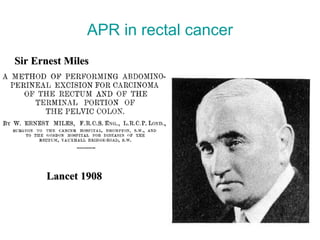
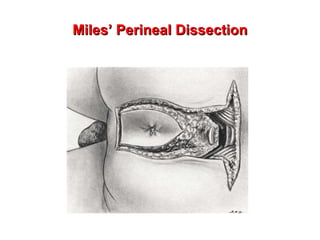
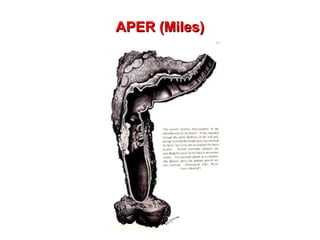
APR in rectal cancer Sir Ernest Miles (1869-1947) Lancet 1908
Miles’ Perineal Dissection
APER (Miles)
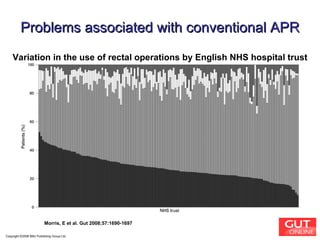
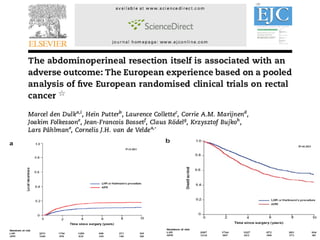
Copyright ©2008 BMJ Publishing Group Ltd. Morris, E et al. Gut 2008;57:1690-1697 Problems associated with conventional APR Variation in the use of rectal operations by English NHS hospital trust
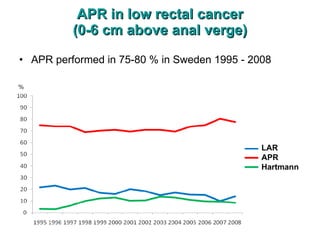
APR performed in 75-80 % in Sweden 1995 - 2008 APR in low rectal cancer (0-6 cm above anal verge) LAR APR Hartmann
 
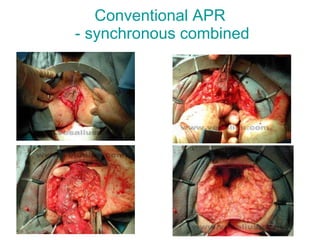
Conventional APR  - synchronous combined
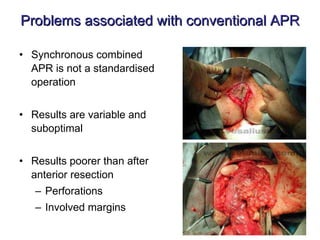
Problems associated with conventional APR Synchronous combined APR is not a standardised operation Results are variable and suboptimal Results poorer than after anterior resection Perforations Involved margins
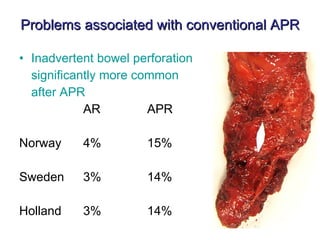
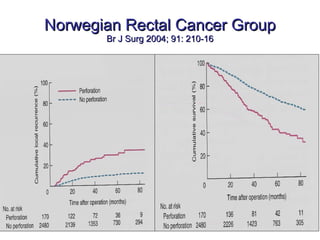
Problems associated with conventional APR Inadvertent bowel perforation significantly more common after APR AR APR Norway 4% 15% Sweden  3% 14% Holland 3% 14%
Norwegian Rectal Cancer Group Br J Surg 2004; 91: 210-16
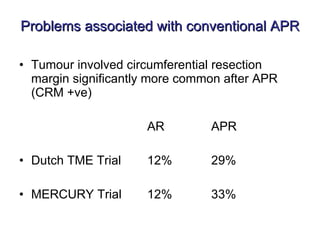
Problems associated with conventional APR Tumour involved circumferential resection margin significantly more common after APR (CRM +ve) AR APR Dutch TME Trial 12% 29% MERCURY Trial  12% 33%
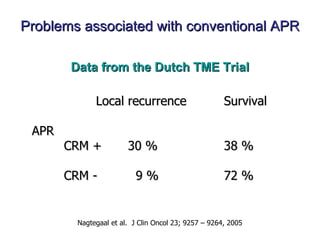
Problems associated with conventional APR Data from the Dutch TME Trial Local recurrence Survival APR CRM + 30 % 38 % CRM -   9 % 72 % Nagtegaal et al.  J Clin Oncol 23; 9257 – 9264, 2005
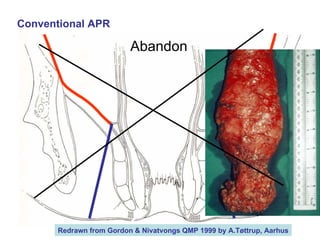
Abdominoperineal Resection Conventional APR Abandon Redrawn from Gordon & Nivatvongs QMP 1999 by A.Tøttrup, Aarhus
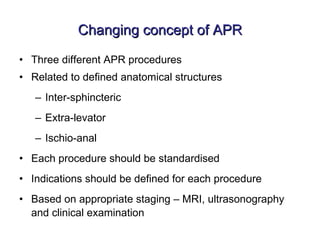
Changing concept of APR Three different APR procedures Related to defined anatomical structures Inter-sphincteric Extra-levator Ischio-anal Each procedure should be standardised Indications should be defined for each procedure Based on appropriate staging – MRI, ultrasonography and clinical examination
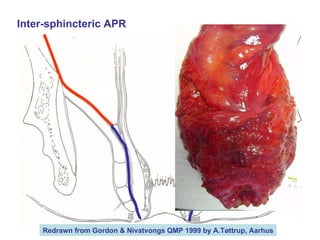
Inter-sphincteric APR Redrawn from Gordon & Nivatvongs QMP 1999 by A.Tøttrup, Aarhus
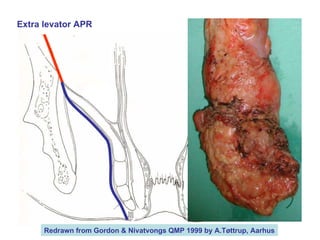
Extra levator APR Redrawn from Gordon & Nivatvongs QMP 1999 by A.Tøttrup, Aarhus
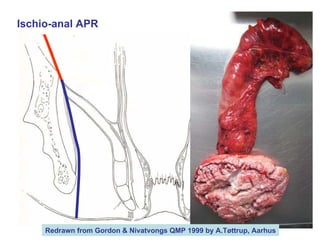
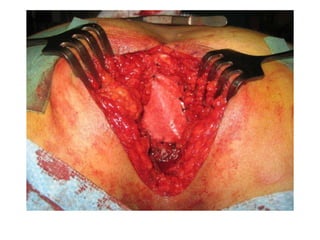
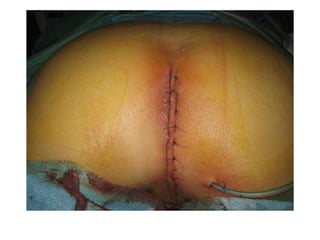
Ischio-anal APR Redrawn from Gordon & Nivatvongs QMP 1999 by A.Tøttrup, Aarhus
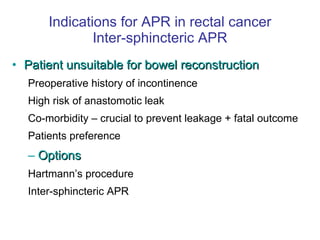
Indications for APR in rectal cancer Inter-sphincteric APR Patient unsuitable for bowel reconstruction Preoperative history of incontinence High risk of anastomotic leak Co-morbidity – crucial to prevent leakage + fatal outcome Patients preference Options Hartmann’s procedure Inter-sphincteric APR
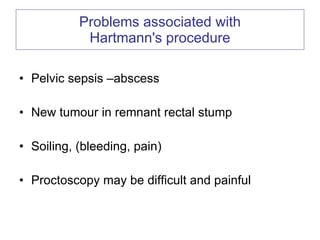
Problems associated with Hartmann's procedure Pelvic sepsis –abscess New tumour in remnant rectal stump Soiling, (bleeding, pain) Proctoscopy may be difficult and painful
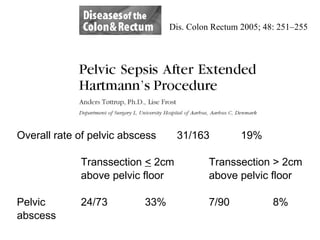
Overall rate of pelvic abscess 31/163 19%  Transsection  <  2cm Transsection > 2cm above pelvic floor above pelvic floor Pelvic 24/73 33% 7/90 8% abscess  Dis. Colon Rectum 2005; 48: 251–255
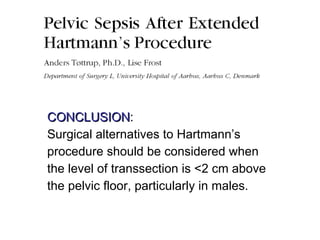
CONCLUSION : Surgical alternatives to Hartmann’s procedure should be considered when the level of transsection is <2 cm above the pelvic floor, particularly in males.
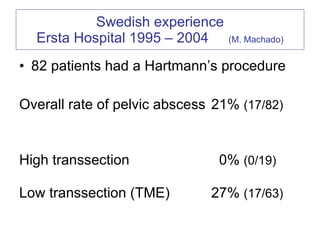
Swedish experience Ersta Hospital 1995 – 2004 (M. Machado) 82 patients had a Hartmann’s procedure Overall rate of pelvic abscess 21%  (17/82) High transsection   0%  (0/19) Low transsection (TME) 27%  (17/63)
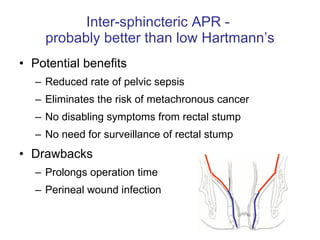
Inter-sphincteric APR -  probably better than low Hartmann’s Potential benefits Reduced rate of pelvic sepsis Eliminates the risk of metachronous cancer No disabling symptoms from rectal stump No need for surveillance of rectal stump Drawbacks Prolongs operation time  Perineal wound infection
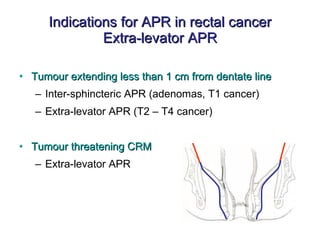
Indications for APR in rectal cancer Extra-levator APR Tumour extending less than 1 cm from dentate line Inter-sphincteric APR (adenomas, T1 cancer) Extra-levator APR (T2 – T4 cancer) Tumour threatening CRM Extra-levator APR
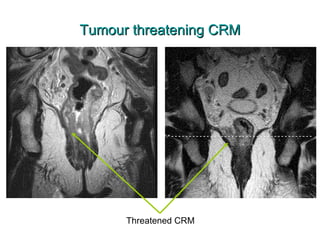
Tumour threatening CRM Threatened CRM


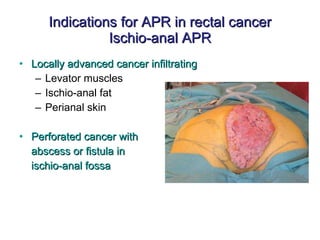
Indications for APR in rectal cancer Ischio-anal APR Locally advanced cancer infiltrating Levator muscles Ischio-anal fat Perianal skin Perforated cancer with abscess or fistula in ischio-anal fossa
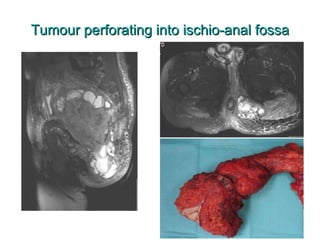
Tumour perforating into ischio-anal fossa
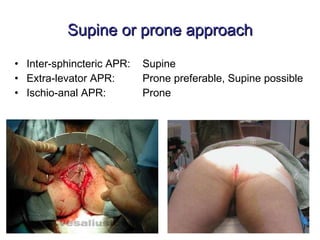
Supine or prone approach Inter-sphincteric APR: Supine Extra-levator APR: Prone preferable, Supine possible Ischio-anal APR: Prone
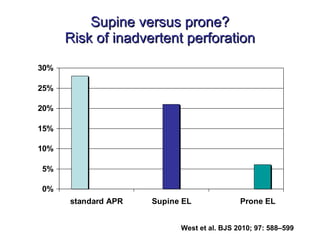
Supine versus prone? Risk of inadvertent perforation West et al. BJS 2010; 97: 588–599
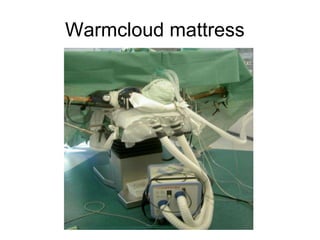
Phase 1 Supine position Warm cloud mattress Split legs Trendelenburgs position Support for the shoulders Catheterisation of the bladder (closed)
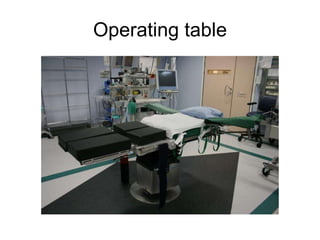
Operating table
Warmcloud mattress
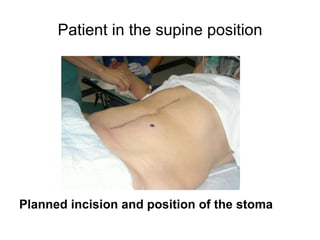
Patient in the supine position Planned incision and position of the stoma
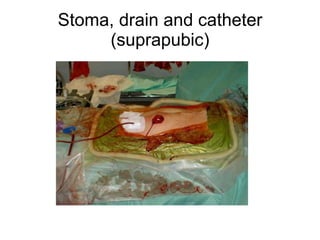
Stoma, drain and catheter (suprapubic)
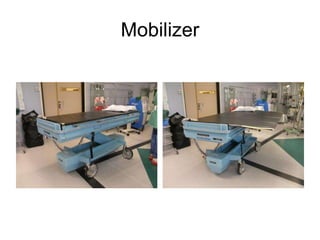
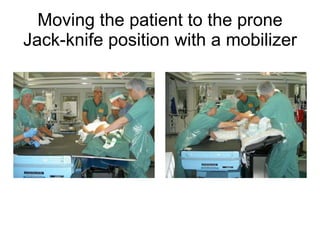
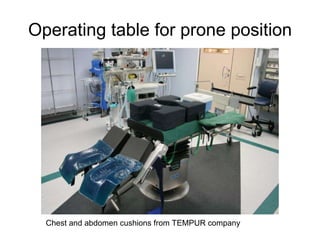
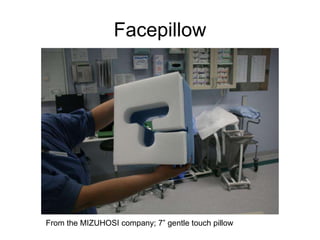
Phase 2 Turning session Mobilizer Jack-knife position Leg support devices Special pillow for the face
Mobilizer
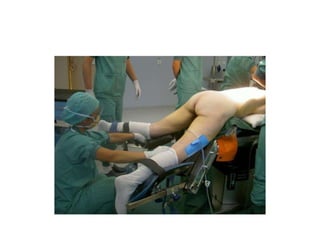
Moving the patient to the prone Jack-knife position with a mobilizer
Operating table for prone position Chest and abdomen cushions from TEMPUR company
Facepillow From the MIZUHOSI company; 7” gentle touch pillow
 
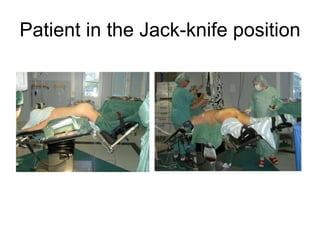
Patient in the Jack-knife position
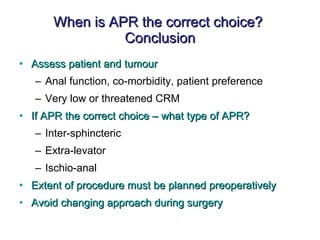
When is APR the correct choice?  Conclusion Assess patient and tumour Anal function, co-morbidity, patient preference Very low or threatened CRM If APR the correct choice – what type of APR? Inter-sphincteric Extra-levator Ischio-anal Extent of procedure must be planned preoperatively Avoid changing approach during surgery
Colorectal surgery at Karolinska Institutet Workshop and Symposium May 4-6, 2011 Stockholm, Sweden Welcome

MCC 2011 - Slide 9

  • 1.
    Positioning and techniqueof a wide perineal resection ESO-ESSO Master Class in Colorectal Cancer Surgery 12 – 17 February 2011 Cascais, Portugal Torbjörn Holm MD PhD Section of Coloproctology Department of Surgery Karolinska University Hospital Stockholm, Sweden
  • 2.
    Outline Problems associatedwith conventional APR Changing concept of APR Inter-sphincteric APR Extra-levator APR Ischio-anal APR Indications for APR in rectal cancer Patient unsuitable for bowel reconstruction Tumour extending less than 1 cm from dentate line Tumour threatening CRM Locally advanced cancer
  • 3.
    APR in rectalcancer Sir Ernest Miles (1869-1947) Lancet 1908
  • 4.
  • 5.
  • 6.
    Copyright ©2008 BMJPublishing Group Ltd. Morris, E et al. Gut 2008;57:1690-1697 Problems associated with conventional APR Variation in the use of rectal operations by English NHS hospital trust
  • 7.
    APR performed in75-80 % in Sweden 1995 - 2008 APR in low rectal cancer (0-6 cm above anal verge) LAR APR Hartmann
  • 8.
  • 9.
    Conventional APR - synchronous combined
  • 10.
    Problems associated withconventional APR Synchronous combined APR is not a standardised operation Results are variable and suboptimal Results poorer than after anterior resection Perforations Involved margins
  • 11.
    Problems associated withconventional APR Inadvertent bowel perforation significantly more common after APR AR APR Norway 4% 15% Sweden 3% 14% Holland 3% 14%
  • 12.
    Norwegian Rectal CancerGroup Br J Surg 2004; 91: 210-16
  • 13.
    Problems associated withconventional APR Tumour involved circumferential resection margin significantly more common after APR (CRM +ve) AR APR Dutch TME Trial 12% 29% MERCURY Trial 12% 33%
  • 14.
    Problems associated withconventional APR Data from the Dutch TME Trial Local recurrence Survival APR CRM + 30 % 38 % CRM - 9 % 72 % Nagtegaal et al. J Clin Oncol 23; 9257 – 9264, 2005
  • 15.
    Abdominoperineal Resection ConventionalAPR Abandon Redrawn from Gordon & Nivatvongs QMP 1999 by A.Tøttrup, Aarhus
  • 16.
    Changing concept ofAPR Three different APR procedures Related to defined anatomical structures Inter-sphincteric Extra-levator Ischio-anal Each procedure should be standardised Indications should be defined for each procedure Based on appropriate staging – MRI, ultrasonography and clinical examination
  • 17.
    Inter-sphincteric APR Redrawnfrom Gordon & Nivatvongs QMP 1999 by A.Tøttrup, Aarhus
  • 18.
    Extra levator APRRedrawn from Gordon & Nivatvongs QMP 1999 by A.Tøttrup, Aarhus
  • 19.
    Ischio-anal APR Redrawnfrom Gordon & Nivatvongs QMP 1999 by A.Tøttrup, Aarhus
  • 20.
    Indications for APRin rectal cancer Inter-sphincteric APR Patient unsuitable for bowel reconstruction Preoperative history of incontinence High risk of anastomotic leak Co-morbidity – crucial to prevent leakage + fatal outcome Patients preference Options Hartmann’s procedure Inter-sphincteric APR
  • 21.
    Problems associated withHartmann's procedure Pelvic sepsis –abscess New tumour in remnant rectal stump Soiling, (bleeding, pain) Proctoscopy may be difficult and painful
  • 22.
    Overall rate ofpelvic abscess 31/163 19% Transsection < 2cm Transsection > 2cm above pelvic floor above pelvic floor Pelvic 24/73 33% 7/90 8% abscess Dis. Colon Rectum 2005; 48: 251–255
  • 23.
    CONCLUSION : Surgicalalternatives to Hartmann’s procedure should be considered when the level of transsection is <2 cm above the pelvic floor, particularly in males.
  • 24.
    Swedish experience ErstaHospital 1995 – 2004 (M. Machado) 82 patients had a Hartmann’s procedure Overall rate of pelvic abscess 21% (17/82) High transsection 0% (0/19) Low transsection (TME) 27% (17/63)
  • 25.
    Inter-sphincteric APR - probably better than low Hartmann’s Potential benefits Reduced rate of pelvic sepsis Eliminates the risk of metachronous cancer No disabling symptoms from rectal stump No need for surveillance of rectal stump Drawbacks Prolongs operation time Perineal wound infection
  • 26.
    Indications for APRin rectal cancer Extra-levator APR Tumour extending less than 1 cm from dentate line Inter-sphincteric APR (adenomas, T1 cancer) Extra-levator APR (T2 – T4 cancer) Tumour threatening CRM Extra-levator APR
  • 27.
    Tumour threatening CRMThreatened CRM
  • 28.
  • 29.
  • 30.
  • 31.
  • 32.
  • 33.
  • 34.
    Indications for APRin rectal cancer Ischio-anal APR Locally advanced cancer infiltrating Levator muscles Ischio-anal fat Perianal skin Perforated cancer with abscess or fistula in ischio-anal fossa
  • 35.
    Tumour perforating intoischio-anal fossa
  • 36.
    Supine or proneapproach Inter-sphincteric APR: Supine Extra-levator APR: Prone preferable, Supine possible Ischio-anal APR: Prone
  • 37.
    Supine versus prone?Risk of inadvertent perforation West et al. BJS 2010; 97: 588–599
  • 38.
    Phase 1 Supineposition Warm cloud mattress Split legs Trendelenburgs position Support for the shoulders Catheterisation of the bladder (closed)
  • 39.
  • 40.
  • 41.
    Patient in thesupine position Planned incision and position of the stoma
  • 42.
    Stoma, drain andcatheter (suprapubic)
  • 43.
    Phase 2 Turningsession Mobilizer Jack-knife position Leg support devices Special pillow for the face
  • 44.
  • 45.
    Moving the patientto the prone Jack-knife position with a mobilizer
  • 46.
    Operating table forprone position Chest and abdomen cushions from TEMPUR company
  • 47.
    Facepillow From theMIZUHOSI company; 7” gentle touch pillow
  • 48.
  • 49.
    Patient in theJack-knife position
  • 50.
    When is APRthe correct choice? Conclusion Assess patient and tumour Anal function, co-morbidity, patient preference Very low or threatened CRM If APR the correct choice – what type of APR? Inter-sphincteric Extra-levator Ischio-anal Extent of procedure must be planned preoperatively Avoid changing approach during surgery
  • 51.
    Colorectal surgery atKarolinska Institutet Workshop and Symposium May 4-6, 2011 Stockholm, Sweden Welcome