Treatment of Diffuse Large B-Cell Lymphoma :   Trying to do a better job Hamdy A.Azim Professor of Clinical Oncology Cairo University
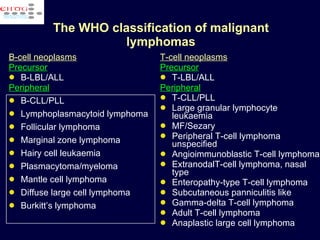
The WHO classification of malignant lymphomas B-cell neoplasms   Precursor B-LBL/ALL Peripheral B-CLL/PLL Lymphoplasmacytoid lymphoma Follicular lymphoma Marginal zone lymphoma Hairy cell leukaemia Plasmacytoma/myeloma Mantle cell lymphoma Diffuse large cell lymphoma Burkitt’s lymphoma T-cell neoplasms Precursor T-LBL/ALL Peripheral T-CLL/PLL Large granular lymphocyte leukaemia MF/Sezary Peripheral T-cell lymphoma unspecified Angioimmunoblastic T-cell lymphoma ExtranodalT-cell lymphoma, nasal type Enteropathy-type T-cell lymphoma Subcutaneous panniculitis like Gamma-delta T-cell lymphoma Adult T-cell lymphoma Anaplastic large cell lymphoma
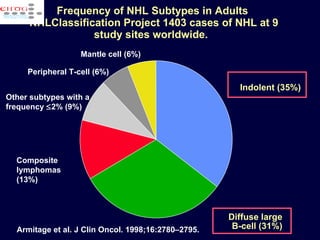
Frequency of NHL Subtypes in Adults  NHLClassification Project 1403 cases of NHL at 9 study sites worldwide.   Indolent (35%) Diffuse large B-cell (31%) Armitage et al. J Clin Oncol. 1998;16:2780 – 2795. Mantle cell (6%) Peripheral T-cell (6%) Other subtypes with a  frequency   2% (9%) Composite  lymphomas (13%)
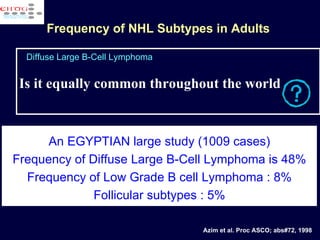
Frequency of NHL Subtypes in Adults  Is it equally common throughout the world An EGYPTIAN large study (1009 cases) Frequency of Diffuse Large B-Cell Lymphoma is 48% Frequency of Low Grade B cell Lymphoma : 8% Follicular subtypes : 5% Azim et al. Proc ASCO; abs#72, 1998 Diffuse Large B-Cell Lymphoma
Treatment of Diffuse Large B-Cell Lymphoma :  Trying to do a better job Molecular subtypes : what do we need to know ? Natural history and clinical aspects of DLBCL First line treatment: R-CHOP and  further improvements  Second line  treatment  :the essential role  of  high dose therapy and auto transplant
Genetic Subgroups in DLBCL Diffuse large B cell lymphoma represents a heterogeneous group of lymphoid disease
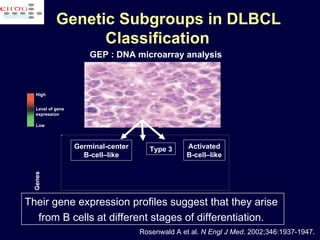
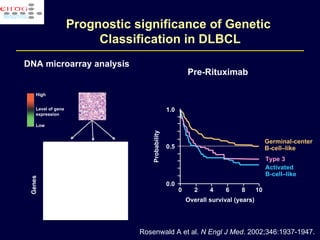
Rosenwald A et al.  N Engl J Med . 2002;346:1937-1947. Activated B-cell–like Type 3 Germinal-center B-cell–like Overall survival (years) Probability 0 2 4 6 8 10 1.0 0.5 0.0 High Level of gene expression Low Genetic Subgroups in DLBCL Classification Germinal-center B-cell–like Type 3 Activated B-cell–like Genes GEP : DNA microarray analysis Their gene expression profiles suggest that they arise  from B cells at different stages of differentiation.
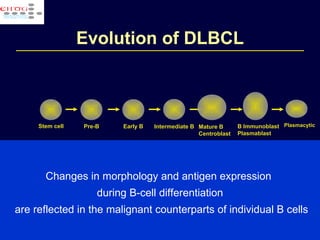
Evolution of DLBCL Pre-B Early B Mature B Centroblast B Immunoblast Plasmablast ±CD5  CD19 CD20 CD22 CD52 Plasmacytic Intermediate B ? ? ? Stem cell Burkitt’s, FL, DLCL, HCL ALL  CLL, PLL WM MM Changes in morphology and antigen expression  during B-cell differentiation are reflected in the malignant counterparts of individual B cells
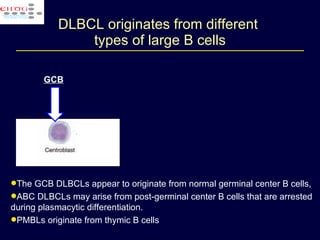
DLBCL originates from different  types of large B cells GCB ABC-like DLBCL PMBL The GCB DLBCLs appear to originate from normal germinal center B cells,  ABC DLBCLs may arise from post-germinal center B cells that are arrested during plasmacytic differentiation.  PMBLs originate from thymic B cells
If you do not have DNA microarray analysis How can you determine the Genetic Subgroups in DLBCL ?
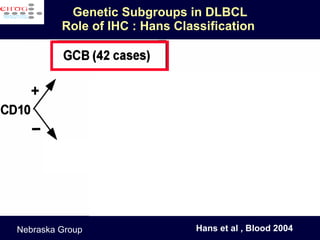
Genetic Subgroups in DLBCL Role of IHC : Hans   Classification   Hans et al , Blood 2004 Nebraska Group
DNA microarray analysis Rosenwald A et al.  N Engl J Med . 2002;346:1937-1947. Activated B-cell–like Type 3 Germinal-center B-cell–like Overall survival (years) Probability 0 2 4 6 8 10 1.0 0.5 0.0 High Level of gene expression Low Prognostic significance of Genetic  Classification in DLBCL Pre-Rituximab Germinal-center B-cell–like Type 3 Activated B-cell–like Genes
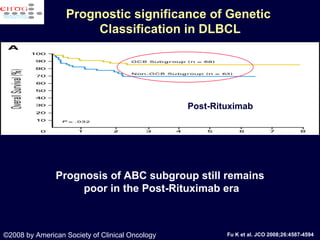
. Prognosis of ABC subgroup still remains poor in the Post-Rituximab era ©2008 by American Society of Clinical Oncology Fu K et al. JCO 2008;26:4587-4594 Prognostic significance of Genetic  Classification in DLBCL Post-Rituximab
GCB DLBCL patients respond favorably to conventional treatment, while ABC DLBCL represents the least curable subtype  Thus, to further improve treatment strategies, a better understanding of the biology of these malignancies is warranted. Genetic subgroups of DLBCL Rosenwald A et al.  N Engl J Med . 2002;346:1937-1947.
Genetic subgroups of DLBCL  Basic Features There are 3 genetic profile subgroups in DLBCL : Germinal-center B-cell  GCB subgroup ,  > 50% of cases bcl2 t(14;18)  Activated B-cell–like,  ABC subgroup  30% of cases  overexpression of genes that are upregulated in peripheral-blood B cells activated by mitogenic stimulation .  Nuclear factor-kappa B (NF-kB) activation Primary Large Mediastinal B Cell (Type 3 ) DLBCL A GEP signature that significantly overlaps with Hodgkin lymphoma cell lines suggesting that the 2 diseases share biological features .  NF-kB activation
Some important molecules of prognostic significance in DLBCL BCL-2  Nuclear factor-kappa B (NF-kB)
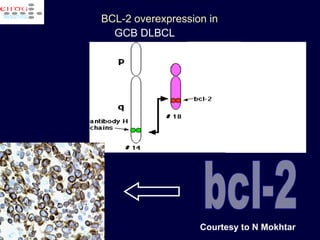
bcl-2 BCL-2 overexpression in  GCB DLBCL   Courtesy to N Mokhtar
BCL2 over-expression BCL2 expression  may also be up-regulated by alternate mechanisms, in the ABC subgroup of DLBCL, which lacks this translocation.  BCL2 over-expression provides a survival advantage for malignant B cells and is thought to play a critical role in  resistance to chemotherapy.  As a result of its biologic functions, BCL2 overexpression should be of prognostic importance in DLBCL. Many new drugs targeting BCL2 activity are in early clinical development  Javeed Iqbal, et alJ Clin Oncol 24:961-968. 2006
Transcription factor = induce gene activation positive mediators of T- and B-cell development, proliferation, survival 1 NF-kB triggers expression of multiple genes responsible for aggressive behaviour of the disease and treatment resistance Anti-apoptotic gene  bcl-2 Vascular endothelial growth factor (VEGF) Matrix metalloproteinases (ECM degradation) IL-6  Jost and Ruland.  Blood.  2007;109:2700-2707. Ghosh.  Cancer Cell.  2006;10:215-226. Nuclear factor - kB (NF-kB)
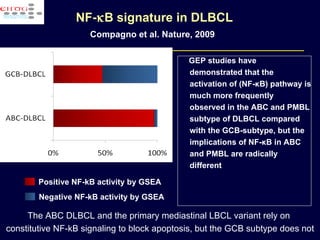
GEP studies have demonstrated that the activation of (NF-κB) pathway is much more frequently observed in the ABC and PMBL subtype of DLBCL compared with the GCB-subtype, but the implications of NF-κB in ABC and PMBL are radically different  NF-  B signature in DLBCL Compagno et al. Nature, 2009  Positive NF-kB activity by GSEA Negative NF-kB activity by GSEA The ABC DLBCL and the primary mediastinal LBCL variant rely on  constitutive NF-kB signaling to block apoptosis, but the GCB subtype does not
Activation of NFκB has been recognized as a key feature of ABC-DLBCL pathophysiology Notably, the antiapoptotic effects of NF-kB counteract the action of cytotoxic chemotherapy Down-regulation of NF-kB effectively induces cell death in ABC-like tumor cells. Nuclear factor-kappa B (NF-kB) Can a drug specifically targeting the NF-kB pathway e.g. Bortezomib , provide a therapeutic benefit in the clinic for patients with ABC-DLBCL ? Davis RE,et al: Constitutive nuclear factor kappaB activity is required for survival of activated B cell–like diffuse large B cell lymphoma cells. J Exp Med. 2001;194:1861-1874
 
Efficacy of bortezomib + chemo ( DA-EPOCH)  in relapsing DLBCL [ABC-DLBCL vs GCB-DLBCL] Dunleavy et al, Blood 2009; 113:6069 3.4 months 10.8 months P =   .003 improved response rates for ABC compared with GCB.   (83% ORR with 41,5% CR vs. 13%  %;  P  < .001 )
The potential role of Bortezomib  In ABC DLBCL  These results suggest bortezomib enhances the activity of chemotherapy in ABC but not GCB DLBCL, and provide a rational therapeutic approach based on genetically distinct DLBCL subtypes A randomized comparison of R-CHOP with and  without Bortezomib in untreated patients with ABC DLBCL is under development.
Natural History of DLBCL Aggressive natural history More often localized at presentation than indolent lymphomas;  more often extra-nodal   Lymphoma cells are frozen at stages normally characterized by  Rapid Replication , But the cells are non-circulating
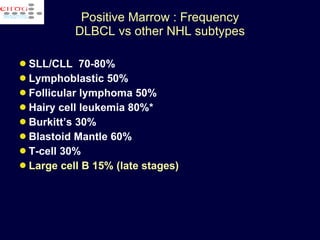
SLL/CLL  70-80% Lymphoblastic 50% Follicular lymphoma 50% Hairy cell leukemia 80%*  Burkitt’s 30% Blastoid Mantle 60% T-cell 30% Large cell B 15% (late stages) Positive Marrow : Frequency DLBCL vs other NHL subtypes
CNS Disease in Aggressive Lymphomas  Risk factors for CNS disease identified from phase III study (N = 444) in elderly, untreated patients with aggressive lymphomas [1]   Most significant risk factors Special sites : Testicle  epidura, sinus, orbit Clinical stage  IPI score  Independent risk factors for CNS disease recurrence  [2] Elevated LDH > 1 extranodal disease site 1. Bj örkholm M, et al. Ann Oncol. 2007;18:1085-1089. 2. Boehme V, et al. Ann Oncol.  2007;18:149-157. Risk Factor CNS Disease P  Value No Yes Testis involvement No  210 15 .002 Yes 4 4 Clinical stage II 145 4 .005 III 113 6 IV 156 19 IPI score 1 114 7 .035 2 145 15 3 86 4
Managing CNS Disease NCCN recommends CNS prophylaxis for patients with aggressive lymphoma who have: Paraspinal tumors Testicular involvement  Bone marrow involvement with large cell lymphoma  Paranasal sinus involvement  1.  Boehme V, et al. Ann Oncol. 2007;18:149-157. 2. NCCN clinical practice guidelines: non-Hodgkin’s lymphomas. V.1.2009. www.nccn.org. Intrathecal chemotherapy used for CNS involvement or for patients at high risk for CNS disease  Methotrexate, cytarabine commonly used  Complications include neurotoxicity, chemical meningitis, infection, and/or acute headache
Natural History of DLBCL Unlike the indolent lymphomas, which have a long natural history, DLBCL are: fatal if untreated, with survival measured in  months curable with intensive combination chemotherapy in 30  60% cases  associated with overall survival at 5 years of approximately 50  60%
Natural History of DLBCL The vast majority of relapses occur in the first 2 years after therapy.  The risk of late relapse is higher in patients with a divergent histology of both indolent and aggressive disease
Diagnosis of DLBCL Lymph node or tissue  biopsy  for evaluation of: Histology (cell type, tissue architecture, pattern of lymphoid infiltration) Phenotyping of tumor cells Genotyping of tumor cells
DLBCL  Clinical Data Age Lymphadenopathy, hepatosplenomegaly, organs Extra-nodal Sites Blood or bone marrow data Serum markers e.g. LDH, beta2 microglobulin Radiologic findings CSF
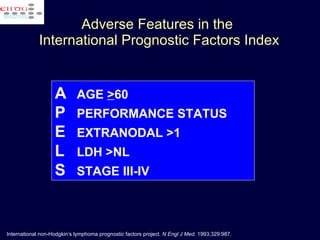
Adverse Features in the  International Prognostic Factors Index A AGE  > 60 P PERFORMANCE STATUS E EXTRANODAL >1 L LDH >NL S STAGE III-IV International non-Hodgkin’s lymphoma prognostic factors project.  N Engl J Med.  1993;329:987.
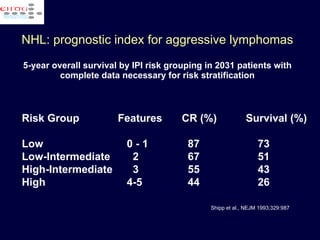
NHL: prognostic index for aggressive lymphomas   5-year overall survival by IPI risk grouping in 2031 patients with complete data necessary for risk stratification Risk Group Features CR (%) Survival (%) Low   0 - 1   87   73 Low-Intermediate   2   67   51 High-Intermediate   3   55   43 High   4-5   44   26 Shipp et al., NEJM 1993;329:987
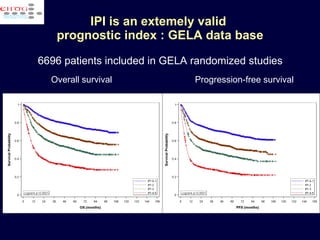
IPI is an extemely valid  prognostic index : GELA data base 6696 patients included in GELA randomized studies Overall survival Progression-free survival
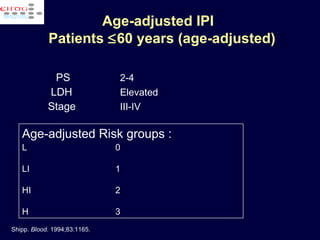
PS  2-4 LDH   Elevated   Stage   III-IV Age-adjusted IPI   Patients   60 years (age-adjusted) Age-adjusted Risk groups : L   0 LI   1 HI   2 H   3 Shipp.  Blood.  1994;83:1165.
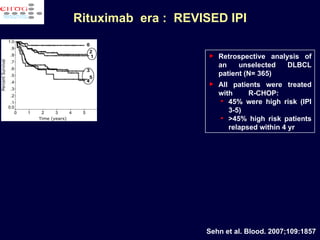
Sehn et al. Blood. 2007;109:1857 Retrospective analysis of an unselected DLBCL patient (N= 365) All patients were treated with  R-CHOP: 45% were high risk (IPI 3-5) >45% high risk patients relapsed within 4 yr IPI score retains its prognostic value  in the Rituximab era Rituximab  era :  REVISED IPI
Treatment of Diffuse Large B-Cell Lymphoma: Trying to do a better job First line : What if Rituximab is not available? How can we improve over  R-CHOP 21  Role of  high dose therapy and auto transplant
What if Rituximab is not available? Trying to improve over the classic standard CHOP Treatment of DLBCL
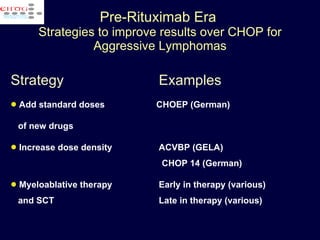
Pre-Rituximab Era  Strategies to improve results over CHOP for Aggressive Lymphomas Strategy Examples Add standard doses  CHOEP (German)  of new drugs  Increase dose density  ACVBP (GELA)     CHOP 14 (German)  Myeloablative therapy Early in therapy (various)   and SCT Late in therapy (various)
Try to give more  dose intensity /density of  doxorubicin  over the classic standard CHOP
 
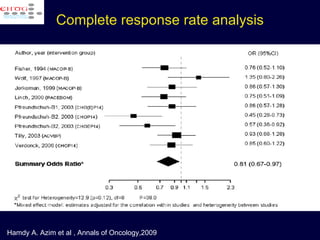
Complete response rate analysis Hamdy A. Azim et al , Annals of Oncology,2009
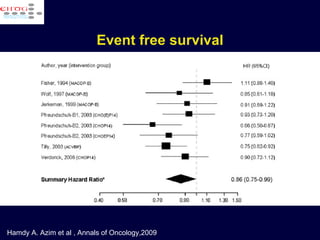
Event free survival Hamdy A. Azim et al , Annals of Oncology,2009
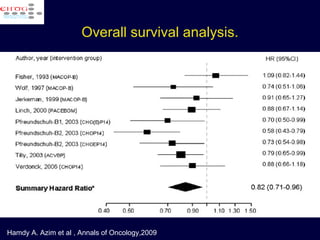
Overall survival analysis. Hamdy A. Azim et al , Annals of Oncology,2009
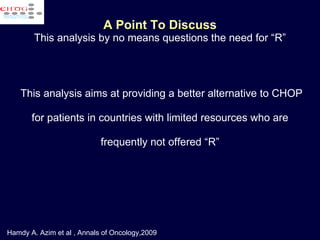
A Point To Discuss This analysis by no means questions the need for “R” This analysis aims at providing a better alternative to CHOP for patients in countries with limited resources who are frequently not offered “R” Hamdy A. Azim et al , Annals of Oncology,2009
Treatment of  DLBCL  Post-Rituximab Era
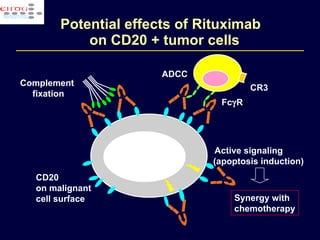
Potential effects of  Rituximab    on CD20 + tumor cells Synergy with  chemotherapy Complement  fixation CD20 on malignant cell surface Active signaling  (apoptosis induction) ADCC Fc  R CR3
DLCL  : Rituximab improves outcomes compared with CHOP-like chemotherapy alone R-Chemo Chemo MInT 2 Overall survival British Columbia 3 Overall survival p  = 0.0001 p  < 0.0001 Overall survival GELA 1 p  = 0.0004 Failure-free survival ECOG 4 p  = 0.003 1.  J Clin Oncol  2007; 25:Abstract 8009; 2.  Lancet Oncol  2006; 7:379–391;3.  J Clin Oncol  2005; 23:5027–5033; 4.  J Clin Oncol  2006; 24:3121–3127; 5.  Lancet Oncol  2008; 9:105–116.
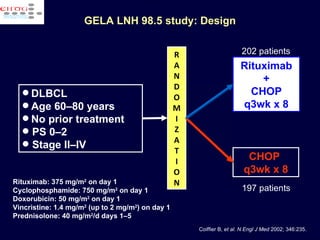
GELA LNH 98.5 study: Design DLBCL Age 60–80 years No prior treatment PS 0–2 Stage II–IV R A N D O M I Z A T I O N CHOP  q3wk x 8 Rituximab + CHOP q3wk x 8 Coiffier B,  et al. N Engl J Med  2002; 346:235. Rituximab: 375 mg/m 2  on day 1 Cyclophosphamide: 750 mg/m 2  on day 1 Doxorubicin: 50 mg/m 2  on day 1 Vincristine: 1.4 mg/m 2  (up to 2 mg/m 2 ) on day 1 Prednisolone: 40 mg/m 2 /d days 1–5 197 patients 202 patients
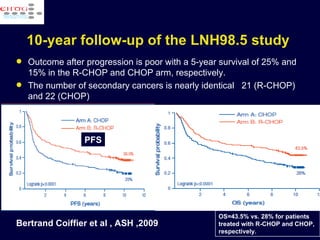
10-year follow-up of the LNH98.5 study  PFS Bertrand Coiffier et al , ASH ,2009 Outcome after progression is poor with a 5-year survival of 25% and 15% in the R-CHOP and CHOP arm, respectively. The number of secondary cancers is nearly identical  21 (R-CHOP) and 22 (CHOP) OS=43.5% vs. 28% for patients treated with R-CHOP and CHOP, respectively.
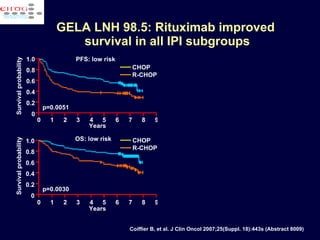
GELA LNH 98.5:  Rituximab improved  survival in all  IPI subgroups PFS: high risk OS: high risk PFS: low risk OS: low risk 1.0 0.8 0.6 0.4 0.2 0 Survival probability CHOP R-CHOP 1.0 0.8 0.6 0.4 0.2 0 Survival probability 1.0 0.8 0.6 0.4 0.2 0 Survival probability 1.0 0.8 0.6 0.4 0.2 0 Survival probability CHOP R-CHOP CHOP R-CHOP CHOP R-CHOP p=0.0051 p=0.0030 p=0.0022 p=0.0213 0 1 2 3 4 5 6 7 8 9 Years 0 1 2 3 4 5 6 7 8 9 Years 0 1 2 3 4 5 6 7 8 9 Years 0 1 2 3 4 5 6 7 8 9 Years Coiffier B, et al. J Clin Oncol 2007;25(Suppl. 18):443s (Abstract 8009)
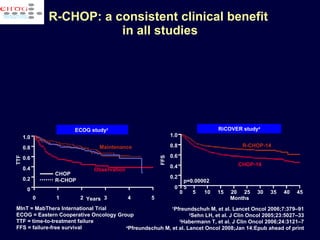
R-CHOP: a consistent clinical benefit  in all studies TTF Years 0 1 2 3 4 5 ECOG study 3   Maintenance Observation CHOP R-CHOP R-CHOP-14 p=0.000025  FFS 0 5 10 15 20 25 30 35 40 45 Months RiCOVER study 4 CHOP-14 British Columbia 2 Years Survival Post-rituximab Pre-rituximab p=0.0001 1 Pfreundschuh M, et al. Lancet Oncol 2006;7:379–91 2 Sehn LH, et al. J Clin Oncol 2005;23:5027 –33 3 Habermann T, et al. J Clin Oncol 2006;24:3121–7 4 Pfreundschuh M, et al. Lancet Oncol 2008;Jan 14:Epub ahead of print MInT = MabThera International Trial ECOG = Eastern Cooperative Oncology Group TTF = time-to-treatment failure FFS = failure-free survival 1.0 0.8 0.6 0.4 0.2 0 1.0 0.8 0.6 0.4 0.2 0 1.0 0.8 0.6 0.4 0.2 0 0 1 2 3 4
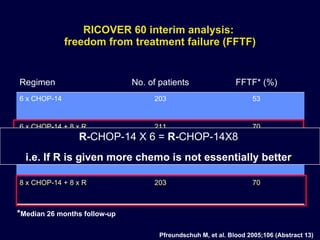
RICOVER 60 interim analysis:  freedom from treatment failure (FFTF) Pfreundschuh M, et al. Blood 2005;106 (Abstract 13)  * Median 26 months follow-up R- CHOP-14 X 6 =  R- CHOP-14X8  i.e. If R is given more chemo is not essentially better  70 203 8 x CHOP-14 + 8 x R 58 210 8 x CHOP-14 70 211 6 x CHOP-14 + 8 x R 53 203 6 x CHOP-14 FFTF* (%) No. of patients Regimen
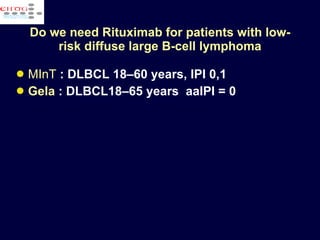
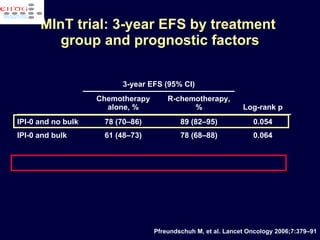
Do we need Rituximab for patients with low-risk diffuse large B-cell lymphoma MInT   : DLBCL 18–60 years, IPI 0,1 Gela  : DLBCL18–65 years  aaIPI = 0
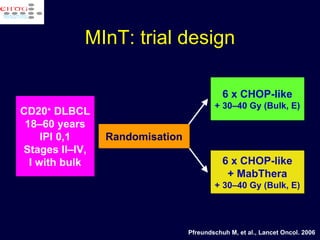
CD20 +  DLBCL 18–60 years IPI 0,1 Stages II–IV, I with bulk 6 x CHOP-like + 30–40 Gy (Bulk, E) 6 x CHOP-like + MabThera + 30–40 Gy (Bulk, E) Randomisation MInT: trial design Pfreundschuh M, et al.,  Lancet Oncol. 2006
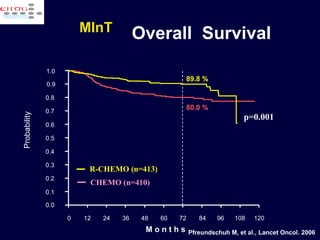
0.0 0.1 0.2 0.3 0.4 0.5 0.6 0.7 0.8 0.9 1.0 Probability 0 12 24 36 48 60 72 84 96 108 120 M o n t h s 89.8 % 80.0 % Overall  Survival  R-CHEMO (n=413) CHEMO (n=410) p=0.001 Pfreundschuh M, et al.,  Lancet Oncol. 2006 MInT
MInT trial: 3-year EFS by treatment  group and prognostic factors Pfreundschuh M, et al. Lancet Oncology 2006;7:379–91
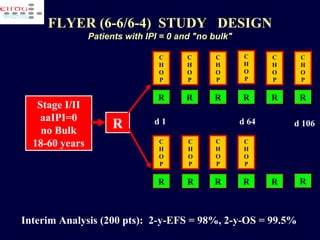
FLYER (6-6/6-4)  STUDY  DESIGN Patients with IPI = 0 and &quot;no bulk&quot; d 106 Interim Analysis (200 pts):  2-y-EFS = 98%, 2-y-OS = 99.5% C H O P C H O P C H O P C H O P C H O P C H O P R R R R R R C H O P R C H O P C H O P R R R R C H O P R R Stage I/II aaIPI=0 no Bulk 18-60 years d 1 d 64
ACVBP versus ACVBP plus rituximab for young patients with localized low-risk diffuse large B-cell lymphoma: A study by the Groupe d’Etude des Lymphomes de l’Adulte Ketterer N,  et al . ICML 2011; Abstract 030
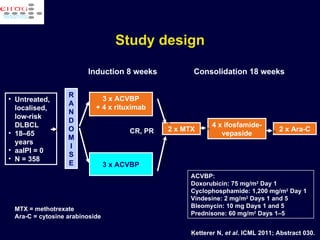
Study design Untreated, localised, low-risk DLBCL 18–65 years  aaIPI = 0 N = 358 R A N D O M I S E 3 x ACVBP + 4 x rituximab 3 x ACVBP 2 x MTX 4 x ifosfamide-vepaside 2 x Ara-C CR, PR Consolidation 18 weeks Induction 8 weeks ACVBP: Doxorubicin: 75 mg/m 2  Day 1 Cyclophosphamide: 1,200 mg/m 2  Day 1 Vindesine: 2 mg/m 2  Days 1 and 5 Bleomycin: 10 mg Days 1 and 5 Prednisone: 60 mg/m 2  Days 1–5 MTX = methotrexate Ara-C = cytosine arabinoside Ketterer N,  et al . ICML 2011; Abstract 030.
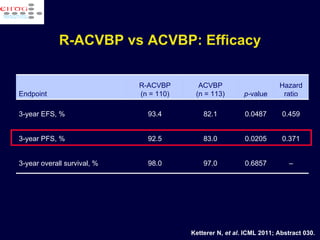
R-ACVBP vs ACVBP: Efficacy Ketterer N,  et al . ICML 2011; Abstract 030. Endpoint R-ACVBP (n = 110) ACVBP (n = 113) p- value Hazard ratio 3-year EFS, % 93.4 82.1 0.0487 0.459 3-year PFS, % 92.5 83.0 0.0205 0.371 3-year overall survival, % 98.0 97.0 0.6857 –
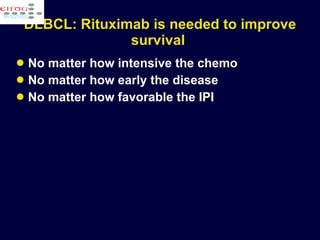
DLBCL: Rituximab is needed to improve survival  No matter how intensive the chemo No matter how early the disease No matter how favorable the IPI
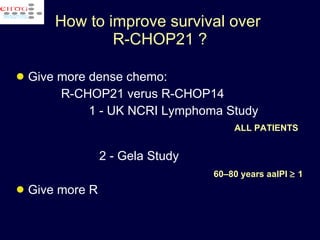
Give more dense chemo:  R-CHOP21 verus R-CHOP14  1 -  UK NCRI Lymphoma Study ALL PATIENTS 2 - Gela Study  60–80 years aaIPI    1   Give more R How to improve survival over  R-CHOP21 ?
A phase III trial comparing R-CHOP 14 and  R-CHOP 21 for the treatment of newly diagnosed diffuse large B cell lymphoma   Results from a trial by the UK NCRI Lymphoma Clinical Study Group (CRUKE/03/019)   D. Cunningham , P. Smith, P. Mouncey,  W. Qian, C. Pocock, K. M. Ardeshna,  J. Radford, J. Davies, A. McMillan, D. Linch   on behalf of the NCRI trial collaborators ASCO 2011, ABS# 8000
Trial design: R-CHOP14 vs. 21 Newly diagnosed CD20+ve DLBCL R-CHOP21 CHOP21    8 cycles Rituximab    8 cycles   R-CHOP14 CHOP14    6 cycles Rituximab    8 cycles Lenograstim Day 4-12 n=540 n=540 Stratified by IPI (0-1, 2, 3, 4-5) Age ≤60 vs. >60 Treatment centre 1080 patients; 119 sites Recruitment March 2005 - Nov 2008 R
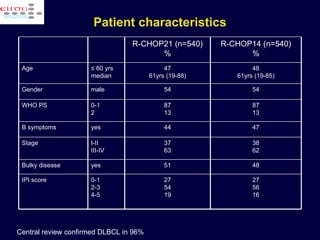
Patient characteristics Central review confirmed DLBCL in 96% R-CHOP21 (n=540) % R-CHOP14 (n=540) % Age  ≤  60 yrs median 47 61yrs (19-88) 48 61yrs (19-85) Gender  male 54 54 WHO PS 0-1 2 87 13 87 13 B symptoms yes 44 47 Stage  I-II III-IV 37 63 38 62 Bulky disease yes 51 48 IPI score 0-1 2-3 4-5 27 54 19 27 56 16
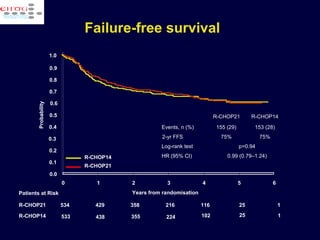
Failure-free survival R-CHOP14 533 438 355 224 102 25 1 Patients at Risk R-CHOP21 534 429 358 216 116 25 1 Years from randomisation R-CHOP21  R-CHOP14  Probability 0.0 0.1 0.2 0.3 0.4 0.5 0.6 0.7 0.8 0.9 1.0 0 1 2 3 4 5 6 0.99 (0.79–1.24) HR (95% CI) p=0.94 Log-rank test 75% 75% 2-yr FFS 153 (28) 155 (29) Events, n (%)  R-CHOP14 R-CHOP21
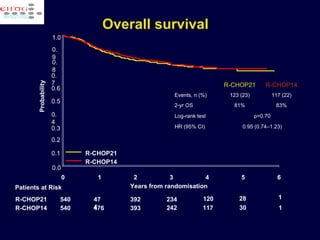
Overall survival Patients at Risk R-CHOP21 R-CHOP14 540 474 392 234 120 28 1 540 476 393 242 117 30 1 R-CHOP21  R-CHOP14  Probability 0.0 0.1 0.2 0.3 0.4 0.5 0.6 0.7 0.8 0.9 1.0 Years from randomisation 0 1 2 3 4 5 6 0.95 (0.74–1.23) HR (95% CI) p=0.70 Log-rank test 83% 81% 2-yr OS 117 (22) 123 (23) Events, n (%)  R-CHOP14 R-CHOP21
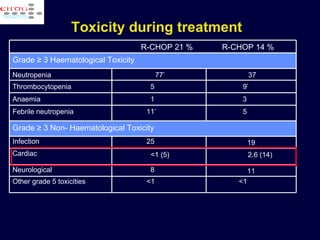
Toxicity during treatment *p < 0.01  (considered significant due to multiple testing) <1 <1 Other grade 5 toxicities 11 8 Neurological 2.6 (14) <1 (5) Cardiac   19 25 Infection  Grade ≥ 3 Non- Haematological Toxicity 5 11 * Febrile neutropenia    3 1 Anaemia 9 * 5 Thrombocytopenia 37 77 * Neutropenia Grade ≥ 3  Haematological Toxicity R-CHOP 21 %  R-CHOP 14 %
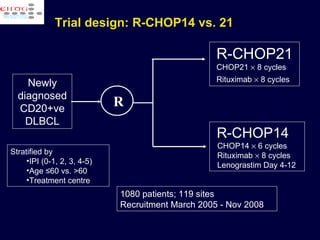
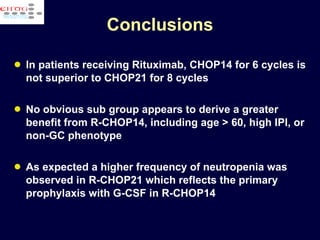
In patients receiving Rituximab, CHOP14 for 6 cycles is not superior to CHOP21 for 8 cycles No obvious sub group appears to derive a greater benefit from R-CHOP14, including age > 60, high IPI, or non-GC phenotype As expected a higher frequency of neutropenia was observed in R-CHOP21 which reflects the primary prophylaxis with G-CSF in R-CHOP14 Conclusions
R-CHOP-14 compared to R-CHOP-21 in elderly patients with diffuse large B-cell lymphoma (DLBCL): Results of the second interim analysis of the LNH03-6B GELA study Delarue R,  et al . ICML 2011; Abstract 106
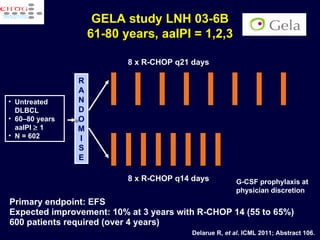
Untreated DLBCL 60–80 years aaIPI    1 N = 602 R A N D O M I S E 8 x R-CHOP q21 days 8 x R-CHOP q14 days G-CSF prophylaxis at physician discretion Delarue R,  et al . ICML 2011; Abstract 106. Primary endpoint: EFS  Expected improvement: 10% at 3 years with R-CHOP 14 (55 to 65%) 600 patients required (over 4 years) GELA study LNH 03-6B 61-80 years, aaIPI = 1,2,3
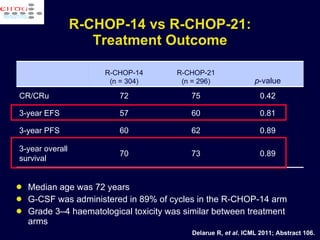
Median age was 72 years   G-CSF was administered in 89% of cycles in the R-CHOP-14 arm Grade 3–4 haematological toxicity was similar between treatment arms R-CHOP-14 vs R-CHOP-21: Treatment Outcome Delarue R,  et al . ICML 2011; Abstract 106. R-CHOP-14 (n = 304) R-CHOP-21 (n = 296) p -value CR/CRu 72 75 0.42 3-year EFS 57 60 0.81 3-year PFS 60 62 0.89 3-year overall survival 70 73 0.89
R-CHOP14 versus  R-CHOP21 Lessons from the UK and French Studies These 2 studies do not support the assumption that  R-CHOP-14 is more effective than R-CHOP-21 in patients with DLBCL Out side clinical trials :6-8 cycles of R-CHOP21 remains standard first-line treatment for the majority of DLBCL  Still the question is : How can we improve over R-CHOP-21 ?
Still the question is : How can we improve over R-CHOP-21 ?  Try it the French way !!!
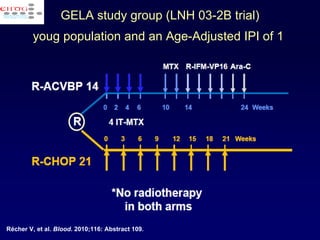
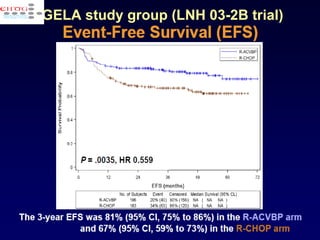
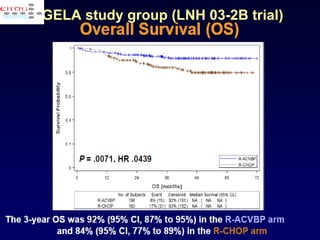
Randomized Study of ACVBP Plus Rituximab Versus R-CHOP Plus in Non-Previously-Treated Patients Aged from 18 to 59 Years with CD20+ Diffuse Large B-Cell Lymphoma and an Age-Adjusted IPI of 1  Final analysis of a phase III clinical trial from the GELA study group (LNH 03-2B trial) GELA study group (LNH 03-2B trial) youg population and an Age-Adjusted IPI of 1  Récher V, et al.  Blood . 2010;116: Abstract 109.
Récher V, et al.  Blood . 2010;116: Abstract 109. GELA study group (LNH 03-2B trial) youg population and an Age-Adjusted IPI of 1  GELA:
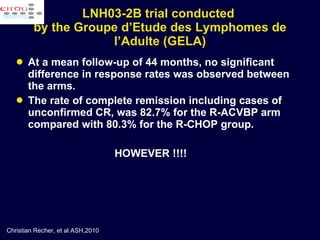
LNH03-2B trial conducted  by the Groupe d’Etude des Lymphomes de l’Adulte (GELA) At a mean follow-up of 44 months, no significant difference in response rates was observed between the arms.  The rate of complete remission including cases of unconfirmed CR, was 82.7% for the R-ACVBP arm compared with 80.3% for the R-CHOP group. HOWEVER !!!! Christian Recher, et al ASH,2010
GELA study group (LNH 03-2B trial)
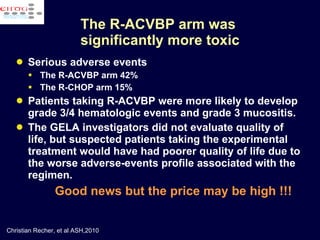
The R-ACVBP arm was  significantly more toxic Serious adverse events  The R-ACVBP arm 42%  The R-CHOP arm 15%  Patients taking R-ACVBP were more likely to develop grade 3/4 hematologic events and grade 3 mucositis. The GELA investigators did not evaluate quality of life, but suspected patients taking the experimental treatment would have had poorer quality of life due to the worse adverse-events profile associated with the regimen. Good news but the price may be high !!! Christian Recher, et al ASH,2010
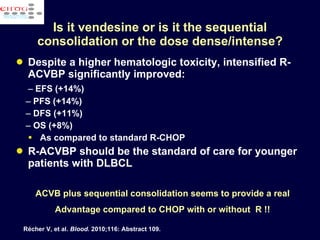
Is it vendesine or is it the sequential consolidation or the dose dense/intense? Despite a higher hematologic toxicity, intensified R-ACVBP significantly improved: –  EFS (+14%) –  PFS (+14%) –  DFS (+11%) –  OS (+8%)  As compared to standard R-CHOP R-ACVBP should be the standard of care for younger patients with DLBCL Récher V, et al.  Blood . 2010;116: Abstract 109. ACVB plus sequential consolidation seems to provide a real Advantage compared to CHOP with or without  R !!
A more real challenge!! Young patients With unfavorable characteristics  with 2-3 factors of aaIPI Go ahead and transplant early
Randomized phase III US / Canadian Intergroup trial (SWOG S9704) comparing CHOP±R x 8 vs CHOP±R x 6 followed by high dose therapy and auto transplant for patients with diffuse aggressive non-Hodgkin’s lymphoma (NHL) in high-intermediate (H-Int) or high IPI risk groups . P.J. Stiff 1 , J.M. Unger 2  J.R. Cook 3 , L.S. Constine 4 , S. Couban 5 , T.C. Shea 6 , J.N. Winter 7 , T.P. Miller 8 , R.R. Tubbs 3 , D.C. Marcellus 9 , J. Friedberg 4 , K. Barton 1 , G. Mills 10 , M. LeBlanc 2 , L. Rimsza 8 , S.J. Forman 11 , R.I. Fisher 4   1 Loyola University Medical Center, Maywood, IL;  2 SWOG Statistical Center, Seattle, WA;  3 Cleveland Clinic Foundation, Cleveland, OH;  4 University of Rochester, Rochester, NY;  5 Queen Elizabeth II Health Sciences Centre, Halifax, Nova Scotia, CAN;  6 University of North Carolina at Chapel Hill, Chapel Hill, NC;  7 Northwestern University, Chicago, IL;  8 University of Arizona, Tucson, AZ;  9 Margaret and Charles Juravinski Cancer Centre, Hamilton, Ontario, CAN;  10 Louisiana State University Medical Center, Shreveport, LA;  11 City of Hope Medical Center, Duarte, CA
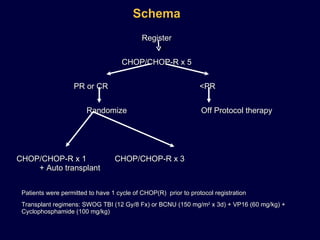
Schema Register CHOP/CHOP-R x 5   PR or CR <PR   Randomize Off Protocol therapy CHOP/CHOP-R x 1   CHOP/CHOP-R x 3 + Auto transplant Patients were permitted to have 1 cycle of CHOP(R)  prior to protocol registration Transplant regimens: SWOG TBI (12 Gy/8 Fx) or BCNU (150 mg/m 2  x 3d) + VP16 (60 mg/kg) + Cyclophosphamide (100 mg/kg)
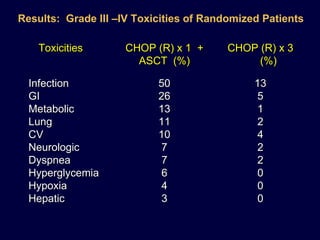
Results:  Grade III –IV Toxicities of Randomized Patients   Toxicities CHOP (R) x 1  + ASCT  (%) CHOP (R) x 3 (%) Infection  GI Metabolic Lung  CV Neurologic Dyspnea Hyperglycemia Hypoxia Hepatic  50 26 13 11 10 7 7 6 4 3 13 5 1 2 4 2 2 0 0 0
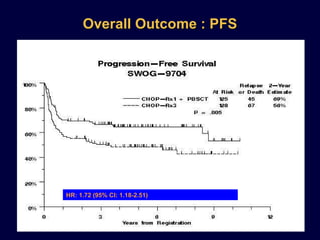
Overall Outcome : PFS HR: 1.72 (95% CI: 1.18-2.51)
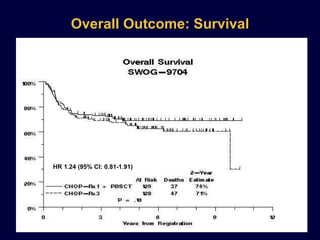
Overall Outcome: Survival HR 1.24 (95% CI: 0.81-1.91)
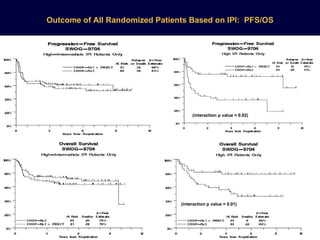
Outcome of All Randomized Patients Based on IPI:  PFS/OS (interaction p value = 0.02)   (interaction p value = 0.01)
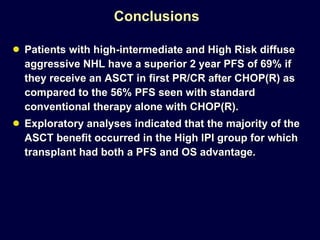
Conclusions Patients with high-intermediate and High Risk diffuse aggressive NHL have a superior 2 year PFS of 69% if they receive an ASCT in first PR/CR after CHOP(R) as compared to the 56% PFS seen with standard conventional therapy alone with CHOP(R).  Exploratory analyses indicated that the majority of the ASCT benefit occurred in the High IPI group for which transplant had both a PFS and OS advantage.
A randomised multicentre Phase III study for first-line treatment of young patients with high-risk (AAIPI 2-3) diffuse large B-cell lymphoma (DLBCL): Rituximab (R) plus dose-dense chemotherapy CHOP14/MegaCHOP14 with or without intensified high-dose chemotherapy (HDC) and autologous stem cell transplantation (ASCT). Results of DLCL04 trial of Italian Lymphoma Foundation (FIL) Vitolo U,  et al . ICML 2011; Abstract 072
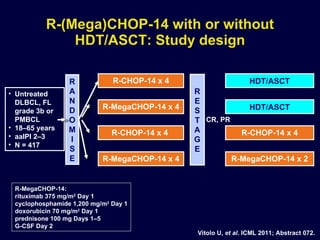
R-(Mega)CHOP-14 with or without HDT/ASCT: Study design Untreated DLBCL, FL grade 3b or PMBCL 18–65 years aaIPI 2–3 N = 417 R A N D O M I S E R-MegaCHOP-14:  rituximab 375 mg/m 2  Day 1 cyclophosphamide 1,200 mg/m 2  Day 1 doxorubicin 70 mg/m 2  Day 1 prednisone 100 mg Days 1–5 G-CSF Day 2 R E S T A G E CR, PR Vitolo U,  et al . ICML 2011; Abstract 072. R-CHOP-14 x 4 R-MegaCHOP-14 x 4 R-MegaCHOP-14 x 4 R-CHOP-14 x 4  HDT/ASCT R-MegaCHOP-14 x 2 HDT/ASCT R-CHOP-14 x 4
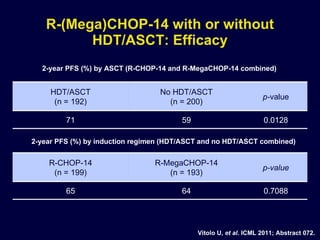
R-(Mega)CHOP-14 with or without HDT/ASCT: Efficacy 2-year PFS (%) by ASCT (R-CHOP-14 and R-MegaCHOP-14 combined) 2-year PFS (%) by induction regimen (HDT/ASCT and no HDT/ASCT combined) Vitolo U,  et al . ICML 2011; Abstract 072. HDT/ASCT (n = 192) No HDT/ASCT (n = 200) p- value 71 59 0.0128 R-CHOP-14 (n = 199) R-MegaCHOP-14 (n = 193) p-value 65 64 0.7088
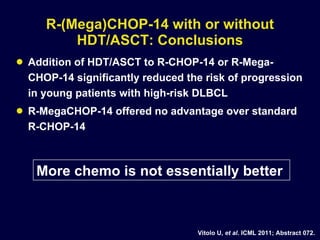
R-(Mega)CHOP-14 with or without HDT/ASCT: Conclusions Addition of HDT/ASCT to R-CHOP-14 or R-Mega-CHOP-14 significantly reduced the risk of progression in young patients with high-risk DLBCL R-MegaCHOP-14 offered no advantage over standard R-CHOP-14 Vitolo U,  et al . ICML 2011; Abstract 072. More chemo is not essentially better
Going more aggressive beyond  R-CHOP Do we need more  Rituximab ?
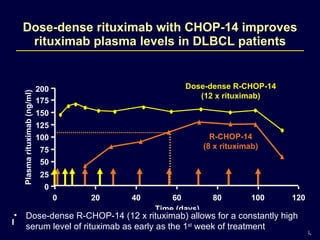
Dose-dense rituximab with CHOP-14 improves rituximab plasma levels in DLBCL patients Pfreundschuh M,  et al. J Clin Oncol  2008; 26:Abstract 8508. 200 150 125 75 50 25 0 100 175 0 20 40 60 80 100 120 R-CHOP-14 (8 x rituximab) Plasma rituximab (ng/ml) Time (days) Rituximab infusion Dose-dense R-CHOP-14 (12 x rituximab) allows for a constantly high serum level of rituximab as early as the 1 st  week of treatment Dose-dense R-CHOP-14 (12 x rituximab)
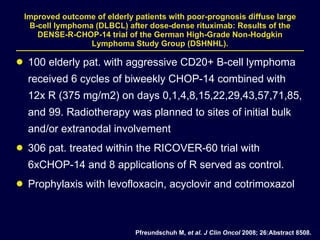
Improved outcome of elderly patients with poor-prognosis diffuse large B-cell lymphoma (DLBCL) after dose-dense rituximab: Results of the DENSE-R-CHOP-14 trial of the German High-Grade Non-Hodgkin Lymphoma Study Group (DSHNHL). 100 elderly pat. with aggressive CD20+ B-cell lymphoma received 6 cycles of biweekly CHOP-14 combined with 12x R (375 mg/m2) on days 0,1,4,8,15,22,29,43,57,71,85, and 99. Radiotherapy was planned to sites of initial bulk and/or extranodal involvement 306 pat. treated within the RICOVER-60 trial with 6xCHOP-14 and 8 applications of R served as control.  Prophylaxis with levofloxacin, acyclovir and cotrimoxazol  Pfreundschuh M,  et al. J Clin Oncol  2008; 26:Abstract 8508.
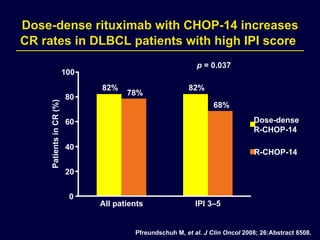
Dose-dense rituximab with CHOP-14 increases CR rates in DLBCL patients with high IPI score   p  = 0.037 Dose-dense R-CHOP-14 R-CHOP-14 82% 82% 78% 68% 0 20 40 60 80 100 All patients IPI 3–5 Patients in CR (%) Pfreundschuh M,  et al. J Clin Oncol  2008; 26:Abstract 8508.
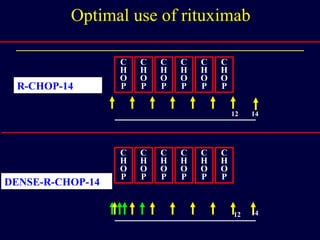
Optimal use of rituximab C H O P C H O P C H O P C H O P C H O P C H O P DENSE-R-CHOP-14 12 14 C H O P C H O P C H O P C H O P C H O P C H O P 12 14 R-CHOP-14
Treatment of relapsing DLBCL Pre -Rituximab era:  The PARMA Trial  Post -Rituximab  era :The  CORAL Trial
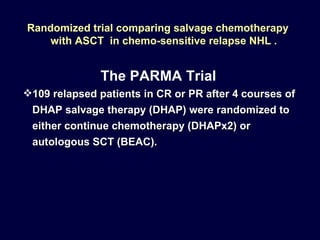
The PARMA Trial 109 relapsed patients in CR or PR after 4 courses of DHAP salvage therapy (DHAP) were randomized to either continue chemotherapy (DHAPx2) or autologous SCT (BEAC). Randomized trial comparing salvage chemotherapy  with ASCT  in chemo-sensitive relapse NHL .
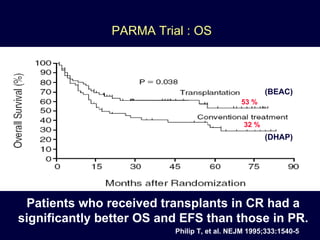
PARMA Trial : OS 53 % 32 % Philip T, et al. NEJM 1995;333:1540-5 (BEAC) (DHAP) Patients who received transplants in CR had a significantly better OS and EFS than those in PR.
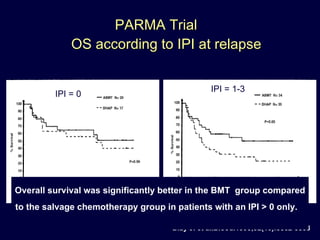
PARMA Trial    OS according to IPI at relapse   IPI = 1-3 IPI = 0 Blay J. et al.Blood.1998;92(10):3562-3568 Overall survival was significantly better in the BMT  group compared to the salvage chemotherapy group in patients with an IPI > 0 only.
Relapse After CHOP : Do we have a better regimen ?   Is it  R-ICE or R-DHAP?
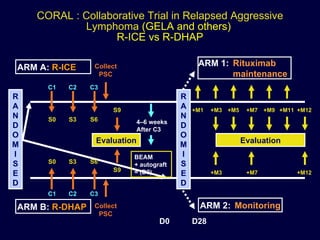
CORAL : Collaborative Trial in Relapsed Aggressive Lymphoma  (GELA and others)  R-ICE vs R-DHAP R A N D O M I S E D ARM 1:  Rituximab maintenance ARM 2:  Monitoring C1 C2 C3 C1 C2 C3 S0 S3 S6 S0 S3 S6 Evaluation ARM B:  R-DHAP Collect PSC ARM A:  R-ICE Collect PSC S9 S9 4–6 weeks After C3 BEAM + autograft = (D0) Evaluation +M1 +M3 +M5 +M9 +M7 +M11 +M12 +M3 +M7 +M12 R A N D O M I S E D D0  D28
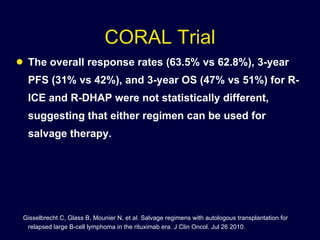
CORAL Trial The overall response rates (63.5% vs 62.8%), 3-year PFS (31% vs 42%), and 3-year OS (47% vs 51%) for R-ICE and R-DHAP were not statistically different, suggesting that either regimen can be used for salvage therapy.  Gisselbrecht C, Glass B, Mounier N, et al. Salvage regimens with autologous transplantation for relapsed large B-cell lymphoma in the rituximab era. J Clin Oncol. Jul 26 2010.
CORAL Trial : Factors affecting 3-year OS  1) age-adjusted IPI at relapse : 2 to 3 versus 0 (32% vs 62%),  2) relapse <12 months after completion of first-line therapy (39% vs 64%),  3) prior rituximab exposure in the front-line setting (40% vs 66%).  Gisselbrecht C, Glass B, Mounier N, et al. Salvage regimens with autologous transplantation for relapsed large B-cell lymphoma in the rituximab era. J Clin Oncol. Jul 26 2010.
CORAL study: Important alarm  Given that nearly all patients with DLBCL currently receive front-line rituximab, these data call into question our current strategies for salvage therapy, particularly for patients who relapse within one year of initial therapy.  Gisselbrecht C, Glass B, Mounier N, et al. Salvage regimens with autologous transplantation for relapsed large B-cell lymphoma in the rituximab era. J Clin Oncol. Jul 26 2010.
Do we need Maintenance with rituximab after autologous stem cell transplantation ?
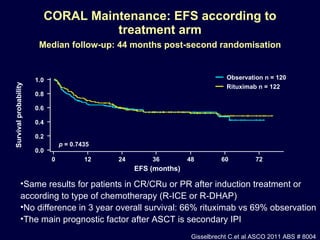
CORAL Maintenance: EFS according to treatment arm   Median follow-up: 44 months post-second randomisation   Survival probability EFS (months) p  = 0.7435 Observation n = 120 Rituximab n = 122 Gisselbrecht C.et al ASCO 2011 ABS # 8004 Same results for patients in CR/CRu or PR after induction treatment or according to type of chemotherapy (R-ICE or R-DHAP)  No difference in 3 year overall survival: 66% rituximab vs 69% observation  The main prognostic factor after ASCT is secondary IPI   0.0 0.2 0.4 0.6 0.8 1.0 0 12 24 36 48 60 72
Role of PET
Value of interim PET  in DLBCL
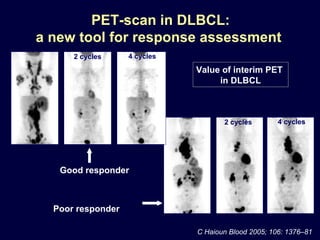
.. .. .. PET-scan in DLBCL: a new tool for response assessment  Value of interim PET  in DLBCL Poor responder 2 cycles 2 cycles 4 cycles 4 cycles C  Haioun Blood 2005; 106: 1376–81  Good responder
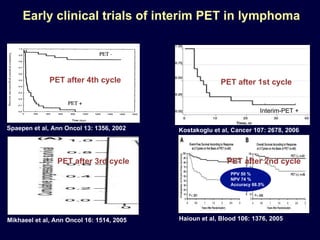
Kostakoglu et al, Cancer 107: 2678, 2006 Haioun et al, Blood 106: 1376, 2005 Mikhaeel et al, Ann Oncol 16: 1514, 2005 Spaepen et al, Ann Oncol 13: 1356, 2002 Early clinical trials of interim PET in lymphoma PET after 4th cycle PET after 3rd cycle PET after 2nd cycle PPV 50 % NPV 74 % Accuracy 68.5% PET after 1st cycle Interim-PET +
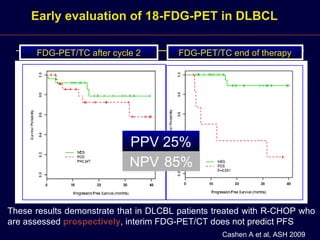
Cashen A et al, ASH 2009 FDG-PET/TC after cycle 2 FDG-PET/TC end of therapy These results demonstrate that in DLCBL patients treated with R-CHOP who are assessed  prospectively , interim FDG-PET/CT does not predict PFS   Early evaluation of 18-FDG-PET in DLBCL NPV 85% PPV 25%
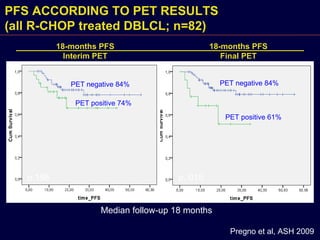
18-months PFS Interim PET 18-months PFS Final PET Median follow-up 18 months PFS ACCORDING TO PET RESULTS (all R-CHOP treated DBLCL; n=82) Pregno et al, ASH 2009 PET positive 61% PET negative 84% PET positive 74% PET negative 84% p.198 p. 015
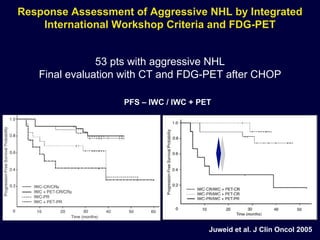
Juweid et al. J Clin Oncol 2005 53 pts with aggressive NHL Final evaluation with CT and FDG-PET after CHOP PFS – IWC / IWC + PET Response Assessment of Aggressive NHL by Integrated International Workshop Criteria and FDG-PET
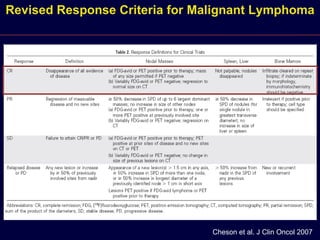
Revised Response Criteria for Malignant Lymphoma Cheson et al. J Clin Oncol 2007
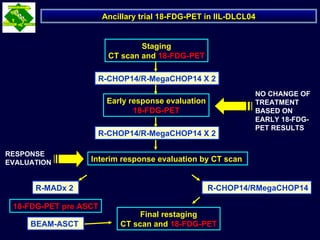
Ancillary trial 18-FDG-PET in IIL-DLCL04 Staging CT scan and   18-FDG-PET R-CHOP14/R-MegaCHOP14 X 2 R-CHOP14/R-MegaCHOP14 X 2 R-MADx 2  Final restaging CT scan and   18-FDG-PET Early response evaluation 18-FDG-PET Interim response evaluation by CT scan  R-CHOP14/RMegaCHOP14 18-FDG-PET pre ASCT BEAM-ASCT  RESPONSE EVALUATION NO CHANGE OF TREATMENT BASED ON EARLY 18-FDG-PET RESULTS
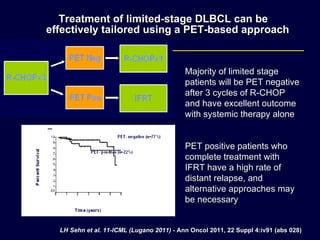
Treatment of limited-stage DLBCL can be   effectively tailored using a PET-based approach  LH Sehn  et  al. 11-ICML (Lugano 2011) -  Ann Oncol 2011, 22 Suppl 4:iv91 (abs 028) N=134 Majority of limited stage patients will be PET negative after 3 cycles of R-CHOP and have excellent outcome with systemic therapy alone PET positive patients who complete treatment with IFRT have a high rate of distant relapse, and alternative approaches may be necessary OS N=134

1 azim

  • 1.
    Treatment of DiffuseLarge B-Cell Lymphoma : Trying to do a better job Hamdy A.Azim Professor of Clinical Oncology Cairo University
  • 2.
    The WHO classificationof malignant lymphomas B-cell neoplasms Precursor B-LBL/ALL Peripheral B-CLL/PLL Lymphoplasmacytoid lymphoma Follicular lymphoma Marginal zone lymphoma Hairy cell leukaemia Plasmacytoma/myeloma Mantle cell lymphoma Diffuse large cell lymphoma Burkitt’s lymphoma T-cell neoplasms Precursor T-LBL/ALL Peripheral T-CLL/PLL Large granular lymphocyte leukaemia MF/Sezary Peripheral T-cell lymphoma unspecified Angioimmunoblastic T-cell lymphoma ExtranodalT-cell lymphoma, nasal type Enteropathy-type T-cell lymphoma Subcutaneous panniculitis like Gamma-delta T-cell lymphoma Adult T-cell lymphoma Anaplastic large cell lymphoma
  • 3.
    Frequency of NHLSubtypes in Adults NHLClassification Project 1403 cases of NHL at 9 study sites worldwide. Indolent (35%) Diffuse large B-cell (31%) Armitage et al. J Clin Oncol. 1998;16:2780 – 2795. Mantle cell (6%) Peripheral T-cell (6%) Other subtypes with a frequency  2% (9%) Composite lymphomas (13%)
  • 4.
    Frequency of NHLSubtypes in Adults Is it equally common throughout the world An EGYPTIAN large study (1009 cases) Frequency of Diffuse Large B-Cell Lymphoma is 48% Frequency of Low Grade B cell Lymphoma : 8% Follicular subtypes : 5% Azim et al. Proc ASCO; abs#72, 1998 Diffuse Large B-Cell Lymphoma
  • 5.
    Treatment of DiffuseLarge B-Cell Lymphoma : Trying to do a better job Molecular subtypes : what do we need to know ? Natural history and clinical aspects of DLBCL First line treatment: R-CHOP and further improvements Second line treatment :the essential role of high dose therapy and auto transplant
  • 6.
    Genetic Subgroups inDLBCL Diffuse large B cell lymphoma represents a heterogeneous group of lymphoid disease
  • 7.
    Rosenwald A etal. N Engl J Med . 2002;346:1937-1947. Activated B-cell–like Type 3 Germinal-center B-cell–like Overall survival (years) Probability 0 2 4 6 8 10 1.0 0.5 0.0 High Level of gene expression Low Genetic Subgroups in DLBCL Classification Germinal-center B-cell–like Type 3 Activated B-cell–like Genes GEP : DNA microarray analysis Their gene expression profiles suggest that they arise from B cells at different stages of differentiation.
  • 8.
    Evolution of DLBCLPre-B Early B Mature B Centroblast B Immunoblast Plasmablast ±CD5 CD19 CD20 CD22 CD52 Plasmacytic Intermediate B ? ? ? Stem cell Burkitt’s, FL, DLCL, HCL ALL CLL, PLL WM MM Changes in morphology and antigen expression during B-cell differentiation are reflected in the malignant counterparts of individual B cells
  • 9.
    DLBCL originates fromdifferent types of large B cells GCB ABC-like DLBCL PMBL The GCB DLBCLs appear to originate from normal germinal center B cells, ABC DLBCLs may arise from post-germinal center B cells that are arrested during plasmacytic differentiation. PMBLs originate from thymic B cells
  • 10.
    If you donot have DNA microarray analysis How can you determine the Genetic Subgroups in DLBCL ?
  • 11.
    Genetic Subgroups inDLBCL Role of IHC : Hans Classification Hans et al , Blood 2004 Nebraska Group
  • 12.
    DNA microarray analysisRosenwald A et al. N Engl J Med . 2002;346:1937-1947. Activated B-cell–like Type 3 Germinal-center B-cell–like Overall survival (years) Probability 0 2 4 6 8 10 1.0 0.5 0.0 High Level of gene expression Low Prognostic significance of Genetic Classification in DLBCL Pre-Rituximab Germinal-center B-cell–like Type 3 Activated B-cell–like Genes
  • 13.
    . Prognosis ofABC subgroup still remains poor in the Post-Rituximab era ©2008 by American Society of Clinical Oncology Fu K et al. JCO 2008;26:4587-4594 Prognostic significance of Genetic Classification in DLBCL Post-Rituximab
  • 14.
    GCB DLBCL patientsrespond favorably to conventional treatment, while ABC DLBCL represents the least curable subtype Thus, to further improve treatment strategies, a better understanding of the biology of these malignancies is warranted. Genetic subgroups of DLBCL Rosenwald A et al. N Engl J Med . 2002;346:1937-1947.
  • 15.
    Genetic subgroups ofDLBCL Basic Features There are 3 genetic profile subgroups in DLBCL : Germinal-center B-cell GCB subgroup , > 50% of cases bcl2 t(14;18) Activated B-cell–like, ABC subgroup 30% of cases overexpression of genes that are upregulated in peripheral-blood B cells activated by mitogenic stimulation . Nuclear factor-kappa B (NF-kB) activation Primary Large Mediastinal B Cell (Type 3 ) DLBCL A GEP signature that significantly overlaps with Hodgkin lymphoma cell lines suggesting that the 2 diseases share biological features . NF-kB activation
  • 16.
    Some important moleculesof prognostic significance in DLBCL BCL-2 Nuclear factor-kappa B (NF-kB)
  • 17.
    bcl-2 BCL-2 overexpressionin GCB DLBCL Courtesy to N Mokhtar
  • 18.
    BCL2 over-expression BCL2expression may also be up-regulated by alternate mechanisms, in the ABC subgroup of DLBCL, which lacks this translocation. BCL2 over-expression provides a survival advantage for malignant B cells and is thought to play a critical role in resistance to chemotherapy. As a result of its biologic functions, BCL2 overexpression should be of prognostic importance in DLBCL. Many new drugs targeting BCL2 activity are in early clinical development Javeed Iqbal, et alJ Clin Oncol 24:961-968. 2006
  • 19.
    Transcription factor =induce gene activation positive mediators of T- and B-cell development, proliferation, survival 1 NF-kB triggers expression of multiple genes responsible for aggressive behaviour of the disease and treatment resistance Anti-apoptotic gene bcl-2 Vascular endothelial growth factor (VEGF) Matrix metalloproteinases (ECM degradation) IL-6 Jost and Ruland. Blood. 2007;109:2700-2707. Ghosh. Cancer Cell. 2006;10:215-226. Nuclear factor - kB (NF-kB)
  • 20.
    GEP studies havedemonstrated that the activation of (NF-κB) pathway is much more frequently observed in the ABC and PMBL subtype of DLBCL compared with the GCB-subtype, but the implications of NF-κB in ABC and PMBL are radically different NF-  B signature in DLBCL Compagno et al. Nature, 2009 Positive NF-kB activity by GSEA Negative NF-kB activity by GSEA The ABC DLBCL and the primary mediastinal LBCL variant rely on constitutive NF-kB signaling to block apoptosis, but the GCB subtype does not
  • 21.
    Activation of NFκBhas been recognized as a key feature of ABC-DLBCL pathophysiology Notably, the antiapoptotic effects of NF-kB counteract the action of cytotoxic chemotherapy Down-regulation of NF-kB effectively induces cell death in ABC-like tumor cells. Nuclear factor-kappa B (NF-kB) Can a drug specifically targeting the NF-kB pathway e.g. Bortezomib , provide a therapeutic benefit in the clinic for patients with ABC-DLBCL ? Davis RE,et al: Constitutive nuclear factor kappaB activity is required for survival of activated B cell–like diffuse large B cell lymphoma cells. J Exp Med. 2001;194:1861-1874
  • 22.
  • 23.
    Efficacy of bortezomib+ chemo ( DA-EPOCH) in relapsing DLBCL [ABC-DLBCL vs GCB-DLBCL] Dunleavy et al, Blood 2009; 113:6069 3.4 months 10.8 months P = .003 improved response rates for ABC compared with GCB. (83% ORR with 41,5% CR vs. 13% %; P < .001 )
  • 24.
    The potential roleof Bortezomib In ABC DLBCL These results suggest bortezomib enhances the activity of chemotherapy in ABC but not GCB DLBCL, and provide a rational therapeutic approach based on genetically distinct DLBCL subtypes A randomized comparison of R-CHOP with and without Bortezomib in untreated patients with ABC DLBCL is under development.
  • 25.
    Natural History ofDLBCL Aggressive natural history More often localized at presentation than indolent lymphomas; more often extra-nodal Lymphoma cells are frozen at stages normally characterized by Rapid Replication , But the cells are non-circulating
  • 26.
    SLL/CLL 70-80%Lymphoblastic 50% Follicular lymphoma 50% Hairy cell leukemia 80%* Burkitt’s 30% Blastoid Mantle 60% T-cell 30% Large cell B 15% (late stages) Positive Marrow : Frequency DLBCL vs other NHL subtypes
  • 27.
    CNS Disease inAggressive Lymphomas Risk factors for CNS disease identified from phase III study (N = 444) in elderly, untreated patients with aggressive lymphomas [1] Most significant risk factors Special sites : Testicle epidura, sinus, orbit Clinical stage IPI score Independent risk factors for CNS disease recurrence [2] Elevated LDH > 1 extranodal disease site 1. Bj örkholm M, et al. Ann Oncol. 2007;18:1085-1089. 2. Boehme V, et al. Ann Oncol. 2007;18:149-157. Risk Factor CNS Disease P Value No Yes Testis involvement No 210 15 .002 Yes 4 4 Clinical stage II 145 4 .005 III 113 6 IV 156 19 IPI score 1 114 7 .035 2 145 15 3 86 4
  • 28.
    Managing CNS DiseaseNCCN recommends CNS prophylaxis for patients with aggressive lymphoma who have: Paraspinal tumors Testicular involvement Bone marrow involvement with large cell lymphoma Paranasal sinus involvement 1. Boehme V, et al. Ann Oncol. 2007;18:149-157. 2. NCCN clinical practice guidelines: non-Hodgkin’s lymphomas. V.1.2009. www.nccn.org. Intrathecal chemotherapy used for CNS involvement or for patients at high risk for CNS disease Methotrexate, cytarabine commonly used Complications include neurotoxicity, chemical meningitis, infection, and/or acute headache
  • 29.
    Natural History ofDLBCL Unlike the indolent lymphomas, which have a long natural history, DLBCL are: fatal if untreated, with survival measured in months curable with intensive combination chemotherapy in 30  60% cases associated with overall survival at 5 years of approximately 50  60%
  • 30.
    Natural History ofDLBCL The vast majority of relapses occur in the first 2 years after therapy. The risk of late relapse is higher in patients with a divergent histology of both indolent and aggressive disease
  • 31.
    Diagnosis of DLBCLLymph node or tissue biopsy for evaluation of: Histology (cell type, tissue architecture, pattern of lymphoid infiltration) Phenotyping of tumor cells Genotyping of tumor cells
  • 32.
    DLBCL ClinicalData Age Lymphadenopathy, hepatosplenomegaly, organs Extra-nodal Sites Blood or bone marrow data Serum markers e.g. LDH, beta2 microglobulin Radiologic findings CSF
  • 33.
    Adverse Features inthe International Prognostic Factors Index A AGE > 60 P PERFORMANCE STATUS E EXTRANODAL >1 L LDH >NL S STAGE III-IV International non-Hodgkin’s lymphoma prognostic factors project. N Engl J Med. 1993;329:987.
  • 34.
    NHL: prognostic indexfor aggressive lymphomas 5-year overall survival by IPI risk grouping in 2031 patients with complete data necessary for risk stratification Risk Group Features CR (%) Survival (%) Low 0 - 1 87 73 Low-Intermediate 2 67 51 High-Intermediate 3 55 43 High 4-5 44 26 Shipp et al., NEJM 1993;329:987
  • 35.
    IPI is anextemely valid prognostic index : GELA data base 6696 patients included in GELA randomized studies Overall survival Progression-free survival
  • 36.
    PS 2-4LDH Elevated Stage III-IV Age-adjusted IPI Patients  60 years (age-adjusted) Age-adjusted Risk groups : L 0 LI 1 HI 2 H 3 Shipp. Blood. 1994;83:1165.
  • 37.
    Sehn et al.Blood. 2007;109:1857 Retrospective analysis of an unselected DLBCL patient (N= 365) All patients were treated with R-CHOP: 45% were high risk (IPI 3-5) >45% high risk patients relapsed within 4 yr IPI score retains its prognostic value in the Rituximab era Rituximab era : REVISED IPI
  • 38.
    Treatment of DiffuseLarge B-Cell Lymphoma: Trying to do a better job First line : What if Rituximab is not available? How can we improve over R-CHOP 21 Role of high dose therapy and auto transplant
  • 39.
    What if Rituximabis not available? Trying to improve over the classic standard CHOP Treatment of DLBCL
  • 40.
    Pre-Rituximab Era Strategies to improve results over CHOP for Aggressive Lymphomas Strategy Examples Add standard doses CHOEP (German) of new drugs Increase dose density ACVBP (GELA) CHOP 14 (German) Myeloablative therapy Early in therapy (various) and SCT Late in therapy (various)
  • 41.
    Try to givemore dose intensity /density of doxorubicin over the classic standard CHOP
  • 42.
  • 43.
    Complete response rateanalysis Hamdy A. Azim et al , Annals of Oncology,2009
  • 44.
    Event free survivalHamdy A. Azim et al , Annals of Oncology,2009
  • 45.
    Overall survival analysis.Hamdy A. Azim et al , Annals of Oncology,2009
  • 46.
    A Point ToDiscuss This analysis by no means questions the need for “R” This analysis aims at providing a better alternative to CHOP for patients in countries with limited resources who are frequently not offered “R” Hamdy A. Azim et al , Annals of Oncology,2009
  • 47.
    Treatment of DLBCL Post-Rituximab Era
  • 48.
    Potential effects of Rituximab on CD20 + tumor cells Synergy with chemotherapy Complement fixation CD20 on malignant cell surface Active signaling (apoptosis induction) ADCC Fc  R CR3
  • 49.
    DLCL :Rituximab improves outcomes compared with CHOP-like chemotherapy alone R-Chemo Chemo MInT 2 Overall survival British Columbia 3 Overall survival p = 0.0001 p < 0.0001 Overall survival GELA 1 p = 0.0004 Failure-free survival ECOG 4 p = 0.003 1. J Clin Oncol 2007; 25:Abstract 8009; 2. Lancet Oncol 2006; 7:379–391;3. J Clin Oncol 2005; 23:5027–5033; 4. J Clin Oncol 2006; 24:3121–3127; 5. Lancet Oncol 2008; 9:105–116.
  • 50.
    GELA LNH 98.5study: Design DLBCL Age 60–80 years No prior treatment PS 0–2 Stage II–IV R A N D O M I Z A T I O N CHOP q3wk x 8 Rituximab + CHOP q3wk x 8 Coiffier B, et al. N Engl J Med 2002; 346:235. Rituximab: 375 mg/m 2 on day 1 Cyclophosphamide: 750 mg/m 2 on day 1 Doxorubicin: 50 mg/m 2 on day 1 Vincristine: 1.4 mg/m 2 (up to 2 mg/m 2 ) on day 1 Prednisolone: 40 mg/m 2 /d days 1–5 197 patients 202 patients
  • 51.
    10-year follow-up ofthe LNH98.5 study PFS Bertrand Coiffier et al , ASH ,2009 Outcome after progression is poor with a 5-year survival of 25% and 15% in the R-CHOP and CHOP arm, respectively. The number of secondary cancers is nearly identical 21 (R-CHOP) and 22 (CHOP) OS=43.5% vs. 28% for patients treated with R-CHOP and CHOP, respectively.
  • 52.
    GELA LNH 98.5: Rituximab improved survival in all IPI subgroups PFS: high risk OS: high risk PFS: low risk OS: low risk 1.0 0.8 0.6 0.4 0.2 0 Survival probability CHOP R-CHOP 1.0 0.8 0.6 0.4 0.2 0 Survival probability 1.0 0.8 0.6 0.4 0.2 0 Survival probability 1.0 0.8 0.6 0.4 0.2 0 Survival probability CHOP R-CHOP CHOP R-CHOP CHOP R-CHOP p=0.0051 p=0.0030 p=0.0022 p=0.0213 0 1 2 3 4 5 6 7 8 9 Years 0 1 2 3 4 5 6 7 8 9 Years 0 1 2 3 4 5 6 7 8 9 Years 0 1 2 3 4 5 6 7 8 9 Years Coiffier B, et al. J Clin Oncol 2007;25(Suppl. 18):443s (Abstract 8009)
  • 53.
    R-CHOP: a consistentclinical benefit in all studies TTF Years 0 1 2 3 4 5 ECOG study 3 Maintenance Observation CHOP R-CHOP R-CHOP-14 p=0.000025 FFS 0 5 10 15 20 25 30 35 40 45 Months RiCOVER study 4 CHOP-14 British Columbia 2 Years Survival Post-rituximab Pre-rituximab p=0.0001 1 Pfreundschuh M, et al. Lancet Oncol 2006;7:379–91 2 Sehn LH, et al. J Clin Oncol 2005;23:5027 –33 3 Habermann T, et al. J Clin Oncol 2006;24:3121–7 4 Pfreundschuh M, et al. Lancet Oncol 2008;Jan 14:Epub ahead of print MInT = MabThera International Trial ECOG = Eastern Cooperative Oncology Group TTF = time-to-treatment failure FFS = failure-free survival 1.0 0.8 0.6 0.4 0.2 0 1.0 0.8 0.6 0.4 0.2 0 1.0 0.8 0.6 0.4 0.2 0 0 1 2 3 4
  • 54.
    RICOVER 60 interimanalysis: freedom from treatment failure (FFTF) Pfreundschuh M, et al. Blood 2005;106 (Abstract 13) * Median 26 months follow-up R- CHOP-14 X 6 = R- CHOP-14X8 i.e. If R is given more chemo is not essentially better 70 203 8 x CHOP-14 + 8 x R 58 210 8 x CHOP-14 70 211 6 x CHOP-14 + 8 x R 53 203 6 x CHOP-14 FFTF* (%) No. of patients Regimen
  • 55.
    Do we needRituximab for patients with low-risk diffuse large B-cell lymphoma MInT : DLBCL 18–60 years, IPI 0,1 Gela : DLBCL18–65 years aaIPI = 0
  • 56.
    CD20 + DLBCL 18–60 years IPI 0,1 Stages II–IV, I with bulk 6 x CHOP-like + 30–40 Gy (Bulk, E) 6 x CHOP-like + MabThera + 30–40 Gy (Bulk, E) Randomisation MInT: trial design Pfreundschuh M, et al., Lancet Oncol. 2006
  • 57.
    0.0 0.1 0.20.3 0.4 0.5 0.6 0.7 0.8 0.9 1.0 Probability 0 12 24 36 48 60 72 84 96 108 120 M o n t h s 89.8 % 80.0 % Overall Survival R-CHEMO (n=413) CHEMO (n=410) p=0.001 Pfreundschuh M, et al., Lancet Oncol. 2006 MInT
  • 58.
    MInT trial: 3-yearEFS by treatment group and prognostic factors Pfreundschuh M, et al. Lancet Oncology 2006;7:379–91
  • 59.
    FLYER (6-6/6-4) STUDY DESIGN Patients with IPI = 0 and &quot;no bulk&quot; d 106 Interim Analysis (200 pts): 2-y-EFS = 98%, 2-y-OS = 99.5% C H O P C H O P C H O P C H O P C H O P C H O P R R R R R R C H O P R C H O P C H O P R R R R C H O P R R Stage I/II aaIPI=0 no Bulk 18-60 years d 1 d 64
  • 60.
    ACVBP versus ACVBPplus rituximab for young patients with localized low-risk diffuse large B-cell lymphoma: A study by the Groupe d’Etude des Lymphomes de l’Adulte Ketterer N, et al . ICML 2011; Abstract 030
  • 61.
    Study design Untreated,localised, low-risk DLBCL 18–65 years aaIPI = 0 N = 358 R A N D O M I S E 3 x ACVBP + 4 x rituximab 3 x ACVBP 2 x MTX 4 x ifosfamide-vepaside 2 x Ara-C CR, PR Consolidation 18 weeks Induction 8 weeks ACVBP: Doxorubicin: 75 mg/m 2 Day 1 Cyclophosphamide: 1,200 mg/m 2 Day 1 Vindesine: 2 mg/m 2 Days 1 and 5 Bleomycin: 10 mg Days 1 and 5 Prednisone: 60 mg/m 2 Days 1–5 MTX = methotrexate Ara-C = cytosine arabinoside Ketterer N, et al . ICML 2011; Abstract 030.
  • 62.
    R-ACVBP vs ACVBP:Efficacy Ketterer N, et al . ICML 2011; Abstract 030. Endpoint R-ACVBP (n = 110) ACVBP (n = 113) p- value Hazard ratio 3-year EFS, % 93.4 82.1 0.0487 0.459 3-year PFS, % 92.5 83.0 0.0205 0.371 3-year overall survival, % 98.0 97.0 0.6857 –
  • 63.
    DLBCL: Rituximab isneeded to improve survival No matter how intensive the chemo No matter how early the disease No matter how favorable the IPI
  • 64.
    Give more densechemo: R-CHOP21 verus R-CHOP14 1 - UK NCRI Lymphoma Study ALL PATIENTS 2 - Gela Study 60–80 years aaIPI  1 Give more R How to improve survival over R-CHOP21 ?
  • 65.
    A phase IIItrial comparing R-CHOP 14 and R-CHOP 21 for the treatment of newly diagnosed diffuse large B cell lymphoma Results from a trial by the UK NCRI Lymphoma Clinical Study Group (CRUKE/03/019) D. Cunningham , P. Smith, P. Mouncey, W. Qian, C. Pocock, K. M. Ardeshna, J. Radford, J. Davies, A. McMillan, D. Linch on behalf of the NCRI trial collaborators ASCO 2011, ABS# 8000
  • 66.
    Trial design: R-CHOP14vs. 21 Newly diagnosed CD20+ve DLBCL R-CHOP21 CHOP21  8 cycles Rituximab  8 cycles R-CHOP14 CHOP14  6 cycles Rituximab  8 cycles Lenograstim Day 4-12 n=540 n=540 Stratified by IPI (0-1, 2, 3, 4-5) Age ≤60 vs. >60 Treatment centre 1080 patients; 119 sites Recruitment March 2005 - Nov 2008 R
  • 67.
    Patient characteristics Centralreview confirmed DLBCL in 96% R-CHOP21 (n=540) % R-CHOP14 (n=540) % Age ≤ 60 yrs median 47 61yrs (19-88) 48 61yrs (19-85) Gender male 54 54 WHO PS 0-1 2 87 13 87 13 B symptoms yes 44 47 Stage I-II III-IV 37 63 38 62 Bulky disease yes 51 48 IPI score 0-1 2-3 4-5 27 54 19 27 56 16
  • 68.
    Failure-free survival R-CHOP14533 438 355 224 102 25 1 Patients at Risk R-CHOP21 534 429 358 216 116 25 1 Years from randomisation R-CHOP21 R-CHOP14 Probability 0.0 0.1 0.2 0.3 0.4 0.5 0.6 0.7 0.8 0.9 1.0 0 1 2 3 4 5 6 0.99 (0.79–1.24) HR (95% CI) p=0.94 Log-rank test 75% 75% 2-yr FFS 153 (28) 155 (29) Events, n (%) R-CHOP14 R-CHOP21
  • 69.
    Overall survival Patientsat Risk R-CHOP21 R-CHOP14 540 474 392 234 120 28 1 540 476 393 242 117 30 1 R-CHOP21 R-CHOP14 Probability 0.0 0.1 0.2 0.3 0.4 0.5 0.6 0.7 0.8 0.9 1.0 Years from randomisation 0 1 2 3 4 5 6 0.95 (0.74–1.23) HR (95% CI) p=0.70 Log-rank test 83% 81% 2-yr OS 117 (22) 123 (23) Events, n (%) R-CHOP14 R-CHOP21
  • 70.
    Toxicity during treatment*p < 0.01 (considered significant due to multiple testing) <1 <1 Other grade 5 toxicities 11 8 Neurological 2.6 (14) <1 (5) Cardiac 19 25 Infection Grade ≥ 3 Non- Haematological Toxicity 5 11 * Febrile neutropenia   3 1 Anaemia 9 * 5 Thrombocytopenia 37 77 * Neutropenia Grade ≥ 3 Haematological Toxicity R-CHOP 21 % R-CHOP 14 %
  • 71.
    In patients receivingRituximab, CHOP14 for 6 cycles is not superior to CHOP21 for 8 cycles No obvious sub group appears to derive a greater benefit from R-CHOP14, including age > 60, high IPI, or non-GC phenotype As expected a higher frequency of neutropenia was observed in R-CHOP21 which reflects the primary prophylaxis with G-CSF in R-CHOP14 Conclusions
  • 72.
    R-CHOP-14 compared toR-CHOP-21 in elderly patients with diffuse large B-cell lymphoma (DLBCL): Results of the second interim analysis of the LNH03-6B GELA study Delarue R, et al . ICML 2011; Abstract 106
  • 73.
    Untreated DLBCL 60–80years aaIPI  1 N = 602 R A N D O M I S E 8 x R-CHOP q21 days 8 x R-CHOP q14 days G-CSF prophylaxis at physician discretion Delarue R, et al . ICML 2011; Abstract 106. Primary endpoint: EFS Expected improvement: 10% at 3 years with R-CHOP 14 (55 to 65%) 600 patients required (over 4 years) GELA study LNH 03-6B 61-80 years, aaIPI = 1,2,3
  • 74.
    Median age was72 years G-CSF was administered in 89% of cycles in the R-CHOP-14 arm Grade 3–4 haematological toxicity was similar between treatment arms R-CHOP-14 vs R-CHOP-21: Treatment Outcome Delarue R, et al . ICML 2011; Abstract 106. R-CHOP-14 (n = 304) R-CHOP-21 (n = 296) p -value CR/CRu 72 75 0.42 3-year EFS 57 60 0.81 3-year PFS 60 62 0.89 3-year overall survival 70 73 0.89
  • 75.
    R-CHOP14 versus R-CHOP21 Lessons from the UK and French Studies These 2 studies do not support the assumption that R-CHOP-14 is more effective than R-CHOP-21 in patients with DLBCL Out side clinical trials :6-8 cycles of R-CHOP21 remains standard first-line treatment for the majority of DLBCL Still the question is : How can we improve over R-CHOP-21 ?
  • 76.
    Still the questionis : How can we improve over R-CHOP-21 ? Try it the French way !!!
  • 77.
    Randomized Study ofACVBP Plus Rituximab Versus R-CHOP Plus in Non-Previously-Treated Patients Aged from 18 to 59 Years with CD20+ Diffuse Large B-Cell Lymphoma and an Age-Adjusted IPI of 1 Final analysis of a phase III clinical trial from the GELA study group (LNH 03-2B trial) GELA study group (LNH 03-2B trial) youg population and an Age-Adjusted IPI of 1 Récher V, et al. Blood . 2010;116: Abstract 109.
  • 78.
    Récher V, etal. Blood . 2010;116: Abstract 109. GELA study group (LNH 03-2B trial) youg population and an Age-Adjusted IPI of 1 GELA:
  • 79.
    LNH03-2B trial conducted by the Groupe d’Etude des Lymphomes de l’Adulte (GELA) At a mean follow-up of 44 months, no significant difference in response rates was observed between the arms. The rate of complete remission including cases of unconfirmed CR, was 82.7% for the R-ACVBP arm compared with 80.3% for the R-CHOP group. HOWEVER !!!! Christian Recher, et al ASH,2010
  • 80.
    GELA study group(LNH 03-2B trial)
  • 81.
    GELA study group(LNH 03-2B trial)
  • 82.
    The R-ACVBP armwas significantly more toxic Serious adverse events The R-ACVBP arm 42% The R-CHOP arm 15% Patients taking R-ACVBP were more likely to develop grade 3/4 hematologic events and grade 3 mucositis. The GELA investigators did not evaluate quality of life, but suspected patients taking the experimental treatment would have had poorer quality of life due to the worse adverse-events profile associated with the regimen. Good news but the price may be high !!! Christian Recher, et al ASH,2010
  • 83.
    Is it vendesineor is it the sequential consolidation or the dose dense/intense? Despite a higher hematologic toxicity, intensified R-ACVBP significantly improved: – EFS (+14%) – PFS (+14%) – DFS (+11%) – OS (+8%) As compared to standard R-CHOP R-ACVBP should be the standard of care for younger patients with DLBCL Récher V, et al. Blood . 2010;116: Abstract 109. ACVB plus sequential consolidation seems to provide a real Advantage compared to CHOP with or without R !!
  • 84.
    A more realchallenge!! Young patients With unfavorable characteristics with 2-3 factors of aaIPI Go ahead and transplant early
  • 85.
    Randomized phase IIIUS / Canadian Intergroup trial (SWOG S9704) comparing CHOP±R x 8 vs CHOP±R x 6 followed by high dose therapy and auto transplant for patients with diffuse aggressive non-Hodgkin’s lymphoma (NHL) in high-intermediate (H-Int) or high IPI risk groups . P.J. Stiff 1 , J.M. Unger 2 J.R. Cook 3 , L.S. Constine 4 , S. Couban 5 , T.C. Shea 6 , J.N. Winter 7 , T.P. Miller 8 , R.R. Tubbs 3 , D.C. Marcellus 9 , J. Friedberg 4 , K. Barton 1 , G. Mills 10 , M. LeBlanc 2 , L. Rimsza 8 , S.J. Forman 11 , R.I. Fisher 4 1 Loyola University Medical Center, Maywood, IL; 2 SWOG Statistical Center, Seattle, WA; 3 Cleveland Clinic Foundation, Cleveland, OH; 4 University of Rochester, Rochester, NY; 5 Queen Elizabeth II Health Sciences Centre, Halifax, Nova Scotia, CAN; 6 University of North Carolina at Chapel Hill, Chapel Hill, NC; 7 Northwestern University, Chicago, IL; 8 University of Arizona, Tucson, AZ; 9 Margaret and Charles Juravinski Cancer Centre, Hamilton, Ontario, CAN; 10 Louisiana State University Medical Center, Shreveport, LA; 11 City of Hope Medical Center, Duarte, CA
  • 86.
    Schema Register CHOP/CHOP-Rx 5 PR or CR <PR Randomize Off Protocol therapy CHOP/CHOP-R x 1 CHOP/CHOP-R x 3 + Auto transplant Patients were permitted to have 1 cycle of CHOP(R) prior to protocol registration Transplant regimens: SWOG TBI (12 Gy/8 Fx) or BCNU (150 mg/m 2 x 3d) + VP16 (60 mg/kg) + Cyclophosphamide (100 mg/kg)
  • 87.
    Results: GradeIII –IV Toxicities of Randomized Patients Toxicities CHOP (R) x 1 + ASCT (%) CHOP (R) x 3 (%) Infection GI Metabolic Lung CV Neurologic Dyspnea Hyperglycemia Hypoxia Hepatic 50 26 13 11 10 7 7 6 4 3 13 5 1 2 4 2 2 0 0 0
  • 88.
    Overall Outcome :PFS HR: 1.72 (95% CI: 1.18-2.51)
  • 89.
    Overall Outcome: SurvivalHR 1.24 (95% CI: 0.81-1.91)
  • 90.
    Outcome of AllRandomized Patients Based on IPI: PFS/OS (interaction p value = 0.02) (interaction p value = 0.01)
  • 91.
    Conclusions Patients withhigh-intermediate and High Risk diffuse aggressive NHL have a superior 2 year PFS of 69% if they receive an ASCT in first PR/CR after CHOP(R) as compared to the 56% PFS seen with standard conventional therapy alone with CHOP(R). Exploratory analyses indicated that the majority of the ASCT benefit occurred in the High IPI group for which transplant had both a PFS and OS advantage.
  • 92.
    A randomised multicentrePhase III study for first-line treatment of young patients with high-risk (AAIPI 2-3) diffuse large B-cell lymphoma (DLBCL): Rituximab (R) plus dose-dense chemotherapy CHOP14/MegaCHOP14 with or without intensified high-dose chemotherapy (HDC) and autologous stem cell transplantation (ASCT). Results of DLCL04 trial of Italian Lymphoma Foundation (FIL) Vitolo U, et al . ICML 2011; Abstract 072
  • 93.
    R-(Mega)CHOP-14 with orwithout HDT/ASCT: Study design Untreated DLBCL, FL grade 3b or PMBCL 18–65 years aaIPI 2–3 N = 417 R A N D O M I S E R-MegaCHOP-14: rituximab 375 mg/m 2 Day 1 cyclophosphamide 1,200 mg/m 2 Day 1 doxorubicin 70 mg/m 2 Day 1 prednisone 100 mg Days 1–5 G-CSF Day 2 R E S T A G E CR, PR Vitolo U, et al . ICML 2011; Abstract 072. R-CHOP-14 x 4 R-MegaCHOP-14 x 4 R-MegaCHOP-14 x 4 R-CHOP-14 x 4 HDT/ASCT R-MegaCHOP-14 x 2 HDT/ASCT R-CHOP-14 x 4
  • 94.
    R-(Mega)CHOP-14 with orwithout HDT/ASCT: Efficacy 2-year PFS (%) by ASCT (R-CHOP-14 and R-MegaCHOP-14 combined) 2-year PFS (%) by induction regimen (HDT/ASCT and no HDT/ASCT combined) Vitolo U, et al . ICML 2011; Abstract 072. HDT/ASCT (n = 192) No HDT/ASCT (n = 200) p- value 71 59 0.0128 R-CHOP-14 (n = 199) R-MegaCHOP-14 (n = 193) p-value 65 64 0.7088
  • 95.
    R-(Mega)CHOP-14 with orwithout HDT/ASCT: Conclusions Addition of HDT/ASCT to R-CHOP-14 or R-Mega-CHOP-14 significantly reduced the risk of progression in young patients with high-risk DLBCL R-MegaCHOP-14 offered no advantage over standard R-CHOP-14 Vitolo U, et al . ICML 2011; Abstract 072. More chemo is not essentially better
  • 96.
    Going more aggressivebeyond R-CHOP Do we need more Rituximab ?
  • 97.
    Dose-dense rituximab withCHOP-14 improves rituximab plasma levels in DLBCL patients Pfreundschuh M, et al. J Clin Oncol 2008; 26:Abstract 8508. 200 150 125 75 50 25 0 100 175 0 20 40 60 80 100 120 R-CHOP-14 (8 x rituximab) Plasma rituximab (ng/ml) Time (days) Rituximab infusion Dose-dense R-CHOP-14 (12 x rituximab) allows for a constantly high serum level of rituximab as early as the 1 st week of treatment Dose-dense R-CHOP-14 (12 x rituximab)
  • 98.
    Improved outcome ofelderly patients with poor-prognosis diffuse large B-cell lymphoma (DLBCL) after dose-dense rituximab: Results of the DENSE-R-CHOP-14 trial of the German High-Grade Non-Hodgkin Lymphoma Study Group (DSHNHL). 100 elderly pat. with aggressive CD20+ B-cell lymphoma received 6 cycles of biweekly CHOP-14 combined with 12x R (375 mg/m2) on days 0,1,4,8,15,22,29,43,57,71,85, and 99. Radiotherapy was planned to sites of initial bulk and/or extranodal involvement 306 pat. treated within the RICOVER-60 trial with 6xCHOP-14 and 8 applications of R served as control. Prophylaxis with levofloxacin, acyclovir and cotrimoxazol Pfreundschuh M, et al. J Clin Oncol 2008; 26:Abstract 8508.
  • 99.
    Dose-dense rituximab withCHOP-14 increases CR rates in DLBCL patients with high IPI score p = 0.037 Dose-dense R-CHOP-14 R-CHOP-14 82% 82% 78% 68% 0 20 40 60 80 100 All patients IPI 3–5 Patients in CR (%) Pfreundschuh M, et al. J Clin Oncol 2008; 26:Abstract 8508.
  • 100.
    Optimal use ofrituximab C H O P C H O P C H O P C H O P C H O P C H O P DENSE-R-CHOP-14 12 14 C H O P C H O P C H O P C H O P C H O P C H O P 12 14 R-CHOP-14
  • 101.
    Treatment of relapsingDLBCL Pre -Rituximab era: The PARMA Trial Post -Rituximab era :The CORAL Trial
  • 102.
    The PARMA Trial109 relapsed patients in CR or PR after 4 courses of DHAP salvage therapy (DHAP) were randomized to either continue chemotherapy (DHAPx2) or autologous SCT (BEAC). Randomized trial comparing salvage chemotherapy with ASCT in chemo-sensitive relapse NHL .
  • 103.
    PARMA Trial :OS 53 % 32 % Philip T, et al. NEJM 1995;333:1540-5 (BEAC) (DHAP) Patients who received transplants in CR had a significantly better OS and EFS than those in PR.
  • 104.
    PARMA Trial OS according to IPI at relapse IPI = 1-3 IPI = 0 Blay J. et al.Blood.1998;92(10):3562-3568 Overall survival was significantly better in the BMT group compared to the salvage chemotherapy group in patients with an IPI > 0 only.
  • 105.
    Relapse After CHOP: Do we have a better regimen ? Is it R-ICE or R-DHAP?
  • 106.
    CORAL : CollaborativeTrial in Relapsed Aggressive Lymphoma (GELA and others) R-ICE vs R-DHAP R A N D O M I S E D ARM 1: Rituximab maintenance ARM 2: Monitoring C1 C2 C3 C1 C2 C3 S0 S3 S6 S0 S3 S6 Evaluation ARM B: R-DHAP Collect PSC ARM A: R-ICE Collect PSC S9 S9 4–6 weeks After C3 BEAM + autograft = (D0) Evaluation +M1 +M3 +M5 +M9 +M7 +M11 +M12 +M3 +M7 +M12 R A N D O M I S E D D0 D28
  • 107.
    CORAL Trial Theoverall response rates (63.5% vs 62.8%), 3-year PFS (31% vs 42%), and 3-year OS (47% vs 51%) for R-ICE and R-DHAP were not statistically different, suggesting that either regimen can be used for salvage therapy. Gisselbrecht C, Glass B, Mounier N, et al. Salvage regimens with autologous transplantation for relapsed large B-cell lymphoma in the rituximab era. J Clin Oncol. Jul 26 2010.
  • 108.
    CORAL Trial :Factors affecting 3-year OS 1) age-adjusted IPI at relapse : 2 to 3 versus 0 (32% vs 62%), 2) relapse <12 months after completion of first-line therapy (39% vs 64%), 3) prior rituximab exposure in the front-line setting (40% vs 66%). Gisselbrecht C, Glass B, Mounier N, et al. Salvage regimens with autologous transplantation for relapsed large B-cell lymphoma in the rituximab era. J Clin Oncol. Jul 26 2010.
  • 109.
    CORAL study: Importantalarm Given that nearly all patients with DLBCL currently receive front-line rituximab, these data call into question our current strategies for salvage therapy, particularly for patients who relapse within one year of initial therapy. Gisselbrecht C, Glass B, Mounier N, et al. Salvage regimens with autologous transplantation for relapsed large B-cell lymphoma in the rituximab era. J Clin Oncol. Jul 26 2010.
  • 110.
    Do we needMaintenance with rituximab after autologous stem cell transplantation ?
  • 111.
    CORAL Maintenance: EFSaccording to treatment arm Median follow-up: 44 months post-second randomisation Survival probability EFS (months) p = 0.7435 Observation n = 120 Rituximab n = 122 Gisselbrecht C.et al ASCO 2011 ABS # 8004 Same results for patients in CR/CRu or PR after induction treatment or according to type of chemotherapy (R-ICE or R-DHAP) No difference in 3 year overall survival: 66% rituximab vs 69% observation The main prognostic factor after ASCT is secondary IPI 0.0 0.2 0.4 0.6 0.8 1.0 0 12 24 36 48 60 72
  • 112.
  • 113.
    Value of interimPET in DLBCL
  • 114.
    .. .. ..PET-scan in DLBCL: a new tool for response assessment Value of interim PET in DLBCL Poor responder 2 cycles 2 cycles 4 cycles 4 cycles C Haioun Blood 2005; 106: 1376–81 Good responder
  • 115.
    Kostakoglu et al,Cancer 107: 2678, 2006 Haioun et al, Blood 106: 1376, 2005 Mikhaeel et al, Ann Oncol 16: 1514, 2005 Spaepen et al, Ann Oncol 13: 1356, 2002 Early clinical trials of interim PET in lymphoma PET after 4th cycle PET after 3rd cycle PET after 2nd cycle PPV 50 % NPV 74 % Accuracy 68.5% PET after 1st cycle Interim-PET +
  • 116.
    Cashen A etal, ASH 2009 FDG-PET/TC after cycle 2 FDG-PET/TC end of therapy These results demonstrate that in DLCBL patients treated with R-CHOP who are assessed prospectively , interim FDG-PET/CT does not predict PFS  Early evaluation of 18-FDG-PET in DLBCL NPV 85% PPV 25%
  • 117.
    18-months PFS InterimPET 18-months PFS Final PET Median follow-up 18 months PFS ACCORDING TO PET RESULTS (all R-CHOP treated DBLCL; n=82) Pregno et al, ASH 2009 PET positive 61% PET negative 84% PET positive 74% PET negative 84% p.198 p. 015
  • 118.
    Juweid et al.J Clin Oncol 2005 53 pts with aggressive NHL Final evaluation with CT and FDG-PET after CHOP PFS – IWC / IWC + PET Response Assessment of Aggressive NHL by Integrated International Workshop Criteria and FDG-PET
  • 119.
    Revised Response Criteriafor Malignant Lymphoma Cheson et al. J Clin Oncol 2007
  • 120.
    Ancillary trial 18-FDG-PETin IIL-DLCL04 Staging CT scan and 18-FDG-PET R-CHOP14/R-MegaCHOP14 X 2 R-CHOP14/R-MegaCHOP14 X 2 R-MADx 2 Final restaging CT scan and 18-FDG-PET Early response evaluation 18-FDG-PET Interim response evaluation by CT scan R-CHOP14/RMegaCHOP14 18-FDG-PET pre ASCT BEAM-ASCT RESPONSE EVALUATION NO CHANGE OF TREATMENT BASED ON EARLY 18-FDG-PET RESULTS
  • 121.
    Treatment of limited-stageDLBCL can be effectively tailored using a PET-based approach LH Sehn et al. 11-ICML (Lugano 2011) - Ann Oncol 2011, 22 Suppl 4:iv91 (abs 028) N=134 Majority of limited stage patients will be PET negative after 3 cycles of R-CHOP and have excellent outcome with systemic therapy alone PET positive patients who complete treatment with IFRT have a high rate of distant relapse, and alternative approaches may be necessary OS N=134

Editor's Notes

  • #4 Key Point : The REAL/WHO classification system makes it possible to define clinically distinct types of NHL. 1,2 This is a clinical evaluation of the REAL classifications in 1403 cases of NHL at 9 study sites worldwide. 2 For most subtypes, diagnostic accuracy and reproducibility were ≥85%. 2 The most common NHL subtypes 2 Indolent lymphomas 35% Follicular lymphoma 22% Small lymphocytic lymphoma 6% Marginal zone B-cell MALT 5% Marginal zone B-cell nodal 1% Lymphoplasmacytic 1% Mantle cell lymphoma 6% Peripheral T-cell lymphoma 6% Diffuse large B-cell lymphoma 31% Composite lymphomas 13% The Non-Hodgkin’s Lymphoma Classification Project. A clinical evaluation of the International Lymphoma Study Group classification of non-Hodgkin’s lymphoma. Blood . 1997;89:3909–3918. Armitage JO, Weisenburger DD, for the Non-Hodgkin’s Lymphoma Classification Project. New approach to classifying non-Hodgkin’s lymphomas: clinical features of the major histologic subtypes. J Clin Oncol . 1998;16:2780–2795.
  • #8 There are 3 genetic profile subgroups (from DNA microarray analysis) in diffuse large B-cell lymphoma (DLBCL): Germinal-center B-cell–like, which accounts for 50% of cases t(14;18) bcl2 and c-rel amplification Activated B-cell–like, which accounts for 30% of cases Nuclear factor-kappaB (NF-  B) activation Type 3 DLBCL Germinal-center B-cell–like DLBCL has the highest 5-year survival. Genetic profiling can be used to predict survival after chemotherapy. The figure at left shows the levels of expression of 57 genes that distinguish 3 subgroups of DLBCL: Germinal-center B-cell–like (orange); activated B-cell–like (blue); and type 3 (purple). The Kaplan-Meier curve illustrates the differing survival among the subgroups after chemotherapy. Rosenwald A, Wright G, Chan WC, et al. The use of molecular profiling to predict survival after chemotherapy for diffuse large-B-cell lymphoma. N Engl J Med . 2002;346:1937-1947. Staudt LM. Molecular diagnosis of the hematologic cancers. N Engl J Med . 2003;348:1777-1785.
  • #9 Individual stages of B-cell differentiation are identified by characteristic morphology and expression patterns of cell-surface antigens (CDs). CD19 is a marker of B-cell commitment, and its expression is first detected during the pre – B-cell stage. Changes in morphology and antigen expression during B-cell differentiation are reflected in the malignant counterparts of individual B cells. Detection of specific subsets of antigens has become an important method for identifying leukemia and lymphoma subtypes. For example, CLL is a malignancy of intermediate B cells characterized by expression of CD19, CD20, CD23, and CD5 antigens. 37 The malignant clone of FL is a more mature B cell, expressing CD19, CD20, and CD22, but not CD5. 124 Several anti-CD20, CD22, and CD52 MoAbs are currently being investigated for the treatment of B-cell malignancies. With the advent of MoAb therapy, understanding of specific patterns of antigen expression will be critical for successful treatments. ALL = acute lymphoblastic leukemia; CLL = chronic lymphocytic leukemia; PLL = prolymphocytic leukemia; FL = follicular lymphoma; DLCL = diffuse large B-cell lymphoma; HCL = hairy cell leukemia; WM = Waldenström’s macroglobulinemia; MM = multiple myeloma.
  • #13 There are 3 genetic profile subgroups (from DNA microarray analysis) in diffuse large B-cell lymphoma (DLBCL): Germinal-center B-cell–like, which accounts for 50% of cases t(14;18) bcl2 and c-rel amplification Activated B-cell–like, which accounts for 30% of cases Nuclear factor-kappaB (NF-  B) activation Type 3 DLBCL Germinal-center B-cell–like DLBCL has the highest 5-year survival. Genetic profiling can be used to predict survival after chemotherapy. The figure at left shows the levels of expression of 57 genes that distinguish 3 subgroups of DLBCL: Germinal-center B-cell–like (orange); activated B-cell–like (blue); and type 3 (purple). The Kaplan-Meier curve illustrates the differing survival among the subgroups after chemotherapy. Rosenwald A, Wright G, Chan WC, et al. The use of molecular profiling to predict survival after chemotherapy for diffuse large-B-cell lymphoma. N Engl J Med . 2002;346:1937-1947. Staudt LM. Molecular diagnosis of the hematologic cancers. N Engl J Med . 2003;348:1777-1785.
  • #28 CNS, central nervous system; IPI, International Prognostic Index; LDH, lactate dehydrogenase.
  • #29 CNS, central nervous system; DLBCL, diffuse large B-cell lymphoma. Toxicity information Methotrexate (Treon SP, et al. Clin Chem. 1996;42:1322-1329.) Toxic levels in patients can lead to severe mucositis, myelosuppression, nephrotoxicity, and dermatitis. Methotrexate-induced renal impairment leads to prolonged plasma elevations of methotrexate, exacerbating other methotrexate-associated toxicities. Several drugs may increase the toxicity, including salicylates, sulfisoxazole, penicillins, phenytoin, and nonsteroidal anti-inflammatory agents. Transient liver dysfunction has also been observed in conjunction with delayed MTX excretion. Cytarabine Neurotoxicity – neurology checks recomlmended prior to dosing to evaluate cerebellar ataxia, lethargy, and confusion (cytarabine package insert) Conjunctivitis – patients should receive steroid eyedrops to reduce incidence Skin toxicities including erythema, exfoliation, radiation recall
  • #41 Certain more aggressive lymphomas clearly respond better to more intensive therapies. Revised chemotherapy regimens are being investigated. Increased doses of certain chemotherapy agents are also undergoing trials. Myeloablative therapy with stem cell transplantation (SCT) can be carried out either early or late in therapy. Addition of biologic agents to chemotherapy may significantly increase survival.
  • #47 So in order to improve the analysis, we made an amendment to our selection criteria in an attempt to standardize stage and the treatment regimen. So, we excluded studies restricted to localized disease (Reyes) and restricted the analysis to studies conducted in generalized disease. And as doxorubicin is the key drug in this disease, we specified the inclusion of studies that administered doxo / 2weeks at a dose of 35mg/m2 or higher (regardless the scheduling of the other regimens, like the MACOP-B). The MACOP-B studies were not included at the beginning as we epecified that all the regimen should be recycles all together on equal intervals. This analysis is currently underway. We believe that this analysis will provide us with a more reliable interpretation for the advantage of the dose dense doxo. The second point is how can we place dose dense in the rituximab era .. Well as you all know that R in combination with chemo is the standard for the B-cell subtypes which constitutes around 85% of all patients with aggressive NHL. Moreover, the addition of R to dose dense regimens in superior to dose dense regimens alone as recently published in Lancet oncol by Pfeundschuh et al (Ricover 60) as well as the Nordic study. So this analysis by no means questions the need for “R”, so if you have “R” you should give it This analysis however, aims at providing a better alternative to CHOP for patients in which “R” is not available lie in countries with limited resources in which “R” is not routinely available. so, if you have a patient and “R” is not available, may the dose dense approach is the way to go. We believe that our pending analysis will provide us with more insights regarding that matter.