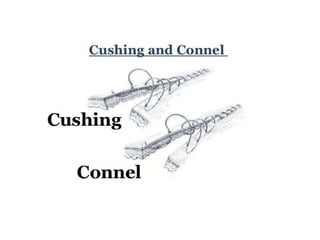
Anastomotic techniques
Dr. Aditya Yadav
MS (Gen Surgery)
Factors to note:
• Blood Supply
• Transillumination to identify mesenteric blood vessels
• Isolation of vessels by dividing surrounding fat
• Division between clamps
• Ligation with suitable sutures to prevent knot slippage
• On-needle transfixation of large vascular pedicles with nonabsorbable sutures is a safer method.
• Tension
• Anastomotic diameter
• Mesentery
• Drains
• Handsewing/ staplers
Basics in Colo-rectal and small bowel anastomosis:
• Suture material: slowly absorbable non absorbable monofilament .
• Size of suture bite: 5 mm from margin, 3-5 in next suturing.
• Inverting vs everting : inverting
• Single vs double layered: in colorectal anastomosis, single layered -
less time consuming, less costly, lesser post anastomotic inflammation.
• Interrupted vs continuous:
• Hand sewn vs Staplers- staplers are good for less experienced surgeon
otherwise no added benefit in term of leak.
Advantages of the single - row suture:
1) performance speed;
2) lesser traumatization ;
3) lesser amount of foreign tissue ;
4) better intestinal wall layers cohesion;
5) smaller tissue adhesion area ;
6) lesser extent of lumen distortion ;
7) lesser extent of blood and lymph circulation compromise ;
8) faster tissue regeneration ;
9) faster and better scar formation ;
10) lesser extent of tissue infiltration ;
11) lesser chance of microabscess formation ;
12) faster immune suture rejection
13) more adequate anastomosis ;
14) lesser suture failure rate.
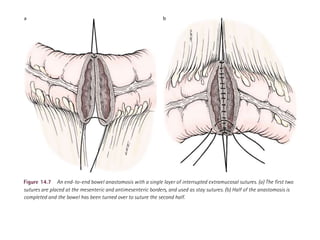
End to end Anastomosis
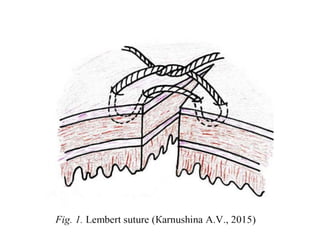
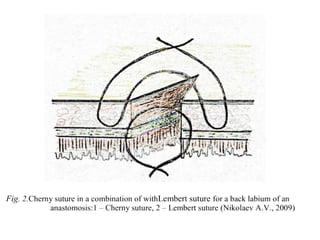
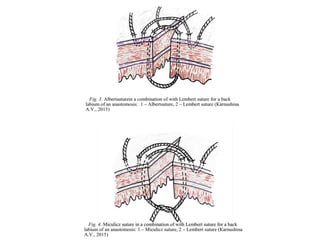
• Single layered interrupted extra mucosal ,
• Mucosa does nothing but heamostasis only
• Mucosa is already apronxipamted with good extramucosal
approximation and starts healing within 24 hours
• Always include muscular mucosa
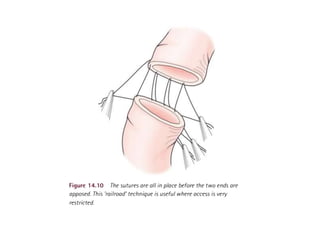
• Railroading and parachutin in restricted access
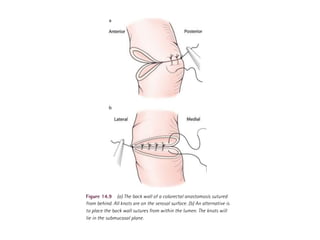
End to side
• An end-to-side sutured anastomosis is merely an adaptation of the
end-to-end technique.
• the length of the incision should be such that there are two equal
‘lumens’ for the anastomosis.
• The suture technique used is similar to t an end-to-end
anastomosis.
Side to Side
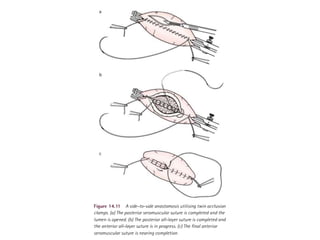
Four layer technique
• Posterior seromuscular suture. This is a continuous absorbable suture that does not include the
mucosa and that unites the adjacent surfaces of gut
• Posterior all-layer suture. This suture begins at one extremity of the incisions and unites the
posterior cut edges, travers- ing all coats of the gut.
• Anterior all-layer suture. This suture begins as a continuation of the posterior layer, the needle
passing from one lumen to the other as before, except that the wall of each gut edge must be
traversed separately
• Anterior seromuscular suture. This suture begins as a continuation of the posterior seromuscular
suture and on completion is tied to the end that was held in forceps at the start of the procedure
Bowel anastomosis

Bowel anastomosis

  • 1.
    Anastomotic techniques Dr. AdityaYadav MS (Gen Surgery)
  • 2.
    Factors to note: •Blood Supply • Transillumination to identify mesenteric blood vessels • Isolation of vessels by dividing surrounding fat • Division between clamps • Ligation with suitable sutures to prevent knot slippage • On-needle transfixation of large vascular pedicles with nonabsorbable sutures is a safer method. • Tension • Anastomotic diameter • Mesentery • Drains • Handsewing/ staplers
  • 3.
    Basics in Colo-rectaland small bowel anastomosis: • Suture material: slowly absorbable non absorbable monofilament . • Size of suture bite: 5 mm from margin, 3-5 in next suturing. • Inverting vs everting : inverting • Single vs double layered: in colorectal anastomosis, single layered - less time consuming, less costly, lesser post anastomotic inflammation. • Interrupted vs continuous: • Hand sewn vs Staplers- staplers are good for less experienced surgeon otherwise no added benefit in term of leak.
  • 4.
    Advantages of thesingle - row suture: 1) performance speed; 2) lesser traumatization ; 3) lesser amount of foreign tissue ; 4) better intestinal wall layers cohesion; 5) smaller tissue adhesion area ; 6) lesser extent of lumen distortion ; 7) lesser extent of blood and lymph circulation compromise ; 8) faster tissue regeneration ; 9) faster and better scar formation ; 10) lesser extent of tissue infiltration ; 11) lesser chance of microabscess formation ; 12) faster immune suture rejection 13) more adequate anastomosis ; 14) lesser suture failure rate.
  • 5.
    End to endAnastomosis • Single layered interrupted extra mucosal , • Mucosa does nothing but heamostasis only • Mucosa is already apronxipamted with good extramucosal approximation and starts healing within 24 hours • Always include muscular mucosa • Railroading and parachutin in restricted access
  • 13.
    End to side •An end-to-side sutured anastomosis is merely an adaptation of the end-to-end technique. • the length of the incision should be such that there are two equal ‘lumens’ for the anastomosis. • The suture technique used is similar to t an end-to-end anastomosis.
  • 14.
    Side to Side Fourlayer technique • Posterior seromuscular suture. This is a continuous absorbable suture that does not include the mucosa and that unites the adjacent surfaces of gut • Posterior all-layer suture. This suture begins at one extremity of the incisions and unites the posterior cut edges, travers- ing all coats of the gut. • Anterior all-layer suture. This suture begins as a continuation of the posterior layer, the needle passing from one lumen to the other as before, except that the wall of each gut edge must be traversed separately • Anterior seromuscular suture. This suture begins as a continuation of the posterior seromuscular suture and on completion is tied to the end that was held in forceps at the start of the procedure