Smartphones as an Alerting, Command and
Control System for the Preparedeness Groups
and Civilians: Results of Preliminary Tests with
the Finnish Police
Kuula Jaana, Kauppinen Olli, Auvinen Vili, Kettunen Pauli, Viitanen Santtu /
University of Jyväskylä, Dept. Of Mathematical Information Technology
Korhonen Tuomo / Central Finland Police Department
The 10th International ISCRAM Conference
Baden-Baden, Germany, 12-15th May, 2013
Contact: jaana.kuula@jyu.fi
The project has been funded by Tekes – the Finnish Funding Agency for Technology and
Innovation, University of Jyväskylä, Magister Solutions Ltd, Pardco Group, Jämsän Apteekki
and European structural funds.
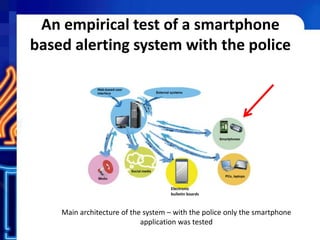
An empirical test of a smartphone
based alerting system with the police
Electronic
bulletin boards
Main architecture of the system – with the police only the smartphone
application was tested
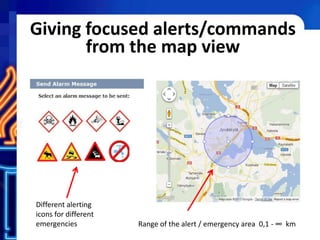
Giving focused alerts/commands
from the map view
Range of the alert / emergency area 0,1 - ∞ km
Different alerting
icons for different
emergencies
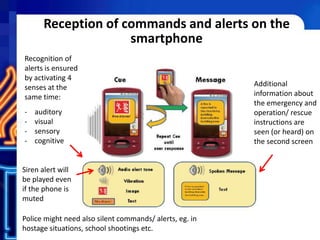
Reception of commands and alerts on the
smartphone
Recognition of
alerts is ensured
by activating 4
senses at the
same time:
- auditory
- visual
- sensory
- cognitive
Additional
information about
the emergency and
operation/ rescue
instructions are
seen (or heard) on
the second screen
Siren alert will
be played even
if the phone is
muted
Police might need also silent commands/ alerts, eg. in
hostage situations, school shootings etc.
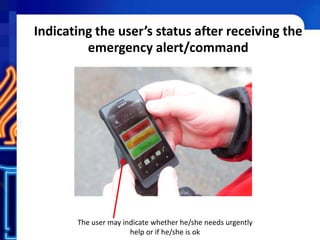
Indicating the user’s status after receiving the
emergency alert/command
The user may indicate whether he/she needs urgently
help or if he/she is ok
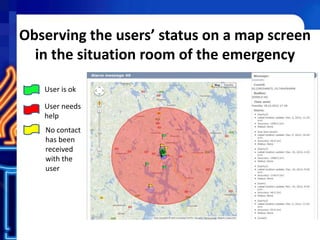
Observing the users’ status on a map screen
in the situation room of the emergency
User is ok
User needs
help
No contact
has been
received
with the
user
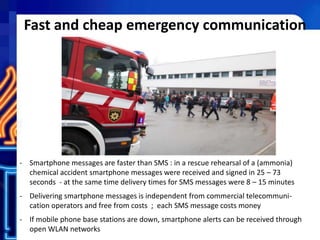
Fast and cheap emergency communication
- Smartphone messages are faster than SMS : in a rescue rehearsal of a (ammonia)
chemical accident smartphone messages were received and signed in 25 – 73
seconds - at the same time delivery times for SMS messages were 8 – 15 minutes
- Delivering smartphone messages is independent from commercial telecommuni-
cation operators and free from costs ; each SMS message costs money
- If mobile phone base stations are down, smartphone alerts can be received through
open WLAN networks
Some figures from the test with the police
- 10 test users from 8 police departments in Finland in an area of
Ø 1000 km (from Helsinki to the Arctic Circle & from the
Russian border to the Swedish border)
- Alerts were given in random times 24 / 7 for two weeks
- Alerting sounds, icons, vibration and textual messages were
altered in different alerts
- At the daytime there was so much and so loud digital garbage
and other noise around that emergency sirens could not be
heard on the phone in many ordinary situations like in the
lunch room, crowded corridor or outside in the city even if the
siren was played at the maximum volume of the phone
- Vibration helped noticing alerts
- Yet it is critical where the phone is being held – on the table, in
the pocket, in a bag, on a belt or vest..
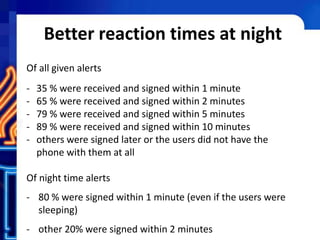
Better reaction times at night
Of all given alerts
- 35 % were received and signed within 1 minute
- 65 % were received and signed within 2 minutes
- 79 % were received and signed within 5 minutes
- 89 % were received and signed within 10 minutes
- others were signed later or the users did not have the
phone with them at all
Of night time alerts
- 80 % were signed within 1 minute (even if the users were
sleeping)
- other 20% were signed within 2 minutes
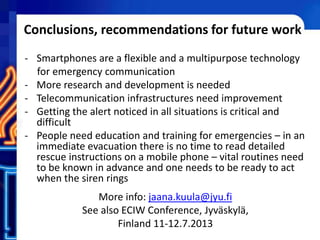
Conclusions, recommendations for future work
- Smartphones are a flexible and a multipurpose technology
for emergency communication
- More research and development is needed
- Telecommunication infrastructures need improvement
- Getting the alert noticed in all situations is critical and
difficult
- People need education and training for emergencies – in an
immediate evacuation there is no time to read detailed
rescue instructions on a mobile phone – vital routines need
to be known in advance and one needs to be ready to act
when the siren rings
More info: jaana.kuula@jyu.fi
See also ECIW Conference, Jyväskylä,
Finland 11-12.7.2013

ISCRAM 2013: Smartphones as an Alerting, Command and Control System for the Preparedeness Groups and Civilians: Results of Preliminary Tests with the Finnish Police

  • 1.
    Smartphones as anAlerting, Command and Control System for the Preparedeness Groups and Civilians: Results of Preliminary Tests with the Finnish Police Kuula Jaana, Kauppinen Olli, Auvinen Vili, Kettunen Pauli, Viitanen Santtu / University of Jyväskylä, Dept. Of Mathematical Information Technology Korhonen Tuomo / Central Finland Police Department The 10th International ISCRAM Conference Baden-Baden, Germany, 12-15th May, 2013 Contact: jaana.kuula@jyu.fi The project has been funded by Tekes – the Finnish Funding Agency for Technology and Innovation, University of Jyväskylä, Magister Solutions Ltd, Pardco Group, Jämsän Apteekki and European structural funds.
  • 2.
    An empirical testof a smartphone based alerting system with the police Electronic bulletin boards Main architecture of the system – with the police only the smartphone application was tested
  • 3.
    Giving focused alerts/commands fromthe map view Range of the alert / emergency area 0,1 - ∞ km Different alerting icons for different emergencies
  • 4.
    Reception of commandsand alerts on the smartphone Recognition of alerts is ensured by activating 4 senses at the same time: - auditory - visual - sensory - cognitive Additional information about the emergency and operation/ rescue instructions are seen (or heard) on the second screen Siren alert will be played even if the phone is muted Police might need also silent commands/ alerts, eg. in hostage situations, school shootings etc.
  • 5.
    Indicating the user’sstatus after receiving the emergency alert/command The user may indicate whether he/she needs urgently help or if he/she is ok
  • 6.
    Observing the users’status on a map screen in the situation room of the emergency User is ok User needs help No contact has been received with the user
  • 7.
    Fast and cheapemergency communication - Smartphone messages are faster than SMS : in a rescue rehearsal of a (ammonia) chemical accident smartphone messages were received and signed in 25 – 73 seconds - at the same time delivery times for SMS messages were 8 – 15 minutes - Delivering smartphone messages is independent from commercial telecommuni- cation operators and free from costs ; each SMS message costs money - If mobile phone base stations are down, smartphone alerts can be received through open WLAN networks
  • 8.
    Some figures fromthe test with the police - 10 test users from 8 police departments in Finland in an area of Ø 1000 km (from Helsinki to the Arctic Circle & from the Russian border to the Swedish border) - Alerts were given in random times 24 / 7 for two weeks - Alerting sounds, icons, vibration and textual messages were altered in different alerts - At the daytime there was so much and so loud digital garbage and other noise around that emergency sirens could not be heard on the phone in many ordinary situations like in the lunch room, crowded corridor or outside in the city even if the siren was played at the maximum volume of the phone - Vibration helped noticing alerts - Yet it is critical where the phone is being held – on the table, in the pocket, in a bag, on a belt or vest..
  • 9.
    Better reaction timesat night Of all given alerts - 35 % were received and signed within 1 minute - 65 % were received and signed within 2 minutes - 79 % were received and signed within 5 minutes - 89 % were received and signed within 10 minutes - others were signed later or the users did not have the phone with them at all Of night time alerts - 80 % were signed within 1 minute (even if the users were sleeping) - other 20% were signed within 2 minutes
  • 10.
    Conclusions, recommendations forfuture work - Smartphones are a flexible and a multipurpose technology for emergency communication - More research and development is needed - Telecommunication infrastructures need improvement - Getting the alert noticed in all situations is critical and difficult - People need education and training for emergencies – in an immediate evacuation there is no time to read detailed rescue instructions on a mobile phone – vital routines need to be known in advance and one needs to be ready to act when the siren rings More info: jaana.kuula@jyu.fi See also ECIW Conference, Jyväskylä, Finland 11-12.7.2013