EABM
1
Meeting the Sphere Standards:
a case analysis of earthquake response in China
Tao Bo
Earthquake Administration of Beijing Municipality, China
Bartel Van de Walle
Tilburg University, the Netherlands
ISCRAM2013 MAY15
EABM
2
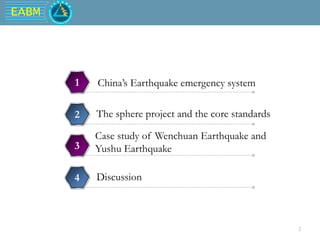
1
The sphere project and the core standards2
Case study of Wenchuan Earthquake and
Yushu Earthquake3
Discussion4
China’s Earthquake emergency system
EABM
3
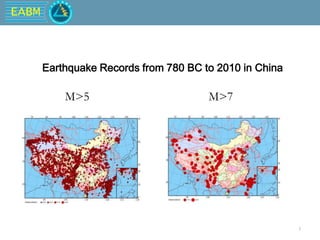
M>5 M>7
Earthquake Records from 780 BC to 2010 in China
EABM
4
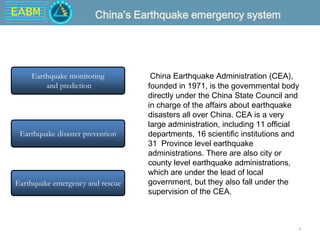
China Earthquake Administration (CEA),
founded in 1971, is the governmental body
directly under the China State Council and
in charge of the affairs about earthquake
disasters all over China. CEA is a very
large administration, including 11 official
departments, 16 scientific institutions and
31 Province level earthquake
administrations. There are also city or
county level earthquake administrations,
which are under the lead of local
government, but they also fall under the
supervision of the CEA.
Earthquake monitoring
and prediction
Earthquake disaster prevention
Earthquake emergency and rescue
China’s Earthquake emergency system
EABM
5
China’s Earthquake emergency system
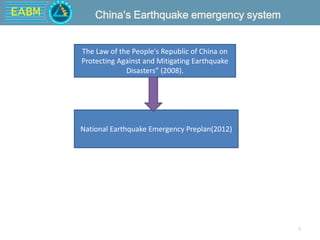
The Law of the People's Republic of China on
Protecting Against and Mitigating Earthquake
Disasters” (2008).
National Earthquake Emergency Preplan(2012)
EABM
6
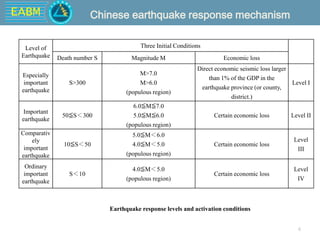
Level of
Earthquake
Three Initial Conditions
Death number S Magnitude M Economic loss
Especially
important
earthquake
S>300
M>7.0
M>6.0
(populous region)
Direct economic seismic loss larger
than 1% of the GDP in the
earthquake province (or county,
district.)
Level I
Important
earthquake
50≦S<300
6.0≦M≦7.0
5.0≦M≦6.0
(populous region)
Certain economic loss Level II
Comparativ
ely
important
earthquake
10≦S<50
5.0≦M<6.0
4.0≦M<5.0
(populous region)
Certain economic loss
Level
III
Ordinary
important
earthquake
S<10
4.0≦M<5.0
(populous region)
Certain economic loss
Level
IV
Earthquake response levels and activation conditions
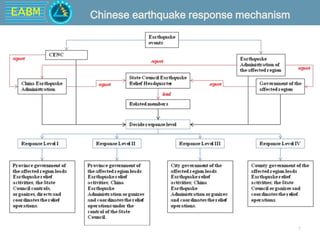
Chinese earthquake response mechanism
EABM
7
Chinese earthquake response mechanism
EABM
8
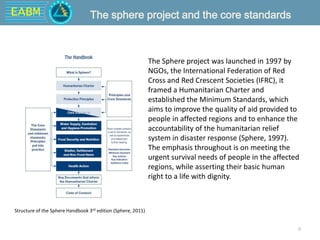
The sphere project and the core standards
The Sphere project was launched in 1997 by
NGOs, the International Federation of Red
Cross and Red Crescent Societies (IFRC), it
framed a Humanitarian Charter and
established the Minimum Standards, which
aims to improve the quality of aid provided to
people in affected regions and to enhance the
accountability of the humanitarian relief
system in disaster response (Sphere, 1997).
The emphasis throughout is on meeting the
urgent survival needs of people in the affected
regions, while asserting their basic human
right to a life with dignity.
Structure of the Sphere Handbook 3rd edition (Sphere, 2011)
EABM
9
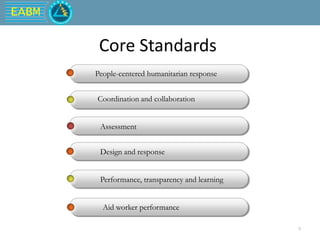
Core Standards
People-centered humanitarian response
Coordination and collaboration
Assessment
Design and response
Performance, transparency and learning
Aid worker performance
EABM
10
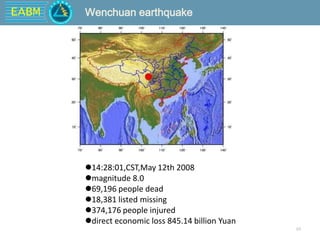
Wenchuan earthquake
14:28:01,CST,May 12th 2008
magnitude 8.0
69,196 people dead
18,381 listed missing
374,176 people injured
direct economic loss 845.14 billion Yuan
EABM
11
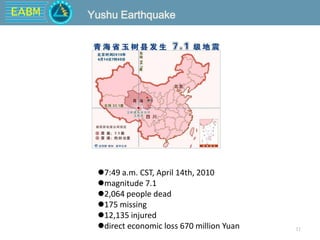
Yushu Earthquake
7:49 a.m. CST, April 14th, 2010
magnitude 7.1
2,064 people dead
175 missing
12,135 injured
direct economic loss 670 million Yuan
EABM
12
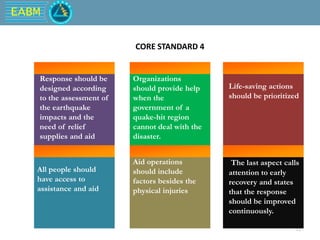
Organizations
should provide help
when the
government of a
quake-hit region
cannot deal with the
disaster.
Life-saving actions
should be prioritized
All people should
have access to
assistance and aid
Aid operations
should include
factors besides the
physical injuries
The last aspect calls
attention to early
recovery and states
that the response
should be improved
continuously.
CORE STANDARD 4
Response should be
designed according
to the assessment of
the earthquake
impacts and the
need of relief
supplies and aid
EABM
13
Difficulties in Wenchuan Earthquake Response
Information Isolation
NGOs and Volunteers
Huge damage and
secondary disaster
EABM
14
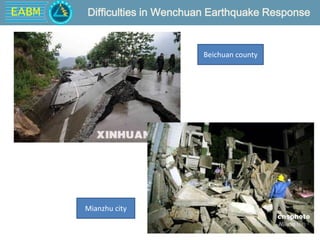
Beichuan county
Mianzhu city
Difficulties in Wenchuan Earthquake Response
EABM
15
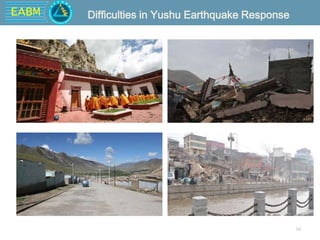
Difficulties in Yushu Earthquake Response
High Altitude
Culture Difference
EABM
16
Difficulties in Yushu Earthquake Response
EABM
17
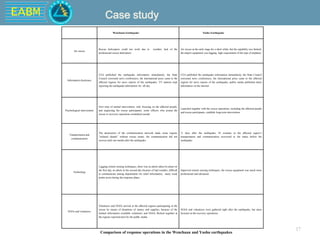
Case study
Wenchuan Earthquake Yushu Earthquake
Air rescue
Rescue helicopters could not work due to weather; lack of the
professional rescue helicopters
Air rescue at the early stage for a short while, but the capability was limited;
the airport equipment was lagging, high requirement of the type of airplanes
Information disclosure
CEA published the earthquake information immediately, the State
Council convened news conferences; the international press came to the
affected regions for news reports of the earthquake; TV stations kept
reporting the earthquake information for all day
CEA published the earthquake information immediately, the State Council
convened news conferences; the international press came to the affected
regions for news reports of the earthquake; public media published latest
information on the internet
Psychological intervention
First time of mental intervention, only focusing on the affected people,
and neglecting the rescue participants; some officers who joined the
rescue or recovery operations committed suicide
Launched together with the rescue operations, including the affected people
and rescue participants, establish long-term intervention
Transportation and
communication
The destruction of the communication network made some regions
“isolated islands” without rescue teams; the communication did not
recover until one month after the earthquake
11 days after the earthquake, 45 counties in the affected region’s
transportation and communication recovered to the status before the
earthquake
Technology
Lagging remote sensing techniques, there was no photo taken by plane on
the first day, no photo in the second day because of bad weather; difficult
to communicate among departments for relief information; many weak
points arose during the response phase
Improved remote sensing techniques, the rescue equipment was much more
professional and advanced
NGOs and volunteers
Volunteers and NGOs arrived at the affected regions participating in the
rescue by means of donations of money and supplies; because of the
limited information available volunteers and NGOs flocked together at
the regions reported most by the public media
NGOs and volunteers were gathered right after the earthquake, but more
focused on the recovery operations
Comparison of response operations in the Wenchuan and Yushu earthquakes
EABM
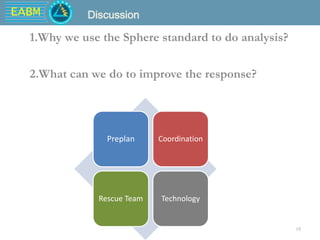
1.Why we use the Sphere standard to do analysis?
18
Discussion
Preplan Coordination
Rescue Team Technology
2.What can we do to improve the response?
EABM
lindabo717@hotmail.com
19

ISCRAM 2013: Meeting the Sphere Standards a case analysis of earthquake response in China

  • 1.
    EABM 1 Meeting the SphereStandards: a case analysis of earthquake response in China Tao Bo Earthquake Administration of Beijing Municipality, China Bartel Van de Walle Tilburg University, the Netherlands ISCRAM2013 MAY15
  • 2.
    EABM 2 1 The sphere projectand the core standards2 Case study of Wenchuan Earthquake and Yushu Earthquake3 Discussion4 China’s Earthquake emergency system
  • 3.
    EABM 3 M>5 M>7 Earthquake Recordsfrom 780 BC to 2010 in China
  • 4.
    EABM 4 China Earthquake Administration(CEA), founded in 1971, is the governmental body directly under the China State Council and in charge of the affairs about earthquake disasters all over China. CEA is a very large administration, including 11 official departments, 16 scientific institutions and 31 Province level earthquake administrations. There are also city or county level earthquake administrations, which are under the lead of local government, but they also fall under the supervision of the CEA. Earthquake monitoring and prediction Earthquake disaster prevention Earthquake emergency and rescue China’s Earthquake emergency system
  • 5.
    EABM 5 China’s Earthquake emergencysystem The Law of the People's Republic of China on Protecting Against and Mitigating Earthquake Disasters” (2008). National Earthquake Emergency Preplan(2012)
  • 6.
    EABM 6 Level of Earthquake Three InitialConditions Death number S Magnitude M Economic loss Especially important earthquake S>300 M>7.0 M>6.0 (populous region) Direct economic seismic loss larger than 1% of the GDP in the earthquake province (or county, district.) Level I Important earthquake 50≦S<300 6.0≦M≦7.0 5.0≦M≦6.0 (populous region) Certain economic loss Level II Comparativ ely important earthquake 10≦S<50 5.0≦M<6.0 4.0≦M<5.0 (populous region) Certain economic loss Level III Ordinary important earthquake S<10 4.0≦M<5.0 (populous region) Certain economic loss Level IV Earthquake response levels and activation conditions Chinese earthquake response mechanism
  • 7.
  • 8.
    EABM 8 The sphere projectand the core standards The Sphere project was launched in 1997 by NGOs, the International Federation of Red Cross and Red Crescent Societies (IFRC), it framed a Humanitarian Charter and established the Minimum Standards, which aims to improve the quality of aid provided to people in affected regions and to enhance the accountability of the humanitarian relief system in disaster response (Sphere, 1997). The emphasis throughout is on meeting the urgent survival needs of people in the affected regions, while asserting their basic human right to a life with dignity. Structure of the Sphere Handbook 3rd edition (Sphere, 2011)
  • 9.
    EABM 9 Core Standards People-centered humanitarianresponse Coordination and collaboration Assessment Design and response Performance, transparency and learning Aid worker performance
  • 10.
    EABM 10 Wenchuan earthquake 14:28:01,CST,May 12th2008 magnitude 8.0 69,196 people dead 18,381 listed missing 374,176 people injured direct economic loss 845.14 billion Yuan
  • 11.
    EABM 11 Yushu Earthquake 7:49 a.m.CST, April 14th, 2010 magnitude 7.1 2,064 people dead 175 missing 12,135 injured direct economic loss 670 million Yuan
  • 12.
    EABM 12 Organizations should provide help whenthe government of a quake-hit region cannot deal with the disaster. Life-saving actions should be prioritized All people should have access to assistance and aid Aid operations should include factors besides the physical injuries The last aspect calls attention to early recovery and states that the response should be improved continuously. CORE STANDARD 4 Response should be designed according to the assessment of the earthquake impacts and the need of relief supplies and aid
  • 13.
    EABM 13 Difficulties in WenchuanEarthquake Response Information Isolation NGOs and Volunteers Huge damage and secondary disaster
  • 14.
  • 15.
    EABM 15 Difficulties in YushuEarthquake Response High Altitude Culture Difference
  • 16.
    EABM 16 Difficulties in YushuEarthquake Response
  • 17.
    EABM 17 Case study Wenchuan EarthquakeYushu Earthquake Air rescue Rescue helicopters could not work due to weather; lack of the professional rescue helicopters Air rescue at the early stage for a short while, but the capability was limited; the airport equipment was lagging, high requirement of the type of airplanes Information disclosure CEA published the earthquake information immediately, the State Council convened news conferences; the international press came to the affected regions for news reports of the earthquake; TV stations kept reporting the earthquake information for all day CEA published the earthquake information immediately, the State Council convened news conferences; the international press came to the affected regions for news reports of the earthquake; public media published latest information on the internet Psychological intervention First time of mental intervention, only focusing on the affected people, and neglecting the rescue participants; some officers who joined the rescue or recovery operations committed suicide Launched together with the rescue operations, including the affected people and rescue participants, establish long-term intervention Transportation and communication The destruction of the communication network made some regions “isolated islands” without rescue teams; the communication did not recover until one month after the earthquake 11 days after the earthquake, 45 counties in the affected region’s transportation and communication recovered to the status before the earthquake Technology Lagging remote sensing techniques, there was no photo taken by plane on the first day, no photo in the second day because of bad weather; difficult to communicate among departments for relief information; many weak points arose during the response phase Improved remote sensing techniques, the rescue equipment was much more professional and advanced NGOs and volunteers Volunteers and NGOs arrived at the affected regions participating in the rescue by means of donations of money and supplies; because of the limited information available volunteers and NGOs flocked together at the regions reported most by the public media NGOs and volunteers were gathered right after the earthquake, but more focused on the recovery operations Comparison of response operations in the Wenchuan and Yushu earthquakes
  • 18.
    EABM 1.Why we usethe Sphere standard to do analysis? 18 Discussion Preplan Coordination Rescue Team Technology 2.What can we do to improve the response?
  • 19.