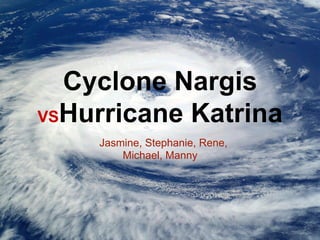
Cyclone Nargis
VSHurricane Katrina
    Jasmine, Stephanie, Rene,
        Michael, Manny
•  Hurricane Katrina slammed into the U.S. Gulf
   Coast on Aug. 29, 2005
•  The third most destructive storm to strike the
   United States
•  Maximum winds --> stretched to 25 to 30
   nautical miles
•  Hurricane force winds --> extended to at least
   75 nautical miles to the east from the center.
•  with winds up to 175 miles per hour.
•  With a storm surge of 20 feet (6 meters high)
•  An estimated 80 percent of New Orleans was
   under water, up to 20 feet deep in places.
•  Over 1800 people lost their lives,
     nearly 750 were reported missing.
•    Affected over 15 million people in
     different factors; economy,
     evacuations
•    20% of its 500,000 citizens were
     trapped without power, food or
     drinking water.
•    Caused 81 billion in property
     damages, but estimated that total
     economic impact exceeded 150 billion.
Characteristic                   Scale (1-5)
Frequency                        3 Once every 4 years
(Frequent - Rare)


Duration                         3-4 Lasted for 8 days, however
(Long - Short)                   damage lasted longer


Areal Extent(Widespread - 3 Affected several states such as
Limited)                         Louisiana and New Orleans


Speed of Onset                   2 Rains for several days and takes a few
(Slow - Fast)                    days to dissipate


Spatial Dispersion               2-3 New Orleans was affected badly
(Diffuse - Concentrated)         but it was somewhat diffuse.


Regularity                       3-4 Atlantic Hurricanes often occur,
(Regular - Random)               however not Category 5 hurricanes.
•  On 2 May, 2008, Cyclone Nargis made landfall in
   Myanmar, terrorising the country for 2 days.
•  7th-8th deadliest cyclone of all time
•  Estimated 84,500 were killed and 53,800 are
   reported missing
•  UN estimates up to 2.4 million people have been
   affected
•  In the town of Bogale alone, 80 thousand people
   lost their lives
•  Primarily affected Ayeyarwadi Region (River
   Delta= low land and constantly saturated soil)
•  Lack of openess and the confiscation of aid to
   individuals contributed higher casualty rate
Characteristic                  Scale (1-5)
Frequency                       3 History shows previous Category 4
(Frequent - Rare)               hurricanes in Burma


Duration                        3-4 1 week. April 27th to May 3rd.
(Long - Short)


Areal Extent(Widespread - 3 Mostly affected Burma; Bangladesh,
Limited)                        India, and Sri Lanka too.


Speed of Onset                  2 Rains for days and takes a few days to
(Slow - Fast)                   dissipate


Spatial Dispersion              3-4 Burma was strongly affected
(Diffuse - Concentrated)        (strong concentration especially in south)


Regularity                      2 Category 4 in past. Next to Indian
(Regular - Random)              Ocean (warmest ocean)
Hurricane Katrina
•    Government (Democracy)
      o  Bottom to top system. Openly accepted aid (not
         a closed government that restricted access
         unlike Burma)
•    The economic disparity in New Orleans led to the
     poorer population being much more vulnerable to
     the Hurricane than the richer population
•    More urbanized than Burma, better form of
     infrastructure and shelter.
•    High HDI
Cyclone Nargis
•    Government (Military Junta)
      o  After Cyclone Nargis, Burmese government
         actually limited/restricted aid in the areas
         affected
      o  Burmese government confiscated aid and used
         it for their own military
•    Lack of proper facilities and infrastructure led to
     problems in disaster response
•    Individuals affected were poor compared to those
     affected by Katrina
•    Low HDI
•    Gender bias
      o  Statistics on women are likely to be silenced
2008 Burma GDP - per capita   2005 USA GDP - per capita
   (PPP): $1,817              (PPP): $43,480
Total Population 48,724.400   Total Population 315,791.300


                              Births: 14.0/1000 people
Births 19.3/1000 people
                              Deaths: 8.3/1000 people
Deaths 8.9/1000 people        HDI Ranking 3
HDI Ranking 147
•    51% African American
 •    42% White
 •    2% Hispanic

Differences in affectedness:
 •    During:
       o  Black population most affected,
           as they lived in areas more
           prone to flooding due to their
           lower economic status
       o  The white population was much
           better prepared, and had more
           time to react
 •    After:
       o  Black population much slower to
           recover and return, as the
           lasting effect on their homes and
           lives was much greater generally
           than that of the white population.
•  Ethnic Variation in Burma

•  Majority of people affected
   come from Bamar ethnic
   minority (compose of 68%
   of Burma) in Ayeyarwadi
   region

•  Burma restricted aid to
   majority of people in this
   area (asides from military)

•  People living in rural areas
•    People in Burma more vulnerable than people in USA (economic,
     and demographic factors)


•    Both places affected were densely populated


•    USA (more disaster prepared) vs. Burma (less disaster prepared)
      o  USA: Good infrastructure, informed citizens, good
         communication
      o  Burma: Relatively poor infrastructure, large uneducated
         population, poor communication channels
•    Democratic govt. (more open) vs. Military Junta (restricted)
•    USA: more vulnerable black population (low income)
•    Burma: Rural local population greatly affected (low education, low
     income)

Hurricane Katrina vs Cyclone Nargis

  • 1.
    Cyclone Nargis VSHurricane Katrina Jasmine, Stephanie, Rene, Michael, Manny
  • 2.
    •  Hurricane Katrinaslammed into the U.S. Gulf Coast on Aug. 29, 2005 •  The third most destructive storm to strike the United States •  Maximum winds --> stretched to 25 to 30 nautical miles •  Hurricane force winds --> extended to at least 75 nautical miles to the east from the center. •  with winds up to 175 miles per hour. •  With a storm surge of 20 feet (6 meters high) •  An estimated 80 percent of New Orleans was under water, up to 20 feet deep in places.
  • 3.
    •  Over 1800people lost their lives, nearly 750 were reported missing. •  Affected over 15 million people in different factors; economy, evacuations •  20% of its 500,000 citizens were trapped without power, food or drinking water. •  Caused 81 billion in property damages, but estimated that total economic impact exceeded 150 billion.
  • 4.
    Characteristic Scale (1-5) Frequency 3 Once every 4 years (Frequent - Rare) Duration 3-4 Lasted for 8 days, however (Long - Short) damage lasted longer Areal Extent(Widespread - 3 Affected several states such as Limited) Louisiana and New Orleans Speed of Onset 2 Rains for several days and takes a few (Slow - Fast) days to dissipate Spatial Dispersion 2-3 New Orleans was affected badly (Diffuse - Concentrated) but it was somewhat diffuse. Regularity 3-4 Atlantic Hurricanes often occur, (Regular - Random) however not Category 5 hurricanes.
  • 5.
    •  On 2May, 2008, Cyclone Nargis made landfall in Myanmar, terrorising the country for 2 days. •  7th-8th deadliest cyclone of all time •  Estimated 84,500 were killed and 53,800 are reported missing •  UN estimates up to 2.4 million people have been affected •  In the town of Bogale alone, 80 thousand people lost their lives •  Primarily affected Ayeyarwadi Region (River Delta= low land and constantly saturated soil) •  Lack of openess and the confiscation of aid to individuals contributed higher casualty rate
  • 6.
    Characteristic Scale (1-5) Frequency 3 History shows previous Category 4 (Frequent - Rare) hurricanes in Burma Duration 3-4 1 week. April 27th to May 3rd. (Long - Short) Areal Extent(Widespread - 3 Mostly affected Burma; Bangladesh, Limited) India, and Sri Lanka too. Speed of Onset 2 Rains for days and takes a few days to (Slow - Fast) dissipate Spatial Dispersion 3-4 Burma was strongly affected (Diffuse - Concentrated) (strong concentration especially in south) Regularity 2 Category 4 in past. Next to Indian (Regular - Random) Ocean (warmest ocean)
  • 7.
    Hurricane Katrina •  Government (Democracy) o  Bottom to top system. Openly accepted aid (not a closed government that restricted access unlike Burma) •  The economic disparity in New Orleans led to the poorer population being much more vulnerable to the Hurricane than the richer population •  More urbanized than Burma, better form of infrastructure and shelter. •  High HDI
  • 8.
    Cyclone Nargis •  Government (Military Junta) o  After Cyclone Nargis, Burmese government actually limited/restricted aid in the areas affected o  Burmese government confiscated aid and used it for their own military •  Lack of proper facilities and infrastructure led to problems in disaster response •  Individuals affected were poor compared to those affected by Katrina •  Low HDI •  Gender bias o  Statistics on women are likely to be silenced
  • 9.
    2008 Burma GDP- per capita 2005 USA GDP - per capita (PPP): $1,817 (PPP): $43,480 Total Population 48,724.400 Total Population 315,791.300 Births: 14.0/1000 people Births 19.3/1000 people Deaths: 8.3/1000 people Deaths 8.9/1000 people HDI Ranking 3 HDI Ranking 147
  • 10.
    •  51% African American •  42% White •  2% Hispanic Differences in affectedness: •  During: o  Black population most affected, as they lived in areas more prone to flooding due to their lower economic status o  The white population was much better prepared, and had more time to react •  After: o  Black population much slower to recover and return, as the lasting effect on their homes and lives was much greater generally than that of the white population.
  • 11.
    •  Ethnic Variationin Burma •  Majority of people affected come from Bamar ethnic minority (compose of 68% of Burma) in Ayeyarwadi region •  Burma restricted aid to majority of people in this area (asides from military) •  People living in rural areas
  • 12.
    •  People in Burma more vulnerable than people in USA (economic, and demographic factors) •  Both places affected were densely populated •  USA (more disaster prepared) vs. Burma (less disaster prepared) o  USA: Good infrastructure, informed citizens, good communication o  Burma: Relatively poor infrastructure, large uneducated population, poor communication channels •  Democratic govt. (more open) vs. Military Junta (restricted) •  USA: more vulnerable black population (low income) •  Burma: Rural local population greatly affected (low education, low income)