Context Ontology for
Humanitarian Assistance
in Crisis Response
Satria Hutomo Jihan, Aviv Segev
1
Outline
2
Background
Solution Offered
System Description
Experiment & Result
Conclusion and Future Direction
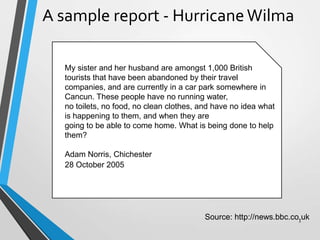
My sister and her husband are amongst 1,000 British
tourists that have been abandoned by their travel
companies, and are currently in a car park somewhere in
Cancun. These people have no running water,
no toilets, no food, no clean clothes, and have no idea what
is happening to them, and when they are
going to be able to come home. What is being done to help
them?
Adam Norris, Chichester
A sample report - HurricaneWilma
Source: http://news.bbc.co.uk
28 October 2005
3
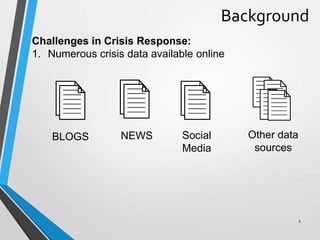
Challenges in Crisis Response:
1. Numerous crisis data available online
BLOGS NEWS Social
Media
Background
Other data
sources
4
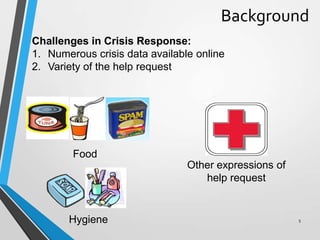
Hygiene
Challenges in Crisis Response:
1. Numerous crisis data available online
2. Variety of the help request
Background
Other expressions of
help request
Food
5
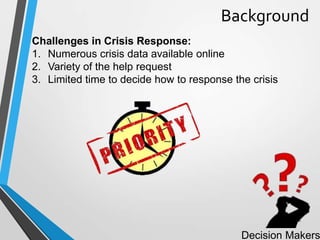
Challenges in Crisis Response:
1. Numerous crisis data available online
2. Variety of the help request
3. Limited time to decide how to response the crisis
Decision Makers
Background
6
Solution Proposed
• To build knowledge representation system for
the rapid response
• Provide the necessary info & recommendation
actions for decision makers to respond
7
RelatedWorks
• Di Maio (2007) addresses open ontology methodology for open
source emergency response system.
• Li et al. (2008) propose a practical emergency response workflow
and emergency response ontology architecture.
• Truptil et al. (2008) develops meta-model of crisis situations by
using ontological links to integrate and support interoperability
of heterogeneous information systems
• Fan and Zlatanova (2011) explore the semantic interoperability of
the terms and spatial information to be used by different
emergency response communities
However, aforementioned previous works did not explore raw data as
source data nor offer a solution between crisis needs and humanitarian
assistance.
8
Main Contributions
• The construction of generic Crisis Identification &
Response Ontology using expert resources
• Extracting ontological crisis concepts from online
textual data
• Inference logic rules for inferring
recommendations based on humanitarian
standard.
9
System Description
Context Ontology For Crisis
• Ontology is an explicit and formal specification of a
conceptualization (Gruber 1993)
• Context ontology which cover crisis concepts and
its relations
• Context ontology includes Crisis Identification &
Crisis Response sub-ontology
• Context ontology adapts:
1. actual & dynamic data as its local ontology and
2. Static and predetermined data as its global ontology
11
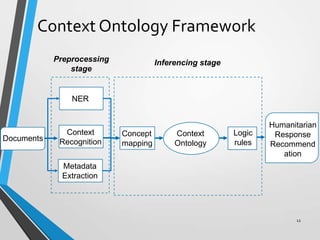
Context Ontology Framework
Documents
NER
Metadata
Extraction
Context
Recognition
Preprocessing
stage
Inferencing stage
Concept
mapping
Logic
rules
Context
Ontology
Humanitarian
Response
Recommend
ation
12
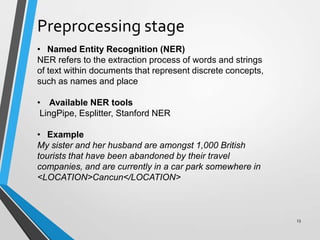
Preprocessing stage
• Named Entity Recognition (NER)
NER refers to the extraction process of words and strings
of text within documents that represent discrete concepts,
such as names and place
• Available NER tools
LingPipe, Esplitter, Stanford NER
• Example
My sister and her husband are amongst 1,000 British
tourists that have been abandoned by their travel
companies, and are currently in a car park somewhere in
<LOCATION>Cancun</LOCATION>
13
Preprocessing stage
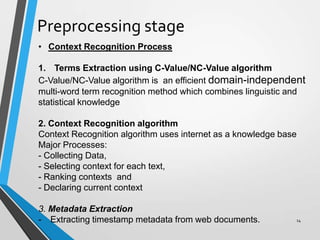
• Context Recognition Process
1. Terms Extraction using C-Value/NC-Value algorithm
C-Value/NC-Value algorithm is an efficient domain-independent
multi-word term recognition method which combines linguistic and
statistical knowledge
2. Context Recognition algorithm
Context Recognition algorithm uses internet as a knowledge base
Major Processes:
- Collecting Data,
- Selecting context for each text,
- Ranking contexts and
- Declaring current context
3. Metadata Extraction
- Extracting timestamp metadata from web documents. 14
Building Context Ontology
• Expert Sources:
1. The Sphere Handbook
One of the most widely known and
internationally recognized sets of common
principles and universal minimum standards
in humanitarian response areas.
2. Dbpedia
The community-driven data pool that
structures data from Wikipedia
15
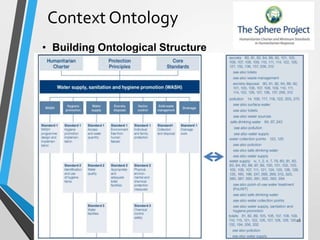
Context Ontology
• Building Ontological Structure
16
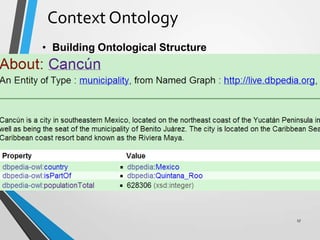
Context Ontology
• Building Ontological Structure
17
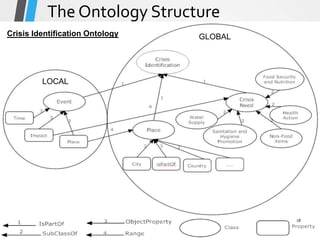
The Ontology Structure
Crisis Identification Ontology
18
LOCAL
GLOBAL
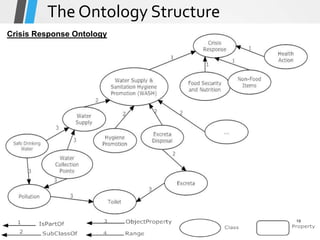
Crisis Response Ontology
The Ontology Structure
19
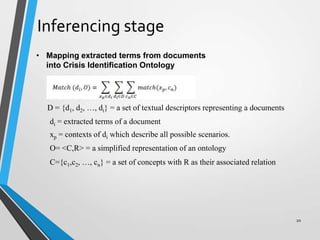
• Mapping extracted terms from documents
into Crisis Identification Ontology
di = extracted terms of a document
D = {d1, d2, …, di} = a set of textual descriptors representing a documents
C={c1,c2, …, cn} = a set of concepts with R as their associated relation
xp = contexts of di which describe all possible scenarios.
O= <C,R> = a simplified representation of an ontology
Inferencing stage
20
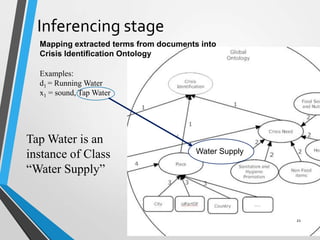
Mapping extracted terms from documents into
Crisis Identification Ontology
Examples:
d1 = Running Water
x1 = sound, Tap Water
Tap Water is an
instance of Class
“Water Supply”
Water Supply
Inferencing stage
21
Logic Rules
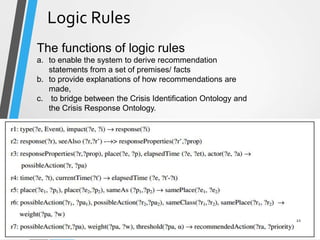
The functions of logic rules
a. to enable the system to derive recommendation
statements from a set of premises/ facts
b. to provide explanations of how recommendations are
made,
c. to bridge between the Crisis Identification Ontology and
the Crisis Response Ontology.
22
Logic Rules
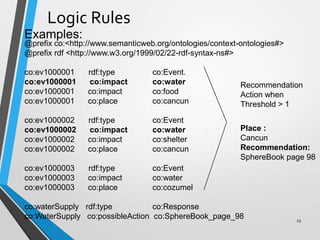
Examples:
@prefix co:<http://www.semanticweb.org/ontologies/context-ontologies#>
@prefix rdf <http://www.w3.org/1999/02/22-rdf-syntax-ns#>
co:ev1000001 rdf:type co:Event.
co:ev1000001 co:impact co:water
co:ev1000001 co:impact co:food
co:ev1000001 co:place co:cancun
co:ev1000002 rdf:type co:Event
co:ev1000002 co:impact co:water
co:ev1000002 co:impact co:shelter
co:ev1000002 co:place co:cancun
co:ev1000003 rdf:type co:Event
co:ev1000003 co:impact co:water
co:ev1000003 co:place co:cozumel
co:waterSupply rdf:type co:Response
co:WaterSupply co:possibleAction co:SphereBook_page_98
Recommendation
Action when
Threshold > 1
Place :
Cancun
Recommendation:
SphereBook page 98
23
Logic Rules
Examples:
@prefix co:<http://www.semanticweb.org/ontologies/context-ontologies#>
@prefix rdf <http://www.w3.org/1999/02/22-rdf-syntax-ns#>
co:ev1000001 rdf:type co:Event.
co:ev1000001 co:impact co:water
co:ev1000001 co:impact co:food
co:ev1000001 co:place co:cancun
co:ev1000002 rdf:type co:Event
co:ev1000002 co:impact co:water
co:ev1000002 co:impact co:shelter
co:ev1000002 co:place co:cancun
co:ev1000003 rdf:type co:Event
co:ev1000003 co:impact co:water
co:ev1000003 co:place co:cozumel
co:waterSupply rdf:type co:Response
co:WaterSupply co:possibleAction co:SphereBook_page_98
Recommendation
Action when
Threshold > 1
Place : Cancun
Recommendation:
SphereBook page
98
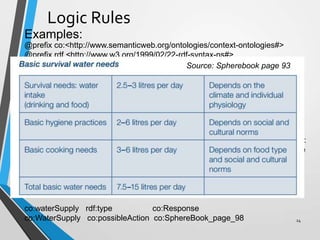
Source: Spherebook page 93
24
Logic Rules
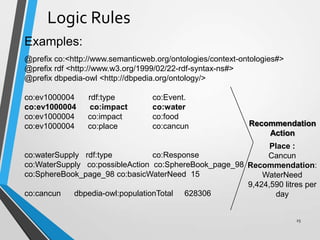
Examples:
@prefix co:<http://www.semanticweb.org/ontologies/context-ontologies#>
@prefix rdf <http://www.w3.org/1999/02/22-rdf-syntax-ns#>
@prefix dbpedia-owl <http://dbpedia.org/ontology/>
co:ev1000004 rdf:type co:Event.
co:ev1000004 co:impact co:water
co:ev1000004 co:impact co:food
co:ev1000004 co:place co:cancun
co:waterSupply rdf:type co:Response
co:WaterSupply co:possibleAction co:SphereBook_page_98
co:SphereBook_page_98 co:basicWaterNeed 15
co:cancun dbpedia-owl:populationTotal 628306
Recommendation
Action
Place :
Cancun
Recommendation:
WaterNeed
9,424,590 litres per
day
25
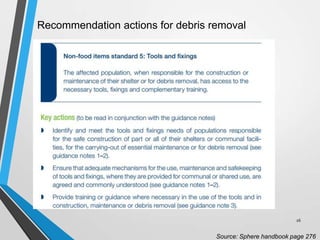
Recommendation actions for debris removal
Source: Sphere handbook page 276
26
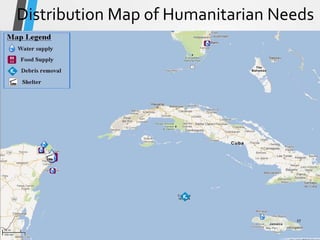
Distribution Map of Humanitarian Needs
27
Experiment & Result
Experiments
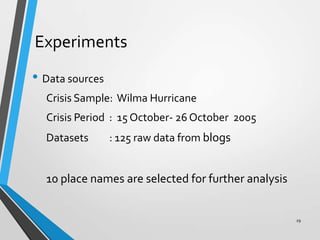
• Data sources
Crisis Sample: Wilma Hurricane
Crisis Period : 15 October- 26 October 2005
Datasets : 125 raw data from blogs
10 place names are selected for further analysis
29
Experiments
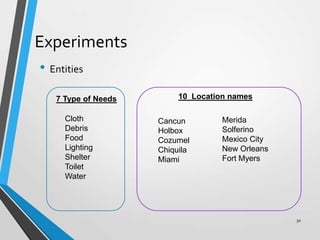
• Entities
Cloth
Debris
Food
Lighting
Shelter
Toilet
Water
7 Type of Needs
Cancun
Holbox
Cozumel
Chiquila
Miami
Merida
Solferino
Mexico City
New Orleans
Fort Myers
10 Location names
30
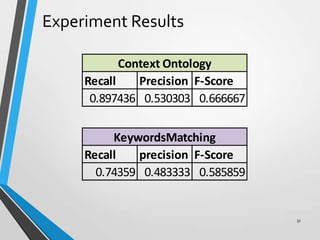
Experiment Results
Recall Precision F-Score
0.897436 0.530303 0.666667
Context Ontology
Recall precision F-Score
0.74359 0.483333 0.585859
KeywordsMatching
31
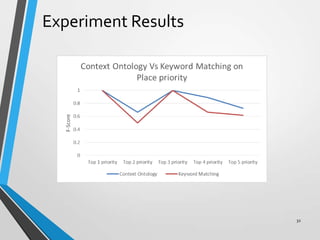
Experiment Results
32
Conclusion
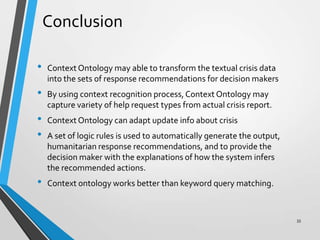
• Context Ontology may able to transform the textual crisis data
into the sets of response recommendations for decision makers
• By using context recognition process,Context Ontology may
capture variety of help request types from actual crisis report.
• Context Ontology can adapt update info about crisis
• A set of logic rules is used to automatically generate the output,
humanitarian response recommendations, and to provide the
decision maker with the explanations of how the system infers
the recommended actions.
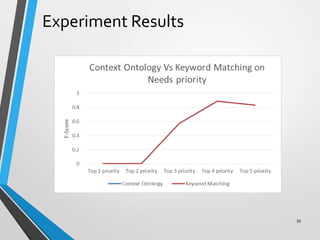
• Context ontology works better than keyword query matching.
33
Future Directions
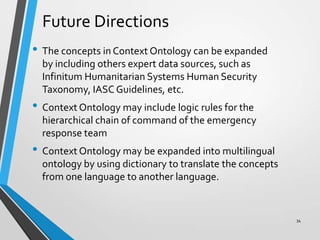
• The concepts in Context Ontology can be expanded
by including others expert data sources, such as
Infinitum Humanitarian Systems Human Security
Taxonomy, IASC Guidelines, etc.
• Context Ontology may include logic rules for the
hierarchical chain of command of the emergency
response team
• Context Ontology may be expanded into multilingual
ontology by using dictionary to translate the concepts
from one language to another language.
34
Q&A
35
36
THANKS
YOU
becauseOf
References
37
38
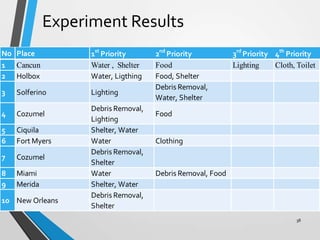
Experiment Results
No Place 1st
Priority 2nd
Priority 3rd
Priority 4th
Priority
1 Cancun Water , Shelter Food Lighting Cloth, Toilet
2 Holbox Water, Ligthing Food, Shelter
3 Solferino Lighting
Debris Removal,
Water, Shelter
4 Cozumel
Debris Removal,
Lighting
Food
5 Ciquila Shelter, Water
6 Fort Myers Water Clothing
7 Cozumel
Debris Removal,
Shelter
8 Miami Water Debris Removal, Food
9 Merida Shelter, Water
10 New Orleans
Debris Removal,
Shelter
39
Experiment Results

ISCRAM 2013: Context Ontology for Humanitarian Assistance in Crisis Response

  • 1.
    Context Ontology for HumanitarianAssistance in Crisis Response Satria Hutomo Jihan, Aviv Segev 1
  • 2.
  • 3.
    My sister andher husband are amongst 1,000 British tourists that have been abandoned by their travel companies, and are currently in a car park somewhere in Cancun. These people have no running water, no toilets, no food, no clean clothes, and have no idea what is happening to them, and when they are going to be able to come home. What is being done to help them? Adam Norris, Chichester A sample report - HurricaneWilma Source: http://news.bbc.co.uk 28 October 2005 3
  • 4.
    Challenges in CrisisResponse: 1. Numerous crisis data available online BLOGS NEWS Social Media Background Other data sources 4
  • 5.
    Hygiene Challenges in CrisisResponse: 1. Numerous crisis data available online 2. Variety of the help request Background Other expressions of help request Food 5
  • 6.
    Challenges in CrisisResponse: 1. Numerous crisis data available online 2. Variety of the help request 3. Limited time to decide how to response the crisis Decision Makers Background 6
  • 7.
    Solution Proposed • Tobuild knowledge representation system for the rapid response • Provide the necessary info & recommendation actions for decision makers to respond 7
  • 8.
    RelatedWorks • Di Maio(2007) addresses open ontology methodology for open source emergency response system. • Li et al. (2008) propose a practical emergency response workflow and emergency response ontology architecture. • Truptil et al. (2008) develops meta-model of crisis situations by using ontological links to integrate and support interoperability of heterogeneous information systems • Fan and Zlatanova (2011) explore the semantic interoperability of the terms and spatial information to be used by different emergency response communities However, aforementioned previous works did not explore raw data as source data nor offer a solution between crisis needs and humanitarian assistance. 8
  • 9.
    Main Contributions • Theconstruction of generic Crisis Identification & Response Ontology using expert resources • Extracting ontological crisis concepts from online textual data • Inference logic rules for inferring recommendations based on humanitarian standard. 9
  • 10.
  • 11.
    Context Ontology ForCrisis • Ontology is an explicit and formal specification of a conceptualization (Gruber 1993) • Context ontology which cover crisis concepts and its relations • Context ontology includes Crisis Identification & Crisis Response sub-ontology • Context ontology adapts: 1. actual & dynamic data as its local ontology and 2. Static and predetermined data as its global ontology 11
  • 12.
    Context Ontology Framework Documents NER Metadata Extraction Context Recognition Preprocessing stage Inferencingstage Concept mapping Logic rules Context Ontology Humanitarian Response Recommend ation 12
  • 13.
    Preprocessing stage • NamedEntity Recognition (NER) NER refers to the extraction process of words and strings of text within documents that represent discrete concepts, such as names and place • Available NER tools LingPipe, Esplitter, Stanford NER • Example My sister and her husband are amongst 1,000 British tourists that have been abandoned by their travel companies, and are currently in a car park somewhere in <LOCATION>Cancun</LOCATION> 13
  • 14.
    Preprocessing stage • ContextRecognition Process 1. Terms Extraction using C-Value/NC-Value algorithm C-Value/NC-Value algorithm is an efficient domain-independent multi-word term recognition method which combines linguistic and statistical knowledge 2. Context Recognition algorithm Context Recognition algorithm uses internet as a knowledge base Major Processes: - Collecting Data, - Selecting context for each text, - Ranking contexts and - Declaring current context 3. Metadata Extraction - Extracting timestamp metadata from web documents. 14
  • 15.
    Building Context Ontology •Expert Sources: 1. The Sphere Handbook One of the most widely known and internationally recognized sets of common principles and universal minimum standards in humanitarian response areas. 2. Dbpedia The community-driven data pool that structures data from Wikipedia 15
  • 16.
    Context Ontology • BuildingOntological Structure 16
  • 17.
    Context Ontology • BuildingOntological Structure 17
  • 18.
    The Ontology Structure CrisisIdentification Ontology 18 LOCAL GLOBAL
  • 19.
    Crisis Response Ontology TheOntology Structure 19
  • 20.
    • Mapping extractedterms from documents into Crisis Identification Ontology di = extracted terms of a document D = {d1, d2, …, di} = a set of textual descriptors representing a documents C={c1,c2, …, cn} = a set of concepts with R as their associated relation xp = contexts of di which describe all possible scenarios. O= <C,R> = a simplified representation of an ontology Inferencing stage 20
  • 21.
    Mapping extracted termsfrom documents into Crisis Identification Ontology Examples: d1 = Running Water x1 = sound, Tap Water Tap Water is an instance of Class “Water Supply” Water Supply Inferencing stage 21
  • 22.
    Logic Rules The functionsof logic rules a. to enable the system to derive recommendation statements from a set of premises/ facts b. to provide explanations of how recommendations are made, c. to bridge between the Crisis Identification Ontology and the Crisis Response Ontology. 22
  • 23.
    Logic Rules Examples: @prefix co:<http://www.semanticweb.org/ontologies/context-ontologies#> @prefixrdf <http://www.w3.org/1999/02/22-rdf-syntax-ns#> co:ev1000001 rdf:type co:Event. co:ev1000001 co:impact co:water co:ev1000001 co:impact co:food co:ev1000001 co:place co:cancun co:ev1000002 rdf:type co:Event co:ev1000002 co:impact co:water co:ev1000002 co:impact co:shelter co:ev1000002 co:place co:cancun co:ev1000003 rdf:type co:Event co:ev1000003 co:impact co:water co:ev1000003 co:place co:cozumel co:waterSupply rdf:type co:Response co:WaterSupply co:possibleAction co:SphereBook_page_98 Recommendation Action when Threshold > 1 Place : Cancun Recommendation: SphereBook page 98 23
  • 24.
    Logic Rules Examples: @prefix co:<http://www.semanticweb.org/ontologies/context-ontologies#> @prefixrdf <http://www.w3.org/1999/02/22-rdf-syntax-ns#> co:ev1000001 rdf:type co:Event. co:ev1000001 co:impact co:water co:ev1000001 co:impact co:food co:ev1000001 co:place co:cancun co:ev1000002 rdf:type co:Event co:ev1000002 co:impact co:water co:ev1000002 co:impact co:shelter co:ev1000002 co:place co:cancun co:ev1000003 rdf:type co:Event co:ev1000003 co:impact co:water co:ev1000003 co:place co:cozumel co:waterSupply rdf:type co:Response co:WaterSupply co:possibleAction co:SphereBook_page_98 Recommendation Action when Threshold > 1 Place : Cancun Recommendation: SphereBook page 98 Source: Spherebook page 93 24
  • 25.
    Logic Rules Examples: @prefix co:<http://www.semanticweb.org/ontologies/context-ontologies#> @prefixrdf <http://www.w3.org/1999/02/22-rdf-syntax-ns#> @prefix dbpedia-owl <http://dbpedia.org/ontology/> co:ev1000004 rdf:type co:Event. co:ev1000004 co:impact co:water co:ev1000004 co:impact co:food co:ev1000004 co:place co:cancun co:waterSupply rdf:type co:Response co:WaterSupply co:possibleAction co:SphereBook_page_98 co:SphereBook_page_98 co:basicWaterNeed 15 co:cancun dbpedia-owl:populationTotal 628306 Recommendation Action Place : Cancun Recommendation: WaterNeed 9,424,590 litres per day 25
  • 26.
    Recommendation actions fordebris removal Source: Sphere handbook page 276 26
  • 27.
    Distribution Map ofHumanitarian Needs 27
  • 28.
  • 29.
    Experiments • Data sources CrisisSample: Wilma Hurricane Crisis Period : 15 October- 26 October 2005 Datasets : 125 raw data from blogs 10 place names are selected for further analysis 29
  • 30.
    Experiments • Entities Cloth Debris Food Lighting Shelter Toilet Water 7 Typeof Needs Cancun Holbox Cozumel Chiquila Miami Merida Solferino Mexico City New Orleans Fort Myers 10 Location names 30
  • 31.
    Experiment Results Recall PrecisionF-Score 0.897436 0.530303 0.666667 Context Ontology Recall precision F-Score 0.74359 0.483333 0.585859 KeywordsMatching 31
  • 32.
  • 33.
    Conclusion • Context Ontologymay able to transform the textual crisis data into the sets of response recommendations for decision makers • By using context recognition process,Context Ontology may capture variety of help request types from actual crisis report. • Context Ontology can adapt update info about crisis • A set of logic rules is used to automatically generate the output, humanitarian response recommendations, and to provide the decision maker with the explanations of how the system infers the recommended actions. • Context ontology works better than keyword query matching. 33
  • 34.
    Future Directions • Theconcepts in Context Ontology can be expanded by including others expert data sources, such as Infinitum Humanitarian Systems Human Security Taxonomy, IASC Guidelines, etc. • Context Ontology may include logic rules for the hierarchical chain of command of the emergency response team • Context Ontology may be expanded into multilingual ontology by using dictionary to translate the concepts from one language to another language. 34
  • 35.
  • 36.
  • 37.
  • 38.
    38 Experiment Results No Place1st Priority 2nd Priority 3rd Priority 4th Priority 1 Cancun Water , Shelter Food Lighting Cloth, Toilet 2 Holbox Water, Ligthing Food, Shelter 3 Solferino Lighting Debris Removal, Water, Shelter 4 Cozumel Debris Removal, Lighting Food 5 Ciquila Shelter, Water 6 Fort Myers Water Clothing 7 Cozumel Debris Removal, Shelter 8 Miami Water Debris Removal, Food 9 Merida Shelter, Water 10 New Orleans Debris Removal, Shelter
  • 39.

Editor's Notes

  • #14 1. Baldwin, B. and Carpenter, B. (2003) LingPipe, available from World Wide Web: http://alias-i.com/lingpipe/2. Zhu, J., Uren, V. and Motta, E. (2005) ESpotter: Adaptive named entity recognition for web browsing, Professional Knowledge Management, 3782, 518-529.3. Jenny Rose Finkel, TrondGrenager, and Christopher Manning. 2005. Incorporating Non-local Information into Information Extraction Systems by Gibbs Sampling. Proceedings of the 43nd Annual Meeting of the Association for Computational Linguistics (ACL 2005), pp. 363-370
  • #34 http://wwhgd.org/content/human-security-taxonomy
  • #35 6. http://wwhgd.org/content/human-security-taxonomy