Evaluate Fukushima nuclear
powerdisaster.
Examining technical failures, environmental impact, social and economic
repercussions, and lessons learnt.
GROUP 2
2.
Group Members
1) GumboNyemwererai
2) Svosve Diana
3) Dube Moses
4) Sanyamaropa Alexio
5) Ndavazocheva Moses
3.
Background
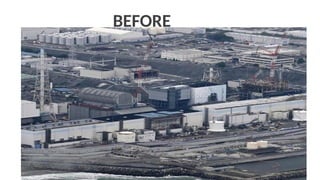
• The FukushimaNuclear Power Plant, officially known as Fukushima Daiichi, is
located in the town of Okuma in Fukushima Prefecture, Japan constructed in
1967, and commissioned in 1971.
• The facility originally consisted of six boiling water reactors (BWRs), with
Units 1 to 5 operational by the late 1970s and Unit 6 coming online in 1986.
• The plant was operated by the Tokyo Electric Power Company (TEPCO) and
its primary purpose was to generate electricity particularly in the Tokyo
metropolitan area as it was seen as a key component of Japan's energy
strategy, providing a stable and low-carbon source of electricity.
• The nuclear power accident occurred on 11 March, 2011, and was primarily
caused by a combination of natural disasters and system failures.
4.
…
• Nuclear powerwas seen as a key component of Japan's energy
strategy, providing a stable and low-carbon source of electricity.
• The plant was designed to contribute to energy security and reduce
reliance on fossil fuels, especially in the context of Japan's limited
domestic energy resources
5.
Main causes ofthe accident
Natural disasters
• Earthquake: The magnitude 9.0 Tohoku earthquake struck off the coast
of great East- Japan, triggering automatic shutdown protocols in the
reactors. (Chan, 2011), (Aladesote, 2020).
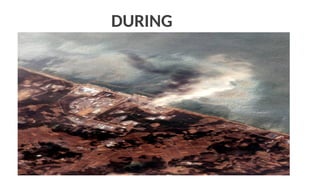
• Tsunami : A 15-meter tsunami followed the earthquake and it disabled
all Alternating Current (AC) power to units 1, 2, and 3. It also carried
away fuel tanks for EDGs (Emergency Diesel Generators), thereby
crippling backup power systems. (Chan, 2011).
System failures
• Loss of power: the earthquake led to the total loss of AC power, which
was was crucial for cooling and maintaining reactor stability
6.
…
• Failure ofCooling Systems: Water injection into the emergency core cooling
systems of Units 1, 2, and 3 failed. This led to fuel core meltdowns and the release
of radioactive materials (Chan, 2011)
• Hydrogen Explosions: As the cooling systems failed, hydrogen gas accumulated
within the reactor buildings. This buildup resulted in multiple hydrogen explosions
that damaged the reactor structures and further compromised safety measures
Emergency Response Issues
• Ineffective Emergency Measures: Despite efforts to inject seawater into the
reactors to cool them down, the failures compounded, leading to the inability to
maintain proper cooling and containment of radioactive materials
• Delayed Reaction: The response to the emergency was hampered by the
catastrophic nature of the events, making it difficult for operators to implement
effective safety protocols quickly (Taniguchi, 2017).
7.
Environmental Impact
Radioactive Contamination
•Release of radioactive materials into the environment via air and seawater
(Chan, 2011).
• Major nuclides released included iodine-131, cesium-134, and cesium-137
(Hachiya, 2016).
• The deposition of these materials resulted in high ambient radiation doses
around the plant (Hachiya, 2016).
Impact on Ecosystems
• Contamination of soil, water, and marine ecosystems (Wilson, 2021).
• The fisheries and aquaculture industries were suspended due to high radio-
cesium levels in coastal waters (Wilson, 2021).
8.
…
• Daily radiationtesting of fisheries products was implemented, and the
industry tentatively resumed once radiation levels dropped below 50
Bq/kg (Wilson, 2021).
• Sedimentation characteristics of caesium isotopes and their deposition
out to sea mediated the recovery of the fisheries industry (Wilson, 2021).
Long-Term Monitoring
• Continued monitoring and characterization of radioactivity levels in the
environment (Yamashita, 2014).
• This is vital for informed decision-making regarding living in contaminated
areas and returning to evacuated areas (Yamashita, 2014).
• Radioisotope tracer applications for source identification (Yang, 2019).
9.
Health Impact
Direct andIndirect Health Effects
• No acute radiation injuries were reported in the immediate aftermath
(Yamashita, 2014).
• However, the accident led to diverse health effects due to radiation
exposure and changes in lifestyle and social environment (Ito, 2024).
• Indirect health effects included increased mortality among elderly
people during evacuation and in temporary housing (Yoshida, 2020),
(Sawano, 2021), (Fairlie, 2015).
• Increased risk of diseases and mental health issues (Yoshida, 2020).
10.
…
Psychological and LifestyleConsiderations
• Evacuation caused severe psychological distress among residents from evacuation
zones (Hasegawa, 2016).
• Psychiatric problems and lifestyle-related issues such as increased rates of being
overweight, hypertension, diabetes, and dyslipidemia (Hasegawa, 2016).
• These issues may lead to increased cardiovascular disease risk in the future
(Hasegawa, 2016).
• Long-term mental health consequences, including post-traumatic stress disorder,
anxiety, and mood disorders (Shigemura, 2021).
• Stigmatization and discrimination against affected populations (Shigemura, 2021).
11.
…
Fukushima Health ManagementSurvey
• Implementation of the Fukushima Health Management Survey to
monitor the health of residents (Yamashita, 2014).
• The survey includes a basic survey for estimating external doses
received during the first four months after the accident (Yamashita,
2014).
• More detailed surveys include thyroid ultrasound examination,
comprehensive health check-ups, mental health and lifestyle surveys,
and surveys of pregnant women and nursing mothers (Yamashita,
2014).
12.
Social Impact
Evacuation andDisplacement
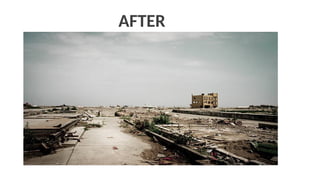
• Approximately 150,000 residents were ordered to evacuate following the
accident (Hori, 2020).
• Evacuation led to the loss of homes, jobs, and disrupted family ties
(Yoshida, 2020).
• Weakening of traditional family support systems and increased social
isolation of the elderly (Yoshida, 2020).
Community Disruption
• The destruction of the local infrastructure on which the safety system
depended (Yamashita, 2014).
13.
…
• Challenges inrebuilding medical, welfare, and commercial
infrastructure and services (Hori, 2020).
• Loss of emotional ties and disruption of mutually dependent social
networks (Hori, 2020).
Social and Economic Status
• High internal radiation exposure was associated with low socio-
economic status (Sawano, 2019).
• Decline in social support, poverty, and social isolation exacerbated the
impact on vulnerable groups (Sawano, 2019).
• The need to strengthen linkages between local government and
welfare service providers to increase social support (Sawano, 2019).
14.
Economic Impact
Direct EconomicLosses
• The economic impact of the nuclear power plant accident was estimated at
approximately 25 trillion yen ($300 billion) (Aladesote, 2020).
• Suspension of fisheries and aquaculture industries led to significant
economic losses (Wilson, 2021).
• Decline in land prices due to radioactive contamination (Managi, 2016).
Long-Term Economic Effects
• Continued domestic and international economic impact due to the stigma of
Fukushima radiation (Wilson, 2021).
• Challenges in restoring consumer confidence in agricultural and food
products from the affected region (Bachev, 2014).
15.
…
• Increased costsfor decontamination, compensation, and
decommissioning of the nuclear plant (Bachev, 2014).
Energy Policy Shifts
• The Fukushima disaster led to a global review of nuclear power
policies (Fam, 2012).
• Germany declared a complete phasing out of its nuclear reactors by
2022 (Fam, 2012).
• Other countries, such as Switzerland and France, also rethought their
nuclear programs (Fam, 2012), (Elliott, 2012).
• However, rapid denuclearization may lead to increased reliance on
fossil fuels and greater greenhouse gas emissions (Fam, 2012).
16.
Lessons Learned
Safety andRegulation
• The Fukushima accident highlighted the importance of robust safety
standards and regulatory oversight (Cochran, 2012).
• Need for improved risk assessment and disaster preparedness (Bachev,
2021), (Bachev, 2019).
• The importance of considering diverse hazards and multiple effects of
potential disasters (Bachev, 2021).
• Modernization of property rights, regulations, safety standards, and
norms (Bachev, 2021).
• Enhancing the capability of responsible public authorities and improving
coordination between diverse actors (Bachev, 2021).
17.
…
Emergency Response
• Theaccident revealed the need for better emergency response planning and
coordination (, 2012).
• Importance of clear and timely communication with the public (Ohno,
2015), (Sato, 2024).
• The necessity of providing accurate information about radiation risks and
protective measures (Ohno, 2015).
• The need for efficient evacuation procedures and support for evacuees
(Hasegawa, 2016), (Sawano, 2021).
Public Health Management
• The importance of long-term health monitoring and management for
affected populations (Yamashita, 2014).
18.
…
• Need formental health support and interventions to address
psychological distress (Shigemura, 2021).
• The importance of addressing the social and economic factors that
exacerbate the impact on vulnerable groups (Sawano, 2019).
International Cooperation
• The Fukushima disaster underscored the need for international
cooperation in nuclear safety and emergency response (Forrester, 2011).
• Sharing of lessons learned and best practices to prevent future accidents
(Mukhopadhyay, 2014).
• The role of international organizations in providing assistance and
support to affected countries (Brown, 2016).
19.
Conclusion
• The Fukushimanuclear disaster resulted from a combination of
natural disasters and systemic failures at the plant.
• The accident has highlighted the complexities surrounding radiation
exposure, medical countermeasures, and the psychological impacts of
such disasters.
• The environmental and health impacts are profound and will require
ongoing study and mitigation efforts to address both immediate and
long-term consequences.
20.
REFERENCES
Chan, Chang-Chuan andChen, Ya-mei (2011) 'A Fukushima-Like Nuclear Crisis in Taiwan or a
Nonnuclear Taiwan?', None. Available at: https://doi.org/10.1215/18752160-1415560
[Accessed 7 March 2025].
Aladesote, Olatunde J (2020) 'Fukushima Daiichi Nuclear Power Plant Accident Impact on
Okuma Japan and Assessment of Ethics, Risk Analysis and Mitigation', None. Available at:
https://doi.org/None [Accessed 7 March 2025].
Taniguchi, Taketoshi and Shiroyama, H. (2017) 'Long-term and Cross-sectoral Management of
Interconnected Events: The Case of the Fukushima Nuclear Accident', None. Available at:
https://doi.org/10.17265/2328-2134/2017.09.001 [Accessed 7 March 2025].
Ezra, John Kalef (2023) 'Chernobyl and Fukushima nuclear accidents: similarities and
differences', None. Available at: https://doi.org/10.12681/hnpsanp.5094 [Accessed 7 March
2025].
Hachiya, M. and Akashi, M. (2016) 'Lessons Learned from the Accident at the Fukushima Dai-
ichi Nuclear Power Plant-More than Basic Knowledge: Education and its Effects Improve the
Preparedness and Response to Radiation Emergency.', Radiation Protection Dosimetry.
Available at: https://doi.org/10.1093/rpd/ncw182 [Accessed 7 March 2025].
21.
…
Wilson, Peter W.,Park, T. L., Harrison-Day, Beatrice, Hinton, D., Nilssen, Laura, Rose, M., and
Isles, Stuart (2021) 'Environmental and Economic Recovery Post-Fukushima Daiichi Nuclear
Disaster: Isotope Characteristics and the Recovery of a Crippled Fisheries Industry', None.
Available at: https://doi.org/10.9734/JSRR/2021/V27I430378 [Accessed 7 March 2025].
Yamashita, S. (2014) 'Tenth Warren K. Sinclair Keynote AddressThe Fukushima Nuclear Power
Plant Accident and Comprehensive Health Risk Management', Health Physics. Available at:
https://doi.org/10.1097/HP.0000000000000007 [Accessed 7 March 2025].
Yang, Guosheng, Hu, Jun, and Zheng, Jian (2019) 'Environmental impact and food safety in
Japan after the Fukushima Daiichi Nuclear Power Plant accident', None. Available at:
https://doi.org/10.3760/CMA.J.ISSN.1673-4114.2019.02.001 [Accessed 7 March 2025].
Ito, Naomi (2024) 'Prolonged impact of the Fukushima Nuclear Power Plant Accident on
health and society', Open Access Government. Available at: https://doi.org/10.56367/oag-
041-11215 [Accessed 7 March 2025].
Yoshida, Izumi, Morita, T., Ishii, Takeaki, Leppold, C., and Tsubokura, M. (2020) 'Minimizing
Isolation of the Elderly Following the Fukushima Nuclear Power Plant Disaster', Disaster
Medicine and Public Health Preparedness. Available at:
https://doi.org/10.1017/dmp.2020.36 [Accessed 7 March 2025].

![REFERENCES
Chan, Chang-Chuan and Chen, Ya-mei (2011) 'A Fukushima-Like Nuclear Crisis in Taiwan or a
Nonnuclear Taiwan?', None. Available at: https://doi.org/10.1215/18752160-1415560
[Accessed 7 March 2025].
Aladesote, Olatunde J (2020) 'Fukushima Daiichi Nuclear Power Plant Accident Impact on
Okuma Japan and Assessment of Ethics, Risk Analysis and Mitigation', None. Available at:
https://doi.org/None [Accessed 7 March 2025].
Taniguchi, Taketoshi and Shiroyama, H. (2017) 'Long-term and Cross-sectoral Management of
Interconnected Events: The Case of the Fukushima Nuclear Accident', None. Available at:
https://doi.org/10.17265/2328-2134/2017.09.001 [Accessed 7 March 2025].
Ezra, John Kalef (2023) 'Chernobyl and Fukushima nuclear accidents: similarities and
differences', None. Available at: https://doi.org/10.12681/hnpsanp.5094 [Accessed 7 March
2025].
Hachiya, M. and Akashi, M. (2016) 'Lessons Learned from the Accident at the Fukushima Dai-
ichi Nuclear Power Plant-More than Basic Knowledge: Education and its Effects Improve the
Preparedness and Response to Radiation Emergency.', Radiation Protection Dosimetry.
Available at: https://doi.org/10.1093/rpd/ncw182 [Accessed 7 March 2025].](https://image.slidesharecdn.com/fukushimagp2-250507033552-31e73f21/85/Fukushima-Nuclear-Power-DisasterGp2-pptx-20-320.jpg)
![…
Wilson, Peter W., Park, T. L., Harrison-Day, Beatrice, Hinton, D., Nilssen, Laura, Rose, M., and
Isles, Stuart (2021) 'Environmental and Economic Recovery Post-Fukushima Daiichi Nuclear
Disaster: Isotope Characteristics and the Recovery of a Crippled Fisheries Industry', None.
Available at: https://doi.org/10.9734/JSRR/2021/V27I430378 [Accessed 7 March 2025].
Yamashita, S. (2014) 'Tenth Warren K. Sinclair Keynote AddressThe Fukushima Nuclear Power
Plant Accident and Comprehensive Health Risk Management', Health Physics. Available at:
https://doi.org/10.1097/HP.0000000000000007 [Accessed 7 March 2025].
Yang, Guosheng, Hu, Jun, and Zheng, Jian (2019) 'Environmental impact and food safety in
Japan after the Fukushima Daiichi Nuclear Power Plant accident', None. Available at:
https://doi.org/10.3760/CMA.J.ISSN.1673-4114.2019.02.001 [Accessed 7 March 2025].
Ito, Naomi (2024) 'Prolonged impact of the Fukushima Nuclear Power Plant Accident on
health and society', Open Access Government. Available at: https://doi.org/10.56367/oag-
041-11215 [Accessed 7 March 2025].
Yoshida, Izumi, Morita, T., Ishii, Takeaki, Leppold, C., and Tsubokura, M. (2020) 'Minimizing
Isolation of the Elderly Following the Fukushima Nuclear Power Plant Disaster', Disaster
Medicine and Public Health Preparedness. Available at:
https://doi.org/10.1017/dmp.2020.36 [Accessed 7 March 2025].](https://image.slidesharecdn.com/fukushimagp2-250507033552-31e73f21/85/Fukushima-Nuclear-Power-DisasterGp2-pptx-21-320.jpg)