Community-based Comprehensive Recovery:
Closing collaboration gaps in
urban disaster recovery
Martijn Neef, Kees van Dongen, Marijn Rijken
TNO Innovation for Life
The Netherlands
10th International Conference on
Information Systems for Crisis Response
and Management, 12-15 May 2013
Baden-Baden, Germany.
2
Community-based Comprehensive Recovery:
Closing collaboration gaps in
urban disaster recovery
Urban disaster recovery
Collaboration gaps
Innovation pathways
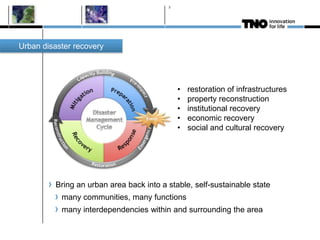
Bring an urban area back into a stable, self-sustainable state
many communities, many functions
many interdependencies within and surrounding the area
3
Urban disaster recovery
• restoration of infrastructures
• property reconstruction
• institutional recovery
• economic recovery
• social and cultural recovery
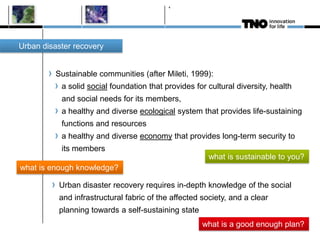
Sustainable communities (after Mileti, 1999):
a solid social foundation that provides for cultural diversity, health
and social needs for its members,
a healthy and diverse ecological system that provides life-sustaining
functions and resources
a healthy and diverse economy that provides long-term security to
its members
4
Urban disaster recovery
Urban disaster recovery requires in-depth knowledge of the social
and infrastructural fabric of the affected society, and a clear
planning towards a self-sustaining state
what is sustainable to you?
what is enough knowledge?
what is a good enough plan?
Communities
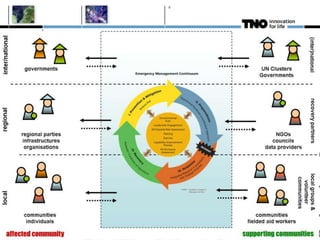
Disaster response and recovery is by default a community-effort
professional communities, social communities, informal communities
sustained communities, temporary communities …
5
community
community
community
communitycommunity
affected supporting
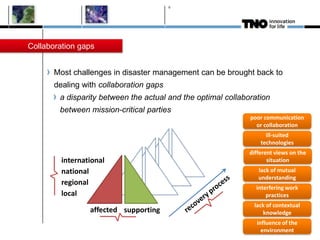
Most challenges in disaster management can be brought back to
dealing with collaboration gaps
a disparity between the actual and the optimal collaboration
between mission-critical parties
6
local
regional
national
international
poor communication
or collaboration
ill-suited
technologies
lack of mutual
understanding
interfering work
practices
lack of contextual
knowledge
influence of the
environment
different views on the
situation
Collaboration gaps
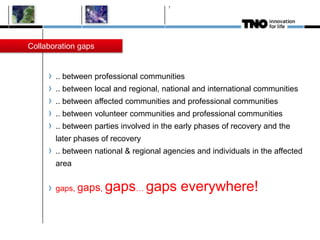
.. between professional communities
.. between local and regional, national and international communities
.. between affected communities and professional communities
.. between volunteer communities and professional communities
.. between parties involved in the early phases of recovery and the
later phases of recovery
.. between national & regional agencies and individuals in the affected
area
gaps, gaps, gaps… gaps everywhere!
7
Collaboration gaps
OCHA Policy and Studies Series - Humanitarianism in the Network Age (2013)
In rich and poor countries, people are connecting through technology at an accelerating
pace. … Some see great opportunities; many face uncertainty. But everyone agrees that
technology has changed how people interact and how power is distributed.
This report explores how new ways of interacting are bringing people in need closer to
people who can help. It responds to the changing needs and practices of communities,
volunteers and frontline responders. It tells the story of agencies listening to their
demands for change and responding creatively. ..
Its conclusions suggest a fundamental shift in power from capitals and headquarters to the
people aid agencies aim to assist. For some, this is an unsettling prospect. It calls for
more diverse and bottom-up forms of decision-making—something that most
Governments and humanitarian organizations were not designed for.
8
Collaboration gaps
Two innovation pathways to close the gaps:
improve community-wide collaboration building
a comprehensive approach in needs-assessment and recovery
planning.
Different, but synergetic!
9
Innovation pathways
Pathway: improve collaboration building
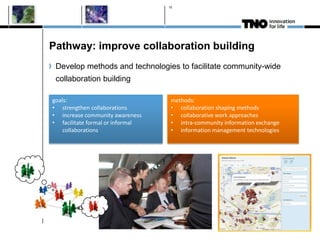
Develop methods and technologies to facilitate community-wide
collaboration building
10
goals:
• strengthen collaborations
• increase community awareness
• facilitate formal or informal
collaborations
methods:
• collaboration shaping methods
• collaborative work approaches
• intra-community information exchange
• information management technologies
Pathway: stimulate a comprehensive approach
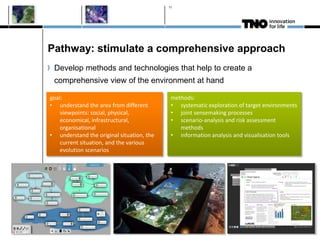
Develop methods and technologies that help to create a
comprehensive view of the environment at hand
11
goal:
• understand the area from different
viewpoints: social, physical,
economical, infrastructural,
organisational
• understand the original situation, the
current situation, and the various
evolution scenarios
methods:
• systematic exploration of target environments
• joint sensemaking processes
• scenario-analysis and risk assessment
methods
• information analysis and visualisation tools
12
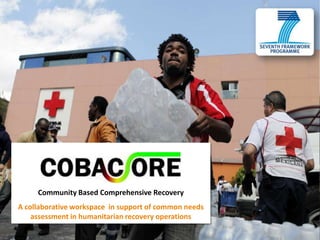
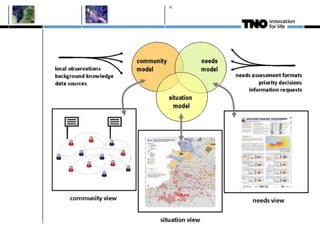
Community Based Comprehensive Recovery
A collaborative workspace in support of common needs
assessment in humanitarian recovery operations
13
1 april 2013 – 31 march 2016
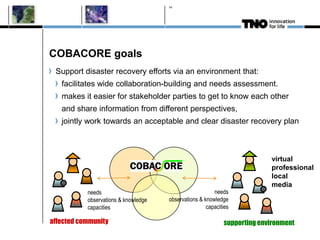
COBACORE goals
Support disaster recovery efforts via an environment that:
facilitates wide collaboration-building and needs assessment.
makes it easier for stakeholder parties to get to know each other
and share information from different perspectives,
jointly work towards an acceptable and clear disaster recovery plan
14
affected community supporting environment
needs
observations & knowledge
capacities
needs
observations & knowledge
capacities
virtual
professional
local
media
15
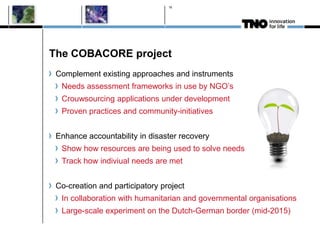
The COBACORE project
Complement existing approaches and instruments
Needs assessment frameworks in use by NGO’s
Crouwsourcing applications under development
Proven practices and community-initiatives
Enhance accountability in disaster recovery
Show how resources are being used to solve needs
Track how indiviual needs are met
Co-creation and participatory project
In collaboration with humanitarian and governmental organisations
Large-scale experiment on the Dutch-German border (mid-2015)
16
Thank you for your attention!
Martijn Neef
Networked Organizations Group
TNO Innovation for Life
The Hague, The Netherlands
e-mail: martijn.neef@tno.nl
17

ISCRAM 2013: Community-based Comprehensive Recovery Closing collaboration gaps in urban disaster recovery

  • 1.
    Community-based Comprehensive Recovery: Closingcollaboration gaps in urban disaster recovery Martijn Neef, Kees van Dongen, Marijn Rijken TNO Innovation for Life The Netherlands 10th International Conference on Information Systems for Crisis Response and Management, 12-15 May 2013 Baden-Baden, Germany.
  • 2.
    2 Community-based Comprehensive Recovery: Closingcollaboration gaps in urban disaster recovery Urban disaster recovery Collaboration gaps Innovation pathways
  • 3.
    Bring an urbanarea back into a stable, self-sustainable state many communities, many functions many interdependencies within and surrounding the area 3 Urban disaster recovery • restoration of infrastructures • property reconstruction • institutional recovery • economic recovery • social and cultural recovery
  • 4.
    Sustainable communities (afterMileti, 1999): a solid social foundation that provides for cultural diversity, health and social needs for its members, a healthy and diverse ecological system that provides life-sustaining functions and resources a healthy and diverse economy that provides long-term security to its members 4 Urban disaster recovery Urban disaster recovery requires in-depth knowledge of the social and infrastructural fabric of the affected society, and a clear planning towards a self-sustaining state what is sustainable to you? what is enough knowledge? what is a good enough plan?
  • 5.
    Communities Disaster response andrecovery is by default a community-effort professional communities, social communities, informal communities sustained communities, temporary communities … 5 community community community communitycommunity
  • 6.
    affected supporting Most challengesin disaster management can be brought back to dealing with collaboration gaps a disparity between the actual and the optimal collaboration between mission-critical parties 6 local regional national international poor communication or collaboration ill-suited technologies lack of mutual understanding interfering work practices lack of contextual knowledge influence of the environment different views on the situation Collaboration gaps
  • 7.
    .. between professionalcommunities .. between local and regional, national and international communities .. between affected communities and professional communities .. between volunteer communities and professional communities .. between parties involved in the early phases of recovery and the later phases of recovery .. between national & regional agencies and individuals in the affected area gaps, gaps, gaps… gaps everywhere! 7 Collaboration gaps
  • 8.
    OCHA Policy andStudies Series - Humanitarianism in the Network Age (2013) In rich and poor countries, people are connecting through technology at an accelerating pace. … Some see great opportunities; many face uncertainty. But everyone agrees that technology has changed how people interact and how power is distributed. This report explores how new ways of interacting are bringing people in need closer to people who can help. It responds to the changing needs and practices of communities, volunteers and frontline responders. It tells the story of agencies listening to their demands for change and responding creatively. .. Its conclusions suggest a fundamental shift in power from capitals and headquarters to the people aid agencies aim to assist. For some, this is an unsettling prospect. It calls for more diverse and bottom-up forms of decision-making—something that most Governments and humanitarian organizations were not designed for. 8 Collaboration gaps
  • 9.
    Two innovation pathwaysto close the gaps: improve community-wide collaboration building a comprehensive approach in needs-assessment and recovery planning. Different, but synergetic! 9 Innovation pathways
  • 10.
    Pathway: improve collaborationbuilding Develop methods and technologies to facilitate community-wide collaboration building 10 goals: • strengthen collaborations • increase community awareness • facilitate formal or informal collaborations methods: • collaboration shaping methods • collaborative work approaches • intra-community information exchange • information management technologies
  • 11.
    Pathway: stimulate acomprehensive approach Develop methods and technologies that help to create a comprehensive view of the environment at hand 11 goal: • understand the area from different viewpoints: social, physical, economical, infrastructural, organisational • understand the original situation, the current situation, and the various evolution scenarios methods: • systematic exploration of target environments • joint sensemaking processes • scenario-analysis and risk assessment methods • information analysis and visualisation tools
  • 12.
    12 Community Based ComprehensiveRecovery A collaborative workspace in support of common needs assessment in humanitarian recovery operations
  • 13.
    13 1 april 2013– 31 march 2016
  • 14.
    COBACORE goals Support disasterrecovery efforts via an environment that: facilitates wide collaboration-building and needs assessment. makes it easier for stakeholder parties to get to know each other and share information from different perspectives, jointly work towards an acceptable and clear disaster recovery plan 14 affected community supporting environment needs observations & knowledge capacities needs observations & knowledge capacities virtual professional local media
  • 15.
  • 16.
    The COBACORE project Complementexisting approaches and instruments Needs assessment frameworks in use by NGO’s Crouwsourcing applications under development Proven practices and community-initiatives Enhance accountability in disaster recovery Show how resources are being used to solve needs Track how indiviual needs are met Co-creation and participatory project In collaboration with humanitarian and governmental organisations Large-scale experiment on the Dutch-German border (mid-2015) 16
  • 17.
    Thank you foryour attention! Martijn Neef Networked Organizations Group TNO Innovation for Life The Hague, The Netherlands e-mail: martijn.neef@tno.nl 17

Editor's Notes

  • #2 Effective disaster management is driven by the ability to form the right type of collaborations between communities at the right time, in the right form, and with properly articulated intentions and mutual understanding of capabilities and constraints.