HOME SCIENCE
MODULE - 1
Home Science in Daily Life
142
Notes
Care and Maintenance of Fabrics
9
CARE AND MAINTENANCE
OF FABRICS
Agroupofstudentswerechattingduringlunchbreak.CharlescomplimentedJoseph
forhisfavouritesparklingwhiteshirtthattheyhadbroughttogetheralmosttwoyears
ago.JustthenPurnimasaidthatshewasveryunhappyabouttheconditionofhersilk
blouse after one washing.Akbar said he too could not wear his expensive pure wool
cardigan after the first wash. Then Kabir told them that he has acquired knowledge
regardingcareofdifferenttypesoffabricsinahousekeepingcourse.Hetoldthemthat
theyshouldnotwashalltypesoffabricswithonedetergent.Hefurtheraddedthatthere
aredifferent methods of washing and finishing different types of clothes. He advised
that a little care can keep their favourite dress as good as new.
Do you know that clothes speak volumes about the wearer’s personality? It is good
to select clothes carefully. But even more important is to wash and finish them
regularly for a well groomed appearance. Let us learn how to take care of clothes so
that we have no regrets later.
OBJECTIVES
After reading this lesson you will be able to do the following:
l explain the meaning and need of brushing, airing and laundering your clothes;
l remove stains using appropriate reagents and techniques;
l check care labels and colour fastness of your clothes before washing;
l launderdifferentfabricsusingappropriatecleaningmethodsandfinishingagents
and;
l store laundered clothes suitably.
MODULE - 1
Home Science in Daily Life
143
HOME SCIENCE
Notes
Care and Maintenance of Fabrics
9.1 ROLE OF SHAKING, BRUSHING, AIRING AND
LAUNDERING CLOTHES IN CARE AND
MAINTENANCE OF FABRICS
We all know that when we wear clothes they become dirty and need laundering.The
dirtisdue tostains,dust,greaseandperspiration.Whenleftonfabrics,thesecanlead
to the following damages:
l Stains and dirt on clothes become medium for the growth of bacteria, fungus or
other harmful organisms which may lead to skin problems and poor personal
hygiene.
l Dirty clothes lose their freshness and smell unpleasant.
l Left on clothes the dirt and stains reduce the strength of the fabric.
l No one feels good wearing stained and dirty clothes.
Clothes need not be washed every time they are worn. It depends on the weather in
which these have been worn and how much sweat they have absorbed. When the
weather is good and you do not sweat, you can safely reuse your clothes. But before
puttingthemawayforreusekeepthefollowingstepsinmindtomaintainyourclothes.
9.1.1 Shaking, Brushing and Airing
‘Shaking’ helps in removing loose dust from the fabric. Hold the dress with both
hands and shake it vigorously.
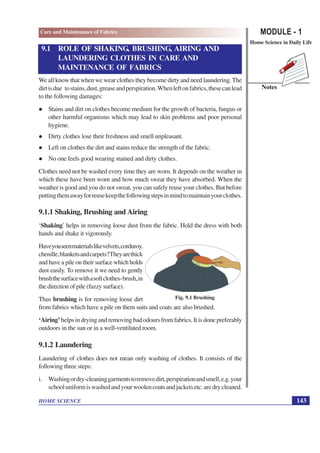
Haveyouseenmaterialslikevelvets,corduroy,
chenille,blanketsandcarpets?Theyarethick
and have a pile on their surface which holds
dust easily. To remove it we need to gently
brushthesurfacewithasoftclothes-brush,in
the direction of pile (fuzzy surface).
Thus brushing is for removing loose dirt
from fabrics which have a pile on them suits and coats are also brushed.
‘Airing’ helps in drying and removing bad odours from fabrics. It is done preferably
outdoors in the sun or in a well-ventilated room.
9.1.2 Laundering
Laundering of clothes does not mean only washing of clothes. It consists of the
following three steps:
i. Washingordry-cleaninggarmentstoremovedirt,perspirationandsmell,e.g.your
schooluniformiswashedandyourwoolencoatsandjacketsetc.aredrycleaned.
Fig. 9.1 Brushing
HOME SCIENCE
MODULE - 1
Home Science in Daily Life
144
Notes
Care and Maintenance of Fabrics
ii. Finishingthegarmentswithstiffeningagentslikestarchandgum,brighteningor
bleaching agents, drying them then ironing or pressing, folding and hanging
garments, e.g. cotton dupattas and sarees are starched.
iii. Storing the garments for a short or long time, e.g. when the winter season arrives
you put away summer clothes and take out woolen shawls, sweaters, coats etc.
Remember, washing and dry cleaning are two different processes used for
cleaning different types of clothes.
Washing Dry-cleaning
Means removing dirt using soap/ Means removing dirt using grease
detergent and water. absorbents and solvents.
Colourfast fabrics can be easily washed. Leather and fur, selected silks and
woolens, zari and other costly fabrics
are dry cleaned.
INTEXT QUESTIONS 9.1
1. Meenahasabasketfullofsoiledclothes.Theseincludehersilkblouse,zarisaree,
cotton shirt, cotton payjama and woolen shawl. Which of these would you
recommend her to wash at home and which clothes should she send for dry
cleaning? Why?
__________________________________________________________
__________________________________________________________
2. Summerseasonhasset;youhavetoputawaythewinterclothes.Whatstepswould
you suggest to your friend to ensure that his clothes are clean and ready to store
till the next season?
__________________________________________________________
__________________________________________________________9.2
9.2 GETTING READY TO LAUNDER CLOTHES AT HOME
Whenever you are ready to launder clothes at home remember that there are certain
preparations required. What are these? Why are these preparations necessary? How
and what we need to do, let us find out.
MODULE - 1
Home Science in Daily Life
145
HOME SCIENCE
Notes
Care and Maintenance of Fabrics
9.2.1 Collection of clothes and supplies:
If you have a set place to keep your dirty clothes and supplies for washing, then this
stepisalreadytakencareof.Ifnotthencollectallthedirtyclothesandsuppliesneeded
forwashing,atoneplace.Ithelpstoconserveenergywhilewashing.Canyouexplain
how?
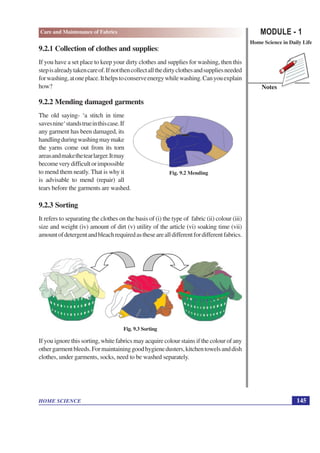
9.2.2 Mending damaged garments
The old saying- ‘a stitch in time
savesnine‘standstrueinthiscase.If
any garment has been damaged, its
handlingduringwashingmaymake
the yarns come out from its torn
areasandmakethetearlarger.Itmay
becomeverydifficultorimpossible
to mend them neatly. That is why it
is advisable to mend (repair) all
tears before the garments are washed.
9.2.3 Sorting
It refers to separating the clothes on the basis of (i) the type of fabric (ii) colour (iii)
size and weight (iv) amount of dirt (v) utility of the article (vi) soaking time (vii)
amountofdetergentandbleachrequiredasthesearealldifferentfordifferentfabrics.
Fig. 9.3 Sorting
If you ignore this sorting, white fabrics may acquire colour stains if the colour of any
othergarmentbleeds.Formaintaininggoodhygienedusters,kitchentowelsanddish
clothes, under garments, socks, need to be washed separately.
Fig. 9.2 Mending
HOME SCIENCE
MODULE - 1
Home Science in Daily Life
146
Notes
Care and Maintenance of Fabrics
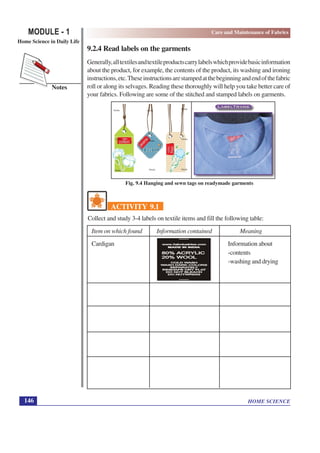
9.2.4 Read labels on the garments
Generally,alltextilesandtextileproductscarrylabelswhichprovidebasicinformation
about the product, for example, the contents of the product, its washing and ironing
instructions,etc.Theseinstructionsarestampedatthebeginningandendofthefabric
roll or along its selvages. Reading these thoroughly will help you take better care of
your fabrics. Following are some of the stitched and stamped labels on garments.
Fig. 9.4 Hanging and sewn tags on readymade garments
ACTIVITY 9.1
Collect and study 3-4 labels on textile items and fill the following table:
Item on which found Information contained Meaning
Cardigan Information about
-contents
-washing and drying
MODULE - 1
Home Science in Daily Life
147
HOME SCIENCE
Notes
Care and Maintenance of Fabrics
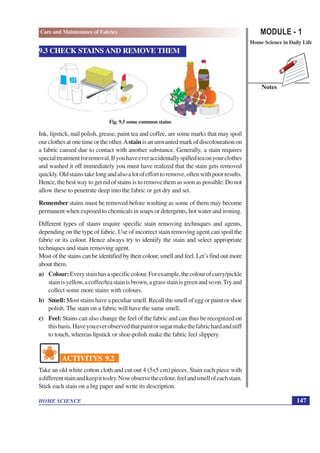
9.3 CHECK STAINS AND REMOVE THEM
Fig. 9.5 some common stains
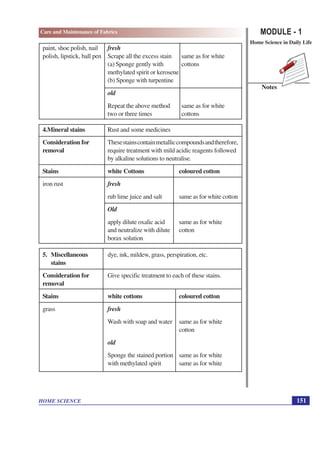
Ink, lipstick, nail polish, grease, paint tea and coffee, are some marks that may spoil
ourclothesatonetimeortheother.Astainisanunwantedmarkofdiscolourationon
a fabric caused due to contact with another substance. Generally, a stain requires
specialtreatmentforremoval.Ifyouhaveeveraccidentallyspilledteaonyourclothes
and washed it off immediately you must have realized that the stain gets removed
quickly.Oldstainstakelongandalsoalotofefforttoremove,oftenwithpoorresults.
Hence, the best way to get rid of stains is to remove them as soon as possible. Do not
allow these to penetrate deep into the fabric or get dry and set.
Remember stains must be removed before washing as some of them may become
permanent when exposed to chemicals in soaps or detergents, hot water and ironing.
Different types of stains require specific stain removing techniques and agents,
depending on the type of fabric. Use of incorrect stain removing agent can spoil the
fabric or its colour. Hence always try to identify the stain and select appropriate
techniques and stain removing agent.
Most of the stains can be identified by their colour, smell and feel. Let’s find out more
about them.
a) Colour:Everystainhasaspecificcolour.Forexample,thecolourofcurry/pickle
stainisyellow,acoffee/teastainisbrown,agrassstainisgreenandsoon.Tryand
collect some more stains with colours.
b) Smell: Most stains have a peculiar smell. Recall the smell of egg or paint or shoe
polish. The stain on a fabric will have the same smell.
c) Feel: Stains can also change the feel of the fabric and can thus be recognized on
thisbasis.Haveyoueverobservedthatpaintorsugarmakethefabrichardandstiff
to touch, whereas lipstick or shoe-polish make the fabric feel slippery.
ACTIVITYS 9.2
Take an old white cotton cloth and cut out 4 (5x5 cm) pieces. Stain each piece with
adifferentstainandkeepittodry.Nowobservethecolour,feelandsmellofeachstain.
Stick each stain on a big paper and write its description.
HOME SCIENCE
MODULE - 1
Home Science in Daily Life
148
Notes
Care and Maintenance of Fabrics
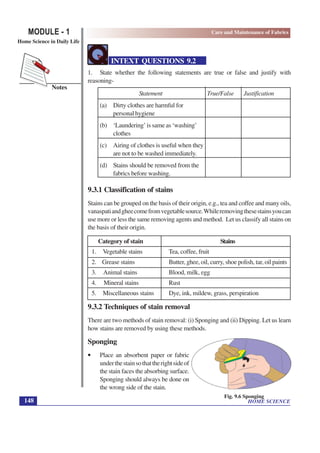
Fig. 9.6 Sponging
INTEXT QUESTIONS 9.2
1. State whether the following statements are true or false and justify with
reasoning-
Statement True/False Justification
(a) Dirty clothes are harmful for
personal hygiene
(b) ‘Laundering’ is same as ‘washing’
clothes
(c) Airing of clothes is useful when they
are not to be washed immediately.
(d) Stains should be removed from the
fabrics before washing.
9.3.1 Classification of stains
Stains can be grouped on the basis of their origin, e.g., tea and coffee and many oils,
vanaspatiandgheecomefromvegetablesource.Whileremovingthesestainsyoucan
use more or less the same removing agents and method. Let us classify all stains on
the basis of their origin.
Category of stain Stains
1. Vegetable stains Tea, coffee, fruit
2. Grease stains Butter, ghee, oil, curry, shoe polish, tar, oil paints
3. Animal stains Blood, milk, egg
4. Mineral stains Rust
5. Miscellaneous stains Dye, ink, mildew, grass, perspiration
9.3.2 Techniques of stain removal
There are two methods of stain removal: (i) Sponging and (ii) Dipping. Let us learn
how stains are removed by using these methods.
Sponging
• Place an absorbent paper or fabric
underthestainsothattherightsideof
the stain faces the absorbing surface.
Sponging should always be done on
the wrong side of the stain.
MODULE - 1
Home Science in Daily Life
149
HOME SCIENCE
Notes
Care and Maintenance of Fabrics
• Takeasoftcloth,dipitinthestain-removerandgentlyrubthestainstartingfrom
its outer corner moving inwards, towards the centre.
• Use light, circular strokes as these prevent the stain from spreading.
• Theabsorbentpaperorfabric(commonlyknownasblotter)mustbechangedas
soon as it starts showing the stain.
Dipping
Dipping is the method in which the entire fabric
can be immersed in the stain removing agent. It
issuitableiftherearemanystainsoralargestain
on the fabric. We can choose the stain removing
re-agent depending upon the type of stain.
Some of the common reagents used for stain removal are borax powder, ammonia,
hydrogen peroxide, oxalic acid and ready to use bleaches.
Type of stains and method of removal
1. Vegetable stains Tea, coffee, fruit, etc.
Consideration for Use alkaline reagents such as borax powder to
removal remove stains as these are acidic in nature.
Stains White Cottons Coloured Cotton
Fresh
tea/coffee, chocolate, Pour boiling water on the Soak in warm water
fruit stain and borax (2
cups of water + ½
Old teaspoon of borax)
Dip the stained portion in Same as for white
glycerin. Or spread borax cottons
powder over stain and pour
boiling water while holding
the stained portion on the
mouth of a mug or pan.
Fig. 9.7 Dipping
HOME SCIENCE
MODULE - 1
Home Science in Daily Life
150
Notes
Care and Maintenance of Fabrics
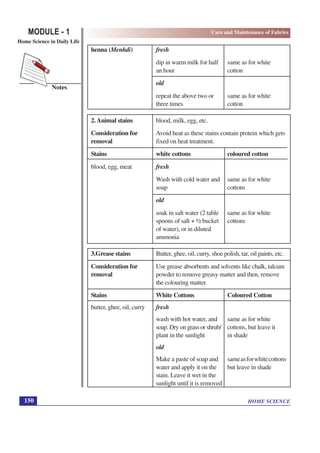
henna (Menhdi) fresh
dip in warm milk for half same as for white
an hour cotton
old
repeat the above two or same as for white
three times cotton
2. Animal stains blood, milk, egg, etc.
Consideration for Avoid heat as these stains contain protein which gets
removal fixed on heat treatment.
Stains white cottons coloured cotton
blood, egg, meat fresh
Wash with cold water and same as for white
soap cottons
old
soak in salt water (2 table same as for white
spoons of salt + ½ bucket cottons
of water), or in diluted
ammonia
3.Grease stains Butter, ghee, oil, curry, shoe polish, tar, oil paints, etc.
Consideration for Use grease absorbents and solvents like chalk, talcum
removal powder to remove greasy matter and then, remove
the colouring matter.
Stains White Cottons Coloured Cotton
butter, ghee, oil, curry fresh
wash with hot water, and same as for white
soap. Dry on grass or shrub/ cottons, but leave it
plant in the sunlight in shade
old
Make a paste of soap and sameasforwhitecottons
water and apply it on the but leave in shade
stain. Leave it wet in the
sunlight until it is removed
MODULE - 1
Home Science in Daily Life
151
HOME SCIENCE
Notes
Care and Maintenance of Fabrics
paint, shoe polish, nail fresh
polish, lipstick, ball pen Scrape all the excess stain same as for white
(a) Sponge gently with cottons
methylated spirit or kerosene
(b) Sponge with turpentine
old
Repeat the above method same as for white
two or three times cottons
4.Mineral stains Rust and some medicines
Consideration for Thesestainscontainmetalliccompoundsandtherefore,
removal require treatment with mild acidic reagents followed
by alkaline solutions to neutralise.
Stains white Cottons coloured cotton
iron rust fresh
rub lime juice and salt same as for white cotton
Old
apply dilute oxalic acid same as for white
and neutralize with dilute cotton
borax solution
5. Miscellaneous dye, ink, mildew, grass, perspiration, etc.
stains
Consideration for Give specific treatment to each of these stains.
removal
Stains white cottons coloured cotton
grass fresh
Wash with soap and water same as for white
cotton
old
Sponge the stained portion same as for white
with methylated spirit same as for white
HOME SCIENCE
MODULE - 1
Home Science in Daily Life
152
Notes
Care and Maintenance of Fabrics
betal leaf (paan) fresh
apply a paste of onions and same as for white cottons
leave in the sunlight but leave in shade
Old
repeat above method two same as for white cotton
or three times
ink Fresh
wash with soap and cold same as for white cotton
water
Old
(a) soak in sour butter milk same as for white cotton
(lassi) for half an hour except do not leave in
sun, put it in shade
(b) apply lime juice and salt
and leave in the sun
(c) bleach the stain
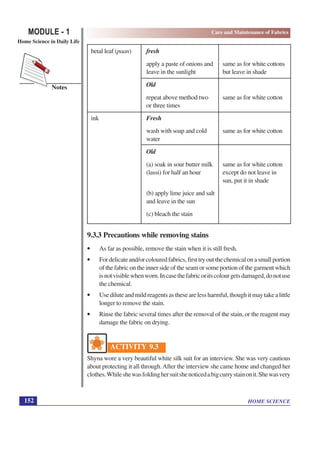
9.3.3 Precautions while removing stains
• As far as possible, remove the stain when it is still fresh.
• Fordelicateand/orcolouredfabrics,firsttryoutthechemicalonasmallportion
of the fabric on the inner side of the seam or some portion of the garment which
isnotvisiblewhenworn.Incasethefabricoritscolourgetsdamaged,donotuse
the chemical.
• Usediluteandmildreagentsasthesearelessharmful,thoughitmaytakealittle
longer to remove the stain.
• Rinse the fabric several times after the removal of the stain, or the reagent may
damage the fabric on drying.
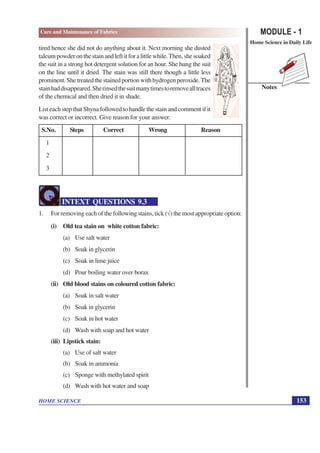
ACTIVITY 9.3
Shyna wore a very beautiful white silk suit for an interview. She was very cautious
about protecting it all through.After the interview she came home and changed her
clothes.Whileshewasfoldinghersuitshenoticedabigcurrystainonit.Shewasvery
MODULE - 1
Home Science in Daily Life
153
HOME SCIENCE
Notes
Care and Maintenance of Fabrics
tired hence she did not do anything about it. Next morning she dusted
talcumpowderonthestainandleftitforalittlewhile.Then,shesoaked
the suit in a strong hot detergent solution for an hour. She hung the suit
on the line until it dried. The stain was still there though a little less
prominent.Shetreatedthestainedportionwithhydrogenperoxide.The
stainhaddisappeared.Sherinsedthesuitmanytimestoremovealltraces
of the chemical and then dried it in shade.
List each step that Shyna followed to handle the stain and comment if it
was correct or incorrect. Give reason for your answer.
S.No. Steps Correct Wrong Reason
1
2
3
INTEXT QUESTIONS 9.3
1. For removing each of the following stains, tick (√) the most appropriate option:
(i) Old tea stain on white cotton fabric:
(a) Use salt water
(b) Soak in glycerin
(c) Soak in lime juice
(d) Pour boiling water over borax
(ii) Old blood stains on coloured cotton fabric:
(a) Soak in salt water
(b) Soak in glycerin
(c) Soak in hot water
(d) Wash with soap and hot water
(iii) Lipstick stain:
(a) Use of salt water
(b) Soak in ammonia
(c) Sponge with methylated spirit
(d) Wash with hot water and soap
HOME SCIENCE
MODULE - 1
Home Science in Daily Life
154
Notes
Care and Maintenance of Fabrics
(iv) Rust stain:
(a) Use of salt water
(b) Use lime juice and salt
(c) Soak in methylated spirit
(d) Wash with soap and cold water
(v) Nail polish stain on polyester fabric:
(a) Sponge with methylated spirit
(b) Soak in warm borax water
(c) Rub lime juice and salt
(d) Soak in warm water and soap
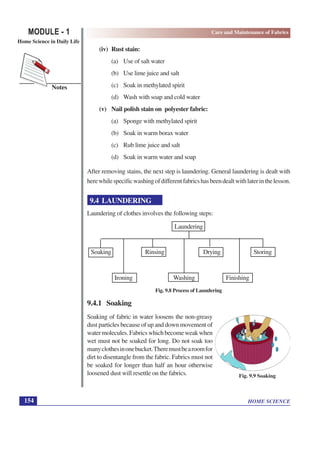
After removing stains, the next step is laundering. General laundering is dealt with
herewhilespecificwashingofdifferentfabricshasbeendealtwithlaterinthelesson.
9.4 LAUNDERING
Laundering of clothes involves the following steps:
Laundering
Soaking Rinsing Drying Storing
Ironing Washing Finishing
Fig. 9.8 Process of Laundering
9.4.1 Soaking
Soaking of fabric in water loosens the non-greasy
dust particles because of up and down movement of
watermolecules.Fabricswhichbecomeweakwhen
wet must not be soaked for long. Do not soak too
manyclothesinonebucket.Theremustbearoomfor
dirt to disentangle from the fabric. Fabrics must not
be soaked for longer than half an hour otherwise
loosened dust will resettle on the fabrics. Fig. 9.9 Soaking
MODULE - 1
Home Science in Daily Life
155
HOME SCIENCE
Notes
Care and Maintenance of Fabrics
9.4.2 Washing
As said earlier, soaked clothes must be
washed soon. The process of washing
involves removal of dirt that has been
loosened from fabrics by soaking. There
are many ways to do this and the choice
depends on the fabric being washed.You
will now learn about these methods and
theirsuitabilitytovarioustypesoffabrics.
Methods of Washing
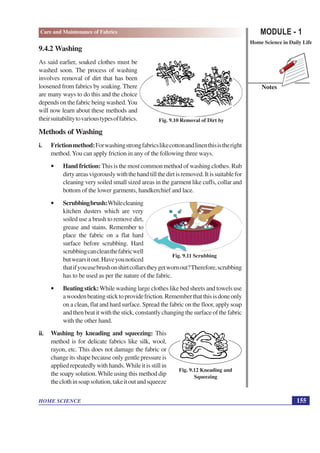
i. Frictionmethod:Forwashingstrongfabricslikecottonandlinenthisistheright
method. You can apply friction in any of the following three ways.
• Hand friction:This is the most common method of washing clothes. Rub
dirtyareasvigorouslywiththehandtillthedirtisremoved.Itissuitablefor
cleaning very soiled small sized areas in the garment like cuffs, collar and
bottom of the lower garments, handkerchief and lace.
• Scrubbingbrush:Whilecleaning
kitchen dusters which are very
soiled use a brush to remove dirt,
grease and stains. Remember to
place the fabric on a flat hard
surface before scrubbing. Hard
scrubbingcancleanthefabricwell
butwearsitout.Haveyounoticed
thatifyouusebrushonshirtcollarstheygetwornout?Therefore,scrubbing
has to be used as per the nature of the fabric.
• Beating stick:While washing large clothes like bed sheets and towels use
awoodenbeatingsticktoprovidefriction.Rememberthatthisisdoneonly
on a clean, flat and hard surface. Spread the fabric on the floor, apply soap
andthenbeatitwiththestick,constantlychangingthesurfaceofthefabric
with the other hand.
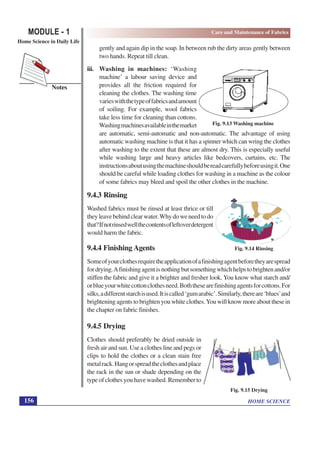
ii. Washing by kneading and squeezing: This
method is for delicate fabrics like silk, wool,
rayon, etc. This does not damage the fabric or
change its shape because only gentle pressure is
appliedrepeatedlywithhands.Whileitisstillin
the soapy solution. While using this method dip
theclothinsoapsolution,takeitoutandsqueeze
Fig. 9.10 Removal of Dirt by
Fig. 9.11 Scrubbing
Fig. 9.12 Kneading and
Squeezing
HOME SCIENCE
MODULE - 1
Home Science in Daily Life
156
Notes
Care and Maintenance of Fabrics
gently and again dip in the soap. In between rub the dirty areas gently between
two hands. Repeat till clean.
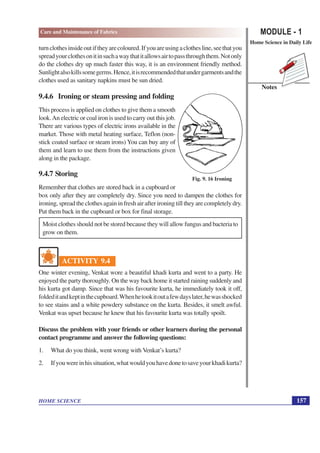
iii. Washing in machines: ‘Washing
machine’ a labour saving device and
provides all the friction required for
cleaning the clothes. The washing time
varieswiththetypeoffabricsandamount
of soiling. For example, wool fabrics
take less time for cleaning than cottons.
Washingmachinesavailableinthemarket
are automatic, semi-automatic and non-automatic. The advantage of using
automatic washing machine is that it has a spinner which can wring the clothes
after washing to the extent that these are almost dry. This is especially useful
while washing large and heavy articles like bedcovers, curtains, etc. The
instructionsaboutusingthemachineshouldbereadcarefullybeforeusingit.One
should be careful while loading clothes for washing in a machine as the colour
of some fabrics may bleed and spoil the other clothes in the machine.
9.4.3 Rinsing
Washed fabrics must be rinsed at least thrice or till
theyleavebehindclearwater.Whydoweneedtodo
that?Ifnotrinsedwellthecontentsofleftoverdetergent
would harm the fabric.
9.4.4 Finishing Agents
Someofyourclothesrequiretheapplicationofafinishingagentbeforetheyarespread
fordrying.Afinishingagentisnothingbutsomethingwhichhelpstobrightenand/or
stiffen the fabric and give it a brighter and fresher look. You know what starch and/
orblueyourwhitecottonclothesneed.Boththesearefinishingagentsforcottons.For
silks,adifferentstarchisused.Itiscalled‘gumarabic’.Similarly,thereare‘blues’and
brightening agents to brighten you white clothes.You will know more about these in
the chapter on fabric finishes.
9.4.5 Drying
Clothes should preferably be dried outside in
fresh air and sun. Use a clothes line and pegs or
clips to hold the clothes or a clean stain free
metalrack.Hangorspreadtheclothesandplace
the rack in the sun or shade depending on the
type of clothes you have washed. Remember to
Fig. 9.13 Washing machine
Fig. 9.14 Rinsing
Fig. 9.15 Drying
MODULE - 1
Home Science in Daily Life
157
HOME SCIENCE
Notes
Care and Maintenance of Fabrics
turnclothesinsideoutiftheyarecoloured.Ifyouareusingaclothesline,seethatyou
spreadyourclothesonitinsuchawaythatitallowsairtopassthroughthem.Notonly
do the clothes dry up much faster this way, it is an environment friendly method.
Sunlightalsokillssomegerms.Hence,itisrecommendedthatundergarmentsandthe
clothes used as sanitary napkins must be sun dried.
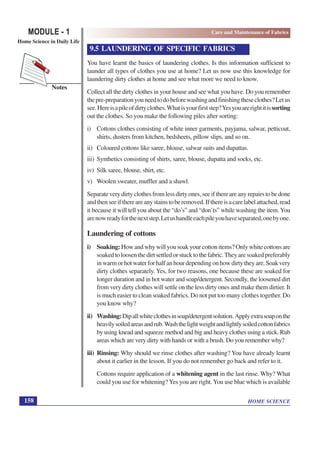
9.4.6 Ironing or steam pressing and folding
This process is applied on clothes to give them a smooth
look.An electric or coal iron is used to carry out this job.
There are various types of electric irons available in the
market. Those with metal heating surface, Teflon (non-
stick coated surface or steam irons) You can buy any of
them and learn to use them from the instructions given
along in the package.
9.4.7 Storing
Remember that clothes are stored back in a cupboard or
box only after they are completely dry. Since you need to dampen the clothes for
ironing, spread the clothes again in fresh air after ironing till they are completely dry.
Put them back in the cupboard or box for final storage.
Moist clothes should not be stored because they will allow fungus and bacteria to
grow on them.
ACTIVITY 9.4
One winter evening, Venkat wore a beautiful khadi kurta and went to a party. He
enjoyed the party thoroughly. On the way back home it started raining suddenly and
his kurta got damp. Since that was his favourite kurta, he immediately took it off,
foldeditandkeptinthecupboard.Whenhetookitoutafewdayslater,hewasshocked
to see stains and a white powdery substance on the kurta. Besides, it smelt awful.
Venkat was upset because he knew that his favourite kurta was totally spoilt.
Discuss the problem with your friends or other learners during the personal
contact programme and answer the following questions:
1. What do you think, went wrong with Venkat’s kurta?
2. Ifyouwereinhissituation,whatwouldyouhavedonetosaveyourkhadikurta?
Fig. 9. 16 Ironing
HOME SCIENCE
MODULE - 1
Home Science in Daily Life
158
Notes
Care and Maintenance of Fabrics
9.5 LAUNDERING OF SPECIFIC FABRICS
You have learnt the basics of laundering clothes. Is this information sufficient to
launder all types of clothes you use at home? Let us now use this knowledge for
laundering dirty clothes at home and see what more we need to know.
Collect all the dirty clothes in your house and see what you have. Do you remember
thepre-preparationyouneedtodobeforewashingandfinishingtheseclothes?Letus
see.Hereisapileofdirtyclothes.Whatisyourfirststep?Yesyouarerightitissorting
out the clothes. So you make the following piles after sorting:
i) Cottons clothes consisting of white inner garments, payjama, salwar, petticoat,
shirts, dusters from kitchen, bedsheets, pillow slips, and so on.
ii) Coloured cottons like saree, blouse, salwar suits and dupattas.
iii) Synthetics consisting of shirts, saree, blouse, dupatta and socks, etc.
iv) Silk saree, blouse, shirt, etc.
v) Woolen sweater, muffler and a shawl.
Separateverydirtyclothesfromlessdirtyones,seeifthereareanyrepairstobedone
andthenseeifthereareanystainstoberemoved.Ifthereisacarelabelattached,read
it because it will tell you about the “do’s” and “don’ts” while washing the item.You
arenowreadyforthenextstep.Letushandleeachpileyouhaveseparated,onebyone.
Laundering of cottons
i) Soaking: Howandwhywillyousoakyourcottonitems?Onlywhitecottonsare
soakedtoloosenthedirtsettledorstucktothefabric.Theyaresoakedpreferably
inwarmorhotwaterforhalfanhourdependingonhowdirtytheyare.Soakvery
dirty clothes separately. Yes, for two reasons, one because these are soaked for
longer duration and in hot water and soap/detergent. Secondly, the loosened dirt
from very dirty clothes will settle on the less dirty ones and make them dirtier. It
is much easier to clean soaked fabrics. Do not put too many clothes together. Do
you know why?
ii) Washing:Dipallwhiteclothesinsoap/detergentsolution.Applyextrasoaponthe
heavilysoiledareasandrub.Washthelightweightandlightlysoiledcottonfabrics
by using knead and squeeze method and big and heavy clothes using a stick. Rub
areas which are very dirty with hands or with a brush. Do you remember why?
iii) Rinsing: Why should we rinse clothes after washing? You have already learnt
about it earlier in the lesson. If you do not remember go back and refer to it.
Cottons require application of a whitening agent in the last rinse. Why? What
could you use for whitening? Yes you are right. You use blue which is available
MODULE - 1
Home Science in Daily Life
159
HOME SCIENCE
Notes
Care and Maintenance of Fabrics
as powder or liquid.These days you get chemicals like optical brighteners in the
market. These are colourless florescent dyes which turn pale fabrics white and
make then look brighter temporarily.
iv) Starching: Putting starch on the white clothes is another procedure which must
becarriedoutbeforetheyarespreadfordrying.Itisdonetogivecottonsasmooth
and shining fresh look.Also, starched articles do not get dirty that easily.
2 table spoons of starch mixed in 5 liters of water is
sufficient for starching 4-5 clothes
You can prepare your own starch using arrowroot.
• Dissolvearrowrootinalittlecoldwatertoprepareathickbatter.Addboilinghot
water to this batter stirring all the time till it changes colour to transparent.Your
starch is ready.
• Nowaddsomeofthisstarchpastethatyouhavemadeinabasinofwaterandmix
well. The strength of starch depends on the thickness of fabric and stiffness
required. To make the fabric very stiff, dilute the full strength starch with 2-3
times water. But add 4-6 times water to get reasonably good stiffness.
• Before starching a garment turn it inside out, open and dip it in water for even
spread of starch in it. Wring out the excess water and then dip it in the starch
solution.
• Squeeze the fabric well and hang it in the sun to dry.
Note:
i) The amount of stiffness is a matter of personal preference. Generally, we starch
table linens like mats, tray cloths and napkins, heavily and inner wear garments
lightly.
ii) Do not starch under garments and those garments which are close fitting like a
blouse, as the starch it may cut into your skin and make you uncomfortable.
iii) If the articles have to be starched as well as blued, do it together in one solution,
by adding blue to the diluted starch and water solution.
Remember:Ifthearticlegetsoverblued,dipitinplainwaterwithafewdropsof
white vinegar or lime juice. The extra blue will get removed.
iv) Drying:Afterrinsing,starchingandbluingtheclothesaredried.Hangtheclothes
by their strongest part along the clothes line.Articles dried in the sun should be
removedassoonastheydry.Overexposuretosunlightcanweakenthefabricand
cause yellowness.
HOME SCIENCE
MODULE - 1
Home Science in Daily Life
160
Notes
Care and Maintenance of Fabrics
v) Ironing: Cotton clothes are ironed best when they are evenly damp. But if they
are starched they must dry completely before they are brought in. Sprinkle water
evenly on them, role them tightly and leave them for some time. Now open them
onebyoneandironwithahotiron.Leavethemforsometimetodrybeforestoring.
vi) Storing: Remember, fungus grows quickly on cotton fabrics. Hence, while
storing cottons make sure that they are completely dry.
Laundering of coloured cottons
l Do not soak cottons, especially when their colour bleeds.
l Use mild or neutral soap for washing.
l Wash using kneading and squeezing method.
l Rinsethoroughlyandapplystarchafterturningclothesinsideoutinthelastrinse.
l Dry in shade.
l Iron clothes after making then evenly damp.
l Store clothes when completely dry.
INTEXT QUESTIONS 9.4
Fill in the blanks with the most appropriate word from those given in brackets:
i. Soaking clothes for some time helps to ___________ dirt. (loosen, fix, settle).
ii. Starchingisdonetogivecottonclothesa_________look.(dull,crisp,shinning).
iii. __________ should not be starched. (table linen, saris, undergarments).
iv. Coloured cotton articles should be dried in the ___________ (sun, shade,
daylight).
v. Long exposure to sunlight makes fabrics __________ (bright, weak, dull).
vi. _____________ should be used to wash very dirty white articles (hot water,
boiling water, luke-warm).
vii. When cotton articles are stored moist, they develop ____________ (dullness,
brightness, mildew).
viii. Fabric that is not properly rinsed becomes __________ (weak, yellow, bright).
ix. Clothes must be ________ before washing. (blued, repaired , ironed).
x. _________ articles should not be soaked before washing. (coloured, white,
dirty).
MODULE - 1
Home Science in Daily Life
161
HOME SCIENCE
Notes
Care and Maintenance of Fabrics
Laundering of Synthetics
Nylon, polyester and acrylic are synthetic fibers. Hence laundering synthetics is
slightly different.
l Useluke-warmorcoldwater.Donotusehotwaterassyntheticswillwrinklevery
badly. Do you remember why? Yes, they soften and melt easily.
l Use any good soap, light pressure and light rubbing while washing.
l Rinse well in cold water to remove soap completely.
l To avoid wrinkles, do not squeeze tightly.
l Preferably dry on a hanger. It will help to maintain the original shape.
l When dry, if necessary, iron with a warm iron and not a hot one (Refer to ironing
temperature chart given later in the lesson). Do you recall why?
l Store when completely dry.
Remember: While washing you can treat terrycot as synthetic fabrics.
Laundering of silks
l Useluke-warmorcoldwater,agoodneutralsoap,lightpressureandlightrubbing
while washing. There is no need to soak silks.
l Rinse well in cold water to remove soap completely.
l Apply starch (gum arabic) and dry in shade.
l Pick up the clothes when evenly damp and iron with a warm iron. Do can you
remember why? Yes you are right, silk gets stained if water is sprinkled on dry
clothes.
l Store preferably on hangers when completely dry.
Laundering of Woolen Clothes
Woolens are more delicate than any of the fabrics used in the house. Wool has hairy
surface which causes felting if handled roughly. Hence woolens need utmost care
while washing.
Knittedwoolenclothesloseshapewhenwethencetheseneedtobeputbacktoshape
after washing and need to be dried on a flat surface. Following steps should be
followed for washing woolens:
• Take outline of the knitted dress on a paper before washing.
• Use mild alkaline soap/detergent dissolved in luke warm water all through.
• Use kneading and squeezing method to wash.
HOME SCIENCE
MODULE - 1
Home Science in Daily Life
162
Notes
Care and Maintenance of Fabrics
• Rinse thoroughly.
• Knitteditemsmustbebroughtbackintoshapebyputtingthembackonthepaper
draft taken earlier and dried on flat surface in shade.
• Steam press if necessary.
• Store them when completely dry in a dry place either on a hanger or on a flat
surface and along with naphthalene balls or odonil tablets.
9.6 HANDY HINTS FOR IRONING
Prepare an ironing table. Cover it with an old blanket and then with a white cotton
sheet. Keep the height of the table comfortable so that you need not bend or stretch
while ironing. Usually, an 80 cm high table is very comfortable.
• Keep some water handy. Spraying water on cotton and linen produces good
results.
• Sleeves, collars, laces, etc., should be ironed first.
• Iron laces, buttons, hooks, embroidered and embossed clothes from the wrong
side.Theembroiderywillstandoutandlookmorebeautiful.Itwillalsonotbreak
or melt due to high temperature.
• Iron the fabric along the length as the yarns are stronger in this direction.
Important: Follow ironing instructions on the labels, if any. Otherwise follow the
ironing temperature chart given below.
Temperature Fibre
Warm 1500
C Wool, silk, polyester and nylon
Hot 1800
C Cotton and rayon
Extra hot 2000
C Cotton and linen
INTEXT QUESTIONS 9.5
1. Tick mark the statements that are true. Correct the false statements.
i. Neutral liquid soaps should be used for washing silks. True/False
____________________________________________
ii. Cold water should be used while washing woolen articles. True/False
______________________________________________
MODULE - 1
Home Science in Daily Life
163
HOME SCIENCE
Notes
Care and Maintenance of Fabrics
iii. Wool articles should be soaked in water. True/False
______________________________________________
iv. Wool articles can be cleaned with any detergent solution. True/False
______________________________________________
v. Friction cannot be applied to clean woolen articles. True/False
______________________________________________
vi. Synthetics are squeezed well before drying True/False
_______________________________________________
vii. Synthetics are ironed, if necessary, with a warm iron. True/False
_______________________________________________
1. Match the columns:
Column A Column B Ans.
1 Wet silk or wool a Strength decreases
2 Wet cotton b Neutral detergents
3 Coloured cottons c Detergent powders/cake
4 Silk d No effect on strength
5 Wet viscose rayon e Strength increases
6 White cotton f Liquid detergent
g Alkaline detergent
HOME SCIENCE
MODULE - 1
Home Science in Daily Life
164
Notes
Care and Maintenance of Fabrics
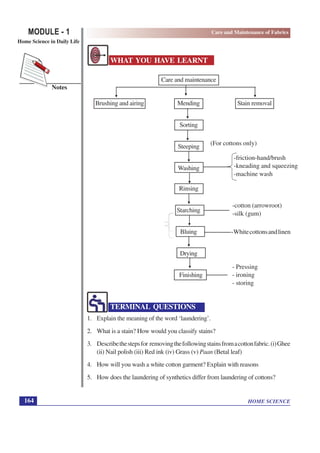
WHAT YOU HAVE LEARNT
Care and maintenance
Brushing and airing Mending Stain removal
Sorting
Steeping
Washing
Rinsing
Starching
Bluing
Drying
Finishing
TERMINAL QUESTIONS
1. Explain the meaning of the word ‘laundering’.
2. What is a stain? How would you classify stains?
3. Describethestepsfor removingthefollowingstainsfromacottonfabric.(i)Ghee
(ii) Nail polish (iii) Red ink (iv) Grass (v) Paan (Betal leaf)
4. How will you wash a white cotton garment? Explain with reasons
5. How does the laundering of synthetics differ from laundering of cottons?
(For cottons only)
-friction-hand/brush
-kneading and squeezing
-machine wash
-cotton (arrowroot)
-silk (gum)
-Whitecottonsandlinen
- Pressing
- ironing
- storing
MODULE - 1
Home Science in Daily Life
165
HOME SCIENCE
Notes
Care and Maintenance of Fabrics
6. Shelly bought a white woolen cardigan. After wearing it twice she washed it
together with other clothes in a washing machine. Predict the effect on the
cardigan and the reasons for it.
7. Rehmanwantstowashhisbrightlyprintedsilkscarfathome.Tellhimthecorrect
procedure.
ANSWER TO INTEXT QUESTIONS
9.1 1. wash at home- cotton shirt, cotton payjama
dry clean- silk blouse, zari saree, woolen shawl
2. Refer text
9.2 1. (a) true, dirty clothes become medium for growth of bacteria or fungus
(b) false, laundering consists of washing or dry cleaning, finishing and
storing
(c) true, airing helps in drying and removing bad odours.
(d) true, stains may become permanent when exposed to chemicals in
soaps or detergents
9.3 1. (i) d (ii) a (iii) c (iv) b (v) d
9.4 (i) loosen (ii) shining (iii) under garments (iv) shade (v) weak (vi) hot water
(vii) mildew (viii) yellow (ix) mended (x) coloured.
9.5 1. (i) True (ii) False – Luke warm water should be used for washing woolen
articles (iii) True (iv) False – woolen articles can be cleaned with mild
alkaline detergent solution (v) True (vi) False – synthetics should not be
squeezed and dried on a hanger. (vii) True
2.
Column A Column B Ans.
1 Wet silk or wool a Strength decreases 2
2 Wet cotton b Neutral detergents 5
3 Coloured cottons c Detergent powders/cake 6
4 Silk d No effect on strength 3
5 Wet viscose rayon e Strength increases 1
6 White cotton f Liquid detergent 4
g Alkaline detergent

care and maintenace module 4.pdf

  • 1.
    HOME SCIENCE MODULE -1 Home Science in Daily Life 142 Notes Care and Maintenance of Fabrics 9 CARE AND MAINTENANCE OF FABRICS Agroupofstudentswerechattingduringlunchbreak.CharlescomplimentedJoseph forhisfavouritesparklingwhiteshirtthattheyhadbroughttogetheralmosttwoyears ago.JustthenPurnimasaidthatshewasveryunhappyabouttheconditionofhersilk blouse after one washing.Akbar said he too could not wear his expensive pure wool cardigan after the first wash. Then Kabir told them that he has acquired knowledge regardingcareofdifferenttypesoffabricsinahousekeepingcourse.Hetoldthemthat theyshouldnotwashalltypesoffabricswithonedetergent.Hefurtheraddedthatthere aredifferent methods of washing and finishing different types of clothes. He advised that a little care can keep their favourite dress as good as new. Do you know that clothes speak volumes about the wearer’s personality? It is good to select clothes carefully. But even more important is to wash and finish them regularly for a well groomed appearance. Let us learn how to take care of clothes so that we have no regrets later. OBJECTIVES After reading this lesson you will be able to do the following: l explain the meaning and need of brushing, airing and laundering your clothes; l remove stains using appropriate reagents and techniques; l check care labels and colour fastness of your clothes before washing; l launderdifferentfabricsusingappropriatecleaningmethodsandfinishingagents and; l store laundered clothes suitably.
  • 2.
    MODULE - 1 HomeScience in Daily Life 143 HOME SCIENCE Notes Care and Maintenance of Fabrics 9.1 ROLE OF SHAKING, BRUSHING, AIRING AND LAUNDERING CLOTHES IN CARE AND MAINTENANCE OF FABRICS We all know that when we wear clothes they become dirty and need laundering.The dirtisdue tostains,dust,greaseandperspiration.Whenleftonfabrics,thesecanlead to the following damages: l Stains and dirt on clothes become medium for the growth of bacteria, fungus or other harmful organisms which may lead to skin problems and poor personal hygiene. l Dirty clothes lose their freshness and smell unpleasant. l Left on clothes the dirt and stains reduce the strength of the fabric. l No one feels good wearing stained and dirty clothes. Clothes need not be washed every time they are worn. It depends on the weather in which these have been worn and how much sweat they have absorbed. When the weather is good and you do not sweat, you can safely reuse your clothes. But before puttingthemawayforreusekeepthefollowingstepsinmindtomaintainyourclothes. 9.1.1 Shaking, Brushing and Airing ‘Shaking’ helps in removing loose dust from the fabric. Hold the dress with both hands and shake it vigorously. Haveyouseenmaterialslikevelvets,corduroy, chenille,blanketsandcarpets?Theyarethick and have a pile on their surface which holds dust easily. To remove it we need to gently brushthesurfacewithasoftclothes-brush,in the direction of pile (fuzzy surface). Thus brushing is for removing loose dirt from fabrics which have a pile on them suits and coats are also brushed. ‘Airing’ helps in drying and removing bad odours from fabrics. It is done preferably outdoors in the sun or in a well-ventilated room. 9.1.2 Laundering Laundering of clothes does not mean only washing of clothes. It consists of the following three steps: i. Washingordry-cleaninggarmentstoremovedirt,perspirationandsmell,e.g.your schooluniformiswashedandyourwoolencoatsandjacketsetc.aredrycleaned. Fig. 9.1 Brushing
  • 3.
    HOME SCIENCE MODULE -1 Home Science in Daily Life 144 Notes Care and Maintenance of Fabrics ii. Finishingthegarmentswithstiffeningagentslikestarchandgum,brighteningor bleaching agents, drying them then ironing or pressing, folding and hanging garments, e.g. cotton dupattas and sarees are starched. iii. Storing the garments for a short or long time, e.g. when the winter season arrives you put away summer clothes and take out woolen shawls, sweaters, coats etc. Remember, washing and dry cleaning are two different processes used for cleaning different types of clothes. Washing Dry-cleaning Means removing dirt using soap/ Means removing dirt using grease detergent and water. absorbents and solvents. Colourfast fabrics can be easily washed. Leather and fur, selected silks and woolens, zari and other costly fabrics are dry cleaned. INTEXT QUESTIONS 9.1 1. Meenahasabasketfullofsoiledclothes.Theseincludehersilkblouse,zarisaree, cotton shirt, cotton payjama and woolen shawl. Which of these would you recommend her to wash at home and which clothes should she send for dry cleaning? Why? __________________________________________________________ __________________________________________________________ 2. Summerseasonhasset;youhavetoputawaythewinterclothes.Whatstepswould you suggest to your friend to ensure that his clothes are clean and ready to store till the next season? __________________________________________________________ __________________________________________________________9.2 9.2 GETTING READY TO LAUNDER CLOTHES AT HOME Whenever you are ready to launder clothes at home remember that there are certain preparations required. What are these? Why are these preparations necessary? How and what we need to do, let us find out.
  • 4.
    MODULE - 1 HomeScience in Daily Life 145 HOME SCIENCE Notes Care and Maintenance of Fabrics 9.2.1 Collection of clothes and supplies: If you have a set place to keep your dirty clothes and supplies for washing, then this stepisalreadytakencareof.Ifnotthencollectallthedirtyclothesandsuppliesneeded forwashing,atoneplace.Ithelpstoconserveenergywhilewashing.Canyouexplain how? 9.2.2 Mending damaged garments The old saying- ‘a stitch in time savesnine‘standstrueinthiscase.If any garment has been damaged, its handlingduringwashingmaymake the yarns come out from its torn areasandmakethetearlarger.Itmay becomeverydifficultorimpossible to mend them neatly. That is why it is advisable to mend (repair) all tears before the garments are washed. 9.2.3 Sorting It refers to separating the clothes on the basis of (i) the type of fabric (ii) colour (iii) size and weight (iv) amount of dirt (v) utility of the article (vi) soaking time (vii) amountofdetergentandbleachrequiredasthesearealldifferentfordifferentfabrics. Fig. 9.3 Sorting If you ignore this sorting, white fabrics may acquire colour stains if the colour of any othergarmentbleeds.Formaintaininggoodhygienedusters,kitchentowelsanddish clothes, under garments, socks, need to be washed separately. Fig. 9.2 Mending
  • 5.
    HOME SCIENCE MODULE -1 Home Science in Daily Life 146 Notes Care and Maintenance of Fabrics 9.2.4 Read labels on the garments Generally,alltextilesandtextileproductscarrylabelswhichprovidebasicinformation about the product, for example, the contents of the product, its washing and ironing instructions,etc.Theseinstructionsarestampedatthebeginningandendofthefabric roll or along its selvages. Reading these thoroughly will help you take better care of your fabrics. Following are some of the stitched and stamped labels on garments. Fig. 9.4 Hanging and sewn tags on readymade garments ACTIVITY 9.1 Collect and study 3-4 labels on textile items and fill the following table: Item on which found Information contained Meaning Cardigan Information about -contents -washing and drying
  • 6.
    MODULE - 1 HomeScience in Daily Life 147 HOME SCIENCE Notes Care and Maintenance of Fabrics 9.3 CHECK STAINS AND REMOVE THEM Fig. 9.5 some common stains Ink, lipstick, nail polish, grease, paint tea and coffee, are some marks that may spoil ourclothesatonetimeortheother.Astainisanunwantedmarkofdiscolourationon a fabric caused due to contact with another substance. Generally, a stain requires specialtreatmentforremoval.Ifyouhaveeveraccidentallyspilledteaonyourclothes and washed it off immediately you must have realized that the stain gets removed quickly.Oldstainstakelongandalsoalotofefforttoremove,oftenwithpoorresults. Hence, the best way to get rid of stains is to remove them as soon as possible. Do not allow these to penetrate deep into the fabric or get dry and set. Remember stains must be removed before washing as some of them may become permanent when exposed to chemicals in soaps or detergents, hot water and ironing. Different types of stains require specific stain removing techniques and agents, depending on the type of fabric. Use of incorrect stain removing agent can spoil the fabric or its colour. Hence always try to identify the stain and select appropriate techniques and stain removing agent. Most of the stains can be identified by their colour, smell and feel. Let’s find out more about them. a) Colour:Everystainhasaspecificcolour.Forexample,thecolourofcurry/pickle stainisyellow,acoffee/teastainisbrown,agrassstainisgreenandsoon.Tryand collect some more stains with colours. b) Smell: Most stains have a peculiar smell. Recall the smell of egg or paint or shoe polish. The stain on a fabric will have the same smell. c) Feel: Stains can also change the feel of the fabric and can thus be recognized on thisbasis.Haveyoueverobservedthatpaintorsugarmakethefabrichardandstiff to touch, whereas lipstick or shoe-polish make the fabric feel slippery. ACTIVITYS 9.2 Take an old white cotton cloth and cut out 4 (5x5 cm) pieces. Stain each piece with adifferentstainandkeepittodry.Nowobservethecolour,feelandsmellofeachstain. Stick each stain on a big paper and write its description.
  • 7.
    HOME SCIENCE MODULE -1 Home Science in Daily Life 148 Notes Care and Maintenance of Fabrics Fig. 9.6 Sponging INTEXT QUESTIONS 9.2 1. State whether the following statements are true or false and justify with reasoning- Statement True/False Justification (a) Dirty clothes are harmful for personal hygiene (b) ‘Laundering’ is same as ‘washing’ clothes (c) Airing of clothes is useful when they are not to be washed immediately. (d) Stains should be removed from the fabrics before washing. 9.3.1 Classification of stains Stains can be grouped on the basis of their origin, e.g., tea and coffee and many oils, vanaspatiandgheecomefromvegetablesource.Whileremovingthesestainsyoucan use more or less the same removing agents and method. Let us classify all stains on the basis of their origin. Category of stain Stains 1. Vegetable stains Tea, coffee, fruit 2. Grease stains Butter, ghee, oil, curry, shoe polish, tar, oil paints 3. Animal stains Blood, milk, egg 4. Mineral stains Rust 5. Miscellaneous stains Dye, ink, mildew, grass, perspiration 9.3.2 Techniques of stain removal There are two methods of stain removal: (i) Sponging and (ii) Dipping. Let us learn how stains are removed by using these methods. Sponging • Place an absorbent paper or fabric underthestainsothattherightsideof the stain faces the absorbing surface. Sponging should always be done on the wrong side of the stain.
  • 8.
    MODULE - 1 HomeScience in Daily Life 149 HOME SCIENCE Notes Care and Maintenance of Fabrics • Takeasoftcloth,dipitinthestain-removerandgentlyrubthestainstartingfrom its outer corner moving inwards, towards the centre. • Use light, circular strokes as these prevent the stain from spreading. • Theabsorbentpaperorfabric(commonlyknownasblotter)mustbechangedas soon as it starts showing the stain. Dipping Dipping is the method in which the entire fabric can be immersed in the stain removing agent. It issuitableiftherearemanystainsoralargestain on the fabric. We can choose the stain removing re-agent depending upon the type of stain. Some of the common reagents used for stain removal are borax powder, ammonia, hydrogen peroxide, oxalic acid and ready to use bleaches. Type of stains and method of removal 1. Vegetable stains Tea, coffee, fruit, etc. Consideration for Use alkaline reagents such as borax powder to removal remove stains as these are acidic in nature. Stains White Cottons Coloured Cotton Fresh tea/coffee, chocolate, Pour boiling water on the Soak in warm water fruit stain and borax (2 cups of water + ½ Old teaspoon of borax) Dip the stained portion in Same as for white glycerin. Or spread borax cottons powder over stain and pour boiling water while holding the stained portion on the mouth of a mug or pan. Fig. 9.7 Dipping
  • 9.
    HOME SCIENCE MODULE -1 Home Science in Daily Life 150 Notes Care and Maintenance of Fabrics henna (Menhdi) fresh dip in warm milk for half same as for white an hour cotton old repeat the above two or same as for white three times cotton 2. Animal stains blood, milk, egg, etc. Consideration for Avoid heat as these stains contain protein which gets removal fixed on heat treatment. Stains white cottons coloured cotton blood, egg, meat fresh Wash with cold water and same as for white soap cottons old soak in salt water (2 table same as for white spoons of salt + ½ bucket cottons of water), or in diluted ammonia 3.Grease stains Butter, ghee, oil, curry, shoe polish, tar, oil paints, etc. Consideration for Use grease absorbents and solvents like chalk, talcum removal powder to remove greasy matter and then, remove the colouring matter. Stains White Cottons Coloured Cotton butter, ghee, oil, curry fresh wash with hot water, and same as for white soap. Dry on grass or shrub/ cottons, but leave it plant in the sunlight in shade old Make a paste of soap and sameasforwhitecottons water and apply it on the but leave in shade stain. Leave it wet in the sunlight until it is removed
  • 10.
    MODULE - 1 HomeScience in Daily Life 151 HOME SCIENCE Notes Care and Maintenance of Fabrics paint, shoe polish, nail fresh polish, lipstick, ball pen Scrape all the excess stain same as for white (a) Sponge gently with cottons methylated spirit or kerosene (b) Sponge with turpentine old Repeat the above method same as for white two or three times cottons 4.Mineral stains Rust and some medicines Consideration for Thesestainscontainmetalliccompoundsandtherefore, removal require treatment with mild acidic reagents followed by alkaline solutions to neutralise. Stains white Cottons coloured cotton iron rust fresh rub lime juice and salt same as for white cotton Old apply dilute oxalic acid same as for white and neutralize with dilute cotton borax solution 5. Miscellaneous dye, ink, mildew, grass, perspiration, etc. stains Consideration for Give specific treatment to each of these stains. removal Stains white cottons coloured cotton grass fresh Wash with soap and water same as for white cotton old Sponge the stained portion same as for white with methylated spirit same as for white
  • 11.
    HOME SCIENCE MODULE -1 Home Science in Daily Life 152 Notes Care and Maintenance of Fabrics betal leaf (paan) fresh apply a paste of onions and same as for white cottons leave in the sunlight but leave in shade Old repeat above method two same as for white cotton or three times ink Fresh wash with soap and cold same as for white cotton water Old (a) soak in sour butter milk same as for white cotton (lassi) for half an hour except do not leave in sun, put it in shade (b) apply lime juice and salt and leave in the sun (c) bleach the stain 9.3.3 Precautions while removing stains • As far as possible, remove the stain when it is still fresh. • Fordelicateand/orcolouredfabrics,firsttryoutthechemicalonasmallportion of the fabric on the inner side of the seam or some portion of the garment which isnotvisiblewhenworn.Incasethefabricoritscolourgetsdamaged,donotuse the chemical. • Usediluteandmildreagentsasthesearelessharmful,thoughitmaytakealittle longer to remove the stain. • Rinse the fabric several times after the removal of the stain, or the reagent may damage the fabric on drying. ACTIVITY 9.3 Shyna wore a very beautiful white silk suit for an interview. She was very cautious about protecting it all through.After the interview she came home and changed her clothes.Whileshewasfoldinghersuitshenoticedabigcurrystainonit.Shewasvery
  • 12.
    MODULE - 1 HomeScience in Daily Life 153 HOME SCIENCE Notes Care and Maintenance of Fabrics tired hence she did not do anything about it. Next morning she dusted talcumpowderonthestainandleftitforalittlewhile.Then,shesoaked the suit in a strong hot detergent solution for an hour. She hung the suit on the line until it dried. The stain was still there though a little less prominent.Shetreatedthestainedportionwithhydrogenperoxide.The stainhaddisappeared.Sherinsedthesuitmanytimestoremovealltraces of the chemical and then dried it in shade. List each step that Shyna followed to handle the stain and comment if it was correct or incorrect. Give reason for your answer. S.No. Steps Correct Wrong Reason 1 2 3 INTEXT QUESTIONS 9.3 1. For removing each of the following stains, tick (√) the most appropriate option: (i) Old tea stain on white cotton fabric: (a) Use salt water (b) Soak in glycerin (c) Soak in lime juice (d) Pour boiling water over borax (ii) Old blood stains on coloured cotton fabric: (a) Soak in salt water (b) Soak in glycerin (c) Soak in hot water (d) Wash with soap and hot water (iii) Lipstick stain: (a) Use of salt water (b) Soak in ammonia (c) Sponge with methylated spirit (d) Wash with hot water and soap
  • 13.
    HOME SCIENCE MODULE -1 Home Science in Daily Life 154 Notes Care and Maintenance of Fabrics (iv) Rust stain: (a) Use of salt water (b) Use lime juice and salt (c) Soak in methylated spirit (d) Wash with soap and cold water (v) Nail polish stain on polyester fabric: (a) Sponge with methylated spirit (b) Soak in warm borax water (c) Rub lime juice and salt (d) Soak in warm water and soap After removing stains, the next step is laundering. General laundering is dealt with herewhilespecificwashingofdifferentfabricshasbeendealtwithlaterinthelesson. 9.4 LAUNDERING Laundering of clothes involves the following steps: Laundering Soaking Rinsing Drying Storing Ironing Washing Finishing Fig. 9.8 Process of Laundering 9.4.1 Soaking Soaking of fabric in water loosens the non-greasy dust particles because of up and down movement of watermolecules.Fabricswhichbecomeweakwhen wet must not be soaked for long. Do not soak too manyclothesinonebucket.Theremustbearoomfor dirt to disentangle from the fabric. Fabrics must not be soaked for longer than half an hour otherwise loosened dust will resettle on the fabrics. Fig. 9.9 Soaking
  • 14.
    MODULE - 1 HomeScience in Daily Life 155 HOME SCIENCE Notes Care and Maintenance of Fabrics 9.4.2 Washing As said earlier, soaked clothes must be washed soon. The process of washing involves removal of dirt that has been loosened from fabrics by soaking. There are many ways to do this and the choice depends on the fabric being washed.You will now learn about these methods and theirsuitabilitytovarioustypesoffabrics. Methods of Washing i. Frictionmethod:Forwashingstrongfabricslikecottonandlinenthisistheright method. You can apply friction in any of the following three ways. • Hand friction:This is the most common method of washing clothes. Rub dirtyareasvigorouslywiththehandtillthedirtisremoved.Itissuitablefor cleaning very soiled small sized areas in the garment like cuffs, collar and bottom of the lower garments, handkerchief and lace. • Scrubbingbrush:Whilecleaning kitchen dusters which are very soiled use a brush to remove dirt, grease and stains. Remember to place the fabric on a flat hard surface before scrubbing. Hard scrubbingcancleanthefabricwell butwearsitout.Haveyounoticed thatifyouusebrushonshirtcollarstheygetwornout?Therefore,scrubbing has to be used as per the nature of the fabric. • Beating stick:While washing large clothes like bed sheets and towels use awoodenbeatingsticktoprovidefriction.Rememberthatthisisdoneonly on a clean, flat and hard surface. Spread the fabric on the floor, apply soap andthenbeatitwiththestick,constantlychangingthesurfaceofthefabric with the other hand. ii. Washing by kneading and squeezing: This method is for delicate fabrics like silk, wool, rayon, etc. This does not damage the fabric or change its shape because only gentle pressure is appliedrepeatedlywithhands.Whileitisstillin the soapy solution. While using this method dip theclothinsoapsolution,takeitoutandsqueeze Fig. 9.10 Removal of Dirt by Fig. 9.11 Scrubbing Fig. 9.12 Kneading and Squeezing
  • 15.
    HOME SCIENCE MODULE -1 Home Science in Daily Life 156 Notes Care and Maintenance of Fabrics gently and again dip in the soap. In between rub the dirty areas gently between two hands. Repeat till clean. iii. Washing in machines: ‘Washing machine’ a labour saving device and provides all the friction required for cleaning the clothes. The washing time varieswiththetypeoffabricsandamount of soiling. For example, wool fabrics take less time for cleaning than cottons. Washingmachinesavailableinthemarket are automatic, semi-automatic and non-automatic. The advantage of using automatic washing machine is that it has a spinner which can wring the clothes after washing to the extent that these are almost dry. This is especially useful while washing large and heavy articles like bedcovers, curtains, etc. The instructionsaboutusingthemachineshouldbereadcarefullybeforeusingit.One should be careful while loading clothes for washing in a machine as the colour of some fabrics may bleed and spoil the other clothes in the machine. 9.4.3 Rinsing Washed fabrics must be rinsed at least thrice or till theyleavebehindclearwater.Whydoweneedtodo that?Ifnotrinsedwellthecontentsofleftoverdetergent would harm the fabric. 9.4.4 Finishing Agents Someofyourclothesrequiretheapplicationofafinishingagentbeforetheyarespread fordrying.Afinishingagentisnothingbutsomethingwhichhelpstobrightenand/or stiffen the fabric and give it a brighter and fresher look. You know what starch and/ orblueyourwhitecottonclothesneed.Boththesearefinishingagentsforcottons.For silks,adifferentstarchisused.Itiscalled‘gumarabic’.Similarly,thereare‘blues’and brightening agents to brighten you white clothes.You will know more about these in the chapter on fabric finishes. 9.4.5 Drying Clothes should preferably be dried outside in fresh air and sun. Use a clothes line and pegs or clips to hold the clothes or a clean stain free metalrack.Hangorspreadtheclothesandplace the rack in the sun or shade depending on the type of clothes you have washed. Remember to Fig. 9.13 Washing machine Fig. 9.14 Rinsing Fig. 9.15 Drying
  • 16.
    MODULE - 1 HomeScience in Daily Life 157 HOME SCIENCE Notes Care and Maintenance of Fabrics turnclothesinsideoutiftheyarecoloured.Ifyouareusingaclothesline,seethatyou spreadyourclothesonitinsuchawaythatitallowsairtopassthroughthem.Notonly do the clothes dry up much faster this way, it is an environment friendly method. Sunlightalsokillssomegerms.Hence,itisrecommendedthatundergarmentsandthe clothes used as sanitary napkins must be sun dried. 9.4.6 Ironing or steam pressing and folding This process is applied on clothes to give them a smooth look.An electric or coal iron is used to carry out this job. There are various types of electric irons available in the market. Those with metal heating surface, Teflon (non- stick coated surface or steam irons) You can buy any of them and learn to use them from the instructions given along in the package. 9.4.7 Storing Remember that clothes are stored back in a cupboard or box only after they are completely dry. Since you need to dampen the clothes for ironing, spread the clothes again in fresh air after ironing till they are completely dry. Put them back in the cupboard or box for final storage. Moist clothes should not be stored because they will allow fungus and bacteria to grow on them. ACTIVITY 9.4 One winter evening, Venkat wore a beautiful khadi kurta and went to a party. He enjoyed the party thoroughly. On the way back home it started raining suddenly and his kurta got damp. Since that was his favourite kurta, he immediately took it off, foldeditandkeptinthecupboard.Whenhetookitoutafewdayslater,hewasshocked to see stains and a white powdery substance on the kurta. Besides, it smelt awful. Venkat was upset because he knew that his favourite kurta was totally spoilt. Discuss the problem with your friends or other learners during the personal contact programme and answer the following questions: 1. What do you think, went wrong with Venkat’s kurta? 2. Ifyouwereinhissituation,whatwouldyouhavedonetosaveyourkhadikurta? Fig. 9. 16 Ironing
  • 17.
    HOME SCIENCE MODULE -1 Home Science in Daily Life 158 Notes Care and Maintenance of Fabrics 9.5 LAUNDERING OF SPECIFIC FABRICS You have learnt the basics of laundering clothes. Is this information sufficient to launder all types of clothes you use at home? Let us now use this knowledge for laundering dirty clothes at home and see what more we need to know. Collect all the dirty clothes in your house and see what you have. Do you remember thepre-preparationyouneedtodobeforewashingandfinishingtheseclothes?Letus see.Hereisapileofdirtyclothes.Whatisyourfirststep?Yesyouarerightitissorting out the clothes. So you make the following piles after sorting: i) Cottons clothes consisting of white inner garments, payjama, salwar, petticoat, shirts, dusters from kitchen, bedsheets, pillow slips, and so on. ii) Coloured cottons like saree, blouse, salwar suits and dupattas. iii) Synthetics consisting of shirts, saree, blouse, dupatta and socks, etc. iv) Silk saree, blouse, shirt, etc. v) Woolen sweater, muffler and a shawl. Separateverydirtyclothesfromlessdirtyones,seeifthereareanyrepairstobedone andthenseeifthereareanystainstoberemoved.Ifthereisacarelabelattached,read it because it will tell you about the “do’s” and “don’ts” while washing the item.You arenowreadyforthenextstep.Letushandleeachpileyouhaveseparated,onebyone. Laundering of cottons i) Soaking: Howandwhywillyousoakyourcottonitems?Onlywhitecottonsare soakedtoloosenthedirtsettledorstucktothefabric.Theyaresoakedpreferably inwarmorhotwaterforhalfanhourdependingonhowdirtytheyare.Soakvery dirty clothes separately. Yes, for two reasons, one because these are soaked for longer duration and in hot water and soap/detergent. Secondly, the loosened dirt from very dirty clothes will settle on the less dirty ones and make them dirtier. It is much easier to clean soaked fabrics. Do not put too many clothes together. Do you know why? ii) Washing:Dipallwhiteclothesinsoap/detergentsolution.Applyextrasoaponthe heavilysoiledareasandrub.Washthelightweightandlightlysoiledcottonfabrics by using knead and squeeze method and big and heavy clothes using a stick. Rub areas which are very dirty with hands or with a brush. Do you remember why? iii) Rinsing: Why should we rinse clothes after washing? You have already learnt about it earlier in the lesson. If you do not remember go back and refer to it. Cottons require application of a whitening agent in the last rinse. Why? What could you use for whitening? Yes you are right. You use blue which is available
  • 18.
    MODULE - 1 HomeScience in Daily Life 159 HOME SCIENCE Notes Care and Maintenance of Fabrics as powder or liquid.These days you get chemicals like optical brighteners in the market. These are colourless florescent dyes which turn pale fabrics white and make then look brighter temporarily. iv) Starching: Putting starch on the white clothes is another procedure which must becarriedoutbeforetheyarespreadfordrying.Itisdonetogivecottonsasmooth and shining fresh look.Also, starched articles do not get dirty that easily. 2 table spoons of starch mixed in 5 liters of water is sufficient for starching 4-5 clothes You can prepare your own starch using arrowroot. • Dissolvearrowrootinalittlecoldwatertoprepareathickbatter.Addboilinghot water to this batter stirring all the time till it changes colour to transparent.Your starch is ready. • Nowaddsomeofthisstarchpastethatyouhavemadeinabasinofwaterandmix well. The strength of starch depends on the thickness of fabric and stiffness required. To make the fabric very stiff, dilute the full strength starch with 2-3 times water. But add 4-6 times water to get reasonably good stiffness. • Before starching a garment turn it inside out, open and dip it in water for even spread of starch in it. Wring out the excess water and then dip it in the starch solution. • Squeeze the fabric well and hang it in the sun to dry. Note: i) The amount of stiffness is a matter of personal preference. Generally, we starch table linens like mats, tray cloths and napkins, heavily and inner wear garments lightly. ii) Do not starch under garments and those garments which are close fitting like a blouse, as the starch it may cut into your skin and make you uncomfortable. iii) If the articles have to be starched as well as blued, do it together in one solution, by adding blue to the diluted starch and water solution. Remember:Ifthearticlegetsoverblued,dipitinplainwaterwithafewdropsof white vinegar or lime juice. The extra blue will get removed. iv) Drying:Afterrinsing,starchingandbluingtheclothesaredried.Hangtheclothes by their strongest part along the clothes line.Articles dried in the sun should be removedassoonastheydry.Overexposuretosunlightcanweakenthefabricand cause yellowness.
  • 19.
    HOME SCIENCE MODULE -1 Home Science in Daily Life 160 Notes Care and Maintenance of Fabrics v) Ironing: Cotton clothes are ironed best when they are evenly damp. But if they are starched they must dry completely before they are brought in. Sprinkle water evenly on them, role them tightly and leave them for some time. Now open them onebyoneandironwithahotiron.Leavethemforsometimetodrybeforestoring. vi) Storing: Remember, fungus grows quickly on cotton fabrics. Hence, while storing cottons make sure that they are completely dry. Laundering of coloured cottons l Do not soak cottons, especially when their colour bleeds. l Use mild or neutral soap for washing. l Wash using kneading and squeezing method. l Rinsethoroughlyandapplystarchafterturningclothesinsideoutinthelastrinse. l Dry in shade. l Iron clothes after making then evenly damp. l Store clothes when completely dry. INTEXT QUESTIONS 9.4 Fill in the blanks with the most appropriate word from those given in brackets: i. Soaking clothes for some time helps to ___________ dirt. (loosen, fix, settle). ii. Starchingisdonetogivecottonclothesa_________look.(dull,crisp,shinning). iii. __________ should not be starched. (table linen, saris, undergarments). iv. Coloured cotton articles should be dried in the ___________ (sun, shade, daylight). v. Long exposure to sunlight makes fabrics __________ (bright, weak, dull). vi. _____________ should be used to wash very dirty white articles (hot water, boiling water, luke-warm). vii. When cotton articles are stored moist, they develop ____________ (dullness, brightness, mildew). viii. Fabric that is not properly rinsed becomes __________ (weak, yellow, bright). ix. Clothes must be ________ before washing. (blued, repaired , ironed). x. _________ articles should not be soaked before washing. (coloured, white, dirty).
  • 20.
    MODULE - 1 HomeScience in Daily Life 161 HOME SCIENCE Notes Care and Maintenance of Fabrics Laundering of Synthetics Nylon, polyester and acrylic are synthetic fibers. Hence laundering synthetics is slightly different. l Useluke-warmorcoldwater.Donotusehotwaterassyntheticswillwrinklevery badly. Do you remember why? Yes, they soften and melt easily. l Use any good soap, light pressure and light rubbing while washing. l Rinse well in cold water to remove soap completely. l To avoid wrinkles, do not squeeze tightly. l Preferably dry on a hanger. It will help to maintain the original shape. l When dry, if necessary, iron with a warm iron and not a hot one (Refer to ironing temperature chart given later in the lesson). Do you recall why? l Store when completely dry. Remember: While washing you can treat terrycot as synthetic fabrics. Laundering of silks l Useluke-warmorcoldwater,agoodneutralsoap,lightpressureandlightrubbing while washing. There is no need to soak silks. l Rinse well in cold water to remove soap completely. l Apply starch (gum arabic) and dry in shade. l Pick up the clothes when evenly damp and iron with a warm iron. Do can you remember why? Yes you are right, silk gets stained if water is sprinkled on dry clothes. l Store preferably on hangers when completely dry. Laundering of Woolen Clothes Woolens are more delicate than any of the fabrics used in the house. Wool has hairy surface which causes felting if handled roughly. Hence woolens need utmost care while washing. Knittedwoolenclothesloseshapewhenwethencetheseneedtobeputbacktoshape after washing and need to be dried on a flat surface. Following steps should be followed for washing woolens: • Take outline of the knitted dress on a paper before washing. • Use mild alkaline soap/detergent dissolved in luke warm water all through. • Use kneading and squeezing method to wash.
  • 21.
    HOME SCIENCE MODULE -1 Home Science in Daily Life 162 Notes Care and Maintenance of Fabrics • Rinse thoroughly. • Knitteditemsmustbebroughtbackintoshapebyputtingthembackonthepaper draft taken earlier and dried on flat surface in shade. • Steam press if necessary. • Store them when completely dry in a dry place either on a hanger or on a flat surface and along with naphthalene balls or odonil tablets. 9.6 HANDY HINTS FOR IRONING Prepare an ironing table. Cover it with an old blanket and then with a white cotton sheet. Keep the height of the table comfortable so that you need not bend or stretch while ironing. Usually, an 80 cm high table is very comfortable. • Keep some water handy. Spraying water on cotton and linen produces good results. • Sleeves, collars, laces, etc., should be ironed first. • Iron laces, buttons, hooks, embroidered and embossed clothes from the wrong side.Theembroiderywillstandoutandlookmorebeautiful.Itwillalsonotbreak or melt due to high temperature. • Iron the fabric along the length as the yarns are stronger in this direction. Important: Follow ironing instructions on the labels, if any. Otherwise follow the ironing temperature chart given below. Temperature Fibre Warm 1500 C Wool, silk, polyester and nylon Hot 1800 C Cotton and rayon Extra hot 2000 C Cotton and linen INTEXT QUESTIONS 9.5 1. Tick mark the statements that are true. Correct the false statements. i. Neutral liquid soaps should be used for washing silks. True/False ____________________________________________ ii. Cold water should be used while washing woolen articles. True/False ______________________________________________
  • 22.
    MODULE - 1 HomeScience in Daily Life 163 HOME SCIENCE Notes Care and Maintenance of Fabrics iii. Wool articles should be soaked in water. True/False ______________________________________________ iv. Wool articles can be cleaned with any detergent solution. True/False ______________________________________________ v. Friction cannot be applied to clean woolen articles. True/False ______________________________________________ vi. Synthetics are squeezed well before drying True/False _______________________________________________ vii. Synthetics are ironed, if necessary, with a warm iron. True/False _______________________________________________ 1. Match the columns: Column A Column B Ans. 1 Wet silk or wool a Strength decreases 2 Wet cotton b Neutral detergents 3 Coloured cottons c Detergent powders/cake 4 Silk d No effect on strength 5 Wet viscose rayon e Strength increases 6 White cotton f Liquid detergent g Alkaline detergent
  • 23.
    HOME SCIENCE MODULE -1 Home Science in Daily Life 164 Notes Care and Maintenance of Fabrics WHAT YOU HAVE LEARNT Care and maintenance Brushing and airing Mending Stain removal Sorting Steeping Washing Rinsing Starching Bluing Drying Finishing TERMINAL QUESTIONS 1. Explain the meaning of the word ‘laundering’. 2. What is a stain? How would you classify stains? 3. Describethestepsfor removingthefollowingstainsfromacottonfabric.(i)Ghee (ii) Nail polish (iii) Red ink (iv) Grass (v) Paan (Betal leaf) 4. How will you wash a white cotton garment? Explain with reasons 5. How does the laundering of synthetics differ from laundering of cottons? (For cottons only) -friction-hand/brush -kneading and squeezing -machine wash -cotton (arrowroot) -silk (gum) -Whitecottonsandlinen - Pressing - ironing - storing
  • 24.
    MODULE - 1 HomeScience in Daily Life 165 HOME SCIENCE Notes Care and Maintenance of Fabrics 6. Shelly bought a white woolen cardigan. After wearing it twice she washed it together with other clothes in a washing machine. Predict the effect on the cardigan and the reasons for it. 7. Rehmanwantstowashhisbrightlyprintedsilkscarfathome.Tellhimthecorrect procedure. ANSWER TO INTEXT QUESTIONS 9.1 1. wash at home- cotton shirt, cotton payjama dry clean- silk blouse, zari saree, woolen shawl 2. Refer text 9.2 1. (a) true, dirty clothes become medium for growth of bacteria or fungus (b) false, laundering consists of washing or dry cleaning, finishing and storing (c) true, airing helps in drying and removing bad odours. (d) true, stains may become permanent when exposed to chemicals in soaps or detergents 9.3 1. (i) d (ii) a (iii) c (iv) b (v) d 9.4 (i) loosen (ii) shining (iii) under garments (iv) shade (v) weak (vi) hot water (vii) mildew (viii) yellow (ix) mended (x) coloured. 9.5 1. (i) True (ii) False – Luke warm water should be used for washing woolen articles (iii) True (iv) False – woolen articles can be cleaned with mild alkaline detergent solution (v) True (vi) False – synthetics should not be squeezed and dried on a hanger. (vii) True 2. Column A Column B Ans. 1 Wet silk or wool a Strength decreases 2 2 Wet cotton b Neutral detergents 5 3 Coloured cottons c Detergent powders/cake 6 4 Silk d No effect on strength 3 5 Wet viscose rayon e Strength increases 1 6 White cotton f Liquid detergent 4 g Alkaline detergent