CREATE A PROTOTYPE
PROTOTYPE
A prototype is a representation of a product idea
Several prototypes are likely to be built, assessed
and tested before a product comes to market.
Prototyping lets you correct design faults and get
feedback from potential customers on your
product usability and performance.
STEPS
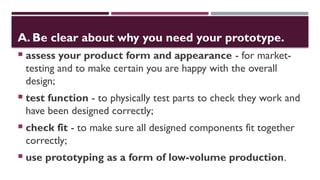
A. Be clear about why you need your prototype.
 assess your product form and appearance - for market-
testing and to make certain you are happy with the overall
design;
 test function - to physically test parts to check they work and
have been designed correctly;
 check fit - to make sure all designed components fit together
correctly;
 use prototyping as a form of low-volume production.
1. SELECTTHETYPE OF
PROTOTYPE
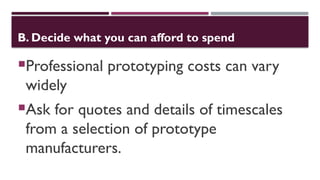
B. Decide what you can afford to spend
Professional prototyping costs can vary
widely
Ask for quotes and details of timescales
from a selection of prototype
manufacturers.
C. Make basic models yourself to assess the
appearance and functionality of your idea

Entrepreneurship-Create a prototype.pptx

  • 1.
  • 2.
    PROTOTYPE A prototype isa representation of a product idea Several prototypes are likely to be built, assessed and tested before a product comes to market. Prototyping lets you correct design faults and get feedback from potential customers on your product usability and performance.
  • 3.
  • 4.
    A. Be clearabout why you need your prototype.  assess your product form and appearance - for market- testing and to make certain you are happy with the overall design;  test function - to physically test parts to check they work and have been designed correctly;  check fit - to make sure all designed components fit together correctly;  use prototyping as a form of low-volume production.
  • 5.
  • 6.
    B. Decide whatyou can afford to spend Professional prototyping costs can vary widely Ask for quotes and details of timescales from a selection of prototype manufacturers.
  • 7.
    C. Make basicmodels yourself to assess the appearance and functionality of your idea