Introduction
● Explaining the importance of the prototyping
phase
● Discussing the benefits of process design
and development
● Highlighting the key elements of a
successful product development process
What is Prototype Design?
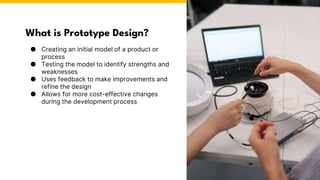
● Creating an initial model of a product or
process
● Testing the model to identify strengths and
weaknesses
● Uses feedback to make improvements and
refine the design
● Allows for more cost-effective changes
during the development process
Understanding Prototyping
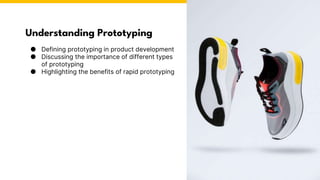
● Defining prototyping in product development
● Discussing the importance of different types
of prototyping
● Highlighting the benefits of rapid prototyping
Benefits of Prototype Design
● Identifies design flaws before final product
release
● Results in a more user-friendly and
functional design
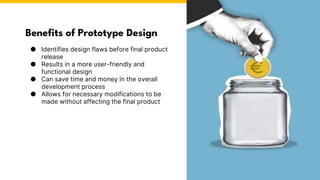
● Can save time and money in the overall
development process
● Allows for necessary modifications to be
made without affecting the final product
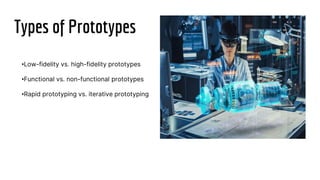
Types of Prototypes
•Low-fidelity vs. high-fidelity prototypes
•Functional vs. non-functional prototypes
•Rapid prototyping vs. iterative prototyping
Design Thinking Process
● Empathize – understand the user’s needs
and perspective
● Define – clearly define the problem and
desired outcome
● Ideate – generate a range of solutions
● Prototype – build a physical or digital model
of the solution
● Test – evaluate the prototype and gather
feedback
● Iterate – refine the prototype and repeat
testing as necessary
Design Elements to Consider
● Functionality
● Usability
● Aesthetics
● Technical feasibility
● Safety and durability
● Environmental impact
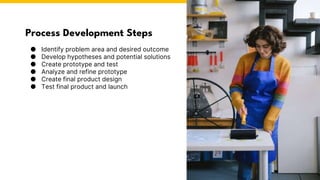
Process Development Steps
● Identify problem area and desired outcome
● Develop hypotheses and potential solutions
● Create prototype and test
● Analyze and refine prototype
● Create final product design
● Test final product and launch
Agile Methodology
● Flexible and iterative approach to
development
● Sprints – short, focused work periods
● Scrum – daily team check-ins and progress
updates
● Continuous feedback and collaboration
● Frequent testing and adjustments
● Allows for adaptation to changing needs and
requirements
Testing and Feedback
● Highlighting the importance of testing and
feedback in the product development
process
● Discussing different types of testing
methods and feedback channels
● Explaining how testing and feedback can
lead to product improvement and innovation
Risks in Product Design and
Development
● Highlighting the common risks in product
design and development
● Discussing how to mitigate these risks
● Explaining the importance of pivoting and
iterating during development
Managing the Design and
Development Process
● Discussing the importance of communication
and collaboration between teams
● Highlighting the role of project managers in
the design and development process
● Explaining the importance of progress
tracking to ensure timely development
User-Centered Design
● Focuses on the needs and perspective of
the user
● Involves user research and testing
throughout the design process
● Creates more effective and user-friendly
designs
● Generates higher user engagement and
satisfaction
● Establishes a competitive advantage
Applications of Prototype
Design
● Product design and development
● Software development
● Architectural design and planning
● Manufacturing process and efficiency
improvement
● Marketing and advertising campaign testing
● Human-machine interface testing and
development
Benefits of Effective Design
● Discussing how effective design improves
customer experience
● Highlighting the impact of good design on
brand loyalty
● Explaining how good design can lead to
increased profitability
Challenges of Prototype Design
● Cost and time investment
● Difficulty in predicting user reaction and
feedback
● Managing scope and expectations
● Multidisciplinary project team management
● Technical complexity of prototyping
● Balancing innovation with feasibility and
practicality
Prototype design and development1.pptx

Prototype design and development1.pptx

  • 1.
    Introduction ● Explaining theimportance of the prototyping phase ● Discussing the benefits of process design and development ● Highlighting the key elements of a successful product development process
  • 2.
    What is PrototypeDesign? ● Creating an initial model of a product or process ● Testing the model to identify strengths and weaknesses ● Uses feedback to make improvements and refine the design ● Allows for more cost-effective changes during the development process
  • 3.
    Understanding Prototyping ● Definingprototyping in product development ● Discussing the importance of different types of prototyping ● Highlighting the benefits of rapid prototyping
  • 4.
    Benefits of PrototypeDesign ● Identifies design flaws before final product release ● Results in a more user-friendly and functional design ● Can save time and money in the overall development process ● Allows for necessary modifications to be made without affecting the final product
  • 5.
    Types of Prototypes •Low-fidelityvs. high-fidelity prototypes •Functional vs. non-functional prototypes •Rapid prototyping vs. iterative prototyping
  • 6.
    Design Thinking Process ●Empathize – understand the user’s needs and perspective ● Define – clearly define the problem and desired outcome ● Ideate – generate a range of solutions ● Prototype – build a physical or digital model of the solution ● Test – evaluate the prototype and gather feedback ● Iterate – refine the prototype and repeat testing as necessary
  • 7.
    Design Elements toConsider ● Functionality ● Usability ● Aesthetics ● Technical feasibility ● Safety and durability ● Environmental impact
  • 8.
    Process Development Steps ●Identify problem area and desired outcome ● Develop hypotheses and potential solutions ● Create prototype and test ● Analyze and refine prototype ● Create final product design ● Test final product and launch
  • 9.
    Agile Methodology ● Flexibleand iterative approach to development ● Sprints – short, focused work periods ● Scrum – daily team check-ins and progress updates ● Continuous feedback and collaboration ● Frequent testing and adjustments ● Allows for adaptation to changing needs and requirements
  • 10.
    Testing and Feedback ●Highlighting the importance of testing and feedback in the product development process ● Discussing different types of testing methods and feedback channels ● Explaining how testing and feedback can lead to product improvement and innovation
  • 11.
    Risks in ProductDesign and Development ● Highlighting the common risks in product design and development ● Discussing how to mitigate these risks ● Explaining the importance of pivoting and iterating during development
  • 12.
    Managing the Designand Development Process ● Discussing the importance of communication and collaboration between teams ● Highlighting the role of project managers in the design and development process ● Explaining the importance of progress tracking to ensure timely development
  • 13.
    User-Centered Design ● Focuseson the needs and perspective of the user ● Involves user research and testing throughout the design process ● Creates more effective and user-friendly designs ● Generates higher user engagement and satisfaction ● Establishes a competitive advantage
  • 14.
    Applications of Prototype Design ●Product design and development ● Software development ● Architectural design and planning ● Manufacturing process and efficiency improvement ● Marketing and advertising campaign testing ● Human-machine interface testing and development
  • 15.
    Benefits of EffectiveDesign ● Discussing how effective design improves customer experience ● Highlighting the impact of good design on brand loyalty ● Explaining how good design can lead to increased profitability
  • 16.
    Challenges of PrototypeDesign ● Cost and time investment ● Difficulty in predicting user reaction and feedback ● Managing scope and expectations ● Multidisciplinary project team management ● Technical complexity of prototyping ● Balancing innovation with feasibility and practicality